Psalms 31:22

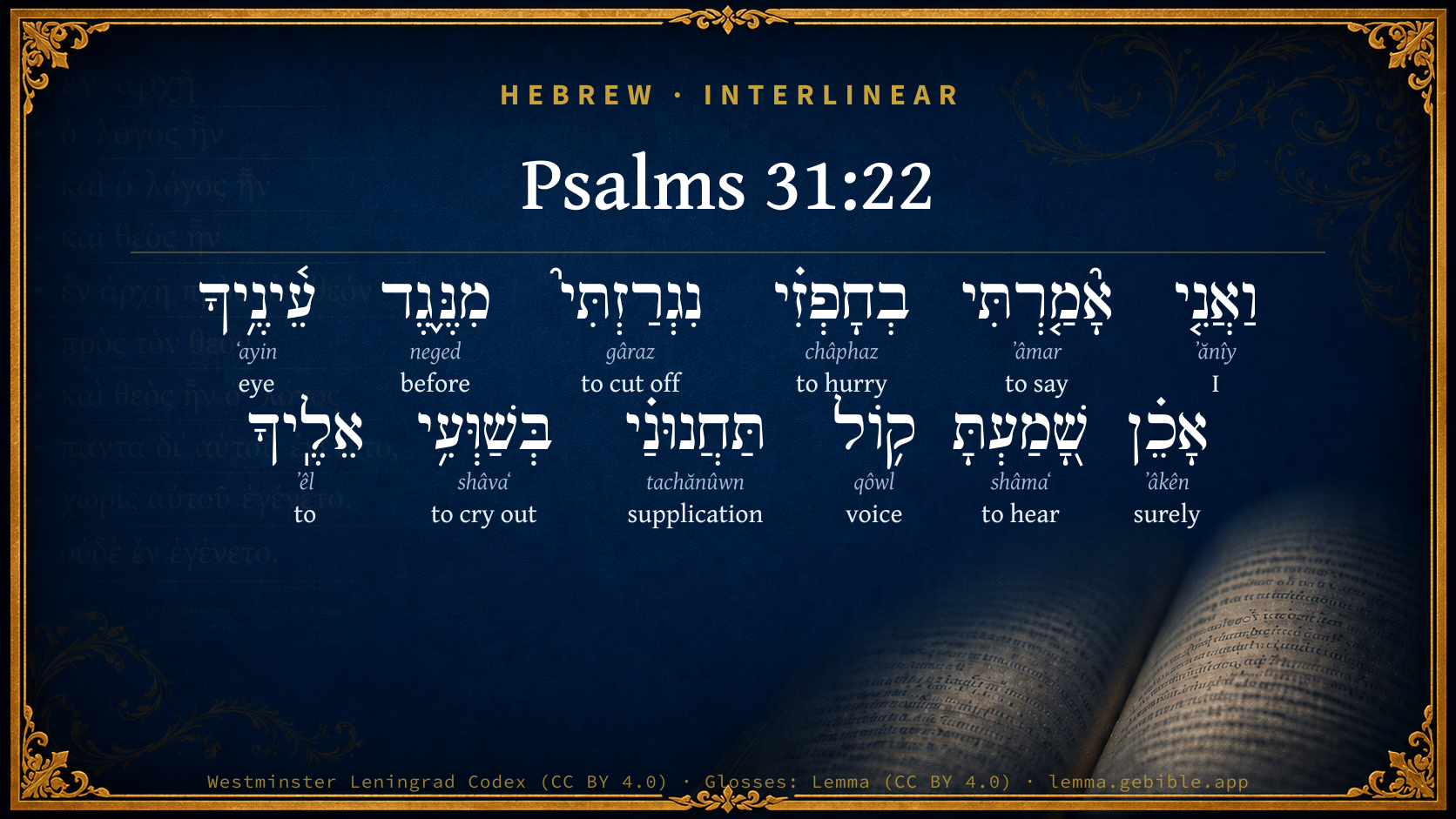
Hebrew (Westminster Leningrad Codex) Psalms 31:22 appears in the Hebrew Old Testament. The text above is from the Westminster Leningrad Codex. Each word links to its Strong’s number, a concise gloss, and parsing drawn from the Open Scriptures Hebrew Bible morphology. Click any word for its full Brown-Driver-Briggs (BDB) entry.
Download image
Cite this verse

Psalms 31:22 (World English Bible). Public Domain. Lemma interlinear Bible study tool, https://lemma.gebible.app/v/psalms/31/22.

Show BibTeX & RIS
BibTeX
RIS
English Translation
As for me, I said in my haste, "I am cut off from before your eyes." Nevertheless you heard the voice of my petitions when I cried to you.
World English Bible · Public Domain
Highlights
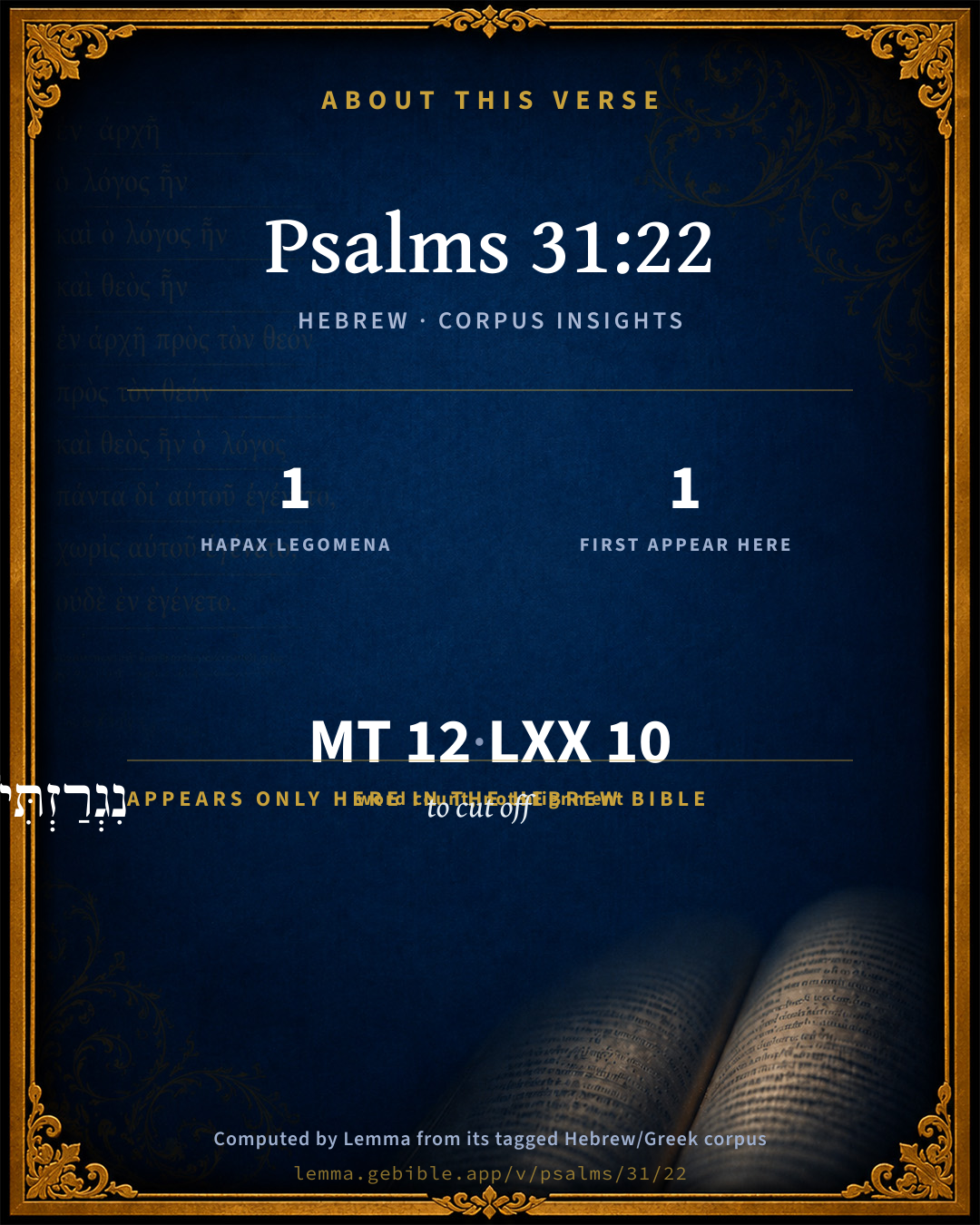
  • 1 hapax legomenon — only here in the Hebrew Bible
  • 1 first appearance in the Hebrew Bible
Full analysis ↓
Download a study sheet

One document with this verse’s original text, its word-by-word gloss line, the meaning frame, cross-references with their text, attributed commentary, and full source and license credits — printable, and it pastes into notes with its structure intact.

This verse Autodidact and up

Study sheet (.html) Plain text (.txt)

A passage Seminary Student

Up to 50 verses in one chapter. A passage sheet keeps up to 6 commentary sources and 12 cross-references per verse, in the order this page ranks them, and says so on the sheet whenever that leaves anything out. Ask for a single verse and you get the Autodidact verse sheet above.

Everything on this page stays free to read, with no account — the sheet is a download of what is already on screen, not access to it.

Want to remove ads? Support Godless Engineer
Compare translations 3

The same verse in 3 English versions, stacked beneath the original-language interlinear above. Click any original word for its lexicon entry.

Each is an independent rendering of the whole verse — the interlinear is not word-aligned to these translations.

Highlighted words mark where these versions differ — a whole-verse word diff, not a word-by-word alignment.

  • World English Bible Public Domain
    As for me, I said in my haste, "I am cut off from before your eyes." Nevertheless you heard the voice of my petitions when I cried to you.
  • King James Version Public Domain
    For I said in my haste, I am cut off from before thine eyes: nevertheless thou heardest the voice of my supplications when I cried unto thee.
  • unfoldingWord Literal Text CC BY-SA 4.0
    For I said in my alarm, “I am cut off from your eyes.” But indeed you heard the voice of my pleas when I cried out to you.

unfoldingWord Literal Text — © unfoldingWord, licensed CC BY-SA 4.0. Word-aligned USFM3 via Door43 (git.door43.org/unfoldingWord/en_ult).

Versions to compare (up to 4)

3 of 4 selected

Show all 18 translations

Every available English version of this verse, each an independent rendering of the whole verse.

  • World English Bible Public Domain
    As for me, I said in my haste, "I am cut off from before your eyes." Nevertheless you heard the voice of my petitions when I cried to you.
  • Berean Standard Bible Public Domain
    In my alarm I said, “I am cut off from Your sight!” But You heard my plea for mercy when I called to You for help.
  • Majority Standard Bible Public Domain
    In my alarm I said, “I am cut off from Your sight!” But You heard my plea for mercy when I called to You for help.
  • King James Version Public Domain
    For I said in my haste, I am cut off from before thine eyes: nevertheless thou heardest the voice of my supplications when I cried unto thee.
  • American Standard Version (1901) Public Domain
    As for me, I said in my haste, I am cut off from before thine eyes: Nevertheless thou heardest the voice of my supplications When I cried unto thee.
  • Revised Version (1885) Public Domain
    As for me, I said in my haste, I am cut off from before thine eyes: nevertheless thou heardest the voice of my supplications when I cried unto thee.
  • Geneva Bible (1599) Public Domain
    Though I said in mine haste, I am cast out of thy sight, yet thou heardest the voyce of my prayer, when I cryed vnto thee.
  • Douay-Rheims (1899) Public Domain
    Blessed be the Lord, for he hath shewn his wonderful mercy to me in a fortified city.
  • Young's Literal Translation Public Domain
    And I -- I have said in my haste, `I have been cut off from before Thine eyes,' But Thou hast heard the voice of my supplications, In my crying unto Thee.
  • Literal Standard Version CC BY-SA 4.0
    And I have said in my haste, “I have been cut off from before Your eyes,” || But You have heard the voice of my supplications, || In my crying to You.
  • Unlocked Literal Bible CC BY-SA 4.0
    Though I said in my haste, “I am cut off from your eyes,” yet you heard my plea for help when I cried to you.
  • unfoldingWord Literal Text CC BY-SA 4.0
    For I said in my alarm, “I am cut off from your eyes.” But indeed you heard the voice of my pleas when I cried out to you.
  • Darby Bible Public Domain
    As for me, I said in my haste, I am cut off from before thine eyes; nevertheless thou heardest the voice of my supplications when I cried unto thee.
  • World Messianic Bible Public Domain
    As for me, I said in my haste, “I am cut off from before your eyes.” Nevertheless you heard the voice of my petitions when I cried to you.
  • Webster's Bible Public Domain
    \\31:21\\Blessed be the LORD: for he hath showed me his wonderful kindness in a strong city.
  • Free Bible Version CC BY-SA 4.0
    Terrified I cried out, “I am being destroyed right in front of you!” But you heard my cry when I called out for you to help me.
  • Bible in Basic English Public Domain
    And as for me, I said in my fear, I am cut off from before your eyes; but you gave ear to the voice of my prayer, when my cry went up to you.
  • JPS Tanakh (1917) Public Domain
    (31-23) As for me, I said in my haste: 'I am cut off from before Thine eyes'; nevertheless Thou heardest the voice of my supplications when I cried unto Thee.

Literal Standard Version (2020), Covenant Press — licensed CC BY-SA 4.0. Text via the HelloAO Bible API (eBible.org). Unlocked Literal Bible (unfoldingWord) — licensed CC BY-SA 4.0. Text via the HelloAO Bible API (eBible.org). unfoldingWord Literal Text — © unfoldingWord, licensed CC BY-SA 4.0. Word-aligned USFM3 via Door43 (git.door43.org/unfoldingWord/en_ult). Free Bible Version, Dr. Jonathan Gallagher — licensed CC BY-SA 4.0. Text via the HelloAO Bible API (eBible.org).

Word by word

More ways to search: Search by grammar → Find every occurrence → Compare this word →

Practice this passage: Drill this verse → Learn its vocabulary →

נִגְרַזְתִּי֮
gâraz
H1629
“to cut off”
Verb, Niphal, Perfect, 1st Person, Common, Singular
Part of Speech
Verb
Stem
Niphal
Form
Perfect
Person
1st Person
Gender
Common
Number
Singular
Full BDB Definition

Origin: a primitive root

TWOT: 379

to cut, cut off - (Niphal) to be cut off (destroyed)
  1. וַאֲנִ֤י ʼănîy H589 “and · I” Conjunction + Pronoun, Personal, 1st Person, Common, Singular
  2. אָ֘מַ֤רְתִּי ʼâmar H559 “to say” Verb, Qal, Perfect, 1st Person, Common, Singular
  3. בְחָפְזִ֗י châphaz H2648 “in/at · to hurry · me” Preposition + Verb, Qal, Infinitive Construct + Suffix, Personal, 1st Person, Common, Singular
  4. מִנֶּ֪גֶד neged H5048 “from · before” Preposition + Preposition
  5. עֵ֫ינֶ֥יךָ ʻayin H5869 “eyes · your” Noun, Common, Both, Dual, Construct + Suffix, Personal, 2nd Person, Masculine, Singular
  6. אָכֵ֗ן ʼâkên H403 “surely” Adverb
  7. שָׁ֭מַעְתָּ shâmaʻ H8085 “to hear” Verb, Qal, Perfect, 2nd Person, Masculine, Singular
  8. ק֥וֹל qôwl H6963 “voice of” Noun, Common, Masculine, Singular, Construct
  9. תַּחֲנוּנַ֗י tachănûwn H8469 “supplications · my” Noun, Common, Masculine, Plural, Construct + Suffix, Personal, 1st Person, Common, Singular
  10. בְּשַׁוְּעִ֥י shâvaʻ H7768 “in/at · to cry out · me” Preposition + Verb, Piel, Infinitive Construct + Suffix, Personal, 1st Person, Common, Singular
  11. אֵלֶֽיךָ ʼêl H413 “to · you” Preposition + Suffix, Personal, 2nd Person, Masculine, Singular

About this verse

These counts appear in no published source. They are computed here, from the morphology-tagged text and Lemma’s own curated glosses. What Lemma adds →

12
words
12
distinct lemmas
Wisdom
section

Notable vocabulary

1 hapax legomenon — a word that appears only here in the entire Hebrew Bible:

  • נִגְרַזְתִּי֮ to cut off H1629

First appearance in Scripture

This word makes its first canonical appearance in the Hebrew Bible here:

  • נִגְרַזְתִּי֮ to cut off H1629

Shared distinctive vocabulary

בְחָפְזִ֗י to hurry H2648 occurs in 9 verses of the Hebrew Bible. Also found in:

Grammatical profile

  • 5 verbs
  • 3 nouns
  • 1 pronoun
  • 2 prepositions
  • 1 adverb

Verb forms

  • אָ֘מַ֤רְתִּי Qal · Perfect
  • בְחָפְזִ֗י Qal · Infinitive Construct
  • נִגְרַזְתִּי֮ Niphal · Perfect
  • שָׁ֭מַעְתָּ Qal · Perfect
  • בְּשַׁוְּעִ֥י Piel · Infinitive Construct

Hebrew & Septuagint length

In English translation the verse runs 29 words from the Hebrew and 34 from the Septuagint (LXX English) — closely comparable.

A rough comparison of the two English renderings, which tokenize alike — not a word-level alignment.

Word counts can differ between the Hebrew and the Greek without any difference in meaning — e.g. the Hebrew direct-object marker אֵת has no separate Greek word, and Greek often adds the article ὁ.

In the original languages it is 12 Hebrew tokens and 10 Greek tokens — but the two are counted differently (Hebrew bundles its prefixes and suffixes into one token; the Greek is in lemma form), so that isn’t a like-for-like length.

Cross-references

16

Topical passages linked to Psalms 31:22 in the Treasury of Scripture Knowledge — connected by theme and wording, ordered by reader-vote popularity; previews shown in the World English Bible.

  • Psalms 116:11 I said in my haste, "All men are liars."
  • Hebrews 5:7 He, in the days of his flesh, having offered up prayers and petitions with strong crying and tears to him who was able to save him from death, and having been heard for his godly fear,
  • Job 35:14 How much less when you say you don't see him. The cause is before him, and you wait for him!
  • Psalms 6:9 Yahweh has heard my supplication. Yahweh accepts my prayer.
  • Psalms 88:16 Your fierce wrath has gone over me. Your terrors have cut me off.
  • Ezekiel 37:11 Then he said to me, Son of man, these bones are the whole house of Israel: behold, they say, Our bones are dried up, and our hope is lost; we are clean cut off.
  • Jonah 2:7–9 "When my soul fainted within me, I remembered Yahweh. My prayer came in to you, into your holy temple.
  • 1 Samuel 23:26 Saul went on this side of the mountain, and David and his men on that side of the mountain: and David made haste to get away for fear of Saul; for Saul and his men compassed David and his men round about to take them.
  • 1 Samuel 27:1 David said in his heart, I shall now perish one day by the hand of Saul: there is nothing better for me than that I should escape into the land of the Philistines; and Saul will despair of me, to seek me any more in all the borders of Israel: so shall I escape out of his hand.
  • 2 Chronicles 33:11–13 Therefore Yahweh brought on them the captains of the host of the king of Assyria, who took Manasseh in chains, and bound him with fetters, and carried him to Babylon.
  • Isaiah 6:5 Then I said, "Woe is me! For I am undone, because I am a man of unclean lips, and I dwell in the midst of a people of unclean lips: for my eyes have seen the King, Yahweh of Hosts!"
  • Isaiah 38:10–12 I said, In the noontide of my days I shall go into the gates of Sheol: I am deprived of the residue of my years.
  • Isaiah 49:14 But Zion said, Yahweh has forsaken me, and the Lord has forgotten me.
  • Lamentations 3:54–55 Waters flowed over my head; I said, I am cut off.
  • Jonah 2:4 I said, 'I have been banished from your sight; Yet I will look again toward your holy temple.'
  • Psalms 31:17 Let me not be disappointed, Yahweh, for I have called on you. Let the wicked be disappointed. Let them be silent in Sheol.

Cross-references courtesy of OpenBible.info (CC BY 4.0).

Hebrew and Greek witnesses Masoretic Hebrew ↔ Greek Septuagint

The same verse in the two great witnesses to the Old Testament, shown verse-for-verse.

You’re reading Greek Psalm 30 (Hebrew Psalm 31). The Septuagint counts the superscription, so verse numbers can differ from the Hebrew — chapter-level alignment, not verse-by-verse. Numbering follows Rahlfs.

These are two independent witnesses, not word-aligned to each other, and the Septuagint is shown in lemma (dictionary) form.

Hebrew Psalms 31:22 Masoretic · Westminster Leningrad Codex

וַאֲנִ֤י אָ֘מַ֤רְתִּי בְחָפְזִ֗י נִגְרַזְתִּי֮ מִנֶּ֪גֶד עֵ֫ינֶ֥יךָ אָכֵ֗ן שָׁ֭מַעְתָּ ק֥וֹל תַּחֲנוּנַ֗י בְּשַׁוְּעִ֥י אֵלֶֽיךָ

As for me, I said in my haste, "I am cut off from before your eyes." Nevertheless you heard the voice of my petitions when I cried to you.

World English Bible · Public Domain

Greek LXX Greek Psalm 30:22 Septuagint · lemma form

εὐλογητός κύριος ὅτι θυαμαστόω ὁ ἔλεος αὐτός ἐν πόλις περιοχή

But I said in my extreme fear, I am cast out from the sight of your eyes: therefore you did listen, O Lord, to the voice of my supplication when I cried to you.

LXX2012 (modern English Septuagint) · Public Domain

Hebrew: Westminster Leningrad Codex (CC BY 4.0). Greek: Septuagint (public domain); English from LXX2012 (modern English Septuagint) (Public Domain). How the Septuagint differs from the Hebrew →

Commentary

Notes on Psalms 31:22 from classic Christian and Jewish commentators (each source and its license shown beneath its notes). The classic Christian expositions comment on the surrounding passage and are grouped to its opening verse, so a note may address several verses; the Jewish commentaries on the Tanakh (Rashi and others) are per-verse, so they appear only where the commentator wrote on this verse.

Lemma curates 59 commentaries, every one of them public domain or Creative Commons licensed, each selected and text-cleaned for this edition rather than reprinted as found. About our sources →

Trapp's Complete Commentary

John Trapp

Psa 31:22 For I said in my haste, I am cut off from before thine eyes: nevertheless thou heardest the voice of my supplications when I cried unto thee.

Ver. 22. For I said in my haste, I am cut off, &c.] A frightful and sinful saying, doubtless, full of diffidence and despair. See the like Psa 116:11 Job 9:16 Jdg 13:22 Psa 77:1-3; Joh 2:4. Thus he spake when he, trembling, fled, and was posting away.

Nevertheless thou heardest the voice of my supplication] A pitiful poor one though it were, and full of infirmity. God considereth whereof we are made; he taketh not advantages against his suppliants; it would be wide with them if he should.

John Trapp, A Commentary or Exposition upon All the Books of the Old and New Testament (1647–1656) — public domain. Text from a community e-Sword module.

The Biblical Illustrator

Joseph S. Exell

Psa_31:22

For I said in my haste, I am cut off from before Thine eyes: nevertheless Thou heartiest the voice of my supplications when I cried unto Thee.

Consolation for the despairing

I am as a watcher on the sea beach, telescope in hand, keeping guard for an appointed time. The watcher looks through his glass again and again, but a glance contents him so far as most of yonder gallant vessels are concerned, which are now in the offing; but by and by, his glass remains steadily ate his eye; his gaze is fixed, and in a few moments he gives a signal to his fellows, and they launch their boat. The explanation is, that he has noted signals of distress in one of the craft and, therefore, he has bestirred himself for her help. And so, too, the preacher is on the look-out for distress signals, and would render help where souls bound for eternity are foundering in doubt, ready to despair.

I. deep inward sorrow. The man who wrote it was pained at his heart, and there are many in like ease now. How came they so? Some are constitutionally depressed and desponding. Others are so, through great trial. Some, through secret sin unconfessed, which has festered into misery. Hurtful teaching, unwise ministry, often adds sorrow to the heart. And when the spirit sinks, the depression of men takes its own form according to what they are. In religious men it will take a religious form. It did so in the author of this psalm. What more dreadful apprehension could there be than this--I am cut off from before Thine eyes. Many good men have felt like that. But God brings good out of it for the man himself and for others through him.

II. the rash expression of this sorrow. I said in my haste. David, more than once, spoke hastily. He had better have bitten his tongue. Better count a dozen before we speak when our minds are agitated. But such speech rests on altogether insufficient grounds.

1. Sad and distressful circumstances. But these do not prove that God has cast you away. If so, then God cast away His own Son. The foxes had holes and, etc.

2. Feelings. But what more fluctuating and unstable than they? The wind does not veer more fitfully than does the current of our emotions. And yet despairing people are obstinate in their convictions. You cannot persuade them. For the declaration that God has forsaken us, or any man who seeks Him, is diametrically opposed to Scripture. There is not one text which advises any man to despair of the mercy of God. It is dishonouring God to think so. Jesus says, I can save. The sinner says, You cannot, and thus makes Christ a liar.

III. A pleading cry. When David feared that he was cut off from God, he was wise enough to take to crying. It is a significant word. It tells of pain. Red eyes often relieve breaking hearts, and to cry unto God is a real relief. Prayer is the surest and most blessed vent for the soul. And then there came--

IV. A cheerful result. Thou heartiest, etc. This blessing went beyond the promise. The promise is to believing prayer. But even when He meets with unbelieving ones, He gives faith, and so saves them. We are like lost children and cry, and God will not leave us to die in the dark. God heard David, then He will hear you and me. (C. H. Spurgeon.)

A hasty expression penitently retracted

I said in my haste, etc. That is a bit of genuine experience honestly told. How glad we ought to be that David never fell into the hand of an ordinary biographer, for then we had never been told what here we read. But it is comforting to find that even great men act at times as we often do. The experience of such a man as David cannot but be very instructive. Now in this text listen--

I. To an utterance of unbelief. I said in my haste, I am cut off from before Thine eyes. Note here--

1. That unbelief is generally talkative.

I said. He had better not even have thought it, but if he did think of it he had far best not say it. I have heard it said, If it is in the mind it may as well come out, but this is not true. If I had a rattlesnake in a box on this platform, I think you would none of you vote for the creature being let loose. Poison in a phial is deadly, but it will hurt no one until the cork is drawn, and then we cannot tell how far the mischief will go. If thou hast an ill thought, repent of it, but do not repeat it. Do as David did in another case, when he had a very ugly thought; he said, If I should speak thus I shall offend against the generation of thy children. So he would not put his thought into words lest he should do harm. Alas, unbelief does not understand holding its tongue. It will prattle.

2. Its utterances are generally hasty. There was no reason for saying such a thing at all, and certainly not for being in a hurry to say it; for he said unto God, I am cut off from before Thine eyes. But was it true? See if it be founded on fact; see whether after all you have not made a mistake. John Bunyan says of the pilgrim that he was much tumbled up and down in his thoughts. It means that he was in much confusion of mind. But why in such haste to write your blunders down. What a man says in his haste he generally has to repent at his leisure. Hasty deeds and hasty words make up the most horrible parts of human history.

3. They are often the result of quick temper. I fear we professing Christians are often out of temper with God. Too often such blasphemy enters into the human heart.

4. And are frequently exaggerated. See what David says here, I am cut off, etc. No, David, no. It is not so. You are cut off from much you love, but not from God. Some people always talk big about everything. There must be a very narrow line, fine as a razors edge, between a lie and the unguarded expressions of exaggeration. Some people talk about their trials on a scale of a mile to the inch. Their afflictions are awful, they are dreadful, they are without parallel. They are altogether quite equal to Job and Jeremiah rolled into one. If you try to comfort them they will tell you at once that you do not know anything about the great deeps whereon they are doing business; you are only knee deep in the waters of trouble. Such is the way of unbelief. Let us leave it off.

5. They dishonour God. David does, as it were, blame God. Before Thy very eyes I have suffered this. There never was a godly man cut off from God yet, and there never will be. If any of us have uttered words of unbelief let us call them back and drown them in our tears. But we have here also--

II. an effort of struggling faith.

1. He prayed to God. He says, Thou heardest the voice of my supplications, etc. Oh, child of God, cry to a smiting God. Cry to God even when He seems to cast thee off. Sink or swim, live or die, do not doubt thy God, but still pray.

2. He prayed in downright earnest. His was a crying prayer. That is the prayer which is neither said nor sung, but cried; it drops from the eyes in tears. The words of a child the mother may not listen to, but let it cry and see if she will act come. And--

3. God heard his prayer. God dealt with David not according to his unbelief, but his faith. His faith was small, but it was true. Thou who art in trouble, whoever thou mayest be, listen not to the voice of Satan who tempts thee to cease prayer. Do not say, God will not hear me; remember the words, Out of the depths have I cried unto thee, O Lord.

III. A testimony of gratitude. Nevertheless Thou heardest the voice of my supplications. God acted in the reverse way to David.

1. He spoke, but God did not speak. He was a listener. Thou heartiest. Not a word came from God: there had been too many words in the business already.

2. And there was no haste in God. God was quietly hearing while His petulant servant was fiercely complaining. It is a great thing for a minister who visits his people to be a good listener. The afflicted value this quality above gold. Such hearing has tender and precious sympathy in it. Hence the Scriptures say of God, O Thou that hearest prayer. David does not cease to wonder that in his unhappy condition he had yet been regarded of the Lord: Thou heartiest the voice of my supplication. How beautiful that is! Further--

3. There was no exaggeration with God. Unbelief exaggerates, but God does not. On the contrary, He diminishes the evil of His servants, till it comes to nothing.

4. And He did not dishonour His servants prayer. He might have done so, but did not. He might have said, If he thinks I have forsaken him, let it be so. But God did not do so. Look at the word never-the-less, what it tells of the graciousness of God.

Conclusion.

1. Repent heartily of every hard thought we have had of God.

2. Earnestly pray that if we think so wrongly we may keep our mouth as with a bridle.

3. Pray without ceasing, always pray let come what will.

4. Let us always speak well of the Lords mercy. (C. H. Spurgeon.)

Faith shaken

1. The faith of the godly may be shaken, and the strongest faith may sometimes show its infirmity.

2. Though faith be shaken, yet it is fixed in the root, as a tree beaten by the wind, keeping strong grips of good ground; though faith seem to yield, yet it faileth not, and even when it is at the weakest, it is uttering itself in some act, as a wrestler; for here the expression of Davids infirmity in faith is directed to God, and his earnest prayer joined with it.

3. Praying faith, how weak soever, shall not be misregarded of God.

4. There may be in a soul at one time both grief oppressing, and hope upholding: both darkness of trouble, and the light of faith; both desperately doubting, and strong gripping of Gods truth and goodness; both a fainting and a fighting; a seeming yielding in the fight, and yet a striving of faith against all opposition; both a foolish haste, and a settled staidness of faith; as here, I said in my haste, etc. (D. Dickson.)

The eloquence of a cry

If you were walking the streets and heard or saw a poor child crying, you would be far more affected by it than by the oration of the pretended mechanic who is eloquently stating his wants to the dwellers on both sides of the way. A poor child crying in the dark, under your window, in mid-winter, in the snow, would move your pity and obtain your help. Even if it were a foreigner, and knew not a single word of English, you would fully feel its pleading. The eloquence of a cry is overwhelming, pity owns its power, and lends her aid. There is a chord in human nature which responds to a childs cry, and there is something in the Divine nature which is equally touched by prayer. The Lord will not suffer a young raven to cry in vain, and much less will He suffer men who are made in His own image to cry to Him in the bitterness of their hearts, and find Him deaf to their entreaties. (C. H. Spurgeon.)

The Biblical Illustrator, edited by Joseph S. Exell (c. 1880s–1900s) — public domain. Text from a community e-Sword module.

J. A. Alexander on Psalms

Joseph Addison Alexander

23. (Psa 31:22). And (yet it was) I (that) said in my terror, I am cut off from before thine eyes. Nevertheless, thou didst hear the voice of my prayers (for mercy) in my crying unto thee (for help). The full force of the emphatic pronoun can be represented only by a paraphrase. The meaning is that this very person who experiences this wonderful protection was the same who, but a little while before, had given himself up for lost.—In my haste. The Hebrew word denotes the hurried flight of one escaping panic-struck from his pursuers. See the literal application of the verb, in historical prose, to the case of David himself, 1Sa 23:26, and compare Psa 48:6 (5), Psa 104:7. Our idiom absolutely requires an adversative particle at the beginning of the second clause, although the Hebrew word is properly a particle of affirmation, meaning certainly or surely. Notwithstanding his despondency and unbelief, Jehovah heard and answered his prayers for mercy and his cries for help, both which ideas are suggested in the original.

Joseph Addison Alexander, The Psalms Translated and Explained (1850) — public domain. Text from a community e-Sword module.

Geneva Bible (1599)

Geneva Bible translators

And so by my rashness and infidelity deserved to have been forsaken.

Geneva Bible (1599) marginal notes — public domain. Text via Bolls.life.

Jamieson, Fausset & Brown

Robert Jamieson, A. R. Fausset & David Brown

For I said--literally, "And I said," in an adversative sense. I, thus favored, was despondent.

in my haste--in my terror.

cut off . . . eyes--from all the protection of Thy presence.

Jamieson, Fausset & Brown — Commentary Critical and Explanatory on the Whole Bible (1871) — public domain (CC PDM 1.0). Text via the HelloAO Bible API.

Adam Clarke's Commentary

Verse 22. I said in my haste] Not duly adverting to the promise of God, I was led to conclude that my enemies were so strong, so numerous, and had so many advantages against me, that I must necessarily fall into and by their hands; however, I continued to pray, and thou didst hear the voice of my supplication.

Adam Clarke's Commentary on the Bible (1810–1826) — public domain. Text from a community e-Sword/MySword module.

John Calvin's Commentaries

22. And I said in my fear. David here confesses that for his distrust he deserved to be deserted by God and left to perish. It is true that to confess this before men he felt to be a shameful thing; but that he may the more fully illustrate the grace of God to him, he hesitates not to publish the shame of his fault. He repeats almost the same acknowledgement in Psalm 116:11, “I said in my haste, All men are liars.” I am aware that the Hebrew word חפז, chaphaz, is explained by some as meaning flight; as if David, in fleeing from death, because he was unable to make resistance, was stricken with this fear. But I refer it rather to his trouble of mind. Whether, therefore, we translate it haste or fear, it means that he had been, as it were, carried headlong to entertain the thought that he was neglected by God. And this haste is opposed to calm and deliberate consideration; for although David was stricken with fear, he did not faint under the trial, and this persuasion did not continue fixed in his mind. For we know that the faithful are often disquieted by fears and the heat of impatience, or driven headlong as it were by their too hasty or precipitate wishes, but afterwards they come to themselves. That David’s faith had never been overthrown by this temptation appears from the context, for he immediately adds, that God had heard the voice of his supplications; but if his faith had been extinguished, he could not have brought his mind earnestly to engage in prayer, and therefore this complaint was only a lapse of the tongue uttered in haste. Now if peevish hastiness of thought could drive this holy prophet of God, a man who was adorned with so many excellencies, to despair, how much reason have we to fear, lest our minds should fail and fatally ruin us? This confession of David, as we have already observed, serves to magnify the grace of God; but at the same time he sufficiently shows, in the second clause of the verse, that his faith, although severely shaken, had not been altogether eradicated, because he ceased not meanwhile to pray. The saints often wrestle in this manner with their distrust, that partly they may not despond, and that partly they may gather courage and stimulate themselves to prayer. Nor does the weakness of the flesh, even when they are almost overthrown, hinder them from showing that they are unwearied and invincible champions before God. But although David stoutly resisted temptation, he nevertheless acknowledges himself unworthy of God’s grace, of which he in some measure deprived himself by his doubt. For the Hebrew particle אכן, aken, is here to be understood adversatively and rendered yet, intimating that David had been preserved without any desert of his own, inasmuch as God’s immeasurable goodness strove with his unbelief. But as it is a sign of affirmation in Hebrew, I have thought proper to translate it, Yet truly. I have no doubt that he opposes his language to the various temptations with which, it is probable, his mind had been driven hither and thither.

John Calvin's Commentaries (1540-1563) — public domain. Text from the Calvin Translation Society English edition (1840s-50s) via the Christian Classics Ethereal Library (ccel.org). Calvin's coverage is partial (roughly two-thirds of the Bible); uncommented books and verses are honest gaps, never fabricated. The 19th-century editor's footnotes and remarks are omitted so the notes are faithfully Calvin's own voice.

Ellicott's Commentary for English Readers

(22) In my haste . . .—Literally, in my fleeing away in fear. Jerome, Aquila, and Symmachus, “in my confusion.”

A Bible Commentary for English Readers, edited by Charles John Ellicott (1878–1897) — public domain. Text from a community e-Sword module.

The Cambridge Bible for Schools and Colleges

gen. ed. J. J. S. Perowne

22. For I said &c.] But as for me, I said In my haste (or, alarm). Humbly he confesses his want of faith in the hour of trial, when he thought himself out of God’s sight, and contrasts it with God’s goodness. Cp. Psa_30:6; Psa_116:2. With 22 a cp. Jon_2:4 : with 22 b cp. Psa_28:2.

The Cambridge Bible for Schools and Colleges (gen. ed. J. J. S. Perowne; Cambridge University Press, 1878–1918) — public domain. Text from a community e-Sword module.

John Gill's Exposition

For I said in my haste,.... When he made haste to get away for fear of Saul, Sa1 23:26; and so the Targum renders it, "I said when I sought to flee away"; or else he said this hastily and rashly, in the hurry of his mind, being in the utmost confusion and distress, as in Psa 116:11;

I am cut off from before thine eyes; his case was very bad, he was reduced to the utmost extremity, and his faith was as low; he thought it was all over with him, and there was no way of escape, nor hope of it; and that he was like a branch cut off, ready to be cast into the fire; that he was cut off from the house of God, and from communion with him; that he would never look upon him more, and he should never enjoy his presence: this instance of weakness and unbelief is mentioned to illustrate the goodness of God, and to make his kindness appear to be the more marvellous in the salvation of him; so sometimes the Lord suffers his people to be in the utmost distress, and their faith to be at the lowest ebb, when he appears to their help, and makes it manifest that their salvation is by his own arm, and of his own good will, and not by them, or for any goodness of theirs;

nevertheless, thou heardest the voice of my supplications when I cried unto thee; for though faith was very low, and unbelief strongly prevailed, yet he was not so far gone as to stop praying; for though he saw no rational way of escape, and feared the Lord would take no notice of him; yet he knew that nothing was impossible with him, and therefore he still looked up to him, as Jonah did when he thought himself in a like condition, Jon 2:4; and such was the grace and goodness of God, that he did not despise but regard his prayer, though attended with so much weakness and unbelief.

John Gill's Exposition of the Whole Bible (1746–1763) — public domain (CC PDM 1.0). Text via the HelloAO Bible API.

Albert Barnes' Notes on the Bible

For I said in my haste - In my fear; my apprehension. The word rendered “haste” means properly that terror or alarm which causes one to flee, or to endeavor to escape. It is not “haste” in the sense of an opinion formed too quickly, or formed rashly; it is “haste” in the sense of terror leading to sudden flight, or an effort to escape. See an illustration of this idea in the case of David himself, in 1Sa 23:26.

I am cut off - That is, I shall certainly be cut off or destroyed.

From before thine eyes - Either, in thy very presence; or, so that I shall not be admitted into thy presence. I shall be cut down, and suffered no more to come before thee to worship thee. Compare the notes at Psa 6:5.

Nevertheless thou heardest ... - Contrary to my apprehensions, I was heard and delivered. God’s mercy went beyond the psalmist’s faith - as it often does to His people now, far beyond what they hope for; far beyond what they even pray for; far beyond what they believe to be possible; so far beyond all this, as to make the result, as in the case of David Psa 31:21, a matter of wonder and astonishment.

Albert Barnes' Notes on the Bible (1834–1885) — public domain. Text from a community e-Sword/MySword module.

Matthew Poole's English Annotations

In my haste, i.e. in my hasty flight from Saul, when he and his men had almost encompassed me, 1Sa 23:26, which happened presently after his deliverance in and from the strong city of Keilah. Or, in my fear, or trembling, when my passion took away my consideration, and weakened my faith.

Cut off from before thine eyes, i.e. cast out of thy sight, and out of the care of thy gracious providence; my case is desperate. Or, cut off whilst thou lookest on, and dost not pity nor help me.

Thou heardest the voice of my supplications; my fears were quickly confuted by thy gracious answer to my prayers.

Matthew Poole's English Annotations on the Holy Bible (1683–1685) — public domain. Text from a community e-Sword/MySword module.

The Treasury of David

Charles H. Spurgeon

Ver. 22. Confession of faults is always proper; and when we reflect upon the goodness of God, we ought to be reminded of our own errors and offences. For I said in my haste. We generally speak amiss when we are in a hurry. Hasty words are but for a moment on the tongue, but they often lie for years on the conscience. I am cut off from before thine eyes. This was an unworthy speech; but unbelief will have a corner in the heart of the firmest believer, and out of that corner it will vent many spiteful things against the Lord if the course of providence be not quite so smooth as nature might desire. No saint ever was, or ever could be, cut off from before the eyes of God, and yet no doubt many have thought so, and more than one has said so. For ever be such dark suspicions banished from our minds. Nevertheless thou heardest the voice of my supplications when I cried unto thee. What a mercy that if we believe not, yet God abideth faithful, hearing prayer even when we are labouring under doubts which dishonour his name. If we consider the hindrances in the way of our prayers, and the poor way in which we present them, it is a wonder of wonders that they ever prevail with heaven.

Ver. 22. I said in my haste, I am cut off from before thine eyes: nevertheless thou heardest the voice of my supplications. Who would have thought those prayers should ever have had any prevalence in God's ears which were mixed with so much infidelity in the petitioner's heart! William Secker.

Ver. 22. I said in my haste, I am cut off from before thine eyes. No, no, Christian; a prayer sent up in faith, according to the will of God, cannot be lost, though it be delayed. We may say of it, as David said of Saul's sword and Jonathan's bow, that they never return empty. So David adds, Nevertheless thou heardest the voice of my supplications when I cried unto thee. John Flavel.

Ver. 22. I said in my haste, I am cut off from before thine eyes, etc. Let us with whom it was once night, improve that morning joy that now shines upon us. Let us be continual admirers of God's grace and mercy to us. He has prevented us with his goodness, when he saw nothing in us but impatience and unbelief, when we were like Jonas in the belly of hell, his bowels yearned over us, and his power brought us safe to land. What did we to hasten his deliverance, or to obtain his mercy? If he had never come to our relief till he saw something in us to invite him, we had not yet been relieved. No more did we contribute to our restoration than we do to the rising of the sun, or the approach of day. We were like dry bones without motion, and without strength. Eze 37:1-11. And we also said, that `we were cut off for our parts, and our hope was gone, and he caused breath to enter into us, and we live.' Who is a God like to our God that pardoneth iniquity, transgression, and sin? that retains not his anger for ever? that is slow to wrath and delights in mercy? that has been displeased with us for a moment, but gives us hope of his everlasting kindness? Oh! what love is due from us to Christ, that has pleaded for us when we ourselves had nothing to say! That has brought us out of a den of lions, and from the jaws of the roaring lion! To say, as Mrs. Sarah Wright did, "I have obtained mercy, that thought my time of mercy past for ever; I have hope of heaven, that thought I was already damned by unbelief; I said many a time, there is no hope in mine end, and I thought I saw it; I was so desperate, I cared not what became of me. Oft was I at the very brink of death and hell, even at the very gates of both, and then Christ shut them. I was as Daniel in the lion's den, and he stopped the mouth of those lions, and delivered me. The goodness of God is unsearchable; how great is the excellency of his majesty, that yet he would look upon such a one as I; that he has given me peace that was full of terror, and walked continually as amidst fire and brimstone." Timothy Rogers.

Ver. 22. I said in my haste, I am cut off from before thine eyes: i.e., Thou hast quite forsaken me, and I must not expect to be looked upon or regarded by thee any more. I shall perish one day by the hand of Saul, and so be cut off from before thine eyes, be ruined while thou lookest on 1Sa 27:1. This he said in his flight (so some read it), which notes the distress of his affairs: Saul was just at his back, and ready to seize him, which made the temptation strong; in his haste (so we read it), which notes the disturbance and discomposure of his mind, which made the temptation surprising, so that it found him off his guard. Note, it is a common thing to speak amiss, when we speak in haste and without consideration; but what we speak amiss in haste, we must repent of at leisure, particularly that which we have spoken distrustfully of God. Matthew Henry.

Ver. 22. I said in my haste. Sometimes a sudden passion arises, and out it goes in angry and froward words, setting all in an uproar and combustion: by and by our hearts recur upon us, and then we wish, "O that I had bit my tongue, and not given it such an unbridled liberty." Sometimes we break out into rash censures of those that it may be are better than ourselves, whereupon when we reflect, we are ashamed that the fools' bolt was so soon shot, and wish we had been judging ourselves when we were censuring our brethren. Richard Alleine.

Ver. 22. Nevertheless thou heardest the voice of my supplications when I cried unto thee. As if he had said, when I prayed with so little faith, that I, as it were, unprayed my own prayer, by concluding my case in a manner desperate; yet God pardoned my hasty spirit, and gave me that mercy which I had hardly any faith to expect; and what use doth he make of this experience, but to raise every saint's hope in time of need? "Be of good courage and he shall strengthen your heart, all ye that hope in the Lord." William Gurnall.

Ver. 22. He confesseth the great distress he was in, and how weak his faith was under the temptation; this he doth to his own shame acknowledge also, that he may give the greater glory to God. Whence learn, 1. The faith of the godly may be slackened, and the strongest faith may sometimes show its infirmity. I said in my haste, I am cut off from before thine eyes. 2. Though faith be shaken, yet it is fixed in the root, as a tree beaten by the wind keeping strong grips of good ground. Though faith seem to yield, yet it faileth not, and even when it is at the weakest, it is uttering itself in some act, as a wrestler, for here the expression of David's infirmity in faith, is directed to God, and his earnest prayer joined with it, I am cut off from before thine eyes: nevertheless thou heardest the voice of my supplications. 3. Praying faith, how weak soever, shall not be misregarded of God; for nevertheless, saith he, thou heardest the voice of my supplications. 4. There may be in a soul at one time, both grief oppressing, and hope upholding; both darkness of trouble, and the light of faith; both desperately doubting, and strong gripping of God's truth and goodness; both a fainting and a fighting; a seeming yielding in the fight, and yet a striving of faith against all opposition; both a foolish haste, and a settled staidness of faith; as here, I said in my haste, etc. David Dickson.

Ver. 22. David vents his astonishment at the Lord's condescension in hearing his prayer. How do we wonder at the goodness of a petty man in granting our desires! How much more should we at the humility and goodness of the most sovereign Majesty of heaven and earth! Stephen Charnock.

Ver. 22. Unbelief confessed and faithfulness adored.

The mischief of hasty speeches.

Psalms 31:23*

Charles H. Spurgeon's The Treasury of David (1869–1885) — public domain. Psalms only. Text from a community e-Sword/MySword module.

The Pulpit Commentary

For I said in my haste; rather, and I indeed had said in my haste. (comp. Psa_116:11) David"s faith was not so firmly fixed but that he was liable, from time to time, to a sudden access of fear. (see 1Sa_27:1 2Sa_15:14 Psa_31:13) He had said to God in his heart, on one such occasion, I am cut off from before thine eyes; i.e. he had despaired and given himself up for lost. It is somewhat forced to understand the words as meaning, "I am banished from the city where the ark is placed" ("Speaker"s Commentary"). Nevertheless, thou heardest the voice of my supplications when I cried unto thee. God did not forsake his servant on account of this temporary failure of faith. No sooner did the psalmist rid himself of his extreme alarm, and turn once more to God in prayer, than he was heard, and his prayer answered.

The Pulpit Commentary (1880–1919), ed. H.D.M. Spence-Jones & Joseph S. Exell — public domain. Text from a community e-Sword module.

John Wesley's Explanatory Notes

Haste - When my passion took away my consideration, and weakened my faith. Cut off - Cast out of thy sight, and out of the care of thy gracious providence.

John Wesley, Explanatory Notes Upon the Whole Bible (1754–1765) — public domain. Text via the GEBible commentary corpus.

Rashi

Rabbi Shlomo Yitzchaki (Rashi)

for He has been wondrously kind to me in a beseiged city In Keilah, when Saul said concerning me (I Sam. 23:7): “for he has been shut in by coming into a city with doors and bars.”

Rashi on the Tanakh — English translations: “The Judaica Press complete Tanach with Rashi, translated by A. J. Rosenberg” (CC BY 4.0); “Pentateuch with Rashi's commentary by M. Rosenbaum and A.M. Silbermann, 1929-1934” (public domain); “The Metsudah Tanach series, Lakewood, N.J” (CC BY 4.0); and “The Book of Joshua, Metsudah Publications, 1997” (CC BY 4.0). Text via Sefaria.

Lesson kit

Teaching starters — assembled from the data on this page, not authored interpretation. Every prompt links to the verse data it draws on. Edit before teaching.

Psalms, in the Wisdom, opens this verse with 12 words (12 distinct Hebrew lemmas). Its most distinctive word is gâraz (“to cut off”). A historical commentator’s framing appears above. Read the whole chapter for the surrounding context.

Discussion questions

  1. The word gâraz carries the sense “to cut off.” How does it shape the verse?
  2. This verse holds 1 word here found nowhere else in the Hebrew Bible. What might the rare word draw attention to?
  3. The word “to cut off” first appears here in Scripture. What is being introduced at this debut?
  4. Deuteronomy 20:3 shares the word «to hurry» with this verse. How do the two illuminate each other?
  5. The translations on this page render this verse differently — a whole-verse word diff, not a word-by-word alignment. What might account for the different wordings?
  6. The verb «אָ֘מַ֤רְתִּי» is Qal Perfect. How does its form color the action?
  7. Reading how Trapp's Complete Commentary and The Biblical Illustrator read this verse, where do the two commentators agree and where do they part?

Things to notice

Reading settings

Reading text

Shown beneath each verse's original-language words.

Old Testament
Old Testament edition

Read the OT as the Masoretic Hebrew (MT) or the Greek Septuagint (LXX).

English shown for the Greek Septuagint (in the Hebrew ↔ Greek comparison).

Comparing translations? Open the Compare panel on any verse page to stack up to four side by side.