
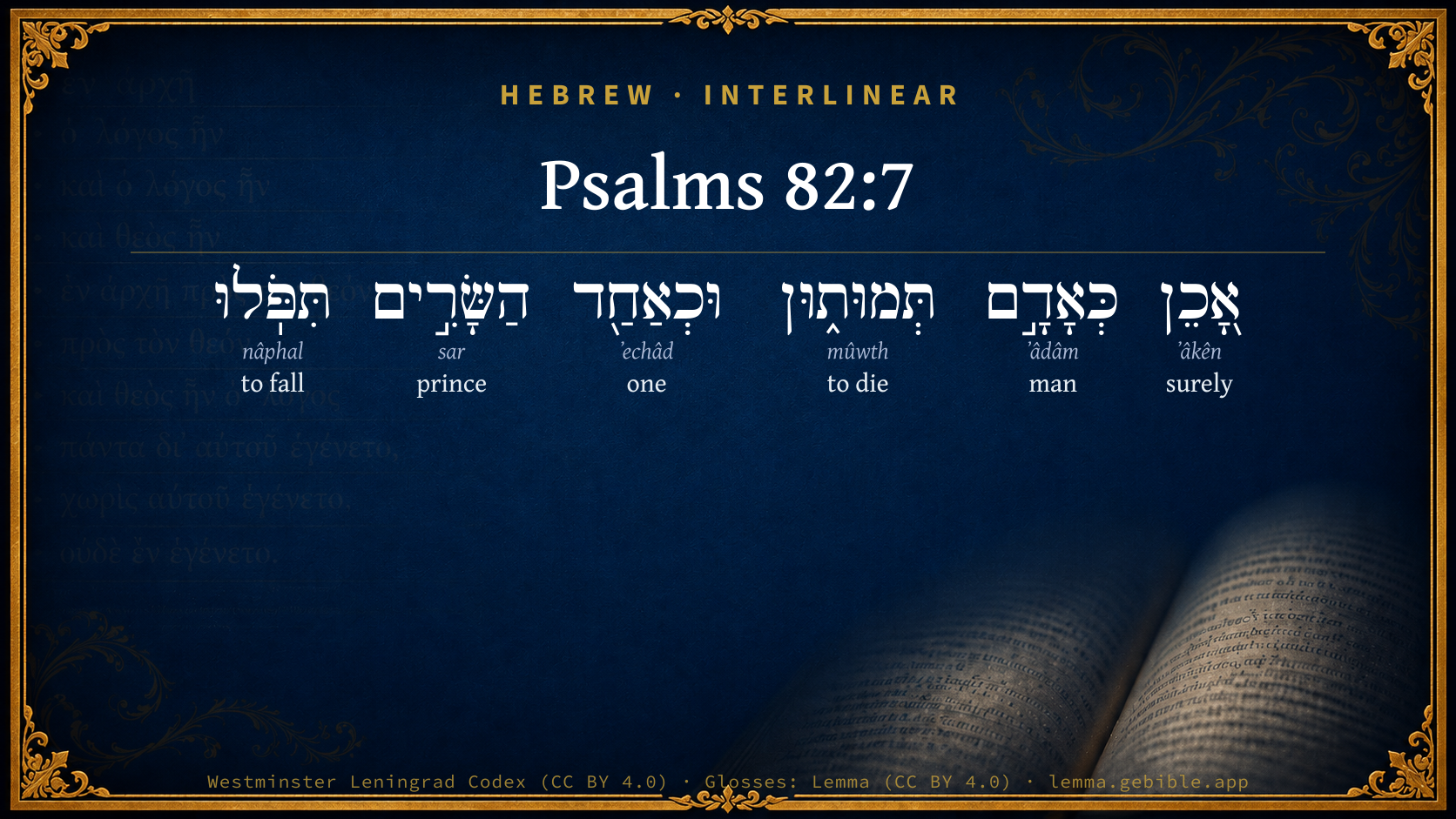
Psalms 82:7

Hebrew (Westminster Leningrad Codex) Psalms 82:7 appears in the Hebrew Old Testament. The text above is from the Westminster Leningrad Codex. Each word links to its Strong’s number, a concise gloss, and parsing drawn from the Open Scriptures Hebrew Bible morphology. Click any word for its full Brown-Driver-Briggs (BDB) entry.
Download image
Cite this verse

Psalms 82:7 (World English Bible). Public Domain. Lemma interlinear Bible study tool, https://lemma.gebible.app/v/psalms/82/7.

Show BibTeX & RIS
BibTeX
RIS
English Translation
Nevertheless you shall die like men, And fall like one of the rulers."
World English Bible · Public Domain
Download a study sheet

One document with this verse’s original text, its word-by-word gloss line, the meaning frame, cross-references with their text, attributed commentary, and full source and license credits — printable, and it pastes into notes with its structure intact.

This verse Autodidact and up

Study sheet (.html) Plain text (.txt)

A passage Seminary Student

Up to 50 verses in one chapter. A passage sheet keeps up to 6 commentary sources and 12 cross-references per verse, in the order this page ranks them, and says so on the sheet whenever that leaves anything out. Ask for a single verse and you get the Autodidact verse sheet above.

Everything on this page stays free to read, with no account — the sheet is a download of what is already on screen, not access to it.

Want to remove ads? Support Godless Engineer
Compare translations 3

The same verse in 3 English versions, stacked beneath the original-language interlinear above. Click any original word for its lexicon entry.

Each is an independent rendering of the whole verse — the interlinear is not word-aligned to these translations.

Highlighted words mark where these versions differ — a whole-verse word diff, not a word-by-word alignment.

  • World English Bible Public Domain
    Nevertheless you shall die like men, And fall like one of the rulers."
  • King James Version Public Domain
    But ye shall die like men, and fall like one of the princes.
  • unfoldingWord Literal Text CC BY-SA 4.0
    But you will die like man, and like one of the princes, you will fall.’”

unfoldingWord Literal Text — © unfoldingWord, licensed CC BY-SA 4.0. Word-aligned USFM3 via Door43 (git.door43.org/unfoldingWord/en_ult).

Versions to compare (up to 4)

3 of 4 selected

Show all 18 translations

Every available English version of this verse, each an independent rendering of the whole verse.

  • World English Bible Public Domain
    Nevertheless you shall die like men, And fall like one of the rulers."
  • Berean Standard Bible Public Domain
    But like mortals you will die, and like rulers you will fall.”
  • Majority Standard Bible Public Domain
    But like mortals you will die, and like rulers you will fall.”
  • King James Version Public Domain
    But ye shall die like men, and fall like one of the princes.
  • American Standard Version (1901) Public Domain
    Nevertheless ye shall die like men, And fall like one of the princes.
  • Revised Version (1885) Public Domain
    Nevertheless ye shall die like men, and fall like one of the princes.
  • Geneva Bible (1599) Public Domain
    But ye shall die as a man, and yee princes, shall fall like others.
  • Douay-Rheims (1899) Public Domain
    But you like men shall die: and shall fall like one of the princes.
  • Young's Literal Translation Public Domain
    But as man ye die, and as one of the heads ye fall,
  • Literal Standard Version CC BY-SA 4.0
    But you die as man, and you fall as one of the heads.”
  • Unlocked Literal Bible CC BY-SA 4.0
    Nevertheless you will die like men and fall like one of the princes.”
  • unfoldingWord Literal Text CC BY-SA 4.0
    But you will die like man, and like one of the princes, you will fall.’”
  • Darby Bible Public Domain
    But ye shall die like men, and fall like one of the princes.
  • World Messianic Bible Public Domain
    Nevertheless you shall die like men, and fall like one of the rulers.”
  • Webster's Bible Public Domain
    But ye shall die like men, and fall like one of the princes.
  • Free Bible Version CC BY-SA 4.0
    But you will die like any human being, you will fall like any other leader.”
  • Bible in Basic English Public Domain
    But you will come to death like men, falling like one of the rulers of the earth.
  • JPS Tanakh (1917) Public Domain
    Nevertheless ye shall die like men, and fall like one of the princes.'

Literal Standard Version (2020), Covenant Press — licensed CC BY-SA 4.0. Text via the HelloAO Bible API (eBible.org). Unlocked Literal Bible (unfoldingWord) — licensed CC BY-SA 4.0. Text via the HelloAO Bible API (eBible.org). unfoldingWord Literal Text — © unfoldingWord, licensed CC BY-SA 4.0. Word-aligned USFM3 via Door43 (git.door43.org/unfoldingWord/en_ult). Free Bible Version, Dr. Jonathan Gallagher — licensed CC BY-SA 4.0. Text via the HelloAO Bible API (eBible.org).

Word by word

More ways to search: Search by grammar → Find every occurrence → Compare this word →

Practice this passage: Drill this verse → Learn its vocabulary →

About this verse

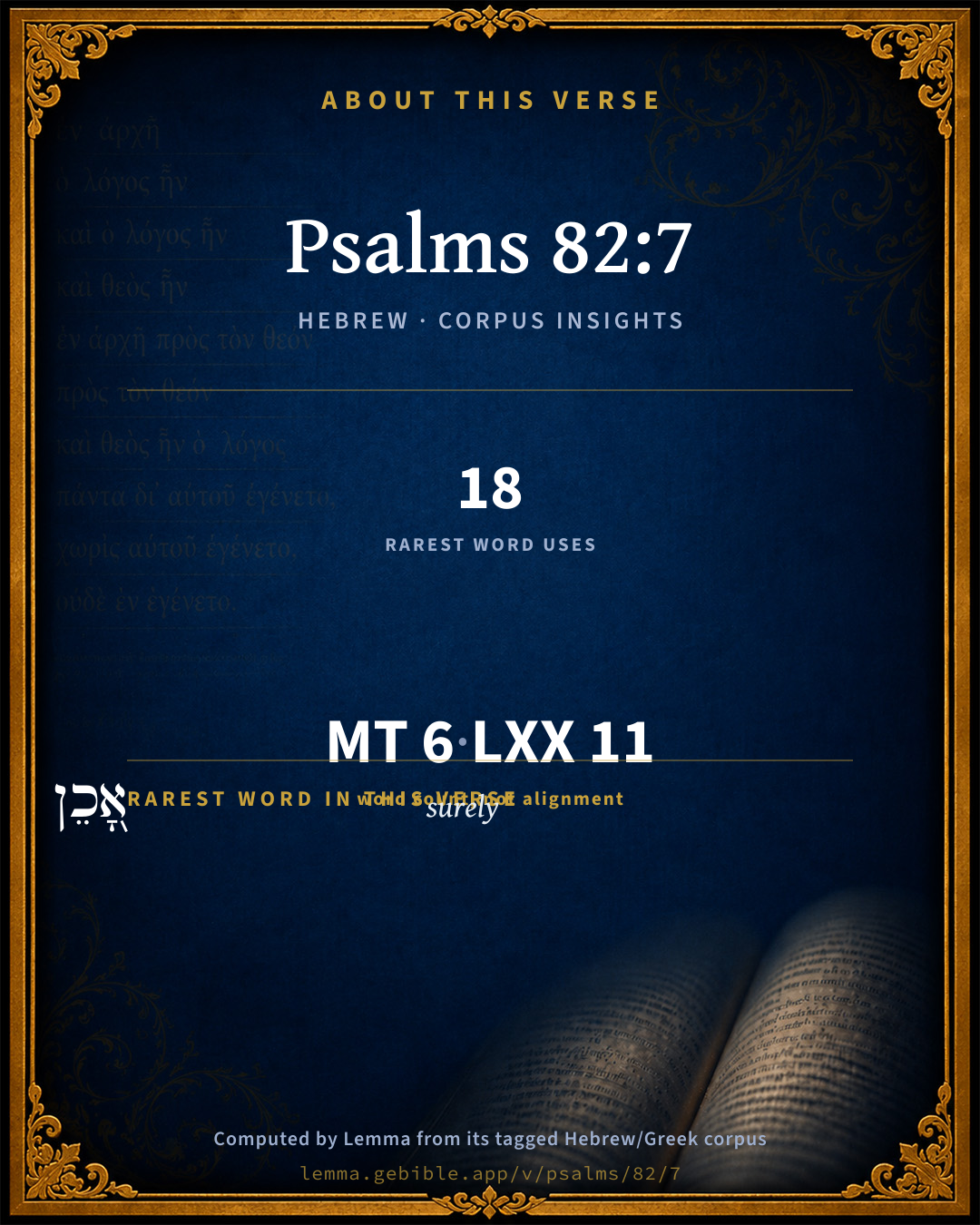
These counts appear in no published source. They are computed here, from the morphology-tagged text and Lemma’s own curated glosses. What Lemma adds →

6
words
6
distinct lemmas
Wisdom
section

Notable vocabulary

The rarest word here is אָ֭כֵן surely H403 — appearing just 18 times in the whole Hebrew Bible.

Shared distinctive vocabulary

אָ֭כֵן surely H403 occurs in 17 verses of the Hebrew Bible. Also found in:

Grammatical profile

  • 2 verbs
  • 2 nouns
  • 1 adjective
  • 1 adverb

Verb forms

  • תְּמוּת֑וּן Qal · Imperfect
  • תִּפֹּֽלוּ Qal · Imperfect

Hebrew & Septuagint length

In English translation the verse runs 13 words from the Hebrew and 12 from the Septuagint (LXX English) — closely comparable.

A rough comparison of the two English renderings, which tokenize alike — not a word-level alignment.

Word counts can differ between the Hebrew and the Greek without any difference in meaning — e.g. the Hebrew direct-object marker אֵת has no separate Greek word, and Greek often adds the article ὁ.

In the original languages it is 6 Hebrew tokens and 11 Greek tokens — but the two are counted differently (Hebrew bundles its prefixes and suffixes into one token; the Greek is in lemma form), so that isn’t a like-for-like length.

Cross-references

4

Topical passages linked to Psalms 82:7 in the Treasury of Scripture Knowledge — connected by theme and wording, ordered by reader-vote popularity; previews shown in the World English Bible.

  • Psalms 49:12 But man, despite his riches, doesn't endure. He is like the animals that perish.
  • Ezekiel 31:14 to the end that none of all the trees by the waters exalt themselves in their stature, neither set their top among the thick boughs, nor that their mighty ones stand up on their height, [even] all who drink water: for they are all delivered to death, to the lower parts of the earth, in the midst of the children of men, with those who go down to the pit.
  • Job 21:32 Yet shall he be borne to the grave, Men shall keep watch over the tomb.
  • Psalms 83:11 Make their nobles like Oreb and Zeeb; Yes, all their princes like Zebah and Zalmunna;

Cross-references courtesy of OpenBible.info (CC BY 4.0).

Hebrew and Greek witnesses Masoretic Hebrew ↔ Greek Septuagint

The same verse in the two great witnesses to the Old Testament, shown verse-for-verse.

You’re reading Greek Psalm 81 (Hebrew Psalm 82). The Septuagint counts the superscription, so verse numbers can differ from the Hebrew — chapter-level alignment, not verse-by-verse. Numbering follows Rahlfs.

These are two independent witnesses, not word-aligned to each other, and the Septuagint is shown in lemma (dictionary) form.

Hebrew Psalms 82:7 Masoretic · Westminster Leningrad Codex

אָ֭כֵן כְּאָדָ֣ם תְּמוּת֑וּן וּכְאַחַ֖ד הַשָּׂרִ֣ים תִּפֹּֽלוּ

Nevertheless you shall die like men, And fall like one of the rulers."

World English Bible · Public Domain

Greek LXX Greek Psalm 81:7 Septuagint · lemma form

σύ δέ ὡς ἄνθρωπος ἀποθνήσκω καί ὡς εἷς ὁ ἄρχων πίπτω

But you⌃ die as men, and fall as one of the princes.

LXX2012 (modern English Septuagint) · Public Domain

Hebrew: Westminster Leningrad Codex (CC BY 4.0). Greek: Septuagint (public domain); English from LXX2012 (modern English Septuagint) (Public Domain). How the Septuagint differs from the Hebrew →

Commentary

Notes on Psalms 82:7 from classic Christian and Jewish commentators (each source and its license shown beneath its notes). The classic Christian expositions comment on the surrounding passage and are grouped to its opening verse, so a note may address several verses; the Jewish commentaries on the Tanakh (Rashi and others) are per-verse, so they appear only where the commentator wrote on this verse.

Lemma curates 59 commentaries, every one of them public domain or Creative Commons licensed, each selected and text-cleaned for this edition rather than reprinted as found. About our sources →

Trapp's Complete Commentary

John Trapp

Psa 82:7 But ye shall die like men, and fall like one of the princes.

Ver. 7. But ye shall die like men] Yea, if wicked, like beasts, but only for their pillow and bolster. Super cubilia forsan in honore moriuntur, quo a bestiis differunt, sed non in morte, saith Kimchi. God, who had so highly advanced such, will lay them low enough; even in the slimy valley (if not in hell), where are many already like them, and more shall come after them, Job 21:31-32. Our Henry VIII was told on his death bed that he should go to the place of princes; which was no great comfort, if the old proverb be true, that hell is paved with the crowns of princes and helmets of soldiers. The Spanish friar used to say, there were but few princes in hell; for what reason? there were but few in all.

And fall like one of the princes] Of the heathen tyrants, which are oft slain by the people, as most of the Caesars before Constantine were. Ad generum Cereris, &c. Some of the fathers, Arnobius, Chrysostom, Theodoret, &c., understand it to be Beelzebub and his fellows, qui acerbissimis et exquisitissimis tormentis cruciantur, who are most tormented in hell, 2Pe 2:1, Potentes potenter torquebantur. Some read it, And ye, O princes, shall fall as one, i.e. as others do. A necessary consideration for great ones, who are apt to dream of an immortality, or, at least, to drive off the thoughts of death.

John Trapp, A Commentary or Exposition upon All the Books of the Old and New Testament (1647–1656) — public domain. Text from a community e-Sword module.

J. A. Alexander on Psalms

Joseph Addison Alexander

7. (Psa 82:7) (Yet) verily like mankind shall ye die, and like one of the princes shall ye fall. Our idiom requires an adversative particle at the beginning, to bring out the antithetical relation of the sentences. But the first word in Hebrew is properly a particle of strong asseveration, certainly, assuredly. See above, on Psa 31:22, and compare my note on Isa 53:4. Like mankind, or men collectively, or like a man indefinitely, i.e. any other man. So in the other clause, like one of the princes, i.e. any other prince, or person holding an exalted station. The clauses constitute a climax. The first merely describes them as sharers in the general mortality of man. The second threatens them with death, i.e. violent or untimely death, as a special punishment. Ye shall fall, by the sword (Jer 39:18), or in some analogous manner. The verb is often absolutely used in this way to denote a violent and penal loss of life. See above, Psa 20:8, and below, Psa 111:7, and compare Exo 19:21, Jer 8:12. The general meaning of this verse, when taken in connection with the one before it, is that notwithstanding their exalted dignity, bestowed and recognised by God himself, they were not thereby exempted from the common mortality of men, nor even from those signal and destructive strokes, with which God often visits men as highly favoured and exalted as themselves.

Joseph Addison Alexander, The Psalms Translated and Explained (1850) — public domain. Text from a community e-Sword module.

Geneva Bible (1599)

Geneva Bible translators

No title of honor shall excuse you, but you shall be subject to God’s judgment, and render account as well as other men.

Geneva Bible (1599) marginal notes — public domain. Text via Bolls.life.

Adam Clarke's Commentary

Verse 7. But ye shall die like men] כאדם keadam, "ye shall die like Adam," who fell from his high perfection and dignity as ye have done. Your high office cannot secure you an immortality.

And fall like one of the princes.] Justice shall pursue you, and judgment shall overtake you; and you shall be executed like public state criminals. You shall not, in the course of nature, fall into the grave; but your life shall be brought to an end by a legal sentence, or a particular judgment of God.

Adam Clarke's Commentary on the Bible (1810–1826) — public domain. Text from a community e-Sword/MySword module.

The Cambridge Bible for Schools and Colleges

gen. ed. J. J. S. Perowne

7. But] R.V., Nevertheless. Though they bear this high title, it will not exempt them from punishment. They shall die like common men, and fall like any other princes whose ruin is recorded in history (Hos_7:7). Or is there an allusion to the princes mentioned in Psa_83:9 ff.?

The Cambridge Bible for Schools and Colleges (gen. ed. J. J. S. Perowne; Cambridge University Press, 1878–1918) — public domain. Text from a community e-Sword module.

John Gill's Exposition

But ye shall die like men,.... As men in common do, to whom it is appointed to die, Heb 9:27 or as common men, as men in the lowest class of life: the wise man dies as the fool, the king as the peasant, high as the low, rich as the poor; death levels and makes all alike: or as Adam, as the first man, so Jarchi, who was lord of the whole universe; but being in honour, abode not, but became like the beasts that perish; sinning he died, and so all his posterity, even those who have the greatest power and authority on earth; see Psa 49:2 and not only die a corporeal death, but an eternal one, dying in their sins; as Christ threatened the Jewish rulers, Scribes, and Pharisees, if they believed not in him, Joh 8:21.

and fall like one of the princes; or the chief of them, Satan, who fell like lightning from heaven, Luk 10:18 or rather as one of the giants that lived in the old world, famous for their injustice and oppression, that fell in the deluge, Gen 6:4 or any of the Heathen princes, tyrants and oppressors, such as are mentioned in the following psalm, Psa 83:9. This may have respect to the destruction of the Jewish nation, which is called the falling of them, Rom 11:11 and the words may be rendered, "and ye shall fall together, equally and alike, O ye princes" (a); when the Jewish state, civil and ecclesiastical, fell, they fell with it, and together; the princes of this world then came to nought, or were abolished, they and their authority, as the Apostle Paul says they should, Co1 2:6 the sceptre then departed from Judah, and the lawgiver from between his feet; all rule and authority ceased among them, as Jacob foretold it would, Gen 49:10.

(a) "pariter; sive ex aequo", Maius apud Gataker. Cin. c. 10. p. 292.

John Gill's Exposition of the Whole Bible (1746–1763) — public domain (CC PDM 1.0). Text via the HelloAO Bible API.

Albert Barnes' Notes on the Bible

But ye shall die like men - You are mortal, like other people. This fact you have forgotten. You have been lifted up with pride, as if you were in fact more exalted than other people; as if you were not subject to the law which consigns all people to the grave. An ancient monarch directed his servant to address him each morning in this language: “Remember, sire, that thou art mortal.” No more salutary truth can be impressed on the minds of the rich and the great than that they are, in this respect, like other people - like the poorest, the meanest of the race: that they will die under similar forms of disease; that they will experience the same pain; that all which is fearful in death will be their portion as well as that of the most obscure; and that in the grave, with whatever pomp and splendor they descend to it, or however magnificent the monument which may be reared over the spot where they lie, there will be the same offensive and repulsive process of decay which occurs in the most humble grave in the country churchyard. Why, then - oh, why - should man be proud?

And fall like one of the princes - And die as one of the princes. The idea in the word fall may be, perhaps, that they would die by the hand of violence - or be cut down, as princes often are, e. g. in battle. The use of the word princes here denotes that they would die as other persons of exalted rank do; that is, that they were mortal as all people, high and low, are - as common people are, and as princes are. Though they had names - אל 'Êl, and אלהים 'Elohiym - that suggested the idea of divinity, yet such appellations did not make any real change in their condition as people, and as subject to the ordinary laws under which people live. Whatever name they bore. it did not afford any security against death.

Albert Barnes' Notes on the Bible (1834–1885) — public domain. Text from a community e-Sword/MySword module.

Matthew Poole's English Annotations

But ye shall die: but let not this make you insolent and secure; for though you are gods by name and office, yet still you are mortal men, you must die and give up your account to me your superior Lord and Governor; and you shall die and fall by the hands of my justice, if you persist in your unjust and ungodly courses.

Like men; or, like ordinary men, as the Hebrew word adam sometimes signifies, as it doth Psa 49:2. If it be objected, that there adam is opposed to ish, which notes persons of a higher rank; in like manner it is here opposed to the same sort of men, who are here called gods.

And fall like one of the princes: so the sense is, You (who are esteemed by yourselves and others gods upon earth) shall fall (or die, as he said in the former branch; falling being oft put for dying, with this addition, that it notes not an ordinary, but a violent and judicial death, as Exo 19:21; Jer 39:18; Hos 5:5)

like one (or, like other, or other’s, as this very word is rendered, Jdg 16:7,11, which also is expounded there, Jdg 16:17, like every, or any) of the princes, i.e. as other unrighteous or tyrannical rulers have done in all foregoing ages, and still do, your eyes seeing it; even in like manner shall you, to whom now I speak, fall and perish, if you do not learn by their examples. But these words are by some late learned interpreters translated otherwise, and that very agreeably to the Hebrew words and accents, And you, O ye princes, (or, you that are princes, before called gods.) shall fall like one, or like every, or any, of them, i.e. of the ordinary men last mentioned. So there is only an ellipsis of the pronoun, which is frequent in the Hebrew language. Or, shall fall together, as this word is translated, Ezr 2:64; 3:9; or alike, as it is rendered Ecc 11:6, in like manner, to wit, as ordinary men do. Your godhead shall be taken away from you, and your death shall show you to be but mortal men, as others are.

Matthew Poole's English Annotations on the Holy Bible (1683–1685) — public domain. Text from a community e-Sword/MySword module.

The Treasury of David

Charles H. Spurgeon

Ver. 7. But ye shall die like men. What sarcasm it seems! Great as the office made the men, they were still but men, and must die. To every judge this verse is a memento mori! He must leave the bench to stand at the bar, and on the way must put off the ermine to put on the shroud.

And fall like one of the princes. Who were usually the first to die: for battle, sedition, and luxury, made greater havoc among the great than among any others. Even as princes have often been cut off by sudden and violent deaths, so should the judges be who forget to do justice. Men usually respect the office of a judge, and do not conspire to slay him, as they do to kill princes and kings; but injustice withdraws this protection, and puts the unjust magistrate in personal danger. How quickly death unrobes the great. What a leveller he is. He is no advocate for liberty, but in promoting equality and fraternity he is a masterly democrat. Great men die as common men do. As their blood is the same, so the stroke which lets out their life produces the same pains and throes. No places are too high for death's arrows: he brings down his birds from the tallest trees. It is time that all men considered this.

Whole Psalm. Asaph, who has written so much in the previous Psalms of the coming of Christ in the flesh, now speaks of his second coming to judgment. Josephus Maria Thomasius. 1649-1713.

Ver. 7. Ye shall die like men, etc. Even you which glisten like angels, whom all the world admires, and sues and bows to, which are called honourable, mighty and gracious lords, I will tell you to what your honour shall come: first, ye shall wax old like others, then ye shall fall sick, like others, then ye shall die like others, then ye shall be buried like others, then ye shall be consumed like others, then ye shall be judged like others, even like the beggars which cry at your gates: one sickens, the other sickens; one dies, the other dies; one rots, the other rots: look in the grave, and shew me which was Dives and which was Lazarus. This is some comfort to the poor, that once he shall be like the rich; one day he shall be as wealthy, and as glorious as a king: one hour of death will make all alike; they which crowed over others, and looked down upon them like oaks, others shall walk upon them like worms, and they shall be gone as if they had never been. Henry Smith.

Ver. 7. Ye shall die like men, and fall like one of the princes. The meditation of death would pull down the plumes of pride; thou art but dust animated; shall dust and ashes be proud? Thou hast a grassy body, and shall shortly be mowed down: I have said, ye are gods; but lest they should grow proud, he adds a corrective: ye shall die like men; ye are dying gods. Thomas Watson.

Ver. 7. And fall like one of the princes. Tyrants seldom go to their graves in peace. Most of the Caesars fell by the hands of the people, q.d. If you be like tyrants in sin, expect to be like them in punishment; as I cast them out of their thrones for their insolence and violence, so will I cast you out, and you shall fall like one of these tyrannical princes. Thomas Hall.

Ver. 7.

1. Ye shall fall from the highest pinnacle of honour and reputation. The place of magistracy, which knoweth you now, will know you no more. One of the ancients, standing by Caesars tomb, crieth out, Ubi nunc pulchritudo Caesaris? quo abiit magnificentia ejus? Where is now the beauty; what is become of the magnificence; where are the armies now; where the honours, the triumphs, the trophies of Caesar? All was gone when Caesar was gone. You honours and your worships, your power, and your places, all die with you, if not before you.

2. Ye fall from your greatest treasures and possessions. As ye brought nothing into the world, so it is certain ye shall carry nothing out of the world. 1Ti 6:7. Saladin, the mighty monarch of the east, is gone, and hath carried no more along with him than ye seei.e., a shirt hung up for that purpose said the priest that went before the bier.

3. Ye fall from all your friends and relations; when ye die, they that were near and dear to you will leave you. George Swinnock.

Ver. 7. Impressiveness is a leading characteristic of the "death" or "fall" of "princes:" such incidents, from a variety of causes, are most striking. But can the same remark be commonly made respecting the decease of the children of poverty? Regard being had to the startling effect which the demise of the potentate is calculated to produce, has the departure of the peasant, for example, in itself, the same tendency to beget solemnity and awe, so that, even under this point of view, the peasant might be justly affirmed to fall like one of the princes Indeed, if you think of the outward circumstances attending his last moments; and then, immediately afterwards, of those which belong to the close of the life of the dweller in regal or stately halls, there would seem to be hardly any ground here for instituting the slightest comparison: but I would have you to associate the man, as he lies on the eve of dissolution, not with others, his superiors in rank, in a similar case, but with himself, when, in the full vigour of existence, he walked to and fro, and performed his own humble but laborious share of this world's business; and, as you subsequently mark how the great Destroyer has crushed all his energies, and left but a corpse behind, you will surely admit that there is as wide a difference between the individual as he was and as he is, as there can possibly be between the scenes at the death beds, respectively, of princes and of the poor. Yes, and as impressive a difference too; so that you have only to allow the exhibition of the striking change to have its legitimate effect upon the mind, and then, so far as that effect will be concerned, you may declare of the rural labourer, that "he has fallen like one of the princes; "seeing that he has given a lesson every whit as awakening and as emphatic in its admonitions as could the other. Hugh B. Moffatt, 1861.

Ver. 7-8. Your day is coming! The saints are raising the loud cry of Ps 82:8, inviting Messiah, the true God, the Son of the Most High (Joh 10:34), the Mighty One, the Judge and Ruler, to arise and take his inheritance, for he is the heir of all things, and to be the true Othniel, Ehud, Shamgar, Barak, Gideon, Tola, Jair, Jephthah, Samson, and Samuel, who will judge, or govern and rule, a mismanaged earth. We sing this song of Zion in his ears, urging him to come quickly; and we sing it to one another in joyful hope, while the foundations of earth seem out of course, because here we find Messiah the true Judge of a misgoverned world. Andrew A. Bonar.

None.

Psalms 82:8*

Charles H. Spurgeon's The Treasury of David (1869–1885) — public domain. Psalms only. Text from a community e-Sword/MySword module.

Whedon's Commentary on the Bible

Daniel D. Whedon

7. Ye shall die like men—Your high office and titles will give you no immunity, from the common fate of mortal men. You “shall die” like those poor whose cause you have despised, (see Psa_49:11-14,) and like all other princes of the earth. The form of speech is similar to Jdg_16:7; Jdg_16:11; Jdg_16:17, “Then shall I be weak, and be as another man.”

Daniel D. Whedon (gen. ed.), Commentary on the Old and New Testaments (1874–1909) — public domain. Text from a community e-Sword module.

The Pulpit Commentary

But ye shall die like men. The name of "gods," even the fact of your being representatives of God, shall not save you from condign punishment. Ye shall be punished with death, as other wicked men are punished. (Psa_73:18) And fall like one of the princes; i.e. come to an untimely end, as so many "princes" have done. (see Jos_12:9-24 Jud_1:7 3:21 7:25 8:21, etc.)

The Pulpit Commentary (1880–1919), ed. H.D.M. Spence-Jones & Joseph S. Exell — public domain. Text from a community e-Sword module.

John Wesley's Explanatory Notes

Like men - Or, like ordinary men.

John Wesley, Explanatory Notes Upon the Whole Bible (1754–1765) — public domain. Text via the GEBible commentary corpus.

Rashi

Rabbi Shlomo Yitzchaki (Rashi)

Indeed, as man, you will die Indeed, as Adam, you will die since you corrupted your deeds as he did.

and as one of the princes the first [princes], who died, so will you fall. The Midrash Aggadah (Mid. Ps. 82:3) [explains]: As one of the celestial princes, for it is said (Isa. 24:21): “the Lord will visit punishment upon the host of heaven on high.”

Rashi on the Tanakh — English translations: “The Judaica Press complete Tanach with Rashi, translated by A. J. Rosenberg” (CC BY 4.0); “Pentateuch with Rashi's commentary by M. Rosenbaum and A.M. Silbermann, 1929-1934” (public domain); “The Metsudah Tanach series, Lakewood, N.J” (CC BY 4.0); and “The Book of Joshua, Metsudah Publications, 1997” (CC BY 4.0). Text via Sefaria.

Lesson kit

Teaching starters — assembled from the data on this page, not authored interpretation. Every prompt links to the verse data it draws on. Edit before teaching.

Psalms, in the Wisdom, opens this verse with 6 words (6 distinct Hebrew lemmas). Its most distinctive word is ʼâkên (“surely”). A historical commentator’s framing appears above. Read the whole chapter for the surrounding context.

Discussion questions

  1. What does “surely” (ʼâkên) contribute to the verse as a whole?
  2. How does Genesis 28:16, which shares the word «surely», read alongside this verse?
  3. The translations on this page render this verse differently — a whole-verse word diff, not a word-by-word alignment. What might account for the different wordings?
  4. «תְּמוּת֑וּן» is a Qal Imperfect verb. How does that grammatical form shape the action described?
  5. Compare how Trapp's Complete Commentary and J. A. Alexander on Psalms read this verse. Where do they agree or differ?

Things to notice

Reading settings

Reading text

Shown beneath each verse's original-language words.

Old Testament
Old Testament edition

Read the OT as the Masoretic Hebrew (MT) or the Greek Septuagint (LXX).

English shown for the Greek Septuagint (in the Hebrew ↔ Greek comparison).

Comparing translations? Open the Compare panel on any verse page to stack up to four side by side.