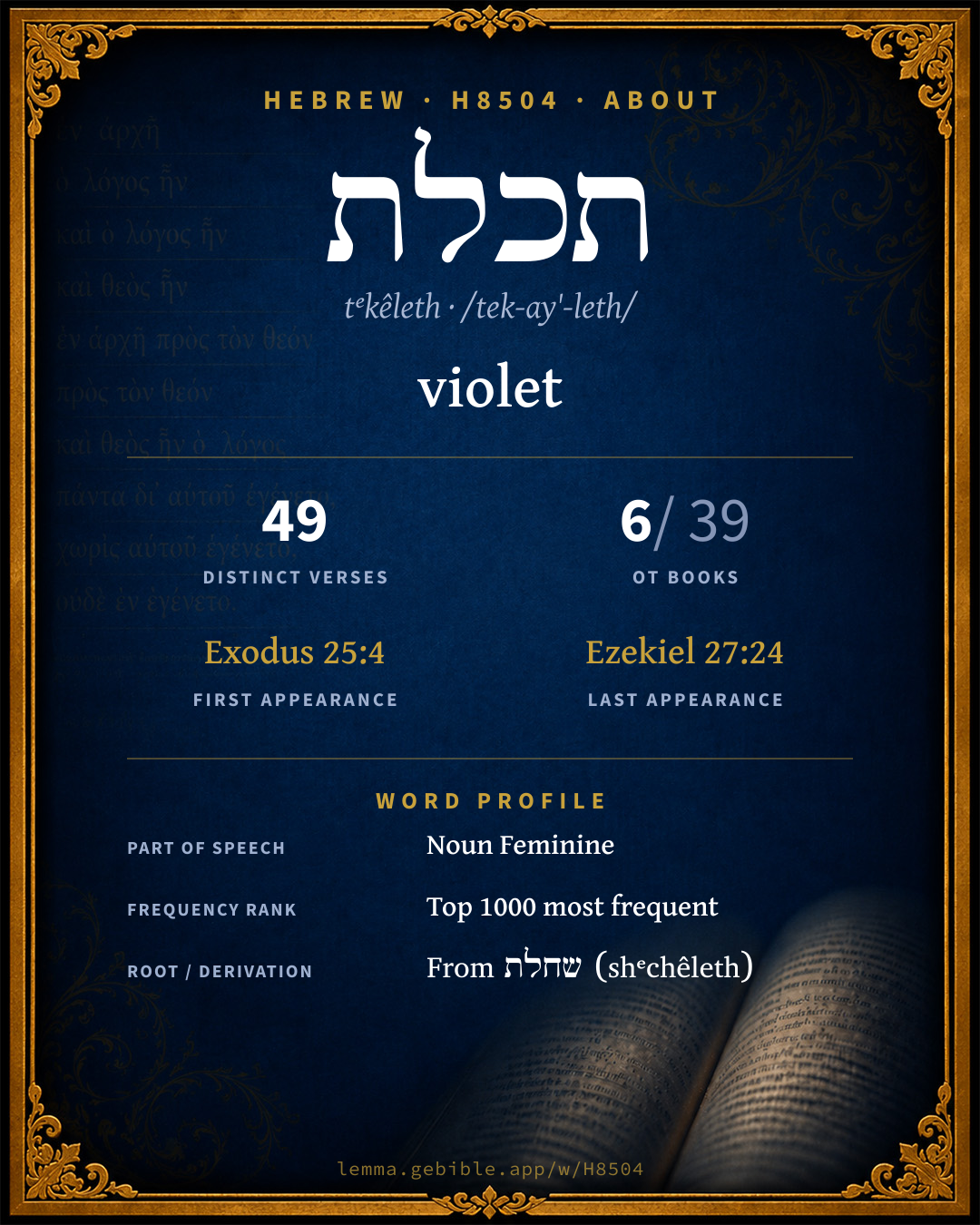
תְּכֵ֫לֶת
violet
‘violet’ is one of 2 main senses fuller range ↓
Full lexicon entry — Brown-Driver-Briggs (BDB)
From Brown-Driver-Briggs (BDB)
Where this word appears
See every Absolute-state word in the Hebrew Bible →
Grammar key — what these labels mean
Part of speech
- Noun
- A naming word — a person, place, thing, or idea.
Noun type
- Common
- A common noun — a general class of person, place, or thing (“king,” “city,” “water”), not a specific name.
State
- Absolute
- The independent form of a noun, not bound to a following word.
- Construct
- A noun bound to a following noun in a possessive / “of” relationship (the construct chain).
Gender
- Feminine
- Grammatically feminine.
Number
- Singular
- One.
Grammatical forms
- Noun, Common, Feminine, Singular, Absolute 48 times (98%)
- Noun, Common, Feminine, Singular, Construct 1 time (2%)
Parsed forms decoded from the imported morphology (morphhb / Westminster Leningrad Codex — WLC text public domain, morphhb tagging CC BY 4.0), counted across 49 parsed occurrences — not distinct verses.
Every verse where H8504 appears — 49 distinct verses across 6 books. Click any verse to open its interlinear word-by-word view. Verse text shown in the World English Bible for context — . Each verse’s Hebrew form is shown with its reference; the English is not keyword-highlighted, since the data carries no word-level English alignment. Use “Compare translations” on any verse to read it across multiple English versions. This concordance covers the Hebrew Bible; Septuagint (Greek Old Testament) occurrences are not indexed here.
Exodus 34 verses
- Exodus 25:4 וּ/תְכֵ֧לֶת conj + n c fs blue, purple, scarlet, fine linen, goats' hair,
- Exodus 26:1 וּ/תְכֵ֤לֶת conj + n c fs "Moreover you shall make the tent with ten curtains; of fine twined linen, and blue, and purple, and scarlet, with cherubim. The work of the skillful workman you shall make them.
- Exodus 26:4 תְּכֵ֗לֶת n c fs You shall make loops of blue on the edge of the one curtain from the edge in the coupling; and likewise shall you make in the edge of the curtain that is outmost in the second coupling.
- Exodus 26:31 תְּכֵ֧לֶת n c fs "You shall make a veil of blue, and purple, and scarlet, and fine twined linen, with cherubim. The work of the skillful workman shall it be made.
- Exodus 26:36 תְּכֵ֧לֶת n c fs "You shall make a screen for the door of the Tent, of blue, and purple, and scarlet, and fine twined linen, the work of the embroiderer.
- Exodus 27:16 תְּכֵ֨לֶת n c fs For the gate of the court shall be a screen of twenty cubits, of blue, and purple, and scarlet, and fine twined linen, the work of the embroiderer; their pillars four, and their sockets four.
- Exodus 28:5 הַ/תְּכֵ֖לֶת ptcl def.art + n c fs They shall take the gold, and the blue, and the purple, and the scarlet, and the fine linen.
- Exodus 28:6 תְּכֵ֨לֶת n c fs "They shall make the ephod of gold, of blue, and purple, scarlet, and fine twined linen, the work of the skillful workman.
- Exodus 28:8 תְּכֵ֧לֶת n c fs The skillfully woven band, which is on it, that is on him, shall be like its work and of the same piece; of gold, of blue, and purple, and scarlet, and fine twined linen.
- Exodus 28:15 תְּכֵ֨לֶת n c fs "You shall make a breastplate of judgment, the work of the skillful workman; like the work of the ephod you shall make it; of gold, of blue, and purple, and scarlet, and fine twined linen, shall you make it.
- Exodus 28:28 תְּכֵ֔לֶת n c fs They shall bind the breastplate by the rings of it to the rings of the ephod with a lace of blue, that it may be on the skillfully woven band of the ephod, and that the breastplate may not swing out from the ephod.
- Exodus 28:31 תְּכֵֽלֶת n c fs "You shall make the robe of the ephod all of blue.
- Exodus 28:33 תְּכֵ֤לֶת n c fs On its hem you shall make pomegranates of blue, and of purple, and of scarlet, around its hem; and bells of gold between them round about:
- Exodus 28:37 תְּכֵ֔לֶת n c fs You shall put it on a lace of blue, and it shall be on the sash; on the front of the sash it shall be.
- Exodus 35:6 וּ/תְכֵ֧לֶת conj + n c fs blue, purple, scarlet, fine linen, goats' hair,
- Exodus 35:23 תְּכֵ֧לֶת n c fs Everyone, with whom was found blue, purple, scarlet, fine linen, goats' hair, rams' skins dyed red, and sea cow hides, brought them.
- Exodus 35:25 הַ/תְּכֵ֨לֶת֙ ptcl def.art + n c fs All the women who were wise-hearted spun with their hands, and brought that which they had spun, the blue, the purple, the scarlet, and the fine linen.
- Exodus 35:35 בַּ/תְּכֵ֣לֶת prep det + n c fs He has filled them with wisdom of heart, to work all manner of workmanship, of the engraver, of the skillful workman, and of the embroiderer, in blue, in purple, in scarlet, and in fine linen, and of the weaver, even of those who do any workmanship, and of those who make skillful works.
- Exodus 36:8 וּ/תְכֵ֤לֶת conj + n c fs All the wise-hearted men among those who did the work made the tent with ten curtains; of fine twined linen, blue, purple, and scarlet, with cherubim, the work of the skillful workman, they made them.
- Exodus 36:11 תְּכֵ֗לֶת n c fs He made loops of blue on the edge of the one curtain from the edge in the coupling. Likewise he made in the edge of the curtain that was outmost in the second coupling.
- Exodus 36:35 תְּכֵ֧לֶת n c fs He made the veil of blue, purple, scarlet, and fine twined linen: with cherubim. He made it the work of a skillful workman.
- Exodus 36:37 תְּכֵ֧לֶת n c fs He made a screen for the door of the tent, of blue, purple, scarlet, and fine twined linen, the work of an embroiderer;
- Exodus 38:18 תְּכֵ֧לֶת n c fs The screen for the gate of the court was the work of the embroiderer, of blue, purple, scarlet, and fine twined linen. Twenty cubits was the length, and the height in the breadth was five cubits, like to the hangings of the court.
- Exodus 38:23 בַּ/תְּכֵ֨לֶת֙ prep det + n c fs With him was Oholiab, the son of Ahisamach, of the tribe of Dan, an engraver, and a skillful workman, and an embroiderer in blue, in purple, in scarlet, and in fine linen.
- Exodus 39:1 הַ/תְּכֵ֤לֶת ptcl def.art + n c fs Of the blue, purple, and scarlet, they made finely worked garments, for ministering in the holy place, and made the holy garments for Aaron; as Yahweh commanded Moses.
- Exodus 39:2 תְּכֵ֧לֶת n c fs He made the ephod of gold, blue, purple, scarlet, and fine twined linen.
- Exodus 39:3 הַ/תְּכֵ֨לֶת֙ ptcl def.art + n c fs They beat the gold into thin plates, and cut it into wires, to work it in the blue, in the purple, in the scarlet, and in the fine linen, the work of the skillful workman.
- Exodus 39:5 תְּכֵ֧לֶת n c fs The skillfully woven band that was on it, with which to fasten it on, was of the same piece, like its work; of gold, of blue, purple, scarlet, and fine twined linen; as Yahweh commanded Moses.
- Exodus 39:8 תְּכֵ֧לֶת n c fs He made the breastplate, the work of a skillful workman, like the work of the ephod; of gold, of blue, purple, scarlet, and fine twined linen.
- Exodus 39:21 תְּכֵ֗לֶת n c fs They bound the breastplate by its rings to the rings of the ephod with a lace of blue, that it might be on the skillfully woven band of the ephod, and that the breastplate might not come loose from the ephod, as Yahweh commanded Moses.
- Exodus 39:22 תְּכֵֽלֶת n c fs He made the robe of the ephod of woven work, all of blue.
- Exodus 39:24 תְּכֵ֥לֶת n c fs They made on the skirts of the robe pomegranates of blue, purple, scarlet, and twined linen.
- Exodus 39:29 וּ/תְכֵ֧לֶת conj + n c fs and the sash of fine twined linen, and blue, and purple, and scarlet, the work of the embroiderer, as Yahweh commanded Moses.
- Exodus 39:31 תְּכֵ֔לֶת n c fs They tied to it a lace of blue, to fasten it on the turban above, as Yahweh commanded Moses.
Numbers 6 verses
- Numbers 4:6 תְּכֵ֖לֶת n c fs and shall put a covering of sealskin on it, and shall spread over it a cloth all of blue, and shall put in its poles.
- Numbers 4:7 תְּכֵלֶת֒ n c fs On the table of show bread they shall spread a blue cloth, and put on it the dishes, the spoons, the bowls, and the cups with which to pour out; and the continual bread shall be on it.
- Numbers 4:9 תְּכֵ֗לֶת n c fs They shall take a blue cloth, and cover the lampstand of the light, and its lamps, and its snuffers, and its snuff dishes, and all its oil vessels, with which they minister to it.
- Numbers 4:11 תְּכֵ֔לֶת n c fs On the golden altar they shall spread a blue cloth, and cover it with a covering of sealskin, and shall put in its poles.
- Numbers 4:12 תְּכֵ֔לֶת n c fs They shall take all the vessels of ministry, with which they minister in the sanctuary, and put them in a blue cloth, and cover them with a covering of sealskin, and shall put them on the frame.
- Numbers 15:38 תְּכֵֽלֶת n c fs Speak to the children of Israel, and bid those who they make them fringes in the borders of their garments throughout their generations, and that they put on the fringe of each border a cord of blue:
2 Chronicles 3 verses
- 2 Chronicles 2:7 וּ/תְכֵ֔לֶת conj + n c fs Now therefore send me a man skillful to work in gold, and in silver, and in brass, and in iron, and in purple, and crimson, and blue, and who knows how to engrave [all manner of] engravings, [to be] with the skillful men who are with me in Judah and in Jerusalem, whom David my father did provide.
- 2 Chronicles 2:14 בַּ/תְּכֵ֨לֶת֙ prep det + n c fs the son of a woman of the daughters of Dan; and his father was a man of Tyre, skillful to work in gold, and in silver, in brass, in iron, in stone, and in timber, in purple, in blue, and in fine linen, and in crimson, also to engrave any manner of engraving, and to devise any device; that there may be [a place] appointed to him with your skillful men, and with the skillful men of my lord David your father.
- 2 Chronicles 3:14 תְּכֵ֥לֶת n c fs He made the veil of blue, and purple, and crimson, and fine linen, and worked cherubim thereon.
Esther 2 verses
- Esther 1:6 וּ/תְכֵ֗לֶת conj + n c fs [There were hangings of] white [cloth], [of] green, and [of] blue, fastened with cords of fine linen and purple to silver rings and pillars of marble: the couches were of gold and silver, on a pavement of red, and white, and yellow, and black marble.
- Esther 8:15 תְּכֵ֣לֶת n c fs Mordecai went forth from the presence of the king in royal clothing of blue and white, and with a great crown of gold, and with a robe of fine linen and purple: and the city of Shushan shouted and was glad.
Jeremiah 1 verse
Ezekiel 3 verses
- Ezekiel 23:6 תְכֵ֨לֶת֙ n c fs who were clothed with blue, governors and rulers, all of them desirable young men, horsemen riding on horses.
- Ezekiel 27:7 תְּכֵ֧לֶת n c fs Of fine linen with embroidered work from Egypt was your sail, that it might be to you for an ensign; blue and purple from the isles of Elishah was your awning.
- Ezekiel 27:24 תְּכֵ֣לֶת n c fs These were your traffickers in choice wares, in wrappings of blue and embroidered work, and in chests of rich clothing, bound with cords and made of cedar, among your merchandise.
About this entry
At a glance — auto-summarized from this page’s data, not written by a person. Every figure links to its source below. This summary describes the numbers; it doesn’t interpret them.
תכלת (tᵉkêleth) is a Hebrew noun most often rendered “violet.” It clusters heavily in Exodus, which alone accounts for 69% of its uses. It turns up in 49 verses across 6 books, a moderately common footprint. Scripture first uses it in Exodus 25:4. Not a single-sense word: explore its full sense range. For the data behind this summary, explore the sense tree and the renderings breakdown below.
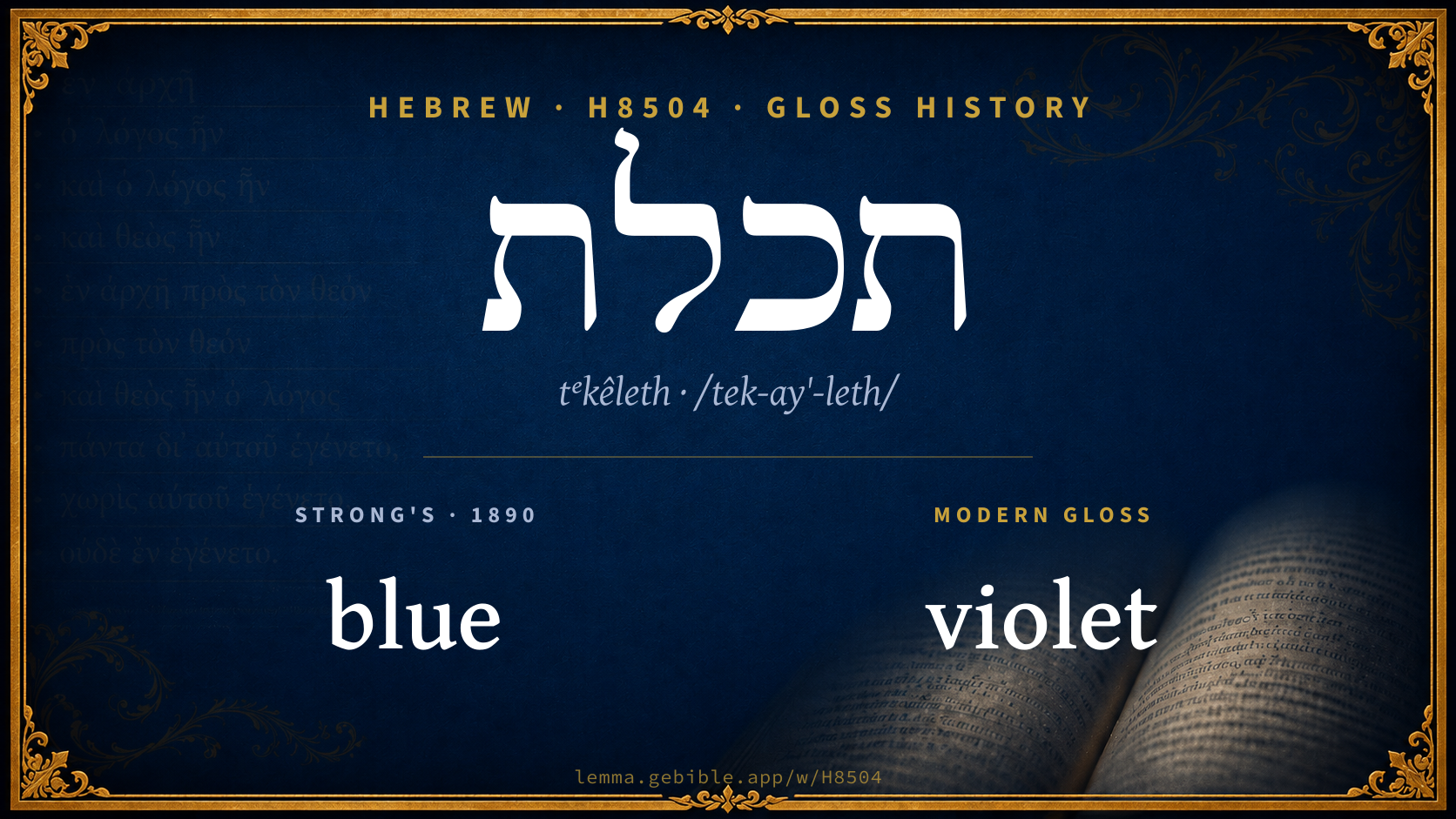
Gloss history
Strong's 1890 vs modern scholarship
About this word
Strong's H8504 catalogs a Hebrew word from the Hebrew Old Testament.
These counts are not copied from any lexicon or concordance. They are computed here, from the morphology-tagged Hebrew Old Testament. What Lemma adds →
- 49
- distinct verses
- The word appears in 49 distinct verses.
- 6 / 39
- OT books
- The word appears in 6 of 39 Old Testament books.
- #752
- by frequency
- Top 1000 most frequent Hebrew words (rank 752 of 8,640 Hebrew words by occurrence).
View all 49 occurrences in the concordance →
Most concentrated in
- Exodus 34 verses 69%
- Numbers 6 verses 12%
- 2 Chronicles 3 verses 6%
By section of the Old Testament
By traditional corpus
Conventional, traditional groupings — biblical authorship is debated, so this is a traditional corpus grouping, not an authorship claim. Each share is this word’s portion of its verses in that division of the Hebrew canon. Each figure is a share of the word’s 49 distinct verses.
- Torah (Pentateuch) 40 verses · 82%
- Writings (Ketuvim) 5 verses · 10%
- Prophets (Nevi'im) 4 verses · 8%
How translations render this word
Counts come from each version’s own published word-to-Strong’s tagging or interlinear alignment — an approximate guide to how each version renders this word, not a word-level alignment the data otherwise carries. Because each total is that version’s own tagged count, the per-version totals vary from one another and need not match the appearance or distinct-verse counts above. These counts may also differ from a printed concordance because Lemma counts each distinctly tagged rendering and does not collapse phrase taggings into a single head-word total. This is a fixed set of word-tagged versions (KJV, ASV, BSB, ULT) and does not change with the reading translation you choose elsewhere. Each version’s license is shown beside its name below (and on Sources).
- King James Version: Blue 48×
- American Standard Version: Blue 43×, Gold of blue 3×
- Berean Standard Bible: Blue 42×, Blue yarn 3×, Blue cloth 2×
- unfoldingWord Literal Text: Blue 44×, Violet 4×
King James Version Public Domain
Renders H8504 across 50 tagged occurrences — most commonly:
Plus 2 renderings that appear only once — usually multi-word phrases or single function words the recovered tagging swept in, not distinct renderings.
American Standard Version Public Domain
Renders H8504 across 50 tagged occurrences — most commonly:
Plus 4 renderings that appear only once — usually multi-word phrases or single function words the recovered tagging swept in, not distinct renderings.
Berean Standard Bible Public Domain
Renders H8504 across 49 tagged occurrences — most commonly:
Plus 2 renderings that appear only once — usually multi-word phrases or single function words the recovered tagging swept in, not distinct renderings.
unfoldingWord Literal Text CC BY-SA 4.0
Renders H8504 across 50 tagged occurrences — most commonly:
Plus 2 renderings that appear only once — usually multi-word phrases or single function words the recovered tagging swept in, not distinct renderings.
Senses in the full BDB
What do BDB’s symbols mean?
BDB uses these scholarly abbreviations:
| Symbol | Meaning |
|---|---|
| 𝔊 | the Septuagint (the ancient Greek translation, LXX) |
| 𝔙 | the Vulgate (the Latin translation) |
| 𝔖 | the Syriac version (the Peshitta) |
| 𝔗 | the Targum (the Aramaic translation) |
| ψ | the Psalms |
| √ | root (the underlying root or stem) |
| ‖ | parallel passage (a synonymous or contrasted parallel) |
| † | the dagger: every passage where the word occurs is cited |
The 4 senses and sub-senses the full Brown-Driver-Briggs lexicon distinguishes for this word, in lexicon order (not ranked by frequency), with BDB’s own verbatim wording and sub-sense lettering. Shown in Hebrew script with BDB’s own scholarly abbreviations. The condensed entry is in the Lexicon Entry tab. See also the Forms in the corpus table below.
- 1. violet thread (spun, Ex 35:25; woven, 39:3): e.g. Exodus 35:25
- a. in Ex (P) of hangings of tabern., ephod, etc., ת׳ + אַרְגָּמָן, תּוֹלַעַת שָׁנִי (q.v.; often also שֵׁשׁ, זהב), Ex 25:4; 26:1; 28:5, 6; 28:33; 35:25 + 20 times; of temple hangings (+ אַרְגָּמָן, אַרְגְּוָן, כַּרְמִיל, בּוּץ) 2 Ch 2:6, 13, 14; loops or cords of ת׳ (alone) Ex 26:4; 28:28, 31, 37; 36:11; 39:21, 22, 31; Nu 15:38 (all P). e.g. Exodus 25:4
- b. palace hangings in Shushan, + חוּר Est 1:6. e.g. Esther 1:6
- 2. violet stuff, fabric; לְבוּשֵׁי ת׳ Ez 23:6, גְּלוֹמֵי ת׳ וְרִקְמָה 27:24; ת׳ וְאַרְגָּמָן לְבוּשָׁם Je 10:9; also in trade Ez 27:7 (+ אַרְגָּמָן, שֵׁשׁ בְּרִקְמָה), cf. בֶּגֶד ת׳ for covering sacred utensils Nu 4:6, 7, 9, 11, 12 (P). e.g. Ezekiel 23:6
Senses from the full Brown-Driver-Briggs lexicon (Brown, Driver, Briggs; Oxford 1906 — public domain), digitized via Sefaria, supplemented by the OpenScriptures HebrewLexicon (CC BY 4.0). Full attribution on Sources.
Word origin
n.f. violet, i.e. violet thread and stuff; 𝔊; usually ὑάκινθος, ὑακίνθινος; v. ThatcherHast.DB Colours (NH = BH; 𝔗 תִּכְלָא, תַּכְלָא, תְּכֵילְתָּא);—
— Brown-Driver-Briggs (Oxford 1906, public domain), digitized via Sefaria, supplemented by the OpenScriptures HebrewLexicon (CC BY 4.0). See Sources.
Derived from שחלת (shᵉchêleth) (H7827) — onycha.
Jastrow Dictionary
A second Hebrew/Aramaic lexicon for comparison, covering Aramaic and post-biblical (Talmudic, Targumic, Midrashic) usage that the biblical-Hebrew BDB does not. Matched by lemma rather than by Strong’s number, so a lemma may carry more than one Jastrow headword (shown separately below), and the entries cover usage well beyond the Bible.
תְּכֵלֶת
- (b. h.) purple-shell, a bluish or cerulean dye, purple-blue wool, esp. the purple-blue thread used for the show-fringes. Sot. 46ᵇ היא לוז שצובעין בה ת׳ that is the city of Luz where they dye the t’kheleth (v. לוּז I). Men. IV, 1, v. עָכַב. Ib. 38ᵃ מצוה … לבן לת׳ it is proper to take the white thread first and then the blue. Ib. 38ᵇ איגרדם ת׳, v. גַּרְדֵּם. Num. R. s. 183 טלית שכולה ת׳ מהו וכ׳ if a cloak is made entirely of blue wool, is it exempt from show-fringes? Ib. טלית שכולה ת׳ אינה וכ׳ a cloak entirely of blue wool does not release (is insufficient for compliance with the law), and four threads are sufficient?; a. v. fr.
A Dictionary of the Targumim, the Talmud Babli and Yerushalmi, and the Midrashic Literature (Marcus Jastrow; London, Luzac, 1903) — Public Domain. Digitized via Sefaria. Digitized via Sefaria. Full attribution on Sources.
Forms in the corpus
The 20 distinct written forms H8504 takes in the Hebrew Bible, most frequent first — each parse links to that state’s occurrences in the concordance. Hebrew forms include their vowel points and cantillation, so a single lemma takes many written forms.
Septuagint verse parallels
This word appears in 45 verses that also exist in the Greek Old Testament (Septuagint), out of the 49 Hebrew verses it occurs in. You can read those verses in Greek by switching the Old Testament edition to the Septuagint.
Read these verses in the Septuagint
This is a verse-level parallel only — the same verses exist in both the Hebrew and Greek Old Testaments. No word-level Hebrew↔Greek correspondence is claimed: the data carries no such alignment, so no Greek word is shown as this Hebrew word’s translation. Coverage is not total — the Septuagint omits the deuterocanon and renumbers the Psalms, so some Hebrew verses have no direct Greek parallel.