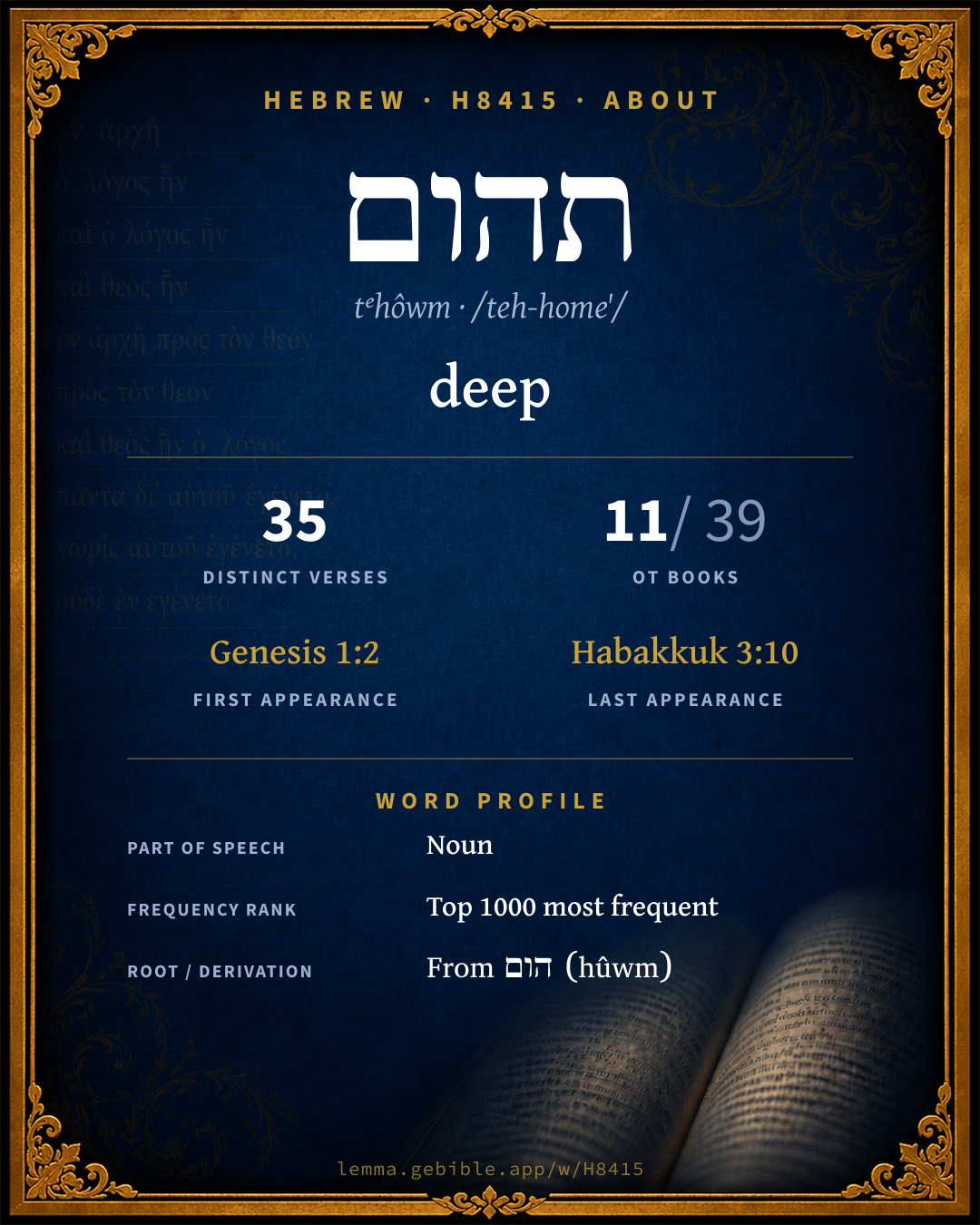
תְּהוֹם
deep
also: depths, deep places, abyss, sea fuller range ↓
Full lexicon entry — Brown-Driver-Briggs (BDB)
From Brown-Driver-Briggs (BDB)
Where this word appears
Grammar key — what these labels mean
Part of speech
- Noun
- A naming word — a person, place, thing, or idea.
Noun type
- Common
- A common noun — a general class of person, place, or thing (“king,” “city,” “water”), not a specific name.
State
- Absolute
- The independent form of a noun, not bound to a following word.
- Construct
- A noun bound to a following noun in a possessive / “of” relationship (the construct chain).
Gender
- Both
- Attested as both masculine and feminine.
Number
- Singular
- One.
- Plural
- More than one (in Hebrew, generally three or more).
Every verse where H8415 appears in the Book of Ezekiel — 3 distinct verses. Click any verse to open its interlinear word-by-word view. Verse text shown in the World English Bible for context — . Each verse’s Hebrew form is shown with its reference; the English is not keyword-highlighted, since the data carries no word-level English alignment. Use “Compare translations” on any verse to read it across multiple English versions. This concordance covers the Hebrew Bible; Septuagint (Greek Old Testament) occurrences are not indexed here.
Ezekiel
- Ezekiel 26:19 תְּה֔וֹם n c bs For thus says the Lord Yahweh: When I shall make you a desolate city, like the cities that are not inhabited; when I shall bring up the deep on you, and the great waters shall cover you;
- Ezekiel 31:4 תְּה֖וֹם n c bs The waters nourished it, the deep made it to grow: the rivers of it ran round about its plantation; and it sent out its channels to all the trees of the field.
- Ezekiel 31:15 תְּה֔וֹם n c bs Thus says the Lord Yahweh: In the day when he went down to Sheol I caused a mourning: I covered the deep for him, and I restrained the rivers of it; and the great waters were stayed; and I caused Lebanon to mourn for him, and all the trees of the field fainted for him.
About this entry
At a glance — auto-summarized from this page’s data, not written by a person. Every figure links to its source below. This summary describes the numbers; it doesn’t interpret them.
תהום (tᵉhôwm) is a Hebrew noun most often rendered “deep.” Beyond its headline sense, its full sense range takes in “depths”, “deep places”, and “abyss”. The Hebrew Bible uses it across 35 verses — moderately common. Psalms dominates its distribution — 11 of 35 verses. It first appears in Genesis 1:2. The sections below give every sense, occurrence, and version rendering.
Gloss history
Strong's 1890 vs modern scholarship
About this word
Strong's H8415 catalogs a Hebrew word from the Hebrew Old Testament.
These counts are not copied from any lexicon or concordance. They are computed here, from the morphology-tagged Hebrew Old Testament. What Lemma adds →
- 35
- distinct verses
- The word appears in 35 distinct verses.
- 11 / 39
- OT books
- The word appears in 11 of 39 Old Testament books.
- #990
- by frequency
- Top 1000 most frequent Hebrew words (rank 990 of 8,640 Hebrew words by occurrence).
View all 35 occurrences in the concordance →
By section of the Old Testament
By traditional corpus
Conventional, traditional groupings — biblical authorship is debated, so this is a traditional corpus grouping, not an authorship claim. Each share is this word’s portion of its verses in that division of the Hebrew canon. Each figure is a share of the word’s 35 distinct verses.
- Writings (Ketuvim) 19 verses · 54%
- Torah (Pentateuch) 8 verses · 23%
- Prophets (Nevi'im) 8 verses · 23%
How translations render this word
Counts come from each version’s own published word-to-Strong’s tagging or interlinear alignment — an approximate guide to how each version renders this word, not a word-level alignment the data otherwise carries. Because each total is that version’s own tagged count, the per-version totals vary from one another and need not match the appearance or distinct-verse counts above. These counts may also differ from a printed concordance because Lemma counts each distinctly tagged rendering and does not collapse phrase taggings into a single head-word total. This is a fixed set of word-tagged versions (KJV, ASV, BSB, ULT) and does not change with the reading translation you choose elsewhere. Each version’s license is shown beside its name below (and on Sources).
- King James Version: Deep 18×, Depths 7×, Depth 5×
- American Standard Version: Deep 20×, Deeps 3×, Depths 3×
- Berean Standard Bible: Deep 16×, Depths 8×, Watery depths 3×
- unfoldingWord Literal Text: Deep 17×, Deeps 5×, Depths 4×
King James Version Public Domain
Renders H8415 across 36 tagged occurrences — most commonly:
Plus 6 renderings that appear only once — usually multi-word phrases or single function words the recovered tagging swept in, not distinct renderings.
American Standard Version Public Domain
Renders H8415 across 36 tagged occurrences — most commonly:
Plus 6 renderings that appear only once — usually multi-word phrases or single function words the recovered tagging swept in, not distinct renderings.
Berean Standard Bible Public Domain
Renders H8415 across 36 tagged occurrences — most commonly:
Plus 5 renderings that appear only once — usually multi-word phrases or single function words the recovered tagging swept in, not distinct renderings.
unfoldingWord Literal Text CC BY-SA 4.0
Renders H8415 across 42 tagged occurrences — most commonly:
Plus 7 renderings that appear only once — usually multi-word phrases or single function words the recovered tagging swept in, not distinct renderings.
Senses in the full BDB
What do BDB’s symbols mean?
BDB uses these scholarly abbreviations:
| Symbol | Meaning |
|---|---|
| 𝔊 | the Septuagint (the ancient Greek translation, LXX) |
| 𝔙 | the Vulgate (the Latin translation) |
| 𝔖 | the Syriac version (the Peshitta) |
| 𝔗 | the Targum (the Aramaic translation) |
| ψ | the Psalms |
| √ | root (the underlying root or stem) |
| ‖ | parallel passage (a synonymous or contrasted parallel) |
| † | the dagger: every passage where the word occurs is cited |
The 5 senses and sub-senses the full Brown-Driver-Briggs lexicon distinguishes for this word, in lexicon order (not ranked by frequency), with BDB’s own verbatim wording and sub-sense lettering. Shown in Hebrew script with BDB’s own scholarly abbreviations. The condensed entry is in the Lexicon Entry tab. See also the Forms in the corpus table below.
- 1. deep, of subterranean waters, Gn 49:25 (poem in J; opp. שָׁמַיִם), Dt 33:13 (opp. id.); מַעְיְנוֹת ת׳ רַבָּה Gn 7:11; 8:2 (P; ‖ אֲרֻבֹּת הַשָּׁמַיִם), עִינוֹת ת׳ Pr 8:28 (‖ שְׁחָקִים), Jb 28:14; 38:16 (both ‖ יָם); תְּהוֹם רַבָּה Am 7:4 (prob.), מִשְׁפָּטֶיךָ ת׳ רַבָּה ψ 36:7 (opp. צִדְקָֽתְךָ כְּהַרְרֵי אֵל), Is 51:10 (perhaps); so pl. תְּהֹמוֹת, Pr 8:24 (‖ מַעְיָנוֹת), 3:20 (opp. שְׁחָקִים), and prob. ψ 33:7 (‖ מֵי הַיָּם), 135:6 (+ יַמִּים). e.g. Genesis 49:25
- 2. (deep) sea, overwhelming Tyre Ez 26:19 (‖ הַמַּיִם הָרַבִּים), roaring at theoph Hb 3:10; in gen., ‖ יָם, Jb 38:30 (פְנֵי ת׳); ‖ מַיִם Jon 2:6; alone Jb 41:24; fig., ת׳ אֶל־ת׳ קוֹרֵא ψ 42:8 (‖ מִשְׁבָּרִים, גַּלִּים; but poss. here of Jordan, cf. 4); in pl. = abysses of sea, Ex 15:5, 8 (of Red Sea, so) Is 63:13 ‖ ψ 106:9, ψ 77:17; also 78:15 (in sim.), 107:26 (poet. of hollows of great waves, opp. שָׁמַיִם; vaguely, כָּל־תְּהֹמוֹת ψ 135:6; 148:7. e.g. Ezekiel 26:19
- 3. primaeval ocean, deep, in Heb. cosmogony, פְּנֵי ת׳ Gn 1:2 (P; ‖ פְּנֵי הַמַּיִם), Pr 8:27 (‖ שָׁמַיִם), ψ 104:6.—(cf., further, GunkSchöpfung u. Chaos 21 ff. OCWhitehouseHast. DB Cosmogony ZimKAT3, 492 f., 509 f., 585). e.g. Genesis 1:2
- 4. deep, depth, of river Ez 31:4 (Nile; ‖ מַיִם, + נַהֲרוֹתֶיהָ), v 15 (‖ id.); pl. of bursts of water fertilizing Canaan, יוצאים בבקעה ובהר Dt 8:7 (+ עֲיָנֹת, נַחֲלֵי מַיִם).—On ψ 42:8 v. 2. e.g. Ezekiel 31:4
- 5. abyss (si vera l.): תְּהוֹמוֹת הָאָרֶץ = She’ôl, ψ 71:20, but Ol We תַּחְתִּיּוֹת. e.g. Psalms 71:20
Senses from the full Brown-Driver-Briggs lexicon (Brown, Driver, Briggs; Oxford 1906 — public domain), digitized via Sefaria, supplemented by the OpenScriptures HebrewLexicon (CC BY 4.0). Full attribution on Sources.
Word origin
n.f. Gn 7:11 + 7 times et. m. Jb. 28:14 + 5 times (AlbrZAW xvi (1896), 62 Köii. 2. 167 Ency. Bib. Deep) deep, sea, abyss (almost always poet.);—abs. ת׳ Gn 1:2 +; pl. abs. תְּהֹמוֹת ψ 77:17 +, etc., בַּתּ׳ Is 63:13 ψ 106:9 (only here c. art.); cstr. תְּהוֹמוֹת 71:20 (but v. 5 infra);—
— Brown-Driver-Briggs (Oxford 1906, public domain), digitized via Sefaria, supplemented by the OpenScriptures HebrewLexicon (CC BY 4.0). See Sources.
Derived from הום (hûwm) (H1949) — to roar.
Jastrow Dictionary
A second Hebrew/Aramaic lexicon for comparison, covering Aramaic and post-biblical (Talmudic, Targumic, Midrashic) usage that the biblical-Hebrew BDB does not. Matched by lemma rather than by Strong’s number, so a lemma may carry more than one Jastrow headword (shown separately below), and the entries cover usage well beyond the Bible.
תְּהוֹם
- , Friedr. Del. Proleg., p. 113) deep, depth, interior of the earth. Gen. R. s. 2 (ref. to Gen. I, 2) זו מלכות … כמו הת׳ ‘the deep’, that is the wicked (Roman) empire which is unfathomable as the deep; מה הת׳ הזה וכ׳ as the deep cannot be searched out, so the wicked &c. Y. Ḥag. II, 77ᶜ מה … ומה למטה מן הת׳ what is above the heavens, and what is beneath the deep. Snh. 97ᵇ, v. נָקַב; a. fr.—קבר הת׳, טומאת הת׳ a grave in the depth, i.e. a covered up uncleanness discovered. Y. Naz. IX, 57ᵈ top אי זה הוא קבר הת׳ המת שנקבר וכ׳ what is a grave of the depth (in a legal sense)? A corpse buried in stubble, straw, earth, or pebbles, but if buried in water &c., it does not make a grave of the depth (does not make unclean that which was above it before discovery). Ib. אי זהו קבר הת׳ … זוכרו a grave of the depth is one that nobody remembers to have existed; a. fr.—Pl. תְּהוֹמוֹת. Mekh. B’shall., Shir., s. 5, v. עִשּׁוֹנִית; a. e. e.g. Genesis 1:2
תְּהוֹם ²
- Targ. Gen. I, 2. Ib. VII, 11. Targ. Ps. XLII, 8; a. fr.—Taan. 25ᵇ I saw Ridia (v. רִידְיָא) וקיימא בין ת׳ תתאה לת׳ עילאה … standing between the lower depth (of the earth), and the upper depth (of the heavens); לת׳ עילאה וכ׳ to the upper t’hom he said, distil thy waters; to the lower depth he said, let thy waters spring forth. Succ. 53ᵃ, v. קְפָא; a. fr.—Pl. תְּהוֹמִין, תְּהוֹמַיָּא, תְּהוֹמֵי. Targ. Deut. VIII, 7. Targ. Ex. XV, 5; 8; a. fr.
A Dictionary of the Targumim, the Talmud Babli and Yerushalmi, and the Midrashic Literature (Marcus Jastrow; London, Luzac, 1903) — Public Domain. Digitized via Sefaria. Digitized via Sefaria. Full attribution on Sources.
Forms in the corpus
The 25 distinct written forms H8415 takes in the Hebrew Bible, most frequent first — each parse links to that state’s occurrences in the concordance. Hebrew forms include their vowel points and cantillation, so a single lemma takes many written forms.
Same root — word family
Other BDB entries built from the same root as H8415, grouped by Strong’s listed origin. These share a root / origin per the lexicon — not necessarily a shared meaning. Each links to that word’s own entry.
Derives from
Shares the same root
Compare all same-root words → Showing 4 of 5 — not the complete family. They share a root, not necessarily a meaning.
Septuagint verse parallels
This word appears in 31 verses that also exist in the Greek Old Testament (Septuagint), out of the 35 Hebrew verses it occurs in. You can read those verses in Greek by switching the Old Testament edition to the Septuagint.
Read these verses in the Septuagint
- Genesis 1:2
- Exodus 15:5
- Deuteronomy 8:7
- Job 28:14
- Psalms 33:7
- Proverbs 3:20
- Isaiah 51:10
- Ezekiel 26:19
- Amos 7:4
- Jonah 2:5
- Habakkuk 3:10
This is a verse-level parallel only — the same verses exist in both the Hebrew and Greek Old Testaments. No word-level Hebrew↔Greek correspondence is claimed: the data carries no such alignment, so no Greek word is shown as this Hebrew word’s translation. Coverage is not total — the Septuagint omits the deuterocanon and renumbers the Psalms, so some Hebrew verses have no direct Greek parallel.