
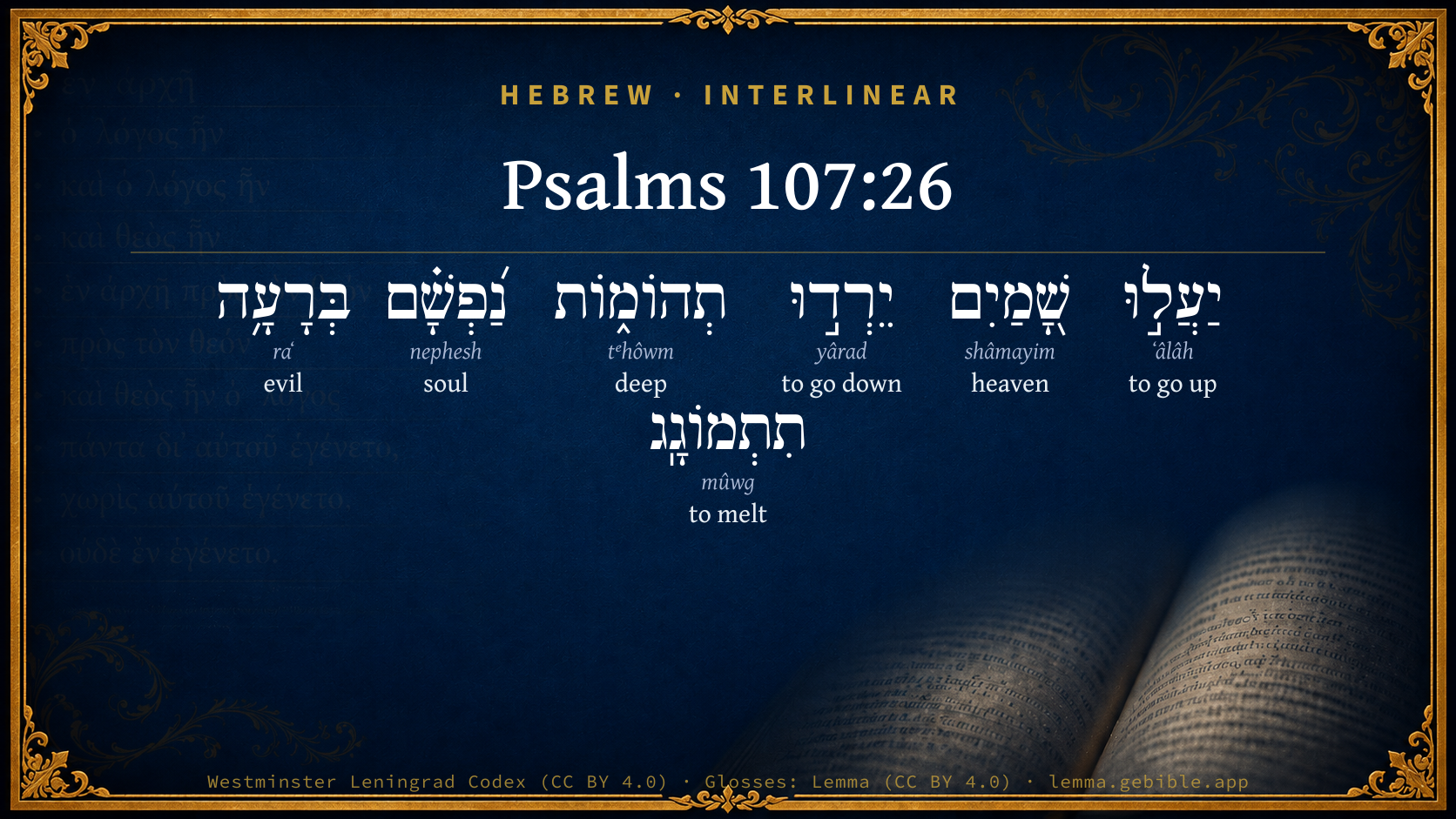
Psalms 107:26

Hebrew (Westminster Leningrad Codex) Psalms 107:26 appears in the Hebrew Old Testament. The text above is from the Westminster Leningrad Codex. Each word links to its Strong’s number, a concise gloss, and parsing drawn from the Open Scriptures Hebrew Bible morphology. Click any word for its full Brown-Driver-Briggs (BDB) entry.
Download image
Cite this verse

Psalms 107:26 (World English Bible). Public Domain. Lemma interlinear Bible study tool, https://lemma.gebible.app/v/psalms/107/26.

Show BibTeX & RIS
BibTeX
RIS
English Translation
They mount up to the sky; they go down again to the depths. Their soul melts away because of trouble.
World English Bible · Public Domain
Download a study sheet

One document with this verse’s original text, its word-by-word gloss line, the meaning frame, cross-references with their text, attributed commentary, and full source and license credits — printable, and it pastes into notes with its structure intact.

This verse Autodidact and up

Study sheet (.html) Plain text (.txt)

A passage Seminary Student

Up to 50 verses in one chapter. A passage sheet keeps up to 6 commentary sources and 12 cross-references per verse, in the order this page ranks them, and says so on the sheet whenever that leaves anything out. Ask for a single verse and you get the Autodidact verse sheet above.

Everything on this page stays free to read, with no account — the sheet is a download of what is already on screen, not access to it.

Want to remove ads? Support Godless Engineer
Compare translations 3

The same verse in 3 English versions, stacked beneath the original-language interlinear above. Click any original word for its lexicon entry.

Each is an independent rendering of the whole verse — the interlinear is not word-aligned to these translations.

Highlighted words mark where these versions differ — a whole-verse word diff, not a word-by-word alignment.

  • World English Bible Public Domain
    They mount up to the sky; they go down again to the depths. Their soul melts away because of trouble.
  • King James Version Public Domain
    They mount up to the heaven, they go down again to the depths: their soul is melted because of trouble.
  • unfoldingWord Literal Text CC BY-SA 4.0
    They went up the sky; they went down the depths. Their souls melted in the disaster.

unfoldingWord Literal Text — © unfoldingWord, licensed CC BY-SA 4.0. Word-aligned USFM3 via Door43 (git.door43.org/unfoldingWord/en_ult).

Versions to compare (up to 4)

3 of 4 selected

Show all 18 translations

Every available English version of this verse, each an independent rendering of the whole verse.

  • World English Bible Public Domain
    They mount up to the sky; they go down again to the depths. Their soul melts away because of trouble.
  • Berean Standard Bible Public Domain
    They mounted up to the heavens, then sunk to the depths; their courage melted in their anguish.
  • Majority Standard Bible Public Domain
    They mounted up to the heavens, then sunk to the depths; their courage melted in their anguish.
  • King James Version Public Domain
    They mount up to the heaven, they go down again to the depths: their soul is melted because of trouble.
  • American Standard Version (1901) Public Domain
    They mount up to the heavens, they go down again to the depths: Their soul melteth away because of trouble.
  • Revised Version (1885) Public Domain
    They mount up to the heaven, they go down again to the depths: their soul melteth away because of trouble.
  • Geneva Bible (1599) Public Domain
    They mount vp to the heauen, and descend to ye deepe, so that their soule melteth for trouble.
  • Douay-Rheims (1899) Public Domain
    They mount up to the heavens, and they go down to the depths: their soul pined away with evils.
  • Young's Literal Translation Public Domain
    They go up `to' the heavens, they go down `to' the depths, Their soul in evil is melted.
  • Literal Standard Version CC BY-SA 4.0
    They go up [to] the heavens, they go down [to] the depths, || Their soul is melted in evil.
  • Unlocked Literal Bible CC BY-SA 4.0
    They reached up to the sky; they went down to the depths. Their lives melted away in distress.
  • unfoldingWord Literal Text CC BY-SA 4.0
    They went up the sky; they went down the depths. Their souls melted in the disaster.
  • Darby Bible Public Domain
    They mount up to the heavens, they go down to the depths; their soul is melted because of trouble;
  • World Messianic Bible Public Domain
    They mount up to the sky; they go down again to the depths. Their soul melts away because of trouble.
  • Webster's Bible Public Domain
    They mount up to the heaven, they go down again to the depths: their soul is melted because of trouble.
  • Free Bible Version CC BY-SA 4.0
    lifting the ships high in the air and then plunging them down. The sailors were so terrified that their courage melted away.
  • Bible in Basic English Public Domain
    The sailors go up to heaven, and down into the deep; their souls are wasted because of their trouble.
  • JPS Tanakh (1917) Public Domain
    They mounted up to the heaven, they went down to the deeps; their soul melted away because of trouble;

Literal Standard Version (2020), Covenant Press — licensed CC BY-SA 4.0. Text via the HelloAO Bible API (eBible.org). Unlocked Literal Bible (unfoldingWord) — licensed CC BY-SA 4.0. Text via the HelloAO Bible API (eBible.org). unfoldingWord Literal Text — © unfoldingWord, licensed CC BY-SA 4.0. Word-aligned USFM3 via Door43 (git.door43.org/unfoldingWord/en_ult). Free Bible Version, Dr. Jonathan Gallagher — licensed CC BY-SA 4.0. Text via the HelloAO Bible API (eBible.org).

Word by word

More ways to search: Search by grammar → Find every occurrence → Compare this word →

Practice this passage: Drill this verse → Learn its vocabulary →

About this verse

These counts appear in no published source. They are computed here, from the morphology-tagged text and Lemma’s own curated glosses. What Lemma adds →

7
words
7
distinct lemmas
Wisdom
section

Notable vocabulary

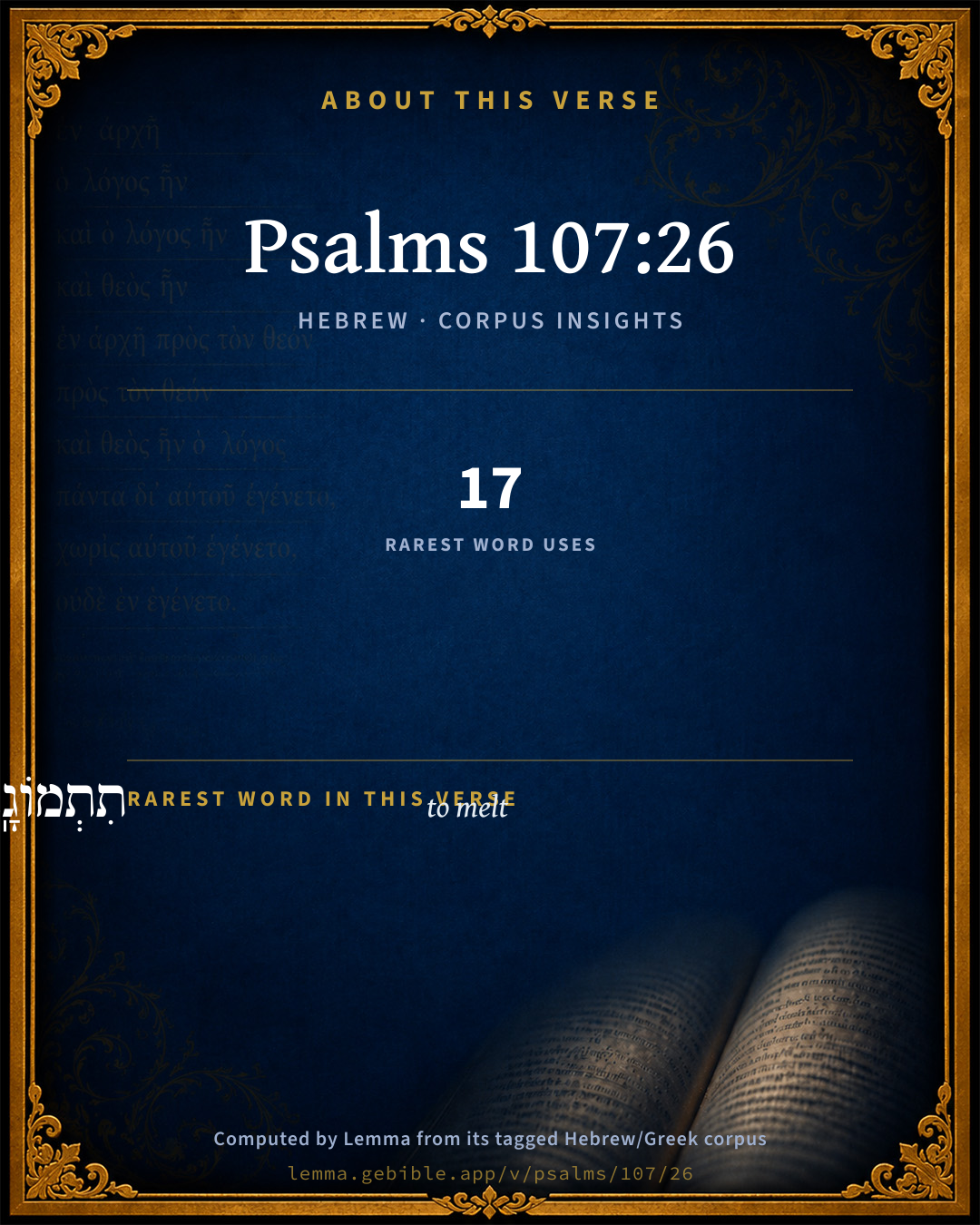
The rarest word here is תִתְמוֹגָֽג to melt H4127 — appearing just 17 times in the whole Hebrew Bible.

Shared distinctive vocabulary

תִתְמוֹגָֽג to melt H4127 occurs in 17 verses of the Hebrew Bible. Also found in:

Grammatical profile

  • 3 verbs
  • 4 nouns

Verb forms

  • יַעֲל֣וּ Qal · Imperfect
  • יֵרְד֣וּ Qal · Imperfect
  • תִתְמוֹגָֽג Hithpolel · Imperfect

Hebrew & Septuagint length

In English translation the verse runs 20 words from the Hebrew and 18 from the Septuagint (LXX English) — closely comparable.

A rough comparison of the two English renderings, which tokenize alike — not a word-level alignment.

Word counts can differ between the Hebrew and the Greek without any difference in meaning — e.g. the Hebrew direct-object marker אֵת has no separate Greek word, and Greek often adds the article ὁ.

Cross-references

5

Topical passages linked to Psalms 107:26 in the Treasury of Scripture Knowledge — connected by theme and wording, ordered by reader-vote popularity; previews shown in the World English Bible.

  • Psalms 22:14 I am poured out like water. All my bones are out of joint. My heart is like wax; It is melted within me.
  • Psalms 119:28 My soul is weary with sorrow: Strengthen me according to your word.
  • 2 Samuel 17:10 Even he who is valiant, whose heart is as the heart of a lion, will utterly melt; for all Israel knows that your father is a mighty man, and those who are with him are valiant men.
  • Isaiah 13:7 Therefore shall all hands be feeble, and every heart of man shall melt:
  • Nahum 2:10 She is empty, void, and waste. The heart melts, the knees knock together, their bodies and faces have grown pale.

Cross-references courtesy of OpenBible.info (CC BY 4.0).

Hebrew and Greek witnesses Masoretic Hebrew ↔ Greek Septuagint

The same verse in the two great witnesses to the Old Testament, shown verse-for-verse.

You’re reading Greek Psalm 106 (Hebrew Psalm 107). The Septuagint counts the superscription, so verse numbers can differ from the Hebrew — chapter-level alignment, not verse-by-verse. Numbering follows Rahlfs.

These are two independent witnesses, not word-aligned to each other, and the Septuagint is shown in lemma (dictionary) form.

Hebrew Psalms 107:26 Masoretic · Westminster Leningrad Codex

יַעֲל֣וּ שָׁ֭מַיִם יֵרְד֣וּ תְהוֹמ֑וֹת נַ֝פְשָׁ֗ם בְּרָעָ֥ה תִתְמוֹגָֽג

They mount up to the sky; they go down again to the depths. Their soul melts away because of trouble.

World English Bible · Public Domain

Greek LXX Greek Psalm 106:26 Septuagint · lemma form

ἀναβαίνω ἕως ὁ οὐρανός καί καταβαίνω ἕως ὁ ἄβυσσος ὁ ψυχή αὐτός ἐν κακός τήκω

They go up to the heavens, and go down to the depths; their soul melts because of troubles.

LXX2012 (modern English Septuagint) · Public Domain

Hebrew: Westminster Leningrad Codex (CC BY 4.0). Greek: Septuagint (public domain); English from LXX2012 (modern English Septuagint) (Public Domain). How the Septuagint differs from the Hebrew →

Commentary

Notes on Psalms 107:26 from classic Christian and Jewish commentators (each source and its license shown beneath its notes). The classic Christian expositions comment on the surrounding passage and are grouped to its opening verse, so a note may address several verses; the Jewish commentaries on the Tanakh (Rashi and others) are per-verse, so they appear only where the commentator wrote on this verse.

Lemma curates 59 commentaries, every one of them public domain or Creative Commons licensed, each selected and text-cleaned for this edition rather than reprinted as found. About our sources →

Trapp's Complete Commentary

John Trapp

Psa 107:26 They mount up to the heaven, they go down again to the depths: their soul is melted because of trouble.

Ver. 26. They mount up to the heaven, they go down, &c.] An elegant hypotyposis or description of a storm at sea; like whereunto is that in Virgil,

Tollimur in coelum curvato gurgite, et iidem

Subducta ad manes imos descendimus unda.

Their soul is melted because of trouble] They are ready to die through fear of death. Juntas understandeth it of extreme vomiting, as if they were casting up their very hearts. Anacharsis for this cause doubted whether he should reckon mariners among the living or the dead. And another said, that any man will go to sea at first I wonder not; but to go a second time thither is little better than madness.

John Trapp, A Commentary or Exposition upon All the Books of the Old and New Testament (1647–1656) — public domain. Text from a community e-Sword module.

J. A. Alexander on Psalms

Joseph Addison Alexander

26. (Psa 107:26) They rise (to) the heavens; they sink (to) the depths; their soul with evil dissolves itself. That the verbs in the first clause relate not to the waves but to the mariners, is evident from the last clause. The words rise and sink are used instead of ascend, descend, or go up, go down, because the Hebrew verbs have no etymological affinity, nor even a single letter common to their roots. The ellipsis of the preposition to is frequent, or rather verbs of motion in Hebrew may be construed directly with a noun, where our idiom requires the intervention of a particle. Evil in the last clause may denote their evil state or painful situation, with all the circumstances comprehended in it; or, more specifically, their distress and painful feelings. Compare Gen 41:29. The reflexive form of the last verb is not essential to the meaning of the sentence, as in Psa 107:17, and may therefore be explained as an intensive or emphatic passage, it is melted. See above, on Psa 22:14. With the whole verse compare Psa 104:8.

Joseph Addison Alexander, The Psalms Translated and Explained (1850) — public domain. Text from a community e-Sword module.

Geneva Bible (1599)

Geneva Bible translators

Their fear and danger is so great.

Geneva Bible (1599) marginal notes — public domain. Text via Bolls.life.

Adam Clarke's Commentary

Verse 26. They mount up to the heaven] This is a most natural and striking description of the state of a ship at sea in a storm: when the sea appears to run mountains high, and the vessel seems for a moment to stand on the sharp ridge of one most stupendous, with a valley of a frightful depth between it and a similar mountain, which appears to be flying in the midst of heaven, that it may submerge the hapless bark, when she descends into the valley of death below. This is a sight the most terrific that can be imagined: nor can any man conceive or form an adequate idea of it, who has not himself been at sea in such a storm.

Their soul is melted because of trouble.] This is not less expressive than it is descriptive. The action of raising the vessel to the clouds, and precipitating her into the abyss, seems to dissolve the very soul: the whole mind seems to melt away, so that neither feeling, reflection, nor impression remains, nothing but the apprehension of inevitable destruction! When the ship is buffeted between conflicting waves, which threaten either to tear her asunder or crush her together; when she reels to and fro, and staggers like a drunken man, not being able to hold any certain course; when sails and masts are an incumbrance, and the helm of no use; when all hope of safety is taken away; and when the experienced captain, the skilful pilot, and the hardy sailors, cry out, with a voice more terrible than the cry of fire at midnight, We are ALL lost! we are all LOST! then, indeed, are they at their wit's end; or, as the inimitable original expresses it, וחל חכמתם תתבלע vechol chochmatham tithballa, "and all their skill is swallowed up," - seems to be gulped down by the frightful abyss into which the ship is about to be precipitated. Then, indeed, can the hand of God alone "bring them out of their distresses." Then, a cry to the Almighty (and in such circumstances it is few that can lift up such a cry) is the only means that can be used to save the perishing wreck! Reader, dost thou ask why I paint thus, and from whose authority I describe? I answer: Not from any books describing storms, tempests, and shipwrecks; not from the relations of shipwrecked marines; not from viewing from the shore a tempest at sea, and seeing a vessel beat to pieces, and all its crew, one excepted, perish. Descriptions of this kind I have read, with the shipwrecked mariner I have conversed, the last scene mentioned above I have witnessed: but none of these could give the fearful impressions, the tremendous and soul-melting apprehensions, described above. "Where then have you had them?" I answer, From the great deep. I have been at sea in the storm, and in the circumstances I describe; and, having cried to the Lord in my trouble, I am spared to describe the storm, and recount the tale of his mercy. None but either a man inspired by God, who, in describing, will show things as they are, or one who has been actually in these circumstances, can tell you with what propriety the psalmist speaks, or utter the thousandth part of the dangers and fearful apprehensions of those concerned in a tempest at sea, where all the winds of heaven seem collected to urge an already crazy vessel among the most tremendous rocks upon a lee shore! God save the reader from such circumstances!

When, in the visitation of the winds,

He takes the ruffian billows by the top,

Curling their monstrous heads, and hanging them,

With deafening clamours, on the slippery clouds,

That with the hurly death itself awakes!

HENRY IV.

A storm at sea - the lifting the vessel to the clouds - her sinking into the vast marine valleys - the melting of the soul - and being at their wit's end, are well touched by several of the ancient poets. See particularly Virgil's description of the storm that dispersed the fleet of AEneas, who was himself not unacquainted with the dangers of the sea: -

Tollimur in coelum curvato gurgite, et idem

Subducta ad manes imos descendimus unda.

AEN. iii., 364.

Now on a towering arch of waves we rise,

Heaved on the bounding billows to the skies.

Then, as the roaring surge retreating fell,

We shoot down headlong to the gates of hell.

PITT.

Rector in incerto est, nec quid fugiatve, petatve,

Invenit: ambiguis ars stupet ipsa malis.

"The pilot himself is in doubt what danger to shun; or whither to steer for safety he knows not: his skill is nonplussed by the choice of the difficulties before him."

See more in the analysis.

Adam Clarke's Commentary on the Bible (1810–1826) — public domain. Text from a community e-Sword/MySword module.

Ellicott's Commentary for English Readers

(26) They mount up.—

“Tollimur in cœlum curvato gurgite, et idem

Subducta ad Manes imos desedimus unda.”

VIRGIL: Æn. iii. 564.

Their soul is melted.—The recollection of seasickness is the best comment on this and the next verse.

A Bible Commentary for English Readers, edited by Charles John Ellicott (1878–1897) — public domain. Text from a community e-Sword module.

The Cambridge Bible for Schools and Colleges

gen. ed. J. J. S. Perowne

26. They mount up] The sailors, not the waves, as is clear from the next line. Cp. Verg. Aen. III. 564,

Tollimur in caelum curvato gurgite, et idem

Subducta ad Manis imos desedimus unda.

their soul &c.] Their soul melteth in evil plight.

The Cambridge Bible for Schools and Colleges (gen. ed. J. J. S. Perowne; Cambridge University Press, 1878–1918) — public domain. Text from a community e-Sword module.

John Gill's Exposition

He maketh the storm a calm,.... As Christ did by a word speaking, Mar 4:39.

So that the waves thereof are still; and roar and toss no more, but subside; and the sea becomes smooth and quiet, its raging ceases: the angry sea, as Horace (p) calls it, becomes calm and peaceable; see Psa 89:9.

(p) "Nec horret iratum mare", Horat. Epod. Ode 2. v. 6. "Nec maris ira manet", Ovid. Metamorph. l. 12. Fab. 7.

John Gill's Exposition of the Whole Bible (1746–1763) — public domain (CC PDM 1.0). Text via the HelloAO Bible API.

Albert Barnes' Notes on the Bible

They mount up to the heaven - The mariners. That it refers to the seamen, and not to the waves, is apparent from the close of the verse: “their soul is melted.”

They go down again to the depths - The word here is different from that used in Psa 107:24, and rendered “deep,” but the idea is essentially the same. It is the sea or ocean considered as “deep;” as bottomless. The idea here is, that they seem to descend into the very depths of the ocean.

Their soul is melted because of trouble - It seems to dissolve; it loses all its vigor; it faints. The word used - מוג mûg - means to melt; to flow down; to soften; and is then applied to the heart or mind that loses its courage or vigor by fear or terror. Exo 15:15; Jos 2:9, Jos 2:24; Nah 1:5. The “trouble” here referred to is that which arises from fear and danger.

Albert Barnes' Notes on the Bible (1834–1885) — public domain. Text from a community e-Sword/MySword module.

Matthew Poole's English Annotations

To the depths; towards the bottom of the sea.

Because of trouble; through the perplexity of their minds, and fear of sudden and violent death.

Matthew Poole's English Annotations on the Holy Bible (1683–1685) — public domain. Text from a community e-Sword/MySword module.

The Treasury of David

Charles H. Spurgeon

Ver. 26. They mount up to the heaven. Borne aloft on the crest of the wave, the sailors and their vessels appear to climb the skies, but it is only for a moment, for very soon in the trough of the sea

they go down again to the depths. As if their vessel were but a sea bird, the mariners are tossed "up and down, up and down, from the base of the wave to the billow's crown."

Their soul is melted because of trouble. Weary, wet, dispirited, hopeless of escape, their heart is turned to water, and they seem to have no manhood left.

Those who have been on the spiritual deep in one of the great storms which occasionally agitate the soul know what this verse means. In these spiritual cyclones presumption alternates with despair, indifference with agony! No heart is left for anything, courage is gone, hope is almost dead. Such an experience is as real as the tossing of a literal tempest and far more painful. Some of us have weathered many such an internal hurricane, and have indeed seen the Lord's wondrous works.

Ver. 26. They mount up to the heaven. There be three heavens. 1. Coelum aerium. 2. Coelum astriferum. 3. Coelum beatorum. It is not the latter now they go to in storms, but the two former. Daniel Pell, in "An Improvement of the Sea", 1659.

Ver. 26. They mount up to the heaven, they go down again to the depths.

To larboard all their oars and canvas bend;

We on a ridge of waters to the sky

Are lifted, down to Erebus again

Sink with the falling wave; thrice howled the rocks

Within their stony caverns, thrice we saw

The splashed up foam upon the lights of heaven. Virgil.

Ver. 26. The ups and downs of a convicted sinner's experience.

Psalms 107:27*

Charles H. Spurgeon's The Treasury of David (1869–1885) — public domain. Psalms only. Text from a community e-Sword/MySword module.

The Pulpit Commentary

They mount up to the heaven, they go down again to the depths. Tossed on the foaming billows, now carried up until they seem almost to touch the sky, (see Gen_11:4) anon sinking into the trough of the sea, and as it were swallowed up in its depths. Their soul is melted because of trouble; or, "their soul melteth away in the trouble" (Cheyne).

The Pulpit Commentary (1880–1919), ed. H.D.M. Spence-Jones & Joseph S. Exell — public domain. Text from a community e-Sword module.

Lesson kit

Teaching starters — assembled from the data on this page, not authored interpretation. Every prompt links to the verse data it draws on. Edit before teaching.

Psalms, in the Wisdom, opens this verse with 7 words (7 distinct Hebrew lemmas). Its most distinctive word is mûwg (“to melt”). A historical commentator’s framing appears above. Read the whole chapter for the surrounding context.

Discussion questions

  1. What does “to melt” (mûwg) contribute to the verse as a whole?
  2. Exodus 15:15 shares the word «to melt» with this verse. How do the two illuminate each other?
  3. These translations render this verse differently. What is at stake in choosing one wording over another?
  4. The verb «יַעֲל֣וּ» is Qal Imperfect. How does its form color the action?
  5. Reading how Trapp's Complete Commentary and J. A. Alexander on Psalms read this verse, where do the two commentators agree and where do they part?

Things to notice

Reading settings

Reading text

Shown beneath each verse's original-language words.

Old Testament
Old Testament edition

Read the OT as the Masoretic Hebrew (MT) or the Greek Septuagint (LXX).

English shown for the Greek Septuagint (in the Hebrew ↔ Greek comparison).

Comparing translations? Open the Compare panel on any verse page to stack up to four side by side.