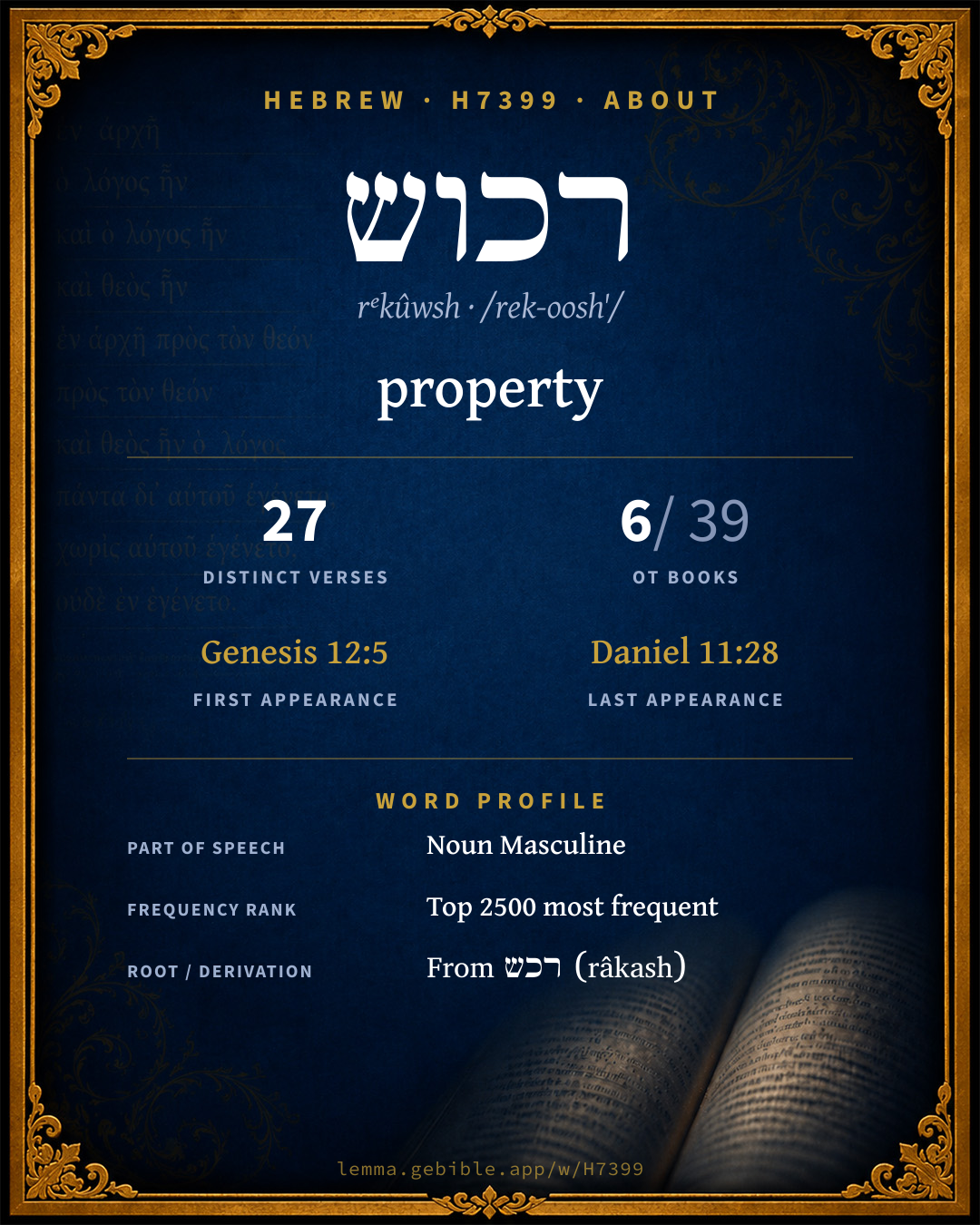
רְכוּשׁ
property
also: goods, possessions fuller range ↓
Full lexicon entry — Brown-Driver-Briggs (BDB)
From Brown-Driver-Briggs (BDB)
Where this word appears
See every Absolute-state word in the Hebrew Bible →
Grammar key — what these labels mean
Part of speech
- Noun
- A naming word — a person, place, thing, or idea.
Noun type
- Common
- A common noun — a general class of person, place, or thing (“king,” “city,” “water”), not a specific name.
State
- Construct
- A noun bound to a following noun in a possessive / “of” relationship (the construct chain).
- Absolute
- The independent form of a noun, not bound to a following word.
Gender
- Masculine
- Grammatically masculine.
Number
- Singular
- One.
Grammatical forms
- Noun, Common, Masculine, Singular, Construct 14 times (50%)
- Noun, Common, Masculine, Singular, Absolute 14 times (50%)
Parsed forms decoded from the imported morphology (morphhb / Westminster Leningrad Codex — WLC text public domain, morphhb tagging CC BY 4.0), counted across 28 parsed occurrences — not distinct verses.
Every verse where H7399 appears — 27 distinct verses across 6 books. Click any verse to open its interlinear word-by-word view. Verse text shown in the World English Bible for context — . Each verse’s Hebrew form is shown with its reference; the English is not keyword-highlighted, since the data carries no word-level English alignment. Use “Compare translations” on any verse to read it across multiple English versions. This concordance covers the Hebrew Bible; Septuagint (Greek Old Testament) occurrences are not indexed here.
Genesis 10 verses
- Genesis 12:5 רְכוּשָׁ/ם֙ n c ms cs + sfx pers 3mp Abram took Sarai his wife, Lot his brother's son, all their substance that they had gathered, and the souls who they had gotten in Haran; and they went forth to go into the land of Canaan. Into the land of Canaan they came.
- Genesis 13:6 רְכוּשָׁ/ם֙ n c ms cs + sfx pers 3mp The land was not able to bear them, that they might live together: for their substance was great, so that they could not live together.
- Genesis 14:11 רְכֻ֨שׁ n c ms cs They took all the goods of Sodom and Gomorrah, and all their food, and went their way.
- Genesis 14:12 רְכֻשׁ֛/וֹ n c ms cs + sfx pers 3ms They took Lot, Abram's brother's son, who lived in Sodom, and his goods, and departed.
- Genesis 14:16 הָ/רְכֻ֑שׁ וּ/רְכֻשׁ/וֹ֙ ptcl def.art + n c ms conj + n c ms cs + sfx pers 3ms He brought back all the goods, and also brought back his relative, Lot, and his goods, and the women also, and the people.
- Genesis 14:21 וְ/הָ/רְכֻ֖שׁ conj + ptcl def.art + n c ms The king of Sodom said to Abram, "Give me the people, and take the goods to yourself."
- Genesis 15:14 בִּ/רְכֻ֥שׁ prep + n c ms I will also judge that nation, whom they will serve. Afterward they will come out with great substance.
- Genesis 31:18 רְכֻשׁ/וֹ֙ n c ms cs + sfx pers 3ms and he carried away all his cattle, and all his substance which he had gathered, the cattle of his getting, which he had gathered in Paddan Aram, to go to Isaac his father to the land of Canaan.
- Genesis 36:7 רְכוּשָׁ֛/ם n c ms cs + sfx pers 3mp For their substance was too great for them to dwell together, and the land of their travels couldn't bear them because of their cattle.
- Genesis 46:6 רְכוּשָׁ/ם֙ n c ms cs + sfx pers 3mp They took their cattle, and their goods, which they had gotten in the land of Canaan, and came into Egypt-- Jacob, and all his seed with him,
Numbers 2 verses
- Numbers 16:32 הָ/רֲכֽוּשׁ ptcl def.art + n c ms and the earth opened its mouth, and swallowed them up, and their households, and all the men who appertained to Korah, and all their goods.
- Numbers 35:3 וְ/לִ/רְכֻשָׁ֔/ם conj + prep + n c ms cs + sfx pers 3mp The cities shall they have to dwell in; and their suburbs shall be for their cattle, and for their substance, and for all their animals.
1 Chronicles 2 verses
- 1 Chronicles 27:31 הָ/רְכ֔וּשׁ ptcl def.art + n c ms All these were the rulers of the substance which was king David's.
- 1 Chronicles 28:1 רְכוּשׁ n c ms David assembled all the princes of Israel, the princes of the tribes, and the captains of the companies who served the king by division, and the captains of thousands, and the captains of hundreds, and the rulers over all the substance and possessions of the king and of his sons, with the officers, and the mighty men, even all the mighty men of valor, to Jerusalem.
2 Chronicles 6 verses
- 2 Chronicles 20:25 וּ/רְכ֤וּשׁ conj + n c ms When Jehoshaphat and his people came to take the spoil of them, they found among them in abundance both riches and dead bodies, and precious jewels, which they stripped off for themselves, more than they could carry away: and they were three days in taking the spoil, it was so much.
- 2 Chronicles 21:14 רְכוּשֶֽׁ/ךָ n c ms cs + sfx pers 2ms behold, Yahweh will strike with a great plague your people, and your children, and your wives, and all your substance;
- 2 Chronicles 21:17 הָ/רְכוּשׁ֙ ptcl def.art + n c ms and they came up against Judah, and broke into it, and carried away all the substance that was found in the king's house, and his sons also, and his wives; so that there was never a son left him, save Jehoahaz, the youngest of his sons.
- 2 Chronicles 31:3 רְכוּשׁ֜/וֹ n c ms cs + sfx pers 3ms [He appointed] also the king's portion of his substance for the burnt-offerings, [to wit], for the morning and evening burnt offerings, and the burnt offerings for the Sabbaths, and for the new moons, and for the set feasts, as it is written in the law of Yahweh.
- 2 Chronicles 32:29 רְכ֖וּשׁ n c ms Moreover he provided him cities, and possessions of flocks and herds in abundance; for God had given him very much substance.
- 2 Chronicles 35:7 מֵ/רְכ֥וּשׁ prep + n c ms cs Josiah gave to the children of the people, of the flock, lambs and kids, all of them for the Passover offerings, to all who were present, to the number of thirty thousand, and three thousand bulls: these were of the king's substance.
Ezra 4 verses
- Ezra 1:4 וּ/בִ/רְכ֣וּשׁ conj + prep + n c ms Whoever is left, in any place where he sojourns, let the men of his place help him with silver, and with gold, and with goods, and with animals, besides the freewill-offering for the house of God which is in Jerusalem.
- Ezra 1:6 בָּ/רְכ֥וּשׁ prep det + n c ms All those who were round about them strengthened their hands with vessels of silver, with gold, with goods, and with animals, and with precious things, besides all that was willingly offered.
- Ezra 8:21 רְכוּשֵֽׁ/נוּ n c ms cs + sfx pers 1cp Then I proclaimed a fast there, at the river Ahava, that we might humble ourselves before our God, to seek of him a straight way for us, and for our little ones, and for all our substance.
- Ezra 10:8 רְכוּשׁ֑/וֹ n c ms cs + sfx pers 3ms and that whoever didn't come within three days, according to the counsel of the princes and the elders, all his substance should be forfeited, and himself separated from the assembly of the captivity.
Daniel 3 verses
- Daniel 11:13 וּ/בִ/רְכ֥וּשׁ conj + prep + n c ms The king of the north shall return, and shall set forth a multitude greater than the former; and he shall come on at the end of the times, [even of] years, with a great army and with much substance.
- Daniel 11:24 וּ/רְכ֖וּשׁ conj + n c ms In time of security shall he come even on the fattest places of the province; and he shall do that which his fathers have not done, nor his fathers' fathers; he shall scatter among them prey, and spoil, and substance: yes, he shall devise his devices against the strongholds, even for a time.
- Daniel 11:28 בִּ/רְכ֣וּשׁ prep + n c ms Then shall he return into his land with great substance; and his heart [shall be] against the holy covenant; and he shall do [his pleasure], and return to his own land.
About this entry
At a glance — auto-summarized from this page’s data, not written by a person. Every figure links to its source below. This summary describes the numbers; it doesn’t interpret them.
רכוש (rᵉkûwsh) is a Hebrew noun most often rendered “property.” Translators differ — “goods” in the King James Version, then “possessions” (Berean Standard Bible), as the renderings breakdown shows. With 27 verses in 6 books, it is a moderately common word in the Hebrew Bible. It concentrates in Genesis, which alone accounts for 37% of its uses. Beyond its headline sense, its full sense range takes in “goods” and “possessions”. The sections below give every sense, occurrence, and version rendering.
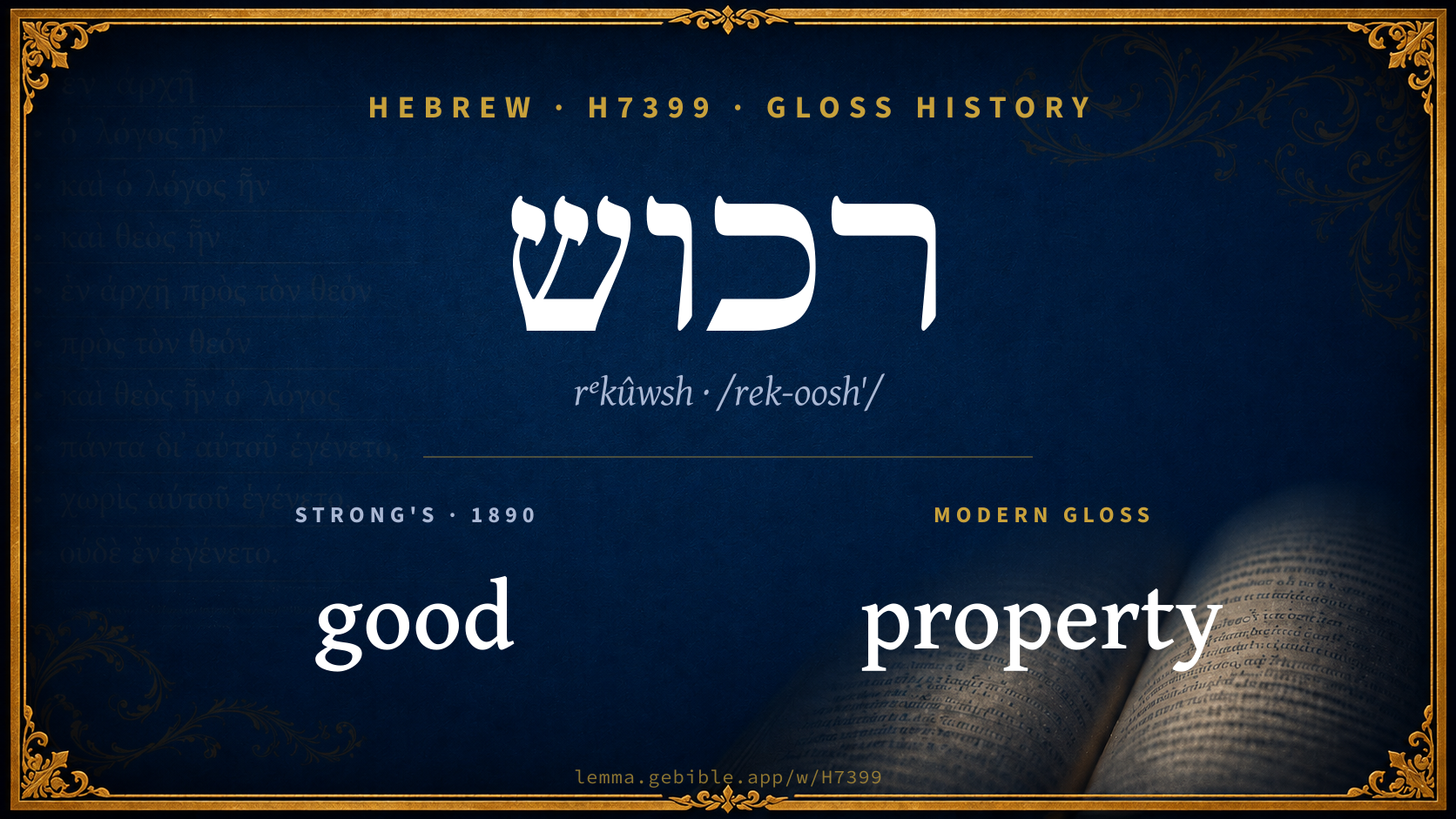
Gloss history
Strong's 1890 vs modern scholarship
About this word
Strong's H7399 catalogs a Hebrew word from the Hebrew Old Testament.
These counts are not copied from any lexicon or concordance. They are computed here, from the morphology-tagged Hebrew Old Testament. What Lemma adds →
- 27
- distinct verses
- The word appears in 27 distinct verses.
- 6 / 39
- OT books
- The word appears in 6 of 39 Old Testament books.
- #1,190
- by frequency
- Top 2500 most frequent Hebrew words (rank 1,190 of 8,640 Hebrew words by occurrence).
View all 27 occurrences in the concordance →
Most concentrated in
- Genesis 10 verses 37%
- 2 Chronicles 6 verses 22%
- Ezra 4 verses 15%
By section of the Old Testament
By traditional corpus
Conventional, traditional groupings — biblical authorship is debated, so this is a traditional corpus grouping, not an authorship claim. Each share is this word’s portion of its verses in that division of the Hebrew canon. Each figure is a share of the word’s 27 distinct verses.
- Writings (Ketuvim) 15 verses · 56%
- Torah (Pentateuch) 12 verses · 44%
How translations render this word
Counts come from each version’s own published word-to-Strong’s tagging or interlinear alignment — an approximate guide to how each version renders this word, not a word-level alignment the data otherwise carries. Because each total is that version’s own tagged count, the per-version totals vary from one another and need not match the appearance or distinct-verse counts above. These counts may also differ from a printed concordance because Lemma counts each distinctly tagged rendering and does not collapse phrase taggings into a single head-word total. This is a fixed set of word-tagged versions (KJV, ASV, BSB, ULT) and does not change with the reading translation you choose elsewhere. Each version’s license is shown beside its name below (and on Sources).
- King James Version: Goods 7×, Substance 6×, Riches 4×
- American Standard Version: Substance 10×, Goods 5×, All his substance 2×
- Berean Standard Bible: Possessions 12×, Goods 6×, Property 3×
- unfoldingWord Literal Text: Possessions 9×, Property 9×, Goods 5×
King James Version Public Domain
Renders H7399 across 28 tagged occurrences — most commonly:
Plus 9 renderings that appear only once — usually multi-word phrases or single function words the recovered tagging swept in, not distinct renderings.
American Standard Version Public Domain
Renders H7399 across 28 tagged occurrences — most commonly:
Plus 9 renderings that appear only once — usually multi-word phrases or single function words the recovered tagging swept in, not distinct renderings.
Berean Standard Bible Public Domain
Renders H7399 across 28 tagged occurrences — most commonly:
Plus 4 renderings that appear only once — usually multi-word phrases or single function words the recovered tagging swept in, not distinct renderings.
unfoldingWord Literal Text CC BY-SA 4.0
Renders H7399 across 31 tagged occurrences — most commonly:
Plus 6 renderings that appear only once — usually multi-word phrases or single function words the recovered tagging swept in, not distinct renderings.
Senses in the full BDB
What do BDB’s symbols mean?
BDB uses these scholarly abbreviations:
| Symbol | Meaning |
|---|---|
| 𝔊 | the Septuagint (the ancient Greek translation, LXX) |
| 𝔙 | the Vulgate (the Latin translation) |
| 𝔖 | the Syriac version (the Peshitta) |
| 𝔗 | the Targum (the Aramaic translation) |
| ψ | the Psalms |
| √ | root (the underlying root or stem) |
| ‖ | parallel passage (a synonymous or contrasted parallel) |
| † | the dagger: every passage where the word occurs is cited |
The 3 senses and sub-senses the full Brown-Driver-Briggs lexicon distinguishes for this word, in lexicon order (not ranked by frequency), with BDB’s own verbatim wording and sub-sense lettering. Shown in Hebrew script with BDB’s own scholarly abbreviations. The condensed entry is in the Lexicon Entry tab. See also the Forms in the corpus table below.
- 1. gen. term for movable possessions of all kinds (often specif. incl. cattle), Gn 12:5; 15:14; Nu 16:32; 1 Ch 27:31; 28:1; 2 Ch 31:3; 32:29; Ezr 8:21; 10:8. e.g. Genesis 12:5
- 2. used specif. of cattle, flocks, etc. Gn 13:6; 31:18; 36:7; Nu 35:3; 2 Ch 35:7. e.g. Genesis 13:6
- 3. of stores, utensils, etc. Gn 46:6; Ezr 1:4, 6, as camp-baggage Dn 11:13, especially as booty Gn 14:11, 12, 16(×2), 21; 2 Ch 20:25; 21:14, 17; Dn 11:24, 28. e.g. Genesis 46:6
Senses from the full Brown-Driver-Briggs lexicon (Brown, Driver, Briggs; Oxford 1906 — public domain), digitized via Sefaria, supplemented by the OpenScriptures HebrewLexicon (CC BY 4.0). Full attribution on Sources.
Word origin
n.m. Gn 13, 6 property, goods;—abs. רְכוּשׁ Nu 16:32 +, רְכֻשׁ Gn 14:16, 21; cstr. רְכוּשׁ 2 Ch 35:7, רְכֻשׁ Gn 14:11; sf. רְכֻשׁוֹ v 12 +, רְכוּשָׁם 12:5 +, etc.;—property, goods, PRChr Dn Gn 14:
— Brown-Driver-Briggs (Oxford 1906, public domain), digitized via Sefaria, supplemented by the OpenScriptures HebrewLexicon (CC BY 4.0). See Sources.
Derived from רכש (râkash) (H7408) — to gather.
Jastrow Dictionary
A second Hebrew/Aramaic lexicon for comparison, covering Aramaic and post-biblical (Talmudic, Targumic, Midrashic) usage that the biblical-Hebrew BDB does not. Matched by lemma rather than by Strong’s number, so a lemma may carry more than one Jastrow headword (shown separately below), and the entries cover usage well beyond the Bible.
רְכוּשׁ
- רכש to join, pile; cmp. רכב) goods, property. Pirké d’R. El. ch. XXVII; a. e.
A Dictionary of the Targumim, the Talmud Babli and Yerushalmi, and the Midrashic Literature (Marcus Jastrow; London, Luzac, 1903) — Public Domain. Digitized via Sefaria. Digitized via Sefaria. Full attribution on Sources.
Forms in the corpus
The 26 distinct written forms H7399 takes in the Hebrew Bible, most frequent first — each parse links to that state’s occurrences in the concordance. Hebrew forms include their vowel points and cantillation, so a single lemma takes many written forms.
Same root — word family
Other BDB entries built from the same root as H7399, grouped by Strong’s listed origin. These share a root / origin per the lexicon — not necessarily a shared meaning. Each links to that word’s own entry.
Derives from
Shares the same root
Compare all same-root words → They share a root, not necessarily a meaning.
Septuagint verse parallels
This word appears in 27 verses that also exist in the Greek Old Testament (Septuagint), out of the 27 Hebrew verses it occurs in. You can read those verses in Greek by switching the Old Testament edition to the Septuagint.
Read these verses in the Septuagint
This is a verse-level parallel only — the same verses exist in both the Hebrew and Greek Old Testaments. No word-level Hebrew↔Greek correspondence is claimed: the data carries no such alignment, so no Greek word is shown as this Hebrew word’s translation. Coverage is not total — the Septuagint omits the deuterocanon and renumbers the Psalms, so some Hebrew verses have no direct Greek parallel.