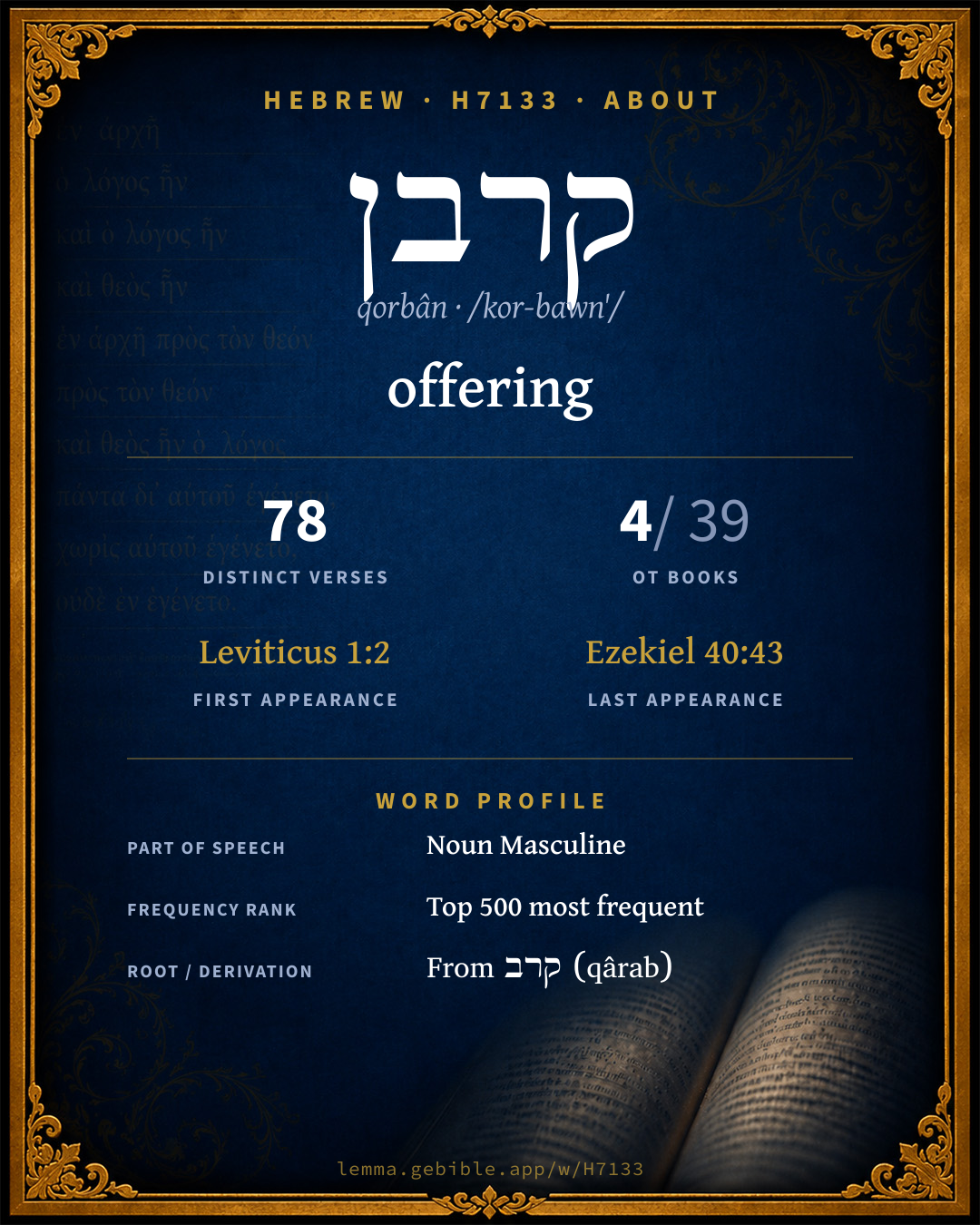
קרבן
offering
Full lexicon entry — Brown-Driver-Briggs (BDB)
From Brown-Driver-Briggs (BDB)
Where this word appears
See every Absolute-state word in the Hebrew Bible →
Grammar key — what these labels mean
Part of speech
- Noun
- A naming word — a person, place, thing, or idea.
Noun type
- Common
- A common noun — a general class of person, place, or thing (“king,” “city,” “water”), not a specific name.
State
- Construct
- A noun bound to a following noun in a possessive / “of” relationship (the construct chain).
- Absolute
- The independent form of a noun, not bound to a following word.
Gender
- Masculine
- Grammatically masculine.
Number
- Singular
- One.
- Plural
- More than one (in Hebrew, generally three or more).
1 verse where H7133 appears in the Absolute state in the Book of Ezekiel. Filtered view — show all forms. Click any verse to open its interlinear word-by-word view. Verse text shown in the World English Bible for context — . Each verse’s Hebrew form is shown with its reference; the English is not keyword-highlighted, since the data carries no word-level English alignment. Use “Compare translations” on any verse to read it across multiple English versions. This concordance covers the Hebrew Bible; Septuagint (Greek Old Testament) occurrences are not indexed here.
Ezekiel
About this entry
At a glance — auto-summarized from this page’s data, not written by a person. Every figure links to its source below. This summary describes the numbers; it doesn’t interpret them.
The Hebrew noun קרבן centers on the idea of “offering.” Its earliest occurrence is Leviticus 1:2. It turns up in 78 verses across 4 books, a moderately common footprint. The word gravitates to Numbers (49%), then Leviticus and Nehemiah. It shares a root with קרב, קרב and קרב. Dig into 78-verse concordance and the renderings breakdown below.
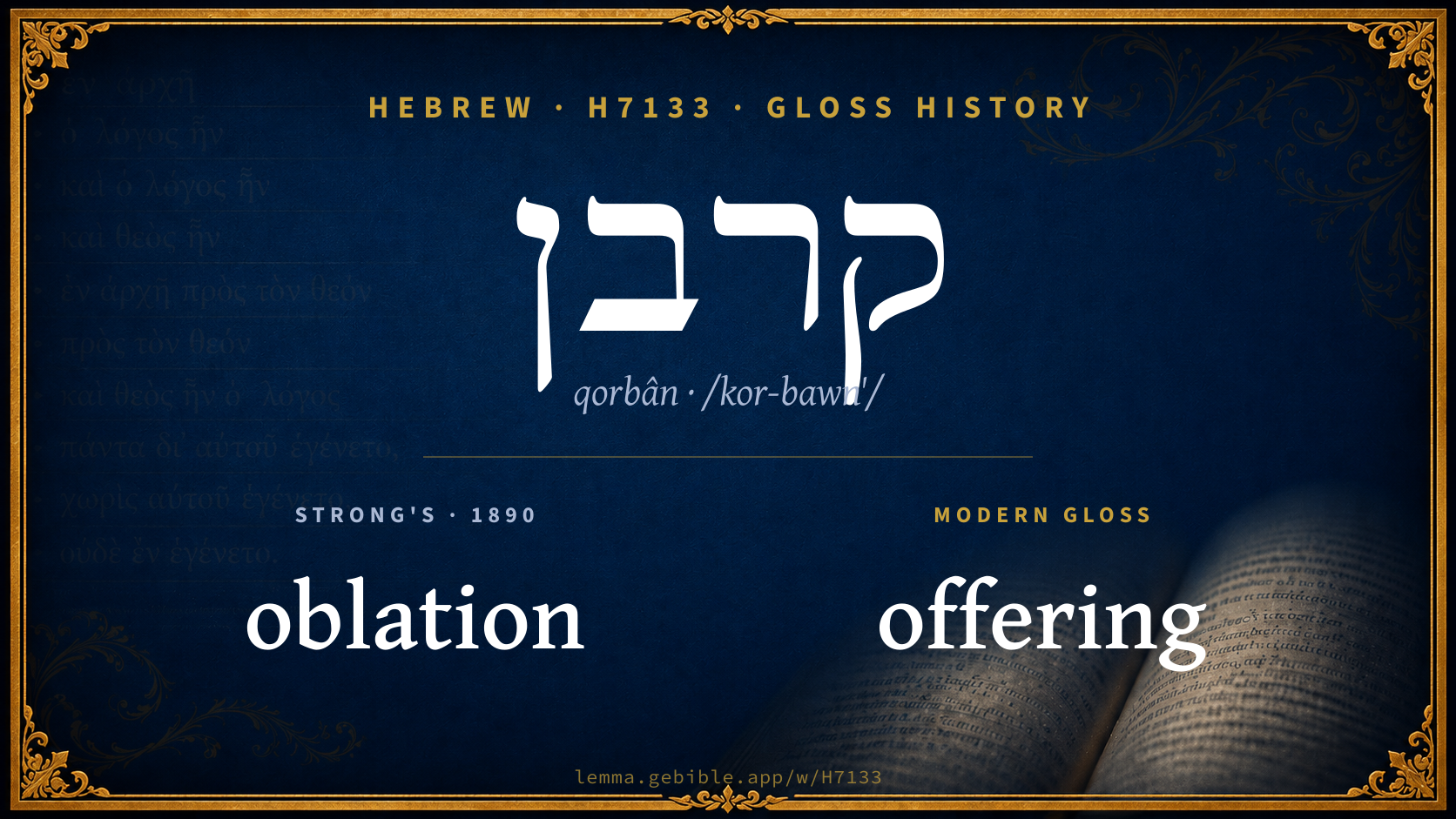
Gloss history
Strong's 1890 vs modern scholarship
About this word
Strong's H7133 catalogs a Hebrew word from the Hebrew Old Testament.
These counts are not copied from any lexicon or concordance. They are computed here, from the morphology-tagged Hebrew Old Testament. What Lemma adds →
- 78
- distinct verses
- The word appears in 78 distinct verses.
- 4 / 39
- OT books
- The word appears in 4 of 39 Old Testament books.
- #487
- by frequency
- Top 500 most frequent Hebrew words (rank 487 of 8,640 Hebrew words by occurrence).
View all 78 occurrences in the concordance →
By section of the Old Testament
By traditional corpus
Conventional, traditional groupings — biblical authorship is debated, so this is a traditional corpus grouping, not an authorship claim. Each share is this word’s portion of its verses in that division of the Hebrew canon. Each figure is a share of the word’s 78 distinct verses.
- Torah (Pentateuch) 74 verses · 95%
- Prophets (Nevi'im) 2 verses · 3%
- Writings (Ketuvim) 2 verses · 3%
How translations render this word
Counts come from each version’s own published word-to-Strong’s tagging or interlinear alignment — an approximate guide to how each version renders this word, not a word-level alignment the data otherwise carries. Because each total is that version’s own tagged count, the per-version totals vary from one another and need not match the appearance or distinct-verse counts above. These counts may also differ from a printed concordance because Lemma counts each distinctly tagged rendering and does not collapse phrase taggings into a single head-word total. This is a fixed set of word-tagged versions (KJV, ASV, BSB, ULT) and does not change with the reading translation you choose elsewhere. Each version’s license is shown beside its name below (and on Sources).
BDB lists this Strong’s number as 2 distinct words (homographs). Each count above pools all of them and is not split by sense — see the Senses section below. A low-frequency rendering may belong to a different one of those words, not the primary meaning.
- King James Version†: Offering 53×, Was the offering 12×, Oblation 8×
- American Standard Version†: Oblation 53×, Old 12×, 's oblation 2×
- Berean Standard Bible†: Offering 44×, Was the offering 12×, Offerings 5×
- unfoldingWord Literal Text†: Offering 51×, Offering of 23×, Offerings 4×
King James Version Public Domain
Renders H7133 across 82† tagged occurrences — most commonly:
Plus 7 renderings that appear only once — usually multi-word phrases or single function words the recovered tagging swept in, not distinct renderings.
American Standard Version Public Domain
Renders H7133 across 83† tagged occurrences — most commonly:
Plus 10 renderings that appear only once — usually multi-word phrases or single function words the recovered tagging swept in, not distinct renderings.
Berean Standard Bible Public Domain
Renders H7133 across 75† tagged occurrences — most commonly:
Plus 10 renderings that appear only once — usually multi-word phrases or single function words the recovered tagging swept in, not distinct renderings. Not rendered by a distinct English word in 4 further occurrences.
unfoldingWord Literal Text CC BY-SA 4.0
Renders H7133 across 82† tagged occurrences — most commonly:
Plus 4 renderings that appear only once — usually multi-word phrases or single function words the recovered tagging swept in, not distinct renderings.
Senses in BDB
The 1 sense BDB distinguishes for this word, in lexicon order (not ranked by frequency or importance). The full entry — with sub-senses — is in the Lexicon Entry tab.
- offering, oblation
Word origin
I. n.m. Lv 6:13 offering, oblation (Assyrian kurbannu, id., appar. always with כ, DlHWB 351);—abs. ק׳ Lv 1:2 +; cstr. קָרְבַּן 2:1 +; sf. קָרְבָּנִי Nu 28:2; pl. sf. קָרְבְּנֵיהֶם Lv 7:38;—offering, oblation, gen. term for all kinds of offering (only Ez Lv Nu [HP]): animal Lv 1:2, 3, 10 +, vegetable 2:1(×2), 5 +, articles of gold Nu 31:50, silver 7:13 +, etc.; as acc. cogn. after הִקְרִיב Lv 1:2(×2); 3:14 Nu 6:14 + (v. √ Hiph. 2 b (5)); cstr. ק׳ מִנְחָה Lv 2:1, 4, 13, ק׳ רֵאשִׁית v 12, ק׳ אִשֶּׁה 22:27; ק׳ י׳ Nu 9:7, 13 (cf. 31:50).
I. n.[m.] offering;—cstr. קֻרְבַּן הָעֵצִים wood-offering for second temple Ne 10:35; 13:31.
— Brown-Driver-Briggs (Oxford 1906, public domain), digitized via Sefaria, supplemented by the OpenScriptures HebrewLexicon (CC BY 4.0). See Sources.
Derived from קרב (qârab) (H7126) — to approach.
Jastrow Dictionary
A second Hebrew/Aramaic lexicon for comparison, covering Aramaic and post-biblical (Talmudic, Targumic, Midrashic) usage that the biblical-Hebrew BDB does not. Matched by lemma rather than by Strong’s number, so a lemma may carry more than one Jastrow headword (shown separately below), and the entries cover usage well beyond the Bible.
קָרְבָּן
- gift, offering, sacrifice. Ber. 15ᵃ מעלה … והקריב עליו ק׳ it is accredited to him, as if he had built an altar and offered a sacrifice on it; Succ. 45ᵃ. Sifra Vayikra, N’dab., ch. II, Par. 2 כל מקום שנאמר ק׳ אמור ביו"ד ה"א wherever in the Scriptures ‘sacrifice’ is used in connection with the divine name, the latter is written with Yod He (יהוה, never אלהים). Ned. I, 4 האומר ק׳ … שאני וכ׳ if one making a vow says, ḳorban … that I will (not) eat &c. Ib. 2 כינויין לק׳ substitutes for ḳorban. Ib. II, 5 בק׳ וכ׳ (נדר) if a man in making a vow uses the word ḳorban, and then says, I vowed only by the gifts to kings; a. fr.—Pl. קָרְבָּנוֹת. Ib. ק׳ של מלכים. Zeb. XIV, 10 קָרְבְּנוֹת הצבור congregational sacrifices, ק׳ היחיד sacrifices offered by individuals. Taan. 27ᵇ כבר תקנתי להם סדר ק׳ וכ׳ I have arranged the order of sacrifices for them (in the Torah), and when they read these sections, I will account it to them as if they offered them. Ex. R. s. 30 בקש הקב"ה … ועבודת ק׳ וכ׳ the Lord wanted to give them (the generation of the flood) four things (to purify them), the Law, sufferings, the sacrificial service, and prayer, but they refused; a. fr.
קָרְבַּן
- Targ. Hos. XII, 2. Targ. O. Gen. IV, 3 ed. Berl. (oth. ed. תקרבתא, v. Berl. Mass., p. 73); Y. ib. Ib. 4; a. fr.—Ḥull. 8ᵃ דקיימין לק׳ are designated to be sent as gifts. Zeb. 116ᵇ the mother of king Shabur שדרה ק׳ וכ׳ sent a sacrifice to Raba, sending word, ‘offer it to the Lord.’ Gitt. 56ᵃ שדר להו ק׳ וכ׳ send them a sacrifice and see whether they will offer it (in the Temple); a. fr.—Pl. קָרְבָּנִין, קָרְבָּנַיָּא, קוּרְ׳. Targ. Am. V, 22. Targ. Lev. VII, 35; a. fr.—Lam. R. to IV, 2 כל אילין ק׳ וכ׳ all those sacrifices which you send them, they eat themselves &c. Gen. R. s. 91; Y. Naz. V, end, 54ᵇ; a. fr.
A Dictionary of the Targumim, the Talmud Babli and Yerushalmi, and the Midrashic Literature (Marcus Jastrow; London, Luzac, 1903) — Public Domain. Digitized via Sefaria. Digitized via Sefaria. Full attribution on Sources.
Forms in the corpus
The 34 distinct written forms H7133 takes in the Hebrew Bible, most frequent first — each parse links to that state’s occurrences in the concordance. Hebrew forms include their vowel points and cantillation, so a single lemma takes many written forms.
Same root — word family
Other BDB entries built from the same root as H7133, grouped by Strong’s listed origin. These share a root / origin per the lexicon — not necessarily a shared meaning. Each links to that word’s own entry.
Derives from
Shares the same root
- קרב qᵉrêb H7127 to approach
- קרב qᵉrâb H7128 battle
- קרב qereb H7130 midst
- קרב qârêb H7131 near
- קרבה qᵉrâbâh H7132 approach
- קרוב qârôwb H7138 near
Compare all same-root words → Showing 4 of 8 — not the complete family. They share a root, not necessarily a meaning.
Septuagint verse parallels
This word appears in 76 verses that also exist in the Greek Old Testament (Septuagint), out of the 78 Hebrew verses it occurs in. You can read those verses in Greek by switching the Old Testament edition to the Septuagint.
Read these verses in the Septuagint
This is a verse-level parallel only — the same verses exist in both the Hebrew and Greek Old Testaments. No word-level Hebrew↔Greek correspondence is claimed: the data carries no such alignment, so no Greek word is shown as this Hebrew word’s translation. Coverage is not total — the Septuagint omits the deuterocanon and renumbers the Psalms, so some Hebrew verses have no direct Greek parallel.