
Job 10:13

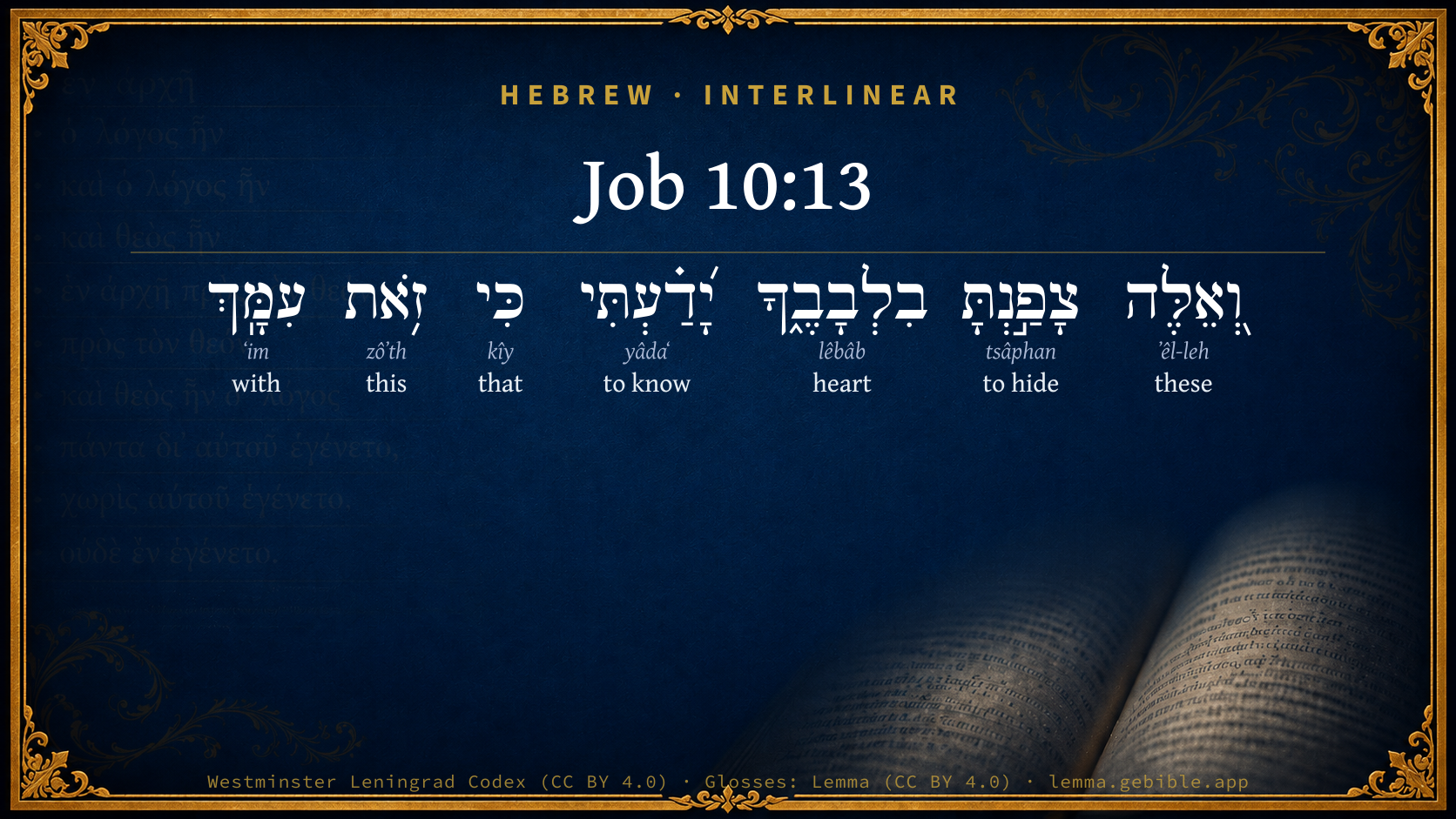
Hebrew (Westminster Leningrad Codex) Job 10:13 appears in the Hebrew Old Testament. The text above is from the Westminster Leningrad Codex. Each word links to its Strong’s number, a concise gloss, and parsing drawn from the Open Scriptures Hebrew Bible morphology. Click any word for its full Brown-Driver-Briggs (BDB) entry.
Download image
Cite this verse

Job 10:13 (World English Bible). Public Domain. Lemma interlinear Bible study tool, https://lemma.gebible.app/v/job/10/13.

Show BibTeX & RIS
BibTeX
RIS
English Translation
Yet you hid these things in your heart. I know that this is with you:
World English Bible · Public Domain
Download a study sheet

One document with this verse’s original text, its word-by-word gloss line, the meaning frame, cross-references with their text, attributed commentary, and full source and license credits — printable, and it pastes into notes with its structure intact.

This verse Autodidact and up

Study sheet (.html) Plain text (.txt)

A passage Seminary Student

Up to 50 verses in one chapter. A passage sheet keeps up to 6 commentary sources and 12 cross-references per verse, in the order this page ranks them, and says so on the sheet whenever that leaves anything out. Ask for a single verse and you get the Autodidact verse sheet above.

Everything on this page stays free to read, with no account — the sheet is a download of what is already on screen, not access to it.

Want to remove ads? Support Godless Engineer
Compare translations 3

The same verse in 3 English versions, stacked beneath the original-language interlinear above. Click any original word for its lexicon entry.

Each is an independent rendering of the whole verse — the interlinear is not word-aligned to these translations.

Highlighted words mark where these versions differ — a whole-verse word diff, not a word-by-word alignment.

  • World English Bible Public Domain
    Yet you hid these things in your heart. I know that this is with you:
  • King James Version Public Domain
    And these things hast thou hid in thine heart: I know that this is with thee.
  • unfoldingWord Literal Text CC BY-SA 4.0
    But in your heart you hid these things (I know that this with you):

unfoldingWord Literal Text — © unfoldingWord, licensed CC BY-SA 4.0. Word-aligned USFM3 via Door43 (git.door43.org/unfoldingWord/en_ult).

Versions to compare (up to 4)

3 of 4 selected

Show all 18 translations

Every available English version of this verse, each an independent rendering of the whole verse.

  • World English Bible Public Domain
    Yet you hid these things in your heart. I know that this is with you:
  • Berean Standard Bible Public Domain
    Yet You concealed these things in Your heart, and I know that this was in Your mind:
  • Majority Standard Bible Public Domain
    Yet You concealed these things in Your heart, and I know that this was in Your mind:
  • King James Version Public Domain
    And these things hast thou hid in thine heart: I know that this is with thee.
  • American Standard Version (1901) Public Domain
    Yet these things thou didst hide in thy heart; I know that this is with thee:
  • Revised Version (1885) Public Domain
    Yet these things thou didst hide in thine heart; I know that this is with thee:
  • Geneva Bible (1599) Public Domain
    Though thou hast hid these things in thine heart, yet I knowe that it is so with thee.
  • Douay-Rheims (1899) Public Domain
    Although thou conceal these things in thy heart, yet I know that thou rememberest all things.
  • Young's Literal Translation Public Domain
    And these Thou hast laid up in Thy heart, I have known that this `is' with Thee.
  • Literal Standard Version CC BY-SA 4.0
    And these You have laid up in Your heart, I have known that this [is] with You.
  • Unlocked Literal Bible CC BY-SA 4.0
    Yet these things you hid in your heart— I know that this is what you were thinking:
  • unfoldingWord Literal Text CC BY-SA 4.0
    But in your heart you hid these things (I know that this with you):
  • Darby Bible Public Domain
    And these things didst thou hide in thy heart; I know that this was with thee.
  • World Messianic Bible Public Domain
    Yet you hid these things in your heart. I know that this is with you:
  • Webster's Bible Public Domain
    And these things hast thou hid in thy heart: I know that this is with thee.
  • Free Bible Version CC BY-SA 4.0
    But you kept these things hidden in your heart. I know your purpose was
  • Bible in Basic English Public Domain
    But you kept these things in the secret of your heart; I am certain this was in your thoughts:
  • JPS Tanakh (1917) Public Domain
    Yet these things Thou didst hide in Thy heart; I know that this is with Thee;

Literal Standard Version (2020), Covenant Press — licensed CC BY-SA 4.0. Text via the HelloAO Bible API (eBible.org). Unlocked Literal Bible (unfoldingWord) — licensed CC BY-SA 4.0. Text via the HelloAO Bible API (eBible.org). unfoldingWord Literal Text — © unfoldingWord, licensed CC BY-SA 4.0. Word-aligned USFM3 via Door43 (git.door43.org/unfoldingWord/en_ult). Free Bible Version, Dr. Jonathan Gallagher — licensed CC BY-SA 4.0. Text via the HelloAO Bible API (eBible.org).

Word by word

More ways to search: Search by grammar → Find every occurrence → Compare this word →

Practice this passage: Drill this verse → Learn its vocabulary →

About this verse

These counts appear in no published source. They are computed here, from the morphology-tagged text and Lemma’s own curated glosses. What Lemma adds →

7
words
7
distinct lemmas
Wisdom
section

Shared distinctive vocabulary

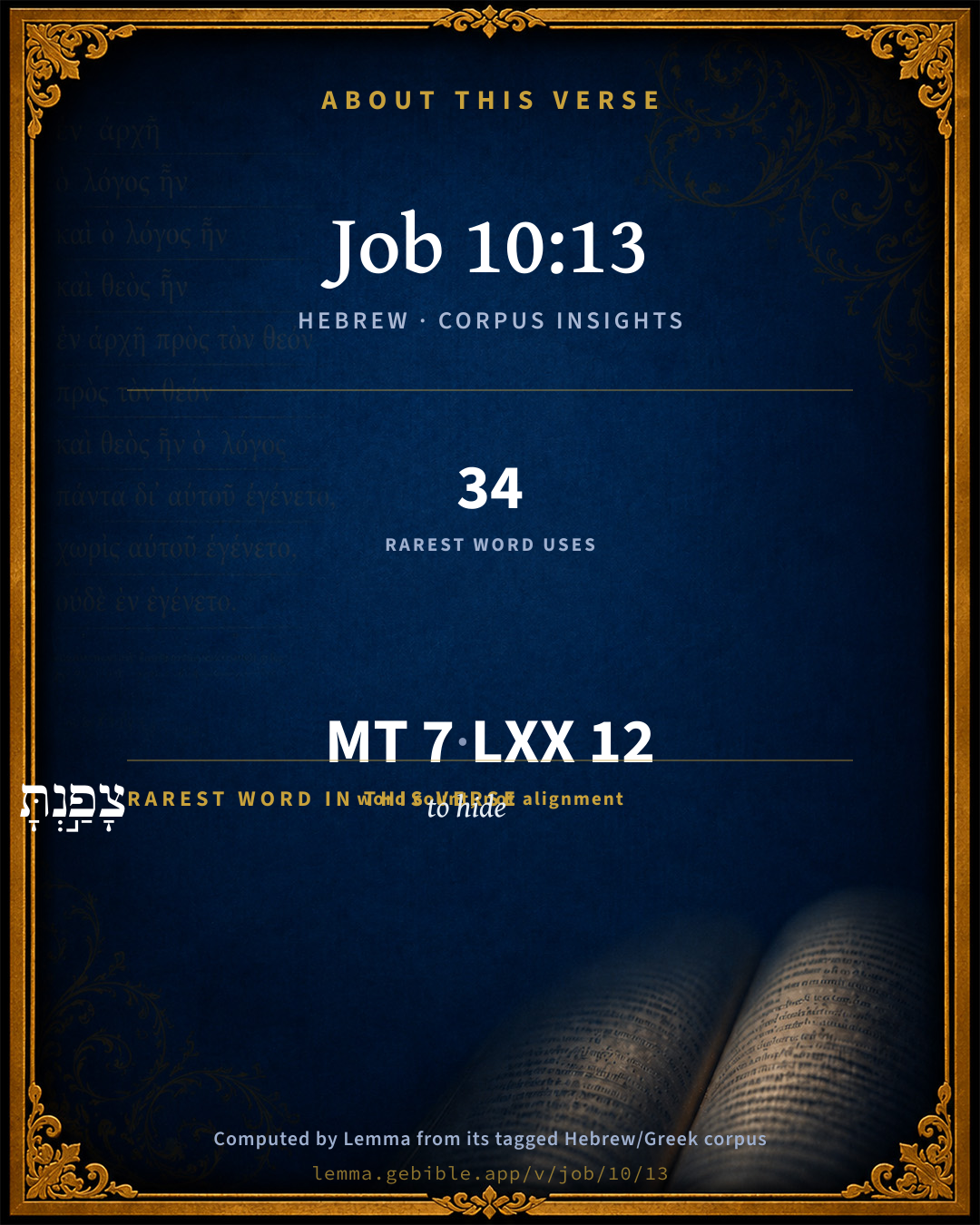
צָפַ֣נְתָּ to hide H6845 occurs in 31 verses of the Hebrew Bible. Also found in:

Grammatical profile

  • 2 verbs
  • 1 noun
  • 2 pronouns
  • 1 preposition
  • 1 conjunction

Verb forms

  • צָפַ֣נְתָּ Qal · Perfect
  • יָ֝דַ֗עְתִּי Qal · Perfect

Hebrew & Septuagint length

In English translation the verse runs 15 words from the Hebrew and 19 from the Septuagint (LXX English) — closely comparable.

A rough comparison of the two English renderings, which tokenize alike — not a word-level alignment.

Word counts can differ between the Hebrew and the Greek without any difference in meaning — e.g. the Hebrew direct-object marker אֵת has no separate Greek word, and Greek often adds the article ὁ.

In the original languages it is 7 Hebrew tokens and 12 Greek tokens — but the two are counted differently (Hebrew bundles its prefixes and suffixes into one token; the Greek is in lemma form), so that isn’t a like-for-like length.

Cross-references

10

Topical passages linked to Job 10:13 in the Treasury of Scripture Knowledge — connected by theme and wording, ordered by reader-vote popularity; previews shown in the World English Bible.

  • Job 23:13 But he stands alone, and who can oppose him? What his soul desires, even that he does.
  • Deuteronomy 32:39 See now that I, even I, am he, There is no god with me: I kill, and I make alive; I wound, and I heal; There is none who can deliver out of my hand.
  • Job 23:9 He works to the north, but I can't see him; He turns south, but I can't catch a glimpse of him.
  • Ecclesiastes 8:6–7 For there is a time and procedure for every purpose, although the misery of man is heavy on him.
  • Isaiah 45:7 I form the light, and create darkness; I make peace, and create evil. I am Yahweh, who does all these things.
  • Isaiah 45:15 Most assuredly you are a God who hid yourself, God of Israel, the Savior.'
  • Isaiah 46:9–11 Remember the former things of old: for I am God, and there is none else; [I am] God, and there is none like me;
  • Lamentations 3:37 Who is he who says, and it comes to pass, when the Lord doesn't command it?
  • Romans 11:33 Oh the depth of the riches both of the wisdom and the knowledge of God! How unsearchable are his judgments, and his ways past tracing out!
  • Ephesians 3:11 according to the eternal purpose which he purposed in Christ Jesus our Lord;

Cross-references courtesy of OpenBible.info (CC BY 4.0).

Hebrew and Greek witnesses Masoretic Hebrew ↔ Greek Septuagint

The same verse in the two great witnesses to the Old Testament, shown verse-for-verse.

These are two independent witnesses, not word-aligned to each other, and the Septuagint is shown in lemma (dictionary) form.

Hebrew Job 10:13 Masoretic · Westminster Leningrad Codex

וְ֭אֵלֶּה צָפַ֣נְתָּ בִלְבָבֶ֑ךָ יָ֝דַ֗עְתִּי כִּי זֹ֥את עִמָּֽךְ

Yet you hid these things in your heart. I know that this is with you:

World English Bible · Public Domain

Greek LXX Job 10:13 Septuagint · lemma form

οὗτος ἔχω ἐν σεαυτοῦ οἶδα ὅτι πᾶς δύναμαι ἀδυνατέω δέ σύ οὐδείς

Having these things in yourself, I know that you can do all things; for nothing is impossible with you.

LXX2012 (modern English Septuagint) · Public Domain

On this verse, Haydock's Catholic Bible Commentary discusses the Septuagint’s reading. Read the note in Commentary ↓

Hebrew: Westminster Leningrad Codex (CC BY 4.0). Greek: Septuagint (public domain); English from LXX2012 (modern English Septuagint) (Public Domain). How the Septuagint differs from the Hebrew →

Commentary

Notes on Job 10:13 from classic Christian and Jewish commentators (each source and its license shown beneath its notes). The classic Christian expositions comment on the surrounding passage and are grouped to its opening verse, so a note may address several verses; the Jewish commentaries on the Tanakh (Rashi and others) are per-verse, so they appear only where the commentator wrote on this verse.

Lemma curates 59 commentaries, every one of them public domain or Creative Commons licensed, each selected and text-cleaned for this edition rather than reprinted as found. About our sources →

Trapp's Complete Commentary

John Trapp

Job 10:13 And these [things] hast thou hid in thine heart: I know that this [is] with thee.

Ver. 13. And those things hast thou hid in thine heart] Legendum hoc cum stomacho, saith Mercer: And hast thou indeed hid these things in thine heart? What things meaneth Job? his afflictions, which God was long before preparing for him, and now took his time to lay load upon him, to be revenged on him at unawares, and at greatest advantage. If this be the sense of Job’s words (as some would conclude from the next verses), he was mightily mistaken; and this was atrox querimonia, a grievous complaint, and unworthy of God, who lieth not at the catch, nor pretendeth fair when he intendeth otherwise. A Cain may do so to Abel, Esau to Jacob, Absalom to Amnon, Joab to Amasa, &c. The Creator needs not daub or prevaricate thus with his creatures; if Job thought he did with him, Job was utterly out, though for confirmation he add, I know that this is with thee; I am sure that thou hast dealt thus closely and covertly with me, and that thy plagues have surprised me. Oh these still revenges! Merlin and others understand by those things hid in God’s heart, and which he was well assured could not have befallen him without God’s will and decree, the mercies which in the former verses Job had recounted and reckoned up, viz, his conception, quickening, preservation; all which he looked upon as love tokens coming out of the heart of God, and from the spring of special love. Here, then, we see whence we may fetch comfort when most hardly bestead; namely, from those effects whereby God sealed up his love to us in forming us in the womb; but especially in his covenant of grace, that beehive of heavenly honey, whereby he hath engaged to be our God even from the womb to the tomb; yea, to all perpetuity. Hereunto Job had respect, and so had David, Psa 22:10-11; Psa 25:10.

John Trapp, A Commentary or Exposition upon All the Books of the Old and New Testament (1647–1656) — public domain. Text from a community e-Sword module.

Joseph Benson's Commentary

Job 10:13. These things hast thou hid in thy heart — Both thy former favours and thy present frowns. Both are according to thy own will, and therefore undoubtedly consistent with each other, however they seem. When God does what we cannot account for, we are bound to believe there are good reasons for it hid in his heart. It is not with us, or in our reach, to assign the cause; but I know this is with thee.

Joseph Benson's Commentary on the Old and New Testaments (1811–1818) — public domain. Text from a community e-Sword module.

Whedon's Commentary on the Bible

Daniel D. Whedon

Second section, double strophe — A LIFE OF MISERY, SPRINGING FROM GOD’S LEONINE HOSTILITY TO MAN, THOUGH DIVINELY PLANNED, IS LESS DESIRABLE THAN THE MISERABLE ESTATE OF THE DEAD, Job_10:13-22.

a. The relentless assaults of God on man without respect to the life he may lead, betray a hidden purpose or plan inexplicably discordant with all creative evidences of goodness, Job_10:13-17.

13. And — But. A glance at the ruin and misery wrought by his loathsome disease (Job_10:15) causes Job another painful revulsion, startles him out of his pleasant revery over God’s watchful care in the past, and drags him again to the brink of despair.

With thee — That is, in thy mind. There is no reference in this verse to “the decrees” of the Almighty, as some suppose. This would not harmonize with the context. “In the present ill treatment of his creature Job believes that he sees the secret plan of God formed at his creation, which he now unfolds to him in detail.” — Hirtzel and Dillman. He who conceived a plan of cosmical creation, and gradually developed it during vast periods of time; who stamped upon the brute creation a prototype pointing forward to man, who in his physical make is the culmination of all vertebrates; who constructed the tabernacle according to a pattern first “showed to Moses in the mount,” (Heb_8:5,) — has launched no human being into existence without a plan for his life; and all the discipline of life is intended to develop and perfect this divine design. That plan may be thwarted or sadly distorted by the actions of the free agent, as the blossom or unripened fruit may be cast to the ground by the untimely blast, but the propose stands no less true.

Daniel D. Whedon (gen. ed.), Commentary on the Old and New Testaments (1874–1909) — public domain. Text from a community e-Sword module.

Geneva Bible (1599)

Geneva Bible translators

Though I be not fully able to comprehend these things, yet I must needs confess that it is so.

Geneva Bible (1599) marginal notes — public domain. Text via Bolls.life.

Jamieson, Fausset & Brown

Robert Jamieson, A. R. Fausset & David Brown

is with thee--was Thy purpose. All God's dealings with Job in his creation, preservation, and present afflictions were part of His secret counsel (Psa 139:16; Act 15:18; Ecc 3:11).

Jamieson, Fausset & Brown — Commentary Critical and Explanatory on the Whole Bible (1871) — public domain (CC PDM 1.0). Text via the HelloAO Bible API.

Adam Clarke's Commentary

Verse 13. And these things hast thou hid in thine heart] Thou hast had many gracious purposes concerning me which thou hast not made known; but thy visitations and mercy are sufficient proofs of kindness towards me; though for purposes unknown to me thou hast sorely afflicted me, and continuest to treat me as an enemy.

Adam Clarke's Commentary on the Bible (1810–1826) — public domain. Text from a community e-Sword/MySword module.

Ellicott's Commentary for English Readers

(13) These things hast thou hid in thine heart.—Job implies that his sense of God’s goodness is embittered by the thought that while showing him such kindness, He had in reserve for him the trials and sorrows under which he was then labouring: while showering good upon him, He intended eventually to overwhelm him with affliction. This was the purpose He had hidden in His heart.

A Bible Commentary for English Readers, edited by Charles John Ellicott (1878–1897) — public domain. Text from a community e-Sword module.

The Cambridge Bible for Schools and Colleges

gen. ed. J. J. S. Perowne

13. and these things hast thou hid] Better perhaps, but these things didst thou hide.

this is with thee] Rather, this was with thee,—was thy purpose, and in thy thoughts, cf. ch. Job_9:35. “These things” and “this” refer to the details about to be given (Job_10:14-17) of God’s deep purpose cherished beforehand of plaguing Job.

13–17. The contradiction between this dealing with Job in the womb and since his birth and God’s present treatment of him is only to be reconciled by the supposition that God’s present severe treatment of Job had been resolved on from the first, and that His careful fashioning of him and care over him had been in order the better to carry out His purpose. The details of this cruel purpose are given in the following verses.

The Cambridge Bible for Schools and Colleges (gen. ed. J. J. S. Perowne; Cambridge University Press, 1878–1918) — public domain. Text from a community e-Sword module.

John Gill's Exposition

If I sin, then thou markest me,.... Or "observest me" (t); that is, he took notice of his sins, strictly inquired into them and all the circumstances of them, watched the motions and progress of them, and carefully laid them up, in order to bring them out against him another day, and afflict or punish him for them; or he set a watch about him, "kept him in" (u), and enclosed him on every side with affliction, as if he was in a watch or prison, as Gersom; or, "wilt thou keep me" (w)? that is, in such close confinement: Gussetius (x) renders it, "if I have offered a sacrifice for sin", as the word is sometimes used; signifying, that though he should, as no doubt he did, offer sacrifice for himself, as it is certain he did for his children, yet even that was not regarded by the Lord; he still marked and observed him and his sins, and would not forgive him, or absolve him from his sins, as follows; see Job 7:12,

and thou wilt not acquit me from mine iniquity; clear him of it, and discharge him from it; pronounce him innocent, or pardon him; but, on the contrary, hold him guilty, and deal with him as such in a rigorous way; or wilt not "cleanse" or purify me, as the Targum and others (y), but let me continue, or treat me as an impure person, not fit for communion or converse.

(t) "observasti me", Beza, Mercerus; "tum observas me", Schmidt. (u) "Custodisti me", Drusius. (w) "Custodies me", Vatablus. (x) Ebr. Comment. p. 923. (y) "mundabis", Mercerus; "mundes", Pagninus, Montanus, Bolducius; "purges me", Junius & Tremellius.

John Gill's Exposition of the Whole Bible (1746–1763) — public domain (CC PDM 1.0). Text via the HelloAO Bible API.

Albert Barnes' Notes on the Bible

And these things hast thou hid in thine heart - This may either refer to the arrangements by which God had made him, or to the calamities which he had brought upon him. Most expositors suppose that the latter is intended. Such is the opinion of Rosenmuller, Good, Noyes, and Scott. According to this the idea is, that God had purposed in his heart to bring these calamities upon him. They were a part of his counsel and design. To hide in the heart, or to lay up in the heart, is a phrase expressive of a secret purpose. I see no reason to confine it, however, to the calamities which Job had experienced. It may refer to all the plans and doings of the Most High, to which Job had just referred. All his acts in the creation and preservation of man, were a part of his secret counsel, He had formed the plan in his heart, and was now executing it in the various dispensations of his providence.

I know that this is with thee - That all this is a part of thy purpose. It has its origin in thee, and is according to thy counsel. This is the language of piety, recognizing the great truth that all things are in accordance with the purposes of God, or that his plans embrace all events - a doctrine which Job most assuredly held.

Albert Barnes' Notes on the Bible (1834–1885) — public domain. Text from a community e-Sword/MySword module.

Haydock's Catholic Bible Commentary

Rememberest. Septuagint, "canst do all things." Hebrew, "this is with thee." (Haydock) --- I am convinced that thou still regardest me with affection, though it would appear as if thou hadst forgotten me. (Calmet)

George Leo Haydock (1774–1849), Haydock's Catholic Family Bible and Commentary, 1859 edition — public domain. Excludes Psalms (Douay-Rheims chapter numbering differs from Protestant) and Deuterocanonical books (Catholic canon only).

Matthew Poole's English Annotations

This place may be understood either,

1. Of Job’s present afflictions. So the sense is this, Yet in the midst of all those manifestations of thy grace and kindness to me, thou didst retain a secret purpose of changing thy course and carriage towards me, and of bringing these dreadful calamities upon me. Or rather,

2. Of his former mercies,

these things, to wit, last mentioned;

thou hast hid them in thy heart, i.e. thou dost exactly remember them, as this phrase is used, Psa 119:11; Luk 2:51. So the argument is this, Let the remembrance of thy former great favours vouchsafed to me move thee to give me further blessings, and a speedy deliverance. For this is usual both with God and men, to choose and delight to do more good to those to whom they have done much good already; which is the ground of that known passage, Mat 13:12. To him that hath shall be given. With thee, i.e. in thy mind and heart; thou hast not forgot it: so the same thing is here repeated in other words.

Matthew Poole's English Annotations on the Holy Bible (1683–1685) — public domain. Text from a community e-Sword/MySword module.

The Pulpit Commentary

And these things hast thou hid in thine heart; rather, get these things didst thou hide in thine heart; i.e. "Yet all the while, notwithstanding thy protecting care and gracious favour, thou wert hiding in thy heart the intention to bring all these evils upon me; thou couldst not but have known what thou wert about to do, though thou didst conceal thy intention, and allow no sign of it to escape thee." I know that this is with thee; rather, I know that this was with thee; i.e. this intention to destroy my happiness was "with thee present to thy thought even while thou wert loading me with favour. Job"s statement cannot be gainsaid; but it involves no real charge against God, who assigns men prosperity or suffering as is best for them at the time.

Vers. 13-17. The hidden purposes of affliction.

Job has reasoned much, and he has asked for an explanation of the Divine purpose. "Wherefore contendest thou with me? Doubtless he judges, as do his friends, that suffering is the natural consequence and certain punishment of wrong-doing. But he is conscientious in affirming his innocence of transgression, and the Divine testimony to his goodness agrees with this. (Job_2:3) What, then, is the explanation of the whole? Can we ever hope to know in this world what are the deep purposes of God in the afflictions of which the human life is capable, and especially in the sufferings of the godly? No. The purposes, though partially revealed, are still to a great extent "hidden hidden in the "heart" of God. Job feels himself hedged in. He is "full of confusion." We must remember Job had not the clear light in which we view the Divine work. Yet even from us his ways are hidden. We must say, "Clouds and darkness are round about him.

I WE MUST SEE IT TO BE PERFECTLY NATURAL THAT THE DIVINE WAYS SHOULD BE HIDDEN FROM MEN. How should man be able to trace the Divine purpose? It is high; he cannot attain unto it. Hidden in the Divine mind not always revealed by the incidents of affliction. "These things hast thou hid in thine heart.

II THE HIDING OF THE DIVINE PURPOSES IS A SALUTARY TEST TO FAITH. Faith in God needful in order to a right relation of the human soul towards God. It is the basis of peace; encouragement to obedience; ground of holy fear; help to holy love. But the testing of faith leads to a more spiritual dependence upon God, to a more frequent reference of the heart to him. Walking by faith honours God. Faith needed by the very conditions of human life. Its exercise promotes its growth.

III THE HIDING OF THE DIVINE PURPOSE IS A GRACIOUS DESIGN ON THE PART OF GOD MORE EFFECTUALLY TO WORK OUT HIS WILL CONCERNING MAN. The rebellious, not knowing it, cannot frustrate it. Secretly the Divine will is wrought out in the experience and history of the sufferer. The entire dependence of the soul on God is encouraged. This must lead to submission, and submission in faith. The reliance of the soul must be on the character of God, and not on circumstances and incidents.

IV THE HIDING OF THE DIVINE PURPOSES ISSUES IN THE PERFECTING OF THE SUPREME EXCELLENCE OF THE HUMAN CHARACTER PATIENCE. Thus it has its "perfect work," and the soul is left "entire, lacking nothing." He who can patiently and trustfully wait upon God, bearing up under pressure of afflictive circumstances, gains s vigour and beauty of character. If patience be wanting, all other qualities of the character are impaired. Man"s wisdom is to be satisfied with committing himself to the hidden purposes of God. In faith to confide in them as wise and good. In patience to await their exposition when it shall please God to reveal them to him. R.G.

The things that are hidden in God"s heart.

Job is possessed by a fearful thought. His tremendous troubles, and the cruel accusations of his friends, have driven him to the conclusion that God must have conceived the idea of thus tormenting him long before Job knew anything of it; that God must have hidden the dreadful purpose in his heart; that all the while Job was complacently enjoying his prosperity, God was nursing the secret design of scattering it to the winds, and plunging his servant into the depths of misery.

I GOD"S PURPOSES ARE HIDDEN FROM MAN. They are more hidden than Job supposed. He thought that the Divine plan had just appeared. But it was deeper than he imagined. Not only was it hidden in the sunny days of prosperity; it was also hidden in the dark and dreadful days of misery. Had Job known the Divine purpose, his suspicions would have been dissipated, and he would have seen how unjust his arraignment of Providence was. We cannot yet see the Divine thought. If it were revealed to us, the discipline of trial would be frustrated. Moreover, it is too deep and wide for us to grasp it. Therefore we must walk by faith. (2Co_5:7)

II GOD APPEARS TO HIDE DARK DESIGNS. So Job thought, and so the events of his life seemed to show. As the curtain slowly lifted, dreadful things were discovered behind. God was always in the future, preparing it for its advent; yet when it came it appeared in thunder and ruin. Was God secretly planning all this misery in the quiet, old peaceful days when Job suspected no danger? The unrolling of many a life-story has seemed to tell the same tale of God"s secret thoughts made manifest in calamity.

III GOD REALLY HIDES PURPOSES OF LOVE IN HIS HEART.

1. He must do so because he is love. We cannot understand his plans, but we can understand his nature as far as it is revealed to us. Now the revelation of God is wholly of goodness. This includes wrath against sin, but no injustice, no harshness, no delight in inflicting misery. Therefore, though we do not see the Divine intention, we may be sure that it is gracious.

2. He is seen to do so as far as his purposes are revealed.

(1) In Scripture. Ancient prophecy and the New Testament gospel concur in setting forth the Divine plan, and although this includes judgment and the punishment of sin, its main design is the redemption of man.

(2) In experience. Some of God"s purposes are ripened and fulfilled daring our earthly life. These are seen to be good and gracious. It is only the unaccomplished purpose that wears a threatening aspect.

IV THE HIDDEN PURPOSES OF GOD"S HEART WILL BE ULTIMATELY REVEALED. God does not delight in secrecy, much less does he designedly tantalize his creatures by perplexing them with needless mysteries and alarming them with bogus fears. What we know not now we shall know hereafter. (Joh_13:7) The great apocalypse of futurity will answer many a dark riddle of providence in the light of eternal love. We have but to possess our souls in patience, and all will be clear. Job"s life-problem was solved at last. When ours is made clear it will only enlarge our wondering gratitude for the depth of the love which God had hidden in his heart. W.F.A.

The Pulpit Commentary (1880–1919), ed. H.D.M. Spence-Jones & Joseph S. Exell — public domain. Text from a community e-Sword module.

John Wesley's Explanatory Notes

Hid - Both thy former favours and thy present frowns. Both are according to thy own will, and therefore undoubtedly consistent, however they seem. When God does what we cannot account for, we are bound to believe, there are good reasons for it hid in his heart. It is not with us, or in our reach to assign the cause; but I know this is with thee.

John Wesley, Explanatory Notes Upon the Whole Bible (1754–1765) — public domain. Text via the GEBible commentary corpus.

Keil & Delitzsch

C. F. Keil & F. Delitzsch

13 And such Thou hast hidden in Thy heart,

I perceive that this was in Thy mind:

14 If I should sin, Thou wouldst take note of it,

And not acquit me of my iniquity.

15 If I should act wickedly, woe unto me!

And were I righteous, I should not lift up my head,

Being full of shame and conscious of my misery.

16 And were I to raise it, Thou wouldst hunt me as a lion,

And ever display on me Thy wondrous power,

17 Thou wouldst ever bring fresh witnesses against me,

And increase Thy wrath against me,

I should be compelled to withstand continuously advancing troops and a host.

This manifestation of divine goodness which Job has experienced from the earliest existence seems to him, as he compares his present lot of suffering with it, to have served as a veil to a hidden purpose of a totally opposite character. That purpose - to make this life, which has been so graciously called into existence and guarded thus far, the object of the severest and most condemning visitation - is now manifest. Both אלּה and זאת refer to what is to follow: עמּך זאת used of the thought conceived, the purpose cherished, as Job 23:14; Job 27:11. All that follows receives a future colouring from this principal clause, "This is what Thou hadst designed to do," which rules the strophe. Thus Job 10:14 is to be rendered: If I had sinned, Thou wouldst have kept me in remembrance, properly custodies me, which is here equivalent to custoditurus eras me. שׁמר, with the acc. of the person, according to Psa 130:3 (where it is followed by the acc. of the sin), is to be understood: to keep any one in remembrance, i.e., to mark him as sinful (Hirzel). This appears more appropriate than rigide observaturus eras me (Schlottm.). ושׁמרתני, according to Ges. 121, 4, might be taken for לי ושׁמרת (viz., חטּאתי); but this is unnecessary, and we have merely translated it thus for the sake of clearness. His infirmities must not be passed by unpunished; and if he should act wickedly (רשׁע, of malignant sin, in distinction from חטא), woe unto him (comp. οἰαί μοι, Co1 9:16). According to the construction referred to above, וצדקתי is praet. hypotheticum (Ges. 155, 4, a); and the conclusion follows without waw apodosis: If I had acted rightly, I should not have raised my head, being full of shame and conscious of my misery. The adjectives are not in apposition to ראשׁי (Bttcher), but describe the condition into which he would be brought, instead of being able (according to the ethical principle, Gen 4:7) to raise his head cheerfully. ראה constr. of ראה, as שׂבע or שׂבע. It is needless, with Pisc., Hirz., Bttch., and Ewald, to alter it to ראה, since ראה is verbal adjective like יפה, נכה, קשׁה. Moreover, וּראה cannot be imperative (Rosenm., De Wette); for although imperatives, joined by waw to sentences of a different construction, do occur (Psa 77:2; Sa2 21:3), such an exclamation would destroy the connection and tone of the strophe in the present case.

Job 10:16

יגאה is hypothetical, like וצדקתי, but put in the future form, because referring to a voluntary act (Ewald, 357, b): and if it (the head) would (nevertheless) exalt itself (גאה, to raise proudly or in joyous self-consciousness), then (without waw apod., which is found in other passages, e.g., Job 22:28) Thou wouldst hunt me like a shachal (vid., Job 4:10), - Job likens God to the lion (as Hos 5:14; Hos 13:7), and himself to the prey which the lion pursues-Thou wouldst ever anew show Thyself wonderful at my expense (תּשׁב, voluntative form, followed by a future with which it is connected adverbially, Ges. 142, 3, b; תּתפּלּא, with in the last syllable, although not in pause, as Num 19:12; Ewald, 141, c.), i.e., wonderful in power, and inventive by ever new forms off suffering, by which I should be compelled to repent this haughtiness. The witnesses (עדים) that God continually brings forth afresh against him are his sufferings (vid., Job 16:8), which, while he is conscious of his innocence, declare him to be a sinner; for Job, like the friends, cannot think of suffering and sin otherwise than as connected one with the other: suffering is partly the result of sin, and partly it sets the mark of sin on the man who is no sinner. תּרב (fut. apoc. Hiph. Ges. 75, rem. 15) is also the voluntative form: Thou wouldst multiply, increase Thy malignity against me. עם, contra, as also in other passages with words denoting strife and war, Job 13:19; Job 23:6; Job 31:13; or where the context implies hostility, Psa 55:19; Psa 94:16. The last line is a clause by itself consisting of nouns. וצבא חליפות is considered by all modern expositors as hendiadys, as Mercier translates: impetor variis et sibi succedentibus malorum agminibus; and צבא is mostly taken collectively. Changes and hosts = hosts continuously dispersing themselves, and always coming on afresh to the attack. But is not this form of expression unnatural? By חליפות Job means the advancing troops, and by צבא the main body of the army, from which they are reinforced; the former stands first, because the thought figuratively expressed in תחדשׁ and תרב is continued (comp. Job 19:12): the enmity of God is manifested against him by ever fresh sufferings, which are added to the one chief affliction. Bttcher calls attention to the fact that all the lines from v. 14 end in , a rhythm formed by the inflection, which is also continued in v. 18. This repetition of the pronominal suffix gives intensity to the impression that these manifestations of the divine wrath have special reference to himself individually.

Keil & Delitzsch — Biblical Commentary on the Old Testament (1861–1891) — public domain (CC PDM 1.0). Text via the HelloAO Bible API. (Old Testament only.)

Kretzmann's Popular Commentary

Paul E. Kretzmann

Job Renews his Complaint of his Affliction

v. 13. And these things hast Thou hid in Thine heart; I know that this is with Thee, that is: In spite of all God’s care in the creation and preservation of Job, in spite of all His apparent kindness in the past, His hidden purpose had planned Job’s destruction.

v. 14. If I sin, then Thou markest me, that is, If Job should sin, God had intended to watch very carefully and immediately charge it against him, and Thou wilt not acquit me from mine iniquity; He carefully notes down every evidence of wickedness.

v. 15. If I be wicked, woe unto me! He must expect a sudden and violent punishment. And if I be righteous, yet will I not lift up my head, even if he were right, he would not dare to look up with freedom and confidence, for this would not be acknowledged. I am full of confusion, filled with shame; therefore see Thou mine affliction. He always had his misery in sight and must hang his head in shame, like a wicked sinner who was getting his just deserts,

v. 16. For it increaseth, rather, "and should my head lift itself up," should Job dare to show a cheerful courage, Thou huntest me as a fierce lion; and again Thou showest Thyself marvelous upon me, God would show His wonderful power in destroying him,

v. 17. Thou renewest Thy witnesses against me, God would cause ever new witnesses to appear against Job, and increasest Thine indignation upon me, with an ever new amount of displeasure. Changes and war are against me; Job would have to consider ever new troops and a whole army opposed to him, He alone is the mark of God’s displeasure,

v. 18. Wherefore, then, hast Thou brought me forth out of the womb? He renews his complaint, bewailing the fact that he was ever born. Oh, that I had given up the ghost, and no eye had seen me! He would have died, never have seen the light of day, if God had not called him into being.

v. 19. I should have been as though I had not been; I should have been carried from the womb to the grave, still-born, a corpse, and out of misery.

v. 20. Are not my days few? Was not the time of his life short enough? Could not God take from him some of the burden which was weighting him down? Cease, then, and let me alone, turning His attention elsewhere, that I may take comfort a little, enjoy just a little brightness and cheerfulness,

v. 21. before I go whence I shall not return, or, "go hence and return not," even to the land of darkness and the shadow of death;

v. 22. a land of darkness, as darkness itself, black as the shades of midnight; and of the shadow of death, without any order, filled with chaotic confusion, and where the light is as darkness, literally, "where it is light as midnight," said of the most intense darkness, an utterly sunless gloom. Job here, in the bitterness of his soul, gave way to a hopelessness which should never be found in a believer, but which sometimes threatens to overwhelm him, It is only the remembrance of God’s unwavering kindness, as a characteristic of faith, that will keep us from such depths of despair.

Paul E. Kretzmann, Popular Commentary of the Bible (1921–1924) — public domain. Text from a community e-Sword module.

Rashi

Rabbi Shlomo Yitzchaki (Rashi)

But You hid these in Your heart to destroy me as though You did not remember them, but...

I knew that this was with You, everything as it was delineated, and You did not forget.

Rashi on the Tanakh — English translations: “The Judaica Press complete Tanach with Rashi, translated by A. J. Rosenberg” (CC BY 4.0); “Pentateuch with Rashi's commentary by M. Rosenbaum and A.M. Silbermann, 1929-1934” (public domain); “The Metsudah Tanach series, Lakewood, N.J” (CC BY 4.0); and “The Book of Joshua, Metsudah Publications, 1997” (CC BY 4.0). Text via Sefaria.

Lesson kit

Teaching starters — assembled from the data on this page, not authored interpretation. Every prompt links to the verse data it draws on. Edit before teaching.

Job, in the Wisdom, opens this verse with 7 words (7 distinct Hebrew lemmas). Its most distinctive word is tsâphan (“to hide”). A historical commentator’s framing appears above. Read the whole chapter for the surrounding context.

Discussion questions

  1. The word tsâphan carries the sense “to hide.” How does it shape the verse?
  2. Exodus 2:2 shares the word «to hide» with this verse. How do the two illuminate each other?
  3. These translations render this verse differently; the difference is in the English rendering, not the original. What questions does that raise?
  4. The verb «צָפַ֣נְתָּ» is Qal Perfect. How does its form color the action?
  5. Reading how Trapp's Complete Commentary and Joseph Benson's Commentary read this verse, where do the two commentators agree and where do they part?

Things to notice

Reading settings

Reading text

Shown beneath each verse's original-language words.

Old Testament
Old Testament edition

Read the OT as the Masoretic Hebrew (MT) or the Greek Septuagint (LXX).

English shown for the Greek Septuagint (in the Hebrew ↔ Greek comparison).

Comparing translations? Open the Compare panel on any verse page to stack up to four side by side.