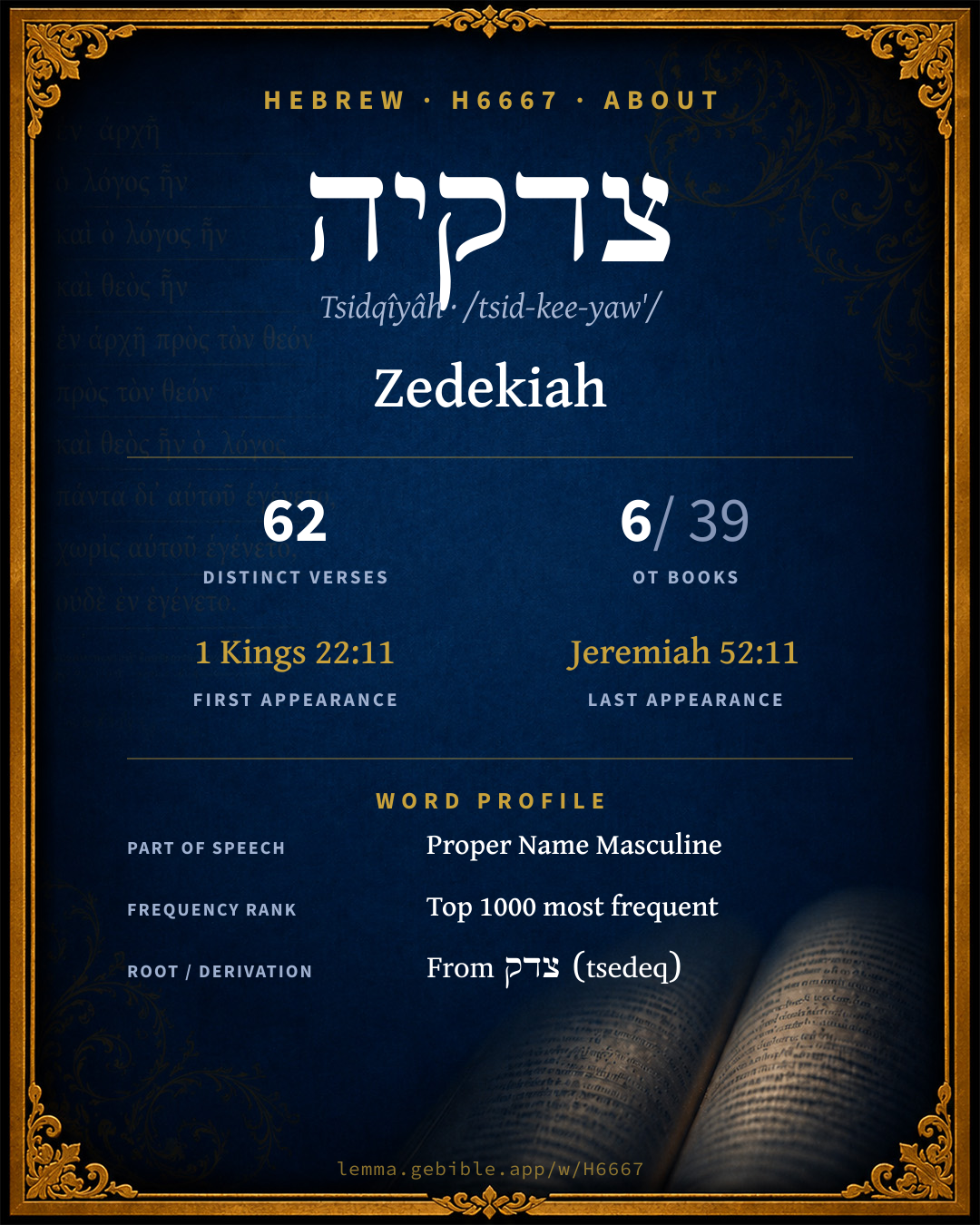
צִדְקִיָּ֫הוּ
Zedekiah
BDB lists 7 entries for ‘Zedekiah’ fuller range ↓
Full lexicon entry — Brown-Driver-Briggs (BDB)
From Brown-Driver-Briggs (BDB)
Where this word appears
Grammar key — what these labels mean
Part of speech
- Noun
- A naming word — a person, place, thing, or idea.
Noun type
- Proper
- A name of a specific person, place, or people (e.g. Abraham, Zion, Israel).
Every verse where H6667 appears in the Book of 2 Chronicles — 4 distinct verses. Click any verse to open its interlinear word-by-word view. Verse text shown in the World English Bible for context — . Each verse’s Hebrew form is shown with its reference; the English is not keyword-highlighted, since the data carries no word-level English alignment. Use “Compare translations” on any verse to read it across multiple English versions. This concordance covers the Hebrew Bible; Septuagint (Greek Old Testament) occurrences are not indexed here.
2 Chronicles
- 2 Chronicles 18:10 צִדְקִיָּ֥הוּ n Proper Zedekiah the son of Chenaanah made him horns of iron, and said, Thus says Yahweh, With these shall you push the Syrians, until they be consumed.
- 2 Chronicles 18:23 צִדְקִיָּ֣הוּ n Proper Then Zedekiah the son of Chenaanah came near, and struck Micaiah on the cheek, and said, Which way went the Spirit of Yahweh from me to speak to you?
- 2 Chronicles 36:10 צִדְקִיָּ֣הוּ n Proper At the return of the year king Nebuchadnezzar sent, and brought him to Babylon, with the goodly vessels of the house of Yahweh, and made Zedekiah his brother king over Judah and Jerusalem.
- 2 Chronicles 36:11 צִדְקִיָּ֣הוּ n Proper Zedekiah was twenty-one years old when he began to reign; and he reigned eleven years in Jerusalem:
About this entry
At a glance — auto-summarized from this page’s data, not written by a person. Every figure links to its source below. This summary describes the numbers; it doesn’t interpret them.
“Zedekiah” is the headline sense of the Hebrew name צדקיה (Tsidqîyâh). More than three-quarters of its appearances fall in Jeremiah. The Hebrew Bible uses it across 62 verses — moderately common. Its earliest occurrence is 1 Kings 22:11. The sections below give every occurrence and version rendering.
Gloss history
Strong's 1890 vs modern scholarship
About this word
Strong's H6667 catalogs a Hebrew word from the Hebrew Old Testament.
These counts are not copied from any lexicon or concordance. They are computed here, from the morphology-tagged Hebrew Old Testament. What Lemma adds →
- 62
- distinct verses
- The word appears in 62 distinct verses.
- 6 / 39
- OT books
- The word appears in 6 of 39 Old Testament books.
- #611
- by frequency
- Top 1000 most frequent Hebrew words (rank 611 of 8,640 Hebrew words by occurrence).
View all 62 occurrences in the concordance →
Most concentrated in
- Jeremiah 48 verses 77%
- 2 Kings 5 verses 8%
- 2 Chronicles 4 verses 6%
By section of the Old Testament
By traditional corpus
Conventional, traditional groupings — biblical authorship is debated, so this is a traditional corpus grouping, not an authorship claim. Each share is this word’s portion of its verses in that division of the Hebrew canon. Each figure is a share of the word’s 62 distinct verses.
- Prophets (Nevi'im) 55 verses · 89%
- Writings (Ketuvim) 7 verses · 11%
How translations render this word
Counts come from each version’s own published word-to-Strong’s tagging or interlinear alignment — an approximate guide to how each version renders this word, not a word-level alignment the data otherwise carries. Because each total is that version’s own tagged count, the per-version totals vary from one another and need not match the appearance or distinct-verse counts above. These counts may also differ from a printed concordance because Lemma counts each distinctly tagged rendering and does not collapse phrase taggings into a single head-word total. This is a fixed set of word-tagged versions (KJV, ASV, BSB, ULT) and does not change with the reading translation you choose elsewhere. Each version’s license is shown beside its name below (and on Sources).
- King James Version: Zedekiah 58×
- American Standard Version: Zedekiah 56×
- Berean Standard Bible: Zedekiah 50×, Zedekiah’s 5×, Now zedekiah 2×
- unfoldingWord Literal Text: Zedekiah 21×
King James Version Public Domain
Renders H6667 across 63 tagged occurrences — most commonly:
Plus 5 renderings that appear only once — usually multi-word phrases or single function words the recovered tagging swept in, not distinct renderings.
American Standard Version Public Domain
Renders H6667 across 63 tagged occurrences — most commonly:
Plus 7 renderings that appear only once — usually multi-word phrases or single function words the recovered tagging swept in, not distinct renderings.
Berean Standard Bible Public Domain
Renders H6667 across 61 tagged occurrences — most commonly:
Plus 2 renderings that appear only once — usually multi-word phrases or single function words the recovered tagging swept in, not distinct renderings. Not rendered by a distinct English word in 2 further occurrences.
unfoldingWord Literal Text CC BY-SA 4.0
Renders H6667 across 23 tagged occurrences — most commonly:
Plus 2 renderings that appear only once — usually multi-word phrases or single function words the recovered tagging swept in, not distinct renderings.
7 senses and sub-senses in the full BDB
What do BDB’s symbols mean?
BDB uses these scholarly abbreviations:
| Symbol | Meaning |
|---|---|
| 𝔊 | the Septuagint (the ancient Greek translation, LXX) |
| 𝔙 | the Vulgate (the Latin translation) |
| 𝔖 | the Syriac version (the Peshitta) |
| 𝔗 | the Targum (the Aramaic translation) |
| ψ | the Psalms |
| √ | root (the underlying root or stem) |
| ‖ | parallel passage (a synonymous or contrasted parallel) |
| † | the dagger: every passage where the word occurs is cited |
The 7 senses and sub-senses the full Brown-Driver-Briggs lexicon distinguishes for this word, in lexicon order (not ranked by frequency), with BDB’s own verbatim wording and sub-sense lettering. Shown in Hebrew script with BDB’s own scholarly abbreviations. The condensed entry is in the Lexicon Entry tab. See also the Forms in the corpus table below.
- 1. last king of Judah, מַתַּנְּיָה, changed to צ׳: -יָּ֫הוּ 2 K 24:17, 18, 20; 25:2, 7(×2) = 2 Ch 36:10, 11, 1 Ch 3:15; Je 1:3; 21:1, 3, 7 + 37 times Je; -יָּה †Je 27:12; 28:1; 29:3; 49:34. e.g. 2 Kings 24:17
- 2. false prophets:
- a. under Ahab, -יָּ֫הוּ 1 K 22:24 = 2 Ch 18:10, 23; -יָּה 1 K 22:11. e.g. 1 Kings 22:24
- b. -יָּ֫הוּ Jerem.’s time, Je 29:21, 22. e.g. Jeremiah 29:21
- 3. -יָּ֫הוּ prince, Jerem.’s time, Je 36:12. e.g. Jeremiah 36:12
- 4. -יָּה, priest, Nehem.’s time, Ne 10:2 (𝔊L Σεχενιας). e.g. Nehemiah 10:2
- 5. -יָּה, son of Jehoiachin, according to 1 Ch 3:16, but prob. gloss, Be SS, cf. Kit. e.g. 1 Chronicles 3:16
Senses from the full Brown-Driver-Briggs lexicon (Brown, Driver, Briggs; Oxford 1906 — public domain), digitized via Sefaria, supplemented by the OpenScriptures HebrewLexicon (CC BY 4.0). Full attribution on Sources.
Word origin
-יָּה7 n.pr.m. (י׳ is righteousness; cf. Sab. צדקאל DHMib., on No. 32);—Σεδεκια(ς):
— Brown-Driver-Briggs (Oxford 1906, public domain), digitized via Sefaria, supplemented by the OpenScriptures HebrewLexicon (CC BY 4.0). See Sources.
Derived from צדק (tsedeq) (H6664) — righteousness.
Forms in the corpus
The 25 distinct written forms H6667 takes in the Hebrew Bible, most frequent first — each parse links to that state’s occurrences in the concordance. Hebrew forms include their vowel points and cantillation, so a single lemma takes many written forms.
| Form | Parsing | Example | Uses |
|---|---|---|---|
| צִדְקִיָּ֖הוּ | Noun, Proper | 2 Kings 24:20 | 12 |
| צִדְקִיָּ֣הוּ | Noun, Proper | 1 Kings 22:24 | 9 |
| צִדְקִיָּ֔הוּ | Noun, Proper | 1 Chronicles 3:15 | 4 |
| צִדְקִיָּ֜הוּ | Noun, Proper | Jeremiah 34:8 | 4 |
| צִדְקִיָּֽהוּ | Noun, Proper | 2 Kings 24:17 | 4 |
| צִדְקִיָּ֗הוּ | Noun, Proper | Jeremiah 21:1 | 3 |
| צִדְקִיָּ֥ה | Noun, Proper | 1 Chronicles 3:16 | 3 |
| צִדְקִיָּ֨הוּ | Noun, Proper | Jeremiah 24:8 | 3 |
| צִדְקִיָּ֛הוּ | Noun, Proper | Jeremiah 38:16 | 2 |
| צִדְקִיָּ֣ה | Noun, Proper | Jeremiah 28:1 | 2 |
| צִדְקִיָּ֥הוּ | Noun, Proper | 2 Chronicles 18:10 | 2 |
| צִדְקִיָּ֨הוּ֙ | Noun, Proper | 2 Kings 25:7 | 2 |
| וְ/צִדְקִיָּ֥הוּ | Noun, Proper | Jeremiah 36:12 | 1 |
| וְ/צִדְקִיָּ֨הוּ֙ | Noun, Proper | Jeremiah 32:4 | 1 |
| וְ/צִדְקִיָּֽה | Noun, Proper | Nehemiah 10:1 | 1 |
| כְּ/צִדְקִיָּ֣הוּ | Noun, Proper | Jeremiah 29:22 | 1 |
| לְ/צִדְקִיָּ֔הוּ | Noun, Proper | Jeremiah 39:2 | 1 |
| לְ/צִדְקִיָּ֖הוּ | Noun, Proper | Jeremiah 32:1 | 1 |
| לְ/צִדְקִיָּ֥הוּ | Noun, Proper | Jeremiah 1:3 | 1 |
| לְ/צִדְקִיָּ֨הוּ | Noun, Proper | Jeremiah 39:1 | 1 |
| צִדְקִיָּ֑הוּ | Noun, Proper | Jeremiah 37:18 | 1 |
| צִדְקִיָּ֡הוּ | Noun, Proper | Jeremiah 38:17 | 1 |
| צִדְקִיָּ֤ה | Noun, Proper | Jeremiah 27:12 | 1 |
| צִדְקִיָּ֤הוּ | Noun, Proper | Jeremiah 51:59 | 1 |
| צִדְקִיָּהוּ֮ | Noun, Proper | Jeremiah 39:5 | 1 |
Bible dictionary
Public-domain dictionary articles matched to this entry by name (Zedekiah). A biblical name can be shared by more than one person or place, so an article may treat several.
Easton's Bible Dictionary · M. G. Easton, 1897
Righteousness of Jehovah. (1.) The last king of Judah. He was the third son of Josiah, and his mother's name was Hamutal, the daughter of Jeremiah of Libnah, and hence he was the brother of Jehoahaz (2 Kings 23:31; 24:17, 18). His original name was Mattaniah; but when Nebuchadnezzar placed him on the throne as the successor to Jehoiachin he changed his name to Zedekiah. The prophet Jeremiah was his counsellor, yet "he did evil in the sight of the Lord" (2 Kings 24:19, 20; Jer. 52:2, 3). He ascended the throne at the age of twenty-one years. The kingdom was at that time tributary to Nebuchadnezzar; but, despite the strong remonstrances of Jeremiah and others, as well as the example of Jehoiachin, he threw off the yoke of Babylon, and entered into an alliance with Hophra, king of Egypt. This brought up Nebuchadnezzar, "with all his host" (2 King 25:1), against Jerusalem. During this siege, which lasted about eighteen months, "every worst woe befell the devoted city, which drank the cup of God's fury to the dregs" (2 Kings 25:3; Lam. 4:4, 5, 10). The city was plundered and laid in ruins. Zedekiah and his followers, attempting to escape, were made captive and taken to Riblah. There, after seeing his own children put to death, his own eyes were put out, and, being loaded with chains, he was carried captive (B.C. 588) to Babylon (2 Kings 25:1-7; 2 Chr. 36:12; Jer. 32:4, 5; 34:2, 3; 39:1-7; 52:4-11; Ezek. 12:12), where he remained a prisoner, how long is unknown, to the day of his death.
After the fall of Jerusalem, Nebuzaraddan was sent to carry out its complete destruction. The city was razed to the ground. Only a small number of vinedressers and husbandmen were permitted to remain in the land (Jer. 52:16). Gedaliah, with a Chaldean guard stationed at Mizpah, ruled over Judah (2 Kings 25:22, 24; jer. 40:1, 2, 5, 6).
(2.) The son of Chenaanah, a false prophet in the days of Ahab (1 Kings 22:11, 24; 2 Chr. 18:10, 23).
(3.) The son of Hananiah, a prince of Judah in the days of Jehoiakim (Jer. 36:12).
Smith's Bible Dictionary · William Smith, 1863
(justice of Jehovah).
+ The last king of Judah and Jerusalem. He was the son of Josiah by his wife Hamutal, and therefore own brother to Jehoahaz. (2 Kings 24:18) comp. 2Kin 23:31 His original name was Mattaniah, which was changed to Zedekiah by Nebuchadnezzar when he carried off his nephew Jehoiachim to Babylon and left him on the throne of Jerusalem. Zedekiah was but twenty-one years old when he was thus placed in charge of an impoverished kingdom, B.C. 597. His history is contained in a short sketch .of the events of his reign given in (2 Kings 24:17; 2 Kings 25:7) and, with some trifling variations in (Jeremiah 39:1-7; 62:1-11) together with the still shorter summary in (1 Chronicles 38:10) etc.; and also in Jere 21,24,27,28,29,32,34,37,38 and (Ezekiel 16:11-21) From these it is evident that Zedekiah was a man not so much bad at heart as weak in will. It is evident from Jere 27 and 28 that the earlier portion of Zedekiah's reign was marked by an agitation throughout the whole of Syria against the Babylonian yoke. Jerusalem seems to have taken the lead, since in the fourth year of Zedekiah's reign we find ambassadors from all the neighboring kingdoms--Tyre, Sidon, Edom and Moab--at his court to consult as to the steps to be taken. The first act of rebellion of which any record survives was the formation of an alliance with Egypt, of itself equivalent to a declaration of enmity with Babylon. As a natural consequence it brought on Jerusalem an immediate invasion of the Chaldaeans. The mention of this event in the Bible though indisputable, is extremely slight, and occurs only in (Jeremiah 37:5-11; 34:21) and Ezek 17:15-20 But Josephus (x.7,3) relates it more fully, and gives the date of its occurrence, namely, the eighth year of Zedekiah. (B.C. 589.) Nebuchadnezzar at once sent an army to ravage Judea. This was done, and the whole country reduced, except Jerusalem and two strong places in the western plain, Lachish and Azekah, which still held out. (Jeremiah 34:7) Called away for a time by an attack from Pharaoh and the Egyptians, on the tenth day of the tenth month of Zedekiah's ninth year the Chaldeans were again before the walls. (Jeremiah 52:4) From this time forward the siege progressed slowly but surely to its consummation, The city was indeed reduced to the last extremity. The bread had for long been consumed, (Jeremiah 38:9) and all the terrible expedients had been tried to which the wretched inhabitants of a besieged town are forced to resort in such cases. At last, after sixteen dreadful months the catastrophe arrived. It was on the ninth day of the fourth month, about the middle of July at midnight, as Josephus with careful minuteness informs us, that the breach in those strong and venerable walls was effected. The moon, nine days old, had gone down. The wretched remnants of the army acquitted the city in the dead of night; and as the Chaldaean army entered the city at one end, the king and his wives fled from it by the opposite gate. They took the road toward the Jordan. As soon as the dawn of day permitted it, swift pursuit was made. The king's party were overtaken near Jericho and carried to Nebuchadnezzar, who was then at Riblah, at the upper end of the valley of Lebanon. Nebuchadnezzar, with a refinement of barbarity characteristic of those cruel times ordered the sons of Zedekiah to be killed before him, and lastly his own eyes to be thrust out. He was then loaded with brazen fetters, and at a later period taken to Babylon, where he died. + Son of Chenaanah, a false prophet at the court of Ahab, head, or, if not head, virtual leader, of the college. (B.C. 896.) He appears but once viz. as spokesman when the prophets are consulted by Ahab on the result of his proposed expedition to Ramoth-gilead. 1Kin 22; 2Chr 18. Zedekiah had prepared himself for the interview with a pair of iron horns, with which he illustrated the manner in which Ahab should drive the Syrians before him. When Micaiah the prophet of the Lord appeared and had delivered his prophecy, Zedekiah sprang forward and struck him a blow on the face, accompanying it by a taunting sneer. + The son of Maaseiah, a false prophet in Babylon. (Jeremiah 29:21,22) He was denounced in the letter of Jeremiah for having, with Ahab the son of Kolaiah, buoyed up the people with false hopes, not for profane and flagitious conduct. Their names were to become a by-word, tend their terrible fate a warning. (B.C. 595.) + The son of Hananiah, one of the princes of Judah in the time of Jeremiah. (Jeremiah 38:12) (B.C. 605.)
Hitchcock's Bible Names Dictionary · Roswell D. Hitchcock, 1869
the Lord is my justice; the justice of the Lord
Classic public-domain reference works; full attribution on Sources.
Septuagint verse parallels
This word appears in 54 verses that also exist in the Greek Old Testament (Septuagint), out of the 62 Hebrew verses it occurs in. You can read those verses in Greek by switching the Old Testament edition to the Septuagint.
Read these verses in the Septuagint
This is a verse-level parallel only — the same verses exist in both the Hebrew and Greek Old Testaments. No word-level Hebrew↔Greek correspondence is claimed: the data carries no such alignment, so no Greek word is shown as this Hebrew word’s translation. Coverage is not total — the Septuagint omits the deuterocanon and renumbers the Psalms, so some Hebrew verses have no direct Greek parallel.