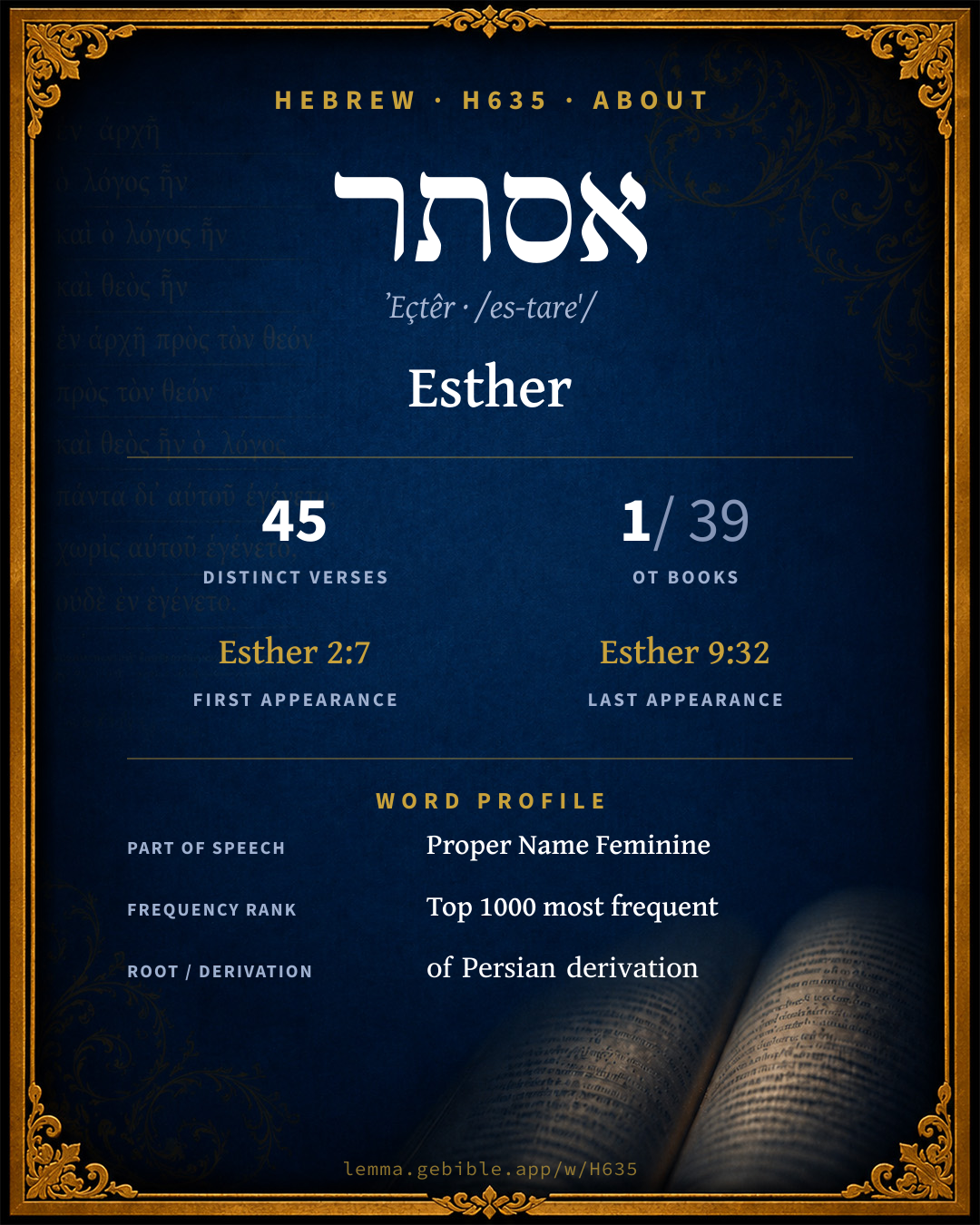
אֶסְתֵּר
Esther
BDB lists 2 entries for ‘Esther’ fuller range ↓
Full lexicon entry — Brown-Driver-Briggs (BDB)
From Brown-Driver-Briggs (BDB)
Where this word appears
Grammar key — what these labels mean
Part of speech
- Noun
- A naming word — a person, place, thing, or idea.
Noun type
- Proper
- A name of a specific person, place, or people (e.g. Abraham, Zion, Israel).
Every verse where H635 appears — 45 distinct verses across 1 book. Click any verse to open its interlinear word-by-word view. Verse text shown in the World English Bible for context — . Each verse’s Hebrew form is shown with its reference; the English is not keyword-highlighted, since the data carries no word-level English alignment. Use “Compare translations” on any verse to read it across multiple English versions. This concordance covers the Hebrew Bible; Septuagint (Greek Old Testament) occurrences are not indexed here.
Esther 45 verses
- Esther 2:7 אֶסְתֵּר֙ n Proper He brought up Hadassah, who is, Esther, his uncle's daughter: for she had neither father nor mother, and the maiden was fair and beautiful; and when her father and mother were dead, Mordecai took her for his own daughter.
- Esther 2:8 אֶסְתֵּר֙ n Proper So it happened, when the king's commandment and his decree was heard, and when many maidens were gathered together to Shushan the palace, to the custody of Hegai, that Esther was taken into the king's house, to the custody of Hegai, keeper of the women.
- Esther 2:10 אֶסְתֵּ֔ר n Proper Esther had not made known her people nor her relatives; for Mordecai had charged her that she should not make it known.
- Esther 2:11 אֶסְתֵּ֔ר n Proper Mordecai walked every day before the court of the women's house, to know how Esther did, and what would become of her.
- Esther 2:15 אֶסְתֵּ֣ר אֶסְתֵּר֙ n Proper n Proper Now when the turn of Esther, the daughter of Abihail the uncle of Mordecai, who had taken her for his daughter, was come to go in to the king, she required nothing but what Hegai the king's chamberlain, the keeper of the women, appointed. Esther obtained favor in the sight of all those who looked at her.
- Esther 2:16 אֶסְתֵּ֜ר n Proper So Esther was taken to king Ahasuerus into his house royal in the tenth month, which is the month Tebeth, in the seventh year of his reign.
- Esther 2:17 אֶסְתֵּר֙ n Proper The king loved Esther above all the women, and she obtained favor and kindness in his sight more than all the virgins; so that he set the royal crown on her head, and made her queen instead of Vashti.
- Esther 2:18 אֶסְתֵּ֑ר n Proper Then the king made a great feast to all his princes and his servants, even Esther's feast; and he made a release to the provinces, and gave gifts, according to the bounty of the king.
- Esther 2:20 אֶסְתֵּ֗ר אֶסְתֵּ֣ר n Proper n Proper Esther had not yet made known her relatives nor her people; as Mordecai had charged her: for Esther did the commandment of Mordecai, like as when she was brought up with him.
- Esther 2:22 לְ/אֶסְתֵּ֣ר אֶסְתֵּ֛ר prep + n Proper n Proper The thing became known to Mordecai, who shown it to Esther the queen; and Esther told the king [of it] in Mordecai's name.
- Esther 4:4 אֶסְתֵּ֤ר n Proper Esther's maidens and her chamberlains came and told it her; and the queen was exceedingly grieved: and she sent clothing to clothe Mordecai, and to take his sackcloth from off him; but he didn't receive it.
- Esther 4:5 אֶסְתֵּ֨ר n Proper Then called Esther for Hathach, one of the king's chamberlains, whom he had appointed to attend on her, and charged him to go to Mordecai, to know what this was, and why it was.
- Esther 4:8 אֶסְתֵּ֖ר n Proper Also he gave him the copy of the writing of the decree that was given out in Shushan to destroy them, to show it to Esther, and to declare it to her, and to charge her that she should go in to the king, to make supplication to him, and to make request before him, for her people.
- Esther 4:9 לְ/אֶסְתֵּ֔ר prep + n Proper Hathach came and told Esther the words of Mordecai.
- Esther 4:10 אֶסְתֵּר֙ n Proper Then Esther spoke to Hathach, and gave him a message to Mordecai [saying]:
- Esther 4:12 אֶסְתֵּֽר n Proper They told to Mordecai Esther's words.
- Esther 4:13 אֶסְתֵּ֑ר n Proper Then Mordecai bade them return answer to Esther, Don't think to yourself that you shall escape in the king's house, more than all the Jews.
- Esther 4:15 אֶסְתֵּ֖ר n Proper Then Esther bade them return answer to Mordecai,
- Esther 4:17 אֶסְתֵּֽר n Proper So Mordecai went his way, and did according to all that Esther had commanded him.
- Esther 5:1 אֶסְתֵּר֙ n Proper Now it happened on the third day, that Esther put on her royal clothing, and stood in the inner court of the king's house, over against the king's house: and the king sat on his royal throne in the royal house, over against the entrance of the house.
- Esther 5:2 אֶסְתֵּ֣ר לְ/אֶסְתֵּ֗ר אֶסְתֵּ֔ר n Proper prep + n Proper n Proper It was so, when the king saw Esther the queen standing in the court, that she obtained favor in his sight; and the king held out to Esther the golden scepter that was in his hand. So Esther drew near, and touched the top of the scepter.
- Esther 5:3 אֶסְתֵּ֣ר n Proper Then said the king to her, What will you, queen Esther? and what is your request? it shall be given you even to the half of the kingdom.
- Esther 5:4 אֶסְתֵּ֔ר n Proper Esther said, If it seem good to the king, let the king and Haman come this day to the banquet that I have prepared for him.
- Esther 5:5 אֶסְתֵּ֑ר אֶסְתֵּֽר n Proper n Proper Then the king said, Cause Haman to make haste, that it may be done as Esther has said. So the king and Haman came to the banquet that Esther had prepared.
- Esther 5:6 לְ/אֶסְתֵּר֙ prep + n Proper The king said to Esther at the banquet of wine, What is your petition? and it shall be granted you: and what is your request? even to the half of the kingdom it shall be performed.
- Esther 5:7 אֶסְתֵּ֖ר n Proper Then answered Esther, and said, My petition and my request is:
- Esther 5:12 אֶסְתֵּ֨ר n Proper Haman said moreover, Yes, Esther the queen did let no man come in with the king to the banquet that she had prepared but myself; and tomorrow also am I invited by her together with the king.
- Esther 6:14 אֶסְתֵּֽר n Proper While they were yet talking with him, came the king's chamberlains, and hurried to bring Haman to the banquet that Esther had prepared.
- Esther 7:1 אֶסְתֵּ֥ר n Proper So the king and Haman came to banquet with Esther the queen.
- Esther 7:2 לְ/אֶסְתֵּ֜ר אֶסְתֵּ֥ר prep + n Proper n Proper The king said again to Esther on the second day at the banquet of wine, What is your petition, queen Esther? and it shall be granted you: and what is your request? even to the half of the kingdom it shall be performed.
- Esther 7:3 אֶסְתֵּ֤ר n Proper Then Esther the queen answered, If I have found favor in your sight, O king, and if it please the king, let my life be given me at my petition, and my people at my request:
- Esther 7:5 לְ/אֶסְתֵּ֣ר prep + n Proper Then spoke the king Ahasuerus and said to Esther the queen, Who is he, and where is he, that dared presume in his heart to do so?
- Esther 7:6 אֶסְתֵּ֔ר n Proper Esther said, An adversary and an enemy, even this wicked Haman. Then Haman was afraid before the king and the queen.
- Esther 7:7 מֵֽ/אֶסְתֵּ֣ר prep + n Proper The king arose in his wrath from the banquet of wine [and went] into the palace garden: and Haman stood up to make request for his life to Esther the queen; for he saw that there was evil determined against him by the king.
- Esther 7:8 אֶסְתֵּ֣ר n Proper Then the king returned out of the palace garden into the place of the banquet of wine; and Haman was fallen on the couch whereon Esther was. Then said the king, Will he even force the queen before me in the house? As the word went out of the king's mouth, they covered Haman's face.
- Esther 8:1 לְ/אֶסְתֵּ֣ר אֶסְתֵּ֖ר prep + n Proper n Proper On that day did the king Ahasuerus give the house of Haman the Jews' enemy to Esther the queen. Mordecai came before the king; for Esther had told what he was to her.
- Esther 8:2 אֶסְתֵּ֛ר n Proper The king took off his ring, which he had taken from Haman, and gave it to Mordecai. Esther set Mordecai over the house of Haman.
- Esther 8:3 אֶסְתֵּ֗ר n Proper Esther spoke yet again before the king, and fell down at his feet, and begged him with tears to put away the mischief of Haman the Agagite, and his device that he had devised against the Jews.
- Esther 8:4 לְ/אֶסְתֵּ֔ר אֶסְתֵּ֔ר prep + n Proper n Proper Then the king held out to Esther the golden scepter. So Esther arose, and stood before the king.
- Esther 8:7 לְ/אֶסְתֵּ֣ר לְ/אֶסְתֵּ֗ר prep + n Proper prep + n Proper Then the king Ahasuerus said to Esther the queen and to Mordecai the Jew, See, I have given Esther the house of Haman, and him they have hanged on the gallows, because he laid his hand on the Jews.
- Esther 9:12 לְ/אֶסְתֵּ֣ר prep + n Proper The king said to Esther the queen, The Jews have slain and destroyed five hundred men in Shushan the palace, and the ten sons of Haman; what then have they done in the rest of the king's provinces! Now what is your petition? and it shall be granted you: or what is your request further? and it shall be done.
- Esther 9:13 אֶסְתֵּר֙ n Proper Then said Esther, If it please the king, let it be granted to the Jews who are in Shushan to do tomorrow also according to this day's decree, and let Haman's ten sons be hanged on the gallows.
- Esther 9:29 אֶסְתֵּ֨ר n Proper Then Esther the queen, the daughter of Abihail, and Mordecai the Jew, wrote with all authority to confirm this second letter of Purim.
- Esther 9:31 וְ/אֶסְתֵּ֣ר conj + n Proper to confirm these days of Purim in their appointed times, according as Mordecai the Jew and Esther the queen had enjoined them, and as they had ordained for themselves and for their seed, in the matter of the fastings and their cry.
- Esther 9:32 אֶסְתֵּ֔ר n Proper The commandment of Esther confirmed these matters of Purim; and it was written in the book.
About this entry
At a glance — auto-summarized from this page’s data, not written by a person. Every figure links to its source below. This summary describes the numbers; it doesn’t interpret them.
אסתר — transliterated ʼEçtêr — is a Hebrew name carrying the sense “Esther.” Its uses cluster heavily in Esther (100% of all occurrences). Spanning 45 verses in 1 book, it ranks among the moderately common words of the Hebrew Bible. Its earliest occurrence is Esther 2:7. See 45-verse concordance and the renderings breakdown below.
Gloss history
Strong's 1890 vs modern scholarship
About this word
Strong's H635 catalogs a Hebrew word from the Hebrew Old Testament.
These counts are not copied from any lexicon or concordance. They are computed here, from the morphology-tagged Hebrew Old Testament. What Lemma adds →
- 45
- distinct verses
- The word appears in 45 distinct verses.
- 1 / 39
- OT books
- The word appears in 1 of 39 Old Testament books.
- #686
- by frequency
- Top 1000 most frequent Hebrew words (rank 686 of 8,640 Hebrew words by occurrence).
View all 45 occurrences in the concordance →
Most concentrated in
- Esther 45 verses 100%
By section of the Old Testament
By traditional corpus
Conventional, traditional groupings — biblical authorship is debated, so this is a traditional corpus grouping, not an authorship claim. Each share is this word’s portion of its verses in that division of the Hebrew canon. Each figure is a share of the word’s 45 distinct verses.
- Writings (Ketuvim) 45 verses · 100%
How translations render this word
Counts come from each version’s own published word-to-Strong’s tagging or interlinear alignment — an approximate guide to how each version renders this word, not a word-level alignment the data otherwise carries. Because each total is that version’s own tagged count, the per-version totals vary from one another and need not match the appearance or distinct-verse counts above. These counts may also differ from a printed concordance because Lemma counts each distinctly tagged rendering and does not collapse phrase taggings into a single head-word total. This is a fixed set of word-tagged versions (KJV, ASV, BSB, ULT) and does not change with the reading translation you choose elsewhere. Each version’s license is shown beside its name below (and on Sources).
- King James Version: Esther 44×, Esther's 3×
- American Standard Version: Esther 43×
- Berean Standard Bible: Esther 40×, Esther’s 5×, She 4×
- unfoldingWord Literal Text: Esther 55×
King James Version Public Domain
Renders H635 across 55 tagged occurrences — most commonly:
Plus 8 renderings that appear only once — usually multi-word phrases or single function words the recovered tagging swept in, not distinct renderings.
American Standard Version Public Domain
Renders H635 across 53 tagged occurrences — most commonly:
Plus 10 renderings that appear only once — usually multi-word phrases or single function words the recovered tagging swept in, not distinct renderings. Not rendered by a distinct English word in 2 further occurrences.
Berean Standard Bible Public Domain
Renders H635 across 53 tagged occurrences — most commonly:
Plus 2 renderings that appear only once — usually multi-word phrases or single function words the recovered tagging swept in, not distinct renderings. Not rendered by a distinct English word in 2 further occurrences.
unfoldingWord Literal Text CC BY-SA 4.0
Renders H635 across 57 tagged occurrences — most commonly:
Plus 2 renderings that appear only once — usually multi-word phrases or single function words the recovered tagging swept in, not distinct renderings.
Senses in BDB
The 2 senses BDB distinguishes for this word, in lexicon order (not ranked by frequency or importance). The full entry — with sub-senses — is in the Lexicon Entry tab.
- Esther = "star"
- the queen of Persia…
Word origin
n.pr.f. Esther (Pers. stâra, star)—daughter of Abihail, cousin and adopted daughter of Mordecai, of tribe of Benjamin; made queen in Vashti’s place by Ahasuerus; her Jewish name הֲדַסָּה q.v. Est 2:7, 8, 10, 11, 15(×2), 16, 17 + 47 times Est.
— Brown-Driver-Briggs (Oxford 1906, public domain), digitized via Sefaria, supplemented by the OpenScriptures HebrewLexicon (CC BY 4.0). See Sources.
Origin: of Persian derivation
Jastrow Dictionary
A second Hebrew/Aramaic lexicon for comparison, covering Aramaic and post-biblical (Talmudic, Targumic, Midrashic) usage that the biblical-Hebrew BDB does not. Matched by lemma rather than by Strong’s number, so a lemma may carry more than one Jastrow headword (shown separately below), and the entries cover usage well beyond the Bible.
אֶסְתֵּר
- (b. h.) pr. n. f. Esther, wife of king Ahasverus. Ex. R. s. 15 ובאה א׳ והאירה and Esther (bright star, v. אִסְתְּהַר) came and brought light. Meg. 13ᵃ; a. fr.—מגילת א׳, or only א׳, the Book of Esther. Snh. 100ᵃ. Meg. 7ᵃ, a. e. (controversy as to its canonic character).
A Dictionary of the Targumim, the Talmud Babli and Yerushalmi, and the Midrashic Literature (Marcus Jastrow; London, Luzac, 1903) — Public Domain. Digitized via Sefaria. Digitized via Sefaria. Full attribution on Sources.
Forms in the corpus
The 19 distinct written forms H635 takes in the Hebrew Bible, most frequent first — each parse links to that state’s occurrences in the concordance. Hebrew forms include their vowel points and cantillation, so a single lemma takes many written forms.
| Form | Parsing | Example | Uses |
|---|---|---|---|
| אֶסְתֵּ֔ר | Noun, Proper | Esther 2:10 | 7 |
| אֶסְתֵּר֙ | Noun, Proper | Esther 2:7 | 7 |
| אֶסְתֵּ֣ר | Noun, Proper | Esther 2:15 | 5 |
| לְ/אֶסְתֵּ֣ר | Noun, Proper | Esther 2:22 | 5 |
| אֶסְתֵּ֖ר | Noun, Proper | Esther 4:8 | 4 |
| אֶסְתֵּֽר | Noun, Proper | Esther 4:12 | 4 |
| אֶסְתֵּ֑ר | Noun, Proper | Esther 2:18 | 3 |
| אֶסְתֵּ֨ר | Noun, Proper | Esther 4:5 | 3 |
| אֶסְתֵּ֗ר | Noun, Proper | Esther 2:20 | 2 |
| אֶסְתֵּ֛ר | Noun, Proper | Esther 2:22 | 2 |
| אֶסְתֵּ֤ר | Noun, Proper | Esther 4:4 | 2 |
| אֶסְתֵּ֥ר | Noun, Proper | Esther 7:1 | 2 |
| לְ/אֶסְתֵּ֔ר | Noun, Proper | Esther 4:9 | 2 |
| לְ/אֶסְתֵּ֗ר | Noun, Proper | Esther 5:2 | 2 |
| אֶסְתֵּ֜ר | Noun, Proper | Esther 2:16 | 1 |
| וְ/אֶסְתֵּ֣ר | Noun, Proper | Esther 9:31 | 1 |
| לְ/אֶסְתֵּ֜ר | Noun, Proper | Esther 7:2 | 1 |
| לְ/אֶסְתֵּר֙ | Noun, Proper | Esther 5:6 | 1 |
| מֵֽ/אֶסְתֵּ֣ר | Noun, Proper | Esther 7:7 | 1 |
Bible dictionary
Public-domain dictionary articles matched to this entry by name (Esther). A biblical name can be shared by more than one person or place, so an article may treat several.
Easton's Bible Dictionary · M. G. Easton, 1897
The queen of Ahasuerus, and heroine of the book that bears her name. She was a Jewess named Hadas'sah (the myrtle), but when she entered the royal harem she received the name by which she henceforth became known (Esther 2:7). It is a Syro-Arabian modification of the Persian word satarah, which means a star. She was the daughter of Abihail, a Benjamite. Her family did not avail themselves of the permission granted by Cyrus to the exiles to return to Jerusalem; and she resided with her cousin Mordecai, who held some office in the household of the Persian king at "Shushan in the palace." Ahasuerus having divorced Vashti, chose Esther to be his wife. Soon after this he gave Haman the Agagite, his prime minister, power and authority to kill and extirpate all the Jews throughout the Persian empire. By the interposition of Esther this terrible catastrophe was averted. Haman was hanged on the gallows he had intended for Mordecai (Esther 7); and the Jews established an annual feast, the feast of Purim (q.v.), in memory of their wonderful deliverance. This took place about fifty-two years after the Return, the year of the great battles of Plataea and Mycale (B.C. 479).
Esther appears in the Bible as a "woman of deep piety, faith, courage, patriotism, and caution, combined with resolution; a dutiful daughter to her adopted father, docile and obedient to his counsels, and anxious to share the king's favour with him for the good of the Jewish people. There must have been a singular grace and charm in her aspect and manners, since she obtained favour in the sight of all them that looked upon her' (Esther 2:15). That she was raised up as an instrument in the hand of God to avert the destruction of the Jewish people, and to afford them protection and forward their wealth and peace in their captivity, is also manifest from the Scripture account."
Smith's Bible Dictionary · William Smith, 1863
(a star), the Persian name of Hadassah (myrtle), daughter of Abihail, the son of Shimei, the son of Kish, a Benjamite. Esther was a beautiful Jewish maiden. She was an orphan, and had been brought up by her cousin Mordecai, who had an office in the household of Ahasuerus king of Persia--supposed to be the Xerxes of history-- and dwelt at "Shushan the palace." When Vashti was dismissed from being queen, the king chose Esther to the place on account of her beauty, not knowing her race or parentage; and on the representation of Haman the Agagite that the Jews scattered through his empire were pernicious race, he gave him full power and authority to kill them all. The means taken by Esther to avert this great calamity from her people and her kindred are fully related in the book of Esther. The Jews still commemorate this deliverance in the yearly festival Purim, on the 14th and 15th of Adar (February, March). History is wholly silent about both Vashti and Esther.
Hitchcock's Bible Names Dictionary · Roswell D. Hitchcock, 1869
secret; hidden
Classic public-domain reference works; full attribution on Sources.
Septuagint verse parallels
This word appears in 45 verses that also exist in the Greek Old Testament (Septuagint), out of the 45 Hebrew verses it occurs in. You can read those verses in Greek by switching the Old Testament edition to the Septuagint.
Read these verses in the Septuagint
This is a verse-level parallel only — the same verses exist in both the Hebrew and Greek Old Testaments. No word-level Hebrew↔Greek correspondence is claimed: the data carries no such alignment, so no Greek word is shown as this Hebrew word’s translation. Coverage is not total — the Septuagint omits the deuterocanon and renumbers the Psalms, so some Hebrew verses have no direct Greek parallel.