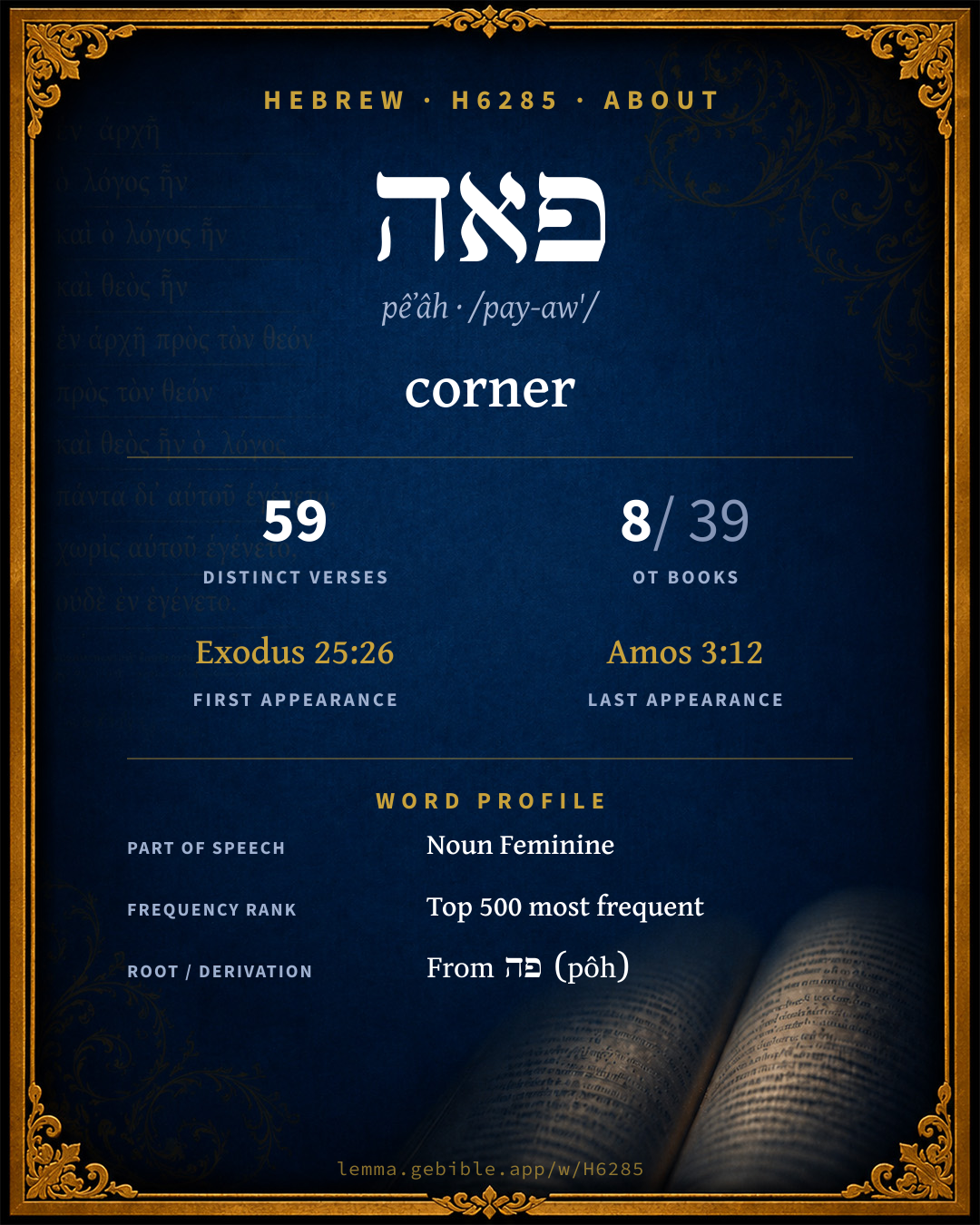
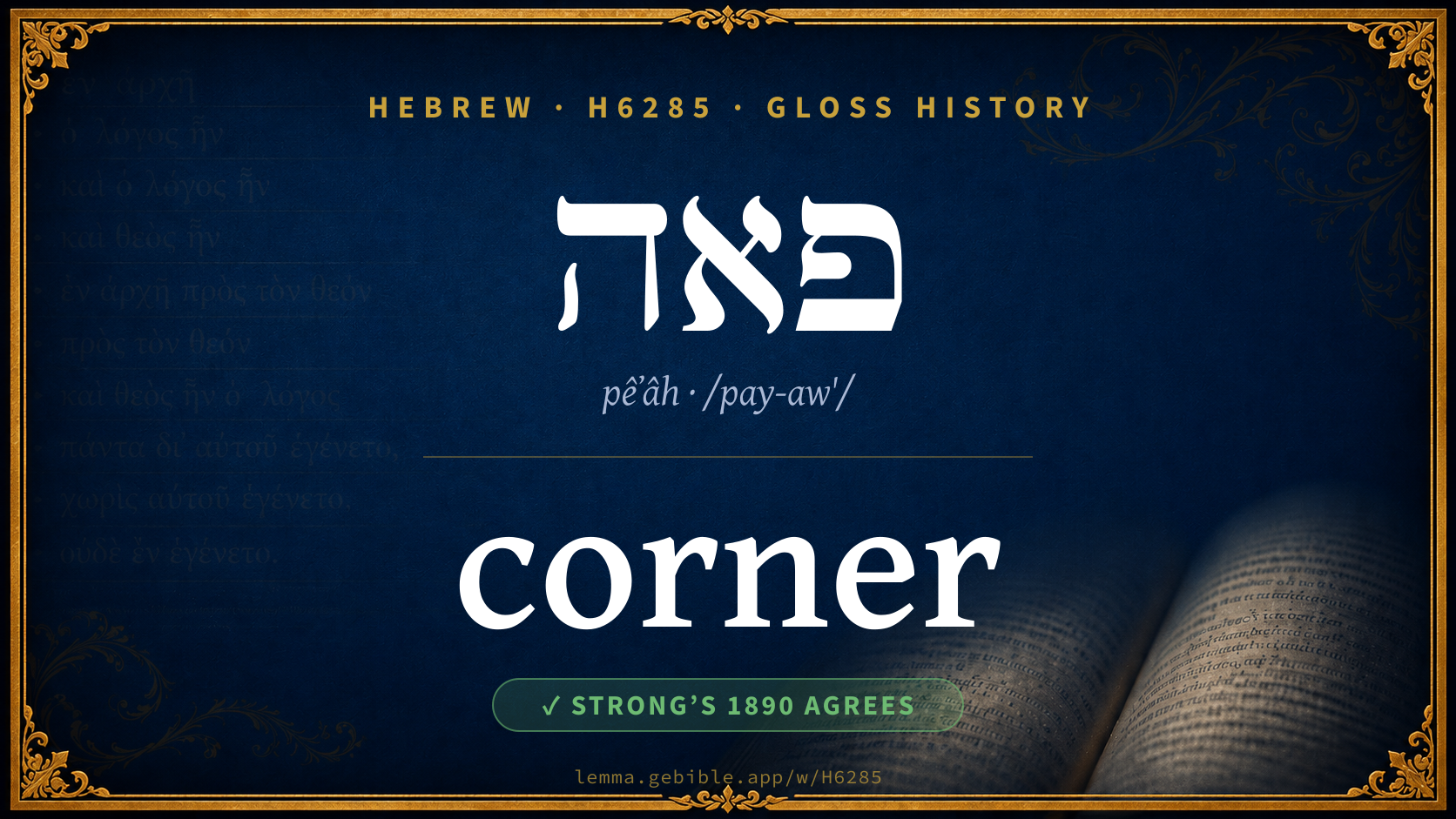
פֵּאָה
corner
also: edge, side, quarter, extremity fuller range ↓
Full lexicon entry — Brown-Driver-Briggs (BDB)
From Brown-Driver-Briggs (BDB)
Where this word appears
Grammar key — what these labels mean
Part of speech
- Noun
- A naming word — a person, place, thing, or idea.
Noun type
- Common
- A common noun — a general class of person, place, or thing (“king,” “city,” “water”), not a specific name.
State
- Construct
- A noun bound to a following noun in a possessive / “of” relationship (the construct chain).
- Absolute
- The independent form of a noun, not bound to a following word.
Gender
- Feminine
- Grammatically feminine.
Number
- Singular
- One.
- Plural
- More than one (in Hebrew, generally three or more).
- Dual
- Exactly two — for natural pairs and some measures of time.
Every verse where H6285 appears in the Book of Numbers — 3 distinct verses. Click any verse to open its interlinear word-by-word view. Verse text shown in the World English Bible for context — . Each verse’s Hebrew form is shown with its reference; the English is not keyword-highlighted, since the data carries no word-level English alignment. Use “Compare translations” on any verse to read it across multiple English versions. This concordance covers the Hebrew Bible; Septuagint (Greek Old Testament) occurrences are not indexed here.
Numbers
- Numbers 24:17 פַּאֲתֵ֣י n c fd cs I see him, but not now; I see him, but not near: There shall come forth a star out of Jacob, A scepter shall rise out of Israel, Shall strike through the corners of Moab, Break down all the sons of tumult.
- Numbers 34:3 פְּאַת n c fs cs then your south quarter shall be from the wilderness of Zin along by the side of Edom, and your south border shall be from the end of the Salt Sea eastward;
- Numbers 35:5 פְּאַת פְּאַת פְּאַת פְּאַ֥ת n c fs cs n c fs cs n c fs cs n c fs cs You shall measure outside of the city for the east side two thousand cubits, and for the south side two thousand cubits, and for the west side two thousand cubits, and for the north side two thousand cubits, the city being in the midst. This shall be to them the suburbs of the cities.
About this entry
At a glance — auto-summarized from this page’s data, not written by a person. Every figure links to its source below. This summary describes the numbers; it doesn’t interpret them.
פאה (pêʼâh) is a Hebrew noun most often rendered “corner.” Scripture first uses it in Exodus 25:26. It turns up in 59 verses across 8 books, a moderately common footprint. It concentrates in Ezekiel, which alone accounts for 44% of its uses. Beyond its headline sense, its full sense range takes in “edge”, “side”, and “quarter”. The sections below give every sense, occurrence, and version rendering.
Gloss history
Strong's 1890 vs modern scholarship
About this word
Strong's H6285 catalogs a Hebrew word from the Hebrew Old Testament.
These counts are not copied from any lexicon or concordance. They are computed here, from the morphology-tagged Hebrew Old Testament. What Lemma adds →
- 59
- distinct verses
- The word appears in 59 distinct verses.
- 8 / 39
- OT books
- The word appears in 8 of 39 Old Testament books.
- #475
- by frequency
- Top 500 most frequent Hebrew words (rank 475 of 8,640 Hebrew words by occurrence).
View all 59 occurrences in the concordance →
By section of the Old Testament
By traditional corpus
Conventional, traditional groupings — biblical authorship is debated, so this is a traditional corpus grouping, not an authorship claim. Each share is this word’s portion of its verses in that division of the Hebrew canon. Each figure is a share of the word’s 59 distinct verses.
- Prophets (Nevi'im) 36 verses · 61%
- Torah (Pentateuch) 22 verses · 37%
- Writings (Ketuvim) 1 verse · 2%
How translations render this word
Counts come from each version’s own published word-to-Strong’s tagging or interlinear alignment — an approximate guide to how each version renders this word, not a word-level alignment the data otherwise carries. Because each total is that version’s own tagged count, the per-version totals vary from one another and need not match the appearance or distinct-verse counts above. These counts may also differ from a printed concordance because Lemma counts each distinctly tagged rendering and does not collapse phrase taggings into a single head-word total. This is a fixed set of word-tagged versions (KJV, ASV, BSB, ULT) and does not change with the reading translation you choose elsewhere. Each version’s license is shown beside its name below (and on Sources).
- King James Version: Side 63×, Corners 11×, Corner 5×
- American Standard Version: Side 62×, Quarter 7×, Corners 6×
- Berean Standard Bible: Side 34×, Boundary 4×, Corners 3×
- unfoldingWord Literal Text: Side 38×, Will be 11×, The 7×
King James Version Public Domain
Renders H6285 across 86 tagged occurrences — most commonly:
Plus 3 renderings that appear only once — usually multi-word phrases or single function words the recovered tagging swept in, not distinct renderings.
American Standard Version Public Domain
Renders H6285 across 86 tagged occurrences — most commonly:
Plus 6 renderings that appear only once — usually multi-word phrases or single function words the recovered tagging swept in, not distinct renderings.
Berean Standard Bible Public Domain
Renders H6285 across 57 tagged occurrences — most commonly:
Plus 10 renderings that appear only once — usually multi-word phrases or single function words the recovered tagging swept in, not distinct renderings. Not rendered by a distinct English word in 29 further occurrences.
unfoldingWord Literal Text CC BY-SA 4.0
Renders H6285 across 97 tagged occurrences — most commonly:
Plus other, less common renderings. Plus 11 renderings that appear only once — usually multi-word phrases or single function words the recovered tagging swept in, not distinct renderings.
Senses in the full BDB
What do BDB’s symbols mean?
BDB uses these scholarly abbreviations:
| Symbol | Meaning |
|---|---|
| 𝔊 | the Septuagint (the ancient Greek translation, LXX) |
| 𝔙 | the Vulgate (the Latin translation) |
| 𝔖 | the Syriac version (the Peshitta) |
| 𝔗 | the Targum (the Aramaic translation) |
| ψ | the Psalms |
| √ | root (the underlying root or stem) |
| ‖ | parallel passage (a synonymous or contrasted parallel) |
| † | the dagger: every passage where the word occurs is cited |
The 4 senses and sub-senses the full Brown-Driver-Briggs lexicon distinguishes for this word, in lexicon order (not ranked by frequency), with BDB’s own verbatim wording and sub-sense lettering. Shown in Hebrew script with BDB’s own scholarly abbreviations. The condensed entry is in the Lexicon Entry tab. See also the Forms in the corpus table below.
- 1. corner of divan Am 3:12; table Ex 25:26, 37:13; field Lv 19:9; 23:22 (H); land (prob.) וַתַּ לְקֵם לְפֵאָה Ne 9:22, i.e. into every corner; פ׳ רֹאשְׁכֶם Lv 19:27 (i.e. your temples), פ׳ זְקָנֶ֑ךָ v 27 cf. 21:5 (all H); קְצוּצֵי פֵאָה those clipped on the temples Je 9:25; 25:23; 49:32 (epith. of Arabic tribes, Herod. iii, 8 WMMAs. u. Eur. 140 f. WeSkizzen iii. 119; Heid. 2, 198); temples of Moab (under fig. of man) Nu 24:17 (JE) Je 48:45. e.g. Amos 3:12
- 2. side:
- a. usually of Ezekiel’s temple, the tabern., the holy city and the land, or its subdivisions (only Ez 41–48 [47 times] and P [26 times]): in plur. פְּאַת קָדִ֫ים(ה) East side Ez 47:18 + 17 times Ez, = פ׳ קֵדְמָה Ex 27:13 + 3 times P and Ez 45:7 (v. Co Toy); פ׳ צָפ֫וֹן(ה) North side Ez 47:15 Ex 26:20 + 9 times; פ׳ נֶגֶב (נֶ֫גְבָּה) South side Ez 47:19(×2) Ex 27:9 + 8 times; פ׳ יָם (יָ֫מָּה) West side Ez 45:7 Ex 27:12 + 21 times + פ׳ דֶּרֶךְ־הַיָּם Ez 41:12 (also פ׳ קָדִים הַיָּם 48:1); abs. only לַפֵּאָה הָאֶחָת Ex 27:9. e.g. Ezekiel 47:18
- b. פְּאַת פָּנָיו Lv 13:41 side (border) of his face (forehead and temples; P). e.g. Leviticus 13:41
Senses from the full Brown-Driver-Briggs lexicon (Brown, Driver, Briggs; Oxford 1906 — public domain), digitized via Sefaria, supplemented by the OpenScriptures HebrewLexicon (CC BY 4.0). Full attribution on Sources.
Word origin
n.f. corner, side (part cut off, ‘Abschnitt,’ according to Schröter in MeArchiv. i. 461 BaZMG xii (1887), 615 BuhlLex, but perhaps bilit., NöM. 485 Sta§ 185, and not from √ פאה; cf. Arabic فِىَٔةٌ company, etc. (Nöl.c.); Assyrian pâtu, side, edge, border, v. especially MeissnSuppl. 74; NH = BH, Aramaic פָּאתָא, ܦܰܐܬܳܐ );—abs. פ׳ Je 9:25 + 4 times; cstr. פְּאַת Am 3:12 + 77 times; pl. abs. פֵּאֹת Ex 25:26; 37:23; du. cstr. פַּאֲתֵי Nu 24:17 (but read prob. פְּאַת as ‖ Je 48:45);—
— Brown-Driver-Briggs (Oxford 1906, public domain), digitized via Sefaria, supplemented by the OpenScriptures HebrewLexicon (CC BY 4.0). See Sources.
Derived from פה (pôh) (H6311) — here.
Jastrow Dictionary
A second Hebrew/Aramaic lexicon for comparison, covering Aramaic and post-biblical (Talmudic, Targumic, Midrashic) usage that the biblical-Hebrew BDB does not. Matched by lemma rather than by Strong’s number, so a lemma may carry more than one Jastrow headword (shown separately below), and the entries cover usage well beyond the Bible.
פֵּאָה
- פאה to split, divide; v. Ges. H. Dict.12 s. v.) section, segment, corner.—Pl. פֵּאוֹת, פֵּי׳. Erub. 51ᵃ (ref. to Num. XXXV, 5) פ׳ כתיבן the text speaks of corners (angular additions); ib. לזה אתה נותן פ׳ אין אתה נותן פ׳ וכ׳ for this purpose (the definition of suburbs) you allow corners to be included (i.e. square measurements), but you must not allow corners to those appointing a Sabbath center (שְׁבִיתָה), i.e. you must allow them to walk only within a circle the radius of which is two thousand cubits. Ib. 11ᵃ בארבע פ׳ השדה Ar. (ed. פינות) in the four corners of the field; a. e.—Esp. e.g. Numbers 35:5
- 1. פְּאַת ראש the hair on the temples; פאת זקן the hair on the chin. Macc. III, 5 המקיף פ׳ ראשו והמשחית פ׳ זקנו (v. Lev. XIX, 27) he who cuts off (shaves) the hair of his temples and destroys the hair of his chins; expl. ib. 20ᵇ פאת ראשו סוף ראשו וכ׳ the peah of his head means cutting the tail-end of the hair of his head … making his temples as smooth as the spot behind the ear and as the forehead; פאת זקנו סוף זקנו וכ׳ the peah of his chin means the pointed ends of his chin &c., v. שִׁיבּוֹלֶת; Sifra K’dosh., Par. 3, ch. VI; a. e.—In gen. curls; פ׳ נכרית strange (false) curls, wig. Sabb. VI, 5. Naz. 28ᵇ; a. e. e.g. Leviticus 19:27
- 2. (פאת שדה) the corner of the field, the portion of the harvest left for the poor, peah (Lev. XIX, 9 sq.) Sifra K’dosh., Par. 1, ch. I פטור מן הלקט … והפ׳ is exempt from the duty of leaving for the poor the gleanings, the forgotten sheaf, and the corner. Ib. חייבים בפ׳ are subject to peah. Ib. אין פ׳ אלא מחמת הכילוי וכ׳ the title of peah comes only through the finishing (of the cutting of the field, i.e. if one left a plot uncut in the middle of a field, the poor cannot take it, before the field is entirely cut), and only when it has a name (has been designated by the owner as the poor man’s share), and the real peah is only that which is left at the end (i.e. he who has left a plot in the middle, must also leave a corner); ib. נתן בתחילה הרי זו פ׳ if he left a portion on beginning to cut or in the middle, it is peah (belongs to the poor, and is exempt from tithes &c.); Peah I, 3; a. v. fr. e.g. Leviticus 19:9
- 3. (transf.) braid, vines plaited together so as to form a cover or a partition. Tosef. Kil. IV, 5 אם היו קנים מדוקרנין עושה אותן פ׳ מלמעלה ומותר if forked reeds were standing there, he forms a plait above, and it is permitted (it forms a partition with regard to mixed seeds); Erub. 11ᵇ. Y. Kil. IV, 29ᵇ מציל משום פ׳ it saves (makes the place marked off by reeds a partitioned field) the same as a garland of vines. Ib. הדא פ׳ מה את וכ׳ what do you mean by that peah? do you mean overhead, or on the side? Ib. bot. הפ׳ אינה וכ׳ the ‘plait’ does not save (is not considered a partition), unless it is solidly joined on four sides. Ib. פ׳ מהו שתציל בסוכה do intertwined vines form a partition with regard to Succah (to be considered a wall)?; Y. Succ. I, 52ᵃ bot. Erub. l. c. top פ׳ מותרת לענין כלאים וכ׳ (Ms. M. פ׳ קליעית קליעית, being a gloss to פ׳; v. Rabb. D. S. a. l. note) ‘braids’ form a partition with regard to mixed seeds, but not with regard to Sabbath laws; a. fr.—Peah, name of a treatise of Mishnah, Tosefta and Talmud Y’rushalmi, of the Order of Z’raʿim.
A Dictionary of the Targumim, the Talmud Babli and Yerushalmi, and the Midrashic Literature (Marcus Jastrow; London, Luzac, 1903) — Public Domain. Digitized via Sefaria. Digitized via Sefaria. Full attribution on Sources.
Forms in the corpus
The 34 distinct written forms H6285 takes in the Hebrew Bible, most frequent first — each parse links to that state’s occurrences in the concordance. Hebrew forms include their vowel points and cantillation, so a single lemma takes many written forms.
Same root — word family
Other BDB entries built from the same root as H6285, grouped by Strong’s listed origin. These share a root / origin per the lexicon — not necessarily a shared meaning. Each links to that word’s own entry.
Derives from
Shares the same root
Compare all same-root words → They share a root, not necessarily a meaning.
Septuagint verse parallels
This word appears in 54 verses that also exist in the Greek Old Testament (Septuagint), out of the 59 Hebrew verses it occurs in. You can read those verses in Greek by switching the Old Testament edition to the Septuagint.
Read these verses in the Septuagint
This is a verse-level parallel only — the same verses exist in both the Hebrew and Greek Old Testaments. No word-level Hebrew↔Greek correspondence is claimed: the data carries no such alignment, so no Greek word is shown as this Hebrew word’s translation. Coverage is not total — the Septuagint omits the deuterocanon and renumbers the Psalms, so some Hebrew verses have no direct Greek parallel.