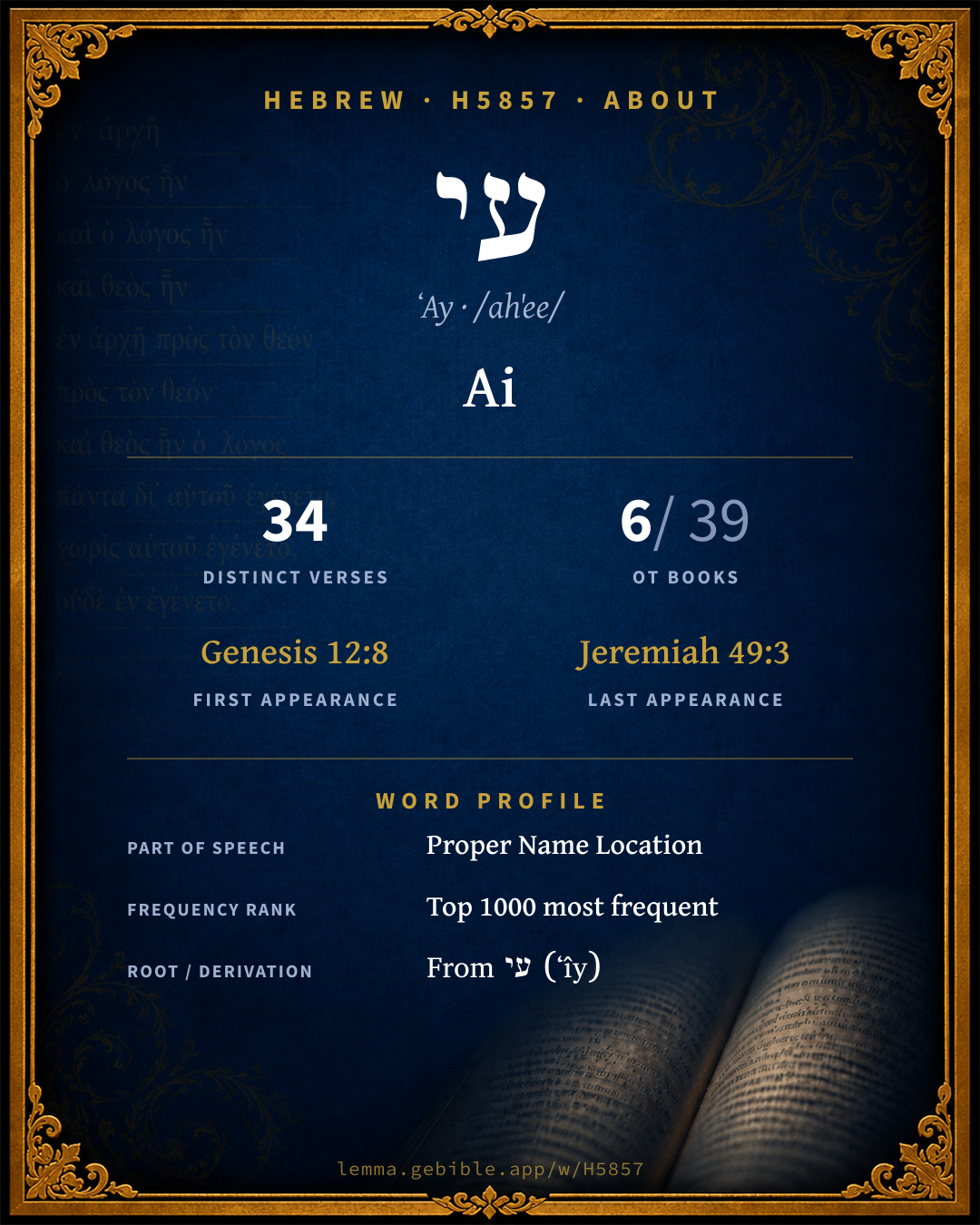
עַי
Ai
BDB lists 3 entries for ‘Ai’ fuller range ↓
Full lexicon entry — Brown-Driver-Briggs (BDB)
From Brown-Driver-Briggs (BDB)
Where this word appears
Grammar key — what these labels mean
Part of speech
- Noun
- A naming word — a person, place, thing, or idea.
Noun type
- Proper
- A name of a specific person, place, or people (e.g. Abraham, Zion, Israel).
Every verse where H5857 appears — 34 distinct verses across 6 books. Click any verse to open its interlinear word-by-word view. Verse text shown in the World English Bible for context — . Each verse’s Hebrew form is shown with its reference; the English is not keyword-highlighted, since the data carries no word-level English alignment. Use “Compare translations” on any verse to read it across multiple English versions. This concordance covers the Hebrew Bible; Septuagint (Greek Old Testament) occurrences are not indexed here.
Genesis 2 verses
- Genesis 12:8 וְ/הָ/עַ֣י conj + ptcl def.art + n Proper He left from there to the mountain on the east of Bethel, and pitched his tent, having Bethel on the west, and Ai on the east. There he built an altar to Yahweh, and called on the name of Yahweh.
- Genesis 13:3 הָ/עָֽי ptcl def.art + n Proper He went on his journeys from the South even to Bethel, to the place where his tent had been at the beginning, between Bethel and Ai,
Joshua 27 verses
- Joshua 7:2 הָ/עַ֞י הָ/עָֽי ptcl def.art + n Proper ptcl def.art + n Proper Joshua sent men from Jericho to Ai, which is beside Beth Aven, on the east side of Bethel, and spoke to them, saying, Go up and spy out the land. The men went up and spied out Ai.
- Joshua 7:3 הָ/עָ֑י ptcl def.art + n Proper They returned to Joshua, and said to him, Don't let all the people go up; but let about two or three thousand men go up and strike Ai; don't make all the people to toil there; for they are but few.
- Joshua 7:4 הָ/עָֽי ptcl def.art + n Proper So there went up there of the people about three thousand men: and they fled before the men of Ai.
- Joshua 7:5 הָ/עַ֗י ptcl def.art + n Proper The men of Ai struck of them about thirty-six men; and they chased them [from] before the gate even to Shebarim, and struck them at the descent; and the hearts of the people melted, and became as water.
- Joshua 8:1 הָ/עָ֑י הָ/עַי֙ ptcl def.art + n Proper ptcl def.art + n Proper Yahweh said to Joshua, Don't be afraid, neither be dismayed: take all the people of war with you, and arise, go up to Ai; behold, I have given into your hand the king of Ai, and his people, and his city, and his land;
- Joshua 8:2 לָ/עַ֜י prep + n Proper You shall do to Ai and her king as you did to Jericho and her king: only the spoil of it, and the cattle of it, shall you take for a prey to yourselves: set you an ambush for the city behind it.
- Joshua 8:3 הָ/עָ֑י ptcl def.art + n Proper So Joshua arose, and all the people of war, to go up to Ai: and Joshua chose out thirty thousand men, the mighty men of valor, and sent them forth by night.
- Joshua 8:9 הָ/עַ֖י לָ/עָ֑י ptcl def.art + n Proper prep + n Proper Joshua sent them forth; and they went to set up the ambush, and stayed between Bethel and Ai, on the west side of Ai: but Joshua lodged that night among the people.
- Joshua 8:10 הָ/עָֽי ptcl def.art + n Proper Joshua arose up early in the morning, and mustered the people, and went up, he and the elders of Israel, before the people to Ai.
- Joshua 8:11 לָ/עַ֔י הָ/עָֽי prep + n Proper ptcl def.art + n Proper All the people, [even] the [men of] war who were with him, went up, and drew near, and came before the city, and encamped on the north side of Ai: now there was a valley between him and Ai.
- Joshua 8:12 הָ/עַ֖י ptcl def.art + n Proper He took about five thousand men, and set them in ambush between Bethel and Ai, on the west side of the city.
- Joshua 8:14 הָ/עַ֗י ptcl def.art + n Proper It happened, when the king of Ai saw it, that they hurried and rose up early, and the men of the city went out against Israel to battle, he and all his people, at the time appointed, before the Arabah; but he didn't know that there was an ambush against him behind the city.
- Joshua 8:16 בָּ/עַ֔י prep + n Proper All the people who were in the city were called together to pursue after them: and they pursued after Joshua, and were drawn away from the city.
- Joshua 8:17 בָּ/עַי֙ prep det + n Proper There was not a man left in Ai or Beth El, who didn't go out after Israel: and they left the city open, and pursued after Israel.
- Joshua 8:18 הָ/עַ֔י ptcl def.art + n Proper Yahweh said to Joshua, Stretch out the javelin that is in your hand toward Ai; for I will give it into your hand. Joshua stretched out the javelin that was in his hand toward the city.
- Joshua 8:20 הָ/עַ֨י ptcl def.art + n Proper When the men of Ai looked behind them, they saw, and, behold, the smoke of the city ascended up to heaven, and they had no power to flee this way or that way: and the people who fled to the wilderness turned back on the pursuers.
- Joshua 8:21 הָ/עָֽי ptcl def.art + n Proper When Joshua and all Israel saw that the ambush had taken the city, and that the smoke of the city ascended, then they turned again, and killed the men of Ai.
- Joshua 8:23 הָ/עַ֖י ptcl def.art + n Proper The king of Ai they took alive, and brought him to Joshua.
- Joshua 8:24 הָ/עַ֜י הָ/עַ֔י ptcl def.art + n Proper ptcl def.art + n Proper It happened, when Israel had made an end of killing all the inhabitants of Ai in the field, in the wilderness in which they pursued them, and they were all fallen by the edge of the sword, until they were consumed, that all Israel returned to Ai, and struck it with the edge of the sword.
- Joshua 8:25 הָ/עָֽי ptcl def.art + n Proper All that fell that day, both of men and women, were twelve thousand, even all the men of Ai.
- Joshua 8:26 הָ/עָֽי ptcl def.art + n Proper For Joshua didn't draw back his hand, with which he stretched out the javelin, until he had utterly destroyed all the inhabitants of Ai.
- Joshua 8:28 הָ/עָ֑י ptcl def.art + n Proper So Joshua burnt Ai, and made it a heap forever, even a desolation, to this day.
- Joshua 8:29 הָ/עַ֛י ptcl def.art + n Proper The king of Ai he hanged on a tree until the evening: and at the going down of the sun Joshua commanded, and they took his body down from the tree, and cast it at the entrance of the gate of the city, and raised thereon a great heap of stones, to this day.
- Joshua 9:3 וְ/לָ/עָֽי conj + prep + n Proper But when the inhabitants of Gibeon heard what Joshua had done to Jericho and to Ai,
- Joshua 10:1 הָ/עַי֮ לָ/עַ֖י ptcl def.art + n Proper prep + n Proper Now it happened, when Adoni-zedek king of Jerusalem heard how Joshua had taken Ai, and had utterly destroyed it; as he had done to Jericho and her king, so he had done to Ai and her king; and how the inhabitants of Gibeon had made peace with Israel, and were among them;
- Joshua 10:2 הָ/עַ֔י ptcl def.art + n Proper that they feared greatly, because Gibeon was a great city, as one of the royal cities, and because it was greater than Ai, and all the men of it were mighty.
- Joshua 12:9 הָ/עַ֛י ptcl def.art + n Proper the king of Jericho, one; the king of Ai, which is beside Bethel, one;
Ezra 1 verse
Nehemiah 2 verses
Isaiah 1 verse
Jeremiah 1 verse
About this entry
At a glance — auto-summarized from this page’s data, not written by a person. Every figure links to its source below. This summary describes the numbers; it doesn’t interpret them.
“Ai” is the headline sense of the Hebrew name עי (ʻAy). It clusters heavily in Joshua, which alone accounts for 79% of its uses. It turns up in 34 verses across 6 books, a moderately common footprint. First canonically at Genesis 12:8, it enters the text early. The sections below give every occurrence and version rendering.
Gloss history
Strong's 1890 vs modern scholarship
About this word
Strong's H5857 catalogs a Hebrew word from the Hebrew Old Testament.
These counts are not copied from any lexicon or concordance. They are computed here, from the morphology-tagged Hebrew Old Testament. What Lemma adds →
- 34
- distinct verses
- The word appears in 34 distinct verses.
- 6 / 39
- OT books
- The word appears in 6 of 39 Old Testament books.
- #909
- by frequency
- Top 1000 most frequent Hebrew words (rank 909 of 8,640 Hebrew words by occurrence).
View all 34 occurrences in the concordance →
By section of the Old Testament
By traditional corpus
Conventional, traditional groupings — biblical authorship is debated, so this is a traditional corpus grouping, not an authorship claim. Each share is this word’s portion of its verses in that division of the Hebrew canon. Each figure is a share of the word’s 34 distinct verses.
- Prophets (Nevi'im) 29 verses · 85%
- Writings (Ketuvim) 3 verses · 9%
- Torah (Pentateuch) 2 verses · 6%
How translations render this word
Counts come from each version’s own published word-to-Strong’s tagging or interlinear alignment — an approximate guide to how each version renders this word, not a word-level alignment the data otherwise carries. Because each total is that version’s own tagged count, the per-version totals vary from one another and need not match the appearance or distinct-verse counts above. These counts may also differ from a printed concordance because Lemma counts each distinctly tagged rendering and does not collapse phrase taggings into a single head-word total. This is a fixed set of word-tagged versions (KJV, ASV, BSB, ULT) and does not change with the reading translation you choose elsewhere. Each version’s license is shown beside its name below (and on Sources).
- King James Version: Ai 31×, Hai 2×
- American Standard Version: Ai 33×
- Berean Standard Bible: Ai 34×
- unfoldingWord Literal Text: Ai 36×, The 2×
King James Version Public Domain
Renders H5857 across 41 tagged occurrences — most commonly:
Plus 8 renderings that appear only once — usually multi-word phrases or single function words the recovered tagging swept in, not distinct renderings.
American Standard Version Public Domain
Renders H5857 across 41 tagged occurrences — most commonly:
Plus 8 renderings that appear only once — usually multi-word phrases or single function words the recovered tagging swept in, not distinct renderings.
Berean Standard Bible Public Domain
Renders H5857 across 39 tagged occurrences — most commonly:
Plus 5 renderings that appear only once — usually multi-word phrases or single function words the recovered tagging swept in, not distinct renderings.
unfoldingWord Literal Text CC BY-SA 4.0
Renders H5857 across 40 tagged occurrences — most commonly:
Plus 2 renderings that appear only once — usually multi-word phrases or single function words the recovered tagging swept in, not distinct renderings.
Senses in the full BDB
What do BDB’s symbols mean?
BDB uses these scholarly abbreviations:
| Symbol | Meaning |
|---|---|
| 𝔊 | the Septuagint (the ancient Greek translation, LXX) |
| 𝔙 | the Vulgate (the Latin translation) |
| 𝔖 | the Syriac version (the Peshitta) |
| 𝔗 | the Targum (the Aramaic translation) |
| ψ | the Psalms |
| √ | root (the underlying root or stem) |
| ‖ | parallel passage (a synonymous or contrasted parallel) |
| † | the dagger: every passage where the word occurs is cited |
The 2 senses and sub-senses the full Brown-Driver-Briggs lexicon distinguishes for this word, in lexicon order (not ranked by frequency), with BDB’s own verbatim wording and sub-sense lettering. Shown in Hebrew script with BDB’s own scholarly abbreviations. The condensed entry is in the Lexicon Entry tab. See also the Forms in the corpus table below.
- 1. old Canaanit. city, עַי always c. art. הָעַי (הָעָ֑י Gn 13:3 +), near Bethel to the SE. (exact site unknown, cf. Di Jos. 7:2 BuhlGeogr. 177), Gn 12:8 (J), 13:3 (J), Jos 7:2(×2), 3, 4, 5; 8:1(×2), 2, 3 + 18 times Jos 8 (+ Qr v 12, 16, but improb., Kt עיר, cf. Di), 9:3; 10:1(×2), 2 (all JE), 12:9 (D), Ezr 2:28 = Ne 7:32; = עַיָּת Is 10:28; עַיָּה (so Baer Ginsb, > עַיָּא van d. H.) Ne 11:31, so read also (for עַזָּה q.v. ad fin.) 1 Ch 7:28. e.g. Genesis 13:3
- 2. E. Jordan city Je 49:3 (+ חֶשְׁבוֹן), but read עָר city (?) Gf RothstKau Co (הָעִיר?). e.g. Jeremiah 49:3
Senses from the full Brown-Driver-Briggs lexicon (Brown, Driver, Briggs; Oxford 1906 — public domain), digitized via Sefaria, supplemented by the OpenScriptures HebrewLexicon (CC BY 4.0). Full attribution on Sources.
Word origin
n.pr.loc. Αγγαι (Gn), Γαι:
— Brown-Driver-Briggs (Oxford 1906, public domain), digitized via Sefaria, supplemented by the OpenScriptures HebrewLexicon (CC BY 4.0). See Sources.
Derived from עי (ʻîy) (H5856) — ruin.
Forms in the corpus
The 23 distinct written forms H5857 takes in the Hebrew Bible, most frequent first — each parse links to that state’s occurrences in the concordance. Hebrew forms include their vowel points and cantillation, so a single lemma takes many written forms.
| Form | Parsing | Example | Uses |
|---|---|---|---|
| הָ/עָֽי | Noun, Proper | Genesis 13:3 | 8 |
| הָ/עָ֑י | Noun, Proper | Joshua 7:3 | 4 |
| הָ/עַ֔י | Noun, Proper | Joshua 8:18 | 3 |
| הָ/עַ֖י | Noun, Proper | Joshua 8:9 | 3 |
| הָ/עַ֗י | Noun, Proper | Joshua 7:5 | 2 |
| הָ/עַ֛י | Noun, Proper | Joshua 8:29 | 2 |
| וְ/הָ/עָ֔י | Noun, Proper | Ezra 2:28 | 2 |
| בָּ/עַ֔י | Noun, Proper | Joshua 8:16 | 1 |
| בָּ/עַי֙ | Noun, Proper | Joshua 8:17 | 1 |
| הָ/עַ֜י | Noun, Proper | Joshua 8:24 | 1 |
| הָ/עַ֞י | Noun, Proper | Joshua 7:2 | 1 |
| הָ/עַ֨י | Noun, Proper | Joshua 8:20 | 1 |
| הָ/עַי֙ | Noun, Proper | Joshua 8:1 | 1 |
| הָ/עַי֮ | Noun, Proper | Joshua 10:1 | 1 |
| וְ/הָ/עַ֣י | Noun, Proper | Genesis 12:8 | 1 |
| וְ/לָ/עָֽי | Noun, Proper | Joshua 9:3 | 1 |
| וְ/עַיָּ֔ה | Noun, Proper | Nehemiah 11:31 | 1 |
| לָ/עַ֔י | Noun, Proper | Joshua 8:11 | 1 |
| לָ/עַ֖י | Noun, Proper | Joshua 10:1 | 1 |
| לָ/עַ֜י | Noun, Proper | Joshua 8:2 | 1 |
| לָ/עָ֑י | Noun, Proper | Joshua 8:9 | 1 |
| עַ֗י | Noun, Proper | Jeremiah 49:3 | 1 |
| עַיַּ֖ת | Noun, Proper | Isaiah 10:28 | 1 |
Same root — word family
Other BDB entries built from the same root as H5857, grouped by Strong’s listed origin. These share a root / origin per the lexicon — not necessarily a shared meaning. Each links to that word’s own entry.
Derives from
Proper names from this root
People and places named from this root — a name, not an additional meaning of the word.
Compare all same-root words → Showing 4 of 5 — not the complete family. 3 of the same-root words are proper names (people or places). They share a root, not necessarily a meaning.
Bible dictionary
Public-domain dictionary articles matched to this entry by name (Ai). A biblical name can be shared by more than one person or place, so an article may treat several.
Easton's Bible Dictionary · M. G. Easton, 1897
Ruins. (1.) One of the royal cities of the Canaanites (Josh. 10:1; Gen. 12:8; 13:3). It was the scene of Joshua's defeat, and afterwards of his victory. It was the second Canaanite city taken by Israel (Josh. 7:2-5; 8:1-29). It lay rebuilt and inhibited by the Benjamites (Ezra 2:28; Neh. 7:32; 11:31). It lay to the east of Bethel, "beside Beth-aven." The spot which is most probably the site of this ancient city is Haiyan, 2 miles east from Bethel. It lay up the Wady Suweinit, a steep, rugged valley, extending from the Jordan valley to Bethel.
(2.) A city in the Ammonite territory (Jer. 49:3). Some have thought that the proper reading of the word is Ar (Isa. 15:1).
Smith's Bible Dictionary · William Smith, 1863
(heap of ruins).
+ A city lying east of Bethel and "beside Bethaven." (Joshua 7:2; 8:9) It was the second city taken by Israel after the passage of the Jordan, and was "utterly destroyed." (Joshua 7:3-5; 8:1; Joshua 9:3; 10:1,2; 12:9) + A city of the Ammonites, apparently attached to Heshbon. (Jeremiah 49:3)
Hitchcock's Bible Names Dictionary · Roswell D. Hitchcock, 1869
or Hai, mass; heap
Classic public-domain reference works; full attribution on Sources.
Septuagint verse parallels
This word appears in 31 verses that also exist in the Greek Old Testament (Septuagint), out of the 34 Hebrew verses it occurs in. You can read those verses in Greek by switching the Old Testament edition to the Septuagint.
Read these verses in the Septuagint
This is a verse-level parallel only — the same verses exist in both the Hebrew and Greek Old Testaments. No word-level Hebrew↔Greek correspondence is claimed: the data carries no such alignment, so no Greek word is shown as this Hebrew word’s translation. Coverage is not total — the Septuagint omits the deuterocanon and renumbers the Psalms, so some Hebrew verses have no direct Greek parallel.