
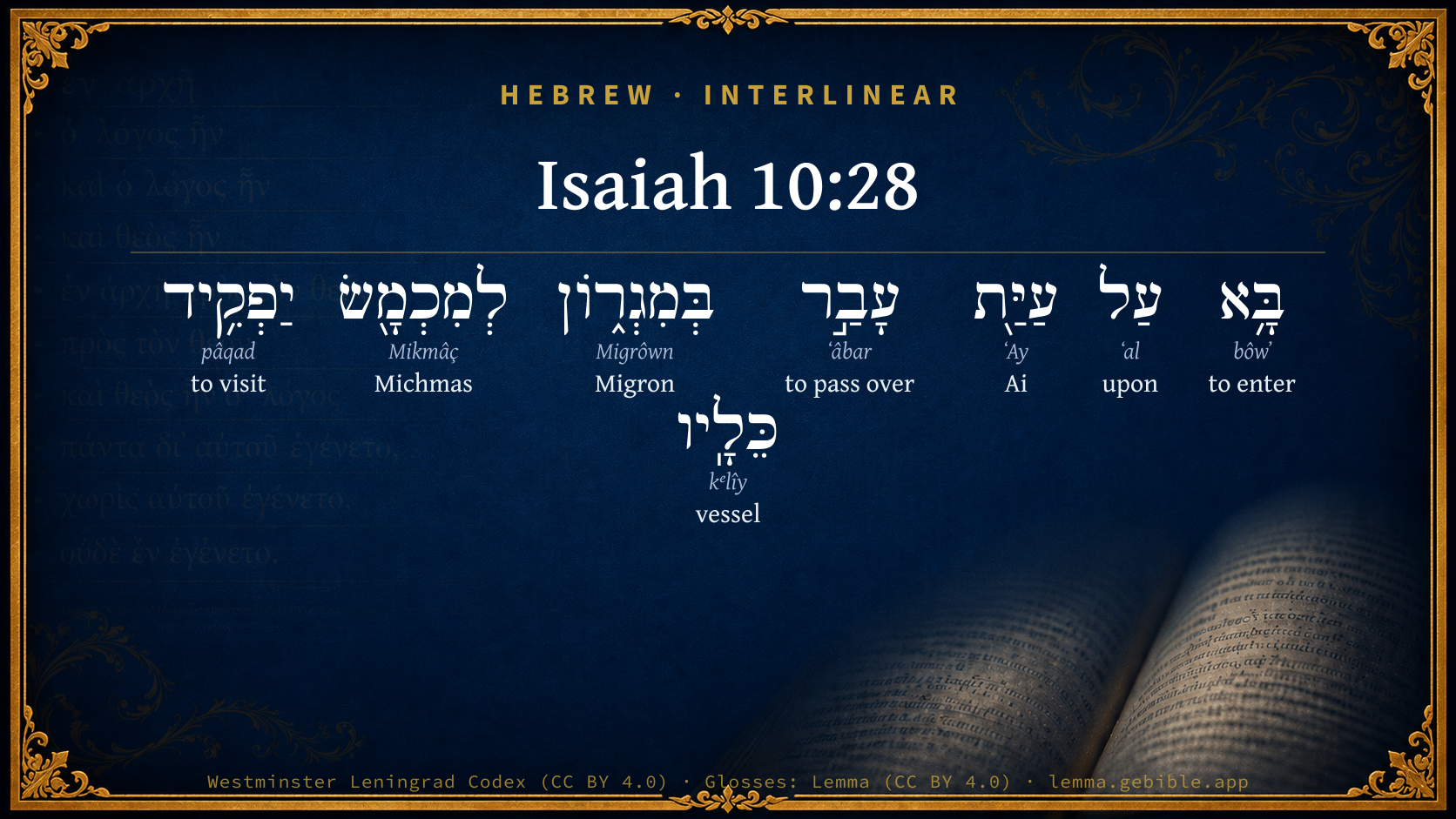
Isaiah 10:28

Hebrew (Westminster Leningrad Codex) Isaiah 10:28 appears in the Hebrew Old Testament. The text above is from the Westminster Leningrad Codex. Each word links to its Strong’s number, a concise gloss, and parsing drawn from the Open Scriptures Hebrew Bible morphology. Click any word for its full Brown-Driver-Briggs (BDB) entry.
Download image
Cite this verse

Isaiah 10:28 (World English Bible). Public Domain. Lemma interlinear Bible study tool, https://lemma.gebible.app/v/isaiah/10/28.

Show BibTeX & RIS
BibTeX
RIS
English Translation
He is come to Aiath, he is passed through Migron; at Michmash he lays up his baggage;
World English Bible · Public Domain
Download a study sheet

One document with this verse’s original text, its word-by-word gloss line, the meaning frame, cross-references with their text, attributed commentary, and full source and license credits — printable, and it pastes into notes with its structure intact.

This verse Autodidact and up

Study sheet (.html) Plain text (.txt)

A passage Seminary Student

Up to 50 verses in one chapter. A passage sheet keeps up to 6 commentary sources and 12 cross-references per verse, in the order this page ranks them, and says so on the sheet whenever that leaves anything out. Ask for a single verse and you get the Autodidact verse sheet above.

Everything on this page stays free to read, with no account — the sheet is a download of what is already on screen, not access to it.

Want to remove ads? Support Godless Engineer
Compare translations 3

The same verse in 3 English versions, stacked beneath the original-language interlinear above. Click any original word for its lexicon entry.

Each is an independent rendering of the whole verse — the interlinear is not word-aligned to these translations.

Highlighted words mark where these versions differ — a whole-verse word diff, not a word-by-word alignment.

  • World English Bible Public Domain
    He is come to Aiath, he is passed through Migron; at Michmash he lays up his baggage;
  • King James Version Public Domain
    He is come to Aiath, he is passed to Migron; at Michmash he hath laid up his carriages:
  • unfoldingWord Literal Text CC BY-SA 4.0
    He has come against Aiath; he has passed through Migron; at Michmash, he stores his equipment.

unfoldingWord Literal Text — © unfoldingWord, licensed CC BY-SA 4.0. Word-aligned USFM3 via Door43 (git.door43.org/unfoldingWord/en_ult).

Versions to compare (up to 4)

3 of 4 selected

Show all 18 translations

Every available English version of this verse, each an independent rendering of the whole verse.

  • World English Bible Public Domain
    He is come to Aiath, he is passed through Migron; at Michmash he lays up his baggage;
  • Berean Standard Bible Public Domain
    Assyria has entered Aiath and passed through Migron, storing their supplies at Michmash.
  • Majority Standard Bible Public Domain
    Assyria has entered Aiath and passed through Migron, storing their supplies at Michmash.
  • King James Version Public Domain
    He is come to Aiath, he is passed to Migron; at Michmash he hath laid up his carriages:
  • American Standard Version (1901) Public Domain
    He is come to Aiath, he is passed through Migron; at Michmash he layeth up his baggage;
  • Revised Version (1885) Public Domain
    He is come to Aiath, he is passed through Migron; at Michmash he layeth up his baggage:
  • Geneva Bible (1599) Public Domain
    He is come to Aiath: he is passed into Migron: at Michmash shall he lay vp his armour.
  • Douay-Rheims (1899) Public Domain
    He shall come into Aiath, he shall pass into Magron: at Machmas he shall lay up his carriages.
  • Young's Literal Translation Public Domain
    He hath come in against Aiath, He hath passed over into Migron, At Michmash he looketh after his vessels.
  • Literal Standard Version CC BY-SA 4.0
    He has come in against Aiath, || He has passed over into Migron, || At Michmash he looks after his vessels.
  • Unlocked Literal Bible CC BY-SA 4.0
    The enemy has come to Aiath and has passed through Migron; at Michmash he has stored his provisions.
  • unfoldingWord Literal Text CC BY-SA 4.0
    He has come against Aiath; he has passed through Migron; at Michmash, he stores his equipment.
  • Darby Bible Public Domain
    He is come to Aiath, he hath passed through Migron; at Michmash he layeth up his baggage.
  • World Messianic Bible Public Domain
    He has come to Aiath. He has passed through Migron. At Michmash he stores his baggage.
  • Webster's Bible Public Domain
    He is come to Aiath, he is passed to Migron; at Michmash he hath laid up his furniture.
  • Free Bible Version CC BY-SA 4.0
    The Assyrians came to Aiath, passed through Migron, and stored their supplies at Michmash.
  • Bible in Basic English Public Domain
    He has gone up from Pene-Rimmon, he has come to Aiath; he has gone past Migron, at Michmash he puts his forces in order.
  • JPS Tanakh (1917) Public Domain
    He is come to Aiath, he is passed through Migron; at Michmas he layeth up his baggage;

Literal Standard Version (2020), Covenant Press — licensed CC BY-SA 4.0. Text via the HelloAO Bible API (eBible.org). Unlocked Literal Bible (unfoldingWord) — licensed CC BY-SA 4.0. Text via the HelloAO Bible API (eBible.org). unfoldingWord Literal Text — © unfoldingWord, licensed CC BY-SA 4.0. Word-aligned USFM3 via Door43 (git.door43.org/unfoldingWord/en_ult). Free Bible Version, Dr. Jonathan Gallagher — licensed CC BY-SA 4.0. Text via the HelloAO Bible API (eBible.org).

Word by word

More ways to search: Search by grammar → Find every occurrence → Compare this word →

Practice this passage: Drill this verse → Learn its vocabulary →

About this verse

These counts appear in no published source. They are computed here, from the morphology-tagged text and Lemma’s own curated glosses. What Lemma adds →

8
words
8
distinct lemmas
Prophets
section

Notable vocabulary

The rarest word here is בְּמִגְר֑וֹן Migron H4051 — appearing just 2 times in the whole Hebrew Bible.

Shared distinctive vocabulary

בְּמִגְר֑וֹן Migron H4051 occurs in 2 verses of the Hebrew Bible. Also found in:

Grammatical profile

  • 3 verbs
  • 4 nouns
  • 1 preposition

Verb forms

  • בָּ֥א Qal · Perfect
  • עָבַ֣ר Qal · Perfect
  • יַפְקִ֥יד Hiphil · Imperfect

Hebrew & Septuagint length

In English translation the verse runs 17 words from the Hebrew and 23 from the Septuagint (LXX English) — closely comparable.

A rough comparison of the two English renderings, which tokenize alike — not a word-level alignment.

Word counts can differ between the Hebrew and the Greek without any difference in meaning — e.g. the Hebrew direct-object marker אֵת has no separate Greek word, and Greek often adds the article ὁ.

Cross-references

9

Topical passages linked to Isaiah 10:28 in the Treasury of Scripture Knowledge — connected by theme and wording, ordered by reader-vote popularity; previews shown in the World English Bible.

  • 1 Samuel 14:2 Saul abode in the uttermost part of Gibeah under the pomegranate tree which is in Migron: and the people who were with him were about six hundred men;
  • 1 Samuel 13:2 Saul chose him three thousand men of Israel, of which two thousand were with Saul in Michmash and in the Mount of Bethel, and one thousand were with Jonathan in Gibeah of Benjamin: and the rest of the people he sent every man to his tent.
  • 1 Samuel 13:5 The Philistines assembled themselves together to fight with Israel, thirty thousand chariots, and six thousand horsemen, and people as the sand which is on the sea-shore in multitude: and they came up, and encamped in Michmash, eastward of Beth Aven.
  • Joshua 7:2 Joshua sent men from Jericho to Ai, which is beside Beth Aven, on the east side of Bethel, and spoke to them, saying, Go up and spy out the land. The men went up and spied out Ai.
  • Judges 18:21 So they turned and departed, and put the little ones and the cattle and the goods before them.
  • 1 Samuel 14:5 The one crag rose up on the north in front of Michmash, and the other on the south in front of Geba.
  • 1 Samuel 14:31 They struck of the Philistines that day from Michmash to Aijalon. The people were very faint;
  • 1 Samuel 17:22 David left his baggage in the hand of the keeper of the baggage, and ran to the army, and came and greeted his brothers.
  • Nehemiah 11:31 The children of Benjamin also [lived] from Geba [onward], at Michmash and Aija, and at Bethel and the towns of it,

Cross-references courtesy of OpenBible.info (CC BY 4.0).

Hebrew and Greek witnesses Masoretic Hebrew ↔ Greek Septuagint

The same verse in the two great witnesses to the Old Testament, shown verse-for-verse.

These are two independent witnesses, not word-aligned to each other, and the Septuagint is shown in lemma (dictionary) form.

Hebrew Isaiah 10:28 Masoretic · Westminster Leningrad Codex

בָּ֥א עַל עַיַּ֖ת עָבַ֣ר בְּמִגְר֑וֹן לְמִכְמָ֖שׂ יַפְקִ֥יד כֵּלָֽיו

He is come to Aiath, he is passed through Migron; at Michmash he lays up his baggage;

World English Bible · Public Domain

Greek LXX Isaiah 10:28 Septuagint · lemma form

ἥκω γάρ εἰς ὁ πόλις αγγαι καί παραἔρχομαι εἰς μαγεδω καί ἐν μαχμας τίθημι ὁ σκεῦος αὐτός

For he shall arrive at the city of Angai, and shall pass on to Maggedo, and shall lay up his stores in Machmas.

LXX2012 (modern English Septuagint) · Public Domain

On this verse, Albert Barnes' Notes on the Bible discusses the Septuagint’s reading. Read the note in Commentary ↓

Hebrew: Westminster Leningrad Codex (CC BY 4.0). Greek: Septuagint (public domain); English from LXX2012 (modern English Septuagint) (Public Domain). How the Septuagint differs from the Hebrew →

Targum (Aramaic paraphrase)

1

The Targum is the ancient Jewish Aramaic paraphrase of the Hebrew Scriptures — an interpretive translation, not the Hebrew text itself. Onkelos (literal) and Pseudo-Jonathan (expansive) render the Torah, and Jonathan the Prophets. Coverage is partial: where no permissively-licensed English translation exists for a verse, only the Aramaic is shown. This is verse-level text, not a word-by-word alignment to the Hebrew.

  1. Targum Jonathan Prophets (Joshua–Malachi)
    אֲתָא עַל עַיָת עָבַר בְּמִגְרוֹן לְמִכְמַשׁ יְמַנֵי רַבָּנֵי מַשִׁרְיָתֵיהּ:

    He is come to Aiath, he has passed through Migron; at Micmash he shall appoint the princes of his army.

    Targum Jonathan — Aramaic: “Mikraot Gedolot” (public domain). English: “Sefaria Community Translation” (CC0 1.0 (public-domain dedication)); “London "Chaldee Paraphrase," 1871” (public domain). Text via Sefaria.

Commentary

Notes on Isaiah 10:28 from classic Christian and Jewish commentators (each source and its license shown beneath its notes). The classic Christian expositions comment on the surrounding passage and are grouped to its opening verse, so a note may address several verses; the Jewish commentaries on the Tanakh (Rashi and others) are per-verse, so they appear only where the commentator wrote on this verse.

Lemma curates 59 commentaries, every one of them public domain or Creative Commons licensed, each selected and text-cleaned for this edition rather than reprinted as found. About our sources →

Ellicott's Commentary for English Readers

(28) He is come to Aiath . . .—There is an obvious break between this and the preceding verse, and a new section begins, connected with the former by unity of subject, both referring to Sargon’s invasion of Judah. That such an invasion took place at or about the time of that king’s attack on Ashdod (Isa_20:1) the inscriptions leave no doubt. The Koujunyik cylinder names the king of Judah as having joined with the king of Ashdod; and in another, Sargon speaks of himself as “the subduer of the lands of Judah” (Layard, Inscriptions, xxxiii. 8). There is nothing in the passage itself to determine whether Isa_10:28-32 are predictive or historical, or when they were first uttered. Assuming that the Messianic prophecy of chap 11 is in close connection with them, it seems most probable that now, as in the earlier attack of Pekah and Rezin (Isaiah 7), as in the later invasion of Sennacherib (Isaiah 37), the bright vision of the future came to sustain the people when they were at their lowest point of depression. This would obviously be when Sargon’s armies were actually encamped round the city, when they had reached the last halting-place of the itinerary which Isaiah traces out. We may infer accordingly that the Assyrian armies were then at or near Nob, and that the prophet, supplied, either by human agency or supernaturally, with a knowledge of the movements of the Assyrian armies, describes their progress to a terrified and expectant people, and fixes the final goal. That progress we now have to trace. (1) Aiath is probably identical with the Ai of Jos_7:2, the Aija of Neh_11:31, in the tribe of Benjamin, not far from Bethel. (2) Migron. The route taken was not the usual one, but passed over three valleys, probably with a view to surprise Jerusalem by an unexpected attack. The modern name, Bure Magrun, survives, a short distance from Bethel. (3) Michmash. Now Muchmas, on the east side of the Migron valley. Here the carriages, i.e., the baggage (Act_21:15; 1Sa_17:22), the impedimenta, of the Assyrian army was left behind that the host might advance with greater rapidity to immediate action. (4) Geba, in the tribe of Benjamin (1Ch_6:60). Here, after defiling through the “passages,” probably the gorge of Wady Suweinit memorable for Jonathan s adventure (1Sa_14:4-5), the army halted and encamped. (5) The panic spread rapidly to Ramah, memorable as the chief residence of Samuel (1Sa_7:17). (6) The inhabitants of Gibeah, still retaining in its name its old association with the hero-king of Israel (1Sa_11:4), left their town deserted and undefended. (7) Gallim, not now identifiable, but mentioned in 1Sa_25:44. (8) Laieh, not the northern city of that name (Jdg_18:29), but near Jerusalem. Read, Listen, O Laish, as if to the tramp of the armies as they passed. (9) Anathoth; about four miles north of Jerusalem, the birth-place of Jeremiah (Jer_1:1). There is a special pathos in the prophet’s accents, anîyah Anathôth. A various reading adopted by many critics gives, Answer, O Anathoth. (10) Madmenah, or Madmen, appears in Jer_48:2, as a Moabite city. The name (“dung-hill”) was, however, not an uncommon one. It is named (Jos_15:31) as one of the south-eastern cities of Judah. (11) The people of Gebim (“water-pits;” locality not identified) gather their goods for flight. (12) At last the army reaches Nob, memorable as having been one of the resting-places of the Tabernacle in the time of Saul (1Sa_21:1). The site has not been identified with certainty, but it was obviously a position that commanded Jerusalem, between it and Anathoth, probably not far from the hill Scopos (“watch-tower”) where Titus and his troops encamped during the siege of Jerusalem. The prophet’s narrative leaves the invader there shaking his hand, as with defiant menace, against the holy city. For “that day,” read this very day, fixing, as it were, the very hour at which Isaiah spoke.

A Bible Commentary for English Readers, edited by Charles John Ellicott (1878–1897) — public domain. Text from a community e-Sword module.

Trapp's Complete Commentary

John Trapp

Isa 10:28 He is come to Aiath, he is passed to Migron; at Michmash he hath laid up his carriages:

Ver. 28. He is come to Aiath.] Elegans hypotyposis, a dainty description of Sennacherib’s invasion into the land, and progress with his army toward Jerusalem, through the tribe of Benjamin.

He is passed to Migron.] Fourteen cities are here set down in order, as distressed by this Poliorceres, of whom it might be truly said, as it is now of the Grand Signor, that no grass groweth on that ground where he hath set his foot once,

At Michmash he hath laid up his carriages,] i.e., He shall; but the prophet speaketh of it as if presently done, or as if himself had been marching along with them.

John Trapp, A Commentary or Exposition upon All the Books of the Old and New Testament (1647–1656) — public domain. Text from a community e-Sword module.

Albert Barnes' Notes on the Bible

He is come to Aiath - These verses Isa 10:28-32 contain a description of the march of the army of Sennacherib as he approached Jerusalem to invest it. The description is expressed with great beauty. It is rapid and hurried, and is such as one would give who was alarmed by the sudden and near approach of an enemy - as if while the narrator was stating that the invader had arrived at one place, he had already come to another; or, as if while one messenger should say, that he had come to one place, another should answer that he was still nearer, and a third, that he was nearer still, so as to produce universal consternation. The prophet speaks of this as if he “saw” it (compare the note at Isa. 1): as if, with the glance of the eye, he sees Sennacherib advancing rapidly to Jerusalem. The general course of this march is from the northeast to the southwest toward Jerusalem, and it is possible still to follow the route by the names of the places here mentioned, and which remain at present.

All the places are in the vicinity of Jerusalem, and this shows how much his rapid approach was suited to excite alarm. The name עית ‛ayâth does not occur elsewhere; but עי ‛ay is often mentioned, and עיא ‛ayâ' is found in Neh 11:31. Doubtless, the same city is meant. It was situated near Bethel eastward; Jos 7:2. It was at this place that Joshua was repulsed on account of the sin of Achaz, though the city was afterward taken by Joshua, the king seized and hanged, and the city destroyed. It was afterward rebuilt, and is often mentioned; Ezr 2:28; Neh 7:32. It is called by the Septuagint, Ἀγγαι Angai; and by Josephus, “Aina.” In the time of Eusebius and Jerome, its site and scanty ruins were still pointed out, not far distant from Bethel toward the east. The name, however, has at present wholly perished, and no trace of the place now remains. It is probable that it was near the modern Deir Diwan, about three miles to the east of Bethel: “see” Robinson’s “Bib. Researches,” ii. pp. 119, 312, 313.

He is passed to Migron - That is, he does not remain at Aiath, but is advancing rapidly toward Jerusalem. This place is mentioned in 1Sa 14:2, from which it appears that it was near Gibeah, and was in the boundaries of the tribe of Benjamin, to the southwest of Ai and Bethel. No trace of this place now remains.

At Michmash - This was a town within the tribe of Ephraim, on the confines of Benjamin; Ezr 2:27; Neh 7:31. This place is now called Mukhmas, and is situated on a slope or low ridge of land between two small wadys, or water-courses. It is now desolate, but bears the marks of having been a much larger and stronger place than the other towns in the neigchourhood. There are many foundations of hewn stones; and some columns are lying among them. It is about nine miles to the northeast of Jerusalem, and in the immediate neighborhood of Gibeah and Ramah. - Robinson’s “Bib. Researches,” ii. p. 117. In the time of Eusebius it was a large village. - “Onomast.” Art. “Machmas.”

He hath laid up his carriages - Hebrew, ‘He hath deposited his weapons.’ The word rendered “hath laid up” - יפקיד yapeqı̂yd - may possibly mean, “he reviewed,” or he took an account of; that is, he made that the place of “review” preparatory to his attack on Jerusalem. Jerome says, that the passage means, that he had such confidence of taking Jerusalem, that he deposited his armor at Michmash, as being unnecessary in the siege of Jerusalem. I think, however, that the passage means simply, that he had made Michmash one of his “stations” to which he had come, and that the expression ‘he hath deposited his armor there,’ denotes merely that he had come there as one of his stations, and had pitched his camp in that place on the way to Jerusalem. The English word “carriage,” sometimes meant formerly, “that which is carried,” baggage, vessels, furniture, etc. - “Webster.” In this sense it is used in this place, and also in 1Sa 17:22; Act 21:15.

Albert Barnes' Notes on the Bible (1834–1885) — public domain. Text from a community e-Sword/MySword module.

Joseph Benson's Commentary

Isa 10:28-32. He is come to Aiath — Here the prophet returns to his former discourse concerning Sennacherib’s invasion of Judah, of whose march toward Jerusalem, the route of his army, and their several stations, he gives so minute a detail, that though the description is a prophecy, he seems rather to speak like an historian, who is relating facts already past. This is the fifth part of the prophet’s discourse, in which we have, 1st, the expedition of the Assyrian monarch, described in the most lively manner in these verses; and, 2d, the unhappy success of that expedition, with its consequences, Isa 10:33-34. The several places here mentioned, are those where Sennacherib may be supposed to have pitched his camp; and were most of them towns of Benjamin, though some were in Judah, as appears from other scriptures. He is passed to Migron — Namely, Sennacherib, in his way to Jerusalem. At Michmash he hath laid up his carriages — Leaving such things there as were less necessary, that so he might march with more expedition. They are gone over the passage — Some considerable passage, then well known. Gibeah of Saul is fled — The people fled to Jerusalem for fear of the Assyrians. Lift up thy voice, O daughter of Gallim — Jerusalem was the mother city, and lesser towns were commonly called her daughters. O poor Anathoth — Hebrew, ענתות עניה, Aniah Anathoth, where the former word, rendered poor, relates to the signification of Anathoth; “a beauty frequently to be met with in the original of the sacred Scriptures, but which can seldom be preserved in any translation.” He shall shake his hand against the mount of Zion — By way of commination. But, withal, the prophet intimates, that he should be able to do no more against it; and that there his proud waves should be stayed, as is declared in the following verses, and in the history.

Joseph Benson's Commentary on the Old and New Testaments (1811–1818) — public domain. Text from a community e-Sword module.

Lange's Commentary on the Holy Scriptures

3. THE IMPETUOUS ONSET OF THE CONDEMNED WORLD—POWER IN THE LIGHT OF ITS FINAL RUIN

Isa_10:28-34

28          He is come to Aiath, he is passed to Migron;

At Michmash he hath laid up his 30carriages:

29     They are gone over the passage:

They have taken up their lodging at Geba;

Ramah is afraid;

Gibeah of Saul is fled.

30     31Lift up thy voice, O daughter of Gallim:

32Cause it to be heard unto Laish,

O poor Anathoth.

31     Madmenah 33is removed;

The inhabitants of Gebim gather themselves to flee.

32     34As yet shall he remain at Nob that day:

He shall shake his hand against the mount of the daughter of Zion,

The hill of Jerusalem.

33     Behold, the Lord, the Lord of hosts,

Shall lop the 35bough with terror:

And the 36high ones of stature shall be hewn down,

And the haughty shall be humbled.

34     And he shall cut down the thickets of the forest with iron,

And Lebanon 37shall fall 38by a mighty one.

TEXTUAL AND GRAMMATICAL

On Isa_10:28. בָּא with עַלֹ like Jdg_18:27, it means “the falling over on.”—הפקיד, commisit, mandavit, deposuit, Jer_36:20; Jer_40:7; Jer_40:10.

On Isa_10:32. ינפף Pilel, only here; Hiph. with similar meaning, Isa_11:15; Isa_13:2; Isa_19:16 : 2Ki_5:11. The swinging of the hand is the gesture of one threatening.—הר וגו׳ stands in accus. localis; K’thibh has בּית־ציון, which is found nowhere else, and probably results from a confounding with הַר בֵּית יהוה.

On Isa_10:33. סֵעֵף (comp. סָעִיף Isa_17:6; Isa_27:10), Pi. denominativum and privativum like the German aesten from Ast, Koepfen from Kopf (comp. זֵנֵּב “to cut off the tail,” Jos_10:19; שֵׁרֵשׁ “to eradicate,” Psa_52:7; סִקֵּל “to remove stones,” Isa_5:2. [Like in English one says “to stone,” i.e., take the stones out]. This סעף is ἅπ. λεγ.——פֻּארָה ἅπ. λεγ., as regards meaning is certainly identical with פֹארָה, Eze_17:6; Eze_31:5-6; Eze_31:8; Eze_31:12-13. It appears to be a poetic expression for the grand, luxurious branch and leafy growth of the tree (פאר original meaning splendere, nitere, comp. תִּפְאֶרֶת ,פְאֵר.—מערצה, ἅπ. λεγ. is “terror” in an active sense = perterrefactio.—קוֹמָה “that which is standing, the trunks, the standing timber” (comp. Isa_37:24).

On Isa_10:34. נִקַּף only here in Isaiah may be either Niph. or Piel.

EXEGETICAL AND CRITICAL

1. The foregoing disposes the reader to look for an immediate portrayal of the destruction of Assyria. But to his surprise the Prophet translates him back into the commencement of the hostilities of Assyria, against Israel (Isa_10:28-32). This first onslaught of Assyria was so impetuous, that it seemed as if Jerusalem could not resist. But it only appeared so. How little dangerous that onslaught was appears from the brief description of the inevitable, impending ruin of the world-power, that immediately follows (Isa_10:33-34). A contrast is hereby presented that gives a most striking effect, which is still more enhanced by the masterly, dramatic representation of the march of the Assyrians against Jerusalem. So that this little passage proves to be a master-piece of Art, both by its arrangement as a whole and its execution in detail.

2. He comes—the hill of Jerusalem.

Isa_10:28-32. These verses describe the last part of the march to Jerusalem. For, no doubt, Aiath is the same as Ai that lay North-east of Jerusalem (עַי or הָעַי “the stone heap,” Jos_7:2 sqq., עַיָּאNeh_11:31, עַיָּה [false reading עַזָּה]; 1Ch_7:28), which is probably identical with עַוִּים (Jos_18:23) comp. Fayin loc.). Finn, Van de Velde, Arnold, Knobel, identify Aiath in Tell-el-Hadschar that lies less than an hour South-east of Beitin (Bethel). On the other hand Delitzsch, following Schegg who personally investigated the spot, locates Aiath about six hours north of Jerusalem in Tejjibe, that is situated on a hill with an extended prospect, in whose neighborhood there is still found a small village, Churbet Ai. It will perhaps depend on whether the locality of Tejjibe corresponds with Jos_8:11; Jos_8:13, according to which there was a valley North of the city. [Concerning the location of all the places named in the text consult “Robinson and Smith’sBib. Res. in Palestine, Vol. II.].

Migron, which is mentioned beside only 1Sa_14:2 (but in all probability this passage is corrupt: Arnold in Herz.R. Encycl. XIV. p. 755) appears to have been quite insignificant. Delitzsch regards it as identical with Burg-Magran, a cluster of ruins eight minutes from Bethel. But, then, would they not have marched backwards? Michmash, a city of Benjamin as all the rest named here, plays an important part in the history of Saul and Jonathan, 1 Samuel 13, 14 It still exists as a small deserted village with the name Muchmas one hour North of Geba (now Dscheba), three hours and a half North of Jerusalem (Robinson and S. II. comp. Ruetschi, Herz.R. Encycl. IX. p. 526). There the Assyrians left their baggage in order to press on quicker. “The passage of Michmash” is mentioned 1 Samuel 13, 14. It is the Wady-es-Suweinit (according to others es-Suweikeh—comp. Ruetschi,l. c.)—a deep, rough ravine, forty-eight minutes wide, immediately below Michmash. As it runs from East to West, they must cross it obliquely to approach Jerusalem. The ravine is difficult to traverse. It is hardly credible that the proper highway from Shechem or Nabulus (comp. Arnold in Herz.R. Encycl. XV. p. 163 sq. Art. “Strassen in Palaestina,”) passed through it. The Prophet’s description is ideal. He depicts not what is past but what is future, and that, not in the manner of historical accuracy, but as became his prophetic interests. He would depict how the enemy presses forward with utmost speed, by the shortest way, deterred by no obstacles. On the arduous way they cheer one another with the cry: “Geba give us lodging.” Thus they promise themselves good quarters in Geba, that lay so charmingly on an elevated plateau (comp. Schegg in Delitzsch). Geba cannot be the same as Gebea of Saul, as appears evident from our text. For if it were the same, why is it mentioned twice with a difference in the form of the name, and with the name of another city coming between? Rama, now er-Ram, the city of Benjamin, made notorious by Saul (1Sa_1:19; 1Sa_2:11, etc.), seems to have lain aside from their route though near by. For it looks with trembling on the passers by; but Gebea of Saul opposite, lying perhaps still nearer, fled outright, It lay on the summit of Tuleil-el-Tul (the Bean mountain, see Arnold, Herz.Real. Encycl. p. 744) which commands a view of the whole neighborhood. In a direct line the expedition encounters Gallim, (1Sa_25:44) which Valentiner (Ztschr. d. D. M. G. XII. p. 169) thinks he has discovered in the hill Chirbet el-Dschisr that lies South of the Bean mountain. Because immediately threatened, Gallim shall shriek out (קולך accus.). Laishah, by no means identical with לַיִשׁJdg_18:29, cannot be located. But Knobel is likely correct in finding evidence of its being a place near Gallim in 1Sa_25:44, where is mentioned Phaltiel son of Laish from Gallim (comp. 2Sa_3:15). עניה ענתות, “O poor Anathoth,” is evidently a play on words. By this and the emotion of the orator is to be explained the order of the words, which is not quite normal (comp. Isa_54:11). Anathoth, now Anata, is only three-fourths of an hour distant from Jerusalem—Madmenah (Dung-heaps) and Gebim (fountains, Jer_14:3) are not mentioned elsewhere, nor are any traces of the places discovered as yet. Both are directly threatened; so nothing remains but to flee and save their goods. “Saving their goods” seems to be indicated by העיזו (comp. Exo_9:19); yet it may very well be construed as synonymous with נָֹדְדָה according to Jer_4:6; Jer_6:1. “To-day still in Nob, to make a halt,” is likewise the enemies’ shout to one another. The thing is to pass on to Nob to-day, but there make a preliminary halt in order to make the necessary dispositions for the attack on Jerusalem. Nob (comp. 2Sa_21:16; 2Sa_21:18; Neh_11:32) without doubt quite near Jerusalem, is to the present not certainly identified. Schegg contends very decidedly that it may be Isawije that lies South-west of Anata fifty-five minutes North of Jerusalem.

3. Behold the Lord—a mighty one.

Isa_10:33-34. The proud expedition of the Assyrian falls like trees felled by the axe. Like the tempest tears away the branches, so the terror that goes forth from Jehovah breaks the power of the Assyrian. “The high ones of stature (of the standing wood)” shall be cut down (Isa_9:9) the lofty ones must bow. The entire forest thicket (Isa_9:17) shall be cut down with the iron; but Lebanon (notice how the Prophet before distinguished branches, trunks and thicket, but at last combines all in the common, all comprehending name Lebanon) shall fall by a Mighty One. Who this Mighty One will be the Prophet does not say. That it is the Lord Himself as the remote cause, who Isa_33:21, comp. Psa_93:4, is called אַדִּיר “glorious, mighty,” is of course. But it may convey also an allusion at the same time to that one among the Lord’s ministers, that was the principal instrument in annihilating the Assyrian army before Jerusalem (Isa_37:36). For the ministers of the Lord, too, are called אדִּירְים “the excellent or mighty,” (Psa_16:3).

DOCTRINAL AND ETHICAL

1. On Isa_7:1. “Hierosolyma oppugnatur, etc. Jerusalem is assaulted but not conquered. The church is pressed but not oppressed.”—Foerster.

2. On Isa_7:2. “Quando ecclesia, etc. When the Church is assaulted and Christ crucified over again in His elect, Rezin and Pekah, Herod and Pilate are wont to form alliance and enter into friendly relations. There are, so to speak, the foxes of Samson, joined indeed by the tails, but their heads are disconnected.”—Foerster.—“He that believes flees not (Isa_28:16). ‘The righteous is bold as a lion’ (Pro_28:1). Hypocrites and those that trust in works (work-saints) have neither reason nor faith. Therefore they cannot by any means quiet their heart. In prosperity they are, indeed, overweening, but in adversity they fall away (Jer_17:9).” Cramer.

3. On Isa_7:9. (“If ye will not believe, surely ye shall not be established.”) “Insignis sententia, etc. A striking sentiment that may be adapted generally to all temptation, because all earnest endeavor after anything, as you know, beguiles us in temptation. But only faith in the word of promise makes us abide and makes sure whatever we would execute. He warns Ahaz, therefore, as if he said: I now promise you by the word, it shall be that those two kings shall not hurt you. Believe this word! For if you do not, whatever you afterwards devise will deceive you: because all confidence is vain which is not supported by the word of God.”—Luther.

4. On Isa_7:10-12. “Wicked Ahaz pretends to great sanctity in abstaining from asking a sign through fear of God. Thus hypocrites are most conscientious where there is no need for it: on the other hand, when they ought to be humble, they are the most insolent. But where God commands to be bold, one must be bold. For to be obedient to the word is not tempting God. That is rather tempting God when one proposes something without having the word for it. It is, indeed, the greatest virtue to rest only in the word, and desire nothing more. But where God would add something more than the word, then it must not be thought a virtue to reject it as superfluous. We must therefore exercise such a faith in the word of God that we will not despise the helps that are given in addition to it as aids to faith. For example the Lord offers us in the gospel all that is necessary to salvation. Why then Baptism and the Lord’s Supper? Are they to be treated as superfluous? By no means. For if one believes the word he will at the same time exhibit an entire obedience toward God. We ought therefore to learn to join the sign with the word, for no man has the power to sever the two.

But do you ask: is it permitted to ask God for a sign? We have an example of this in Gideon. Answer: Although Gideon was not told of God to ask a sign, yet he did it by the impulse of the Holy Spirit, and not according to his own fancy. We must not therefore abuse his example, and must be content with the sign that is offered by the Lord. But there are extraordinary signs or miracles, like that of the text, and ordinary ones like Baptism and the Lord’s Supper. Yet both have the same object and use. For as Gideon was strengthened by that miraculous event, so, too, are we strengthened by Baptism and the Lord’s Supper, although no miracle appears before our eyes.” Heim and Hoffmann after Luther. Eliezer, the servant of Abraham, also asked the Lord to show him the right wife for Isaac by means of a sign of His own choosing, (Gen_24:14).

It ought to be said that this asking a sign (opening the Bible at a venture, or any other book) does not suit Christian perfection (Heb_6:1). A Christian ought to be inwardly sensible of the divine will. He ought to content himself with the guarantees that God Himself offers. Only one must have open eyes and ears for them. This thing of demanding a sign, if it is not directly an effect of superstition (Mat_12:39; Mat_16:4; 1Co_1:22), is certainly childish, and, because it easily leads to superstitious abuses, it is dangerous.

5. On Isa_7:13. “Non caret, etc. That the Prophet calls God his God is not without a peculiar emphasis. In Zec_2:12 it is said, that whoever touches the servants of God touches the pupil of God’s eye. Whoever opposes teacher and preacher will have to deal with God in heaven or with the Lord who has put them into office.”—Foerster.

6. On Isa_7:14. “The name Immanuel is one of the most beautiful and richest in contents of all the Holy Scripture. ‘God with us’ comprises God’s entire plan of salvation with sinful humanity. In a narrower sense it means ‘God-man’ (Mat_1:23), and points to the personal union of divinity and humanity, in the double nature of the Son of God become man. Jesus Christ was a God-with-us, however, in this, that for about 33 years He dwelt among us sinners (Joh_1:11; Joh_1:14). In a deeper and wider sense still He was such by the Immanuel’s work of the atonement (2Co_5:19; 1Ti_2:3). He will also be such to every one that believes on Him by the work of regeneration and sanctification and the daily renewal of His holy and divine communion of the Spirit (Joh_17:23; Joh_17:26; Joh_14:19-21; Joh_14:23). He is such now by His high-priestly and royal administration and government for His whole Church (Mat_28:20; Heb_7:25). He will be snch in the present time of the Church in a still more glorious fashion (Joh_10:16). The entire and complete meaning of the name Immanuel, however, will only come to light in the new earth, and in the heavenly Jerusalem (Rev_21:3; Rev_21:23; Rev_22:5).”—Wilh. Fried. Roos.

Isa_8:7. On Isa_8:5 sqq. “Like boastful swimmers despise small and quiet waters, and on the other hand, for the better display of their skill, boast of the great sea and master it, but often are lost in it,—thus, too, did the hypocrites that despised the small kingdom of Judah, and bragged much and great things of the power and splendor of the kingdom of Israel and of the Syrians; such hypocrites are still to be found now-a-days—such that bear in their eye the admiranda Romae, the splendor, riches, power, ceremonies and pomp of the Romish church, and thereupon ‘set their bushel by the bigger-heap.’ It is but the devil’s temptation over again: ‘I will give all this to thee.’ ”—Cramer.—“Fons Siloa,” etc. “The fountain of Siloam, near the temple, daily reminded the Jews that Christ was coming.”—Calvin on Joh_9:7.

8. On Isa_8:10. “When the great Superlatives sit in their council chambers and have determined everything, how it ought to be, and especially how they will extinguish the gospel, then God sends the angel Gabriel to them, who must look through the window and say: nothing will come of it.”—Luther.—“Christ, who is our Immanuel, is with us by His becoming man, for us by His office of Mediator, in us by the work of His sanctification, by us by His personal, gracious presence.”—Cramer.

9. On Isa_8:14-15. Christ alone is set by God to be a stone by which we are raised up. That He is, however, an occasion of offence to many is because of their purpose, petulance and contempt (1Pe_2:8). Therefore we ought to fear lest we take offence at Him. For whoever falls on this stone will shatter to pieces (Mat_21:44).” Cramer.

10. On Isa_8:16 sqq. He warns His disciples against heathenish superstition, and exhorts them to show respect themselves always to law and testimony. “They must not think that God must answer them by visions and signs, therefore He refers them to the written word, that they may not become altogether too spiritual, like those now-a-days who cry: spirit! spirit! … Christ says, Luke 16 : They have Moses and the prophets, and again Joh_5:39 : Search the Scriptures. So Paul says, 2Ti_3:16 : The Scripture is profitable for doctrine. So says Peter, 2Pe_1:9 : We have a sure word of prophecy. It is the word that changes hearts and moves them. But revelations puff people up and make them insolent.” Heim and Hoffmann after Luther.

Chap. 9–11. On Isa_9:1 sqq. (2). “Postrema pars, etc. The latter part of chap. 8 was νομικὴ καὶ ἀπειλητική (legal and threatening) so, on the other hand, the first and best part of chap. 9 is εὐαγγελικὴ καὶ παραμυθητική, (evangelical and comforting). Thus must ever law and gospel, preaching wrath and grace, words of reproof and words of comfort, a voice of alarm and a voice of peace follow one another in the church.” Foerster.

12. On Isa_9:1 (2). Both in the Old Testament and New Testament Christ is often called light. Thus Isaiah calls Him “a light to the gentiles,” Isa_42:6; Isa_49:6. The same Prophet says: “Arise, shine (make thyself light), for thy light is come,” Isa_60:1. And again Isa_9:19 : “The Lord shall be unto thee an everlasting light.” In the New Testament it is principally John that makes use of this expression: “The life was the light of men,” Joh_1:4, “and the light shined in the darkness,” Joh_9:5. John was not that light, but bore testimony to the light, Joh_9:8. “That was the true light that lighteth every man that cometh into the world,” Joh_9:9. And further: “And this is the condemnation that light is come into the world, and men loved darkness rather than light,” Joh_3:19. “I am the light of the world,” (Joh_8:12; Joh_9:5; comp. Joh_12:35).

13. On Isa_9:1 (2). The people that sit in darkness may be understood to comprise three grades. First, the inhabitants of Zebulon and Naphtali are called so (Isaiah 8:23), for the Prophet’s gaze is fixed first on that region lying in the extreme end of Palestine, which was neighbor to the heathen and mixed with them, and on this account was held in low esteem by the dwellers in Judah. The night that spreads over Israel in general is darkest there. But all Israel partakes of this night, therefore all Israel, too, may be understood, as among the people sitting in darkness. Finally, no one can deny that this night extends over the borders of Israel to the whole human race. For far as men dwell extends the night which Christ, as light of the world, came to dispel, Luk_1:76 sqq.

14. On Isa_9:5 (6). Many lay stress on the notion “child,” inasmuch as they see in that the reason for the reign of peace spoken of afterwards. It is not said a man, a king, a giant is given to us. But this is erroneous. For the child does not remain a child. He becomes a man: and the six names that are ascribed to Him and also the things predicted of His kingdom apply to Him, not as a child, but as a man. That His birth as a child is made prominent, has its reason in this, that thereby His relation to human kind should be designated as an organic one. He does not enter into humanity as a man, i.e. as one whose origin was outside of it, but He was born from it, and especially from the race of David. He is Son of man and Son of David. He is a natural offshoot, but also the crowning bloom of both. Precisely because He was to be conceived, carried and born of a human mother, and indeed of a virgin, this prophecy belongs here as the completion and definition of the two prophetic pictures Isa_7:10 sqq.; Isa_8:1 sqq.—“He came down from heaven for the sake of us men, and for our bliss (1Ti_1:15; Luk_2:7). For our advantage: for He undertook not for the seed of angels, but for the seed of Abraham (Heb_2:16). Not sold to us by God out of great love, but given (Rom_5:15; Joh_3:16). Therefore every one ought to make an application of the word ‘to us’ to himself, and to learn to say: this child was given to me, conceived for me, born to me.”—Cramer.—“Cur oportuit, etc. Why did it become the Redeemer of human kind to be not merely man nor merely God, but God and man conjoined or θεάνθρωπον? Anselm replies briefly, indeed, but pithily: Deum qui posset, hominem, qui deberet.” Foerster.

15. On Isa_9:5 (6). “You must not suppose here that He is to be named and called according to His person, as one usually calls another by his name; but these are names that one must preach, praise and celebrate on account of His act, works and office.” Luther.

16. On Isa_9:6. “Verba pauca, etc. A few words, but to be esteemed great, not for their number but for their weight.” Augustine. “Admirabilis in, etc. Wonderful in birth, counsellor in what He preaches, God in working, strong in suffering, father of the world to come in resurrection, Prince of peace in bliss perpetual.” Bernard of Clairvaux. In reference to “a child is born,” and “a son is given,” Joh. Cocceius remarks in his Heb. Lex. s. v. יֶלֶד: “respectu, etc., in respect to His human nature He is said to be born, and in respect to His divine nature and eternal generation not indeed born, but given, as, Joh_3:16, it reads God gave His only begotten Son.”

“In the application of this language all depends on the words is born to us, is given to us.” The angels are, in this matter, far from being as blessed as we are. They do not say: To us a Saviour is born this day, but; to you. As long as we do not regard Christ as ours, so long we shall have little joy in Him. But when we know Him as our wisdom, righteousness, sanctification and redemption, as a gift that our heavenly Father designed for us, we will appropriate Him to ourselves in humble faith, and take possession of all His redeeming effects that He has acquired. For giving and taking go together. The Son is given to us; we must in faith receive Him.” J. J. Rambach, Betracht. über das Ev. Esaj., Halle, 1724.

On Isa_9:6 (7). “The government is on His shoulders.” “It is further shown how Christ differs in this respect from worldly kings. They remove from themselves the burden of government and lay it on the shoulders of the privy counsellors. But He does not lay His dominion as a burden on any other; He needs no prime minister and vicegerent to help Him bear the burden of administration, but He bears all by the word of His power as He to whom all things are given of the Father. Therefore He says to the house of Jacob (Isa_46:3 sq.): Hearken unto me ye who were laid on my shoulders from your mothers’ womb. I will carry you to old age. I will do it, I will lift, and carry and deliver,—on the contrary the heathen must bear and lift up their idols, (Isa_46:1; Isa_46:7).”—Rambach. “In the first place we must keep in mind His first name: He is called Wonderful. This name affects all the following.” “All is wonderful that belongs to this king: wonderfully does He counsel and comfort; wonderfully He helps to acquire and conquer, and all this in suffering and want of strength. (Luther, Jen. germ. Tom. III. Fol. 184 b.). ” “He uses weakness as a means of subduing all things to Himself. A wretched reed, a crown of thorns and an infamous cross, are the weapons of this almighty God, by means of which He achieves such great things. In the second place, He was a hero and conqueror in that just by death, He robbed him of his might who had the power of death, i.e., the devil (Heb_2:14); in that He, like Samson, buried His enemies with Himself, yea, became poison to death itself, and a plague to hell (Hos_13:14) and more gloriously resumed His life so freely laid down, which none of the greatest heroes can emulate.”—Rambach.

17. On Isa_9:18 (19) sqq. True friendship can never exist among the wicked. For every one loves only himself. Therefore they are enemies one of another; and they are in any case friends to each other, only as long as it concerns making war on a third party.

Isaiah 10-18. On Isa_10:4. (Comp. the same expression in chap. 10). God’s quiver is well filled. If one arrow does not attain His object, He takes another, and so on, until the rights of God, and justice have conquered.

19. On Isa_10:5-7. “God works through men in a threefold way. First, we all live, move and have our being in Him, in that all activity is an outflow of His power. Then, He uses the services of the wicked so that they mutually destroy each other, or He chastises His people by their hand. Of this sort the Prophet speaks here. In the third place, by governing His people by the Spirit of sanctification: and this takes place only in the elect.”—Heim and Hoffmann.

20. On Isa_10:5 sqq. “Ad hunc, etc. Such places are to be turned to uses of comfort. Although the objects of temptation vary and enemies differ, yet the effects are the same, and the same spirit works in the pious. We are therefore to learn not to regard the power of the enemy nor our own weakness, but to look steadily and simply into the word, that will assuredly establish our minds that they despair not, but expect help of God. For God will not subdue our enemies, either spiritual or corporal, by might and power, but by weakness, as says the text: my strength is made perfect in weakness.” (2Co_12:9).—Luther.

21. On Isa_10:15. “Efficacia agendi penes Deum est, homines ministerium tantum praebent. Quare nunc sibilo suo se illos evocaturum minabatur (cap. Isa_5:26; Isa_7:18); nunc instar sagenae sibi fore ad irretiendos, nunc mallei instar ad feriendos Israelitas. Sed praecipue tum declaravit, quod non sit otiosus in illis, dum Sennacherib securim vocat, quae ad secandum manu sua et destinata fuit et impacta. Non male alicubi Augustinus ita definit, quod ipsi peccant, eorum esse; quod peccando hoc vel illud agant, ex virtute Dei esse, tenebras prout visum est dividentis (De praedest Sanctt.).”—Calvin Inst. II. 4, 4.

22. On Isa_10:20-27. “In time of need one ought to look back to the earlier great deliverances of the children of God, as to the deliverance of Israel out of Egypt, or later, from the hand of the Midianites. Israel shall again grow out of the yoke.”—Diedrich.

Isaiah 11-23. On Isa_11:4. “The staff of His mouth.” “Evidence that the kingdom of Christ will not be like an earthly kingdom, but consist in the power of the word and of the sacraments; not in leathern, golden or silver girdles, but in girdles of righteousness and faith.”—Cramer.

24. On Isa_11:10 sqq. If the Prophet honors the heathen in saying that they will come to Christ before Israel, he may be the more readily believed, when Isa_11:11 sqq., he gives the assurance that the return out of the first, the Egyptian exile, shall be succeeded by a return out of the second, the Assyrian exile, (taking this word in the wider sense of Isaiah). It is manifest that the return that took place under Zerubbabel and Ezra was only an imperfect beginning of that promised return. For according to our passage this second return can only take place after the Messiah has appeared. Farthermore, all Israelites that belong to “the remnant of Israel,” in whatever land they may dwell, shall take part in it. It will be, therefore, a universal, not a partial return. If now the Prophet paints this return too with the colors of the present (Isa_11:13 sqq.), still that is no reason for questioning the reality of the matter. Israel will certainly not disappear, but arise to view in the church of the new covenant. But if the nation is to be known among the nations as a whole, though no more as a hostile contrast, but in fraternal harmony, why then shall not the land, too, assume a like position among the lands? But the nation can neither assume its place among nations, nor the land its place among lands, if they are not both united: the people Israel in the land of their fathers.

25. On Isaiah 11 “We may here recall briefly the older, so-called spiritual interpretation. Isa_11:1-5 were understood of Christ’s prophetic office that He exercised in the days of His flesh, then of the overthrow of the Roman Empire and of Antichrist, who was taken to be the Pope. But the most thorough-going of those old expositors must acknowledge, at Isa_11:4, that the Antichrist is not yet enough overthrown, and must be yet more overthrown. If such is the state of the case, then this interpretation is certainly false, for Isa_11:4 describes not a gradual judgment, but one accomplished at once. There have been many Antichrists, and among the Popes too, but the genuine Antichrist described 2 Thessalonians 2, is yet to be expected, and also the fulfillment of Isa_11:4 of our chapter. Thereby is proved at the same time that the peaceful state of things in the brute world and the return of the Jews to their native land are still things of the future, for they must happen in that period when the Antichristian world, and its head shall be judged by Christ. But then, too, the dwelling together of tame and wild beasts is not the entrance of the heathen into the church, to which they were heretofore hostile, and the return of the Jews is not the conversion of a small part of Israel that took place at Pentecost and after. The miracles and signs too, contained in Isa_11:15-16 did not take place then. We see just here how one must do violence to the word if he will not take it as it stands. But if we take it as we have done, then the whole chapter belongs to the doctrine of hope (Hoffnungslehre) of the Scripture, and constitutes an important member of it. The Lord procures right and room for His church. He overthrows the world-kingdom, together with Antichrist. He makes of the remnant of Israel a congregation of believers filled with the Spirit, to whom He is near in an unusual way, and from it causes His knowledge to go out into all the world. He creates peace in the restless creatures, and shows us here in advance what more glorious things we may look for in the new earth. He presents to the world a church which, united in itself, unmolested by neighbors, stands under God’s mighty protection. All these facts are parts of a chain of hope that must be valuable and dear to our hearts. The light of this future illumines the obscurity of the present; the comfort of that day makes the heart fresh.” Weber, der Prophet Jesaja, 1875.

Chap. 12–26. On Isa_12:4 sq. “These will not be the works of the New Testament: sacrificing and slaying, and make pilgrimage to Jerusalem and to the Holy Sepulchre, but praising God and giving thanks, preaching and hearing, believing with the heart and confessing with the mouth. For to praise our God is good; such praise is pleasant and lovely” (Psa_147:1). Cramer.

27. On Chap. 12 “With these words conclude the prophetic discourses on Immanuel. Through what obscurity of history have we not had to go, until we came to the bright light of the kingdom of Christ! How Israel and the nations had to pass through the fire of judgment before the sun arises in Israel and the entire gentile world is illumined! It is the, same way that every Christian has to travel. In and through the fire we become blessed. Much must be burnt up in us, before we press to the full knowledge of God and of His Son, before we become entirely one with Him, entirely glad and joyful in Him. Israel was brought up and is still brought up for glory, and we too. O that our end too were such a psalm of praise as this psalm!” Weber, Der Pr. Jes. 1875.

Footnotes:

[30]baggage.

[31]Heb. Cry shrill with thy voice.

[32]Hark Laish.

[33]takes flight.

[34]yet to-day in Nob to halt.

[35]leafy coronal.

[36]the giants of the standing wood are felled.

[37]he fells.

[38]Or, mightily.

Lange's Commentary on the Holy Scriptures (Critical, Doctrinal, and Homiletical), ed. John Peter Lange, English translation edited by Philip Schaff (1864–1880) — public domain. Text from a community e-Sword module.

Tyndale Open Study Notes

Tyndale Open Resources

10:28-34 Look, the Assyrians are now at Aiath: The march described in 10:29-32 is a poetic account of Assyria’s defeat. The places follow a route from the north down to Jerusalem. Upon arriving at Jerusalem, the Assyrians were forced to retreat. God was with Jerusalem, and eventually Assyria would be utterly destroyed. This passage might foretell Sennacherib’s invasion in 701 BC (see chs 36–37), but it could just as well describe an earlier or later invasion.

Tyndale Open Study Notes — © Tyndale Open Resources, licensed CC BY-SA 4.0. Text via the HelloAO Bible API.

Geneva Bible (1599)

Geneva Bible translators

He describeth by what way the Assyrians should come against Jerusalem, to confirm the faithful, when it should come to pass, that as their plague was come, so should they be delivered.

Geneva Bible (1599) marginal notes — public domain. Text via Bolls.life.

Jamieson, Fausset & Brown

Robert Jamieson, A. R. Fausset & David Brown

Onward gradual march of Sennacherib's army towards Jerusalem, and the panic of the inhabitants vividly pictured before the eyes.

come to--come upon as a sudden invader (Gen 34:27).

Aiath--same as Ai (Jos 7:2; Neh 7:32). In the north of Benjamin; so the other towns also; all on the line of march to Jerusalem.

Michmash--nine miles northeast of Jerusalem.

laid up . . . carriages--He has left his heavier baggage (so "carriages" for the things carried, Act 21:15) at Michmash, so as to be more lightly equipped for the siege of Jerusalem. So Sa1 17:22; Sa1 25:13; Sa1 30:24 [JEROME and MAURER].

Jamieson, Fausset & Brown — Commentary Critical and Explanatory on the Whole Bible (1871) — public domain (CC PDM 1.0). Text via the HelloAO Bible API.

Adam Clarke's Commentary

Verse 28. He is come to Aiath] A description of the march of Sennacherib's army approaching Jerusalem in order to invest it, and of the terror and confusion spreading and increasing through the several places as he advanced; expressed with great brevity, but finely diversified. The places here mentioned are all in the neighbourhood of Jerusalem; from Ai northward, to Nob westward of it; from which last place he might probably have a prospect of Mount Sion. Anathoth was within three Roman miles of Jerusalem, according to Eusebius, Jerome and Josephus. Onomast. Loc. Hebr. et Antiq. Jud. x. 7, 3. Nob was probably still nearer. And it should seem from this passage of Isaiah that Sennacherib's army was destroyed near the latter of these places. In coming out of Egypt he might perhaps join the rest of his army at Ashdod, after the taking of that place, which happened about that time, (see Isa 20:1-6;) and march from thence near the coast by Lachish and Libnah, which lay in his way from south to north, and both which he invested till he came to the north-west of Jerusalem, crossing over to the north of it, perhaps by Joppa and Lydda; or still more north through the plain of Esdraelon.

Adam Clarke's Commentary on the Bible (1810–1826) — public domain. Text from a community e-Sword/MySword module.

John Gill's Exposition

They are gone over the passage,.... Or "from the passage" (b); not of Jordan, as the Targum; but rather of Michmash, Sa1 13:23 this to be understood of the king of Assyria with his army:

they have taken up their lodging at Geba; or "Geba was their lodging"; that is, for a night only; not that they continued here for any time, as our version seems to suggest. This was a city in the tribe of Benjamin, Jos 21:17 called Geba of Benjamin, Kg1 15:22.

Ramah is afraid; the inhabitants of it, as the Targum, at the report of the march of the king of Assyria and his army, and their being near to them. Ramah was in the tribe of Benjamin, Jos 18:25 it is mentioned with Gibeah in Hos 5:8 upon which place Jerom says it was seven miles from Jerusalem; but elsewhere (c) he says it was but six, and was to the north against Bethel. See Jdg 19:13.

Gibeah of Saul is fled; that is, the inhabitants of it fled, upon hearing the king of Assyria with his army was coming that way. This was also a city of Benjamin, and is called Gibeah of Benjamin, Sa1 13:2 and Gibeah of Saul, Sa1 11:4 as here; either because he was born there, as Jerom (d) affirms; and certain it is, that he was of the tribe of Benjamin; or because he built it, or at least a palace in it to dwell in, as Kimchi thinks; and it is plain he dwelt here, for it is called his home, Sa1 10:26 the name of the place with Josephus (e) is Gabathsaoula, which he makes to be thirty furlongs or four miles from Jerusalem, and says it signifies "Saul's hill", and that it was situated in a place called the Valley of Thorns.

(b) "a transitu". (c) De locis Hebraicis, fol. 94. B. (d) Comment. in Hos. v. 8. (e) De Bello Jud. l. 6. c. 2. sect. 1.

John Gill's Exposition of the Whole Bible (1746–1763) — public domain (CC PDM 1.0). Text via the HelloAO Bible API.

Haydock's Catholic Bible Commentary

Into Aiath, &c. Here the prophet describes the march of the Assyrians under Sennacherib; and the terror they should carry with them; and how they should suddenly be destroyed. (Challoner)

George Leo Haydock (1774–1849), Haydock's Catholic Family Bible and Commentary, 1859 edition — public domain. Excludes Psalms (Douay-Rheims chapter numbering differs from Protestant) and Deuterocanonical books (Catholic canon only).

Matthew Poole's English Annotations

He is come to Aiath: here the prophet returns to his former discourse concerning the Assyrian invasion into Judah; which he describes, after the manner of the prophets, as a thing present, and sets down the several stages by which he marched towards Jerusalem. The places here named are most of them towns of Benjamin, and some of Judah, as appears from other scriptures; of which it is needless to say more in this place.

He, to wit, Sennacherib, king of Assyria,

is come in his way to Jerusalem.

He hath laid up his carriages; leaving such things there as were less necessary, that so he might march with more expedition. Heb. he visited his vessels or instruments; which may be meant of his taking a survey of his army and artillery, to see that all things were ready for his enterprise.

Matthew Poole's English Annotations on the Holy Bible (1683–1685) — public domain. Text from a community e-Sword/MySword module.

Whedon's Commentary on the Bible

Daniel D. Whedon

28. Meanwhile another episode of the towering cedar — the Assyrian in his menacing march upon Jerusalem — must come in. All recent commentators admit this to be a scene in vision. It scarcely can be history, for the route described is impassable to so large a body loaded with accoutrements and luggage. The plan of the picture is that of a large army coming as in a straight line from Assyria, spreading terror on the villages near to Jerusalem, and having the city itself quite within its grasp, when suddenly it vanishes out of view, as by the sudden and unseen might of an irresistible providence. Delitzsch says, that esthetically considered, the description is one of the most magnificent human poetry has ever produced.

Daniel D. Whedon (gen. ed.), Commentary on the Old and New Testaments (1874–1909) — public domain. Text from a community e-Sword module.

The Pulpit Commentary

Vers. 28-32. This graphic portraiture of the march of an Assyrian army on Jerusalem is probably not historic, but prophetic. Isaiah sees it in vision, (Isa_1:1) and describes it like an eye-witness. There are at present no sufficient means of deciding to what particular attack it refers, or indeed whether the march is one conducted by Sennacherib or Sargon. Sargon calls himself in one inscription conqueror of the land of Judah" (Layard, "Inscriptions," 33:8), and the details of the present prophecy, especially ver. 9, suit the reign of Sargon rather than that of his son, so that on the whole it is perhaps most probable that some expedition of Sargon"s is portrayed.

He is come to Aiath. "Aiath" is probably Ai, (Jos_8:1-28) with a feminine termination. It lay about three miles south of Bethel, which had become Assyrian with the conquest of Samaria. If an Assyrian army mustered at Bethel, it would naturally enter Judaean territory at Ai. He is passed to Migron; rather, he has passed through Migron. "Migron" is mentioned as a village in the territory of Gibeah of Benjamin; (1Sa_14:2) but the Migron of this passage must have been further to the north. He hath laid up his carriages; i.e. "has left his baggage-train." Michmash was about seven miles nearly due north of Jerusalem. The heavy baggage might conveniently be left there, especially as it was difficult of attack, (1Sa_14:4-13) while a lightly equipped body of troops made a dash at Jerusalem.

The Pulpit Commentary (1880–1919), ed. H.D.M. Spence-Jones & Joseph S. Exell — public domain. Text from a community e-Sword module.

John Wesley's Explanatory Notes

He - Here the prophet returns to the Assyrian invasion; which he describes, after the manner of the prophets, as a thing present, and sets down the several stages by which he marched towards Jerusalem. He, Sennacherib, king of Assyria, is come, in his way to Jerusalem. Laid up - Leaving such things there as were less necessary, that so he might march with more expedition.

John Wesley, Explanatory Notes Upon the Whole Bible (1754–1765) — public domain. Text via the GEBible commentary corpus.

Keil & Delitzsch

C. F. Keil & F. Delitzsch

Aesthetically considered, the description is one of the most magnificent that human poetry has ever produced. "He comes upon Ayyath, passes through Migron; in Michmash he leaves his baggage. They go through the pass: let Geba be our quarters for the night! Ramah trembles; Gibeah of Saul flees. Scream aloud, O daughter of Gallim! Only listen, O Laysha! Poor Anathoth! Madmenah hurries away; the inhabitants of Gebim rescue. He still halts in Nob today; swings his hand over the mountain of the daughter of Zion, the hill of Jerusalem. Behold, the Lord, Jehovah of hosts, lops down the branches with terrific force; and those of towering growth are hewn down, and the lofty are humbled. And He fells the thickets of the forest with iron; and Lebanon, it falls by a Majestic One." When the Assyrian came upon Ayyath (= Ayyah, Ch1 7:28 (?), Neh 11:31, generally hâ-‛ai, or 'Ai), about thirty miles to the north-east of Jerusalem, he trod for the first time upon Benjaminitish territory, which was under the sway of Judaea. The name of this 'Ai, which signifies "stone-heap," tallies, as Knobel observes, with the name of the Tell el-hagar, which is situated about three-quarters of an hour to the south-east of Beitn, i.e., Bethel. But there are tombs, reservoirs, and ruins to be seen about an hour to the south-east of Beitin; and these Robinson associates with Ai. From Ai, however, the army will not proceed towards Jerusalem by the ordinary route, viz., the great north road (or "Nablus road"); but, in order to surprise Jerusalem, it takes a different route, in which it will have to cross three deep and difficult valleys. From Ai they pass to Migron, the name of which has apparently been preserved in the ruins of Burg Magrun, situated about eight minutes' walk from Beitn.

(Note: I also find the name written Magrum (read Magrun), which is probably taken from a more correct hearsay than the Machrn of Robinson (ii. 127).)

Michmash is still to be found in the form of a deserted village with ruins, under the name of Muchms, on the eastern side of the valley of Migron. Here they deposit their baggage (hiphkid, Jer 36:20), so far as they are able to dispense with it - either to leave it lying there, or to have it conveyed after them by an easier route. For they proceed thence through the pass of Michmash, a deep and precipitous ravine about forty-eight minutes in breadth, the present Wady Suweinit. "The pass" (ma‛bârâh) is the defile of Michmash, with two prominent rocky cliffs, where Jonathan had his adventure with the garrison of the Philistines. One of these cliffs was called Seneh (Sa1 14:4), a name which suggests es-Suweinit. Through this defile they pass, encouraging one another, as they proceed along the difficult march, by the prospect of passing the night in Geba, which is close at hand. It is still disputed whether this Geba is the same place as the following Gibeah of Saul or not. There is at the present time a village called Geba' below Muchms, situated upon an eminence. The almost universal opinion now is, that this is not Gibeah of Saul, but that the latter is to be seen in the prominent Tell (Tuleil) el-Fl, which is situated farther south. This is possibly correct.

(Note: This is supported by Robinson in his Later Biblical Researches in Palestine (1857), by Valentiner (pastor at Jerusalem), and by Keil in the Commentary on Joshua, Judges, etc. (Jos 18:21-28), where all the more recent writings on this topographical question are given.)

For there can be no doubt that this mountain, the name of which signifies "Bean-hill," would be a very strong position, and one very suitable for Gibeah of Saul; and the supposition that there were two places in Benjamin named Geba, Gibeah, or Gibeath, is favoured at any rate by Jos 18:21-28, where Geba and Gibeath are distinguished from one another. And this mountain, which is situated to the south of er-Rm - that is to say, between the ancient Ramah and Anathoth - tallies very well with the route of the Assyrian as here described; whilst it is very improbable that Isaiah has designated the very same place first of all Geba, and then (for what reason no one can tell) Gibeah of Saul. We therefore adopt the view, that the Assyrian army took up its quarters for the night at Geba, which still bears this name, spreading terror in all directions, both east and west, and still more towards the south. Starting in the morning from the deep valley between Michmash and Geba, they pass on one side of Rama (the present er-Rm), situated half an hour to the west of Geba, which trembles as it sees them go by; and the inhabitants of Gibeath of Saul, upon the "Bean-hill," a height that commands the whole of the surrounding country, take to flight when they pass by. Every halting-place on their route brings them nearer to Jerusalem. The prophet goes in spirit through it all. It is so objectively real to him, that it produces the utmost anxiety and pain. The cities and villages of the district are lost.

He appeals to the daughter, i.e., the population, of Gallim, to raise a far-sounding yell of lamentation with their voice (Ges. 138, 1, Anm. 3), and calls out in deep sympathy to Laysha, which was close by (on the two places, both of which have vanished now, see Sa1 25:44 and Jdg 18:29), "only listen," the enemy is coming nearer and nearer; and then for Anathoth (‛Anâtâ, still to be seen about an hour and a quarter to the north of Jerusalem) he utters this lamentation (taking the name as an omen of its fate): O poor Anathoth! There is no necessity for any alteration of the text; ‛anniyâh is an appeal, or rather an exclamation, as in Isa 54:11; and ‛anâthoth follows, according to the same verbal order as in Isa 23:12, unless indeed we take it at once as an adjective written before the noun - an arrangement of the words which may possibly have been admissible in such interjectional sentences. The catastrophe so much to be dreaded by Jerusalem draws nearer and nearer. Madmenah (dung-hill, see Comm. on Job, at Job 9:11-15) flees in anxious haste: the inhabitants of Gebim (water-pits) carry off their possessions (הּעיז, from עוּז, to flee, related to chush, hence to carry off in flight, to bring in haste to a place of security, Exo 9:19, cf., Jer 4:6; Jer 6:1; synonymous with hēnı̄s, Exo 9:20; Jdg 6:11; different from ‛âzaz, to be firm, strong, defiant, from which mâ‛oz, a fortress, is derived - in distinction from the Arabic ma‛âdh, a place of refuge: comp. Isa 30:2, to flee to Pharaoh's shelter). There are no traces left of either place. The passage is generally understood as implying that the army rested another day in Nob. But this would be altogether at variance with the design - to take Jerusalem by surprise by the suddenness of the destructive blow. We therefore render it, "Even to-day he will halt in Nob" (in eo est ut subsistat, Ges. 132, Anm. 1) - namely, to gather up fresh strength there in front of the city which was doomed to destruction, and to arrange the plan of attack. The supposition that Nob was the village of el-'Isawiye, which is still inhabited, and lies to the south-west of Ant, fifty-five minutes to the north of Jerusalem, is at variance with the situation, as correctly described by Jerome, when he says: "Stans in oppidulo Nob et procul urbem conspiciens Jerusalem." A far more appropriate situation is to be found in the hill which rises to the north of Jerusalem, and which is called Sadr, from its breast-like projection or roundness - a name which is related in meaning to nob, nâb, to rise. From this eminence the way leads down into the valley of Kidron; and as you descend, the city spreads out before you at a very little distance off. It may have been here, in the prophet's view, that the Assyrians halted.

(Note: This is the opinion of Valentiner, who also regards the march of the Assyrians as an "execution-march" in two columns, one of which took the road through the difficult ground to the east, whilst the other inflicted punishment upon the places that stood near the road. The text does not require this, however, but describes a march, which spread alarm both right and left as it went along.)

It was not long, however (as the yenōphēph which follows ἀσυνδέτως implies), before his hand was drawn out to strike (Isa 11:15; Isa 19:16), and swing over the mountain of the daughter of Zion (Isa 16:1), over the city of the holy hill. But what would Jehovah do, who was the only One who could save His threatened dwelling-place in the face of such an army? As far as Isa 10:32, the prophet's address moved on at a hurried, stormy pace; it then halted, and seemed, as it were, panting with anxiety; it now breaks forth in a dactylic movement, like a long rolling thunder. The hostile army stands in front of Jerusalem, like a broad dense forest. But it is soon manifest that Jerusalem has a God who cannot be defied with impunity, and who will not leave His city in the lurch at the decisive moment, like the gods of Carchemish and Calno. Jehovah is the Lord, the God of both spiritual and starry hosts. He smites down the branches of this forest of an army: sē‛ēph is a so-called piel privativum, to lop (lit. to take the branches in hand; cf., sikkēl, Isa 5:2); and pu'rah = pe'urah (in Ezekiel pō'rah) is used like the Latin frons, to include both branches and foliage - in other words, the leafy branches as the ornament of the tree, or the branches as adorned with leaves. The instrument He employs is ma‛arâtzâh, his terrifying and crushing power (compare the verb in Isa 2:19, Isa 2:21). And even the lofty trunks of the forest thus cleared of branches and leaves do not remain; they lie hewn down, and the lofty ones must fall. It is just the same with the trunks, i.e., the leaders, as with the branches and the foliage, i.e., with the great crowded masses. The whole of the forest thicket (as in Isa 9:17) he hews down (nikkaph, third pers. piel, though it may also be niphal); and Lebanon, i.e., the army of Asshur which is now standing opposite to Mount Zion, like Lebanon with its forest of cedars, falls down through a Majestic One ('addı̄r), i.e., through Jehovah (Isa 33:21, cf., Psa 76:5; Psa 93:4). In the account of the fulfilment (Isa 37:36) it is the angel of the Lord (mal'ach Jehovah), who is represented as destroying the hundred and eighty-five thousand in the Assyrian camp in a single night. The angel of Jehovah is not a messenger of God sent from afar, but the chosen organ of the ever-present divine power.

Keil & Delitzsch — Biblical Commentary on the Old Testament (1861–1891) — public domain (CC PDM 1.0). Text via the HelloAO Bible API. (Old Testament only.)

J. A. Alexander on Isaiah

Joseph Addison Alexander

From the time of the Assyrian’s overthrow the Prophet now reverts to that of his invasion, which he describes in the most vivid manner by rapidly enumerating the main points of his march from the frontier of Judah to the gates of Jerusalem. Some regard the description as ideal and intended to express, in a poetical manner, the quarter from which the invasion was to come and its general direction, by specifying certain places as the points through which it was to pass. The same position is maintained in Robinson’s Researches (vol. 2. p. 149), on the ground that the road here traced could never have been commonly used, because impracticable from the nature of the ground. If passable at all, however, it may well have been adopted in a case of bold invasion, where surprise was a main object. The difficulties of the route in question must be slight compared with those by which Hannibal and Napoleon crossed the Alps. It is therefore not impossible nor even improbable, that Isaiah intended to delineate the actual course taken by Sennacherib. At the same time this is not a necessary supposition, since we may conceive the Prophet standing in vision on the walls of Jerusalem, and looking towards the quarter from which the invasion was to come, enumerating certain intervening points, without intending to predict that he would really pass through them. In this case, the more difficult the route described, the better suited would it be to express the idea that the enemy would come in spite of all opposing obstacles. The places here enumerated seem to have belonged chiefly or wholly to the tribes of Benjamin and Judah. Some of them are still in existence, and the site of several has been recently determined by the personal observations and inquiries of Robinson and Smith. The catalogue begins at the frontier of the kingdom of Judah, and at the first place conquered by the Israelites on taking possession of the land. The language is precisely that of an eye-witness describing at the moment what he actually sees. “He is come to Aiath — he is passed to Migron — to Michmash he in trusts his baggage.” Although the form Aiath nowhere else occurs, it is commonly supposed to be the same with Ai, the ancient royal city of the Canaanites, destroyed by Joshua (Jos 8:1) and afterwards rebuilt (Ezr 2:28; Neh 7:32). The ancient Ai was situated on a height to the north-east of Jerusalem. According to Dr. Robinson, its site is probably still marked by certain ruins, south of Deir Diwan, an hour from Bethel. The present form, ‘he passes’, represents the thing as actually taking place; the preterit, ‘he has passed’, implies that he has scarcely reached a place before he leaves it, and is therefore more expressive of his rapid movements. The precise situation of Migron is now unknown, as it is mentioned only here and in 1Sa 14:2, from which text it would seem to have been near to Gibeah. Michmash is still in existence under the almost unchanged name of Mukhmas, to the north-east of Jeba, on the slope of a steep valley. The place is now desolate, but exhibits signs of former strength, foundations of hewn stone and prostrate columns.

Joseph Addison Alexander, The Prophecies of Isaiah (1846–1847; New York: Scribner, 1870–1878) — public domain. Text from a community e-Sword module.

unfoldingWord translationNotes

Door43 World Missions Community

has come ... has passed ... has stored ... have crossed ... lodge ... trembles ... has fled

Isaiah speaks of these future events as though they have already happened. (See: Predictive Past)

Aiath ... Migron ... Michmash ... Geba ... Ramah ... Gibeah

These are all cities and villages near Jerusalem that the army of Assyria went through and caused trouble in. (See: How to Translate Names)

Ramah trembles and Gibeah of Saul has fled

Here "Ramah" and "Gibeah of Saul" refer to the people who lived in those cities. AT: "The people of Ramah tremble and the people of Gibeah of Saul have fled" (See: Metonymy)

translationWords

Ramah

Saul (OT)

unfoldingWord translationNotes — © Distant Shores Media and the Door43 World Missions Community, licensed CC BY-SA 4.0. Source: git.door43.org/Door43/en_tn.

Rashi

Rabbi Shlomo Yitzchaki (Rashi)

He came upon Aiath He goes on to enumerate the travels which Sennacherib traveled when he came upon the cities of Judah, to come to Jerusalem, on the day of his downfall: Aiath, Migron, Michmas, Ramah, Gib’ath Saul, Bath-galim, Laishah, Anathoth, Madmenah, and Gebim. They are all places.

Rashi on the Tanakh — English translations: “The Judaica Press complete Tanach with Rashi, translated by A. J. Rosenberg” (CC BY 4.0); “Pentateuch with Rashi's commentary by M. Rosenbaum and A.M. Silbermann, 1929-1934” (public domain); “The Metsudah Tanach series, Lakewood, N.J” (CC BY 4.0); and “The Book of Joshua, Metsudah Publications, 1997” (CC BY 4.0). Text via Sefaria.

Lesson kit

Teaching starters — assembled from the data on this page, not authored interpretation. Every prompt links to the verse data it draws on. Edit before teaching.

Isaiah, in the Prophets, opens this verse with 8 words (8 distinct Hebrew lemmas). Its most distinctive word is Migrôwn (“Migron”). A historical commentator’s framing appears above. Read the whole chapter for the surrounding context.

Discussion questions

  1. The word Migrôwn carries the sense “Migron.” How does it shape the verse?
  2. 1 Samuel 14:2 shares the word «Migron» with this verse. How do the two illuminate each other?
  3. These translations render this verse differently. What is at stake in choosing one wording over another?
  4. The verb «בָּ֥א» is Qal Perfect. How does its form color the action?
  5. Reading how Ellicott's Commentary for English Readers and Trapp's Complete Commentary read this verse, where do the two commentators agree and where do they part?

Things to notice

Reading settings

Reading text

Shown beneath each verse's original-language words.

Old Testament
Old Testament edition

Read the OT as the Masoretic Hebrew (MT) or the Greek Septuagint (LXX).

English shown for the Greek Septuagint (in the Hebrew ↔ Greek comparison).

Comparing translations? Open the Compare panel on any verse page to stack up to four side by side.