
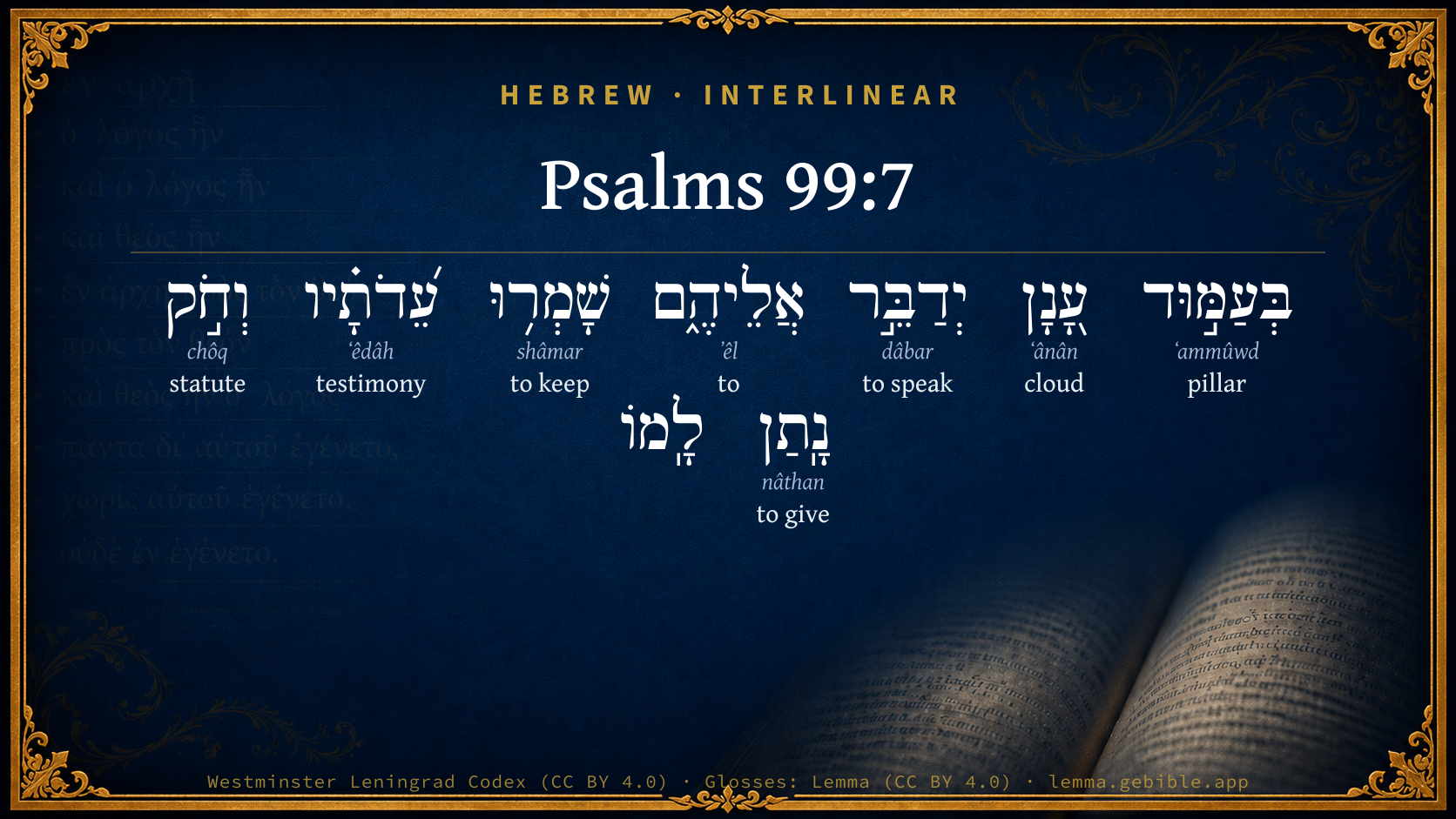
Psalms 99:7

Hebrew (Westminster Leningrad Codex) Psalms 99:7 appears in the Hebrew Old Testament. The text above is from the Westminster Leningrad Codex. Each word links to its Strong’s number, a concise gloss, and parsing drawn from the Open Scriptures Hebrew Bible morphology. Click any word for its full Brown-Driver-Briggs (BDB) entry.
Download image
Cite this verse

Psalms 99:7 (World English Bible). Public Domain. Lemma interlinear Bible study tool, https://lemma.gebible.app/v/psalms/99/7.

Show BibTeX & RIS
BibTeX
RIS
English Translation
He spoke to them in the pillar of cloud. They kept his testimonies, The statute that he gave them.
World English Bible · Public Domain
Download a study sheet

One document with this verse’s original text, its word-by-word gloss line, the meaning frame, cross-references with their text, attributed commentary, and full source and license credits — printable, and it pastes into notes with its structure intact.

This verse Autodidact and up

Study sheet (.html) Plain text (.txt)

A passage Seminary Student

Up to 50 verses in one chapter. A passage sheet keeps up to 6 commentary sources and 12 cross-references per verse, in the order this page ranks them, and says so on the sheet whenever that leaves anything out. Ask for a single verse and you get the Autodidact verse sheet above.

Everything on this page stays free to read, with no account — the sheet is a download of what is already on screen, not access to it.

Want to remove ads? Support Godless Engineer
Compare translations 3

The same verse in 3 English versions, stacked beneath the original-language interlinear above. Click any original word for its lexicon entry.

Each is an independent rendering of the whole verse — the interlinear is not word-aligned to these translations.

Highlighted words mark where these versions differ — a whole-verse word diff, not a word-by-word alignment.

  • World English Bible Public Domain
    He spoke to them in the pillar of cloud. They kept his testimonies, The statute that he gave them.
  • King James Version Public Domain
    He spake unto them in the cloudy pillar: they kept his testimonies, and the ordinance that he gave them.
  • unfoldingWord Literal Text CC BY-SA 4.0
    In the pillar of cloud he spoke to them. They kept his testimonies and the statutes he gave to them.

unfoldingWord Literal Text — © unfoldingWord, licensed CC BY-SA 4.0. Word-aligned USFM3 via Door43 (git.door43.org/unfoldingWord/en_ult).

Versions to compare (up to 4)

3 of 4 selected

Show all 18 translations

Every available English version of this verse, each an independent rendering of the whole verse.

  • World English Bible Public Domain
    He spoke to them in the pillar of cloud. They kept his testimonies, The statute that he gave them.
  • Berean Standard Bible Public Domain
    He spoke to them from the pillar of cloud; they kept His decrees and the statutes He gave them.
  • Majority Standard Bible Public Domain
    He spoke to them from the pillar of cloud; they kept His decrees and the statutes He gave them.
  • King James Version Public Domain
    He spake unto them in the cloudy pillar: they kept his testimonies, and the ordinance that he gave them.
  • American Standard Version (1901) Public Domain
    He spake unto them in the pillar of cloud: They kept his testimonies, And the statute that he gave them.
  • Revised Version (1885) Public Domain
    He spake unto them in the pillar of cloud: they kept his testimonies, and the statute that he gave them.
  • Geneva Bible (1599) Public Domain
    Hee spake vnto them in the cloudie pillar: they kept his testimonies, and the Lawe that he gaue them.
  • Douay-Rheims (1899) Public Domain
    he spoke to them in the pillar of the cloud. They kept his testimonies, and the commandment which he gave them.
  • Young's Literal Translation Public Domain
    In a pillar of cloud He speaketh unto them, They have kept His testimonies, And the statute He hath given to them.
  • Literal Standard Version CC BY-SA 4.0
    He speaks to them in a pillar of cloud, || They have kept His testimonies, || And He has given the statute to them.
  • Unlocked Literal Bible CC BY-SA 4.0
    He spoke to them from the pillar of cloud. They kept his solemn commands and the statutes that he gave them.
  • unfoldingWord Literal Text CC BY-SA 4.0
    In the pillar of cloud he spoke to them. They kept his testimonies and the statutes he gave to them.
  • Darby Bible Public Domain
    He spoke unto them in the pillar of cloud: they kept his testimonies, and the statute that he gave them.
  • World Messianic Bible Public Domain
    He spoke to them in the pillar of cloud. They kept his testimonies, the statute that he gave them.
  • Webster's Bible Public Domain
    He spoke to them in the cloudy pillar: they kept his testimonies, and the ordinance that he gave them.
  • Free Bible Version CC BY-SA 4.0
    He spoke to the people from the pillar of cloud, and they kept the laws and decrees he gave them.
  • Bible in Basic English Public Domain
    His voice came to them from the pillar of cloud; they kept his witness, and the law which he gave them.
  • JPS Tanakh (1917) Public Domain
    He spoke unto them in the pillar of cloud; they kept His testimonies, and the statute that He gave them.

Literal Standard Version (2020), Covenant Press — licensed CC BY-SA 4.0. Text via the HelloAO Bible API (eBible.org). Unlocked Literal Bible (unfoldingWord) — licensed CC BY-SA 4.0. Text via the HelloAO Bible API (eBible.org). unfoldingWord Literal Text — © unfoldingWord, licensed CC BY-SA 4.0. Word-aligned USFM3 via Door43 (git.door43.org/unfoldingWord/en_ult). Free Bible Version, Dr. Jonathan Gallagher — licensed CC BY-SA 4.0. Text via the HelloAO Bible API (eBible.org).

Word by word

More ways to search: Search by grammar → Find every occurrence → Compare this word →

Practice this passage: Drill this verse → Learn its vocabulary →

עֵ֝דֹתָ֗יו
ʻêdâh
H5713
“testimonies · his”
Noun, Common, Feminine, Plural, Construct + Suffix, Personal, 3rd Person, Masculine, Singular
Part of Speech
Noun
Type
Common
Gender
Feminine
Number
Plural
State
Construct
Full BDB Definition

Origin: from H5707 in its technical sense

TWOT: 1576c , 1576e

testimony, witness - always plural and always of laws as divine testimonies
  1. בְּעַמּ֣וּד ʻammûwd H5982 “in/at · pillar of” Preposition + Noun, Common, Masculine, Singular, Construct
  2. עָ֭נָן ʻânân H6051 “cloud” Noun, Common, Masculine, Singular, Absolute
  3. יְדַבֵּ֣ר dâbar H1696 “to speak” Verb, Piel, Imperfect, 3rd Person, Masculine, Singular
  4. אֲלֵיהֶ֑ם ʼêl H413 “to · them” Preposition + Suffix, Personal, 3rd Person, Masculine, Plural
  5. שָׁמְר֥וּ shâmar H8104 “to keep” Verb, Qal, Perfect, 3rd Person, Common, Plural
  6. וְחֹ֣ק chôq H2706 “and · statute” Conjunction + Noun, Common, Masculine, Singular, Absolute
  7. נָֽתַן nâthan H5414 “to give” Verb, Qal, Perfect, 3rd Person, Masculine, Singular

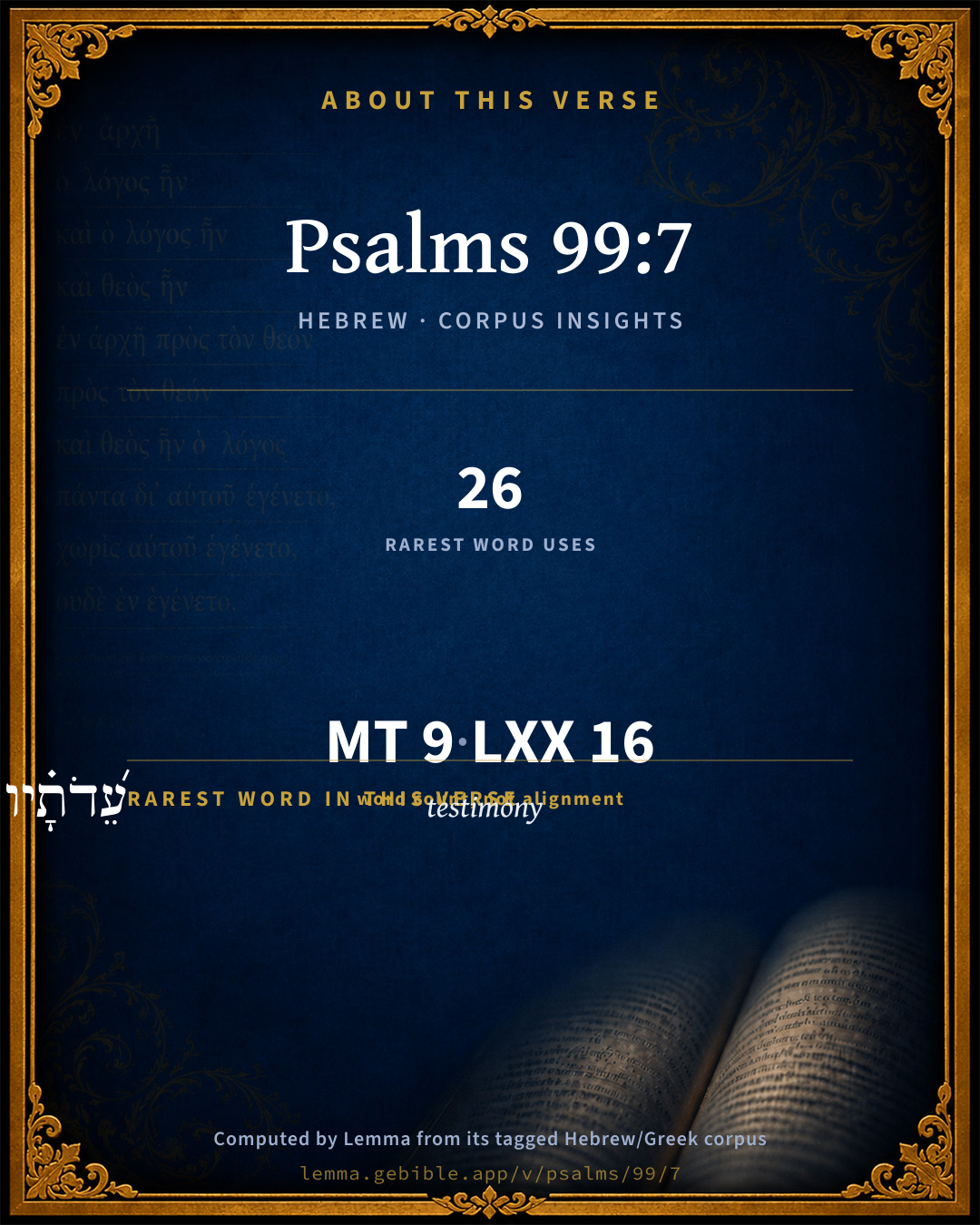
About this verse

These counts appear in no published source. They are computed here, from the morphology-tagged text and Lemma’s own curated glosses. What Lemma adds →

9
words
8
distinct lemmas
Wisdom
section

Shared distinctive vocabulary

עֵ֝דֹתָ֗יו testimony H5713 occurs in 25 verses of the Hebrew Bible. Also found in:

Grammatical profile

  • 3 verbs
  • 4 nouns
  • 2 prepositions

Verb forms

  • יְדַבֵּ֣ר Piel · Imperfect
  • שָׁמְר֥וּ Qal · Perfect
  • נָֽתַן Qal · Perfect

Hebrew & Septuagint length

In English translation the verse runs 19 words from the Hebrew and 20 from the Septuagint (LXX English) — closely comparable.

A rough comparison of the two English renderings, which tokenize alike — not a word-level alignment.

Word counts can differ between the Hebrew and the Greek without any difference in meaning — e.g. the Hebrew direct-object marker אֵת has no separate Greek word, and Greek often adds the article ὁ.

In the original languages it is 9 Hebrew tokens and 16 Greek tokens — but the two are counted differently (Hebrew bundles its prefixes and suffixes into one token; the Greek is in lemma form), so that isn’t a like-for-like length.

Cross-references

12

Topical passages linked to Psalms 99:7 in the Treasury of Scripture Knowledge — connected by theme and wording, ordered by reader-vote popularity; previews shown in the World English Bible.

  • Exodus 33:9 It happened, when Moses entered into the Tent, that the pillar of cloud descended, stood at the door of the Tent, and spoke with Moses.
  • Numbers 12:5 Yahweh came down in a pillar of cloud, and stood at the door of the Tent, and called Aaron and Miriam; and they both came forth.
  • Deuteronomy 4:5 Behold, I have taught you statutes and ordinances, even as Yahweh my God commanded me, that you should do so in the midst of the land where you go in to possess it.
  • Exodus 19:9 Yahweh said to Moses, "Behold, I come to you in a thick cloud, that the people may hear when I speak with you, and may also believe you forever." Moses told the words of the people to Yahweh.
  • Hebrews 3:2 who was faithful to him who appointed him, as also was Moses in all his house.
  • 1 John 3:21–22 Beloved, if our hearts don't condemn us, we have boldness toward God;
  • Exodus 40:16 Thus did Moses: according to all that Yahweh commanded him, so he did.
  • Deuteronomy 33:9 Who said of his father, and of his mother, I have not seen him; Neither did he acknowledge his brothers, Nor knew he his own children: For they have observed your word, Keep your covenant.
  • 1 Samuel 12:3–5 Here I am: witness against me before Yahweh, and before his anointed: whose ox have I taken? or whose donkey have I taken? or whom have I defrauded? whom have I oppressed? or of whose hand have I taken a ransom to blind my eyes therewith? and I will restore it you.
  • Psalms 105:28 He sent darkness, and made it dark. They didn't rebel against his words.
  • Proverbs 28:9 He who turns away his ear from hearing the law, Even his prayer is an abomination.
  • Numbers 16:15 Moses was very angry, and said to Yahweh, "Don't respect their offering: I have not taken one donkey from them, neither have I hurt one of them."

Cross-references courtesy of OpenBible.info (CC BY 4.0).

Hebrew and Greek witnesses Masoretic Hebrew ↔ Greek Septuagint

The same verse in the two great witnesses to the Old Testament, shown verse-for-verse.

You’re reading Greek Psalm 98 (Hebrew Psalm 99). The Septuagint counts the superscription, so verse numbers can differ from the Hebrew — chapter-level alignment, not verse-by-verse. Numbering follows Rahlfs.

These are two independent witnesses, not word-aligned to each other, and the Septuagint is shown in lemma (dictionary) form.

Hebrew Psalms 99:7 Masoretic · Westminster Leningrad Codex

בְּעַמּ֣וּד עָ֭נָן יְדַבֵּ֣ר אֲלֵיהֶ֑ם שָׁמְר֥וּ עֵ֝דֹתָ֗יו וְחֹ֣ק נָֽתַן לָֽמוֹ

He spoke to them in the pillar of cloud. They kept his testimonies, The statute that he gave them.

World English Bible · Public Domain

Greek LXX Greek Psalm 98:7 Septuagint · lemma form

ἐν στῦλος νεφέλη λαλέω πρός αὐτός φυλάσσω ὁ μαρτύριον αὐτός καί ὁ πρόσταγμα ὅς δίδωμι αὐτός

He spoke to them in a pillar of cloud; they kept his testimonies, and the ordinances which he gave them.

LXX2012 (modern English Septuagint) · Public Domain

Hebrew: Westminster Leningrad Codex (CC BY 4.0). Greek: Septuagint (public domain); English from LXX2012 (modern English Septuagint) (Public Domain). How the Septuagint differs from the Hebrew →

Commentary

Notes on Psalms 99:7 from classic Christian and Jewish commentators (each source and its license shown beneath its notes). The classic Christian expositions comment on the surrounding passage and are grouped to its opening verse, so a note may address several verses; the Jewish commentaries on the Tanakh (Rashi and others) are per-verse, so they appear only where the commentator wrote on this verse.

Lemma curates 59 commentaries, every one of them public domain or Creative Commons licensed, each selected and text-cleaned for this edition rather than reprinted as found. About our sources →

Trapp's Complete Commentary

John Trapp

Psa 99:7 He spake unto them in the cloudy pillar: they kept his testimonies, and the ordinance [that] he gave them.

Ver. 7. They kept his testimonies] And so showed that they called upon God with a true heart, in full assurance of faith, Heb 10:22.

John Trapp, A Commentary or Exposition upon All the Books of the Old and New Testament (1647–1656) — public domain. Text from a community e-Sword module.

Joseph Benson's Commentary

Psa 99:7. He spake unto them in the cloudy pillar — That is, to some of them: to Moses frequently, and to Aaron sometimes, as Num 12:5. And although it is not anywhere expressly said that God spake unto Samuel out of the cloudy pillar, yet, as Dr. Hammond observes, it is probable enough from his history that he did so; for when Samuel was so signally heard by God at Mizpeh, 1 Samuel 7., it is said, 1Sa 7:9, The Lord answered him; and 1Sa 7:10, The Lord thundered with a great thunder, which supposes a cloud, if not a cloudy pillar; and so this answering of Samuel with thunder, must be God’s speaking to him at this time out of the cloud. They kept his testimonies — This is added, not only for their commendation, but for the instruction of the Israelites, to teach them that God would not hear the prayers of them who did not keep his commandments.

Joseph Benson's Commentary on the Old and New Testaments (1811–1818) — public domain. Text from a community e-Sword module.

J. A. Alexander on Psalms

Joseph Addison Alexander

7. (Psa 99:7) In a pillar of cloud he speaks to them. They kept his testimonies and the statute he gave unto them. The first clause may be figuratively understood as denoting any special divine communication, or what was literally true of Moses and Aaron (Exo 33:9, Num 12:5, Deu 31:15) may be here applied to all three indiscriminately. The verse contains a second lesson drawn from the history of the theocracy, to wit, the necessity of obedience no less than of prayer. It was true, God spoke to these men in an extraordinary manner; but it was for the purpose of making known his will, and that will they obeyed. For the meaning of testimonies, see above, on Psa 93:5. The last clause may be construed as an independent proposition, and he gave a statute to them, i.e. he rewarded their obedience by revealing to them new laws. But the sense thus obtained is not so clear or natural as that afforded by the relative construction, and the statute (which) he gave them.

Joseph Addison Alexander, The Psalms Translated and Explained (1850) — public domain. Text from a community e-Sword module.

Tyndale Open Study Notes

Tyndale Open Resources

99:7 The Lord spoke to Moses and Aaron from the pillar of cloud (Exod 33:9; Num 12:5-6), and for a time, the people responded to the revelation.

Tyndale Open Study Notes — © Tyndale Open Resources, licensed CC BY-SA 4.0. Text via the HelloAO Bible API.

Adam Clarke's Commentary

Verse 7. He spake unto them in the cloudy pillar] That is, he directed all their operations, marchings, and encampments by this cloudy pillar. See Ex 33:9.

They kept his testimonies] Do ye the same, and God will be your portion as he was theirs.

Adam Clarke's Commentary on the Bible (1810–1826) — public domain. Text from a community e-Sword/MySword module.

The Cambridge Bible for Schools and Colleges

gen. ed. J. J. S. Perowne

7. In the pillar of cloud he speaketh unto them,

When they keep his testimonies, and the statute which he hath given them.

7. He reveals Himself once more as He spoke to His people of old by the mediation of Moses. See Exo_33:7 ff. The second line virtually expresses the condition of prevailing prayer—obedience to the revealed will of God.

The Cambridge Bible for Schools and Colleges (gen. ed. J. J. S. Perowne; Cambridge University Press, 1878–1918) — public domain. Text from a community e-Sword module.

John Gill's Exposition

He spake unto them in the cloudy pillar,.... In the pillar of the clouds of glory, as the Targum; in which the Lord went before the children of Israel in the wilderness, to lead them, and protect them from heat in the day, Exo 13:21, that is, he spake in this to Moses and Aaron; for it ceased when they came to the land of Canaan; instances of which see in Exo 19:9, some have thought that the Lord might speak to Samuel also out of a cloud, when he called upon him, and it thundered, since clouds and thunder go together, Sa1 12:18, the cloudy pillar was a type of Christ; and it is by him the Lord has spoken all his mind and will, when he was clothed with a cloud, or became obscure in the form of a servant; and it is through him, the Mediator, that men have access to God, and answers of prayer from him:

they kept his testimonies; the law, and the precepts of it, which were testifications of the mind and will of God; these Moses, Aaron, and Samuel, kept, though not perfectly, yet sincerely, from a principle of love, and with a view to the glory of God:

and the ordinance that he gave them; the ordinance of the passover, with the several rituals of the ceremonial law, which was an ordinance of God until the Messiah came; and we, under the Gospel dispensation, ought to keep the ordinances of Christ in faith and love, as they have been delivered to us; and such only can expect to be heard and answered by the Lord; and this is the reason of the mention of these things; see Psa 66:18.

John Gill's Exposition of the Whole Bible (1746–1763) — public domain (CC PDM 1.0). Text via the HelloAO Bible API.

Albert Barnes' Notes on the Bible

He spake unto them in the cloudy pillar - He spake to the men of other times; to those who called upon his name. It cannot be meant literally that he spake to “Samuel” from the “cloudy pillar” - the pillar which guided the Israelites in the wilderness, unless that term be understood in the general sense as denoting the “Shechinah” - the visible symbol of the divine presence - the cloud that rested on the ark. The idea is, that God his people in ancient times from the cloud - the symbol of his presence; that he communed with them; that he heard their prayers; that he gave them his commandments; that he interposed in their behalf, and that it was not a vain thing that they worshipped him. All this was as true of Samuel - it is as true now of those who call upon God - as it was of Moses and Aaron.

They kept his testimonies ... - They obeyed his laws, and he thus heard and answered them.

Albert Barnes' Notes on the Bible (1834–1885) — public domain. Text from a community e-Sword/MySword module.

Matthew Poole's English Annotations

Unto them, i.e. to some of them; for the expression is only indefinite, and therefore doth not necessarily reach to all of them: to Moses frequently; to Aaron, Exo 19:24; 33:9-11; Num 12:5; and for Samuel, he answered him, if not by words, yet really and by his actions, thundering against the Philistines, 1Sa 7:9, &c, which supposeth a cloud, if not a cloudy pillar.

They kept his testimonies, and the ordinance that he gave them: this is added, not only for their commendation, but for the instruction of the Israelites, to teach them that God will not hear the prayers of them who do not keep his commandments.

Matthew Poole's English Annotations on the Holy Bible (1683–1685) — public domain. Text from a community e-Sword/MySword module.

The Treasury of David

Charles H. Spurgeon

Ver. 7. He spake unto them in the cloudy pillar. We have had mention of the ark and the shekinah, and now of the fiery cloudy pillar, which was another visible token of the presence of God in the midst of Israel. Responses came to Moses and Aaron out of that glorious overshadowing cloud, and though Samuel saw it not, yet to him also came the mystic voice which was wont to thunder forth from that divine canopy. Men have had converse with God, let men therefore speak to God in return. He has told us things to come, let us in return confess the sins which are past; he has revealed his mind to us, let us then pour out our hearts before him.

They kept his testimonies. When others turned aside they were faithful; in their hearts they laid up his word, and in their lives they obeyed it. When he spake to them they observed his will, and therefore when they spake to him he yielded to their desires. This keeping of the divine testimonies is a virtue all too rare in these our days; men run after their own views and opinions, and make light of the truth of God; hence it is that they fail in prayer, and scoffers have even dared to say that prayer avails not at all. May the good Lord bring back his people to reverence his word, and then will he also have respect unto the voice of their cry.

And the ordinance that he gave them. His practical precept they observed as well as his doctrinal instruction. Ordinances are not to be trifled with, or testimonies will also be despised; and the converse is also true, a light estimate of inspired dogma is sure to end in neglect of moral virtues. To Moses, Aaron, and Samuel special and personal charges were committed, and they were all true to their trust, for they stood in awe of the Lord, their God, and worshipped him with their whole souls. They were very different men, and had each one a work to do peculiar to himself, yet because each was a man of prayer they were all preserved in their integrity, fulfilled their office, and blessed their generation. Lord, teach us like Moses to hold up our hands in prayer and conquer Amalek, like Aaron to wave the censer between the living and the dead till the plague is stayed, and like Samuel to say to a guilty people, "God forbid that I should sin against the Lord in ceasing to pray for you; "if thou wilt make us mighty with thee in prayer, we shall also be kept faithful before thee in the service which thou hast laid upon us.

Ver. 7. They kept his testimonies. For this reason they were so promptly heard, even as the Lord himself says, "If a man love me he will keep my words, "and again, "If ye abide in me and my words abide in you, ye shall ask what ye will and it shall be done unto you." And the ordinance that he gave them. They not only observed the precepts which bind men in general, but the peculiar obligation of governing, directing, and teaching the people committed to them. Bellarmine.

Ver. 7 (first clause). The revelation of the cloud, or what God foreshadowed to Israel in the cloudy pillar.

1. That God was willing to commune with man.

2. That sinful man could not see God and live.

3. That God should become incarnate, veiled in flesh as in the cloud.

4. That he should be their shelter, protector, guide.

5. That God manifest in the flesh should lead them to the Promised LandHeaven. C. D.

Psalms 99:8*

Charles H. Spurgeon's The Treasury of David (1869–1885) — public domain. Psalms only. Text from a community e-Sword/MySword module.

Whedon's Commentary on the Bible

Daniel D. Whedon

7. He spake unto them in the cloudy pillar—That is, unto Moses and Aaron, and through them to the people, as Exo_19:9; Num_12:5; and to Samuel, 1Sa_3:10; 1Sa_7:9-10.

They kept his testimonies—Beautiful is this pious example of these heads and leaders of the nation.

Daniel D. Whedon (gen. ed.), Commentary on the Old and New Testaments (1874–1909) — public domain. Text from a community e-Sword module.

The Pulpit Commentary

He spake unto them in the cloudy pillar. (see Exo_33:9, "And it came to pass, as Moses entered into the tabernacle, the cloudy pillar descended, and stood at the door.., and the Lord talked with Moses They kept his testimonies, and the ordinance that he gave them. Moses was known as "the servant of the Lord". (Deu_34:5 Jos_1:1, Jos_1:2, etc.) He was "faithful in all his house, as a servant". (Heb_3:5) Aaron was "the saint of the Lord". (Psa_106:16) This general obedience was, however, departed from in some few instances (see the comment on ver. 8).

The Pulpit Commentary (1880–1919), ed. H.D.M. Spence-Jones & Joseph S. Exell — public domain. Text from a community e-Sword module.

John Wesley's Explanatory Notes

Spake - To some of them: to Moses and Aaron, Exod. xix, 24; xxxiii, 9-11; 1 Sam. vii, 9, &c.

John Wesley, Explanatory Notes Upon the Whole Bible (1754–1765) — public domain. Text via the GEBible commentary corpus.

Rashi

Rabbi Shlomo Yitzchaki (Rashi)

In a pillar of cloud He would speak to them Even with Samuel. This is what is stated (I Sam. 9: 11f.): “and they said to them, Is the seer here? and they answered them and said, He is (יֵש).” You will see a cloud attached to his doorway, as Scripture says (Num. 9:20): “And sometimes the cloud would be...”

they kept His testimonies and the statute He gave them The statute that He gave them.

Rashi on the Tanakh — English translations: “The Judaica Press complete Tanach with Rashi, translated by A. J. Rosenberg” (CC BY 4.0); “Pentateuch with Rashi's commentary by M. Rosenbaum and A.M. Silbermann, 1929-1934” (public domain); “The Metsudah Tanach series, Lakewood, N.J” (CC BY 4.0); and “The Book of Joshua, Metsudah Publications, 1997” (CC BY 4.0). Text via Sefaria.

Lesson kit

Teaching starters — assembled from the data on this page, not authored interpretation. Every prompt links to the verse data it draws on. Edit before teaching.

Psalms, in the Wisdom, opens this verse with 9 words (8 distinct Hebrew lemmas). Its most distinctive word is ʻêdâh (“testimony”). A historical commentator’s framing appears above. Read the whole chapter for the surrounding context.

Discussion questions

  1. The word ʻêdâh carries the sense “testimony.” How does it shape the verse?
  2. How does Genesis 21:30, which shares the word «testimony», read alongside this verse?
  3. The translations on this page render this verse differently — a whole-verse word diff, not a word-by-word alignment. What might account for the different wordings?
  4. «יְדַבֵּ֣ר» is a Piel Imperfect verb. How does that grammatical form shape the action described?
  5. Compare how Trapp's Complete Commentary and Joseph Benson's Commentary read this verse. Where do they agree or differ?

Things to notice

Reading settings

Reading text

Shown beneath each verse's original-language words.

Old Testament
Old Testament edition

Read the OT as the Masoretic Hebrew (MT) or the Greek Septuagint (LXX).

English shown for the Greek Septuagint (in the Hebrew ↔ Greek comparison).

Comparing translations? Open the Compare panel on any verse page to stack up to four side by side.