
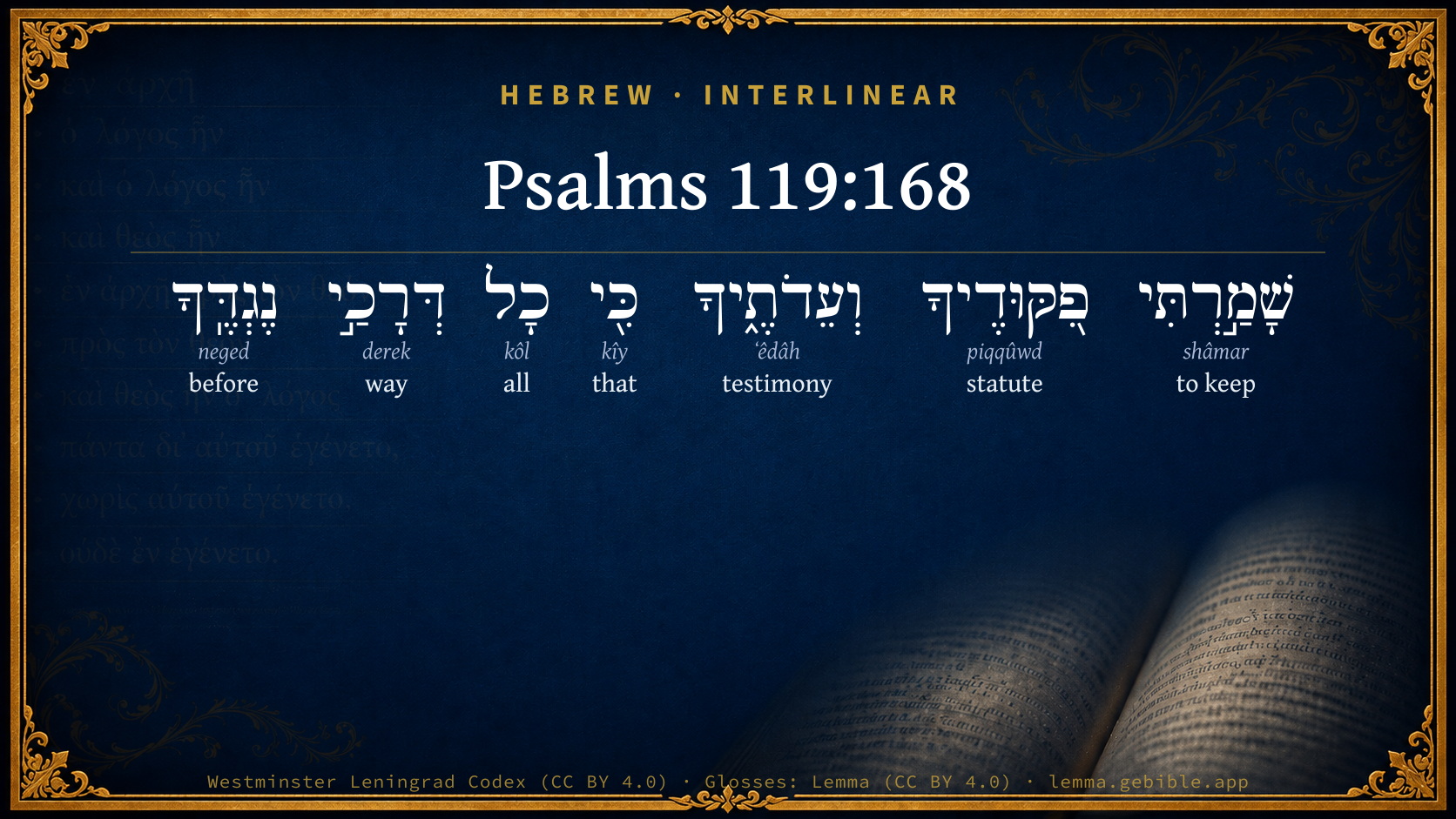
Psalms 119:168

Hebrew (Westminster Leningrad Codex) Psalms 119:168 appears in the Hebrew Old Testament. The text above is from the Westminster Leningrad Codex. Each word links to its Strong’s number, a concise gloss, and parsing drawn from the Open Scriptures Hebrew Bible morphology. Click any word for its full Brown-Driver-Briggs (BDB) entry.
Download image
Cite this verse

Psalms 119:168 (World English Bible). Public Domain. Lemma interlinear Bible study tool, https://lemma.gebible.app/v/psalms/119/168.

Show BibTeX & RIS
BibTeX
RIS
English Translation
I have obeyed your precepts and your testimonies, For all my ways are before you.
World English Bible · Public Domain
Download a study sheet

One document with this verse’s original text, its word-by-word gloss line, the meaning frame, cross-references with their text, attributed commentary, and full source and license credits — printable, and it pastes into notes with its structure intact.

This verse Autodidact and up

Study sheet (.html) Plain text (.txt)

A passage Seminary Student

Up to 50 verses in one chapter. A passage sheet keeps up to 6 commentary sources and 12 cross-references per verse, in the order this page ranks them, and says so on the sheet whenever that leaves anything out. Ask for a single verse and you get the Autodidact verse sheet above.

Everything on this page stays free to read, with no account — the sheet is a download of what is already on screen, not access to it.

Want to remove ads? Support Godless Engineer
Compare translations 3

The same verse in 3 English versions, stacked beneath the original-language interlinear above. Click any original word for its lexicon entry.

Each is an independent rendering of the whole verse — the interlinear is not word-aligned to these translations.

Highlighted words mark where these versions differ — a whole-verse word diff, not a word-by-word alignment.

  • World English Bible Public Domain
    I have obeyed your precepts and your testimonies, For all my ways are before you.
  • King James Version Public Domain
    I have kept thy precepts and thy testimonies: for all my ways are before thee.
  • unfoldingWord Literal Text CC BY-SA 4.0
    I keep your precepts and your testimonies, for all my ways before you. TAV

unfoldingWord Literal Text — © unfoldingWord, licensed CC BY-SA 4.0. Word-aligned USFM3 via Door43 (git.door43.org/unfoldingWord/en_ult).

Versions to compare (up to 4)

3 of 4 selected

Show all 17 translations

Every available English version of this verse, each an independent rendering of the whole verse.

  • World English Bible Public Domain
    I have obeyed your precepts and your testimonies, For all my ways are before you.
  • Berean Standard Bible Public Domain
    I obey Your precepts and Your testimonies, for all my ways are before You.
  • Majority Standard Bible Public Domain
    I obey Your precepts and Your testimonies, for all my ways are before You.
  • King James Version Public Domain
    I have kept thy precepts and thy testimonies: for all my ways are before thee.
  • American Standard Version (1901) Public Domain
    I have observed thy precepts and thy testimonies; For all my ways are before thee.
  • Revised Version (1885) Public Domain
    I have observed thy precepts and thy testimonies; for all my ways are before thee.
  • Geneva Bible (1599) Public Domain
    I haue kept thy precepts and thy testimonies: for all my wayes are before thee.
  • Young's Literal Translation Public Domain
    I have kept Thy precepts and Thy testimonies, For all my ways are before Thee!
  • Literal Standard Version CC BY-SA 4.0
    I have kept Your precepts and Your testimonies, || For all my ways are before You!
  • Unlocked Literal Bible CC BY-SA 4.0
    I keep your instructions and your solemn commands, for you are aware of everything I do.
  • unfoldingWord Literal Text CC BY-SA 4.0
    I keep your precepts and your testimonies, for all my ways before you. TAV
  • Darby Bible Public Domain
    I have kept thy precepts and thy testimonies; for all my ways are before thee.
  • World Messianic Bible Public Domain
    I have obeyed your precepts and your testimonies, for all my ways are before you. TAV
  • Webster's Bible Public Domain
    I have kept thy precepts and thy testimonies: for all my ways are before thee.
  • Free Bible Version CC BY-SA 4.0
    I keep your commandments and laws because you see everything I do. Taw
  • Bible in Basic English Public Domain
    I have been ruled by your orders; for all my ways are before you.
  • JPS Tanakh (1917) Public Domain
    I have observed Thy precepts and Thy testimonies; for all my ways are before Thee.

Literal Standard Version (2020), Covenant Press — licensed CC BY-SA 4.0. Text via the HelloAO Bible API (eBible.org). Unlocked Literal Bible (unfoldingWord) — licensed CC BY-SA 4.0. Text via the HelloAO Bible API (eBible.org). unfoldingWord Literal Text — © unfoldingWord, licensed CC BY-SA 4.0. Word-aligned USFM3 via Door43 (git.door43.org/unfoldingWord/en_ult). Free Bible Version, Dr. Jonathan Gallagher — licensed CC BY-SA 4.0. Text via the HelloAO Bible API (eBible.org).

Word by word

More ways to search: Search by grammar → Find every occurrence → Compare this word →

Practice this passage: Drill this verse → Learn its vocabulary →

About this verse

These counts appear in no published source. They are computed here, from the morphology-tagged text and Lemma’s own curated glosses. What Lemma adds →

7
words
7
distinct lemmas
Wisdom
section

Notable vocabulary

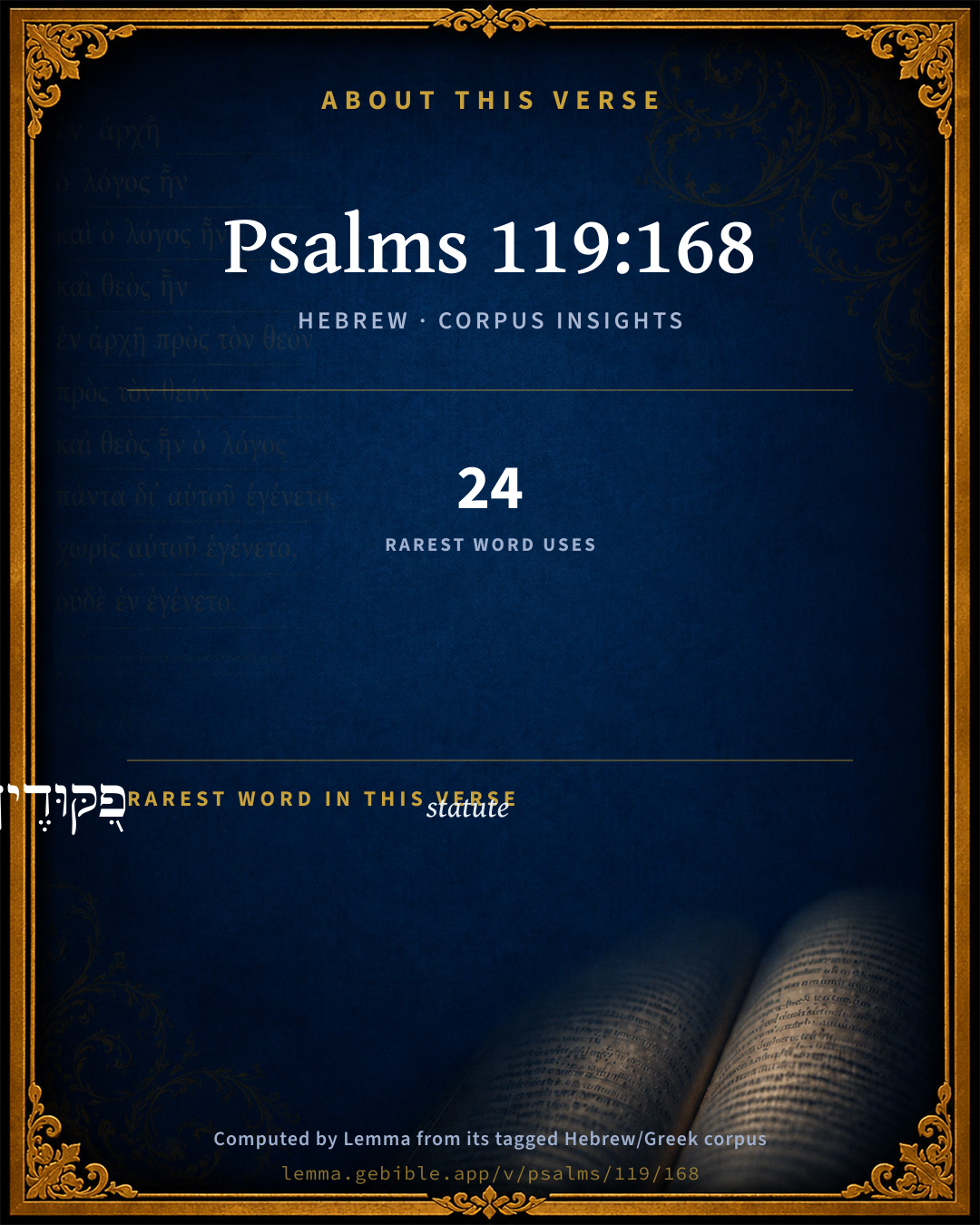
The rarest word here is פִ֭קּוּדֶיךָ statute H6490 — appearing just 24 times in the whole Hebrew Bible.

Shared distinctive vocabulary

פִ֭קּוּדֶיךָ statute H6490 occurs in 24 verses of the Hebrew Bible. Also found in:

Grammatical profile

  • 1 verb
  • 4 nouns
  • 1 preposition
  • 1 conjunction

Verb forms

  • שָׁמַ֣רְתִּי Qal · Perfect

Hebrew & Septuagint length

In English translation the verse runs 15 words from the Hebrew and 17 from the Septuagint (LXX English) — closely comparable.

A rough comparison of the two English renderings, which tokenize alike — not a word-level alignment.

Word counts can differ between the Hebrew and the Greek without any difference in meaning — e.g. the Hebrew direct-object marker אֵת has no separate Greek word, and Greek often adds the article ὁ.

Cross-references

8

Topical passages linked to Psalms 119:168 in the Treasury of Scripture Knowledge — connected by theme and wording, ordered by reader-vote popularity; previews shown in the World English Bible.

  • Proverbs 5:21 For the ways of man are before the eyes of Yahweh. He examines all his paths.
  • Psalms 139:3 You search out my path and my lying down, And are acquainted with all my ways.
  • Psalms 44:20–21 If we have forgotten the name of our God, Or spread forth our hands to a strange god;
  • Job 34:21 "For his eyes are on the ways of a man, He sees all his goings.
  • Jeremiah 23:24 Can any hide himself in secret places so that I shall not see him? says Yahweh. Don't I fill heaven and earth? says Yahweh.
  • Psalms 98:8 Let the rivers clap their hands. Let the mountains sing for joy together.
  • Revelation 2:23 I will kill her children with Death, and all the assemblies will know that I am he who searches the minds and hearts. I will give to each one of you according to your deeds.
  • Hebrews 4:13 There is no creature that is hidden from his sight, but all things are naked and laid open before the eyes of him with whom we have to do.

Cross-references courtesy of OpenBible.info (CC BY 4.0).

Hebrew and Greek witnesses Masoretic Hebrew ↔ Greek Septuagint

The same verse in the two great witnesses to the Old Testament, shown verse-for-verse.

You’re reading Greek Psalm 118 (Hebrew Psalm 119). The Septuagint counts the superscription, so verse numbers can differ from the Hebrew — chapter-level alignment, not verse-by-verse. Numbering follows Rahlfs.

These are two independent witnesses, not word-aligned to each other, and the Septuagint is shown in lemma (dictionary) form.

Hebrew Psalms 119:168 Masoretic · Westminster Leningrad Codex

שָׁמַ֣רְתִּי פִ֭קּוּדֶיךָ וְעֵדֹתֶ֑יךָ כִּ֖י כָל דְּרָכַ֣י נֶגְדֶּֽךָ

I have obeyed your precepts and your testimonies, For all my ways are before you.

World English Bible · Public Domain

Greek LXX Greek Psalm 118:168 Septuagint · lemma form

φυλάσσω ὁ ἐντολή σύ καί ὁ μαρτύριον σύ ὅτι πᾶς ὁ ὁδός ἐγώ ἐναντίον σύ κύριος

I have kept your commandments and your testimonies; for all my ways are before you, O Lord.

LXX2012 (modern English Septuagint) · Public Domain

Hebrew: Westminster Leningrad Codex (CC BY 4.0). Greek: Septuagint (public domain); English from LXX2012 (modern English Septuagint) (Public Domain). How the Septuagint differs from the Hebrew →

Commentary

Notes on Psalms 119:168 from classic Christian and Jewish commentators (each source and its license shown beneath its notes). The classic Christian expositions comment on the surrounding passage and are grouped to its opening verse, so a note may address several verses; the Jewish commentaries on the Tanakh (Rashi and others) are per-verse, so they appear only where the commentator wrote on this verse.

Lemma curates 59 commentaries, every one of them public domain or Creative Commons licensed, each selected and text-cleaned for this edition rather than reprinted as found. About our sources →

Trapp's Complete Commentary

John Trapp

Psa 119:168 I have kept thy precepts and thy testimonies: for all my ways [are] before thee.

Ver. 168. I have kept thy precepts] All thy laws are in my sight; like as all my ways are in thy sight. I desire to approve myself to thee in the discharge of every part and point of my duty; in all my ways I acknowledge thee, Pro 3:6. Here note, that all along this 21st octonary the psalmist propoundeth himself for a pattern of piety.

John Trapp, A Commentary or Exposition upon All the Books of the Old and New Testament (1647–1656) — public domain. Text from a community e-Sword module.

The Biblical Illustrator

Joseph S. Exell

Psa_119:168

I have kept Thy precepts and Thy testimonies: for all my ways are before Thee.

A sincere summary, and a searching inquiry

(with verse 176):--These two verses form a paradox, both true, and true of the same man, at the same time.

I. Our first text is a sincere summary of a godly mans life. Looking back, he can say of it in general, I have kept Thy precepts, etc.

1. It is needfull that we should have so lived that this shall be the summary of our life; for if we have not so lived, what evidence have we that we have been born again,--that we have passed from death unto life,--that we have been delivered from the bondage of sin, and brought into the way of holiness?

2. Whenever a man can truly say, with the psalmist, I have kept Thy precepts and Thy testimonies, it is a fruit of grace.

3. This summary of life is excellent for its breadth. I have kept Thy precepts and Thy testimonies. I feel that I am as much bound to believe right as to act right; and it is just as truly a sin to believe error, when I can learn the truth, as it is to commit iniquity.

4. It is excellent for its length.

5. It is excellent from its cause. The psalmist kept Gods precepts and testimonies because all his ways were before God. He felt that God was watching him, he lived under the consciousness of Gods presence with him both by night and day.

6. It is excellent from its use. It is an argument for the Gospel which the most sceptical cannot refute, and it is a most blessed way of propagating that Gospel, for men are more often convinced by our actions than by our words.

II. The psalmist, after he had spoken thus, and spoken quite sincerely and truly, yet felt that he must close his long lifes summary in another fashion. He then uttered our second text, which I called a searching scrutiny: I have gone astray, etc. The life of a believer may be like that of Job, perfect and upright, but when it comes under the scrutiny of an eye that is illuminated by the Spirit of God, and touched with the heavenly eye-salve, quite another verdict is given; and, tremblingly, with many tears, the confession is poured into the ear of God, I have gone astray like a lost sheep; followed by the petition, Seek Thy servant; and the renewed declaration, for I do not forget Thy commandment. (C. H. Spurgeon.)

The Biblical Illustrator, edited by Joseph S. Exell (c. 1880s–1900s) — public domain. Text from a community e-Sword module.

J. A. Alexander on Psalms

Joseph Addison Alexander

168. (Psa 119:168) I observe thy precepts and thy testimonies, because all my ways are before thee. He does not affect to be prompted by a love exclusive of all fear, but only of a slavish dread. He stands in awe of God's omniscience, and is influenced by dread of his disapprobation to obey his precepts, as well as by attachment to the law itself. My ways, my courses of conduct, mode of life, behaviour. Before thee, open to God's infallible inspection, and subjected to his judgment. Two of the verses in this stanza begin with forms of the verb to observe or keep.

Joseph Addison Alexander, The Psalms Translated and Explained (1850) — public domain. Text from a community e-Sword module.

Geneva Bible (1599)

Geneva Bible translators

I had no respect of men, but set thee always before mine eyes, as the judge of my doings.

Geneva Bible (1599) marginal notes — public domain. Text via Bolls.life.

Adam Clarke's Commentary

Verse 168. For all my ways are before thee.] Thou knowest that I do not lie; thy eye has been upon my heart and my conduct, and thou knowest that I have endeavoured to walk before thee with a perfect heart.

ANALYSIS OF LETTER SCHIN. - Twenty-first Division

In this section the psalmist shows: -

I His love to God; and

II. The ardour and perfection of that love.

I. The first sign of his love was, that it stood in the midst of persecution.

1. "Princes have persecuted."

2. But "without a cause," though they pretended many.

3. "But my heart standeth in awe." My love and confidence have due respect to thy infinite justice and immaculate purity.

The second sign of his love is the joy and delight he took in God's law; it was greater than a conqueror could feel at the fortunate issue of a battle, and the spoils of the vanquished, howsover rich or immense.

The third sign was his hatred to all iniquity: "I hate and abhor lying."

The fourth sign was his fervour and earnestness in - devotion: "Seven times," c.

The fifth sign was the satisfaction he took in the welfare of others.

1. "Great peace have they which love thy law."

2. "Nothing shall offend them." They go on their way rejoicing and they that love God rejoice with them that do rejoice.

II. He shows the perfection of his love, -

1. By his hope and confidence: "Lord, I have hoped," c.

2. By his obedience: "And done thy commandments."

3. By keeping God's testimonies with all his soul.

And this he repeats.

1. "I have kept thy precepts and thy testimonies."

2. I have done this through the purest motives, as thou knowest: "For all my ways are before thee." Whatever he did he did in God's sight for he well knew that the eye of the Lord was constantly upon him.

For other particulars see the preceding notes.

Adam Clarke's Commentary on the Bible (1810–1826) — public domain. Text from a community e-Sword/MySword module.

John Calvin's Commentaries

168. I have kept thy commandments and thy testimonies. What the Psalmist had expressed more strongly, he now repeats more simply, adding there to reason. He abbreviates the statement as made in the preceding verse only by here omitting the word soul, which he there uses, whilst to commandments he joins testimonies, in order the more distinctly to show that he does not speak exclusively of the rule of an upright and holy life, but also comprehends the whole covenant of salvation. And, assuredly, the doctrine of the law could not be so sweet and attractive from its commanding what is right, did it not at the same time exhibit the free favor of God. The reason which the Prophet assigns for his keeping God’s commandments and testimonies — for all my ways are before thee “All my ways are before thee” The meaning of this expression may be gathered from other scriptural phrases: such as ‘walking before God;’ or ‘in his sight;’ which merely signify to live holy and righteously, so as to be acceptable in his sight. God is omniscient, and, consequently, ‘all the ways’ or actions of men are ‘before him,’ or open to his knowledge and sight.” — Warner.

John Calvin's Commentaries (1540-1563) — public domain. Text from the Calvin Translation Society English edition (1840s-50s) via the Christian Classics Ethereal Library (ccel.org). Calvin's coverage is partial (roughly two-thirds of the Bible); uncommented books and verses are honest gaps, never fabricated. The 19th-century editor's footnotes and remarks are omitted so the notes are faithfully Calvin's own voice.

The Cambridge Bible for Schools and Colleges

gen. ed. J. J. S. Perowne

168. With the courage of a good conscience he appeals to God’s omniscience in proof of the sincerity of his purpose.

before thee] Cp. for the phrase Psa_38:9, and for the thought, Heb_4:13.

The Cambridge Bible for Schools and Colleges (gen. ed. J. J. S. Perowne; Cambridge University Press, 1878–1918) — public domain. Text from a community e-Sword module.

John Gill's Exposition

Let thine hand help me,.... Let thine hand of power help me against mine enemies, and deliver me from them; and let thine hand of providence and grace communicate to me, and supply me with and help me to everything needful for me, for body and soul; for time and eternity, all grace here, and glory hereafter; let thy right hand help me on in my way, hold and uphold me, keep and preserve me safe to heaven and happiness;

for I have chosen thy precepts; not only the good part, which shall not be taken away, and the way of truth, Psa 119:30; but even the commandments of God, which he preferred to the commandments of men, and choose rather to obey the one than the other; having a most ardent affection for them, an high esteem of them, and a strong attachment to them; see Psa 119:127.

John Gill's Exposition of the Whole Bible (1746–1763) — public domain (CC PDM 1.0). Text via the HelloAO Bible API.

Albert Barnes' Notes on the Bible

I have kept thy precepts and thy testimonies - This is an appeal which is several times made in the psalm; not with boasting, but as indicating the tenor and purpose of his life. Every man ought to be able to make such an appeal.

For all my ways are before thee - Thou hast seen my manner of life, and I may appeal to thee in proof that I have thus kept thy law. No one can lay claim to entire perfection, but there is many a man who, while conscious of much imperfection, and many shortcomings, can appeal to God for the truth of the statement that his great aim of life has been to keep his commandments.

Albert Barnes' Notes on the Bible (1834–1885) — public domain. Text from a community e-Sword/MySword module.

Matthew Poole's English Annotations

For, or because, all my ways are before thee. This is added either,

1. As the reason or motive of his obedience, which was the consideration of God’s omniscience, and his desire to approve himself and his ways to God; or,

2. As a proof and evidence of it. Whereas this and all his former professions of his piety were charged by his enemies with deep hypocrisy, and might seem to savour of pride and vainglory, here in the close of them he makes a solemn appeal to that God who knew his heart and all his ways, and whether these things were not true and real; which if they were not, he tacitly imprecates God’s judgment upon himself.

Matthew Poole's English Annotations on the Holy Bible (1683–1685) — public domain. Text from a community e-Sword/MySword module.

The Treasury of David

Charles H. Spurgeon

Ver. 168. I have kept thy precepts and thy testimonies. Both the practical and the doctrinal parts of God's word he had stored up, and preserved, and followed. It is a blessed thing to see the two forms of the divine word, equally known, equally valued, equally confessed: there should be no picking and choosing as to the mind of God. We know those who endeavour to be careful as to the precepts, but who seem to think that the doctrines of the gospel are mere matters of opinion, which they may shape for themselves. This is not a perfect condition of things. We have known others again who are very rigid as to the doctrines, and painfully lax with reference to the precepts. This also is far from right. When the two are "kept" with equal earnestness then have we the perfect man.

For all my ways are before thee. Probably he means to say that this was the motive of his endeavouring to be right both in head and heart, because he knew that God saw him, and under the sense of the divine presence he was afraid to err. Or else he is thus appealing to God to bear witness to the truth of what he has said. In either case it is no small consolation to feel that our heavenly Father knows all about us, and that if princes speak against us, and worldlings fill their mouths with cruel lies, yet he can vindicate us, for there is nothing secret or hidden from him.

We are struck with the contrast between this verse, which is the last of its octave, and Ps 119:176, which is similarly placed in the next octave. This is a protest of innocence, "I have kept thy precepts, "and that a confession of sin, "I have gone astray like a lost sheep." Both were sincere, both accurate. Experience makes many a paradox plain, and this is one. Before God we may be clear of open fault and yet at the same time mourn over a thousand heart wanderings which need his restoring hand.

Ver. 168. I have kept thy precepts, for all my ways are before thee. When men are some way off in a king's eye they will be comely in their carriage; but when they come into his presence chamber to speak with him they will be most careful. Because saints are always in God's sight, their constant deportment must be pious and seemly. George Swinnock.

Ver. 168. I have kept thy precepts, etc. The Hebrew word yne, shamar, that is here rendered "kept, "signifies to keep carefully, diligently, studiously, exactly. It signifies to keep as men keep prisoners, and to keep as a watchman keeps the city or the garrison; yea, to keep as a man would keep his very life. But now mark what was the reason that David kept the precepts and the testimonies of the Lord so carefully, so sincerely, so diligently, so studiously, and so exactly. Why, the reason you have in the latter part of the verse, "for all my ways are before thee." O sirs! it is as necessary for him that would be eminent in holiness, to set the Lord always before him, as it is necessary for him to breathe. In that 31st of Job you have a very large narrative of that height and perfection of holiness that Job bad attained to, and the great reason that he gives you, for this is in the 4th verse, "Doth not he see my way, and count all my steps?" The eye of God had so strong an influence upon his heart and life, that it wrought him up to a very high pitch of holiness. Thomas Brooks.

Ver. 168. All my ways are before thee. That God seeth the secrets of our heart, is a point terrible to the wicked but joyful to the godly. The wicked are sorry that their heart is so open: it is a boiling pot of all mischief, a furnace and forge house for evil. It grieveth them that man should hear and see their words and actions; but what a terror is this that their Judge, whom they hate, seeth their thought! If they could deny this, they would. But so many of them as are convinced and forced to acknowledge a God, are shaken betimes with this also that he is All seeing. Others proceed more summarily, and at once deny the Godhead in their heart, and so destroy this conscience of his All knowledge. But it is in vain: the more they harden their heart by this godless thought, the more fear is in them; while they choke and check their conscience that it crow not against them it checks them with foresight of fearful vengeance and for the present convinceth them of the omniscience of God, the more they press to suppress it. But the godly rejoice herein; it is to them a rule to square their thoughts by; they take no liberty of evil thinking, willing, wishing, or affecting, in their hearts. Where that candle shineth, all things are framed as worthy of him and of his sight, whom they know to be seeing their heart. William Struther, 1633.

Ver. 168. All my ways are before thee. Walk, Christian, in the view of God's omniscience; say to thy soul, cave, videt Deus;take heed, God seeth. It is under the rose, as the common phrase is, that treason is spoken, when subjects think they are far enough from their king's hearing; hut did such know the prince to be under the window, or behind the hangings, to their discourse would be more loyal. This made David so upright in his walking: "I have kept thy precepts, for all my ways are before thee." If Alexander's empty chair, which his captains, when they met in counsel, set before them, did awe them so as to keep them in good order; how helpful would it be to set before ourselves the fact that God is looking upon us! The Jews covered Christ's face, and then buffeted him: Mt 14:65. So does the hypocrite; he first says in his heart, God sees not, or at least forgets that he sees, and then he makes bold to sin against him; like that foolish bird, which runs her head among the reeds, and thinks herself safe from the fowler, as if because she did not see her enemy, therefore he could not see her. Te mihi abscondam, non me tibi (Augustine). I may hide thee from my eye, but not myself from thine eye. William Gurnall.

Ver. 168.

1. The claim of God's word upon our utmost obedience." I have kept thy precepts and thy testimonies." He does not mean that he had kept them perfectly; for that were to contradict other expressions in the psalm. He means that he kept them sincerely and strove to keep them perfectly, as one who realized their claim upon him.

(a) The whole word is divine: an equal authority pervades

every precept; no distinction should be made of more or

less obligation.

(b) The whole word is pure and right; expediency, or making

the measure and manner of obedience suitable to our own

purpose, is a false principle; to be carefully

distinguished from righteous expediency, which is the

foregoing of a personal right in consideration of another's

benefit.

(c) The moral code of the word is a unity; obedience is

like a connected chain, a wilful flaw in one link renders

all useless.

2. The consciousness which greatly helps obedience: "For all my ways are before thee."

(a) "Are before thee, "as plainly seen by thee.

(b) "Are before thee, "constantly observed.

(c) "Are before thee; "deliberately placed before thee by

me, that they may be corrected and directed.

J.F.

Ver. 168. All my ways are before thee.

1. The saint's delight.

2. The sinner's distress.

W.W.

Ver. 168 (second clause).

1. Necessarily so: for thou art the omniscient God: Ps 134:3.

2. Voluntarily so: for I choose to walk in thy sight. See Ps 16:9

3. Consciously and blessedly so. For the light of thy countenance inspires and gladdens me. See Ps 89:15.

W.H.J.P.

Ver. 168 (second clause). Living in the sight of God Actually the case with all; designedly the case of the godly; happily the case of the favoured; preeminently the case of those who abide in fellowship.

Ver. 168.

1. The practical and doctrinal teachings of God before us.

2. All our ways before him.

3. The sort of conduct which these two causes will produce.

Psalms 119:169*

The Psalmist is approaching the end of the psalm, and his petitions gather force and fervency; he seems to break into the inner circle of divine fellowship, and to come even to the feet of the great God whose help he is imploring this nearness creates the most lowly mew of himself, and leads him to close the psalm upon his face in deepest self humiliation, begging to be sought out like a lost sheep.

Charles H. Spurgeon's The Treasury of David (1869–1885) — public domain. Psalms only. Text from a community e-Sword/MySword module.

The Pulpit Commentary

I have kept thy precepts and thy testimonies (comp. vers. 166, 167). The assertion is made more broadly than a Christian would make it. But there is no intention to claim absolute perfection (see vers. 67, 71, 116, 117, 133, 176, etc.). For all my ways are before thee. Knowing that nothing which I do, or say, or think is hidden from thee, I have striven to keep thy Law in thought and word and deed.

The Pulpit Commentary (1880–1919), ed. H.D.M. Spence-Jones & Joseph S. Exell — public domain. Text from a community e-Sword module.

Rashi

Rabbi Shlomo Yitzchaki (Rashi)

for all my ways are before You You know all my ways.

Rashi on the Tanakh — English translations: “The Judaica Press complete Tanach with Rashi, translated by A. J. Rosenberg” (CC BY 4.0); “Pentateuch with Rashi's commentary by M. Rosenbaum and A.M. Silbermann, 1929-1934” (public domain); “The Metsudah Tanach series, Lakewood, N.J” (CC BY 4.0); and “The Book of Joshua, Metsudah Publications, 1997” (CC BY 4.0). Text via Sefaria.

Lesson kit

Teaching starters — assembled from the data on this page, not authored interpretation. Every prompt links to the verse data it draws on. Edit before teaching.

Psalms, in the Wisdom, opens this verse with 7 words (7 distinct Hebrew lemmas). Its most distinctive word is piqqûwd (“statute”). A historical commentator’s framing appears above. Read the whole chapter for the surrounding context.

Discussion questions

  1. The word piqqûwd carries the sense “statute.” How does it shape the verse?
  2. Psalms 19:8 shares the word «statute» with this verse. How do the two illuminate each other?
  3. The translations on this page render this verse differently — a whole-verse word diff, not a word-by-word alignment. What might account for the different wordings?
  4. The verb «שָׁמַ֣רְתִּי» is Qal Perfect. How does its form color the action?
  5. Reading how Trapp's Complete Commentary and The Biblical Illustrator read this verse, where do the two commentators agree and where do they part?

Things to notice

Reading settings

Reading text

Shown beneath each verse's original-language words.

Old Testament
Old Testament edition

Read the OT as the Masoretic Hebrew (MT) or the Greek Septuagint (LXX).

English shown for the Greek Septuagint (in the Hebrew ↔ Greek comparison).

Comparing translations? Open the Compare panel on any verse page to stack up to four side by side.