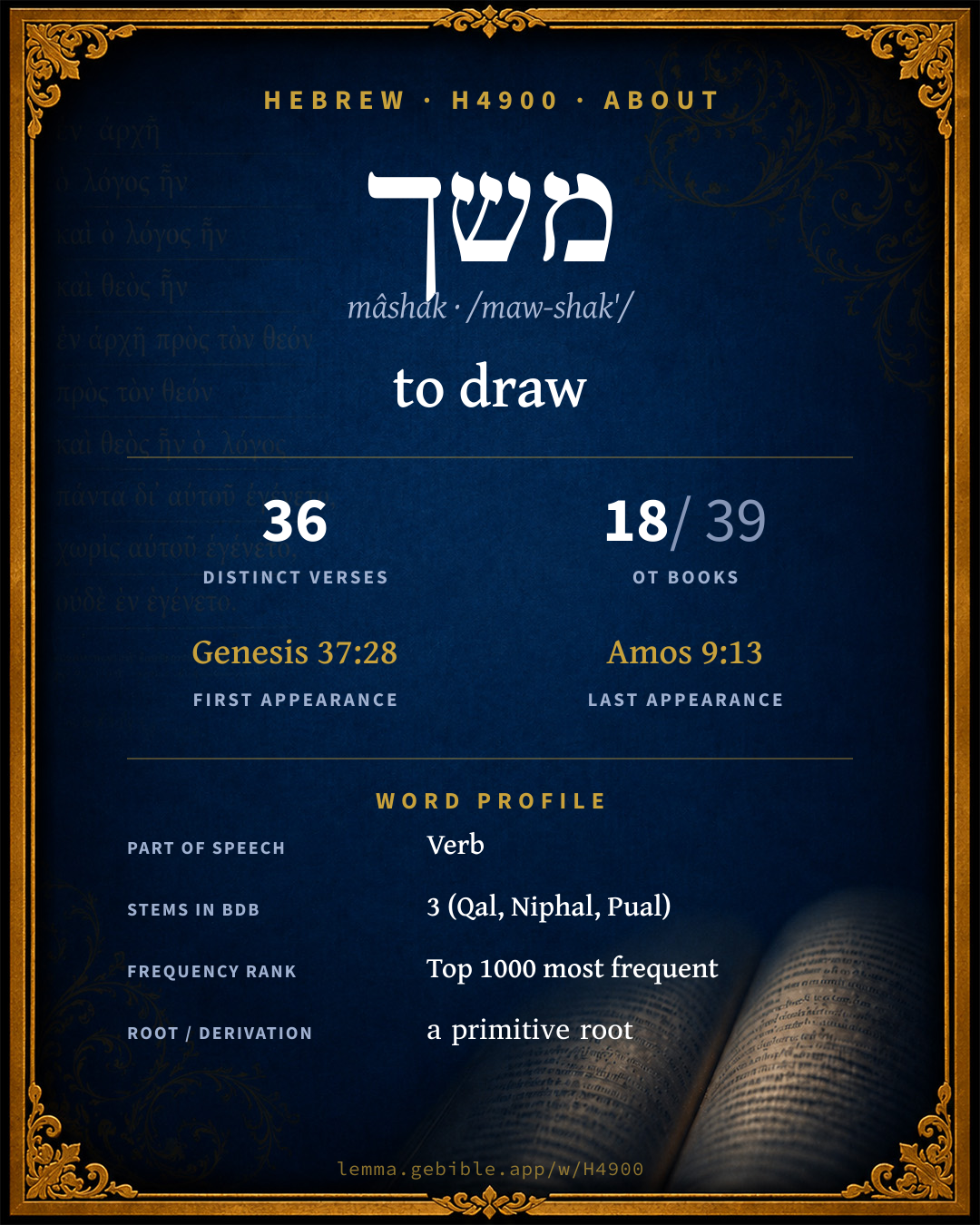
מָשַׁךְ
to draw
also: drag, seize fuller range ↓
Full lexicon entry — Brown-Driver-Briggs (BDB)
From Brown-Driver-Briggs (BDB)
Where this word appears
Grammar key — what these labels mean
Part of speech
- Verb
- An action or state-of-being word.
Stem
- Qal
- The basic, simple active stem — the plain form of the verb (“he wrote”). Here: ‘draw and lift out of’
- Niphal
- Usually the simple passive or reflexive of the Qal (“he was written”).
- Pual
- The passive counterpart of the Piel. Here: ‘long drawn out’
Form
- Infinitive Construct
- A bound verbal noun, frequently with prepositions (“to write / in writing”).
- Perfect
- A completed action or state — Hebrew marks aspect (completeness) more than strict tense (“he wrote”).
- Sequential Imperfect
- An imperfect with prefixed waw — the standard past-narrative form (waw-consecutive imperfect).
- Imperfect
- An incomplete, ongoing, or future action (“he will / would write”).
- Participle Passive
- A verbal adjective expressing action received (“written”).
- Participle Active
- A verbal adjective expressing ongoing or characteristic action (“writing / one who writes”).
- Imperative
- A direct command (“write!”).
- Sequential Perfect
- A perfect with prefixed waw continuing a preceding imperfect or command (waw-consecutive perfect).
- Jussive
- A third- or second-person volitional form expressing wish or command (“let him write”).
State
- Absolute
- The independent form of a noun, not bound to a following word.
- Construct
- A noun bound to a following noun in a possessive / “of” relationship (the construct chain).
Person
- 3rd Person
- The one spoken about (“he / she / it / they”).
- 2nd Person
- The one addressed (“you”).
- 1st Person
- The speaker (“I / we”).
Gender
- Masculine
- Grammatically masculine.
- Feminine
- Grammatically feminine.
- Common
- Either gender — not distinguished for this form.
Number
- Singular
- One.
- Plural
- More than one (in Hebrew, generally three or more).
Every verse where H4900 appears in the Book of Jeremiah — 2 distinct verses. Click any verse to open its interlinear word-by-word view. Verse text shown in the World English Bible for context — . Each verse’s Hebrew form is shown with its reference; the English is not keyword-highlighted, since the data carries no word-level English alignment. Use “Compare translations” on any verse to read it across multiple English versions. This concordance covers the Hebrew Bible; Septuagint (Greek Old Testament) occurrences are not indexed here.
Jeremiah
- Jeremiah 31:3 מְשַׁכְתִּ֥י/ךְ Qal pf 1cs + sfx pers 2fs Yahweh appeared of old to me, [saying], Yes, I have loved you with an everlasting love: therefore with loving kindness have I drawn you.
- Jeremiah 38:13 וַ/יִּמְשְׁכ֤וּ conj + Qal wimpf 3mp So they drew up Jeremiah with the cords, and took him up out of the dungeon: and Jeremiah remained in the court of the guard.
About this entry
At a glance — auto-summarized from this page’s data, not written by a person. Every figure links to its source below. This summary describes the numbers; it doesn’t interpret them.
משך — transliterated mâshak — is a Hebrew verb carrying the sense “to draw.” Debuting at Genesis 37:28, it then recurs through the corpus. With 36 verses in 18 books, it is a moderately common word in the Hebrew Bible. Read the stem: it spans 3 stems, including Qal and Niphal. Sharing its root, it stands alongside מושכה and משך. See the sense tree, 36-verse concordance, and the renderings breakdown below.
Gloss history
Strong's 1890 vs modern scholarship
About this word
Strong's H4900 catalogs a Hebrew word from the Hebrew Old Testament.
These counts are not copied from any lexicon or concordance. They are computed here, from the morphology-tagged Hebrew Old Testament. What Lemma adds →
- 36
- distinct verses
- The word appears in 36 distinct verses.
- 18 / 39
- OT books
- The word appears in 18 of 39 Old Testament books.
- #990
- by frequency
- Top 1000 most frequent Hebrew words (rank 990 of 8,640 Hebrew words by occurrence).
View all 36 occurrences in the concordance →
By section of the Old Testament
By traditional corpus
Conventional, traditional groupings — biblical authorship is debated, so this is a traditional corpus grouping, not an authorship claim. Each share is this word’s portion of its verses in that division of the Hebrew canon. Each figure is a share of the word’s 36 distinct verses.
- Prophets (Nevi'im) 19 verses · 53%
- Writings (Ketuvim) 13 verses · 36%
- Torah (Pentateuch) 4 verses · 11%
How translations render this word
Counts come from each version’s own published word-to-Strong’s tagging or interlinear alignment — an approximate guide to how each version renders this word, not a word-level alignment the data otherwise carries. Because each total is that version’s own tagged count, the per-version totals vary from one another and need not match the appearance or distinct-verse counts above. These counts may also differ from a printed concordance because Lemma counts each distinctly tagged rendering and does not collapse phrase taggings into a single head-word total. This is a fixed set of word-tagged versions (KJV, ASV, BSB, ULT) and does not change with the reading translation you choose elsewhere. Each version’s license is shown beside its name below (and on Sources).
- King James Version: Draw 5×, He draweth 2×, Scattered 2×
- American Standard Version: Draw 4×, Tall 2×
- Berean Standard Bible: Drew 2×, Extend 2×, Tall 2×
- unfoldingWord Literal Text: Drew 2×, Heightened 2×
King James Version Public Domain
Renders H4900 across 36 tagged occurrences — most commonly:
Plus 27 renderings that appear only once — usually multi-word phrases or single function words the recovered tagging swept in, not distinct renderings.
American Standard Version Public Domain
Renders H4900 across 35 tagged occurrences — most commonly:
Plus 29 renderings that appear only once — usually multi-word phrases or single function words the recovered tagging swept in, not distinct renderings.
Berean Standard Bible Public Domain
Renders H4900 across 34 tagged occurrences — most commonly:
Plus 28 renderings that appear only once — usually multi-word phrases or single function words the recovered tagging swept in, not distinct renderings. Not rendered by a distinct English word in 2 further occurrences.
unfoldingWord Literal Text CC BY-SA 4.0
Renders H4900 across 39 tagged occurrences — most commonly:
Plus 35 renderings that appear only once — usually multi-word phrases or single function words the recovered tagging swept in, not distinct renderings.
10 senses and sub-senses in the full BDB
Hebrew verbs can shift meaning by stem (binyan): Qal is the basic action, Niphal is often passive or reflexive, Piel often intensifies or makes it factitive, and Hiphil is typically causative. The senses below are grouped under the stem BDB assigns to each. This entry also uses Pual (the passive of Piel).
What do BDB’s symbols mean?
BDB uses these scholarly abbreviations:
| Symbol | Meaning |
|---|---|
| 𝔊 | the Septuagint (the ancient Greek translation, LXX) |
| 𝔙 | the Vulgate (the Latin translation) |
| 𝔖 | the Syriac version (the Peshitta) |
| 𝔗 | the Targum (the Aramaic translation) |
| ψ | the Psalms |
| √ | root (the underlying root or stem) |
| ‖ | parallel passage (a synonymous or contrasted parallel) |
| † | the dagger: every passage where the word occurs is cited |
The 10 senses and sub-senses the full Brown-Driver-Briggs lexicon distinguishes for this word, in lexicon order (not ranked by frequency), with BDB’s own verbatim wording and sub-sense lettering. Shown in Hebrew script with BDB’s own scholarly abbreviations. The condensed entry is in the Lexicon Entry tab. See also the Forms in the corpus table below.
Qal
- Pf. 3 ms. מ׳ 1 K 22:34 + 2 times, וּמְשַׁךְ consec. Jb 24:22; 3 fs. מָֽשְׁכָה Dt 21:3, etc.; Impf. יִמְשׁוֹךְ Jb 21:33; וַיִּמְשֹׁךְ Ju 20:37; 2 ms. sf. תִּמְשְׁכֵנִי ψ 28:3; 1 s. sf. אֶמְשְׁכֵם Ho 11:4, etc.; Imv. מְשֹׁךְ ψ 36:11, sf. מָשְׁכֵנִי Ct 1:4; mpl. מִשְׁבוּ Ex 12:21, מָשְׁכוּ Ez 32:20; Inf. cstr. מְשֹׁךְ Ex 19:13; Jos 6:5, לִמְשׁוֹךְ Ec 2:3; Pt. מֹשֵׁךְ Am 9:13 ψ 109:12; pl. מֹשְׁכִים Ju 5:14; cstr. מֹשְׁכֵי Is 5:18; 66:19;— e.g. 1 Kings 22:34
- 1. draw and lift out of (מִן), c. acc. pers., וַיִּמְשְׁכוּ וַיַּעֲלוּ אֶת־יוֹסֵף מִן הַבּוֹר Gn 37:28 (E), so Jeremiah (+ בַּחֲבָלִים, ב instr.) Je 38:13; cf. תִּמְשֹׁךְ לִוְיָתָן בְּחַכָּה Jb 40:25; draw, drag along מֹשְׁכֵי עָוֹן בְּחַבְלֵי הַשָּׁוְא Is 5:18 (fig.); בְּמָשְׁכוֹ בְּרִשְׁתּוֹ ψ 10:9 (fig. of wicked catching and dragging the poor); draw, lead along (with hostile purpose) c. acc. pers. Ju 4:7 (subj. י׳; + אֶל־ pers. et rei); lead or drag off (to doom, subj. י׳) ψ 28:3 (cf. 26:9); similarly, or = draw down to death, מָשְׁכוּ אוֹתָהּ וגו׳ Ez 32:20 (si vera l.; ref. to fall of Egypt), but read perhaps a form of שׁכב for משׁכו, 𝔊 Co Berthol, cf. Sm; abs., subj. heifer, מָֽשְׁכָה בְּעוֹל Dt 21:3 (ב instr.); draw, lead (in love), (fig., subj. י׳) בְּחַבְלֵי אָדָם אֶמְשְׁכֵם Ho 11:4, cf. Je 31:3 (al. as 5 infr.) e.g. Genesis 37:28
- 2. draw the bow, מ׳ בַּקֶּשֶׁת 1 K 22:34 = 2 Ch 18:33, but משְׁכֵי ק׳ Is 66:19 (where text dub., 𝔊 Μοσοχ καὶ εἰς (Θοβελ), so Lo StaJavan 8 Du CheHpt,—not Gr CheComm. Di). e.g. 1 Kings 22:34
- 3. proceed, march (cf. Germ. ziehen) וּמָשַׁכְתָּ֫ בְּהַר תָּבוֹר Ju 4:6 cf. 20:37 (abs.), Jb 21:33 (אַחֲרָיו); so also (perhaps) Ex 12:21 proceed (i.e. forth with), and take you a sheep; and prob. משְׁכִים בְּשֵׁבֶט Ju 5:14 those marching with the staff, etc. (most under 2. drawing with, i.e. wielding). e.g. Judges 4:6
- 4. draw out a sound, give a sound, בִּמְשֹׁךְ הַיֹּבֵל Ex 19:13 (E) when the ram (’s horn) sounds בִּמ׳ בְּקֶרֶן הַיֹּבֵל Jos 6:5 (JE). e.g. Exodus 19:13
- 5. draw out, prolong, continue, מְשֹׁךְ חַסְדְךָ לְיֹדְעֶיךָ ψ 36:10 prolong, continue thy kindness to them that know thee; אַל־יְהִי לוֹ משֵׁךְ חֶסֶד 109:12; (so poss. מְשַׁכְתִּיךָ חָ֑סֶד Je 31:3 I have prolonged kindness to thee, cf. Ryle Ne 9:30; al. as 1 supr.); cf. וַתִּמ׳ עֲלֶיהֶם שָׁנִים רַבּוֹת Ne 9:30 (חֶסֶד omitted); תִּמ׳ אַפְּךָ לְדֹר וָדֹר 85:6 (‖ הַלְעוֹלָם תֶּאֱנַף בָּנוּ); וּמ׳ אַבִּירִים בְּכֹחוֹ Jb 24:22 i.e. he (God) prolongeth the life of the mighty (Du draggeth them off, as ψ 28:3 1 supr.,—reading also אֹבְדִים for אַבּ׳, with 𝔊 Bi); cf. Niph. e.g. Psalms 36:10
- 6. trail seed (draw along in sowing) Am 9:13 (opp. דֹּרֵךְ עֲנָבִים; cf. מֶשֶׁךְ infr.) e.g. Amos 9:13
- 7. (late) cheer (draw, attract, gratify) מ׳ בַּיַּיִן אֶת־בְּשָׂרִי Ec 2:3,—so De (who cites NH, Chag14 a) Now Wild—מָשַׁךְ יָדוֹ אֶת־לֹצֲצִים Ho 7:5 is difficult, 𝔊 AV RV he stretcheth out his hand with, maketh common cause with, is hardly poss., text prob. corrupt We Now. e.g. Ecclesiastes 2:3
Niphal
- Impf. 3 mpl. לֹא יִמָּשֵׁ֑כוּ Is 13:22 they shall not be prolonged (days of Babylon); 3 fs. לֹא תִּמָּשֵׁךְ Ez 12:25, 28 it shall not be postponed. e.g. Isaiah 13:22
Pual
- Pt. long drawn out: מְמֻשָּׁךְ Is 18:2, 7 of persons, = tall; תֹּחֶלֶת מְמֻשָּׁכָה Pr 13:12 hope postponed, deferred. e.g. Isaiah 18:2
Senses from the full Brown-Driver-Briggs lexicon (Brown, Driver, Briggs; Oxford 1906 — public domain), digitized via Sefaria, supplemented by the OpenScriptures HebrewLexicon (CC BY 4.0). Full attribution on Sources.
Word origin
vb. draw, drag (NH id.; Aramaic מְשַׁךְ (rare) be extended, also conduct, take, Syriac ܡܫܰܟ is be dry, shrivelled (of fruit, etc.); Ethiopic መሰከ bend (the bow); Arabic مَسَكَ grasp and hold i. Frey; iv. Frey Lane; cf. also Assyrian mašku, skin (perhaps also march DlHWB 431), Arabic مَسْكٌ id., Aramaic ܡܶܫܟܳܐ, מַשְׁכָּא id.);—
— Brown-Driver-Briggs (Oxford 1906, public domain), digitized via Sefaria, supplemented by the OpenScriptures HebrewLexicon (CC BY 4.0). See Sources.
Origin: a primitive root
Jastrow Dictionary
A second Hebrew/Aramaic lexicon for comparison, covering Aramaic and post-biblical (Talmudic, Targumic, Midrashic) usage that the biblical-Hebrew BDB does not. Matched by lemma rather than by Strong’s number, so a lemma may carry more than one Jastrow headword (shown separately below), and the entries cover usage well beyond the Bible.
מֶשֶׁךְ
- (b. h.) pr. n. Meshech, a son of Japheth and progenitor of a race of the same name (v. Schrader KAT, p. 84). Y. Meg. I, 71ᵇ bot.; Yoma 10ᵃ, v. מוּסְיָא.
משַׁךְ
- to draw, pull; to seize; (with מן) to withdraw; in gen. to stretch, produce a continuous line or flow; to conduct. Kil. VIII, 2 לחרוש לִמְשׁוֹךְ ולהנהיג to plough with, to pull (by the head, go in front of), and to drive. Gen. R. s. 86 שהיו מוֹשְׁכִין וכ׳, v. infra. Mekh. Bo, s. 11 (ref. to Ex. XII, 21) מִשְׁכוּ מי שיש לו וכ׳ ‘lead forth’ (select), refers to him who has a lamb, ‘and buy’, refers to one who has none. Ib. מִשְׁכוּ מע"ז withdraw from idolatry. Ib. שמוֹשְׁכִין את ידיהם ממנו וכ׳ that you may withdraw your share in the Passover lamb as long as it has not been slaughtered (v. מָנָה); Pes. VIII, 3. Ib. IX, 10 אלו מושכין להן אחד וכ׳ the one company select one lamb, the other &c.—M. Kat. I, 3 מוֹשְׁכִים את המים וכ׳ you may draw (conduct) the water in channels from tree to tree. Pesik. R. s. 26 שמא יִמְשׁוֹךְ לו חלב והוא אינו מוֹשֵׁךְ perhaps it (the breast) will yield him milk when sucking, but it did not yield. Ex. R. s. 52 התחילה מוֹשֶׁכֶת דינרי וכ׳ it (the valley) began to give forth a flow of gold denars before their eyes. Tosef. Sot. XIV, 8; Sot. 47ᵇ מוֹשְׁכֵי הרוק those who draw out their spittle (assume aristocratic airs). Ḥag. 14ᵃ מושכין לבו וכ׳ they draw the heart of the people as one conducts water, when they lecture; Sabb. 87ᵃ (play on ויגד, Ex. XIX, 9, v. נָגַד) דברים שמושכין … כאגדה words which draw (attract) the heart of man like a lecture. Y. Ab. Zar. III, 42ᶜ top מָשְׁכוּ צינורות דם וכ׳ the gutters of Laodicea carried a flow of blood; a. v. fr.—Esp. (law) to take possession by drawing or seizing an object, v. מְשִׁיכָה. B. Mets. IV, 2 מ׳ הימנו פירות וכ׳ if he took possession of fruits bought of him before paying. Ib. 47ᵃ לא הספיק לִמְשׁוֹךְ וכ׳ he had not yet had time to take possession of the ass; a. v. fr.—Zeb. 6ᵇ סכין מוֹשְׁכַתָּן למה שהן the slaughtering knife takes possession of them for what they are to be, i.e. the slaughtering of the sacrifices decides their purpose; Shebu. 12ᵇ.—מ׳ ערלה to stretch the prepuce, to disguise circumcision. Y. Peah I, 16ᵇ; a. e.—Part. pass. מָשׁוּךְ; f. מְשׁוּכָה; pl. מְשׁוּכִים, מְשׁוּכִין; מְשׁוּכוֹת a) straight-lined, continuous. Nidd. 57ᵇ אם מ׳ if the blood-stain has the shape of a line, opp. עגול. Y. Erub. I, 19ᵇ top היה מ׳ if the wall is straight-lined. Ib. שלא תהא הקורה מ׳ וכ׳ that the beam be not prolonged more than &c. Ib. במשוכין יותר וכ׳ when they are longer than &c.; a. fr.—Mikv. V, 3, v. נָדָל.—b) (with מ־) withdrawn. Pes. IX, 10 ידיך מ׳ משלך וכ׳ thy share be withdrawn from thy lamb, and be transferred to ours; a. e.—c) v. מָשׁוּךְ. e.g. Exodus 12:21
- 1. to be stretched. Y. Yeb. VIII, 8ᵈ bot. נִמְשְׁכָה מאליה if the prepuce overgrew the corona of itself, v. מָשׁוּךְ.
- 2. to be prolonged, continued. Hor. 12ᵃ. אין מושחין … כדי שׁתִּמָּשֵׁךְ מלכותן kings are anointed at a spring in order that their government may be prolonged (cmp. Ḥag. l. c.). Ib. נמשכה מלכותן their dynasty was prolonged; a. fr.
- 3. to be withdrawn. Tosef. Pes. VII, 7 רצו להִמָּשֵׁךְ ולהמנות וכ׳ (ed. Zuck. incorrect) if they desire to withdraw, and that others be entered &c. Ib. נִמְשָׁכִין והולכין וכ׳ they may go on withdrawing &c., a. fr.
- 4. to be drawn after; to follow. Ex. R. s. 24. Gen. R. s. 86 לפרה שהיו מושכין … ולא היתה נִמְשֶׁכֶת like a cow which they attempt to pull to the slaughter-house, and which will not go; a. fr.
- 5. to be conducted in a channel. Tosef. Par. IX (VIII), 9 המים הנִמְשָׁכִין וכ׳ well-water derived into a channel &c., v. מָרַץ; a. e.
- 1. to cause to extend. Keth. 10ᵇ (the rain) מצדן ומַמְשִׁיךְ gives beauty and enlargement (to the fruits).
- 2. to draw, pull. Y. Kil. VIII, 31ᶜ top, a. e. הנהיגה הִמְשִׁיכָהּ וכ׳ if he drove the animal, or pulled it, or called it. Ex. R. s. 20, beg. הִמְשַׁכְתִּיו ברסן I pulled him by the bridle; a. e.
- 3. to conduct water into channels. Tem. 12ᵇ שאובה שהִמְשִׁיכוּהָ כולה a collection of drawn water all of which has been conducted through a channel. Y. Shebi. II, end, 34ᵇ להַמְשִׁיךְ to irrigate by gutters, contrad. to להשקות. Y. M. Kat. I, 80ᵇ top ה׳ המעיין וכ׳ he led the water of a well into it. Tosef. Sabb. VII (VIII), 16 מַמְשִׁיכִין יין וכ׳ you may let wine or oil run in gutters before bride and groom; Ber. 50ᵇ; a. fr.
- 4. to prolong a meal, to add a course. Succ. 27ᵃ, v. פַּרְפֶּרֶת.
מְשַׁךְ I
- 1. to draw, carry along. Targ. Y. Gen. IX, 20 דמושכיה נהרא וכ׳ (read: דמַשְׁכֵיה) which the river had carried along from &c.—Zeb. 53ᵇ, a. e. מַשְׁכוּ גברי לגברא the many brought the single man over (to their opinion).
- 2. to attract. Ab. Zar. 27ᵇ שאני מינות דמָשְּׁכָא it is different with heresy, because it attracts (persuades, offers inducements).
- 3. (neut. verb) מְשׁךְ, מְשִׁיךְ to run in a continuous line; to be prolonged, continued. Targ. Y. Num. XXI, 35; Ber. 54ᵇ מַשְׁכֵי שיניה his teeth were prolonged. Hor. 12ᵃ כי היכי דמַשְׁכוּ מיא מַשְׁכָן וכ׳. as the water runs continually, so may the traditions which you teach be continued. Ib. אי משיך נהוריה (Rashi משיך) if the light continues to burn; Ker. 5ᵇ.—[Ib. משכו שתא, read: מסיק.]—Pes. 8ᵃ משיך נהוריה the light (of a lamp or a candle) burns steadily, opp. מיקטף איקטופי. Ab. Zar. 2ᵇ משכי במלכותייהו they will continue their rulership; Yalk. Is. 316 משכה מלכותייהו; a. e.
- 4. to take possession. B. Mets. 48ᵃ עד דמָשֵׁיךְ until he takes possession; עד דמשך until he has taken &c. Ib. 49ᵃ מַשְׁכֵיה he has taken possession of it; a. fr.—Meg. 31ᵃ משך תורא ‘take possession of the ox’ (mnemotechnical words to designate the order of Scriptural readings on the Passover days, ref. to משכו, Ex. XII, 21; שור, Lev. XXII, 26 &c.). e.g. Exodus 12:21
- 1. to be attracted, carried away, seduced. Ab. Zar. l. c. דאתי למִמְּשַׁךְ בתרייהו he may be induced to follow them (the heretics). Snh. 70ᵃ משום אִימְּשׁוּכֵי הוא it is in order to prevent being carried away (led to intemperance); לא מִימְּשִׁיךְ he will not be carried away (it has no attraction for him); Yalk. Deut. 929. Sabb. 147ᵇ אי׳ בתרייהו he was drawn after them, he indulged in the luxuries of the place; a. fr.
- 2. (v. preced.Nif.) to withdraw. Pes. 78ᵇ אי מִמְשְׁכֵי הני וכ׳ if these should withdraw (from their participation in the Passover sacrifice), it would remain fit for the others.
מְשַׁךְ II
- (preced.) hide, skin. Targ. O. Num. XXXI, 20. Targ. Lev. XIII, 8 (ed. Berl. מַשְׁכָּא). Targ. Y. Gen. III, 14 מִשְׁכ׳; a. fr.—Y. Ned. III, 37ᵈ bot. משך דחיוי the hide of a serpent. B. Kam. 66ᵇ, v. אֲבִרְזִין. Tanḥ. B’resh. 7 הדין ערקא מן הדין מ׳ such a strap from such a hide (such poor work with such good material)!; a. fr.—Pl. מַשְׁכִין, מַשְׁכֵי, מִי׳, מוֹ׳. Targ. Ex. XXVI, 14. Targ. Gen. XXVII, 16; a. fr.
A Dictionary of the Targumim, the Talmud Babli and Yerushalmi, and the Midrashic Literature (Marcus Jastrow; London, Luzac, 1903) — Public Domain. Digitized via Sefaria. Digitized via Sefaria. Full attribution on Sources.
Forms in the corpus
The 34 distinct written forms H4900 takes in the Hebrew Bible, most frequent first — each parse links to that stem’s occurrences in the concordance. Hebrew forms include their vowel points and cantillation, so a single lemma takes many written forms.
Same root — word family
Other BDB entries built from the same root as H4900, grouped by Strong’s listed origin. These share a root / origin per the lexicon — not necessarily a shared meaning. Each links to that word’s own entry.
Derived from this word
Compare all same-root words → They share a root, not necessarily a meaning.
Septuagint verse parallels
This word appears in 33 verses that also exist in the Greek Old Testament (Septuagint), out of the 36 Hebrew verses it occurs in. You can read those verses in Greek by switching the Old Testament edition to the Septuagint.
Read these verses in the Septuagint
- Genesis 37:28
- Exodus 12:21
- Deuteronomy 21:3
- Joshua 6:5
- Judges 4:6
- 1 Kings 22:34
- 2 Chronicles 18:33
- Job 21:33
- Psalms 28:3
- Proverbs 13:12
- Ecclesiastes 2:3
- Song of Solomon 1:4
This is a verse-level parallel only — the same verses exist in both the Hebrew and Greek Old Testaments. No word-level Hebrew↔Greek correspondence is claimed: the data carries no such alignment, so no Greek word is shown as this Hebrew word’s translation. Coverage is not total — the Septuagint omits the deuterocanon and renumbers the Psalms, so some Hebrew verses have no direct Greek parallel.