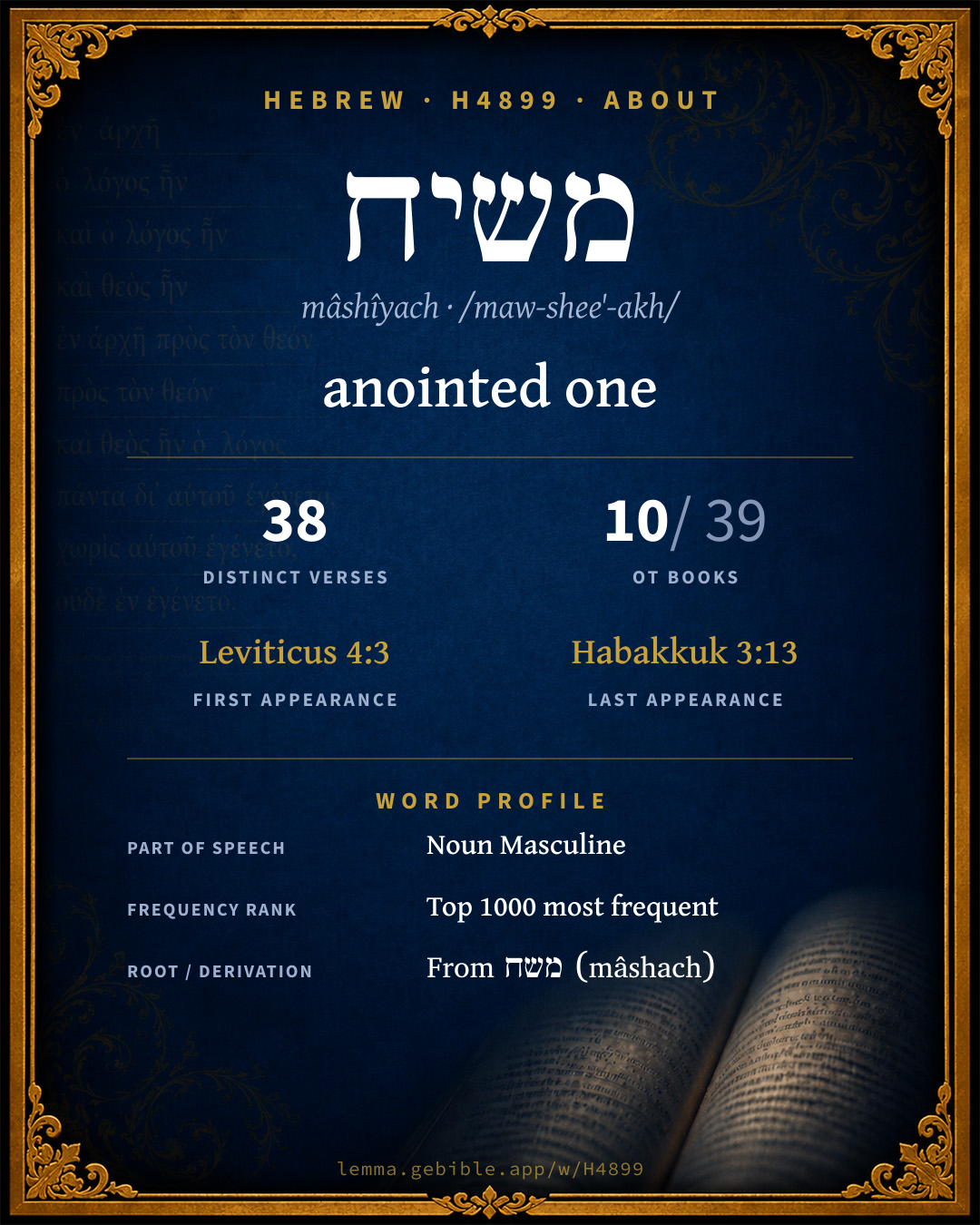
מָשִׁיחַ
anointed one
‘anointed one’ is one of 6 main senses fuller range ↓
Full lexicon entry — Brown-Driver-Briggs (BDB)
From Brown-Driver-Briggs (BDB)
Where this word appears
Grammar key — what these labels mean
Part of speech
- Noun
- A naming word — a person, place, thing, or idea.
- Adjective
- A word that describes or qualifies a noun.
Noun type
- Common
- A common noun — a general class of person, place, or thing (“king,” “city,” “water”), not a specific name.
State
- Construct
- A noun bound to a following noun in a possessive / “of” relationship (the construct chain).
- Absolute
- The independent form of a noun, not bound to a following word.
Gender
- Masculine
- Grammatically masculine.
Number
- Singular
- One.
- Plural
- More than one (in Hebrew, generally three or more).
Every verse where H4899 appears in the Book of Psalms — 10 distinct verses. Click any verse to open its interlinear word-by-word view. Verse text shown in the World English Bible for context — . Each verse’s Hebrew form is shown with its reference; the English is not keyword-highlighted, since the data carries no word-level English alignment. Use “Compare translations” on any verse to read it across multiple English versions. This concordance covers the Hebrew Bible; Septuagint (Greek Old Testament) occurrences are not indexed here.
Psalms
- Psalms 2:2 מְשִׁיחֽ/וֹ adj Adjective ms cs + sfx pers 3ms The kings of the earth take a stand, And the rulers take counsel together, Against Yahweh, and against his anointed, saying,
- Psalms 18:50 לִ/מְשִׁיח֗/וֹ prep + n c ms cs + sfx pers 3ms He gives great deliverance to his king, And shows loving kindness to his anointed, To David and to his seed, forevermore.
- Psalms 20:6 מְשִׁ֫יח֥/וֹ n c ms cs + sfx pers 3ms Now I know that Yahweh saves his anointed. He will answer him from his holy heaven, With the saving strength of his right hand.
- Psalms 28:8 מְשִׁיח֣/וֹ n c ms cs + sfx pers 3ms Yahweh is their strength. He is a stronghold of salvation to his anointed.
- Psalms 84:9 מְשִׁיחֶֽ/ךָ n c ms cs + sfx pers 2ms Behold, God our shield, Look at the face of your anointed.
- Psalms 89:38 מְשִׁיחֶֽ/ךָ n c ms cs + sfx pers 2ms But you have rejected and spurned. You have been angry with your anointed.
- Psalms 89:51 מְשִׁיחֶֽ/ךָ n c ms cs + sfx pers 2ms With which your enemies have mocked, Yahweh, With which they have mocked the footsteps of your anointed one.
- Psalms 105:15 בִ/מְשִׁיחָ֑/י prep + n c mp cs + sfx pers 1cs "Don't touch my anointed ones! Do my prophets no harm!"
- Psalms 132:10 מְשִׁיחֶֽ/ךָ n c ms cs + sfx pers 2ms For your servant David's sake, Don't turn away the face of your anointed one.
- Psalms 132:17 לִ/מְשִׁיחִֽ/י prep + n c ms cs + sfx pers 1cs There I will make the horn of David to bud. I have ordained a lamp for my anointed.
About this entry
At a glance — auto-summarized from this page’s data, not written by a person. Every figure links to its source below. This summary describes the numbers; it doesn’t interpret them.
משיח (mâshîyach) is a Hebrew noun most often rendered “anointed one.” It is not a single-sense word — see its full sense range. The Hebrew Bible uses it across 38 verses — moderately common. 1 Samuel dominates its distribution — 11 of 38 verses. Debuting at Leviticus 4:3, it then recurs through the corpus. For the data behind this summary, explore the sense tree and the renderings breakdown below.
Gloss history
Strong's 1890 vs modern scholarship
About this word
Strong's H4899 catalogs a Hebrew word from the Hebrew Old Testament.
These counts are not copied from any lexicon or concordance. They are computed here, from the morphology-tagged Hebrew Old Testament. What Lemma adds →
- 38
- distinct verses
- The word appears in 38 distinct verses.
- 10 / 39
- OT books
- The word appears in 10 of 39 Old Testament books.
- #922
- by frequency
- Top 1000 most frequent Hebrew words (rank 922 of 8,640 Hebrew words by occurrence).
View all 38 occurrences in the concordance →
By section of the Old Testament
By traditional corpus
Conventional, traditional groupings — biblical authorship is debated, so this is a traditional corpus grouping, not an authorship claim. Each share is this word’s portion of its verses in that division of the Hebrew canon. Each figure is a share of the word’s 38 distinct verses.
- Prophets (Nevi'im) 19 verses · 50%
- Writings (Ketuvim) 15 verses · 39%
- Torah (Pentateuch) 4 verses · 11%
How translations render this word
Counts come from each version’s own published word-to-Strong’s tagging or interlinear alignment — an approximate guide to how each version renders this word, not a word-level alignment the data otherwise carries. Because each total is that version’s own tagged count, the per-version totals vary from one another and need not match the appearance or distinct-verse counts above. These counts may also differ from a printed concordance because Lemma counts each distinctly tagged rendering and does not collapse phrase taggings into a single head-word total. This is a fixed set of word-tagged versions (KJV, ASV, BSB, ULT) and does not change with the reading translation you choose elsewhere. Each version’s license is shown beside its name below (and on Sources).
- King James Version: Anointed 28×, Is anointed 4×
- American Standard Version: Anointed 22×, 's anointed 9×, Touch not mine anointed 2×
- Berean Standard Bible: Anointed 26×, Anointed one 7×, Anointed ones 2×
- unfoldingWord Literal Text: Anointed 20×, Anointed one 6×, Anointed of 4×
King James Version Public Domain
Renders H4899 across 39 tagged occurrences — most commonly:
Plus 7 renderings that appear only once — usually multi-word phrases or single function words the recovered tagging swept in, not distinct renderings.
American Standard Version Public Domain
Renders H4899 across 39 tagged occurrences — most commonly:
Plus 6 renderings that appear only once — usually multi-word phrases or single function words the recovered tagging swept in, not distinct renderings.
Berean Standard Bible Public Domain
Renders H4899 across 39 tagged occurrences — most commonly:
Plus 2 renderings that appear only once — usually multi-word phrases or single function words the recovered tagging swept in, not distinct renderings.
unfoldingWord Literal Text CC BY-SA 4.0
Renders H4899 across 43 tagged occurrences — most commonly:
Plus 4 renderings that appear only once — usually multi-word phrases or single function words the recovered tagging swept in, not distinct renderings.
Senses in the full BDB
What do BDB’s symbols mean?
BDB uses these scholarly abbreviations:
| Symbol | Meaning |
|---|---|
| 𝔊 | the Septuagint (the ancient Greek translation, LXX) |
| 𝔙 | the Vulgate (the Latin translation) |
| 𝔖 | the Syriac version (the Peshitta) |
| 𝔗 | the Targum (the Aramaic translation) |
| ψ | the Psalms |
| √ | root (the underlying root or stem) |
| ‖ | parallel passage (a synonymous or contrasted parallel) |
| † | the dagger: every passage where the word occurs is cited |
The 5 senses and sub-senses the full Brown-Driver-Briggs lexicon distinguishes for this word, in lexicon order (not ranked by frequency), with BDB’s own verbatim wording and sub-sense lettering. Shown in Hebrew script with BDB’s own scholarly abbreviations. The condensed entry is in the Lexicon Entry tab. See also the Forms in the corpus table below.
- 1. king of Israel anointed by divine command, מ׳ יהוה 1 S 24:7(×2), 11; 26:9, 11, 16, 23 2 S 1:14, 16; 19:22; La 4:20; מ׳ אלהי יעקב 2 S 23:1; so c. sfs. ref. to י׳, 1 S 12:3, 5; 16:6 ψ 20:7; 28:8; Hb 3:13; Davidic dynasty with Messianic ideals attached ψ 2:2; 18:51, = 2 S 22:51, ψ 89:39, 52; 132:10 = 2 Ch 6:42, ψ 132:17; 1 S 2:10, 35. e.g. 1 Samuel 24:7
- 2. high priest of Israel, הַכֹּהֵן הַמָּשִׁיחַ, Lv 4:3, 5, 16; 6:15 (P); מְשִׁיהֶ֑ךָ ψ 84:10. e.g. Leviticus 4:3
- 3. Cyrus as commissioned by י׳, מְשִׁיחוֹ Is 45:1. e.g. Isaiah 45:1
- 4. Messianic prince, עַד־מָשִׁיחַ נָגִיד Dn 9:25 = מָשִׁיחַ v 26 (see BrMP 422 f.; others disting. מ׳ v 25 from v 26 and refer v 25 to Cyrus [as 3; so Ew v. Leng Schü Co Behrm], or h. p. Joshua [as 2; so Gr Bev], v 26 to Seleucus iv [Ew v. Leng], or h.p. Onias iii. [Hi Gr Co Bev Behrm]). e.g. Daniel 9:25
- 5. patriarchs, regarded as anointed kings ψ 105:15 = 1 Ch 16:22. e.g. Psalms 105:15
Senses from the full Brown-Driver-Briggs lexicon (Brown, Driver, Briggs; Oxford 1906 — public domain), digitized via Sefaria, supplemented by the OpenScriptures HebrewLexicon (CC BY 4.0). Full attribution on Sources.
Word origin
n.m. anointed;—abs. מ׳ Lv 4:3 + 5 times; cstr. מְשִׁיחַ La 4:20 + 11 times; sf. מְשִׁיחִי ψ 132:17 1 S 2:35; מְשִׁיחֶ֑ךָ Hb 3:13 + 5 times; מְשִׁיחוֹ ψ 2:2 + 9 times; pl. sf. מְשִׁיחָ֑י 105:15 1 Ch 16:22;—
— Brown-Driver-Briggs (Oxford 1906, public domain), digitized via Sefaria, supplemented by the OpenScriptures HebrewLexicon (CC BY 4.0). See Sources.
Derived from משח (mâshach) (H4886) — to anoint.
Jastrow Dictionary
A second Hebrew/Aramaic lexicon for comparison, covering Aramaic and post-biblical (Talmudic, Targumic, Midrashic) usage that the biblical-Hebrew BDB does not. Matched by lemma rather than by Strong’s number, so a lemma may carry more than one Jastrow headword (shown separately below), and the entries cover usage well beyond the Bible.
מָשִׁיחַ
- anointed, esp.
- 1. כֹּהֵן מ׳ or מ׳ (v. מָשׁוּחַ, s. v. מָשַׁח I, v. Lev. IV, 3) the high priest installed by anointment. Tosef. Meg. I, 18 כ׳ מ׳ משמש the active high priest; כ׳ מ׳ שעבר the unfitted high priest (prevented from officiating on the Day of Atonement). Hor. III, 4 ואיזהו המ׳ המשוח וכ׳ what high priest is called mashiaḥ? He who has been anointed &c. Sifra Vayikra, Ḥobah, ch. I, Par. 2, a. e. מ׳ יכול זה המלך by mashiaḥ (Lev. IV, 3) you might understand the king. Ib. המ׳ זה מ׳ וכ׳ ‘the anointed’ means an anointed who has no superior anointed; a. fr. e.g. Leviticus 4:3
- 2. מֶלֶךְ הַמָּ׳, or מָ׳ the Messiah, the future redeemer of Israel from captivity. Gen. R. s. 2 (ref. to Gen. I, 2) זה רוחו של מ׳ המ׳ that means the divine spirit of the king Messiah (with ref. to Is. XI, 2). Succ. 52ᵃ, a. fr. מ׳ בן דוד the Davidic Messiah, contrad. to מ׳ בן יוסף the M., son of Joseph, who is to precede the former. Snh. 98ᵇ אין מ׳ לישראל וכ׳ Israel has no Messiah to expect, for it has enjoyed him (the glory which he was predicted to bring) in the days of Hezekiah. Ib. 97ᵃ; a. fr.—ימות המ׳ the Messianic epoch. Ib. bot. Ber. I, 5 להביא לימות מ׳ this includes (the duty of remembering the exodus from Egypt) even in the Messianic days; a. fr.—חבלו של מ׳, v. חֵבֶל.—Pl. מְשִׁיחִים. Pesik. R. s. 8 (ref. to Zech. IV, 3) אלו שני המ׳ אחד משוח מלחמה וכ׳ these are the two expected Messiahs, one appointed to conduct war (מ׳ בן יוסף) &c.; Yalk. Zech. 570. e.g. Genesis 1:2
A Dictionary of the Targumim, the Talmud Babli and Yerushalmi, and the Midrashic Literature (Marcus Jastrow; London, Luzac, 1903) — Public Domain. Digitized via Sefaria. Digitized via Sefaria. Full attribution on Sources.
Forms in the corpus
The 27 distinct written forms H4899 takes in the Hebrew Bible, most frequent first — each parse links to that state’s occurrences in the concordance. Hebrew forms include their vowel points and cantillation, so a single lemma takes many written forms.
Same root — word family
Other BDB entries built from the same root as H4899, grouped by Strong’s listed origin. These share a root / origin per the lexicon — not necessarily a shared meaning. Each links to that word’s own entry.
Derives from
Shares the same root
Proper names from this root
People and places named from this root — a name, not an additional meaning of the word.
Compare all same-root words → Showing 4 of 6 — not the complete family. 1 of the same-root words is a proper name (a person or place). They share a root, not necessarily a meaning.
Septuagint verse parallels
This word appears in 33 verses that also exist in the Greek Old Testament (Septuagint), out of the 38 Hebrew verses it occurs in. You can read those verses in Greek by switching the Old Testament edition to the Septuagint.
Read these verses in the Septuagint
- Leviticus 4:3
- 1 Samuel 2:10
- 2 Samuel 1:14
- 1 Chronicles 16:22
- 2 Chronicles 6:42
- Psalms 2:2
- Isaiah 45:1
- Lamentations 4:20
- Daniel 9:25
- Habakkuk 3:13
This is a verse-level parallel only — the same verses exist in both the Hebrew and Greek Old Testaments. No word-level Hebrew↔Greek correspondence is claimed: the data carries no such alignment, so no Greek word is shown as this Hebrew word’s translation. Coverage is not total — the Septuagint omits the deuterocanon and renumbers the Psalms, so some Hebrew verses have no direct Greek parallel.