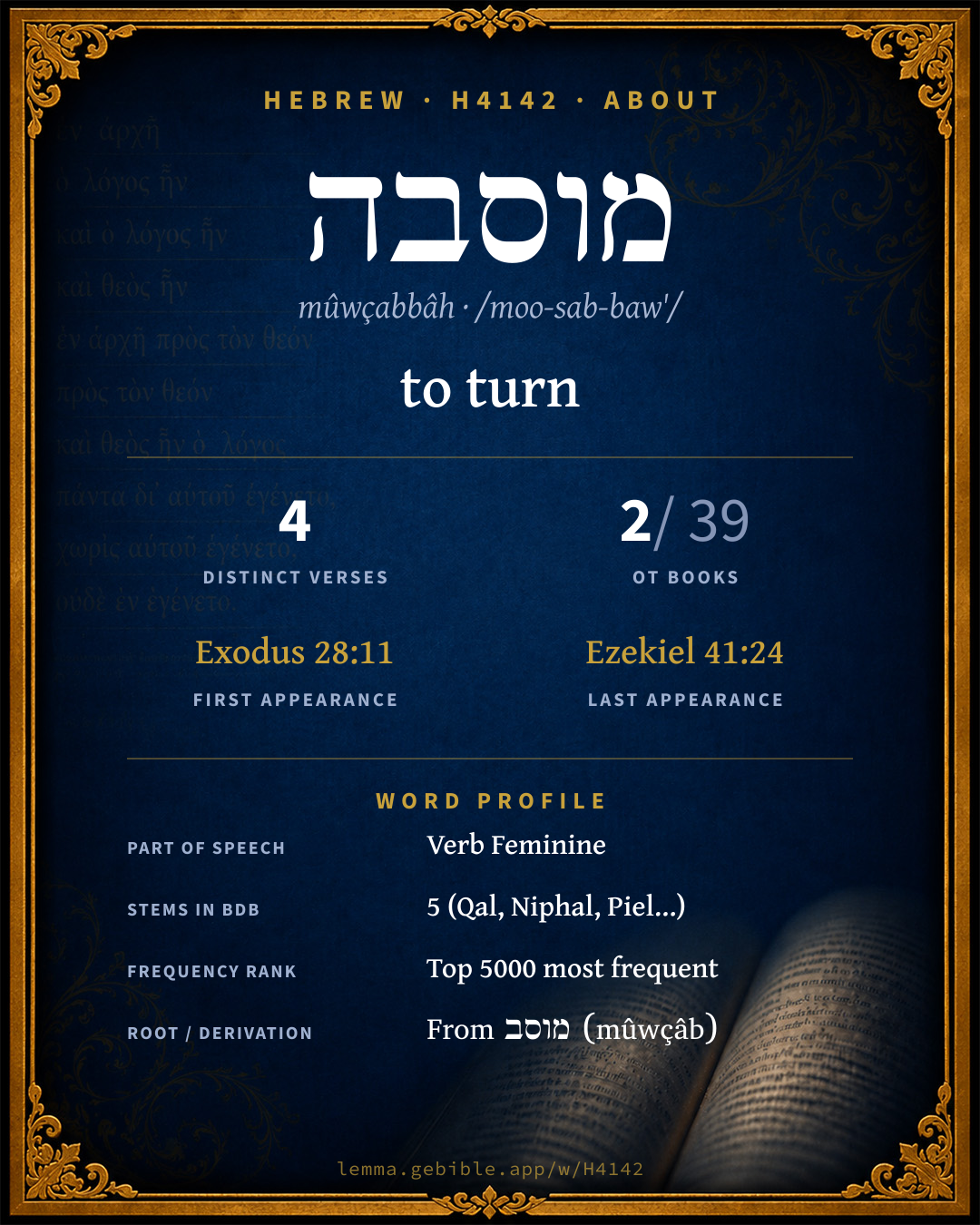
מוּסַבָּה
to turn
‘to turn’ is one of 2 main senses fuller range ↓
Full lexicon entry — Brown-Driver-Briggs (BDB)
From Brown-Driver-Briggs (BDB)
Where this word appears
Grammar key — what these labels mean
Part of speech
- Verb
- An action or state-of-being word.
Stem
- Hophal
- The passive counterpart of the Hiphil (“he was caused to…”). Here: ‘be turned’
Form
- Participle Passive
- A verbal adjective expressing action received (“written”).
State
- Absolute
- The independent form of a noun, not bound to a following word.
- Construct
- A noun bound to a following noun in a possessive / “of” relationship (the construct chain).
Gender
- Feminine
- Grammatically feminine.
Number
- Plural
- More than one (in Hebrew, generally three or more).
Grammatical forms
- Verb, Hophal, Participle Passive, Feminine, Plural, Absolute 3 times (75%)
- Verb, Hophal, Participle Passive, Feminine, Plural, Construct 1 time (25%)
Parsed forms decoded from the imported morphology (morphhb / Westminster Leningrad Codex — WLC text public domain, morphhb tagging CC BY 4.0), counted across 4 parsed occurrences — not distinct verses.
Every verse where H4142 appears — 4 distinct verses across 2 books. Click any verse to open its interlinear word-by-word view. Verse text shown in the World English Bible for context — . Each verse’s Hebrew form is shown with its reference; the English is not keyword-highlighted, since the data carries no word-level English alignment. Use “Compare translations” on any verse to read it across multiple English versions. This concordance covers the Hebrew Bible; Septuagint (Greek Old Testament) occurrences are not indexed here.
Exodus 3 verses
- Exodus 28:11 מֻסַבֹּ֛ת Hophal ptcp.pass fp cs With the work of an engraver in stone, like the engravings of a signet, shall you engrave the two stones, according to the names of the children of Israel: you shall make them to be enclosed in settings of gold.
- Exodus 39:6 מֻֽסַבֹּ֖ת Hophal ptcp.pass fp They worked the onyx stones, enclosed in settings of gold, engraved with the engravings of a signet, according to the names of the children of Israel.
- Exodus 39:13 מֽוּסַבֹּ֛ת Hophal ptcp.pass fp and the fourth row, a chrysolite, an onyx, and a jasper. They were enclosed in gold settings.
Ezekiel 1 verse
About this entry
At a glance — auto-summarized from this page’s data, not written by a person. Every figure links to its source below. This summary describes the numbers; it doesn’t interpret them.
מוסבה (mûwçabbâh) is a Hebrew verb most often rendered “to turn.” With only 4 verses it sits in the long tail of Hebrew Bible vocabulary. Exodus dominates its distribution — 3 of 4 verses. Scripture first uses it in Exodus 28:11. As a verb its force shifts by stem, across 5 stems (Qal, Niphal, and more). For the data behind this summary, explore the sense tree and the renderings breakdown below.
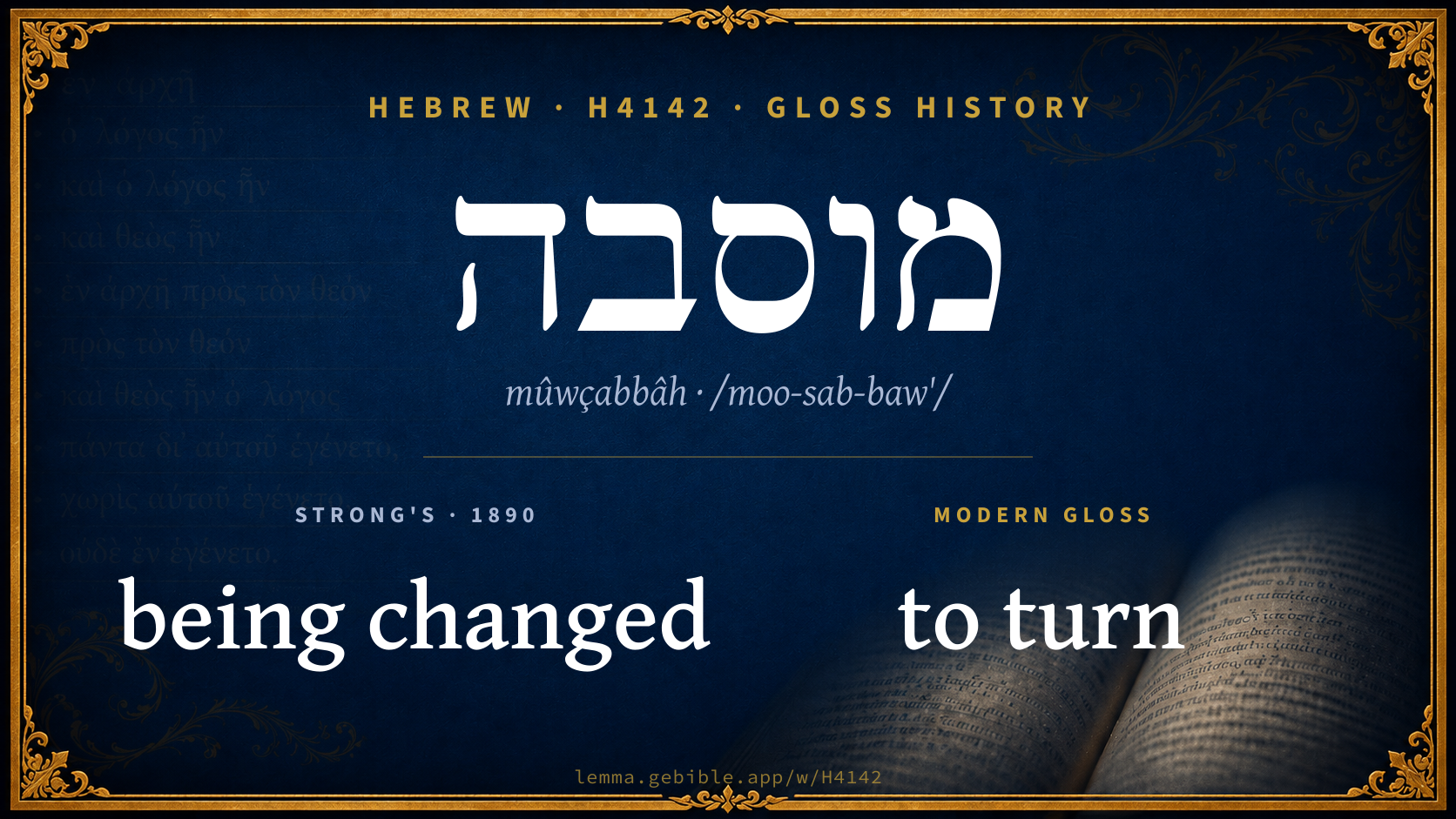
Gloss history
Strong's 1890 vs modern scholarship
About this word
Strong's H4142 catalogs a Hebrew word from the Hebrew Old Testament.
These counts are not copied from any lexicon or concordance. They are computed here, from the morphology-tagged Hebrew Old Testament. What Lemma adds →
- 4
- distinct verses
- The word appears in 4 distinct verses.
- 2 / 39
- OT books
- The word appears in 2 of 39 Old Testament books.
- #3,696
- by frequency
- Top 5000 most frequent Hebrew words (rank 3,696 of 8,640 Hebrew words by occurrence).
View all 4 occurrences in the concordance →
By traditional corpus
Conventional, traditional groupings — biblical authorship is debated, so this is a traditional corpus grouping, not an authorship claim. Each share is this word’s portion of its verses in that division of the Hebrew canon. Each figure is a share of the word’s 4 distinct verses.
- Torah (Pentateuch) 3 verses · 75%
- Prophets (Nevi'im) 1 verse · 25%
How translations render this word
Counts come from each version’s own published word-to-Strong’s tagging or interlinear alignment — an approximate guide to how each version renders this word, not a word-level alignment the data otherwise carries. Because each total is that version’s own tagged count, the per-version totals vary from one another and need not match the appearance or distinct-verse counts above. These counts may also differ from a printed concordance because Lemma counts each distinctly tagged rendering and does not collapse phrase taggings into a single head-word total. This is a fixed set of word-tagged versions (KJV, ASV, BSB, ULT) and does not change with the reading translation you choose elsewhere. Each version’s license is shown beside its name below (and on Sources).
- King James Version: Be set 1×, Being changed 1×, Inclosed 1×
- American Standard Version: Be inclosed 1×, Being changed 1×, Inclosed 1×
- unfoldingWord Literal Text: Panels 1×, Stones were surrounded 1×, Surrounded with 1×
King James Version Public Domain
Renders H4142 across 5 tagged occurrences — most commonly:
American Standard Version Public Domain
Renders H4142 across 5 tagged occurrences — most commonly:
unfoldingWord Literal Text CC BY-SA 4.0
Renders H4142 across 5 tagged occurrences — most commonly:
30 senses and sub-senses in the full BDB
Hebrew verbs can shift meaning by stem (binyan): Qal is the basic action, Niphal is often passive or reflexive, Piel often intensifies or makes it factitive, and Hiphil is typically causative. The senses below are grouped under the stem BDB assigns to each. This entry also uses Hophal (the passive of Hiphil).
What do BDB’s symbols mean?
BDB uses these scholarly abbreviations:
| Symbol | Meaning |
|---|---|
| 𝔊 | the Septuagint (the ancient Greek translation, LXX) |
| 𝔙 | the Vulgate (the Latin translation) |
| 𝔖 | the Syriac version (the Peshitta) |
| 𝔗 | the Targum (the Aramaic translation) |
| ψ | the Psalms |
| √ | root (the underlying root or stem) |
| ‖ | parallel passage (a synonymous or contrasted parallel) |
| † | the dagger: every passage where the word occurs is cited |
The 30 senses and sub-senses the full Brown-Driver-Briggs lexicon distinguishes for this word, in lexicon order (not ranked by frequency), with BDB’s own verbatim wording and sub-sense lettering. Shown in Hebrew script with BDB’s own scholarly abbreviations. The condensed entry is in the Lexicon Entry tab. See also the Forms in the corpus table below.
Qal
- Pf. 3 ms. ס׳ Ez 42:19 +; 1 s. סַבֹּ֫תִי 1 S 22:22 (but v. infr.), סַבּ֫וֹתִי Ec 2:20; 7:25; 3 pl. סָֽבְבוּ Jos 6:15 + 1 S 14:21; 2 S 24:6 (v. infr.), sf. סְבָבוּנִי ψ 18:6 +, סַבּוּנִי 88:18 + 2 times, סַבֻּנִי 2 S 22:6; 2 mpl. וְסַבֹּתֶם consec. Jos 6:3, etc.; Impf. יָסֹב 1 K 7:15 +, sf. יְסֻבֵּנִי ψ 49:6; oftener יִסֹּב 1 S 5:8 +, וַיִּסֹּב Gn 42:24 +; 3 mpl. יָסֹ֫בּוּ Jb 16:13, וַיָּסֹ֫בּוּ Jos 6:14 +, 3 fpl. תְּסֻבֶּינָה Gn 37:7, etc.; Imv. ms. סֹב 1 S 22:18, fs. סֹ֫בִּי Is 23:16, etc.; Inf. cstr. לִסְבֹּב Nu 21:4, סֹב Dt 2:3; Pt. סוֹבֵב 2 K 6:15 +, הַסֹּבֵיב 8:21 (Ginsb הִסְבִּיב Kt, הַסֹּבֵב Qr), etc.;— e.g. Ezekiel 42:19
- 1. turn, intrans. (Impf. of form יִסֹּב in this sense only):
- a. turn about, often as preliminary to something else 1 S 15:12, 27 (sq. inf.), 1 Ch 16:43 (id.; וַיָּ֫שָׁב in ‖ 2 S 6:20) + 1 S 14:21 (read סָֽבְבוּ גַם for MT סָבִיב וְגַם, 𝔊 𝔖 𝔙 Th We, etc.), Je 41:14a (+ שׁוב v b, but 𝔊 om. v a cf. Gie), Ec 1:6(×2); of door, Pr 26:14 turn on (עַל) its hinge (cf. Niph. Ez 26:2); turn (toward one) 1 S 22:17, 18(×2) 2 S 18:30x2; Ct 2:17 (v. Bu); also c. אֶל־ 2 S 14:24(×2) + 24:6 (read סָֽבְבוּ for סָבִיב We Dr Bu Kit HPS; Klo יָסֹבּוּ, cf. Löhr), Ez 42:19 Ec 1:6, אֶל־אַחֲרָ֑י 2 K 9:18, 19; of cup of י׳, it shall come round unto (עַל־, with hostile implic.; עָבַר עַל La 4:22) Hb 2:16; of Jordan, turn לְאָחוֹר ψ 114:3, 5; turn about from (מֵעַל) Gn 42:24, (מִן) 1 S 18:11, + אֶל־ 17:30; so of inheritance Nu 36:7 it shall not go about from (מִן) tribe to (אֶל־) tribe, also v 9 (לְ for אֶל־); cf. (abs.) וַתִּסֹּב הַמְּלוּכָה וַתְּהִי לְאָחִי 1 K 2:15 (cf. Hiph. 1 b); = be brought round, c. acc. loc. 1 S 5:8 (of ark). e.g. 1 Samuel 15:12
- b. turn = change, only Zc 14:10 (of land, changed like [כְּ, i.e. into] a plain), cf. Hiph. 1 c. e.g. Zechariah 14:10
- c. fig. turn (in a new direction) to do something (inf.) Ec 2:20; 7:25.—ψ 71:21 is dub.; Bae reads וְתָשֻׁב for וְתִסֹּב after 𝔊 𝔖 𝔙; Hup-Now Che al. sub a. supr.: turn, comfort me.—Jb 10:8 read אַחַר תִּסֹּב for MT יחד סביב De al. e.g. Ecclesiastes 2:20
- 2.
- a. march, or walk, around, c. acc. (city) Jos 6:3, 4, 7, 14, 15(×2) (all JE), ψ 48:13; poss. also נָסֹב 1 S 16:11 (of marching about altar? so HPS; turn to do something else Th), but cf. תסוב Ecclus 32:1 sit about a table (v. SchechterBS p. 56, and cf. מֵסַב), or read נֵשֵׁב Weir in Dr Kit Bu Löhr (perhaps). e.g. Joshua 6:3
- b. go partly round, circle about, skirt, c. acc. (land) Nu 21:4 (JE) Ju 11:18, also Dt 2:1, 3; of rivers Gn 2:11, 13. e.g. Numbers 21:4
- c. make a round, or circuit, go about to, c. acc. loc. 1 S 7:16; go about in (בְּ) 2 Ch 17:9, cf. also (c. בְּ) 23:2 Ct 3:5; 5:7 Ec 12:5, so c. acc. Is 23:16; = make a circuitous march 2 K 3:9 (c. acc. דֶּרֶךְ).—Vid. also 2 S 5:23 1 Ch 14:14 Hiph. 2 a. e.g. 1 Samuel 7:16
- d. surround, encompass, abs. Gn 37:7 (E); c. acc. Jb 40:22; with hostile purpose, 2 K 6:15 Ec 9:14 (both of siege), cf. 2 K 3:25; acc. om. Ju 16:2, cf. 2 S 18:15; c. acc. rei + עַל־ pers. Ju 20:5; c. עַל־ pers. alone Jb 16:13 2 Ch 18:31; c. אֶל־ pers. 2 K 8:21 = 2 Ch 21:9; often fig. in poetry, c. acc. Ho 7:2 2 S 22:6 = ψ 18:6, ψ 22:13, 17; 49:6; 88:18; 118:10, 11(×2), 12; so also ψ 17:11 (Kt סְבָבוּנִי, Qr סְבָבוּנוּ; on text v. especially Hup-Now); lit. of cord surrounding (measuring circumf. of), c. acc. 1 K 7:15 = Je 52:21, 1 K 7:23 = 2 Ch 4:2; of ornaments, etc., surrounding something (acc.) 1 K 7:24 2 Ch 4:3; surround one with something (2 acc.) 1 K 5:17 ψ 109:3; acc. + בְּ instr. Ho 12:1; ס׳ לָעֹפֶל 2 Ch 33:14 (i.e. build a wall around it).—1 S 22:22 read חַבְתִּי (√ חוּב), 𝔊 𝔖 Th We Dr Kit Bu Löhr HPS. e.g. Genesis 37:7
Niphal
- Pf. 3 ms. נָסַב Jos 15:3 +; 3 fs. נָסֵ֫בָּה Ez 26:2 (Ges§ 67 t St§ 410 b Köi. 342); וְנָֽסְבָה 41:7 (but read וְנוֹסְפָה Ew Sm Co ToyHpt, cf. Berthol); 3 pl. נָסַ֫בּוּ Gn 19:4 +; Impf. 3 mpl. יִסַּ֫בּוּ Ez 1:9 + 5 times;— e.g. Joshua 15:3
- 1.
- a. turn oneself against (עַל־), close round upon (עַל) Gn 19:4 (J) Jos 7:9 (JE); c. acc. Ju 19:22. e.g. Genesis 19:4
- b. turn round (from a direct course), of wheels Ez 1:9, 12, 17; 10:11(×2), also v 16 (but dub., Co ישׁבו, ToyHpt leave, Symm ἀπελείποντο); נָסַ֫בָּה אֵלַי Ez 26:2 of Jerus. under fig. of door (Sm Co Berthol ToyHpt). e.g. Ezekiel 1:9
- c. especially of boundary (Hex only P): turn round from (מִן), toward (לְ) Nu 34:4, + ה loc. Jos 18:14; c. מִן + ה loc. + אֶל־ 15:10; c. מִן alone Nu 34:5; c. ה loc. alone Je 31:39 Jos 15:3; 16:6; circle about, skirt, c. acc. Jos 19:14. e.g. Numbers 34:4
- 2. pass. be turned over to (לְ, into the power of, Je 6:12. e.g. Jeremiah 6:12
Piel
- Inf. cstr. סַבֵּב אֶת־פְּנֵי הַדָּבָר 2 S 14:20 to change, transform, the aspect of the matter. Poʿ. Impf. 3 ms. sf. יְסֹבְבֵנִי Jon 2:4, 6, יְסֹבְבֶנְהוּ Dt 32:10, יְסוֹבְבֶנּוּ ψ 32:10; 3 fs. תְּסוֹבֵב Je 31:22, etc.;—encompass, surround (poet. and chiefly late):— e.g. 2 Samuel 14:20
- 1. encompass (with protection), c. acc. Dt 32:10 (י׳ subj.), c. 2 acc. חֶסֶד יְסוֹבְבֶנּוּ ψ 32:10, cf. v 7 (but 2nd obj. here dub.); similarly נְקֵבָה תְּסוֹבֵב נָּ֑בֶר Je 31:22 i.e. either shall protect (so most) or (Che, cf. Gf) the woman (fig. of Isr.), instead of holding aloof (הַבַּת הַשּׁוֹבֵבָה v 22), will, in the new future which י׳ creates, with affection press round her divine husband. e.g. Deuteronomy 32:10
- 2. come about, assemble round (acc. pers. י׳) ψ 7:8. e.g. Psalms 7:8
- 3. march or go about, city (acc.) ψ 55:11; 59:7, 15; altar (in solemn procession) 26:6; go about in (בְּ) city Ct 3:2. e.g. Psalms 55:11
- 4. enclose, envelop, c. acc. pers. Jon 2:4, 6 (of waters). e.g. Jonah 2:4
Hiphil
- Pf. 3 ms. הֵסֵב 2 K 16:18 +; 2 ms. הֲסִבֹּ֫תָ 1 K 18:37; 3 pl. הֵסַ֫בּוּ 1 S 5:9, 10, etc.; Impf. 3 ms. וַיַּסֵּב Ex 13:18 +, sf. וַיְסִבֵּ֫נִי Ez 47:2; 3 mpl. וַיַּסֵּ֫בּוּ Ju 18:23 + 2 times; 1 pl. נָסֵב 2 Ch 14:6, cohort. נָסֵ֫בָּה 1 Ch 13:3; Imv. ms. הָסֵב 2 S 5:23 1 Ch 14:14 (but v. infr.); fs. הָסֵ֫בִּי Ct 6:5; Inf. cstr. הָסֵב 2 S 3:12 1 Ch 12:23; Pt. מֵסֵב Je 21:4; perhaps also pl. sf. מְסִבָּ֑י ψ 140:10 (Ginsb);— e.g. 2 Kings 16:18
- 1.
- a. turn (trans.), cause to turn: turn face (acc.) Ju 18:23 1 K 8:14 = 2 Ch 6:3 (all = turn toward); = turn round face 1 K 21:4, + אֶל־הַקִּיר 2 K 20:2 = Is 38:2; + מִן Ez 7:22 (subj. י׳), 2 Ch 29:6 (of neglect), 35:22 (of avoiding battle); turn away eyes from (מִן), Ct 6:5; turn (back), change heart 1 K 18:37 (recall from apostasy; + אֲחֹרַנִּית), Ezr 6:22 (+ עַל־); turn back, reverse (weapons) Je 21:4. e.g. Judges 18:23
- b. bring over (i.e. to allegiance), c. acc. + אֶל־ pers., 2 S 3:12 1 Ch 12:24 (van d. H. v 23); of י׳, turn over kingdom to (לְ) 1 Ch 10:14 (cf. Qal 1 a, 1 K 2:15). e.g. 2 Samuel 3:12
- c. turn into, of changing name, 2 acc. 2 K 23:34 = 2 Ch 36:4, 2 K 24:17. e.g. 2 Kings 23:34
- d. = bring round, c. acc. 1 S 5:8, 9; + מִן 2 S 20:12; + אֶל־ 1 S 5:10 1 Ch 13:3; + acc. loc. 2 K 16:18 (sense obscure). e.g. 1 Samuel 5:8
- 2.
- a. cause to go around: of carrying ark around city (2 acc.) Jos 6:11 (JE; but Qal 𝔊 𝔖 𝔙); lead round, i.e. by a round-about way, acc. pers. + acc. דֶּרֶךְ Ex 13:18 (E) Ez 47:2; c. acc. + inf. of purpose 2 Ch 13:13; acc. om., lead round toward (אֶל־) 2 S 5:23, away from (מֵעַל־) ‖ 1 Ch 14:14 (where, however, perhaps read as S, so Be Öt, and, in both, סֹב for הָסֵב Dr KitKau Hpt Bu HPS Löhr). e.g. Joshua 6:11
- b. surround with (acc.) wall, 2 Ch 14:6 (acc. of city om.). e.g. 2 Chronicles 14:6
- c. perhaps also encompass (as foe), מְסִבָּ֑י ψ 140:10 those encompassing me (others sub מֵסַב infr.). e.g. Psalms 140:10
Hophal
- Impf. 3 ms. יוּסָּ֑ב Is 28:27; Pt. fpl. cstr. מֻסַבֹּת Ex 28:11; 39:6; מוּסַבֹּת v 13 Nu 32:38 (v. infr.); מוּסַבּוֹת Ez 41:24;— e.g. Isaiah 28:27
- 1. be turned, of cart wheel, c. עַל־ upon, over; מוּסַבּוֹת דְּלָתוֹת Ez 41:24 pt. appar. as gerundive, that can be turned, movable (Ges§ 116 e; Co reads צלעות מ׳, cf. ToyHpt); מוּס׳ שֵׁם Nu 32:38 turned (i.e. changed) as to name, but gloss, v. Di. e.g. Ezekiel 41:24
- 2. surrounded, i.e. set, of jewels (pt. cstr.) Ex 28:11; 39:6, 13 (all P). e.g. Exodus 28:11
Senses from the full Brown-Driver-Briggs lexicon (Brown, Driver, Briggs; Oxford 1906 — public domain), digitized via Sefaria, supplemented by the OpenScriptures HebrewLexicon (CC BY 4.0). Full attribution on Sources.
Word origin
vb. turn about, go around, surround (NH id., Pi. Hiph., and deriv.; Aramaic סוֹבְבָא rim, border; Arabic سَبَبٌ rope, سَبِيبٌ lock of hair; poss. also سَبٌّ ii. prepare a means of attaining sthg. Lane1284);—
— Brown-Driver-Briggs (Oxford 1906, public domain), digitized via Sefaria, supplemented by the OpenScriptures HebrewLexicon (CC BY 4.0). See Sources.
Derived from מוסב (mûwçâb) (H4141) — surrounding.
Forms in the corpus
The 4 distinct written forms H4142 takes in the Hebrew Bible, most frequent first — each parse links to that stem’s occurrences in the concordance. Hebrew forms include their vowel points and cantillation, so a single lemma takes many written forms.
| Form | Parsing | Example | Uses |
|---|---|---|---|
| מֻֽסַבֹּ֖ת | Verb, Hophal, Participle Passive, Feminine, Plural, Absolute | Exodus 39:6 | 1 |
| מֻסַבֹּ֛ת | Verb, Hophal, Participle Passive, Feminine, Plural, Construct | Exodus 28:11 | 1 |
| מֽוּסַבֹּ֛ת | Verb, Hophal, Participle Passive, Feminine, Plural, Absolute | Exodus 39:13 | 1 |
| מוּסַבּ֣וֹת | Verb, Hophal, Participle Passive, Feminine, Plural, Absolute | Ezekiel 41:24 | 1 |
Septuagint verse parallels
This word appears in 4 verses that also exist in the Greek Old Testament (Septuagint), out of the 4 Hebrew verses it occurs in. You can read those verses in Greek by switching the Old Testament edition to the Septuagint.
Read these verses in the Septuagint
This is a verse-level parallel only — the same verses exist in both the Hebrew and Greek Old Testaments. No word-level Hebrew↔Greek correspondence is claimed: the data carries no such alignment, so no Greek word is shown as this Hebrew word’s translation. Coverage is not total — the Septuagint omits the deuterocanon and renumbers the Psalms, so some Hebrew verses have no direct Greek parallel.