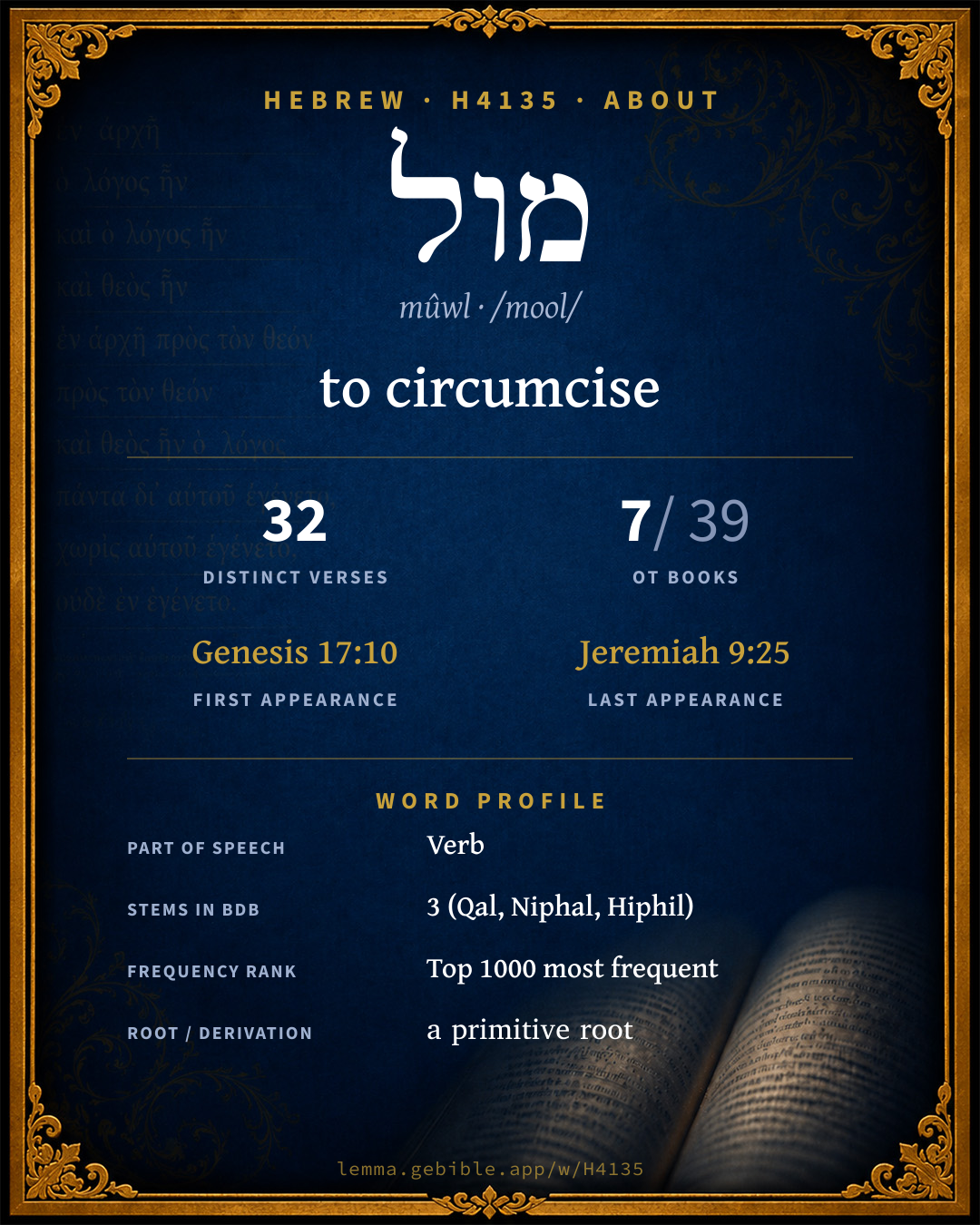
מוּל
to circumcise
also: cut, be cut off fuller range ↓
Full lexicon entry — Brown-Driver-Briggs (BDB)
From Brown-Driver-Briggs (BDB)
Where this word appears
See every Niphal verb in the Hebrew Bible →
Grammar key — what these labels mean
Part of speech
- Verb
- An action or state-of-being word.
- Preposition
- A relational word (e.g. “in,” “to,” “from”) governing a noun.
Stem
- Niphal
- Usually the simple passive or reflexive of the Qal (“he was written”).
- Qal
- The basic, simple active stem — the plain form of the verb (“he wrote”).
- Hiphil
- The causative active stem (“he caused / brought about”).
- Hithpael
- The reflexive or reciprocal stem (the subject acts on itself).
Form
- Infinitive Construct
- A bound verbal noun, frequently with prepositions (“to write / in writing”).
- Imperfect
- An incomplete, ongoing, or future action (“he will / would write”).
- Sequential Imperfect
- An imperfect with prefixed waw — the standard past-narrative form (waw-consecutive imperfect).
- Infinitive Absolute
- An unbound verbal noun, often intensifying or standing in for a finite verb.
- Perfect
- A completed action or state — Hebrew marks aspect (completeness) more than strict tense (“he wrote”).
- Sequential Perfect
- A perfect with prefixed waw continuing a preceding imperfect or command (waw-consecutive perfect).
- Participle Active
- A verbal adjective expressing ongoing or characteristic action (“writing / one who writes”).
- Imperative
- A direct command (“write!”).
- Participle Passive
- A verbal adjective expressing action received (“written”).
State
- Absolute
- The independent form of a noun, not bound to a following word.
Person
- 3rd Person
- The one spoken about (“he / she / it / they”).
- 1st Person
- The speaker (“I / we”).
- 2nd Person
- The one addressed (“you”).
Gender
- Masculine
- Grammatically masculine.
- Common
- Either gender — not distinguished for this form.
Number
- Singular
- One.
- Plural
- More than one (in Hebrew, generally three or more).
Every verse where H4135 appears in the Book of Genesis — 14 distinct verses. Click any verse to open its interlinear word-by-word view. Verse text shown in the World English Bible for context — . Each verse’s Hebrew form is shown with its reference; the English is not keyword-highlighted, since the data carries no word-level English alignment. Use “Compare translations” on any verse to read it across multiple English versions. This concordance covers the Hebrew Bible; Septuagint (Greek Old Testament) occurrences are not indexed here.
Genesis
- Genesis 17:10 הִמּ֥וֹל Niphal inf.abs This is my covenant, which you shall keep, between me and you and your seed after you. Every male among you shall be circumcised.
- Genesis 17:12 יִמּ֥וֹל Niphal impf 3ms He who is eight days old will be circumcised among you, every male throughout your generations, he who is born in the house, or bought with money of any foreigner who is not of your seed.
- Genesis 17:13 הִמּ֧וֹל יִמּ֛וֹל Niphal inf.abs Niphal impf 3ms He who is born in your house, and he who is bought with your money, must be circumcised. My covenant will be in your flesh for an everlasting covenant.
- Genesis 17:14 יִמּוֹל֙ Niphal impf 3ms The uncircumcised male who is not circumcised in the flesh of his foreskin, that soul shall be cut off from his people. He has broken my covenant."
- Genesis 17:23 וַ/יָּ֜מָל conj + Qal wimpf 3ms Abraham took Ishmael his son, all who were born in his house, and all who were bought with his money; every male among the men of Abraham's house, and circumcised the flesh of their foreskin in the same day, as God had said to him.
- Genesis 17:24 בְּ/הִמֹּל֖/וֹ prep + Niphal inf.cs + sfx pers 3ms Abraham was ninety-nine years old, when he was circumcised in the flesh of his foreskin.
- Genesis 17:25 בְּ/הִ֨מֹּל֔/וֹ prep + Niphal inf.cs + sfx pers 3ms Ishmael, his son, was thirteen years old when he was circumcised in the flesh of his foreskin.
- Genesis 17:26 נִמּ֖וֹל Niphal pf 3ms In the same day both Abraham and Ishmael, his son, were circumcised.
- Genesis 17:27 נִמֹּ֖לוּ Niphal pf 3cp All the men of his house, those born in the house, and those bought with money of a foreigner, were circumcised with him.
- Genesis 21:4 וַ/יָּ֤מָל conj + Qal wimpf 3ms Abraham circumcised his son, Isaac, when he was eight days old, as God had commanded him.
- Genesis 34:15 לְ/הִמֹּ֥ל prep + Niphal inf.cs Only on this condition will we consent to you. If you will be as we are, that every male of you be circumcised;
- Genesis 34:17 לְ/הִמּ֑וֹל prep + Niphal inf.cs But if you will not listen to us, to be circumcised, then we will take our sister, and we will be gone."
- Genesis 34:22 בְּ/הִמּ֥וֹל נִמֹּלִֽים prep + Niphal inf.cs Niphal ptcp.act mp Only on this condition will the men consent to us to dwell with us, to become one people, if every male among us be circumcised, as they are circumcised.
- Genesis 34:24 וַ/יִּמֹּ֨לוּ֙ conj + Niphal wimpf 3mp All who went out of the gate of his city listened to Hamor, and to Shechem his son; and every male was circumcised, all who went out of the gate of his city.
About this entry
At a glance — auto-summarized from this page’s data, not written by a person. Every figure links to its source below. This summary describes the numbers; it doesn’t interpret them.
At its core, מול (mûwl) means “to circumcise.” First canonically at Genesis 17:10, it enters the text early. It appears 32 verses across 7 books of the Hebrew Bible, among its moderately common vocabulary. The word gravitates to Genesis (44%), then Joshua and Psalms. Different stems carry different senses — BDB groups them under 3 stems, among them Qal and Niphal. Dig into 32-verse concordance and the renderings breakdown below.
Gloss history
Strong's 1890 vs modern scholarship
About this word
Strong's H4135 catalogs a Hebrew word from the Hebrew Old Testament.
These counts are not copied from any lexicon or concordance. They are computed here, from the morphology-tagged Hebrew Old Testament. What Lemma adds →
- 32
- distinct verses
- The word appears in 32 distinct verses.
- 7 / 39
- OT books
- The word appears in 7 of 39 Old Testament books.
- #990
- by frequency
- Top 1000 most frequent Hebrew words (rank 990 of 8,640 Hebrew words by occurrence).
View all 32 occurrences in the concordance →
By section of the Old Testament
By traditional corpus
Conventional, traditional groupings — biblical authorship is debated, so this is a traditional corpus grouping, not an authorship claim. Each share is this word’s portion of its verses in that division of the Hebrew canon. Each figure is a share of the word’s 32 distinct verses.
- Torah (Pentateuch) 19 verses · 59%
- Prophets (Nevi'im) 8 verses · 25%
- Writings (Ketuvim) 5 verses · 16%
How translations render this word
Counts come from each version’s own published word-to-Strong’s tagging or interlinear alignment — an approximate guide to how each version renders this word, not a word-level alignment the data otherwise carries. Because each total is that version’s own tagged count, the per-version totals vary from one another and need not match the appearance or distinct-verse counts above. These counts may also differ from a printed concordance because Lemma counts each distinctly tagged rendering and does not collapse phrase taggings into a single head-word total. This is a fixed set of word-tagged versions (KJV, ASV, BSB, ULT) and does not change with the reading translation you choose elsewhere. Each version’s license is shown beside its name below (and on Sources).
BDB lists this Strong’s number as 2 distinct words (homographs). Each count above pools all of them and is not split by sense — see the Senses section below. A low-frequency rendering may belong to a different one of those words, not the primary meaning.
- King James Version†: Circumcised 5×, Be circumcised 3×, Circumcise 3×
- American Standard Version†: Circumcised 4×, Circumcise 3×, I will cut them off 3×
- Berean Standard Bible†: Circumcised 6×, I cut them off 3×, Must be circumcised 3×
- unfoldingWord Literal Text†: Circumcised 6×, And 3×, Be circumcised 3×
King James Version Public Domain
Renders H4135 across 36† tagged occurrences — most commonly:
Plus 15 renderings that appear only once — usually multi-word phrases or single function words the recovered tagging swept in, not distinct renderings.
American Standard Version Public Domain
Renders H4135 across 36† tagged occurrences — most commonly:
Plus 18 renderings that appear only once — usually multi-word phrases or single function words the recovered tagging swept in, not distinct renderings.
Berean Standard Bible Public Domain
Renders H4135 across 34† tagged occurrences — most commonly:
Plus 18 renderings that appear only once — usually multi-word phrases or single function words the recovered tagging swept in, not distinct renderings. Not rendered by a distinct English word in 3 further occurrences.
unfoldingWord Literal Text CC BY-SA 4.0
Renders H4135 across 46† tagged occurrences — most commonly:
Plus 17 renderings that appear only once — usually multi-word phrases or single function words the recovered tagging swept in, not distinct renderings.
7 senses and sub-senses in the full BDB
Hebrew verbs can shift meaning by stem (binyan): Qal is the basic action, Niphal is often passive or reflexive, Piel often intensifies or makes it factitive, and Hiphil is typically causative. The senses below are grouped under the stem BDB assigns to each.
What do BDB’s symbols mean?
BDB uses these scholarly abbreviations:
| Symbol | Meaning |
|---|---|
| 𝔊 | the Septuagint (the ancient Greek translation, LXX) |
| 𝔙 | the Vulgate (the Latin translation) |
| 𝔖 | the Syriac version (the Peshitta) |
| 𝔗 | the Targum (the Aramaic translation) |
| ψ | the Psalms |
| √ | root (the underlying root or stem) |
| ‖ | parallel passage (a synonymous or contrasted parallel) |
| † | the dagger: every passage where the word occurs is cited |
The 7 senses and sub-senses the full Brown-Driver-Briggs lexicon distinguishes for this word, in lexicon order (not ranked by frequency), with BDB’s own verbatim wording and sub-sense lettering. Shown in Hebrew script with BDB’s own scholarly abbreviations. The condensed entry is in the Lexicon Entry tab. See also the Forms in the corpus table below.
מול I
- 1. subst. only 1 K 7:5 (si vera l.: v. Sta ZAW 1883, 151) וּמוּל מֶחֱזָה אֶל־מֶחֱזָה and the front of (one) window was towards (the other) window, and Ne 12:38 לְמוֹאל = in the opposite direction (but read prob. לִשְׂמאוֹל, cf. לַיָּמִין v 31). e.g. 1 Kings 7:5
- 2. as prep., Dt 1:1; 2:19 מוּל בני עמון in front of the Ammonites, 3:29 (= 4:46; 34:6) מוּל בית פעור, 11:30 Jos 18:18; 19:46 מוּל יָפוֹ, 1 S 14:5(×2); fig. Ex 18:19 הֱיֵה אַתָּה לעם מול האלהים in front of God, i.e. representing God to them. With prefixes:— e.g. Deuteronomy 1:1
- a. אל־מול towards the front of, 1 S 17:30 וַיִּסֹּב מֵאֶצְלוֹ אֶל־מוּל אַחֵר to the front of another; on the front of, Ex 34:3 (pregn.) וְאַל־יִרְעוּ אל־מול ההר, Jos 8:33(×2); 9:1; 22:11 (v. WAW JPh. xiii. 117 ff.); spec. אֶל־מוּל פְּנֵי towards or on the forefront of, Ex 26:9 28:25 (‖ 39:18), v 37 Lv 8:9 Nu 8:2, 3 2 S 11:15 set ye Uriah אל־מול פני המלחמה. e.g. 1 Samuel 17:30
- b. מִמּוּל:—(a) from the front of, Mi 2:8 (text dub.: read prob. מֵעַל). (b) of position, off (v. מן 1 c) the front of, Lv 5:8 מִמּוּל עָרְפּוֹ off the front of its neck, i.e. close in front of it, Nu 22:5 והוא יושׁב מִמֻּלִי close in front of me, 2 S 5:23 (1 Ch 14:14) ובאת להם ממול בכאים come to them off the front of the mulberry-trees, 1 K 7:39 (2 Ch 4:10) מִמּוּל נֶגֶב; מִמּוּל פָּנָיו on the forefront of, Ex 28:27 (‖ 39:20). e.g. Micah 2:8
מול II circumcise (NH id.
Qal
- Pf. 3 ms. מָל Jos 5:4 + 2 times; 2 ms. מַלְתָּה Ex 12:44; 3 mpl. מָ֫לוּ Jos 5:5, 7; 2 mpl. מַלְתֶּם Dt 10:16; Impf. וַיָּ֫מָל Gn 17:23 + 2 times; Imv. מֹל Jos 5:2; Pt. pass. מוּל Je 9:24; pl. מֻלִים Jos 5:5;—circumcise, c. acc. בשׂר ערלה (flesh of foreskin) Gn 17:23 (P), acc. pers. Gn 21:4 Ex 12:44 (P), Jos 5:2, 3 (J), v 4, 5, 7, 7 (D); fig. ערלת לבב (foreskin of the heart) Dt 10:16; לבב Dt 30:6; pass. מוּל בערלה Je 9:24; מֻלִים Jos 5:5 (D). e.g. Joshua 5:4
Niphal
- Pf. 3 ms. נִמּוֹל (Ges§ 72 ee) Gn 17:26; 3 mpl. נִמֹּ֫לוּ Gn 17:27; 2 mpl. וּנְמַלְתֶּם (consec.) Gn 17:11 (for וּנְמַלֹּתֶם √ מלל Ew§ 234. e. Ges§ 67, R. 11; but Bö1146 B for וּנְמוֹלֹתֶם); Impf. יִמּוֹל Gn 17:12 + 3 times; 3 mpl. וַיִּמֹּ֫לוּ Gn 34:24; Imv. הִמֹּ֑לוּ Je 4:4; Inf. הִמּוֹל Gn 17:10 + 5 times; הִמֹּל Gn 34:15; sf. הִמֹּ֫לוֹ Gn 17:24, 25; Pt. pl. נִמֹּלִים Gn 34:22;—be circumcised, of בשׂר ערלה Gn 17:14, 24, 25 Lv 12:3; elsewhere of pers. Gn 17:10(×2), 12, 13(×2), 26, 27; 34:15, 17, 22, 24; Ex 12:48 (P), Jos 5:8 (J): reflex. הִמֹּלוּ לי׳ Je 4:4 circumcise yourselves to Yahweh (and take away the foreskin of your heart). e.g. Genesis 17:26
Hiphil
- Impf. 1 s. בשׁם י׳ כי אֲמִילַ֑ם ψ 118:10, 11, 12 in the name of י׳, yea I will make them to be circumcised (enemies, by force of arms; but De cut to pieces (from מוּל = מָלַל), Che mow, Bae annihilate (?), 𝔊 Aq ἠμυνάμην, Symm διέθρυψα, Jer ultus sum eas). Hithpoʿl. Impf. 3 mpl. יִתְמֹלָ֑לוּ ψ 58:8 be cut off, of arrows, i.e. made blunt. e.g. Psalms 118:10
Senses from the full Brown-Driver-Briggs lexicon (Brown, Driver, Briggs; Oxford 1906 — public domain), digitized via Sefaria, supplemented by the OpenScriptures HebrewLexicon (CC BY 4.0). Full attribution on Sources.
Word origin
I. (†Dt 1:1), מוֹאל (†Ne 12:38) subst. and prep. front, in front of (deriv. dub.; according to Ol § 223 c Sta§ 378 a, for מְאוֹל from אוּל to be in front: v. further Köii. 300 f. HptBAS i. 172):—
II. vb. circumcise (NH id.; 𝔗 מוּל cut off but only seemingly in the dub. passages (v. III. [מָלַל] and Comm.) Jb 14:2; 18:16; 24:24 [ms. Levy], ψ 37:2; 90:6. (grass, etc.: only for iii. מָלַל, q.v.); cf. NH מָהַל, Aramaic מְהַל, according to Thes NöZMG xl. 1886, 741 Baib. xli. 1887, 626 v. also מהל supr.);—
— Brown-Driver-Briggs (Oxford 1906, public domain), digitized via Sefaria, supplemented by the OpenScriptures HebrewLexicon (CC BY 4.0). See Sources.
Origin: a primitive root
Jastrow Dictionary
A second Hebrew/Aramaic lexicon for comparison, covering Aramaic and post-biblical (Talmudic, Targumic, Midrashic) usage that the biblical-Hebrew BDB does not. Matched by lemma rather than by Strong’s number, so a lemma may carry more than one Jastrow headword (shown separately below), and the entries cover usage well beyond the Bible.
מוֹל
- Assyr. mâla,, v. Del. Proleg. p. 132)
- 1. border, front, in sight of. Ḥull. 19ᵇ (expl. ממול ערפו, Lev. V, 8, border of the neck, the space beginning with the back of the head, opposite the face, and ending with the end of the neck, opposite the throat) מ׳ הרואה את העורף the edge which sees the ʿoref (but not the ʿoref itself). Ib. וכ"ת עורף … מ׳ דידיה היכא if you will say, we know not where ʿoref itself is, how can we know where its border is?—Sifré Num. 59 עֲשֵׂה לה מ׳ פנים (Ms. 3, a. Yalk. ib. 719 מ׳ ופנים) give the candlestick an edge of the front (an edge and a front), i.e. a prominent central light towards which the lights on both sides are turned. Ib. 60 עָשָׂה לה מ׳ פנים. e.g. Leviticus 5:8
מוּל II
- v. preced.)
- 1. to make an edge, to hem or fringe. Tosef. Kel. B. Bath. V, 7 עד שעה שׁיָמוּל until he hems the girdle. Ib. ומָל מרוח אחת when he made a hem on one side (of the piece which he cut out of the middle of a piece of cloth).
- 2. to circumcise. Sabb. XIX, 4 אחד למול אחר וכ׳ one child which was to be circumcised after the Sabbath &c.; ושכח ומָל וכ׳ and by mistake he circumcised &c. Ib. 6 מל ולא פרע וכ׳ if he circumcised but failed to split the prepuce &c. Ib. 5 (137ᵃ) קטן … אין מוֹלִין Ms. M. (ed. מוהלין) a sick infant must not be circumcised. Pesik. R. s. 25 מי מל לשמי וכ׳ who circumcised a son in honor of my name, unless I gave him a son?; Lev. R. s. 27 מלל (corr. acc.); a. fr.—Part. pass. מוּל, pl. מוּלִים, מוּלִין. Yalk. Jer. 285.
- to be circumcised. Sabb. XIX, 5. Lev. R. s. 25; Gen. R. s. 46 ומהיכן יִמּוֹל on what part of the body should one be circumcised?—Y. Shebi. IV, end, 35ᶜ משיִמּוֹלוּ from the time they are circumcised. Gen. R. l. c. גזר הרופא שימולו the physician ordered that they must be circumcised; a. fr.—[Polel מוֹלֵל, v. מָלַל.]
מוּל
- Ithpol. אִתְמוֹלַל (v. מלל) to become brittle, fade. Targ. Job XIV, 2. Ib. XXIV, 24 Ms. (ed. יתקטפ׳). Targ. Ps. XC, 6; a. e.
A Dictionary of the Targumim, the Talmud Babli and Yerushalmi, and the Midrashic Literature (Marcus Jastrow; London, Luzac, 1903) — Public Domain. Digitized via Sefaria. Digitized via Sefaria. Full attribution on Sources.
Forms in the corpus
The 31 distinct written forms H4135 takes in the Hebrew Bible, most frequent first — each parse links to that stem’s occurrences in the concordance. Hebrew forms include their vowel points and cantillation, so a single lemma takes many written forms.
Same root — word family
Other BDB entries built from the same root as H4135, grouped by Strong’s listed origin. These share a root / origin per the lexicon — not necessarily a shared meaning. Each links to that word’s own entry.
Derived from this word
Compare all same-root words → They share a root, not necessarily a meaning.
Septuagint verse parallels
This word appears in 32 verses that also exist in the Greek Old Testament (Septuagint), out of the 32 Hebrew verses it occurs in. You can read those verses in Greek by switching the Old Testament edition to the Septuagint.
Read these verses in the Septuagint
This is a verse-level parallel only — the same verses exist in both the Hebrew and Greek Old Testaments. No word-level Hebrew↔Greek correspondence is claimed: the data carries no such alignment, so no Greek word is shown as this Hebrew word’s translation. Coverage is not total — the Septuagint omits the deuterocanon and renumbers the Psalms, so some Hebrew verses have no direct Greek parallel.