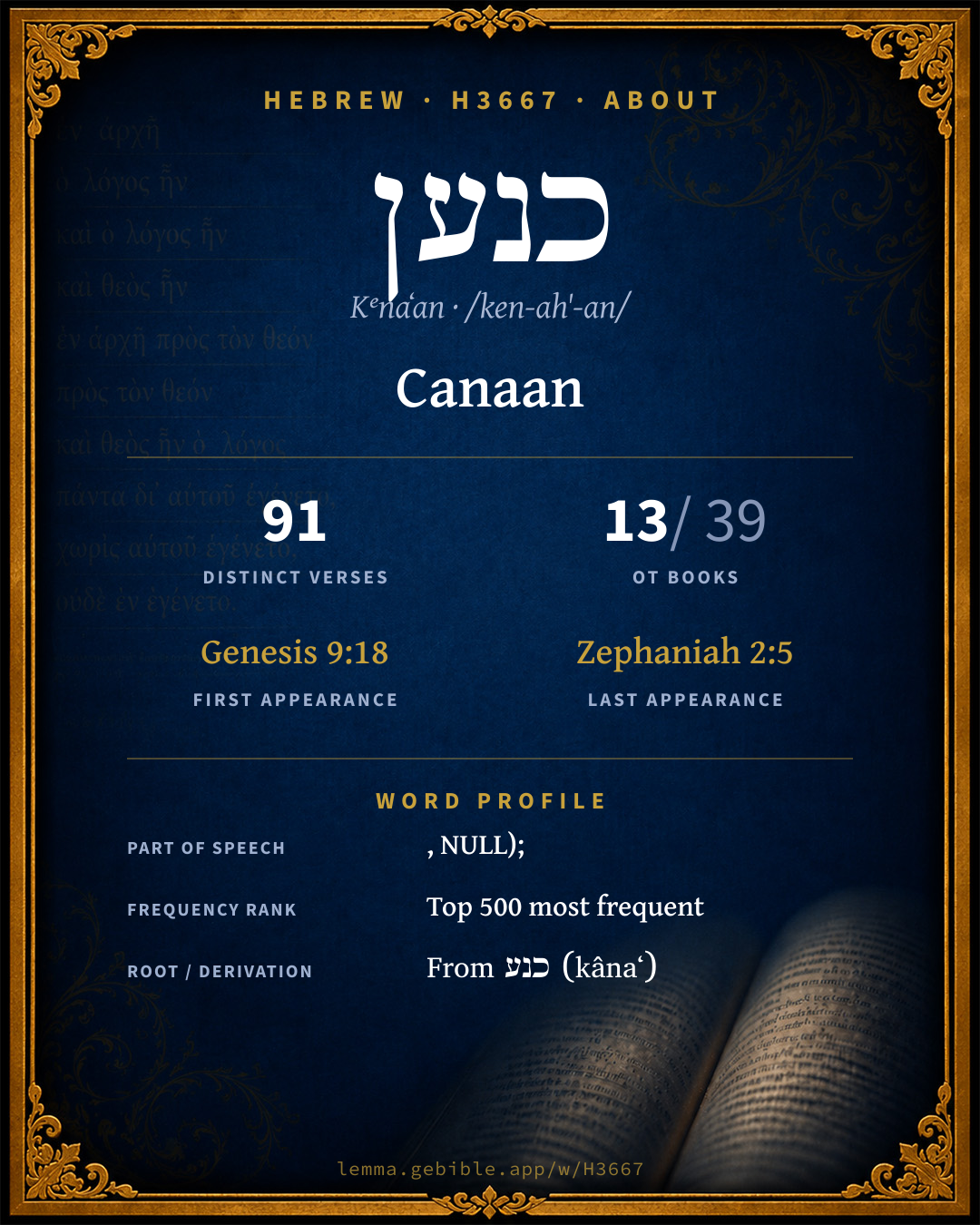
כְּנַ֫עַן
Canaan
BDB lists 4 entries for ‘Canaan’ fuller range ↓
Full lexicon entry — Brown-Driver-Briggs (BDB)
From Brown-Driver-Briggs (BDB)
Where this word appears
Grammar key — what these labels mean
Part of speech
- Noun
- A naming word — a person, place, thing, or idea.
Noun type
- Proper
- A name of a specific person, place, or people (e.g. Abraham, Zion, Israel).
- Common
- A common noun — a general class of person, place, or thing (“king,” “city,” “water”), not a specific name.
State
- Construct
- A noun bound to a following noun in a possessive / “of” relationship (the construct chain).
Gender
- Masculine
- Grammatically masculine.
Number
- Plural
- More than one (in Hebrew, generally three or more).
Every verse where H3667 appears in the Book of Isaiah — 3 distinct verses. Click any verse to open its interlinear word-by-word view. Verse text shown in the World English Bible for context — . Each verse’s Hebrew form is shown with its reference; the English is not keyword-highlighted, since the data carries no word-level English alignment. Use “Compare translations” on any verse to read it across multiple English versions. This concordance covers the Hebrew Bible; Septuagint (Greek Old Testament) occurrences are not indexed here.
Isaiah
- Isaiah 19:18 כְּנַ֔עַן n Proper In that day there shall be five cities in the land of Egypt that speak the language of Canaan, and swear to Yahweh of hosts; one shall be called The city of destruction.
- Isaiah 23:8 כִּנְעָנֶ֖י/הָ n c mp cs + sfx pers 3fs Who has purposed this against Tyre, the giver of crowns, whose merchants are princes, whose traffickers are the honorable of the earth?
- Isaiah 23:11 כְּנַ֔עַן n Proper He has stretched out his hand over the sea, he has shaken the kingdoms: Yahweh has given commandment concerning Canaan, to destroy the strongholds of it.
About this entry
At a glance — auto-summarized from this page’s data, not written by a person. Every figure links to its source below. This summary describes the numbers; it doesn’t interpret them.
At its core, כנען (Kᵉnaʻan) means “Canaan.” It first appears in Genesis 9:18. Spanning 91 verses in 13 books, it ranks among the moderately common words of the Hebrew Bible. Its uses concentrate in Genesis (49% of all occurrences). Dig into 91-verse concordance and the renderings breakdown below.
Gloss history
Strong's 1890 vs modern scholarship
About this word
Strong's H3667 catalogs a Hebrew word from the Hebrew Old Testament.
These counts are not copied from any lexicon or concordance. They are computed here, from the morphology-tagged Hebrew Old Testament. What Lemma adds →
- 91
- distinct verses
- The word appears in 91 distinct verses.
- 13 / 39
- OT books
- The word appears in 13 of 39 Old Testament books.
- #440
- by frequency
- Top 500 most frequent Hebrew words (rank 440 of 8,640 Hebrew words by occurrence).
View all 91 occurrences in the concordance →
By section of the Old Testament
By traditional corpus
Conventional, traditional groupings — biblical authorship is debated, so this is a traditional corpus grouping, not an authorship claim. Each share is this word’s portion of its verses in that division of the Hebrew canon. Each figure is a share of the word’s 91 distinct verses.
- Torah (Pentateuch) 63 verses · 69%
- Prophets (Nevi'im) 22 verses · 24%
- Writings (Ketuvim) 6 verses · 7%
How translations render this word
Counts come from each version’s own published word-to-Strong’s tagging or interlinear alignment — an approximate guide to how each version renders this word, not a word-level alignment the data otherwise carries. Because each total is that version’s own tagged count, the per-version totals vary from one another and need not match the appearance or distinct-verse counts above. These counts may also differ from a printed concordance because Lemma counts each distinctly tagged rendering and does not collapse phrase taggings into a single head-word total. This is a fixed set of word-tagged versions (KJV, ASV, BSB, ULT) and does not change with the reading translation you choose elsewhere. Each version’s license is shown beside its name below (and on Sources).
BDB lists this Strong’s number as 2 distinct words (homographs). Each count above pools all of them and is not split by sense — see the Senses section below. A low-frequency rendering may belong to a different one of those words, not the primary meaning.
- King James Version†: Canaan 87×
- American Standard Version†: Canaan 84×, Let canaan 2×, Traffic 2×
- Berean Standard Bible†: Canaan 82×, Canaanite 3×, Merchants 3×
- unfoldingWord Literal Text†: Canaan 90×, Merchant 2×, The 2×
King James Version Public Domain
Renders H3667 across 94† tagged occurrences — most commonly:
Plus 7 renderings that appear only once — usually multi-word phrases or single function words the recovered tagging swept in, not distinct renderings.
American Standard Version Public Domain
Renders H3667 across 94† tagged occurrences — most commonly:
Plus 6 renderings that appear only once — usually multi-word phrases or single function words the recovered tagging swept in, not distinct renderings.
Berean Standard Bible Public Domain
Renders H3667 across 91† tagged occurrences — most commonly:
Plus 1 rendering that appears only once — usually multi-word phrases or single function words the recovered tagging swept in, not distinct renderings. Not rendered by a distinct English word in 3 further occurrences.
unfoldingWord Literal Text CC BY-SA 4.0
Renders H3667 across 96† tagged occurrences — most commonly:
Plus 2 renderings that appear only once — usually multi-word phrases or single function words the recovered tagging swept in, not distinct renderings.
Senses in the full BDB
What do BDB’s symbols mean?
BDB uses these scholarly abbreviations:
| Symbol | Meaning |
|---|---|
| 𝔊 | the Septuagint (the ancient Greek translation, LXX) |
| 𝔙 | the Vulgate (the Latin translation) |
| 𝔖 | the Syriac version (the Peshitta) |
| 𝔗 | the Targum (the Aramaic translation) |
| ψ | the Psalms |
| √ | root (the underlying root or stem) |
| ‖ | parallel passage (a synonymous or contrasted parallel) |
| † | the dagger: every passage where the word occurs is cited |
The 3 senses and sub-senses the full Brown-Driver-Briggs lexicon distinguishes for this word, in lexicon order (not ranked by frequency), with BDB’s own verbatim wording and sub-sense lettering. Shown in Hebrew script with BDB’s own scholarly abbreviations. The condensed entry is in the Lexicon Entry tab. See also the Forms in the corpus table below.
כנען I m. et terr. Canaan (𝔊 Χανααν, Ph. כנען = Phoenicia
- 1. as n.pr.m., son of Ham Gn 9:18, 22, 25, 27; 10:15 (as ancestor of Canaanites and Phoenicians; all J); 10:6 (P); 1 Ch 1:8, 13 (from Gn 10:6, 15). e.g. Genesis 9:18
- 2.
- a. land, W. of Jordan, into wh. Hebrews came, and where they settled, subduing the inhabitants; מַלְכֵי כְּנַעַן Ju 5:19, מלך כ׳ Ju 4:2, 23, 24(×2); hence מַמְלְכוֹת כ׳ ψ 135:11; ישְׁבֵי כ׳ Ex 15:15 (song in E); cf. מִלְחֲמוֹת כ׳ Ju 3:1; עֲצַבֵּי כ׳ ψ 106:38 idols of Canaan, i. e. of the former inhabitants; especially אֶרֶץ(־) כ׳, אַרְצָה כ׳ Gn 44:8; 46:31; 47:1, 4, 13, 14, 15; 50:5, 13 (all J), 35:6; 42:5, 7, 13, 29, 32; 45:17, 25 Jos 24:3 (all E), Gn 11:31; 12:5(×2); 13:12 (opp. עָרֵי הַכִּכָּר v b), 16:3; 17:8 (P) +, Jos 22:9, 10, 11 (P) Ju 21:12 1 Ch 16:18 = ψ 105:11; also הָאָרֶץ כ׳ Nu 34:2 (P); בְּנוֹת כ׳ Gn 28:1 daughters of Canaan = women of the land, so v 6, 8; 36:2 (all P); כנען is personif. Ho 12:8 = apostate Israel; שְׂפַת כ׳ Is 19:18 = the Hebrew lang. (without evil implication). e.g. Judges 5:19
- b. the coast, especially Phoenicia Is 23:11; cf. כ׳ אֶרֶץ פְּלִשְׁתִּים Zp 2:5. e.g. Isaiah 23:11
כנען II [m.] merchant(s) (because Canaanites, especially Phoenicians, were traders)
Senses from the full Brown-Driver-Briggs lexicon (Brown, Driver, Briggs; Oxford 1906 — public domain), digitized via Sefaria, supplemented by the OpenScriptures HebrewLexicon (CC BY 4.0). Full attribution on Sources.
Word origin
I. n.pr.m. et terr. Canaan (𝔊 Χανααν, Ph. כנען = Phoenicia; Χνα = כנע, Hecataeus, v. MüllerFr. Hist. Gr. i, 17 al.; Egyptian Ka-n-ʿ-nḁ WMMAsien u. Europa, 205 ff.; Tel Amarna Kina̮hna, Kinaḫḫi, etc., BezoldBM Tablets, 150 WklTA 39; etym. dub. GFMPAOS Oct. 1890, lxvii ff.; v. also GASmGeogr. 4 f. BuhlGeogr. § 42);—
II. n.[m.] merchant(s) (because Canaanites, especially Phoenicians, were traders);—כָּל־עַם כְּנַעַן Zp 1:11; אֶרֶץ כ׳ Ez 16:29 (om. 𝔊 B al. Co), 17:4 a land of merchants; cf. כנעני ad fin.
— Brown-Driver-Briggs (Oxford 1906, public domain), digitized via Sefaria, supplemented by the OpenScriptures HebrewLexicon (CC BY 4.0). See Sources.
Derived from כנע (kânaʻ) (H3665) — to humble.
Jastrow Dictionary
A second Hebrew/Aramaic lexicon for comparison, covering Aramaic and post-biblical (Talmudic, Targumic, Midrashic) usage that the biblical-Hebrew BDB does not. Matched by lemma rather than by Strong’s number, so a lemma may carry more than one Jastrow headword (shown separately below), and the entries cover usage well beyond the Bible.
כְּנַעַן
- (b. h.) pr. n. Canaan,
- 1. son of Ham. Gen. R. s. 36 חם חטא וכ׳ וכ׳ Ham sinned and C. was cursed?; Tanḥ. Noah 15; a. e.
- 2. the land of Canaan. R. Hash. 3ᵃ כ׳ על שם מלכותו (Sihon is named) C. from his kingdom; a. fr.
A Dictionary of the Targumim, the Talmud Babli and Yerushalmi, and the Midrashic Literature (Marcus Jastrow; London, Luzac, 1903) — Public Domain. Digitized via Sefaria. Digitized via Sefaria. Full attribution on Sources.
Forms in the corpus
The 16 distinct written forms H3667 takes in the Hebrew Bible, most frequent first — each parse links to that state’s occurrences in the concordance. Hebrew forms include their vowel points and cantillation, so a single lemma takes many written forms.
| Form | Parsing | Example | Uses |
|---|---|---|---|
| כְּנָ֑עַן | Noun, Proper | Exodus 6:4 | 27 |
| כְּנַ֔עַן | Noun, Proper | Deuteronomy 32:49 | 23 |
| כְּנָֽעַן | Noun, Proper | Exodus 16:35 | 20 |
| כְּנַ֖עַן | Noun, Proper | Ezekiel 16:29 | 5 |
| כְּנַ֨עַן֙ | Noun, Proper | Genesis 48:7 | 3 |
| וּ/כְנַ֗עַן | Noun, Proper | Genesis 10:15 | 2 |
| וּ/כְנָֽעַן | Noun, Proper | Genesis 10:6 | 2 |
| כְנַ֔עַן | Noun, Proper | Genesis 9:22 | 2 |
| כְנַ֖עַן | Noun, Proper | Genesis 9:26 | 2 |
| כְנָֽעַן | Noun, Proper | Exodus 15:15 | 2 |
| כְנָ֑עַן | Noun, Proper | Psalms 106:38 | 1 |
| כְּנַ֗עַן | Noun, Proper | Hosea 12:7 | 1 |
| כְּנַ֡עַן | Noun, Proper | Leviticus 18:3 | 1 |
| כְּנַעַן֒ | Noun, Proper | Genesis 47:15 | 1 |
| כְּנָ֔עַן | Noun, Proper | 1 Chronicles 16:18 | 1 |
| כִּנְעָנֶ֖י/הָ | Noun, Common, Masculine, Plural, Construct | Isaiah 23:8 | 1 |
Same root — word family
Other BDB entries built from the same root as H3667, grouped by Strong’s listed origin. These share a root / origin per the lexicon — not necessarily a shared meaning. Each links to that word’s own entry.
Derives from
Shares the same root
Proper names from this root
People and places named from this root — a name, not an additional meaning of the word.
Compare all same-root words → Showing 4 of 6 — not the complete family. 3 of the same-root words are proper names (people or places). They share a root, not necessarily a meaning.
Bible dictionary
Public-domain dictionary articles matched to this entry by name (Canaan). A biblical name can be shared by more than one person or place, so an article may treat several.
Easton's Bible Dictionary · M. G. Easton, 1897
(1.) The fourth son of Ham (Gen. 10:6). His descendants were under a curse in consequence of the transgression of his father (9:22-27). His eldest son, Zidon, was the father of the Sidonians and Phoenicians. He had eleven sons, who were the founders of as many tribes (10:15-18).
(2.) The country which derived its name from the preceding. The name as first used by the Phoenicians denoted only the maritime plain on which Sidon was built. But in the time of Moses and Joshua it denoted the whole country to the west of the Jordan and the Dead Sea (Deut. 11:30). In Josh. 5:12 the LXX. read, "land of the Phoenicians," instead of "land of Canaan."
The name signifies "the lowlands," as distinguished from the land of Gilead on the east of Jordan, which was a mountainous district. The extent and boundaries of Canaan are fully set forth in different parts of Scripture (Gen. 10:19; 17:8; Num. 13:29; 34:8). (See CANAANITES, PALESTINE.)
Smith's Bible Dictionary · William Smith, 1863
(Ca'nan) (low, flat).
+ The fourth son of Ham, (Genesis 10:6; 1 Chronicles 1:8) the progenitor of the Phoenicians [Zidon, Or Sidon], and of the various nations who before the Israelite conquest people the seacoast of Palestine, and generally the while of the country westward of the Jordan. (Genesis 10:13; 1 Chronicles 1:13) (B.C. 2347.) + The name "Canaan" is sometimes employed for the country itself.
Hitchcock's Bible Names Dictionary · Roswell D. Hitchcock, 1869
merchant; trader; or that humbles and subdues
Classic public-domain reference works; full attribution on Sources.
Septuagint verse parallels
This word appears in 91 verses that also exist in the Greek Old Testament (Septuagint), out of the 91 Hebrew verses it occurs in. You can read those verses in Greek by switching the Old Testament edition to the Septuagint.
Read these verses in the Septuagint
- Genesis 9:18
- Exodus 6:4
- Leviticus 14:34
- Numbers 13:2
- Deuteronomy 32:49
- Joshua 5:12
- Judges 3:1
- 1 Chronicles 1:8
- Psalms 105:11
- Isaiah 19:18
- Ezekiel 16:29
- Hosea 12:7
This is a verse-level parallel only — the same verses exist in both the Hebrew and Greek Old Testaments. No word-level Hebrew↔Greek correspondence is claimed: the data carries no such alignment, so no Greek word is shown as this Hebrew word’s translation. Coverage is not total — the Septuagint omits the deuterocanon and renumbers the Psalms, so some Hebrew verses have no direct Greek parallel.