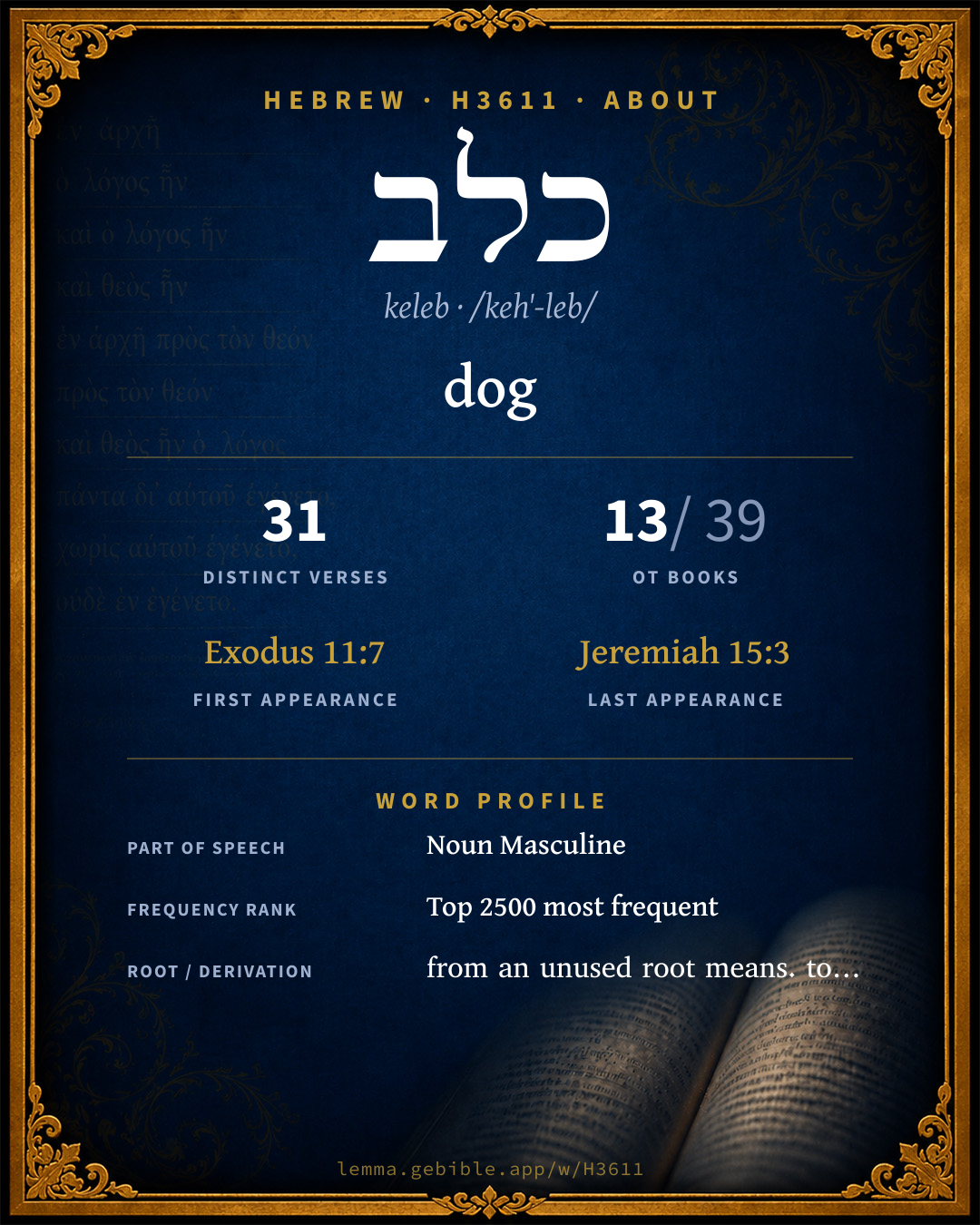
כֶּ֫לֶב
dog
‘dog’ is one of 5 main senses fuller range ↓
Full lexicon entry — Brown-Driver-Briggs (BDB)
From Brown-Driver-Briggs (BDB)
Where this word appears
Grammar key — what these labels mean
Part of speech
- Noun
- A naming word — a person, place, thing, or idea.
Noun type
- Common
- A common noun — a general class of person, place, or thing (“king,” “city,” “water”), not a specific name.
State
- Absolute
- The independent form of a noun, not bound to a following word.
- Construct
- A noun bound to a following noun in a possessive / “of” relationship (the construct chain).
Gender
- Masculine
- Grammatically masculine.
Number
- Plural
- More than one (in Hebrew, generally three or more).
- Singular
- One.
Every verse where H3611 appears in the Book of 1 Kings — 6 distinct verses. Click any verse to open its interlinear word-by-word view. Verse text shown in the World English Bible for context — . Each verse’s Hebrew form is shown with its reference; the English is not keyword-highlighted, since the data carries no word-level English alignment. Use “Compare translations” on any verse to read it across multiple English versions. This concordance covers the Hebrew Bible; Septuagint (Greek Old Testament) occurrences are not indexed here.
1 Kings
- 1 Kings 14:11 הַ/כְּלָבִ֔ים ptcl def.art + n c mp Him who dies of Jeroboam in the city shall the dogs eat; and him who dies in the field shall the birds of the sky eat: for Yahweh has spoken it.
- 1 Kings 16:4 הַ/כְּלָבִ֑ים ptcl def.art + n c mp Him who dies of Baasha in the city shall the dogs eat; and him who dies of his in the field shall the birds of the sky eat.
- 1 Kings 21:19 הַ/כְּלָבִים֙ הַ/כְּלָבִ֛ים ptcl def.art + n c mp ptcl def.art + n c mp You shall speak to him, saying, Thus says Yahweh, Have you killed and also taken possession? You shall speak to him, saying, Thus says Yahweh, In the place where dogs licked the blood of Naboth shall dogs lick your blood, even yours.
- 1 Kings 21:23 הַ/כְּלָבִ֛ים ptcl def.art + n c mp Of Jezebel also spoke Yahweh, saying, The dogs shall eat Jezebel by the rampart of Jezreel.
- 1 Kings 21:24 הַ/כְּלָבִ֑ים ptcl def.art + n c mp Him who dies of Ahab in the city the dogs shall eat; and him who dies in the field shall the birds of the sky eat.
- 1 Kings 22:38 הַ/כְּלָבִים֙ ptcl def.art + n c mp They washed the chariot by the pool of Samaria; and the dogs licked up his blood (now the prostitutes washed themselves [there]); according to the word of Yahweh which he spoke.
About this entry
At a glance — auto-summarized from this page’s data, not written by a person. Every figure links to its source below. This summary describes the numbers; it doesn’t interpret them.
כלב (keleb) is a Hebrew noun most often rendered “dog.” Not a single-sense word: explore its full sense range. It turns up in 31 verses across 13 books, a moderately common footprint. Scripture first uses it in Exodus 11:7. It clusters with כלוב and כלב under a shared root. For the data behind this summary, explore the sense tree and the renderings breakdown below.
Gloss history
Strong's 1890 vs modern scholarship
About this word
Strong's H3611 catalogs a Hebrew word from the Hebrew Old Testament.
These counts are not copied from any lexicon or concordance. They are computed here, from the morphology-tagged Hebrew Old Testament. What Lemma adds →
- 31
- distinct verses
- The word appears in 31 distinct verses.
- 13 / 39
- OT books
- The word appears in 13 of 39 Old Testament books.
- #1,086
- by frequency
- Top 2500 most frequent Hebrew words (rank 1,086 of 8,640 Hebrew words by occurrence).
View all 31 occurrences in the concordance →
By section of the Old Testament
By traditional corpus
Conventional, traditional groupings — biblical authorship is debated, so this is a traditional corpus grouping, not an authorship claim. Each share is this word’s portion of its verses in that division of the Hebrew canon. Each figure is a share of the word’s 31 distinct verses.
- Prophets (Nevi'im) 19 verses · 61%
- Writings (Ketuvim) 9 verses · 29%
- Torah (Pentateuch) 3 verses · 10%
How translations render this word
Counts come from each version’s own published word-to-Strong’s tagging or interlinear alignment — an approximate guide to how each version renders this word, not a word-level alignment the data otherwise carries. Because each total is that version’s own tagged count, the per-version totals vary from one another and need not match the appearance or distinct-verse counts above. These counts may also differ from a printed concordance because Lemma counts each distinctly tagged rendering and does not collapse phrase taggings into a single head-word total. This is a fixed set of word-tagged versions (KJV, ASV, BSB, ULT) and does not change with the reading translation you choose elsewhere. Each version’s license is shown beside its name below (and on Sources).
- King James Version: Dogs 12×, Dog 10×, Like a dog 2×
- American Standard Version: Dogs 11×, Dog 8×, Shall the dogs 3×
- Berean Standard Bible: Dogs 15×, Dog 10×, Like dogs 2×
- unfoldingWord Literal Text: Dogs 15×, Dog 13×, A 3×
King James Version Public Domain
Renders H3611 across 32 tagged occurrences — most commonly:
Plus 4 renderings that appear only once — usually multi-word phrases or single function words the recovered tagging swept in, not distinct renderings.
American Standard Version Public Domain
Renders H3611 across 32 tagged occurrences — most commonly:
Plus 6 renderings that appear only once — usually multi-word phrases or single function words the recovered tagging swept in, not distinct renderings.
Berean Standard Bible Public Domain
Renders H3611 across 32 tagged occurrences — most commonly:
Plus 5 renderings that appear only once — usually multi-word phrases or single function words the recovered tagging swept in, not distinct renderings.
unfoldingWord Literal Text CC BY-SA 4.0
Renders H3611 across 37 tagged occurrences — most commonly:
Plus 3 renderings that appear only once — usually multi-word phrases or single function words the recovered tagging swept in, not distinct renderings.
Senses in the full BDB
What do BDB’s symbols mean?
BDB uses these scholarly abbreviations:
| Symbol | Meaning |
|---|---|
| 𝔊 | the Septuagint (the ancient Greek translation, LXX) |
| 𝔙 | the Vulgate (the Latin translation) |
| 𝔖 | the Syriac version (the Peshitta) |
| 𝔗 | the Targum (the Aramaic translation) |
| ψ | the Psalms |
| √ | root (the underlying root or stem) |
| ‖ | parallel passage (a synonymous or contrasted parallel) |
| † | the dagger: every passage where the word occurs is cited |
The 2 senses and sub-senses the full Brown-Driver-Briggs lexicon distinguishes for this word, in lexicon order (not ranked by frequency), with BDB’s own verbatim wording and sub-sense lettering. Shown in Hebrew script with BDB’s own scholarly abbreviations. The condensed entry is in the Lexicon Entry tab. See also the Forms in the corpus table below.
- a. lit. 1 K 14:11; 16:4; 21:19(×2), 23, 24; 22:38; 2 K 9:10, 36 (all of fierce, hungry dogs, devouring dead bodies and licking blood); cf. Je 15:3 and (לְשׁוֹךָ כְּלָבֶיךָ) ψ 68:24; eating torn flesh, Ex 22:30 (E), כַּלְבֵי צֹאנִי = my sheep-dogs, only Jb 30:1 (in both these with implied inferiority); dog-sacrifice was a heathen rite Is 66:3 (Di al.); v. especially RSSem i. 273 (291), 325 (343); in various sim. Ju 7:5; Pr 26:11, 17 ψ 59:7, 15; in proverbial sayings: לֹא יֶחֱרַץ־כ׳ לִשֹׁנוֹ Ex 11:7 (v. I. חרץ); לְכ׳ חַי הוּא טוֹב מִן־הָאַרְיֵה הַמֵּת Ec 9:4. e.g. 1 Kings 14:11
- b. applied, fig., to men, in contempt 1 S 17:43, so of psalmist’s enemies ψ 22:17, 21, or in excessive humility 2 K 8:13; still more emphatically כ׳ מֵת a dead dog, הַכּ׳ הַמֵּת 2 S 9:8; 16:8; also רֹאשׁ כ׳ 3:8; כְּלָבִים אִלְּמִים Is 56:10 (of misleading prophets), הַכּ׳ עַזֵּי נֶפֶשׁ v 11 (id.); כ׳ was name given to male temple-prostitutes Dt 23:19 (v. Dr; cf. קָדֵשׁ). e.g. 1 Samuel 17:43
Senses from the full Brown-Driver-Briggs lexicon (Brown, Driver, Briggs; Oxford 1906 — public domain), digitized via Sefaria, supplemented by the OpenScriptures HebrewLexicon (CC BY 4.0). Full attribution on Sources.
Word origin
n.m. 1 S 24:15 dog (NH id.; Ph. כלב; Aramaic כַּלְבָּא, ܟܰܠܒܳܐ; Arabic كَلْبٌ; Ethiopic ከልብ: Assyrian kalbu DlHWB 328)—abs. כ׳ Ju 7:5 + 16 times, כָּ֑לֶב ψ 59:7, 15; pl. כְּלָבִים 1 K 14:11 + 12 times; cstr. כַּלְבֵי Jb 30:1; sf. כְּלָבֶיךָ ψ 68:24;—dog:
— Brown-Driver-Briggs (Oxford 1906, public domain), digitized via Sefaria, supplemented by the OpenScriptures HebrewLexicon (CC BY 4.0). See Sources.
Origin: from an unused root means. to yelp, or else to attack
Jastrow Dictionary
A second Hebrew/Aramaic lexicon for comparison, covering Aramaic and post-biblical (Talmudic, Targumic, Midrashic) usage that the biblical-Hebrew BDB does not. Matched by lemma rather than by Strong’s number, so a lemma may carry more than one Jastrow headword (shown separately below), and the entries cover usage well beyond the Bible.
כָּלַב
- (cmp. כָּלַל) to seize.—Denom. כֶּלֶב.
- (denom. of כֶּלֶב) [to make stitches resembling dog-bites (cmp. our ‘cat-stitching’),] to stitch, opp. to תָּפַר to sew in a workmanlike manner. M. Kat. I, 8 (8ᵇ) האומן מְכַלֵּב Ms. M. a. Y. ed. (Mish. a. Babli מַכְלִיב) the professional tailor is permitted (during the festive week) to stitch (but not to sew); expl. ib. 10ᵃ מפסיע he makes wide steps (cross-stitches); (another opin.) שיני כלבתא (Ms. M. only כַּלְבְּתָא q. v.) dog’s teeth, i.e. irregular stitches; Y. ib. 80ᵈ bot. מפסיע; (oth. opin.) אחת אחת each stitch singly. Ib. הרוצענין מְכַלְּבִין the saddlers are permitted to do dog-stitching.
כֶּלֶב
- preced.) dog. Snh. 63ᵇ (expl. נבחן, II Kings XVII, 31) כ׳ they worshipped a dog. Yoma VIII, 6, a. e. כ׳ שוטה a mad dog. Kil. I, 6, v. כּוּפְרִי. Kel. XVII, 13 כ׳ המים sea-dog. Gen. R. s. 77, v. אַגְרִיאוֹן. Y. Snh. VII, 23ᶜ top (ref. to Ps. XXII, 21) מכַּלְבּוֹ של וכ׳ from the dog (the vicious accuser) of that pious man, v. ib. 23ᵇ bot., sq.); a. fr. Pl. כְּלָבִים. Ber. 3ᵃ. Tosef. B. Kam. VIII, 17. Ex. R. s. 20 עשו … כ׳ של וכ׳ the Egyptians made golden dogs by sorcery that they should bark &c.; a. fr. e.g. 2 Kings 17:31
כְּלֵב
- Targ. Ps. LIX, 7. Targ. Prov. VII, 22 (Ms. כְּלֵיבָא; h. text עכס); a. fr.—Y. Ab. Zar. III, 42ᵈ top, expl. נבחן, v. preced.—Erub. 61ᵃ (prov.) כ׳ בלא מתיה וכ׳ a dog away from home barks not for seven years, i.e. however quarrelsome a man may be, he will not fight in a strange place; a. fr.—Trnsf. a mean person. Lev. R. s. 9.—Pl. כַּלְבִּין, כַּלְבַּיָּא, כַּלְבֵּי. Targ. Ps. XXII, 17. Targ. Is. LVI, 10; a. e.—Y. Peah I, 15ᶜ bot.; Y. Kidd. I, 61ᵇ, v. דּוּשׁ ch.—Sabb. 152ᵃ כַּלְבּוֹהִי לא וכ׳ his (euphem. for my) dogs no longer bark, i.e. my voice is weak from old age. B. Mets. 94ᵃ top כך וכך כ׳ איכא וכ׳ so and so many dogs have we with us. Pesik. B’shall., p. 86ᵃ תרין כלבי דחרשין (not כלבא) two dogs (of gold) made by the sorcerers (v. preced.). Ib., sq. כ׳ דקושטא the real (natural) dogs do not bark at us (ref. to Ex. XI, 7); a. e.—[Targ. Koh. IV, 6 כלב גזילא, some ed., read בלא ג׳.—Lam. R. to I, 4 כלבא, read: כַּלְבָּה.] e.g. Exodus 11:7
A Dictionary of the Targumim, the Talmud Babli and Yerushalmi, and the Midrashic Literature (Marcus Jastrow; London, Luzac, 1903) — Public Domain. Digitized via Sefaria. Digitized via Sefaria. Full attribution on Sources.
Forms in the corpus
The 26 distinct written forms H3611 takes in the Hebrew Bible, most frequent first — each parse links to that state’s occurrences in the concordance. Hebrew forms include their vowel points and cantillation, so a single lemma takes many written forms.
Same root — word family
Other BDB entries built from the same root as H3611, grouped by Strong’s listed origin. These share a root / origin per the lexicon — not necessarily a shared meaning. Each links to that word’s own entry.
Derived from this word
Proper names from this root
People and places named from this root — a name, not an additional meaning of the word.
Compare all same-root words → 1 of the same-root words is a proper name (a person or place). They share a root, not necessarily a meaning.
Septuagint verse parallels
This word appears in 27 verses that also exist in the Greek Old Testament (Septuagint), out of the 31 Hebrew verses it occurs in. You can read those verses in Greek by switching the Old Testament edition to the Septuagint.
Read these verses in the Septuagint
- Exodus 11:7
- Deuteronomy 23:18
- Judges 7:5
- 1 Samuel 24:14
- 2 Samuel 3:8
- 1 Kings 14:11
- 2 Kings 8:13
- Job 30:1
- Psalms 59:6
- Proverbs 26:11
- Ecclesiastes 9:4
- Isaiah 56:10
This is a verse-level parallel only — the same verses exist in both the Hebrew and Greek Old Testaments. No word-level Hebrew↔Greek correspondence is claimed: the data carries no such alignment, so no Greek word is shown as this Hebrew word’s translation. Coverage is not total — the Septuagint omits the deuterocanon and renumbers the Psalms, so some Hebrew verses have no direct Greek parallel.