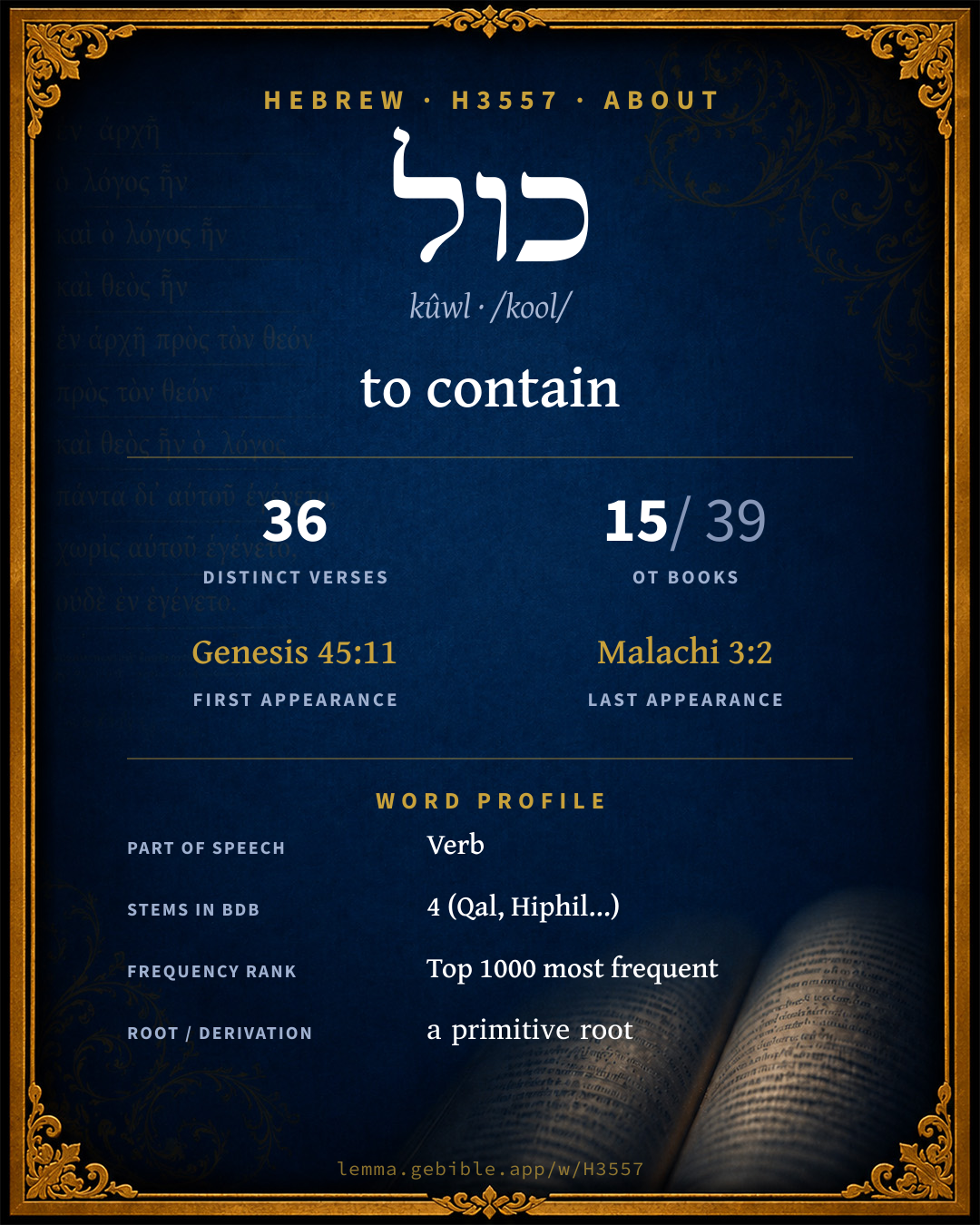
כּוּל
to contain
‘to contain’ is one of 5 main senses fuller range ↓
Full lexicon entry — Brown-Driver-Briggs (BDB)
From Brown-Driver-Briggs (BDB)
Where this word appears
Grammar key — what these labels mean
Part of speech
- Verb
- An action or state-of-being word.
Stem
- Hiphil
- The causative active stem (“he caused / brought about”). Here: ‘contain’
- Pilpel
- A reduplicated intensive stem of two-letter or hollow roots.
- Piel
- An intensive or resultative active stem.
- Qal
- The basic, simple active stem — the plain form of the verb (“he wrote”). Here: ‘only Is 40’
Form
- Infinitive Construct
- A bound verbal noun, frequently with prepositions (“to write / in writing”).
- Imperfect
- An incomplete, ongoing, or future action (“he will / would write”).
- Perfect
- A completed action or state — Hebrew marks aspect (completeness) more than strict tense (“he wrote”).
- Sequential Perfect
- A perfect with prefixed waw continuing a preceding imperfect or command (waw-consecutive perfect).
- Sequential Imperfect
- An imperfect with prefixed waw — the standard past-narrative form (waw-consecutive imperfect).
- Participle Active
- A verbal adjective expressing ongoing or characteristic action (“writing / one who writes”).
State
- Absolute
- The independent form of a noun, not bound to a following word.
Person
- 3rd Person
- The one spoken about (“he / she / it / they”).
- 1st Person
- The speaker (“I / we”).
- 2nd Person
- The one addressed (“you”).
Gender
- Masculine
- Grammatically masculine.
- Common
- Either gender — not distinguished for this form.
Number
- Singular
- One.
- Plural
- More than one (in Hebrew, generally three or more).
Every verse where H3557 appears in the Book of Zechariah — 1 distinct verse. Click any verse to open its interlinear word-by-word view. Verse text shown in the World English Bible for context — . Each verse’s Hebrew form is shown with its reference; the English is not keyword-highlighted, since the data carries no word-level English alignment. Use “Compare translations” on any verse to read it across multiple English versions. This concordance covers the Hebrew Bible; Septuagint (Greek Old Testament) occurrences are not indexed here.
Zechariah
About this entry
At a glance — auto-summarized from this page’s data, not written by a person. Every figure links to its source below. This summary describes the numbers; it doesn’t interpret them.
The Hebrew verb כול centers on the idea of “to contain.” As a verb its force shifts by stem, across 4 stems (Qal, Hiphil, and more). The Hebrew Bible uses it across 36 verses — moderately common. 1 Kings dominates its distribution — 11 of 36 verses. First canonically at Genesis 45:11, it enters the text early. For the data behind this summary, explore the sense tree and the renderings breakdown below.
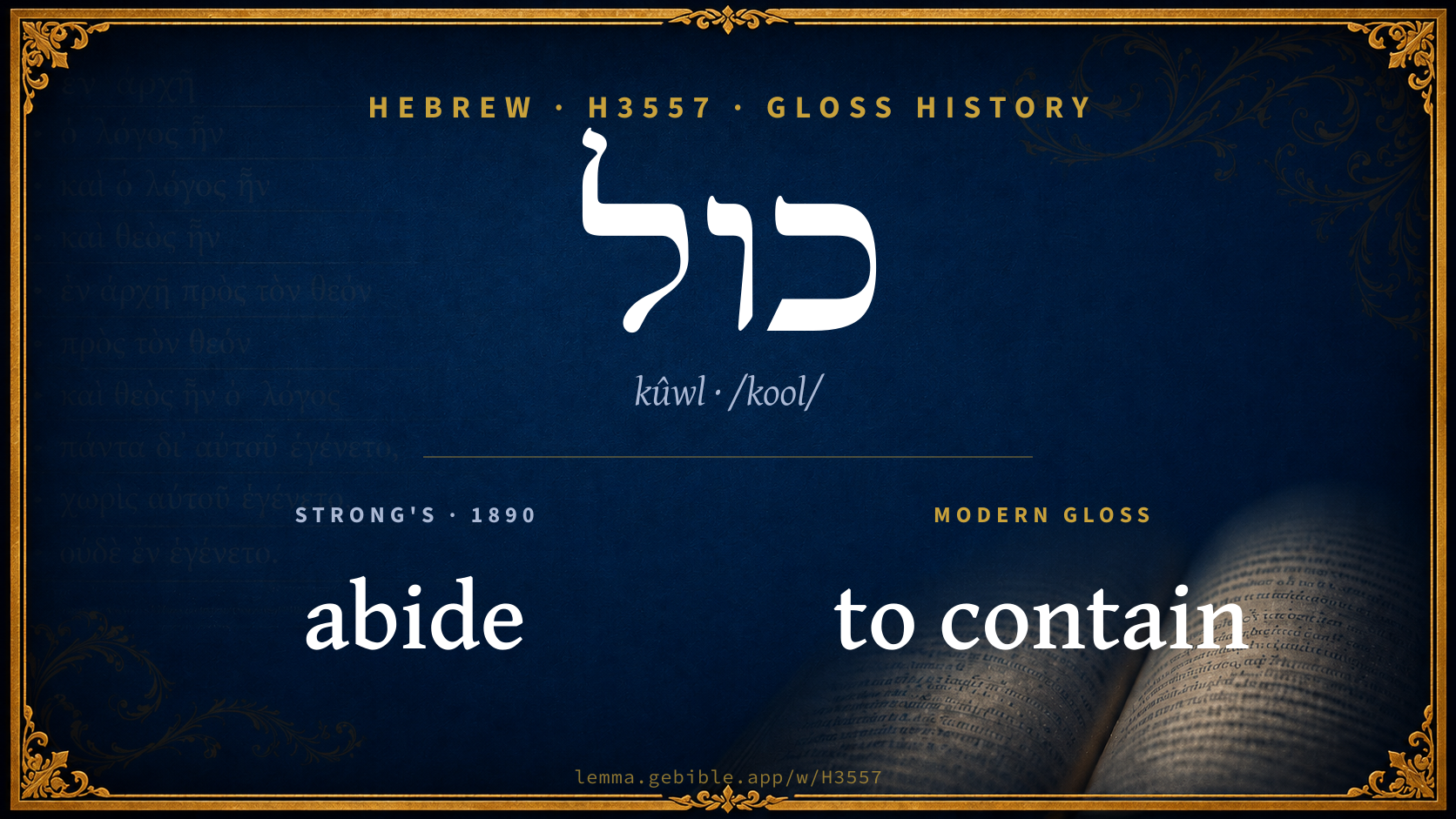
Gloss history
Strong's 1890 vs modern scholarship
About this word
Strong's H3557 catalogs a Hebrew word from the Hebrew Old Testament.
These counts are not copied from any lexicon or concordance. They are computed here, from the morphology-tagged Hebrew Old Testament. What Lemma adds →
- 36
- distinct verses
- The word appears in 36 distinct verses.
- 15 / 39
- OT books
- The word appears in 15 of 39 Old Testament books.
- #967
- by frequency
- Top 1000 most frequent Hebrew words (rank 967 of 8,640 Hebrew words by occurrence).
View all 36 occurrences in the concordance →
Most concentrated in
- 1 Kings 11 verses 31%
- 2 Chronicles 4 verses 11%
- Jeremiah 4 verses 11%
By section of the Old Testament
By traditional corpus
Conventional, traditional groupings — biblical authorship is debated, so this is a traditional corpus grouping, not an authorship claim. Each share is this word’s portion of its verses in that division of the Hebrew canon. Each figure is a share of the word’s 36 distinct verses.
- Prophets (Nevi'im) 24 verses · 67%
- Writings (Ketuvim) 9 verses · 25%
- Torah (Pentateuch) 3 verses · 8%
How translations render this word
Counts come from each version’s own published word-to-Strong’s tagging or interlinear alignment — an approximate guide to how each version renders this word, not a word-level alignment the data otherwise carries. Because each total is that version’s own tagged count, the per-version totals vary from one another and need not match the appearance or distinct-verse counts above. These counts may also differ from a printed concordance because Lemma counts each distinctly tagged rendering and does not collapse phrase taggings into a single head-word total. This is a fixed set of word-tagged versions (KJV, ASV, BSB, ULT) and does not change with the reading translation you choose elsewhere. Each version’s license is shown beside its name below (and on Sources).
- King James Version: Cannot contain 3×, Fed 3×, Contained 2×
- American Standard Version: Cannot contain 3×, Fed 2×, Held 2×
- Berean Standard Bible: Can endure 2×, Contain you 2×, Could hold 2×
- unfoldingWord Literal Text: Do 4×, And 3×, Contain you 2×
King James Version Public Domain
Renders H3557 across 37 tagged occurrences — most commonly:
Plus 25 renderings that appear only once — usually multi-word phrases or single function words the recovered tagging swept in, not distinct renderings.
American Standard Version Public Domain
Renders H3557 across 37 tagged occurrences — most commonly:
Plus 26 renderings that appear only once — usually multi-word phrases or single function words the recovered tagging swept in, not distinct renderings.
Berean Standard Bible Public Domain
Renders H3557 across 38 tagged occurrences — most commonly:
Plus 28 renderings that appear only once — usually multi-word phrases or single function words the recovered tagging swept in, not distinct renderings.
unfoldingWord Literal Text CC BY-SA 4.0
Renders H3557 across 46 tagged occurrences — most commonly:
Plus 33 renderings that appear only once — usually multi-word phrases or single function words the recovered tagging swept in, not distinct renderings.
9 senses and sub-senses in the full BDB
Hebrew verbs can shift meaning by stem (binyan): Qal is the basic action, Niphal is often passive or reflexive, Piel often intensifies or makes it factitive, and Hiphil is typically causative. The senses below are grouped under the stem BDB assigns to each. This entry also uses one or more reduplicated stems (the Pōlēl/Pilpēl type), which for hollow or geminate roots behave much like Piel — often intensive or iterative.
What do BDB’s symbols mean?
BDB uses these scholarly abbreviations:
| Symbol | Meaning |
|---|---|
| 𝔊 | the Septuagint (the ancient Greek translation, LXX) |
| 𝔙 | the Vulgate (the Latin translation) |
| 𝔖 | the Syriac version (the Peshitta) |
| 𝔗 | the Targum (the Aramaic translation) |
| ψ | the Psalms |
| √ | root (the underlying root or stem) |
| ‖ | parallel passage (a synonymous or contrasted parallel) |
| † | the dagger: every passage where the word occurs is cited |
The 9 senses and sub-senses the full Brown-Driver-Briggs lexicon distinguishes for this word, in lexicon order (not ranked by frequency), with BDB’s own verbatim wording and sub-sense lettering. Shown in Hebrew script with BDB’s own scholarly abbreviations. The condensed entry is in the Lexicon Entry tab. See also the Forms in the corpus table below.
Qal
- Pf. only Is 40:12 מִי … כָּל בְּשָׁלִשׁ עֲפַר הָאָרֶץ who hath comprehended the dust of the earth in a shalish-measure? e.g. Isaiah 40:12
Pilp
- Pf. כִּלְכֵּל 2 S 19:33; sf. כִּלְכְּלָם 1 K 18:4; 2 ms. sf. כִּלְבַּלְתָּם Ne 9:21, etc.; Impf. יְכַלְכֵּל Zc 11:16 +, etc.; Inf. cstr. כַּלְכֵּל Je 20:9 +, etc.; Pt. מְכַלְכֵּל Mal 3:2;—sustain, maintain, contain: e.g. 2 Samuel 19:33
- 1. sustain, support, nourish, sq. acc. pers. Gn 45:11; 50:21 (both E), 2 S 19:33, 34; 20:3 1 K 4:7a (v b abs.), 5:7; 17:4, 9 Ne 9:21 Ru 4:15 ψ 55:23 Zc 11:16 (of sheep); sq. acc. pers. + rei (food) Gn 47:12 (J), 1 K 18:4, 13. e.g. Genesis 45:11
- 2. contain, sq. acc. pers. 1 K 8:27 2 Ch 2:5; 6:18 (heavens cannot contain י׳); hold in, restrain Yahweh’s word within one, Je 20:9. e.g. 1 Kings 8:27
- 3. support, endure, sickness רוּחַ אִישׁ יְכַל׳ מַחֲלֵ֑הוּ Pr 18:14 Mal 3:2 (obj. אֶת־יוֹם בּוֹאוֹ); of sustaining a cause, in court, יְכַל׳ דְּבָרָיו בְּמִשְׁפָּט ψ 112:5. e.g. Proverbs 18:14
Polp
- Pf. 3 pl. כָּלְכְּלוּ were supplied with food 1 K 20:27 (Klo proposes בַּגִּלְבֹּעַ) e.g. 1 Kings 20:27
Hiphil
- Impf. יָכִיל 1 K 7:26 + 2 times etc.; Inf. cstr. הָכִיל Je 6:11 + 5 times;—contain, hold, hold in, endure; e.g. 1 Kings 7:26
- 1. contain, sq. acc. (of liquid) 1 K 7:26, 38 2 Ch 4:5; in fig. Je 2:13, abs. Ez 23:32; (of burnt-offering) 1 K 8:64 2 Ch 7:7; hold in (wrath of י׳, obj. not expr.), Je 6:11 (opp. שָׁפַךְ); on Ez 21:33 v. אָכַל. e.g. 1 Kings 7:26
- 2. sustain, endure, sq. acc. Am 7:10 Je 10:10 Jo 2:11. e.g. Amos 7:10
Senses from the full Brown-Driver-Briggs lexicon (Brown, Driver, Briggs; Oxford 1906 — public domain), digitized via Sefaria, supplemented by the OpenScriptures HebrewLexicon (CC BY 4.0). Full attribution on Sources.
Word origin
vb. comprehend, contain (NH, Aramaic id., measure, measure out, of dry or liquid measure; Syriac Aph. ܐܰܟܻܝܠ id.; Arabic كَالَ measure grain)—
— Brown-Driver-Briggs (Oxford 1906, public domain), digitized via Sefaria, supplemented by the OpenScriptures HebrewLexicon (CC BY 4.0). See Sources.
Origin: a primitive root
Jastrow Dictionary
A second Hebrew/Aramaic lexicon for comparison, covering Aramaic and post-biblical (Talmudic, Targumic, Midrashic) usage that the biblical-Hebrew BDB does not. Matched by lemma rather than by Strong’s number, so a lemma may carry more than one Jastrow headword (shown separately below), and the entries cover usage well beyond the Bible.
כּוּל
- (b. h.) [to enclose,] to measure. Ter. X, 8 וכָל גרב Ms. (ed. כל), v. גָּרָב I.—
- q. v.
כּוּל ²
- Perf. כָּל; part. כָּאֵיל, כָּיֵיל. Targ. O. Ex. XVI, 18 (Y. אָכִילוּ Af.). Targ. Ruth. III, 15. Targ. Is. XXVII, 8.—Men. 53ᵇ כי קא כייל וכ׳ when he measures, he measures by &c. Ab. Zar. 71ᵇ אק כ׳ ודמי וכ׳ he measures and pours (the wine) into &c. Ned. 51ᵃ, v. אֲכַל II.—Ḥull. 12ᵃ, a. e. לכי תֵיכוּל עלה כורא דמילחא (I will tell you,) if you will measure out for it a kor of salt (a jesting remark). Kidd. 79ᵇ כולי עלמא כַּיְילֵי ליה וכ׳ to all the world (wisdom) has been measured in a small kab, and to this scholar in a large kab, i.e. he wants to be wiser than all the world.
- same. Targ. Y. Ex. XVI, 18, v. supra. Targ. Y. II, Gen. XXXVIII, 26 מָכִיל (not מְ׳).
- (denom. of כְּלָלָא) to generalize; lay down a rule. Keth. 60ᵃ, v. כְּלָלָא.
- to be measured. Targ. Y. II, Gen. l. c. Targ. Is. XL, 12; a. e.
כּוּלּ־
- h., v. כֹּל
כּוֹל
- 1. all, every one; any. Constr. כָּל (frequ. used absolutely). Targ. O. Gen. XVI, 12, sq. Targ. Ex. XX, 9. Targ. Y. Deut. XXXII, 49 לא כל היאך not at all as (thou sayest); a. fr.—Y. Yoma VIII, 45ᵇ bot. לא כולא מן הדין וכ׳ all does not depend upon this man (it is not at all within his power) to say to the king, Thou art no king, i.e. his saying that the Day of Atonement has no atoning power, cannot affect its power; Y. Shebu. II, 33ᵇ bot.—Snh. 46ᵇ, a. fr. (לאו) לא כל כמיניה all is not as if dependent on him, i.e. he has no power to &c. Gen. R. s. 79, beg. (expl. בכלח, Job V, 26) תבא בכולא אלי וכ׳ (some ed. בכוֹלָּה) thou shalt enter the grave in fulness, full, wanting nothing.—כָּל דְּכֵן = h. כָּל שֶׁכֵּן, v. כֹּל. Targ. Job IV, 19; a. fr.—Nidd. 51ᵃ; a. fr.—כָּל עלמא, v. infra.—With suffix כּוּלָךְ, כּוּלֵיה &c. (Buxt. כֻּלָּךְ &c.) all of thee, of him &c., entire. Targ. Gen. XXV, 25; a. fr.—Yoma 14ᵇ כוליה יומא the entire day; ib. 19ᵃ (not כולי). Ib. 26ᵃ כּוּלְהוּ מצפרא אתו (v. Rabb. D. S. a. l. note 10) all of them come in (for their share) by the lots cast in the morning; a. fr.—Pl. constr. כּוּלֵי all of. Targ. Esth. VI, 1 כ׳ ליליא (ed. Lag. כוליה). Targ. Koh. X, 12 כ׳ עלמא (ed. Lag. כוליה).—Y. Ber. II, 4ᵇ כ׳ עלמא ידעין ed. Lehm. (ed. כל) all the world, all people know (abbr. כ"ע); Y. M. Kat. III, 83ᶜ bot. כל עמא; v. עָלְמָא. Kidd. 79ᵇ, v. כּוּל ch.—כ׳ האי all of that, to that extent. Erub. 61ᵃ. B. Mets. 84ᵇ כ׳ ה׳ ודאי וכ׳ after it has come to all this (it being so well known), it is surely not proper. Ab. Zar. 24ᵃ; a. v. fr.—Ḥag. 4ᵇ כ׳ ה׳ ואולי all this (is required of us) and yet only ‘perhaps’ (Zeph. II, 3)! Taan. 25ᵃ כ׳ ה׳ ואפשר all this (trouble) and ‘only perhaps’!— e.g. Job 5:26
- *2. capacity, power (cmp. יכל). Y. Peah VIII, 20ᵈ bot. לא כָּלָּן מסתור וכ׳ our (my) strength consists not in tearing down but &c.
A Dictionary of the Targumim, the Talmud Babli and Yerushalmi, and the Midrashic Literature (Marcus Jastrow; London, Luzac, 1903) — Public Domain. Digitized via Sefaria. Digitized via Sefaria. Full attribution on Sources.
Forms in the corpus
The 35 distinct written forms H3557 takes in the Hebrew Bible, most frequent first — each parse links to that stem’s occurrences in the concordance. Hebrew forms include their vowel points and cantillation, so a single lemma takes many written forms.
Same root — word family
Other BDB entries built from the same root as H3557, grouped by Strong’s listed origin. These share a root / origin per the lexicon — not necessarily a shared meaning. Each links to that word’s own entry.
Derived from this word
Proper names from this root
People and places named from this root — a name, not an additional meaning of the word.
Compare all same-root words → 1 of the same-root words is a proper name (a person or place). They share a root, not necessarily a meaning.
Septuagint verse parallels
This word appears in 33 verses that also exist in the Greek Old Testament (Septuagint), out of the 36 Hebrew verses it occurs in. You can read those verses in Greek by switching the Old Testament edition to the Septuagint.
Read these verses in the Septuagint
- Genesis 45:11
- Ruth 4:15
- 2 Samuel 19:32
- 1 Kings 4:7
- 2 Chronicles 2:6
- Psalms 112:5
- Proverbs 18:14
- Isaiah 40:12
- Jeremiah 2:13
- Ezekiel 23:32
- Joel 2:11
- Amos 7:10
This is a verse-level parallel only — the same verses exist in both the Hebrew and Greek Old Testaments. No word-level Hebrew↔Greek correspondence is claimed: the data carries no such alignment, so no Greek word is shown as this Hebrew word’s translation. Coverage is not total — the Septuagint omits the deuterocanon and renumbers the Psalms, so some Hebrew verses have no direct Greek parallel.