
2 Samuel 19:32

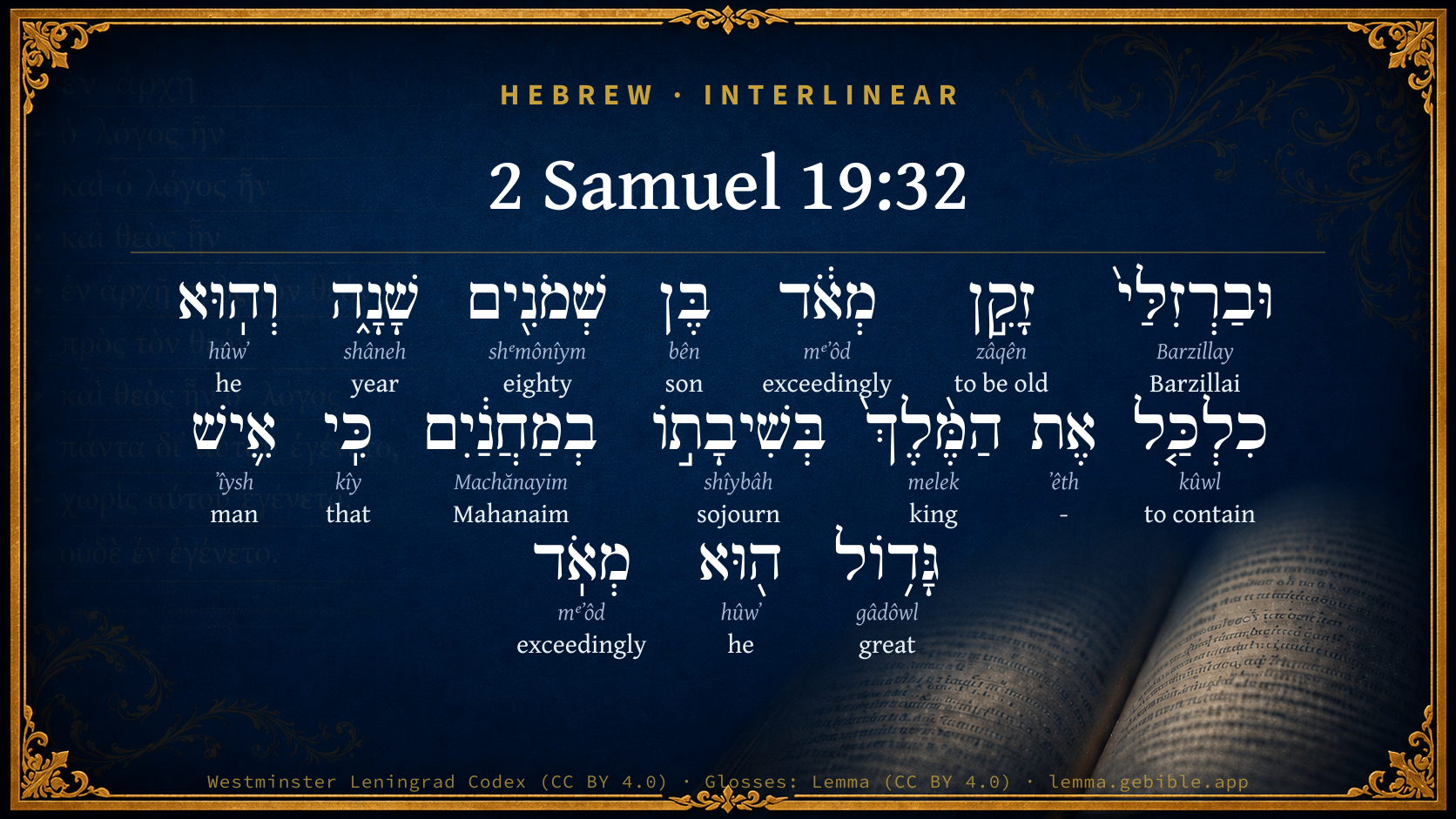
Hebrew (Westminster Leningrad Codex) 2 Samuel 19:32 appears in the Hebrew Old Testament. The text above is from the Westminster Leningrad Codex. Each word links to its Strong’s number, a concise gloss, and parsing drawn from the Open Scriptures Hebrew Bible morphology. Click any word for its full Brown-Driver-Briggs (BDB) entry.
Download image
Cite this verse

2 Samuel 19:32 (World English Bible). Public Domain. Lemma interlinear Bible study tool, https://lemma.gebible.app/v/2-samuel/19/32.

Show BibTeX & RIS
BibTeX
RIS
English Translation
Now Barzillai was a very aged man, even eighty years old: and he had provided the king with sustenance while he lay at Mahanaim; for he was a very great man.
World English Bible · Public Domain
Highlights
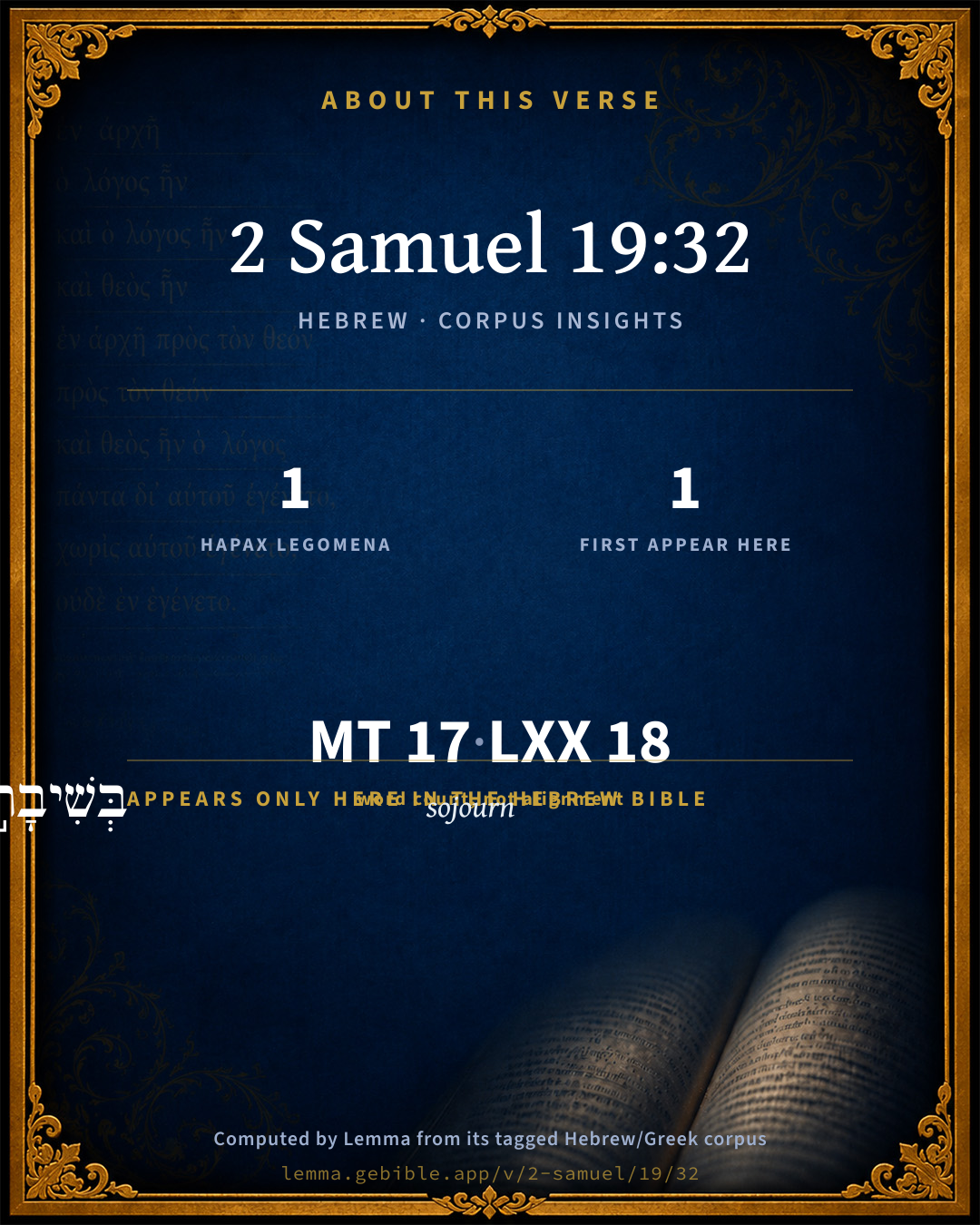
  • 1 hapax legomenon — only here in the Hebrew Bible
  • 1 first appearance in the Hebrew Bible
Full analysis ↓
Download a study sheet

One document with this verse’s original text, its word-by-word gloss line, the meaning frame, cross-references with their text, attributed commentary, and full source and license credits — printable, and it pastes into notes with its structure intact.

This verse Autodidact and up

Study sheet (.html) Plain text (.txt)

A passage Seminary Student

Up to 50 verses in one chapter. A passage sheet keeps up to 6 commentary sources and 12 cross-references per verse, in the order this page ranks them, and says so on the sheet whenever that leaves anything out. Ask for a single verse and you get the Autodidact verse sheet above.

Everything on this page stays free to read, with no account — the sheet is a download of what is already on screen, not access to it.

Want to remove ads? Support Godless Engineer
Compare translations 3

The same verse in 3 English versions, stacked beneath the original-language interlinear above. Click any original word for its lexicon entry.

Each is an independent rendering of the whole verse — the interlinear is not word-aligned to these translations.

Highlighted words mark where these versions differ — a whole-verse word diff, not a word-by-word alignment.

  • World English Bible Public Domain
    Now Barzillai was a very aged man, even eighty years old: and he had provided the king with sustenance while he lay at Mahanaim; for he was a very great man.
  • King James Version Public Domain
    Now Barzillai was a very aged man, even fourscore years old: and he had provided the king of sustenance while he lay at Mahanaim; for he was a very great man.
  • unfoldingWord Literal Text CC BY-SA 4.0
    Now Barzillai had aged greatly, a son of 80 years. And he, he had sustained the king in his stay in Mahanaim, for he a very great man.

unfoldingWord Literal Text — © unfoldingWord, licensed CC BY-SA 4.0. Word-aligned USFM3 via Door43 (git.door43.org/unfoldingWord/en_ult).

Versions to compare (up to 4)

3 of 4 selected

Show all 18 translations

Every available English version of this verse, each an independent rendering of the whole verse.

  • World English Bible Public Domain
    Now Barzillai was a very aged man, even eighty years old: and he had provided the king with sustenance while he lay at Mahanaim; for he was a very great man.
  • Berean Standard Bible Public Domain
    Barzillai was quite old, eighty years of age, and since he was a very wealthy man, he had provided for the king while he stayed in Mahanaim.
  • Majority Standard Bible Public Domain
    Barzillai was quite old, eighty years of age, and since he was a very wealthy man, he had provided for the king while he stayed in Mahanaim.
  • King James Version Public Domain
    Now Barzillai was a very aged man, even fourscore years old: and he had provided the king of sustenance while he lay at Mahanaim; for he was a very great man.
  • American Standard Version (1901) Public Domain
    Now Barzillai was a very aged man, even fourscore years old: and he had provided the king with sustenance while he lay at Mahanaim; for he was a very great man.
  • Revised Version (1885) Public Domain
    Now Barzillai was a very aged man, even fourscore years old: and he had provided the king with sustenance while he lay at Mahanaim; for he was a very great man.
  • Geneva Bible (1599) Public Domain
    Nowe Barzillai was a very aged man, euen fourescore yeere olde, and he had prouided the king of sustenance, while he lay at Mahanaim: for he was a man of very great substance.
  • Douay-Rheims (1899) Public Domain
    Now Berzellai the Galaadite was of a great age, that is to say, fourscore years old, and he provided the king with sustenance when he abode in the camp: for he was a man exceeding rich.
  • Young's Literal Translation Public Domain
    and Barzillai `is' very aged, a son of eighty years, and he hath sustained the king in his abiding in Mahanaim, for he `is' a very great man;
  • Literal Standard Version CC BY-SA 4.0
    and Barzillai [is] very aged, a son of eighty years, and he has sustained the king in his abiding in Mahanaim, for he [is] a very great man;
  • Unlocked Literal Bible CC BY-SA 4.0
    Now Barzillai was a very old man, eighty years old. He had furnished the king with provisions while he stayed at Mahanaim, for he was a very wealthy man.
  • unfoldingWord Literal Text CC BY-SA 4.0
    Now Barzillai had aged greatly, a son of 80 years. And he, he had sustained the king in his stay in Mahanaim, for he a very great man.
  • Darby Bible Public Domain
    And Barzillai was very aged, eighty years old; and it was he that had maintained the king while he abode at Mahanaim; for he was a very great man.
  • World Messianic Bible Public Domain
    Now Barzillai was a very aged man, even eighty years old. He had provided the king with sustenance while he stayed at Mahanaim, for he was a very great man.
  • Webster's Bible Public Domain
    Now Barzillai was a very aged man, even eighty years old: and he had provided the king with sustenance while he lay at Mahanaim: for he was a very great man.
  • Free Bible Version CC BY-SA 4.0
    Barzillai was very old, eighty years of age, and because he was a very wealthy man, he had provided the king with food while he was staying in Mahanaim.
  • Bible in Basic English Public Domain
    Now Barzillai was a very old man, as much as eighty years old: and he had given the king everything he had need of, while he was at Mahanaim, for he was a very great man.
  • JPS Tanakh (1917) Public Domain
    (19-33) Now Barzillai was a very aged man, even fourscore years old; and he had provided the king with sustenance while he lay at Mahanaim; for he was a very great man.

Literal Standard Version (2020), Covenant Press — licensed CC BY-SA 4.0. Text via the HelloAO Bible API (eBible.org). Unlocked Literal Bible (unfoldingWord) — licensed CC BY-SA 4.0. Text via the HelloAO Bible API (eBible.org). unfoldingWord Literal Text — © unfoldingWord, licensed CC BY-SA 4.0. Word-aligned USFM3 via Door43 (git.door43.org/unfoldingWord/en_ult). Free Bible Version, Dr. Jonathan Gallagher — licensed CC BY-SA 4.0. Text via the HelloAO Bible API (eBible.org).

Word by word

More ways to search: Search by grammar → Find every occurrence → Compare this word →

Practice this passage: Drill this verse → Learn its vocabulary →

בְּשִׁיבָת֣וֹ
shîybâh
H7871
“in/at · sojourn · his”
Preposition + Noun, Common, Feminine, Singular, Construct + Suffix, Personal, 3rd Person, Masculine, Singular
Part of Speech
Preposition + Noun
Type
Common
Gender
Feminine
Number
Singular
State
Construct
Full BDB Definition

Origin: from H3427

TWOT: 922b

sojourn
  1. וּבַרְזִלַּי֙ Barzillay H1271 “and · Barzillai” Conjunction + Noun, Proper
  2. זָקֵ֣ן zâqên H2204 “to be old” Verb, Qal, Perfect, 3rd Person, Masculine, Singular
  3. מְאֹ֔ד mᵉʼôd H3966 “exceedingly” Adverb
  4. בֶּן bên H1121 “son of” Noun, Common, Masculine, Singular, Construct
  5. שְׁמֹנִ֖ים shᵉmônîym H8084 “eighty” Adjective, Cardinal number, Both, Plural, Absolute
  6. שָׁנָ֑ה shâneh H8141 “year” Noun, Common, Feminine, Singular, Absolute
  7. וְהֽוּא hûwʼ H1931 “and · he” Conjunction + Pronoun, Personal, 3rd Person, Masculine, Singular
  8. כִלְכַּ֤ל kûwl H3557 “to contain” Verb, Pilpel, Perfect, 3rd Person, Masculine, Singular
  9. אֶת ʼêth H853 “-” Particle, Direct Object
  10. הַמֶּ֨לֶךְ֙ melek H4428 “the · king” Particle, Definite Article + Noun, Common, Masculine, Singular, Absolute
  11. בְמַחֲנַ֔יִם Machănayim H4266 “in/at · Mahanaim” Preposition + Noun, Proper
  12. כִּֽי kîy H3588 “that” Conjunction
  13. אִ֛ישׁ ʼîysh H376 “man” Noun, Common, Masculine, Singular, Absolute
  14. גָּד֥וֹל gâdôwl H1419 “great” Adjective, Adjective, Masculine, Singular, Absolute
  15. ה֖וּא hûwʼ H1931 “he” Pronoun, Personal, 3rd Person, Masculine, Singular
  16. מְאֹֽד mᵉʼôd H3966 “exceedingly” Adverb

About this verse

These counts appear in no published source. They are computed here, from the morphology-tagged text and Lemma’s own curated glosses. What Lemma adds →

17
words
15
distinct lemmas
Historical
section

Notable vocabulary

1 hapax legomenon — a word that appears only here in the entire Hebrew Bible:

  • בְּשִׁיבָת֣וֹ sojourn H7871

First appearance in Scripture

This word makes its first canonical appearance in the Hebrew Bible here:

  • בְּשִׁיבָת֣וֹ sojourn H7871

Shared distinctive vocabulary

וּבַרְזִלַּי֙ Barzillai H1271 occurs in 10 verses of the Hebrew Bible. Also found in:

Grammatical profile

  • 2 verbs
  • 7 nouns
  • 2 adjectives
  • 2 pronouns
  • 1 conjunction
  • 2 adverbs
  • 1 particle

Verb forms

  • זָקֵ֣ן Qal · Perfect
  • כִלְכַּ֤ל Pilpel · Perfect

Repetition

Words recur within this verse — often emphatic in Hebrew:

  • מְאֹ֔ד exceedingly H3966 ×2
  • וְהֽוּא he H1931 ×2

Hebrew & Septuagint length

In English translation the verse runs 31 words from the Hebrew and 28 from the Septuagint (LXX English) — closely comparable.

A rough comparison of the two English renderings, which tokenize alike — not a word-level alignment.

Word counts can differ between the Hebrew and the Greek without any difference in meaning — e.g. the Hebrew direct-object marker אֵת has no separate Greek word, and Greek often adds the article ὁ.

In the original languages it is 17 Hebrew tokens and 18 Greek tokens — but the two are counted differently (Hebrew bundles its prefixes and suffixes into one token; the Greek is in lemma form), so that isn’t a like-for-like length.

Cross-references

11

Topical passages linked to 2 Samuel 19:32 in the Treasury of Scripture Knowledge — connected by theme and wording, ordered by reader-vote popularity; previews shown in the World English Bible.

  • Deuteronomy 34:7 Moses was one hundred twenty years old when he died: his eye was not dim, nor his natural force abated.
  • 1 Samuel 25:2 There was a man in Maon, whose possessions were in Carmel; and the man was very great, and he had three thousand sheep, and a thousand goats: and he was shearing his sheep in Carmel.
  • Job 1:3 His possessions also were seven thousand sheep, three thousand camels, five hundred yoke of oxen, five hundred she-donkeys, and a very great household; so that this man was the greatest of all the children of the east.
  • Proverbs 16:31 Gray hair is a crown of glory. It is attained by a life of righteousness.
  • Genesis 5:27 All the days of Methuselah were nine hundred sixty-nine years, then he died.
  • Genesis 9:29 All the days of Noah were nine hundred fifty years, then he died.
  • Genesis 25:7 These are the days of the years of Abraham's life which he lived: one hundred seventy-five years.
  • Genesis 47:28 Jacob lived in the land of Egypt seventeen years. So the days of Jacob, the years of his life, were one hundred forty-seven years.
  • Genesis 50:26 So Joseph died, being one hundred ten years old, and they embalmed him, and he was put in a coffin in Egypt.
  • 2 Samuel 17:27–29 It happened, when David was come to Mahanaim, that Shobi the son of Nahash of Rabbah of the children of Ammon, and Machir the son of Ammiel of Lodebar, and Barzillai the Gileadite of Rogelim,
  • Psalms 90:3–10 You turn man to destruction, saying, "Return, you children of men."

Cross-references courtesy of OpenBible.info (CC BY 4.0).

Hebrew and Greek witnesses Masoretic Hebrew ↔ Greek Septuagint

The same verse in the two great witnesses to the Old Testament, shown verse-for-verse.

These are two independent witnesses, not word-aligned to each other, and the Septuagint is shown in lemma (dictionary) form.

Hebrew 2 Samuel 19:32 Masoretic · Westminster Leningrad Codex

וּבַרְזִלַּי֙ זָקֵ֣ן מְאֹ֔ד בֶּן שְׁמֹנִ֖ים שָׁנָ֑ה וְהֽוּא כִלְכַּ֤ל אֶת הַמֶּ֨לֶךְ֙ בְּשִׁיבָת֣וֹ בְמַחֲנַ֔יִם כִּֽי אִ֛ישׁ גָּד֥וֹל ה֖וּא מְאֹֽד

Now Barzillai was a very aged man, even eighty years old: and he had provided the king with sustenance while he lay at Mahanaim; for he was a very great man.

World English Bible · Public Domain

Greek LXX 2 Samuel 19:32 Septuagint · lemma form

καί βερζελλι ὁ γαλααδίτης καταβαίνω ἐκ ρωγελλιμ καί διαβαίνω μετά ὁ βασιλεύς ὁ ἰορδάνης ἐκπέμπω αὐτός ὁ ἰορδάνης

And Berzelli was a very old man, eighty years old; and he had maintained the king when he lived in Manaim; for he was a very great man.

LXX2012 (modern English Septuagint) · Public Domain

Hebrew: Westminster Leningrad Codex (CC BY 4.0). Greek: Septuagint (public domain); English from LXX2012 (modern English Septuagint) (Public Domain). How the Septuagint differs from the Hebrew →

Targum (Aramaic paraphrase)

1

The Targum is the ancient Jewish Aramaic paraphrase of the Hebrew Scriptures — an interpretive translation, not the Hebrew text itself. Onkelos (literal) and Pseudo-Jonathan (expansive) render the Torah, and Jonathan the Prophets. Coverage is partial: where no permissively-licensed English translation exists for a verse, only the Aramaic is shown. This is verse-level text, not a word-by-word alignment to the Hebrew.

  1. Targum Jonathan Prophets (Joshua–Malachi)
    וּבַרְזִלֵי גִלְעֲדָאָה נְחַת מֵרוֹגְלִים וַעֲבַר יַת מַלְכָּא יַת יַרְדְנָא לְאַלְוָיוּתֵיהּ יַת יַרְדְנָא:

    (no public-domain English translation for this verse)

    Targum Jonathan — Aramaic: “Mikraot Gedolot” (public domain). English: “Sefaria Community Translation” (CC0 1.0 (public-domain dedication)); “London "Chaldee Paraphrase," 1871” (public domain). Text via Sefaria.

Commentary

Notes on 2 Samuel 19:32 from classic Christian and Jewish commentators (each source and its license shown beneath its notes). The classic Christian expositions comment on the surrounding passage and are grouped to its opening verse, so a note may address several verses; the Jewish commentaries on the Tanakh (Rashi and others) are per-verse, so they appear only where the commentator wrote on this verse.

Lemma curates 59 commentaries, every one of them public domain or Creative Commons licensed, each selected and text-cleaned for this edition rather than reprinted as found. About our sources →

Trapp's Complete Commentary

John Trapp

2Sa 19:32 Now Barzillai was a very aged man, [even] fourscore years old: and he had provided the king of sustenance while he lay at Mahanaim; for he [was] a very great man.

Ver. 32. Now Barzillai was a very aged man.] Senex quasi seminex, he had lost his colour, but had kept his sweet savour with the rose: and like a flower, though he were withering, yet "the root of the matter was in him," as Job speaketh.

For he was a very great man.] Else he could not have so long sustained the king and his company. Crassus accounted no man rich that could not do as much. Pythias, by entertaining Xerxes and his great army, came to extreme poverty.

John Trapp, A Commentary or Exposition upon All the Books of the Old and New Testament (1647–1656) — public domain. Text from a community e-Sword module.

Adam Clarke's Commentary

Verse 32. Barzillai was a very aged man] This venerable person had given full proof of his attachment to David by the supplies he had given him when he lay at Mahanaim, where his case was all but desperate; the sincerity of his congratulations now none can suspect. David's offer to him was at once noble and liberal: he wished to compensate such a man, and he wished to have at hand such a friend.

Adam Clarke's Commentary on the Bible (1810–1826) — public domain. Text from a community e-Sword/MySword module.

Ellicott's Commentary for English Readers

(32) Provided the king of sustenance.—An old use of the preposition “of,” meaning with. The word is the same here as that translated in the next verse “feed thee,” and there is an especial fitness in the use of the same word in both cases which is lost in the English Version. It is translated “nourish” in Gen_45:11; Gen_47:12; Gen_1:21, &c., and “sustain” in 1Ki_17:9, Neh_9:21, &c. The king proposes to return Barzillai’s service in kind, but multiplied manifold.

A Bible Commentary for English Readers, edited by Charles John Ellicott (1878–1897) — public domain. Text from a community e-Sword module.

The Cambridge Bible for Schools and Colleges

gen. ed. J. J. S. Perowne

32. provided … of sustenance] An obsolete use of the preposition of where we now employ with.

lay] i.e. abode. Cp. Jos_2:1, marg.

The Cambridge Bible for Schools and Colleges (gen. ed. J. J. S. Perowne; Cambridge University Press, 1878–1918) — public domain. Text from a community e-Sword module.

John Gill's Exposition

Now Barzillai was a very aged man, even fourscore years old,.... Which was ten years beyond the common term of man's life, and reckoned a very great age in David's time, and has been ever since, and still is, see Psa 90:10,

and he had provided the king of sustenance while he lay at Mahanaim: had supported him and his family, furnished him with provisions, and all the necessaries of life, during his stay there:

for he was a very great man; in wealth and riches, and was a very liberal man, and a man of great wisdom and good sense; and very probably was a man of great grace, which taught him his duty to his prince, and influenced him to show mercy to him in distress.

John Gill's Exposition of the Whole Bible (1746–1763) — public domain (CC PDM 1.0). Text via the HelloAO Bible API.

Haydock's Catholic Bible Commentary

Camp; Mahanaim, chap. xvii. 28.

George Leo Haydock (1774–1849), Haydock's Catholic Family Bible and Commentary, 1859 edition — public domain. Excludes Psalms (Douay-Rheims chapter numbering differs from Protestant) and Deuterocanonical books (Catholic canon only).

Whedon's Commentary on the Bible

Daniel D. Whedon

32. A very great man — A man of great wealth and influence in Gilead.

Daniel D. Whedon (gen. ed.), Commentary on the Old and New Testaments (1874–1909) — public domain. Text from a community e-Sword module.

Rashi

Rabbi Shlomo Yitzchaki (Rashi)

Accompanying him. To accompany him.

Rashi on the Tanakh — English translations: “The Judaica Press complete Tanach with Rashi, translated by A. J. Rosenberg” (CC BY 4.0); “Pentateuch with Rashi's commentary by M. Rosenbaum and A.M. Silbermann, 1929-1934” (public domain); “The Metsudah Tanach series, Lakewood, N.J” (CC BY 4.0); and “The Book of Joshua, Metsudah Publications, 1997” (CC BY 4.0). Text via Sefaria.

Lesson kit

Teaching starters — assembled from the data on this page, not authored interpretation. Every prompt links to the verse data it draws on. Edit before teaching.

2 Samuel, in the Historical, opens this verse with 17 words (15 distinct Hebrew lemmas). Its most distinctive word is shîybâh (“sojourn”). A historical commentator’s framing appears above. Read the whole chapter for the surrounding context.

Discussion questions

  1. How does “sojourn” (shîybâh) shape what this verse is saying?
  2. This verse holds 1 word here found nowhere else in the Hebrew Bible. What might the rare word draw attention to?
  3. The word “sojourn” first appears here in Scripture. What is being introduced at this debut?
  4. 2 Samuel 17:27 shares the word «Barzillai» with this verse. How do the two illuminate each other?
  5. “exceedingly” occurs 2× in this one verse. What is the effect of the repetition?
  6. The translations on this page render this verse differently — a whole-verse word diff, not a word-by-word alignment. What might account for the different wordings?
  7. The verb «זָקֵ֣ן» is Qal Perfect. How does its form color the action?
  8. Reading how Trapp's Complete Commentary and Adam Clarke's Commentary read this verse, where do the two commentators agree and where do they part?

Things to notice

  • 1 word in this verse appears nowhere else in the Hebrew Bible.
  • 1 word makes its first canonical appearance in Scripture here.
  • This verse counts 17 Hebrew ↔ 18 Greek words.
  • These translations choose different wording for 13 words in this verse.
  • “exceedingly” occurs 2× in this single verse.

Reading settings

Reading text

Shown beneath each verse's original-language words.

Old Testament
Old Testament edition

Read the OT as the Masoretic Hebrew (MT) or the Greek Septuagint (LXX).

English shown for the Greek Septuagint (in the Hebrew ↔ Greek comparison).

Comparing translations? Open the Compare panel on any verse page to stack up to four side by side.