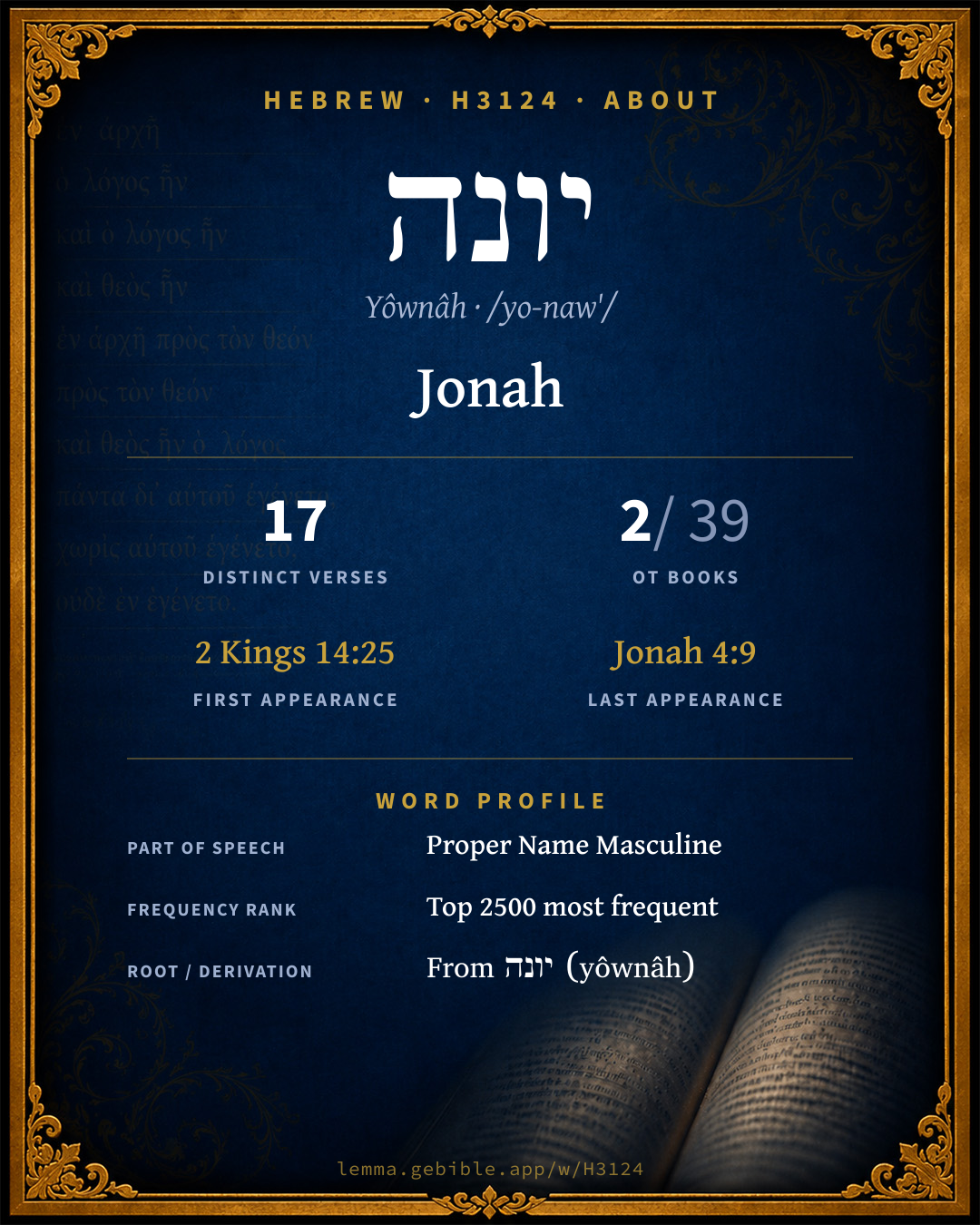
יוֹנָה
Jonah
BDB lists 2 entries for ‘Jonah’ fuller range ↓
Full lexicon entry — Brown-Driver-Briggs (BDB)
From Brown-Driver-Briggs (BDB)
Where this word appears
Grammar key — what these labels mean
Part of speech
- Noun
- A naming word — a person, place, thing, or idea.
Noun type
- Proper
- A name of a specific person, place, or people (e.g. Abraham, Zion, Israel).
Every verse where H3124 appears — 17 distinct verses across 2 books. Click any verse to open its interlinear word-by-word view. Verse text shown in the World English Bible for context — . Each verse’s Hebrew form is shown with its reference; the English is not keyword-highlighted, since the data carries no word-level English alignment. Use “Compare translations” on any verse to read it across multiple English versions. This concordance covers the Hebrew Bible; Septuagint (Greek Old Testament) occurrences are not indexed here.
2 Kings 1 verse
Jonah 16 verses
- Jonah 1:1 יוֹנָ֥ה n Proper Now the word of Yahweh came to Jonah the son of Amittai, saying,
- Jonah 1:3 יוֹנָה֙ n Proper But Jonah rose up to flee to Tarshish from the presence of Yahweh. He went down to Joppa, and found a ship going to Tarshish; so he paid its fare, and went down into it, to go with them to Tarshish from the presence of Yahweh.
- Jonah 1:5 וְ/יוֹנָ֗ה conj + n Proper Then the mariners were afraid, and cried every man to his god. They threw the cargo that was in the ship into the sea, to lighten it. But Jonah had gone down into the innermost parts of the ship, and he was laying down, and was fast asleep.
- Jonah 1:7 יוֹנָֽה n Proper They all said to each other, "Come, let us cast lots, that we may know for whose cause this evil is on us." So they cast lots, and the lot fell on Jonah.
- Jonah 1:15 יוֹנָ֔ה n Proper So they took up Jonah, and threw him into the sea; and the sea ceased its raging.
- Jonah 1:17 יוֹנָ֑ה יוֹנָה֙ n Proper n Proper Yahweh prepared a great fish to swallow up Jonah, and Jonah was in the belly of the fish three days and three nights.
- Jonah 2:1 יוֹנָ֔ה n Proper Then Jonah prayed to Yahweh, his God, out of the fish's belly.
- Jonah 2:10 יוֹנָ֖ה n Proper Yahweh spoke to the fish, and it vomited out Jonah on the dry land.
- Jonah 3:1 יוֹנָ֖ה n Proper The word of Yahweh came to Jonah the second time, saying,
- Jonah 3:3 יוֹנָ֗ה n Proper So Jonah arose, and went to Nineveh, according to the word of Yahweh. Now Nineveh was an exceedingly great city, three days' journey across.
- Jonah 3:4 יוֹנָה֙ n Proper Jonah began to enter into the city a day's journey, and he cried out, and said, "Yet forty days, and Nineveh shall be overthrown!"
- Jonah 4:1 יוֹנָ֖ה n Proper But it displeased Jonah exceedingly, and he was angry.
- Jonah 4:5 יוֹנָה֙ n Proper Then Jonah went out of the city, and sat on the east side of the city, and there made himself a booth, and sat under it in the shade, until he might see what would become of the city.
- Jonah 4:6 לְ/יוֹנָ֗ה יוֹנָ֛ה prep + n Proper n Proper Yahweh God prepared a vine, and made it to come up over Jonah, that it might be a shade over his head, to deliver him from his discomfort. So Jonah was exceedingly glad because of the vine.
- Jonah 4:8 יוֹנָ֖ה n Proper It happened, when the sun arose, that God prepared a sultry east wind; and the sun beat on Jonah's head, so that he fainted, and requested for himself that he might die, and said, "It is better for me to die than to live."
- Jonah 4:9 יוֹנָ֔ה n Proper God said to Jonah, "Is it right for you to be angry about the vine?" He said, "I am right to be angry, even to death."
About this entry
At a glance — auto-summarized from this page’s data, not written by a person. Every figure links to its source below. This summary describes the numbers; it doesn’t interpret them.
The Hebrew name יונה centers on the idea of “Jonah.” The word gravitates to Jonah (94%), then 2 Kings. It turns up in 17 verses across 2 books, an uncommon footprint. Its earliest occurrence is 2 Kings 14:25. For the data behind this summary, explore 17-verse concordance and the renderings breakdown below.
Gloss history
Strong's 1890 vs modern scholarship
About this word
Strong's H3124 catalogs a Hebrew word from the Hebrew Old Testament.
These counts are not copied from any lexicon or concordance. They are computed here, from the morphology-tagged Hebrew Old Testament. What Lemma adds →
- 17
- distinct verses
- The word appears in 17 distinct verses.
- 2 / 39
- OT books
- The word appears in 2 of 39 Old Testament books.
- #1,563
- by frequency
- Top 2500 most frequent Hebrew words (rank 1,563 of 8,640 Hebrew words by occurrence).
View all 17 occurrences in the concordance →
By traditional corpus
Conventional, traditional groupings — biblical authorship is debated, so this is a traditional corpus grouping, not an authorship claim. Each share is this word’s portion of its verses in that division of the Hebrew canon. Each figure is a share of the word’s 17 distinct verses.
- Prophets (Nevi'im) 17 verses · 100%
How translations render this word
Counts come from each version’s own published word-to-Strong’s tagging or interlinear alignment — an approximate guide to how each version renders this word, not a word-level alignment the data otherwise carries. Because each total is that version’s own tagged count, the per-version totals vary from one another and need not match the appearance or distinct-verse counts above. These counts may also differ from a printed concordance because Lemma counts each distinctly tagged rendering and does not collapse phrase taggings into a single head-word total. This is a fixed set of word-tagged versions (KJV, ASV, BSB, ULT) and does not change with the reading translation you choose elsewhere. Each version’s license is shown beside its name below (and on Sources).
BDB lists this Strong’s number as 3 distinct words (homographs). Each count above pools all of them and is not split by sense — see the Senses section below. A low-frequency rendering may belong to a different one of those words, not the primary meaning.
- King James Version†: Jonah 16×, Came unto jonah 2×
- American Standard Version†: Jonah 14×, Came unto jonah 2×
- Berean Standard Bible†: Jonah 14×, Jonah however 2×, Jonah’s 2×
- unfoldingWord Literal Text†: Jonah 19×
King James Version Public Domain
Renders H3124 across 19† tagged occurrences — most commonly:
Plus 1 rendering that appears only once — usually multi-word phrases or single function words the recovered tagging swept in, not distinct renderings.
American Standard Version Public Domain
Renders H3124 across 19† tagged occurrences — most commonly:
Plus 3 renderings that appear only once — usually multi-word phrases or single function words the recovered tagging swept in, not distinct renderings.
Berean Standard Bible Public Domain
Renders H3124 across 19† tagged occurrences — most commonly:
Plus 1 rendering that appears only once — usually multi-word phrases or single function words the recovered tagging swept in, not distinct renderings.
unfoldingWord Literal Text CC BY-SA 4.0
Renders H3124 across 19† tagged occurrences — most commonly:
Senses in the full BDB
What do BDB’s symbols mean?
BDB uses these scholarly abbreviations:
| Symbol | Meaning |
|---|---|
| 𝔊 | the Septuagint (the ancient Greek translation, LXX) |
| 𝔙 | the Vulgate (the Latin translation) |
| 𝔖 | the Syriac version (the Peshitta) |
| 𝔗 | the Targum (the Aramaic translation) |
| ψ | the Psalms |
| √ | root (the underlying root or stem) |
| ‖ | parallel passage (a synonymous or contrasted parallel) |
| † | the dagger: every passage where the word occurs is cited |
The 0 senses and sub-senses the full Brown-Driver-Briggs lexicon distinguishes for this word, in lexicon order (not ranked by frequency), with BDB’s own verbatim wording and sub-sense lettering. Shown in Hebrew script with BDB’s own scholarly abbreviations. The condensed entry is in the Lexicon Entry tab. See also the Forms in the corpus table below.
יונה I dove (NH id.
יונה II m. prophet, according to 2 K 14
Senses from the full Brown-Driver-Briggs lexicon (Brown, Driver, Briggs; Oxford 1906 — public domain), digitized via Sefaria, supplemented by the OpenScriptures HebrewLexicon (CC BY 4.0). Full attribution on Sources.
Word origin
I. n.f. dove (NH id.; Aramaic id., ܝܰܘܢܳܐ )—abs. יוֹנָה Gn 8:8 + 20 times; cstr. יוֹנַת ψ 56:1; sf. יוֹנָתִי Ct 2:14 + 2 times; pl. יוֹנִים Na 2:8 + 6 times; cstr. יוֹנֵי Ez 7:16 (v. infr.);—dove Gn 8:9, 10, 11, 12 (all J); often of offerings, בֶּן־יוֹנָה Lv 12:6 (P; an individual of the species; ‖ תֹּר); בְּנֵי (ה)יונה (‖ תֹּרִים) 1:14; 5:7, 11; 12:3; 14:22, 30; 15:14, 29 Nu 6:10 (all P); חֲרֵי יוֹנִים dove’s dung 2 K 6:25 (Kt, yet v. GeiUrschrift 409); in various similes: Ephr. is כְּיוֹנָה פּוֹתָה like a silly dove Ho 7:11 (allowing itself to be snared); sim. of retun of exiles, like eager flight of doves 11:11, of ships with white outspread sails Is 60:8; אֵבֶר כַּיּוֹנָה ψ 55:7; v. also כַּנְפֵי יוֹנָה 68:14; sim. of fugitive Moab Je 48:28; also כְּיוֹנֵי הַגֵּאָיוֹת Ez 7:16 like the doves of the valleys (but on txt v. Co, who emends כיונים הוֹגִיּוֹת, but regards phr. as gloss); sim. of mourning כְּקוֹל יוֹנִים Na 2:8; without קוֹל, הגה כיונים Is 38:14; 59:11 (from mournful note); fig. of beauty (only Ct): עֵינַיִךְ יוֹנִים thine eyes are (those of) doves Ct 1:15; 4:1, v. also v 12; term of endearment, יוֹנָתִי my dove Ct 2:14; 5:2; 6:9. Elsewhere only ψ 56:1 (title) יוֹנַח אֵלֶם רְחֹקִים (עַל) prob. name of melody: To ‘the dove of distant terebinths’ (read אֵלִים for אֵלֶם; v. אֵלֶם supr. p. 48, and Baeψψ, p. xvii).—On sanctity of dove among Semites, v. RSSem.i. 202, 275.
II. n.pr.m. prophet, according to 2 K 14:25 he was הַנָּבִיא, son of אֲמִתַּי, from גַּת הַחֵפֶר, and predicted the recovery of Isr.’s territory which Jerob. II effected; he is also the principal figure of the Book of Jonah: 1:1 (בֶּן־אֲמִתַּי), v 3, 5, 7, 15 2:1(×2), 2, 11; 3:1, 3, 4; 4:1, 5, 6(×2), 8, 9.
— Brown-Driver-Briggs (Oxford 1906, public domain), digitized via Sefaria, supplemented by the OpenScriptures HebrewLexicon (CC BY 4.0). See Sources.
Derived from יונה (yôwnâh) (H3123) — dove.
Jastrow Dictionary
A second Hebrew/Aramaic lexicon for comparison, covering Aramaic and post-biblical (Talmudic, Targumic, Midrashic) usage that the biblical-Hebrew BDB does not. Matched by lemma rather than by Strong’s number, so a lemma may carry more than one Jastrow headword (shown separately below), and the entries cover usage well beyond the Bible.
יוֹנָה I
- (b. h.) pr. n. m. Jonah,
- 1. the prophet. Y. Erub. X, beg. 26ᵃ; Bab. Erub. 96ᵃ. Snh. 89ᵃ, sq Gen. R. s. 21; a. fr.
- 2. name of several Amoraim. a) R. J. father of R. Mana. Taan. 23ᵇ. Y. Shebi. IV, 35ᵃ bot.; a. v. fr.—b) R. J. of Bozra. Y. Kil. IX, beg. 31ᵈ; a. fr.—[Ḥull. 43ᵇ י׳ אמר ר׳ זירא Jonah said in behalf of R. Z.; oth. opin.: as to the gullet of a dove, &c., v. next w.]
יוֹנָה II
- (b. h.) dove. Ḥull. 6ᵃ דמות י׳ וכ׳ the effigy of a dove was found on Mount Gerizim which they (the Samaritans) worshipped. Gen. R. s. 39 הי׳ הזו בשעה שהיא פורחת וכ׳ the dove when flying and tired, flaps one wing and flies with the other. Gen. R. s. 44 (expl. גוזל, Gen. XV, 9) בר י׳ a young dove, (v. infra, a. Targ. Gen. l. c.).—בֶּן י׳, pl. בְּנֵי י׳ pigeons. Ḥull. I, 5 כשר בתורין פסול בבני י׳ what is fit for offering in doves (large size), is a defect in pigeons; a. fr.—[Sabb. 129ᵃ פתורא דיונה, v. יוֹנָס.].—Pl. יוֹנִים, יוֹנִין. Snh. III, 3 מפריחי י׳ those who let doves fly (betting on them), v. יוֹנְתָא. B. Bath. V, 3, v. שׁוֹבָךְ. Ib. 79ᵃ; a. e. e.g. Genesis 15:9
A Dictionary of the Targumim, the Talmud Babli and Yerushalmi, and the Midrashic Literature (Marcus Jastrow; London, Luzac, 1903) — Public Domain. Digitized via Sefaria. Digitized via Sefaria. Full attribution on Sources.
Forms in the corpus
The 11 distinct written forms H3124 takes in the Hebrew Bible, most frequent first — each parse links to that state’s occurrences in the concordance. Hebrew forms include their vowel points and cantillation, so a single lemma takes many written forms.
| Form | Parsing | Example | Uses |
|---|---|---|---|
| יוֹנָ֖ה | Noun, Proper | Jonah 2:10 | 4 |
| יוֹנָה֙ | Noun, Proper | Jonah 1:3 | 4 |
| יוֹנָ֔ה | Noun, Proper | Jonah 1:15 | 3 |
| וְ/יוֹנָ֗ה | Noun, Proper | Jonah 1:5 | 1 |
| יוֹנָ֑ה | Noun, Proper | Jonah 1:17 | 1 |
| יוֹנָ֗ה | Noun, Proper | Jonah 3:3 | 1 |
| יוֹנָ֛ה | Noun, Proper | Jonah 4:6 | 1 |
| יוֹנָ֤ה | Noun, Proper | 2 Kings 14:25 | 1 |
| יוֹנָ֥ה | Noun, Proper | Jonah 1:1 | 1 |
| יוֹנָֽה | Noun, Proper | Jonah 1:7 | 1 |
| לְ/יוֹנָ֗ה | Noun, Proper | Jonah 4:6 | 1 |
Same root — word family
Other BDB entries built from the same root as H3124, grouped by Strong’s listed origin. These share a root / origin per the lexicon — not necessarily a shared meaning. Each links to that word’s own entry.
Derives from
Proper names from this root
People and places named from this root — a name, not an additional meaning of the word.
Compare all same-root words → 2 of the same-root words are proper names (people or places). They share a root, not necessarily a meaning.
Bible dictionary
Public-domain dictionary articles matched to this entry by name (Jonah). A biblical name can be shared by more than one person or place, so an article may treat several.
Easton's Bible Dictionary · M. G. Easton, 1897
A dove, the son of Amittai of Gath-hepher. He was a prophet of Israel, and predicted the restoration of the ancient boundaries (2 Kings 14:25-27) of the kingdom. He exercised his ministry very early in the reign of Jeroboam II., and thus was contemporary with Hosea and Amos; or possibly he preceded them, and consequently may have been the very oldest of all the prophets whose writings we possess. His personal history is mainly to be gathered from the book which bears his name. It is chiefly interesting from the two-fold character in which he appears, (1) as a missionary to heathen Nineveh, and (2) as a type of the "Son of man."
Smith's Bible Dictionary · William Smith, 1863
(dove), the fifth of the minor prophets, was the son of Amittai, and a native of Gath-hepher. (2 Kings 14:25) He flourished in or before the reign of Jeroboam II., about B.C. 820. Having already, as it seems, prophesied to Israel, he was sent to Nineveh. The time was one of political revival in Israel; but ere long the Assyrians were to be employed by God as a scourge upon them. The prophet shrank from a commission which he felt sure would result, (Jonah 4:2) in the sparing of a hostile city. He attempted therefore to escape to Tarshish. The providence of God, however, watched over him, first in a storm, and then in his being swallowed by a large fish (a sea monster, probably the white shark) for the space of three days and three nights. [On this subject see article Whale] After his deliverance, Jonah executed his commission; and the king, "believing him to be a minister form the supreme deity of the nation," and having heard of his miraculous deliverance, ordered a general fast, and averted the threatened judgment. But the prophet, not from personal but national feelings, grudged the mercy shown to a heathen nation. He was therefore taught by the significant lesson of the "gourd," whose growth and decay brought the truth at once home to him, that he was sent to testify by deed, as other prophets would afterward testify by word, the capacity of Gentiles for salvation, and the design of God to make them partakers of it. This was "the sign of the prophet Jonas." (Luke 11:29,30) But the resurrection of Christ itself was also shadowed forth in the history of the prophet. (Matthew 12:39,41; 16:4) The mission of Jonah was highly symbolical. The facts contained a concealed prophecy. The old tradition made the burial-place of Jonah to be Gath-hepher; the modern tradition places it at Nebi-Yunus, opposite Mosul.
Hitchcock's Bible Names Dictionary · Roswell D. Hitchcock, 1869
or Jonas, a dove; he that oppresses; destroyer
Classic public-domain reference works; full attribution on Sources.
Septuagint verse parallels
This word appears in 16 verses that also exist in the Greek Old Testament (Septuagint), out of the 17 Hebrew verses it occurs in. You can read those verses in Greek by switching the Old Testament edition to the Septuagint.
Read these verses in the Septuagint
This is a verse-level parallel only — the same verses exist in both the Hebrew and Greek Old Testaments. No word-level Hebrew↔Greek correspondence is claimed: the data carries no such alignment, so no Greek word is shown as this Hebrew word’s translation. Coverage is not total — the Septuagint omits the deuterocanon and renumbers the Psalms, so some Hebrew verses have no direct Greek parallel.