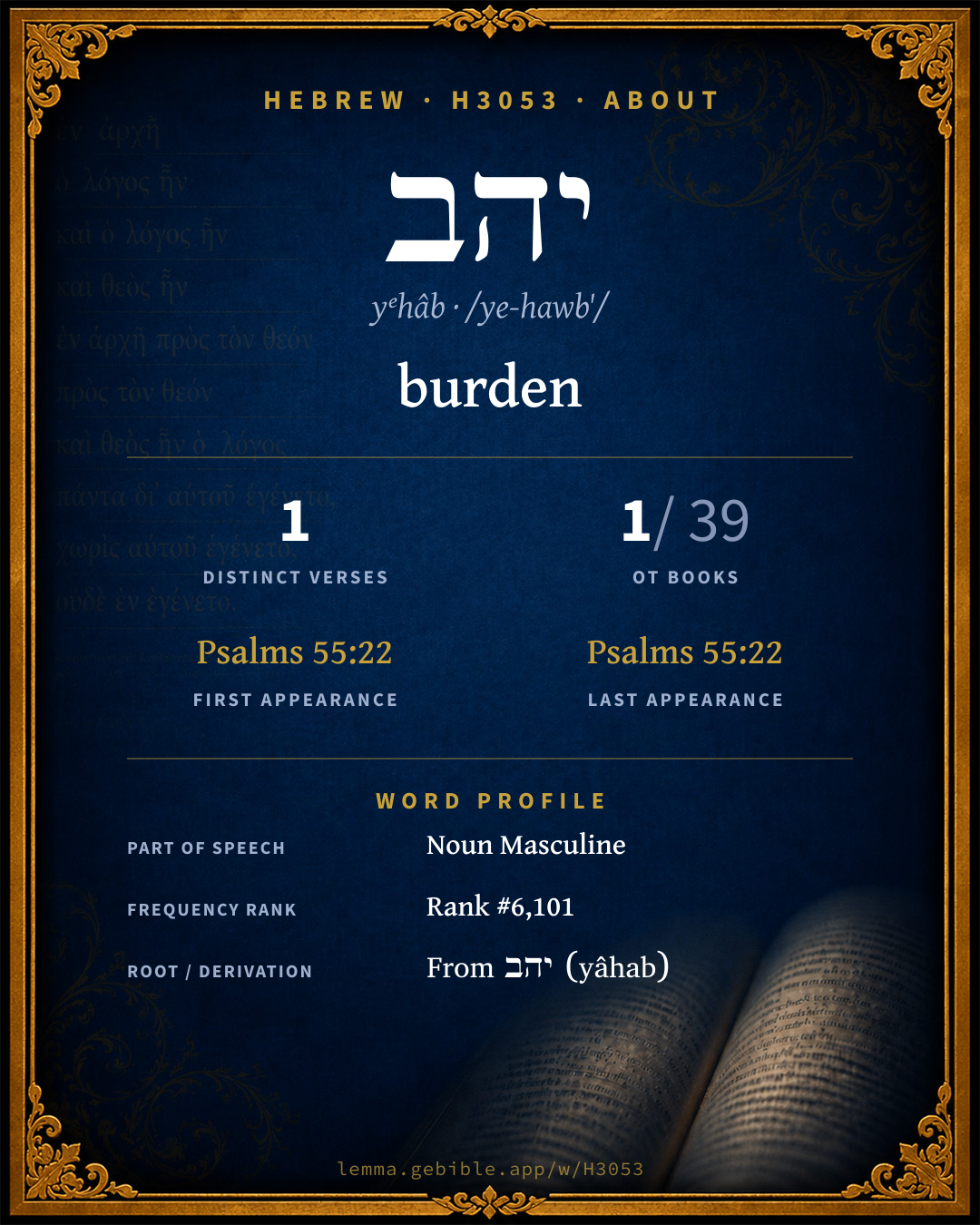
יְהָב
burden
Full lexicon entry — Brown-Driver-Briggs (BDB)
From Brown-Driver-Briggs (BDB)
Where this word appears
Grammar key — what these labels mean
Part of speech
- Noun
- A naming word — a person, place, thing, or idea.
Noun type
- Common
- A common noun — a general class of person, place, or thing (“king,” “city,” “water”), not a specific name.
State
- Construct
- A noun bound to a following noun in a possessive / “of” relationship (the construct chain).
Gender
- Masculine
- Grammatically masculine.
Number
- Singular
- One.
Every verse where H3053 appears — 1 distinct verse across 1 book. Click any verse to open its interlinear word-by-word view. Verse text shown in the World English Bible for context — . Each verse’s Hebrew form is shown with its reference; the English is not keyword-highlighted, since the data carries no word-level English alignment. Use “Compare translations” on any verse to read it across multiple English versions. This concordance covers the Hebrew Bible; Septuagint (Greek Old Testament) occurrences are not indexed here.
Psalms 1 verse
About this entry
At a glance — auto-summarized from this page’s data, not written by a person. Every figure links to its source below. This summary describes the numbers; it doesn’t interpret them.
“burden” is the headline sense of the Hebrew noun יהב (yᵉhâb). It occurs a mere 1 verse across Scripture. More than three-quarters of its appearances fall in Psalms. A true hapax — its single appearance is Psalms 55:22. It shares a root with יהב, הבהב and יהב. The sections below give every sense, occurrence, and version rendering.
Gloss history
Strong's 1890 vs modern scholarship
About this word
Strong's H3053 catalogs a Hebrew word from the Hebrew Old Testament.
These counts are not copied from any lexicon or concordance. They are computed here, from the morphology-tagged Hebrew Old Testament. What Lemma adds →
- 1
- distinct verses
- The word appears in 1 distinct verse.
- 1 / 39
- OT books
- The word appears in 1 of 39 Old Testament books.
- #6,101
- by frequency
- Rank #6,101 (rank 6,101 of 8,640 Hebrew words by occurrence).
View all 1 occurrence in the concordance →
Most concentrated in
- Psalms 1 verse 100%
By section of the Old Testament
By traditional corpus
Conventional, traditional groupings — biblical authorship is debated, so this is a traditional corpus grouping, not an authorship claim. Each share is this word’s portion of its verses in that division of the Hebrew canon. Each figure is a share of the word’s 1 distinct verse.
- Writings (Ketuvim) 1 verse · 100%
How translations render this word
Counts come from each version’s own published word-to-Strong’s tagging or interlinear alignment — an approximate guide to how each version renders this word, not a word-level alignment the data otherwise carries. Because each total is that version’s own tagged count, the per-version totals vary from one another and need not match the appearance or distinct-verse counts above. These counts may also differ from a printed concordance because Lemma counts each distinctly tagged rendering and does not collapse phrase taggings into a single head-word total. This is a fixed set of word-tagged versions (KJV, ASV, BSB, ULT) and does not change with the reading translation you choose elsewhere. Each version’s license is shown beside its name below (and on Sources).
- King James Version: Burden 1×
- American Standard Version: Burden 1×
- Berean Standard Bible: Burden 1×
- unfoldingWord Literal Text: Burden 1×
King James Version Public Domain
Renders H3053 across 1 tagged occurrence — most commonly:
American Standard Version Public Domain
Renders H3053 across 1 tagged occurrence — most commonly:
Berean Standard Bible Public Domain
Renders H3053 across 1 tagged occurrence — most commonly:
unfoldingWord Literal Text CC BY-SA 4.0
Renders H3053 across 1 tagged occurrence — most commonly:
Senses in BDB
The 1 sense BDB distinguishes for this word, in lexicon order (not ranked by frequency or importance). The full entry — with sub-senses — is in the Lexicon Entry tab.
- burden, lot (that which is given)
Word origin
[ יְהָב ] n.[m.] lot (as that which is given )— ψ 55:23
— Brown-Driver-Briggs (Oxford 1906, public domain), digitized via Sefaria, supplemented by the OpenScriptures HebrewLexicon (CC BY 4.0). See Sources.
Derived from יהב (yâhab) (H3051) — to give.
Jastrow Dictionary
A second Hebrew/Aramaic lexicon for comparison, covering Aramaic and post-biblical (Talmudic, Targumic, Midrashic) usage that the biblical-Hebrew BDB does not. Matched by lemma rather than by Strong’s number, so a lemma may carry more than one Jastrow headword (shown separately below), and the entries cover usage well beyond the Bible.
יְהַב
- to give. Targ. Gen. III, 12. Targ. Job III, 19 יֵיהַב Ms. (ed. יָהִיב, ed. Wil. יְהִיב); a. fr.—Part. pass. יְהִיב. Targ. Num. III, 9; a. fr.—Imperative הַב. Targ. Gen. XXX, 26; a. fr.—Y. Ber. VIII, 11ᵇ bot., a. fr. י׳ ליה מילא gave him assurance of safety. Ib. יהב את פלגא (read as:) Y. Naz. V, end, 54ᵇ הב וכ׳ give thou half of it. Ib. [read:] אמר דיֵיבִין ליה יַהֲבוּ ליה ואכל he ordered that they give him (to eat); they gave him, and he ate. Kidd. 9ᵃ אי יהבינא לך וכ׳ (read: יַהֲבִינָהּ) if I give it to thee, wilt thou be betrothed unto me? Said she הָבָהּ מֵיהֲבָהּ give it; כל הבה מיהבה וכ׳ all such phrases as ‘give it’, mean nothing (do not mean assent to the proposal); a. v. fr.—נסב וי׳ (h. = נשא ונתן) to deal. Cant. R. to III, 6. Y. Shebi. VII, 37ᶜ top; a. e.—Lev. R. s. 19, v. infra.—2) to put, place. Targ. Ex. XVI, 33; a. fr.—Y. Keth. XII, 35ᵃ bot. אין אנן יַהֲבִין ליה נֵיהֲבֵיה וכ׳ if we put him (his coffin) anywhere, we must put him with R. &c.; a. fr.
- to be given. Targ. Is. IX, 5. Targ. Ex. V, 16; a. fr.—Kidd. 7ᵃ משום דא׳ למחילה because it (money or money’s worth) may be given away without consideration; v. נָתַן.—[Lev. R. s. 19 … תתיהב דיהבת וכ׳, read: תִּתְיַתַּב … דיַתְּבַת, v. יְתֵב I.]
A Dictionary of the Targumim, the Talmud Babli and Yerushalmi, and the Midrashic Literature (Marcus Jastrow; London, Luzac, 1903) — Public Domain. Digitized via Sefaria. Digitized via Sefaria. Full attribution on Sources.
Same root — word family
Other BDB entries built from the same root as H3053, grouped by Strong’s listed origin. These share a root / origin per the lexicon — not necessarily a shared meaning. Each links to that word’s own entry.
Derives from
Shares the same root
Compare all same-root words → They share a root, not necessarily a meaning.