
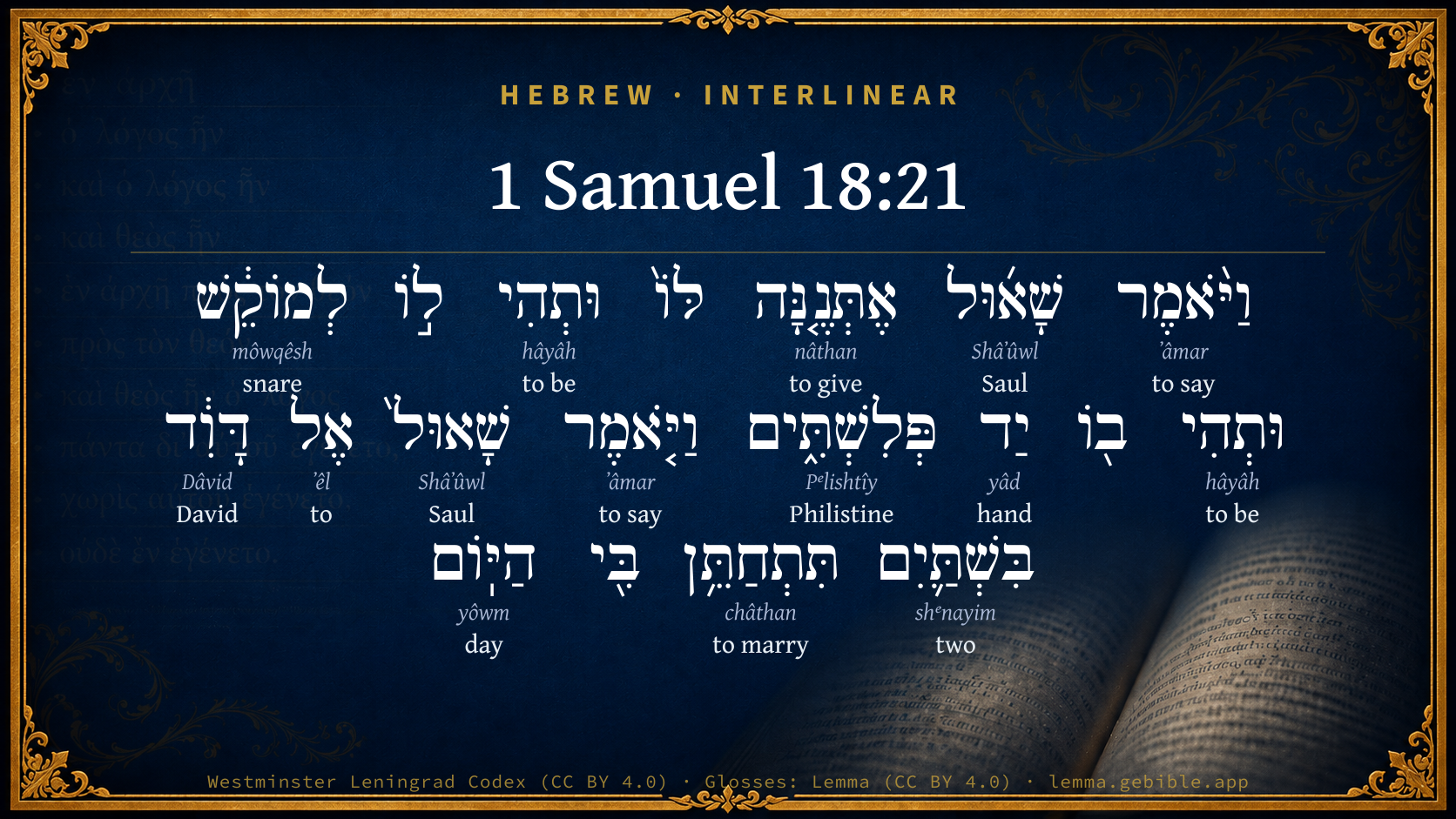
1 Samuel 18:21

Hebrew (Westminster Leningrad Codex) 1 Samuel 18:21 appears in the Hebrew Old Testament. The text above is from the Westminster Leningrad Codex. Each word links to its Strong’s number, a concise gloss, and parsing drawn from the Open Scriptures Hebrew Bible morphology. Click any word for its full Brown-Driver-Briggs (BDB) entry.
Download image
Cite this verse

1 Samuel 18:21 (World English Bible). Public Domain. Lemma interlinear Bible study tool, https://lemma.gebible.app/v/1-samuel/18/21.

Show BibTeX & RIS
BibTeX
RIS
English Translation
Saul said, I will give her to him, that she may be a snare to him, and that the hand of the Philistines may be against him. Therefore Saul said to David, You shall this day be my son-in-law a second time.
World English Bible · Public Domain
Download a study sheet

One document with this verse’s original text, its word-by-word gloss line, the meaning frame, cross-references with their text, attributed commentary, and full source and license credits — printable, and it pastes into notes with its structure intact.

This verse Autodidact and up

Study sheet (.html) Plain text (.txt)

A passage Seminary Student

Up to 50 verses in one chapter. A passage sheet keeps up to 6 commentary sources and 12 cross-references per verse, in the order this page ranks them, and says so on the sheet whenever that leaves anything out. Ask for a single verse and you get the Autodidact verse sheet above.

Everything on this page stays free to read, with no account — the sheet is a download of what is already on screen, not access to it.

Want to remove ads? Support Godless Engineer
Compare translations 3

The same verse in 3 English versions, stacked beneath the original-language interlinear above. Click any original word for its lexicon entry.

Each is an independent rendering of the whole verse — the interlinear is not word-aligned to these translations.

Highlighted words mark where these versions differ — a whole-verse word diff, not a word-by-word alignment.

  • World English Bible Public Domain
    Saul said, I will give her to him, that she may be a snare to him, and that the hand of the Philistines may be against him. Therefore Saul said to David, You shall this day be my son-in-law a second time.
  • King James Version Public Domain
    And Saul said, I will give him her, that she may be a snare to him, and that the hand of the Philistines may be against him. Wherefore Saul said to David, Thou shalt this day be my son in law in the one of the twain.
  • unfoldingWord Literal Text CC BY-SA 4.0
    And Saul said, “I will give her to him, that she may be a snare for him and the hand of the Philistines may be against him.” So Saul said to David for a second, “You may make yourself a son-in-law of mine today.”

unfoldingWord Literal Text — © unfoldingWord, licensed CC BY-SA 4.0. Word-aligned USFM3 via Door43 (git.door43.org/unfoldingWord/en_ult).

Versions to compare (up to 4)

3 of 4 selected

Show all 18 translations

Every available English version of this verse, each an independent rendering of the whole verse.

  • World English Bible Public Domain
    Saul said, I will give her to him, that she may be a snare to him, and that the hand of the Philistines may be against him. Therefore Saul said to David, You shall this day be my son-in-law a second time.
  • Berean Standard Bible Public Domain
    “I will give her to David,” Saul thought, “so that she may be a snare to him, and the hand of the Philistines may be against him.” So Saul said to David, “For a second time now you can be my son-in-law.”
  • Majority Standard Bible Public Domain
    “I will give her to David,” Saul thought, “so that she may be a snare to him, and the hand of the Philistines may be against him.” So Saul said to David, “For a second time now you can be my son-in-law.”
  • King James Version Public Domain
    And Saul said, I will give him her, that she may be a snare to him, and that the hand of the Philistines may be against him. Wherefore Saul said to David, Thou shalt this day be my son in law in the one of the twain.
  • American Standard Version (1901) Public Domain
    And Saul said, I will give him her, that she may be a snare to him, and that the hand of the Philistines may be against him. Wherefore Saul said to David, Thou shalt this day be my son-in-law a second time.
  • Revised Version (1885) Public Domain
    And Saul said, I will give him her, that she may be a snare to him, and that the hand of the Philistines may be against him. Wherefore Saul said to David, Thou shalt this day be my son in law a second time.
  • Geneva Bible (1599) Public Domain
    Therefore Saul said, I wil giue him her, that she may be a snare to him, and that the hand of the Philistims may bee against him. Wherefore Saul sayde to Dauid, Thou shalt this day be my sonne in law in the one of the twayne.
  • Douay-Rheims (1899) Public Domain
    And Saul said: I will give her to him, that she may be a stumblingblock to him, and that the band of the Philistines may be upon him. And Saul said to David: In two things thou shalt be my son in law this day.
  • Young's Literal Translation Public Domain
    and Saul saith, `I give her to him, and she is to him for a snare, and the hand of the Philistines is on him;' and Saul saith unto David, `By the second -- thou dost become my son-in-law to-day.'
  • Literal Standard Version CC BY-SA 4.0
    and Saul says, “I give her to him, and she is for a snare to him, and the hand of the Philistines is on him”; and Saul says to David, “By the second—you become my son-in-law today.”
  • Unlocked Literal Bible CC BY-SA 4.0
    Then Saul thought, “I will give her to him, so that she can be a trap for him, and that the hand of the Philistines may be against him.” So Saul said to David a second time, “You will be my son-in-law.”
  • unfoldingWord Literal Text CC BY-SA 4.0
    And Saul said, “I will give her to him, that she may be a snare for him and the hand of the Philistines may be against him.” So Saul said to David for a second, “You may make yourself a son-in-law of mine today.”
  • Darby Bible Public Domain
    And Saul said, I will give him her, that she may be a snare to him, and that the hand of the Philistines may be upon him. And Saul said to David, Thou shalt this day be my son-in-law a second time.
  • World Messianic Bible Public Domain
    Saul said, I will give her to him, that she may be a snare to him and that the hand of the Philistines may be against him. Therefore Saul said to David a second time, “You shall today be my son-in-law.”
  • Webster's Bible Public Domain
    And Saul said, I will give her to him, that she may be a snare to him, and that the hand of the Philistines may be against him. Wherefore Saul said to David, Thou shalt this day be my son-in-law, in the one of the two.
  • Free Bible Version CC BY-SA 4.0
    “I'll give her to David,” Saul thought. “She can be the bait so the Philistines can trap him.” So Saul said to David, “This is the second time you can become my son-in-law.”
  • Bible in Basic English Public Domain
    And Saul said, I will give her to him, so that she may be a cause of danger to him, and so that the hands of the Philistines may be against him. So Saul said to David, Today you are to become my son-in-law for the second time.
  • JPS Tanakh (1917) Public Domain
    And Saul said: 'I will give him her, that she may be a snare to him, and that the hand of the Philistines may be against him.' Wherefore Saul said to David: 'Thou shalt this day be my son-in-law through the one of the twain.'

Literal Standard Version (2020), Covenant Press — licensed CC BY-SA 4.0. Text via the HelloAO Bible API (eBible.org). Unlocked Literal Bible (unfoldingWord) — licensed CC BY-SA 4.0. Text via the HelloAO Bible API (eBible.org). unfoldingWord Literal Text — © unfoldingWord, licensed CC BY-SA 4.0. Word-aligned USFM3 via Door43 (git.door43.org/unfoldingWord/en_ult). Free Bible Version, Dr. Jonathan Gallagher — licensed CC BY-SA 4.0. Text via the HelloAO Bible API (eBible.org).

Word by word

More ways to search: Search by grammar → Find every occurrence → Compare this word →

Practice this passage: Drill this verse → Learn its vocabulary →

לְמוֹקֵ֔שׁ
môwqêsh
H4170
“to/for · snare”
Preposition + Noun, Common, Masculine, Singular, Absolute
Part of Speech
Preposition + Noun
Type
Common
Gender
Masculine
Number
Singular
State
Absolute
Full BDB Definition

Origin: from H3369

TWOT: 906c

bait, lure, snare
  1. וַיֹּ֨אמֶר ʼâmar H559 “and · to say” Conjunction + Verb, Qal, Sequential Imperfect, 3rd Person, Masculine, Singular
  2. שָׁא֜וּל Shâʼûwl H7586 “Saul” Noun, Proper
  3. אֶתְּנֶ֤נָּה nâthan H5414 “to give · her” Verb, Qal, Imperfect, 1st Person, Common, Singular + Suffix, Personal, 3rd Person, Feminine, Singular
  4. וּתְהִי hâyâh H1961 “and · to be” Conjunction + Verb, Qal, Jussive, 3rd Person, Feminine, Singular
  5. וּתְהִי hâyâh H1961 “and · to be” Conjunction + Verb, Qal, Jussive, 3rd Person, Feminine, Singular
  6. יַד yâd H3027 “hand of” Noun, Common, Both, Singular, Construct
  7. פְּלִשְׁתִּ֑ים Pᵉlishtîy H6430 “Philistines” Noun, Gentilic, Masculine, Plural, Absolute
  8. וַיֹּ֤אמֶר ʼâmar H559 “and · to say” Conjunction + Verb, Qal, Sequential Imperfect, 3rd Person, Masculine, Singular
  9. שָׁאוּל֙ Shâʼûwl H7586 “Saul” Noun, Proper
  10. אֶל ʼêl H413 “to” Preposition
  11. דָּוִ֔ד Dâvid H1732 “David” Noun, Proper
  12. בִּשְׁתַּ֛יִם shᵉnayim H8147 “in/at · two” Preposition + Adjective, Cardinal number, Feminine, Dual, Absolute
  13. תִּתְחַתֵּ֥ן châthan H2859 “to marry” Verb, Hithpael, Perfect, 2nd Person, Masculine, Singular
  14. הַיּֽוֹם yôwm H3117 “the · day” Particle, Definite Article + Noun, Common, Masculine, Singular, Absolute

About this verse

These counts appear in no published source. They are computed here, from the morphology-tagged text and Lemma’s own curated glosses. What Lemma adds →

19
words
12
distinct lemmas
Historical
section

Shared distinctive vocabulary

לְמוֹקֵ֔שׁ snare H4170 occurs in 27 verses of the Hebrew Bible. Also found in:

Grammatical profile

  • 6 verbs
  • 7 nouns
  • 1 adjective
  • 5 prepositions

Verb forms

  • וַיֹּ֨אמֶר Qal · Sequential Imperfect
  • אֶתְּנֶ֤נָּה Qal · Imperfect
  • וּתְהִי Qal · Jussive
  • וּתְהִי Qal · Jussive
  • וַיֹּ֤אמֶר Qal · Sequential Imperfect
  • תִּתְחַתֵּ֥ן Hithpael · Perfect

Repetition

Words recur within this verse — often emphatic in Hebrew:

  • וַיֹּ֨אמֶר to say H559 ×2
  • שָׁא֜וּל Saul H7586 ×2
  • וּתְהִי to be H1961 ×2

Hebrew & Septuagint length

In English translation the verse runs 42 words from the Hebrew and 27 from the Septuagint (LXX English) — the Septuagint runs noticeably shorter here. See the side-by-side →

A rough comparison of the two English renderings, which tokenize alike — not a word-level alignment.

Word counts can differ between the Hebrew and the Greek without any difference in meaning — e.g. the Hebrew direct-object marker אֵת has no separate Greek word, and Greek often adds the article ὁ.

Cross-references

10

Topical passages linked to 1 Samuel 18:21 in the Treasury of Scripture Knowledge — connected by theme and wording, ordered by reader-vote popularity; previews shown in the World English Bible.

  • 1 Samuel 18:17 Saul said to David, Behold, my elder daughter Merab, her will I give you as wife: only be valiant for me, and fight Yahweh's battles. For Saul said, Don't let my hand be on him, but let the hand of the Philistines be on him.
  • Exodus 10:7 Pharaoh's servants said to him, "How long will this man be a snare to us? Let the men go, that they may serve Yahweh, their God. Don't you yet know that Egypt is destroyed?"
  • 1 Samuel 18:26 When his servants told David these words, it pleased David well to be the king's son-in-law. The days were not expired;
  • 1 Samuel 19:11–12 Saul sent messengers to David's house, to watch him, and to kill him in the morning: and Michal, David's wife, told him, saying, If you don't save your life tonight, tomorrow you will be slain.
  • Jeremiah 9:8 Their tongue is a deadly arrow; it speaks deceit: one speaks peaceably to his neighbor with his mouth, but in his heart he lays wait for him.
  • Psalms 7:14–16 Behold, he travails with iniquity; Yes, he has conceived mischief, And brought forth falsehood.
  • Psalms 38:12 They also who seek after my life lay snares. Those who seek my hurt speak mischievous things, And meditate deceits all day long.
  • Proverbs 26:24–26 A malicious man disguises himself with his lips, But he harbors evil in his heart.
  • Proverbs 29:5 A man who flatters his neighbor, Spreads a net for his feet.
  • Jeremiah 5:26 For among my people are found wicked men: they watch, as fowlers lie in wait; they set a trap, they catch men.

Cross-references courtesy of OpenBible.info (CC BY 4.0).

Hebrew and Greek witnesses Masoretic Hebrew ↔ Greek Septuagint

The same verse in the two great witnesses to the Old Testament, shown verse-for-verse.

Here the Septuagint runs noticeably shorter than the Hebrew — LXX2012 (modern English Septuagint) 27 words vs World English Bible 42. A rough length comparison of the two English translations, not a word-level alignment — read both below.

These are two independent witnesses, not word-aligned to each other, and the Septuagint is shown in lemma (dictionary) form.

Hebrew 1 Samuel 18:21 Masoretic · Westminster Leningrad Codex

וַיֹּ֨אמֶר שָׁא֜וּל אֶתְּנֶ֤נָּה לּוֹ֙ וּתְהִי ל֣וֹ לְמוֹקֵ֔שׁ וּתְהִי ב֖וֹ יַד פְּלִשְׁתִּ֑ים וַיֹּ֤אמֶר שָׁאוּל֙ אֶל דָּוִ֔ד בִּשְׁתַּ֛יִם תִּתְחַתֵּ֥ן בִּ֖י הַיּֽוֹם

Saul said, I will give her to him, that she may be a snare to him, and that the hand of the Philistines may be against him. Therefore Saul said to David, You shall this day be my son-in-law a second time.

World English Bible · Public Domain

Greek LXX 1 Samuel 18:21 Septuagint · lemma form
And Saul said, I will give her to him, and she shall be a stumbling block to him. Now the hand of the Philistines was against Saul.

LXX2012 (modern English Septuagint) · Public Domain

On this verse, Ellicott's Commentary for English Readers discusses the Septuagint’s reading. Read the note in Commentary ↓

Hebrew: Westminster Leningrad Codex (CC BY 4.0). Greek: Septuagint (public domain); English from LXX2012 (modern English Septuagint) (Public Domain). How the Septuagint differs from the Hebrew →

Targum (Aramaic paraphrase)

1

The Targum is the ancient Jewish Aramaic paraphrase of the Hebrew Scriptures — an interpretive translation, not the Hebrew text itself. Onkelos (literal) and Pseudo-Jonathan (expansive) render the Torah, and Jonathan the Prophets. Coverage is partial: where no permissively-licensed English translation exists for a verse, only the Aramaic is shown. This is verse-level text, not a word-by-word alignment to the Hebrew.

  1. Targum Jonathan Prophets (Joshua–Malachi)
    וַאֲמַר שָׁאוּל אֶתְּנָהּ לֵיהּ וּתְהֵי לֵיהּ לְתַקָלָא וְיִתְמְסַר בִּידָא דִפְלִשְׁתָּאֵי וַאֲמַר שָׁאוּל לְדָוִד בַּחֲדָא מִתְּרֵין תִּתְחַתֵּן בִּי יוֹמָא דֵין:

    (no public-domain English translation for this verse)

    Targum Jonathan — Aramaic: “Mikraot Gedolot” (public domain). English: “Sefaria Community Translation” (CC0 1.0 (public-domain dedication)); “London "Chaldee Paraphrase," 1871” (public domain). Text via Sefaria.

Commentary

Notes on 1 Samuel 18:21 from classic Christian and Jewish commentators (each source and its license shown beneath its notes). The classic Christian expositions comment on the surrounding passage and are grouped to its opening verse, so a note may address several verses; the Jewish commentaries on the Tanakh (Rashi and others) are per-verse, so they appear only where the commentator wrote on this verse.

Lemma curates 59 commentaries, every one of them public domain or Creative Commons licensed, each selected and text-cleaned for this edition rather than reprinted as found. About our sources →

Trapp's Complete Commentary

John Trapp

1Sa 18:21 And Saul said, I will give him her, that she may be a snare to him, and that the hand of the Philistines may be against him. Wherefore Saul said to David, Thou shalt this day be my son in law in [the one of] the twain.

Ver. 21. Thou shalt this day be my son-in-law.] Here is a fair glove drawn upon a foul hand; there is a great deal of such colluding and colloguing in the world. "Be wise as serpents."

“ Sit licet in partes circumspectissimus omnes,

Nemo tamen vulpes, nemo cavere potest. ”

John Trapp, A Commentary or Exposition upon All the Books of the Old and New Testament (1647–1656) — public domain. Text from a community e-Sword module.

The Biblical Illustrator

Joseph S. Exell

1Sa_18:21

And Saul said, I will give him her that she may be a snare to him.

Marriage an instrument of intrigue

We are not without examples in profane history of royal parents employing matrimonial contracts as instruments of intrigue or revenge. Antiochus the Great wedded his daughter Cleopatra to Ptolemy Epiphanes, King of Egypt, in order thereby to compass his destruction, though the baseness of the plot defeated itself (Delany). Saul, doubtless, in ordinary circumstances, would have violently resented the marriage of Michal; but he was artful enough to see, in the preliminaries to such a connection, a new opportunity for effecting his deadly purpose, and that, too, by a repetition of the identical stratagem and unworthy knavery which on two former occasions had been foiled. The thing pleased him, and Saul said, I will give him her that she may be a snare to him, and that the hand of the Philistines may be against him. (J. R. Macduff, D. D.)

The Biblical Illustrator, edited by Joseph S. Exell (c. 1880s–1900s) — public domain. Text from a community e-Sword module.

Geneva Bible (1599)

Geneva Bible translators

So his hypocrisy appeareth: for under pretence of favor he sought his destruction.

Geneva Bible (1599) marginal notes — public domain. Text via Bolls.life.

Adam Clarke's Commentary

Verse 21. That she may be a snare to him] Saul had already determined the condition on which he would give his daughter to David; viz., that he should slay one hundred Philistines: this he supposed he would undertake for the love of Michal, and that he must necessarily perish in the attempt; and thus Michal would become a snare to him.

Adam Clarke's Commentary on the Bible (1810–1826) — public domain. Text from a community e-Sword/MySword module.

Ellicott's Commentary for English Readers

(21) That she may be a snare to him.—Is it not possible that this dark plot of Saul against a life once so dear to him—a plot which in after days, when the enmity of the king was a matter of general notoriety, became of course known by David—suggested to him (David) the means by which, in the darkest hours of his life, he got rid of the brave Uriah, the husband of Bath-sheba, at the siege of Rabbah? (2 Samuel 11)

In the one of the twain.—More accurately translated. in this second time, or in this second way. The LXX. again leaves out this statement, no doubt because it refers back to the omitted passage in 1Sa_18:17-19.

A Bible Commentary for English Readers, edited by Charles John Ellicott (1878–1897) — public domain. Text from a community e-Sword module.

The Cambridge Bible for Schools and Colleges

gen. ed. J. J. S. Perowne

21. a snare] Michal was to he the bait to lure David into some venturesome raid upon the Philistines in which he might lose his life

Wherefore Saul, &c.] Probably, And Saul said to David a second time, Now shalt thou be my son-in-law. The Sept. (B) omits the clause, but adds, “Now the hand of the Philistines was against Saul.”

The Cambridge Bible for Schools and Colleges (gen. ed. J. J. S. Perowne; Cambridge University Press, 1878–1918) — public domain. Text from a community e-Sword module.

John Gill's Exposition

And Saul commanded his servants, saying, commune with David secretly,.... And persuade him to marry Michal, and assure him of Saul's real regard to him, and good intention towards him; for it seems that David being ill used in the affair of his eldest daughter, did not listen to the proposals of Saul as to the youngest, and therefore Saul took this method to bring him into them:

and say, behold, the king hath a delight in thee; bore a good will towards him, had an high opinion of him, and it would be a pleasure to him that he should he his son-in-law:

and all his servants love thee; which might be true in general, excepting some few; which was no small mortification to Saul, though he here pleads it, and puts his servants on making use of it to gain his present purpose:

now therefore be the king's son in law; accept of the proposal he has made, and marry his youngest daughter.

John Gill's Exposition of the Whole Bible (1746–1763) — public domain (CC PDM 1.0). Text via the HelloAO Bible API.

Albert Barnes' Notes on the Bible

In the one of the twain - Some prefer “the second time” Job 33:14. The first contract had been broken by giving Merab to Adriel.

Albert Barnes' Notes on the Bible (1834–1885) — public domain. Text from a community e-Sword/MySword module.

Haydock's Catholic Bible Commentary

Days. Hebrew, "In two thou shalt," &c. (Calmet) --- Protestants, "in the one of the twain," Merob or Michol. (Haydock) --- Saul had deceived him with respect to the first; but he promises that he shall have "the second," (Calmet) or two motives induced the king to make him this offer, the victory over Goliath, and the slaughter of 100 Philistines. (Menochius; Tirinus) --- The Septuagint omit this sentence, and read, "And the hand of the Philistines was upon Saul, and Saul commended," &c.

George Leo Haydock (1774–1849), Haydock's Catholic Family Bible and Commentary, 1859 edition — public domain. Excludes Psalms (Douay-Rheims chapter numbering differs from Protestant) and Deuterocanonical books (Catholic canon only).

Matthew Poole's English Annotations

This day, i.e. suddenly, within a time which probably Saul prefixed.

In the one of the twain: whereas I have only two daughters, and thou wast disappointed of thy expectation in the one by an unexpected accident, thou shalt certainly have the other, which is the same thing. Heb. in the twain. Thus the cities of Gilead is put for one of them, Jdg 12:7; and the sides of the ship for one of the sides, Jon 1:5. Or he saith in the twain, or in both, because he was in effect betrothed to the one, and should be married to the other, and so was I his son-in-law upon a double account.

Matthew Poole's English Annotations on the Holy Bible (1683–1685) — public domain. Text from a community e-Sword/MySword module.

Whedon's Commentary on the Bible

Daniel D. Whedon

21. In the one of the twain — Better, In the second shalt thou become my son in law this day. That is, by means of the second daughter; or, thou shalt become doubly my son in law, for the first (Merab) was lawfully thine, and now the second shall certainly be given thee.

This day — Some day designated for the marriage.

Daniel D. Whedon (gen. ed.), Commentary on the Old and New Testaments (1874–1909) — public domain. Text from a community e-Sword module.

Rashi

Rabbi Shlomo Yitzchaki (Rashi)

Through the second [of my two daughters] you will become my son-in-law. I have two daughters; through one of them, you will become my son-in-law. And similarly did Targum Yonoson render, 'with one of the two.' Similarly [we find], "I hold three things [meaning, one of three things] over you," as Scripture clarifies there, "choose one of them."

Rashi on the Tanakh — English translations: “The Judaica Press complete Tanach with Rashi, translated by A. J. Rosenberg” (CC BY 4.0); “Pentateuch with Rashi's commentary by M. Rosenbaum and A.M. Silbermann, 1929-1934” (public domain); “The Metsudah Tanach series, Lakewood, N.J” (CC BY 4.0); and “The Book of Joshua, Metsudah Publications, 1997” (CC BY 4.0). Text via Sefaria.

Lesson kit

Teaching starters — assembled from the data on this page, not authored interpretation. Every prompt links to the verse data it draws on. Edit before teaching.

1 Samuel, in the Historical, opens this verse with 19 words (12 distinct Hebrew lemmas). Its most distinctive word is môwqêsh (“snare”). The Greek Septuagint runs shorter here. A historical commentator’s framing appears above. Read the whole chapter for the surrounding context.

Discussion questions

  1. How does “snare” (môwqêsh) shape what this verse is saying?
  2. Exodus 10:7 shares the word «snare» with this verse. How do the two illuminate each other?
  3. “to say” occurs 2× in this one verse. What is the effect of the repetition?
  4. Compared with the Hebrew, the Septuagint runs shorter here. What questions does that raise?
  5. These translations render this verse differently. What is at stake in choosing one wording over another?
  6. The verb «וַיֹּ֨אמֶר» is Qal Sequential Imperfect. How does its form color the action?
  7. Reading how Trapp's Complete Commentary and The Biblical Illustrator read this verse, where do the two commentators agree and where do they part?

Things to notice

Reading settings

Reading text

Shown beneath each verse's original-language words.

Old Testament
Old Testament edition

Read the OT as the Masoretic Hebrew (MT) or the Greek Septuagint (LXX).

English shown for the Greek Septuagint (in the Hebrew ↔ Greek comparison).

Comparing translations? Open the Compare panel on any verse page to stack up to four side by side.