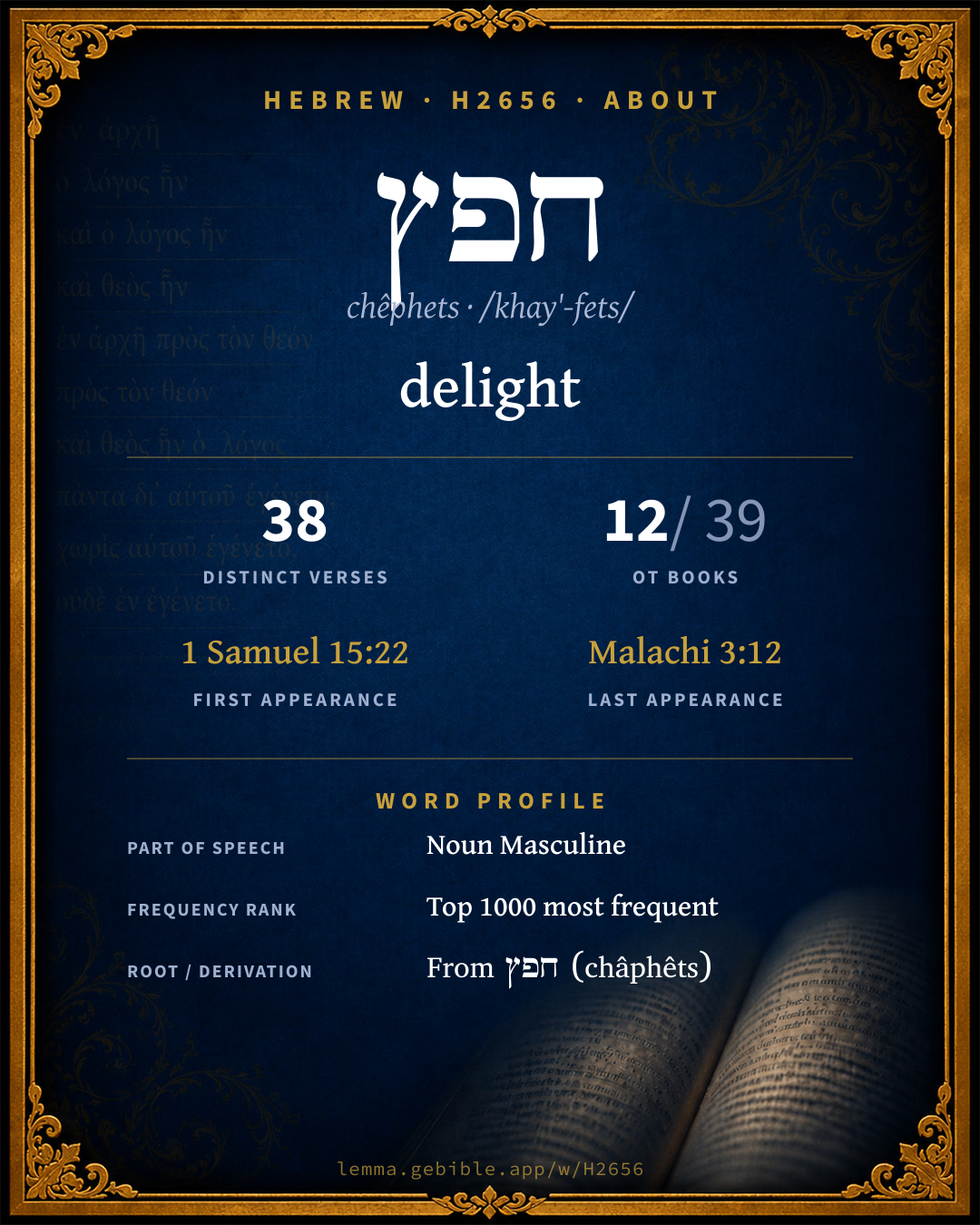
חֵ֫פֶץ
delight
‘delight’ is one of 5 main senses fuller range ↓
Full lexicon entry — Brown-Driver-Briggs (BDB)
From Brown-Driver-Briggs (BDB)
Where this word appears
See every Construct-state word in the Hebrew Bible →
Grammar key — what these labels mean
Part of speech
- Noun
- A naming word — a person, place, thing, or idea.
- Adjective
- A word that describes or qualifies a noun.
Noun type
- Common
- A common noun — a general class of person, place, or thing (“king,” “city,” “water”), not a specific name.
State
- Absolute
- The independent form of a noun, not bound to a following word.
- Construct
- A noun bound to a following noun in a possessive / “of” relationship (the construct chain).
Gender
- Masculine
- Grammatically masculine.
Number
- Singular
- One.
- Plural
- More than one (in Hebrew, generally three or more).
5 verses where H2656 appears in the Construct state in the Book of Isaiah. Filtered view — show all forms. Click any verse to open its interlinear word-by-word view. Verse text shown in the World English Bible for context — . Each verse’s Hebrew form is shown with its reference; the English is not keyword-highlighted, since the data carries no word-level English alignment. Use “Compare translations” on any verse to read it across multiple English versions. This concordance covers the Hebrew Bible; Septuagint (Greek Old Testament) occurrences are not indexed here.
Isaiah
- Isaiah 44:28 חֶפְצִ֖/י n c ms cs + sfx pers 1cs Who says of Cyrus, [He is] my shepherd, and shall perform all my pleasure, even saying of Jerusalem, She shall be built; and of the temple, Your foundation shall be laid.
- Isaiah 46:10 חֶפְצִ֖/י n c ms cs + sfx pers 1cs declaring the end from the beginning, and from ancient times things that are not [yet] done; saying, My counsel shall stand, and I will do all my pleasure;
- Isaiah 48:14 חֶפְצ/וֹ֙ n c ms cs + sfx pers 3ms Assemble yourselves, all you, and hear; who among them has declared these things? He whom Yahweh loves shall perform his pleasure on Babylon, and his arm [shall be on] the Chaldeans.
- Isaiah 53:10 וְ/חֵ֥פֶץ conj + n c ms cs Yet it pleased Yahweh to bruise him; he has put him to grief: when you shall make his soul an offering for sin, he shall see [his] seed, he shall prolong his days, and the pleasure of Yahweh shall prosper in his hand.
- Isaiah 58:13 חֲפָצֶ֖י/ךָ חֶפְצְ/ךָ֖ n c mp cs + sfx pers 2ms n c ms cs + sfx pers 2ms If you turn away your foot from the Sabbath, from doing your pleasure on my holy day; and call the Sabbath a delight, [and] the holy of Yahweh honorable; and shall honor it, not doing your own ways, nor finding your own pleasure, nor speaking [your own] words:
About this entry
At a glance — auto-summarized from this page’s data, not written by a person. Every figure links to its source below. This summary describes the numbers; it doesn’t interpret them.
חפץ (chêphets) is a Hebrew noun most often rendered “delight.” Older and newer Bibles part ways — “pleasure” in the King James Version, “desire” (unfoldingWord Literal Text) in modern versions. See the renderings breakdown. It turns up in 38 verses across 12 books, a moderately common footprint. Scripture first uses it in 1 Samuel 15:22. Not a single-sense word: explore its full sense range. For the data behind this summary, explore the sense tree and the renderings breakdown below.
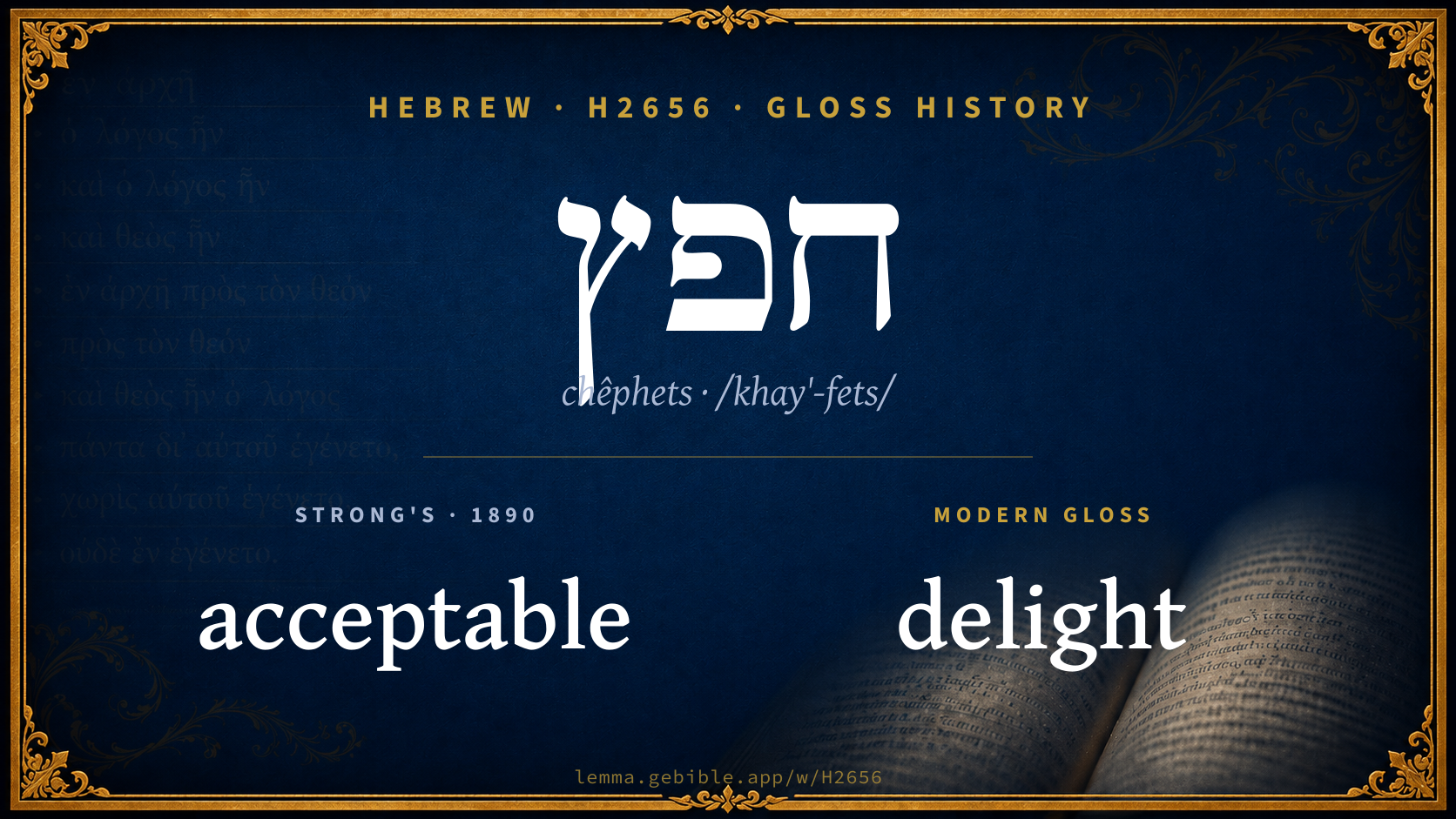
Gloss history
Strong's 1890 vs modern scholarship
About this word
Strong's H2656 catalogs a Hebrew word from the Hebrew Old Testament.
These counts are not copied from any lexicon or concordance. They are computed here, from the morphology-tagged Hebrew Old Testament. What Lemma adds →
- 38
- distinct verses
- The word appears in 38 distinct verses.
- 12 / 39
- OT books
- The word appears in 12 of 39 Old Testament books.
- #922
- by frequency
- Top 1000 most frequent Hebrew words (rank 922 of 8,640 Hebrew words by occurrence).
View all 38 occurrences in the concordance →
Most concentrated in
- Ecclesiastes 7 verses 18%
- Isaiah 7 verses 18%
- 1 Kings 5 verses 13%
By section of the Old Testament
By traditional corpus
Conventional, traditional groupings — biblical authorship is debated, so this is a traditional corpus grouping, not an authorship claim. Each share is this word’s portion of its verses in that division of the Hebrew canon. Each figure is a share of the word’s 38 distinct verses.
- Prophets (Nevi'im) 20 verses · 53%
- Writings (Ketuvim) 18 verses · 47%
How translations render this word
Counts come from each version’s own published word-to-Strong’s tagging or interlinear alignment — an approximate guide to how each version renders this word, not a word-level alignment the data otherwise carries. Because each total is that version’s own tagged count, the per-version totals vary from one another and need not match the appearance or distinct-verse counts above. These counts may also differ from a printed concordance because Lemma counts each distinctly tagged rendering and does not collapse phrase taggings into a single head-word total. This is a fixed set of word-tagged versions (KJV, ASV, BSB, ULT) and does not change with the reading translation you choose elsewhere. Each version’s license is shown beside its name below (and on Sources).
- King James Version: Pleasure 5×, Every purpose 3×, Wherein is no pleasure 3×
- American Standard Version: Every purpose 3×, Pleasure 3×, Wherein none delighteth 3×
- Berean Standard Bible: Delight 4×, Desire 3×, Pleasure 3×
- unfoldingWord Literal Text: Desire 10×, Delight 8×, Pleasure 5×
King James Version Public Domain
Renders H2656 across 39 tagged occurrences — most commonly:
Plus 18 renderings that appear only once — usually multi-word phrases or single function words the recovered tagging swept in, not distinct renderings.
American Standard Version Public Domain
Renders H2656 across 39 tagged occurrences — most commonly:
Plus 22 renderings that appear only once — usually multi-word phrases or single function words the recovered tagging swept in, not distinct renderings.
Berean Standard Bible Public Domain
Renders H2656 across 38 tagged occurrences — most commonly:
Plus 15 renderings that appear only once — usually multi-word phrases or single function words the recovered tagging swept in, not distinct renderings. Not rendered by a distinct English word in 1 further occurrence.
unfoldingWord Literal Text CC BY-SA 4.0
Renders H2656 across 38 tagged occurrences — most commonly:
Plus 9 renderings that appear only once — usually multi-word phrases or single function words the recovered tagging swept in, not distinct renderings.
Senses in the full BDB
What do BDB’s symbols mean?
BDB uses these scholarly abbreviations:
| Symbol | Meaning |
|---|---|
| 𝔊 | the Septuagint (the ancient Greek translation, LXX) |
| 𝔙 | the Vulgate (the Latin translation) |
| 𝔖 | the Syriac version (the Peshitta) |
| 𝔗 | the Targum (the Aramaic translation) |
| ψ | the Psalms |
| √ | root (the underlying root or stem) |
| ‖ | parallel passage (a synonymous or contrasted parallel) |
| † | the dagger: every passage where the word occurs is cited |
The 5 senses and sub-senses the full Brown-Driver-Briggs lexicon distinguishes for this word, in lexicon order (not ranked by frequency), with BDB’s own verbatim wording and sub-sense lettering. Shown in Hebrew script with BDB’s own scholarly abbreviations. The condensed entry is in the Lexicon Entry tab. See also the Forms in the corpus table below.
- 1. delight אבני ח׳ Is 54:12 delightful stones; אֶרֶץ ח׳ Mal 3:12 delightsome land; דִּבְרֵי ח׳ Ec 12:10; so perhaps also בִּגְדֵי ח׳ Ez 27:20 garments of delight, i.e. of beauty and luxury (Gr; MT חֹפֶשׁ q.v.); c. בְּ of persons ψ 16:3; Ec 5:3 Mal 1:10; of things 1 S 15:22; 18:25 ψ 1:2; Jb 21:21; Ec 12:1; כְּלִי אֵין חֵפֶץ בּוֹ vessel wherein is no pleasure Je 22:28; 48:38; Ho 8:8; הַחֵפֶץ לְשַׁדַּי כִּי Jb 22:3 is it a pleasure to Shadday that? e.g. Isaiah 54:12
- 2. desire, longing מנע מח׳ דלים Jb 31:16 withhold the poor from (their) desire; מְחוֹז חֶפְצָם the city of their desire ψ 107:30; כל חפץ all (one’s) desire 2 S 23:5 1 K 5:22, 23, 24; 9:11, 10:13 = 2 Ch 9:12; כל חפצים all things to be desired Pr 3:15; 8:11. e.g. Job 31:16
- 3. the good pleasure, will, purpose, of Yahweh Ju 13:23 (J) Is 44:28; 46:10; 48:14. e.g. Judges 13:23
- 4. that in which one takes delight, his business (late), or matter (very late, cf. Mish. = thing) חֵפֶץ י׳ בְּיָדוֹ יִצְלַח the good pleasure (cause, business) of Yahweh will prosper in his hands Is 53:10; - Is 58:3, 13; עֲשׂוֹת חֲפָצֶךָ doing thy affairs Is 58:13 (see De in loco); בְּחֵפֶץ כַּפֶּיהָ in the business of her hands Pr 31:13; עֵת לְכָל־חֵפֶץ time for every matter, affair Ec 3:1, 17; 8:6; אַל־תִּתְמַהּ עַל־הַחֵפֶץ marvel not at the matter Ec 5:7. e.g. Isaiah 53:10
- —חפץ is not used in any of its forms in E D2 H P of the Hexateuch.
Senses from the full Brown-Driver-Briggs lexicon (Brown, Driver, Briggs; Oxford 1906 — public domain), digitized via Sefaria, supplemented by the OpenScriptures HebrewLexicon (CC BY 4.0). Full attribution on Sources.
Word origin
n.m. Pr 3:15 delight, pleasure;—ח׳ Is 54:12 + 20 times; sf. חֶפְצְךָ Is 58:13 etc. + 13 times sfs.; pl. חֲפָצִים Pr 8:11; sf. חֲפָצֶיךָ Pr 3:15; חֲפָצֶ֖ךָ Is 58:13—
— Brown-Driver-Briggs (Oxford 1906, public domain), digitized via Sefaria, supplemented by the OpenScriptures HebrewLexicon (CC BY 4.0). See Sources.
Derived from חפץ (châphêts) (H2654) — to delight in.
Jastrow Dictionary
A second Hebrew/Aramaic lexicon for comparison, covering Aramaic and post-biblical (Talmudic, Targumic, Midrashic) usage that the biblical-Hebrew BDB does not. Matched by lemma rather than by Strong’s number, so a lemma may carry more than one Jastrow headword (shown separately below), and the entries cover usage well beyond the Bible.
חָפַץ
- 1. to bend (v. Job XL, 17); חָפֵץ to be busy with, to be anxious, desire.—Pesik. Haḥod. p. 47ᵇ הוא ח׳ לגאול אתכם He is anxious to redeem you; ib. ח׳ בגאולתכם; Pesik. R. s. 15 ה׳ לגאולתכם; Cant. R. to II, 8; a. e.—[ e.g. Job 40:17
- 2. to hold in one’s hand, cmp. חָפַן; v. next w.]
חֵפֶץ
- preced.)
- 1. thing (held in hand), object. B. Mets. IV, 10 בכמה ח׳ זה how much is this worth? Cant. R. to I, 4 כל ח׳ טוב any good thing; a. fr.
- 2. concern, business; desire, desirable object. Ib.; Pesik. Sos, p. 147ᵃ אין לי ח׳ טוב ממך I have nothing more desirable than thyself. Koh. R. to V, 7 נעשה חֶפְצוֹ his desire was fulfilled. Num. R. s. 19 אל תחזירני מן חֶפְצִי וכ׳ do not turn me off from (refuse) my desire which &c.; a. fr.—Pl. חֲפָצִים. M. Kat. 9ᵇ (ref. to Prov. III, 15, a. VIII, 11) הא חֶפְצֵי שמים but heavenly affairs (religious deeds) are equal to it (the study of the Law). Y. Peah I, 15ᵈ bot. (ref. to Prov. l. c.) חפצים וכ׳ ‘desirable things’, that means jewels and pearls, ‘thy desirable things’, that means &c. Ib. חֲפָצֶיךָ וחֲפָצַי וכ׳ thy treasures and my treasures cannot compare to what I sent you; Gen. R. s. 35, end.—Sabb. 113ᵃ (ref. to Is. LVIII, 13) חֲפָצֶיךָ אסורין ח׳ שמים וכ׳ thy pursuits are forbidden (on the Sabbath), but heavenly affairs (consultation about public welfare, education &c.) are permitted; ib. 150ᵃ; a. fr. e.g. Proverbs 3:15
A Dictionary of the Targumim, the Talmud Babli and Yerushalmi, and the Midrashic Literature (Marcus Jastrow; London, Luzac, 1903) — Public Domain. Digitized via Sefaria. Digitized via Sefaria. Full attribution on Sources.
Forms in the corpus
The 29 distinct written forms H2656 takes in the Hebrew Bible, most frequent first — each parse links to that state’s occurrences in the concordance. Hebrew forms include their vowel points and cantillation, so a single lemma takes many written forms.
Same root — word family
Other BDB entries built from the same root as H2656, grouped by Strong’s listed origin. These share a root / origin per the lexicon — not necessarily a shared meaning. Each links to that word’s own entry.
Derives from
Shares the same root
Proper names from this root
People and places named from this root — a name, not an additional meaning of the word.
Compare all same-root words → 1 of the same-root words is a proper name (a person or place). They share a root, not necessarily a meaning.
Septuagint verse parallels
This word appears in 34 verses that also exist in the Greek Old Testament (Septuagint), out of the 38 Hebrew verses it occurs in. You can read those verses in Greek by switching the Old Testament edition to the Septuagint.
Read these verses in the Septuagint
- 1 Samuel 15:22
- 2 Samuel 23:5
- 1 Kings 5:9
- 2 Chronicles 9:12
- Job 21:21
- Psalms 1:2
- Proverbs 3:15
- Ecclesiastes 3:1
- Isaiah 44:28
- Jeremiah 22:28
- Hosea 8:8
- Malachi 1:10
This is a verse-level parallel only — the same verses exist in both the Hebrew and Greek Old Testaments. No word-level Hebrew↔Greek correspondence is claimed: the data carries no such alignment, so no Greek word is shown as this Hebrew word’s translation. Coverage is not total — the Septuagint omits the deuterocanon and renumbers the Psalms, so some Hebrew verses have no direct Greek parallel.