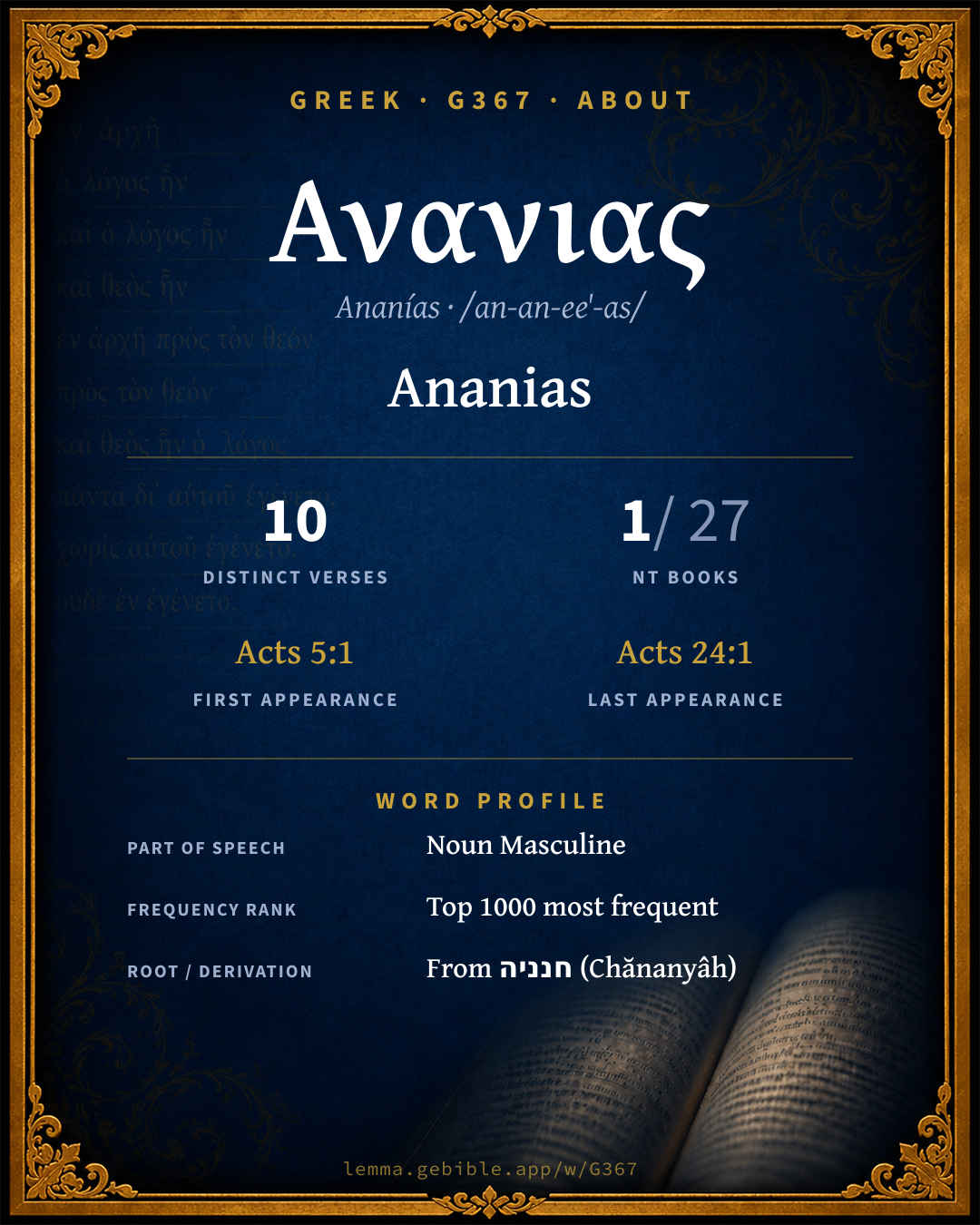
Ἀνανίας
Ananias
Thayer's lists 4 entries for ‘Ananias’ fuller range ↓
Full lexicon entry — Thayer's Greek Lexicon
From Thayer's Greek Lexicon
Where this word appears
See every Nominative-case word in the Greek New Testament →
Grammar key — what these labels mean
Part of speech
- Noun
- A naming word — a person, place, thing, or idea.
Case
- Nominative
- The case of the subject (and the predicate nominative).
- Vocative
- The case of direct address (“O Lord”).
- Accusative
- The case of the direct object and of extent.
Gender
- Masculine
- Grammatically masculine.
Number
- Singular
- One.
Grammatical forms
- Noun, Nominative, Singular, Masculine 8 times (73%)
- Noun, Vocative, Singular, Masculine 2 times (18%)
- Noun, Accusative, Singular, Masculine 1 time (9%)
Parsed forms decoded from the imported morphology (Robinson–Tischendorf, public domain), counted across 11 parsed occurrences — not distinct verses.
Every verse where G367 appears — 10 distinct verses across 1 book. Click any verse to open its interlinear word-by-word view. Verse text shown in the World English Bible for context — . Each verse’s Greek form is shown with its reference; the English is not keyword-highlighted, since the data carries no word-level English alignment. Use “Compare translations” on any verse to read it across multiple English versions. This concordance covers the Greek New Testament; Septuagint (Greek Old Testament) occurrences of this word are not indexed here.
Acts 10 verses
- Acts 5:1 Ἀνανίας n nom sg masc But a certain man named Ananias, with Sapphira, his wife, sold a possession,
- Acts 5:3 Ἀνανία n voc sg masc But Peter said, "Ananias, why has Satan filled your heart to lie to the Holy Spirit, and to keep back part of the price of the land?
- Acts 5:5 Ἀνανίας n nom sg masc Ananias, hearing these words, fell down and died. Great fear came on all who heard these things.
- Acts 9:10 Ἀνανίας Ἀνανία n nom sg masc n voc sg masc Now there was a certain disciple at Damascus named Ananias. The Lord said to him in a vision, "Ananias!" He said, "Behold, it's me, Lord."
- Acts 9:12 Ἀνανίαν n acc sg masc and in a vision he has seen a man named Ananias coming in, and laying his hands on him, that he might receive his sight."
- Acts 9:13 Ἀνανίας n nom sg masc But Ananias answered, "Lord, I have heard from many about this man, how much evil he did to your saints at Jerusalem.
- Acts 9:17 Ἀνανίας n nom sg masc Ananias departed, and entered into the house. Laying his hands on him, he said, "Brother Saul, the Lord, who appeared to you on the road by which you came, has sent me, that you may receive your sight, and be filled with the Holy Spirit."
- Acts 22:12 Ἀνανίας n nom sg masc One Ananias, a devout man according to the law, well reported of by all the Jews who lived in Damascus,
- Acts 23:2 Ἀνανίας n nom sg masc The high priest, Ananias, commanded those who stood by him to strike him on the mouth.
- Acts 24:1 Ἀνανίας n nom sg masc After five days, the high priest, Ananias, came down with certain elders and an orator, one Tertullus. They informed the governor against Paul.
About this entry
At a glance — auto-summarized from this page’s data, not written by a person. Every figure links to its source below. This summary describes the numbers; it doesn’t interpret them.
Ανανιας — transliterated Ananías — is a Greek name carrying the sense “Ananias.” Its uses cluster heavily in Acts (100% of all occurrences). With 10 verses in 1 book, it is an uncommon word in the Greek New Testament. It first appears in Acts 5:1. See 10-verse concordance and the renderings breakdown below.
Gloss history
Strong's 1890 vs modern scholarship
About this word
Strong's G367 catalogs a Greek word from the Greek New Testament.
These counts are not copied from any lexicon or concordance. They are computed here, from the morphology-tagged Greek New Testament. What Lemma adds →
- 10
- distinct verses
- The word appears in 10 distinct verses.
- 1 / 27
- NT books
- The word appears in 1 of 27 New Testament books.
- #978
- by frequency
- Top 1000 most frequent Greek words (rank 978 of 5,347 Greek words by occurrence).
View all 10 occurrences in the concordance →
Most concentrated in
- Acts 10 verses 100%
By section of the New Testament
By traditional corpus
Conventional, traditional groupings — biblical authorship is debated, so this is a traditional corpus grouping, not an authorship claim. Some books belong to more than one corpus (Luke is in both the Gospels and the Lukan corpus, and so on), so these shares overlap and need not total 100%. Each figure is a share of the word’s 10 distinct verses.
- Lukan (Luke–Acts) 10 verses · 100%
How translations render this word
Counts come from each version’s own published word-to-Strong’s tagging or interlinear alignment — an approximate guide to how each version renders this word, not a word-level alignment the data otherwise carries. Because each total is that version’s own tagged count, the per-version totals vary from one another and need not match the appearance or distinct-verse counts above. These counts may also differ from a printed concordance because Lemma counts each distinctly tagged rendering and does not collapse phrase taggings into a single head-word total. This is a fixed set of word-tagged versions (KJV, ASV, BSB, ULT) and does not change with the reading translation you choose elsewhere. Each version’s license is shown beside its name below (and on Sources).
- King James Version: Ananias 11×
- American Standard Version: Ananias 10×
- Berean Standard Bible: Ananias 11×
- unfoldingWord Literal Text: Ananias 11×
King James Version Public Domain
Renders G367 across 11 tagged occurrences — most commonly:
American Standard Version Public Domain
Renders G367 across 10 tagged occurrences — most commonly:
Berean Standard Bible Public Domain
Renders G367 across 11 tagged occurrences — most commonly:
unfoldingWord Literal Text CC BY-SA 4.0
Renders G367 across 11 tagged occurrences — most commonly:
Senses in Thayer's
The 4 senses Thayer's distinguishes for this word, in lexicon order (not ranked by frequency or importance). The full entry — with sub-senses — is in the Lexicon Entry tab.
- Ananias = "whom Jehovah has graciously given"
- a certain Christian at Jerusalem, the husband of Sapphira Acts 5:1
- a Christian at Damascus Acts 9:10
- a son of Nedebaeus, and high priest of the Jews c. A.D. 47-59. In the year 66, he was slain by the Sacarii. Acts 23:2
Word origin
Derived from חנניה (Chănanyâh) (H2608) — Hananiah.
Of hebrew origin [ H2608 ]; Ananias the name of three Israelites : - Ananias.
— Strong’s Exhaustive Concordance (1890), public domain.
Forms in the corpus
The 3 distinct written forms G367 takes in the Greek New Testament, most frequent first — each parse links to that case’s occurrences in the concordance.
| Form | Parsing | Example | Uses |
|---|---|---|---|
| Ἀνανίας Ananías | Noun, Nominative, Singular, Masculine | Acts 5:1 | 8 |
| Ἀνανία Ananía | Noun, Vocative, Singular, Masculine | Acts 5:3 | 2 |
| Ἀνανίαν Ananían | Noun, Accusative, Singular, Masculine | Acts 9:12 | 1 |
Same root — word family
Other Thayer's entries built from the same root as G367, grouped by Strong’s listed origin. These share a root / origin per the lexicon — not necessarily a shared meaning. Each links to that word’s own entry.
Derives from
Proper names from this root
People and places named from this root — a name, not an additional meaning of the word.
Compare all same-root words → 2 of the same-root words are proper names (people or places). They share a root, not necessarily a meaning.
Bible dictionary
Public-domain dictionary articles matched to this entry by name (Ananias). A biblical name can be shared by more than one person or place, so an article may treat several.
Easton's Bible Dictionary · M. G. Easton, 1897
A common Jewish name, the same as Hananiah. (1.) One of the members of the church at Jerusalem, who conspired with his wife Sapphira to deceive the brethren, and who fell down and immediately expired after he had uttered the falsehood (Acts 5:5). By common agreement the members of the early Christian community devoted their property to the work of furthering the gospel and of assisting the poor and needy. The proceeds of the possessions they sold were placed at the disposal of the apostles (Acts 4:36, 37). Ananias might have kept his property had he so chosen; but he professed agreement with the brethren in the common purpose, and had of his own accord devoted it all, as he said, to these sacred ends. Yet he retained a part of it for his own ends, and thus lied in declaring that he had given it all. "The offence of Ananias and Sapphira showed contempt of God, vanity and ambition in the offenders, and utter disregard of the corruption which they were bringing into the society. Such sin, committed in despite of the light which they possessed, called for a special mark of divine indignation."
(2.) A Christian at Damascus (Acts 9:10). He became Paul's instructor; but when or by what means he himself became a Christian we have no information. He was "a devout man according to the law, having a good report of all the Jews which dwelt" at Damascus (22:12).
(3.) The high priest before whom Paul was brought in the procuratorship of Felix (Acts 23:2, 5, 24). He was so enraged at Paul's noble declaration, "I have lived in all good conscience before God until this day," that he commanded one of his attendants to smite him on the mouth. Smarting under this unprovoked insult, Paul quickly replied, "God shall smite thee, thou whited wall." Being reminded that Ananias was the high priest, to whose office all respect was to be paid, he answered, "I wist not, brethren, that he was the high priest" (Acts 23:5). This expression has occasioned some difficulty, as it is scarcely probable that Paul should have been ignorant of so public a fact. The expression may mean (a) that Paul had at the moment overlooked the honour due to the high priest; or (b), as others think, that Paul spoke ironically, as if he had said, "The high priest breaking the law! God's high priest a tyrant and a lawbreaker! I see a man in white robes, and have heard his voice, but surely it cannot, it ought not to be, the voice of the high priest." (See Dr. Lindsay on Acts, in loco.) (c) Others think that from defect of sight Paul could not observe that the speaker was the high priest. In all this, however, it may be explained, Paul, with all his excellency, comes short of the example of his divine Master, who, when he was reviled, reviled not again.
Smith's Bible Dictionary · William Smith, 1863
(whom Jehovah has graciously given)
+ A high priest in (Acts 23:2-5; 24:1) He was the son of Nebedaeus. He was nominated to the office by Herod king of Chalcis in A.D. 48; was deposed shortly before Felix left the province and assassinated by the Sicarii at the beginning of the last Jewish war. + A disciple at Jerusalem, husband of Sapphira. (Acts 5:1-11) having sold his goods for the benefit of the church he kept back a part of the price, bringing to the apostles the remainder as if it was the whole, his wife being privy to the scheme. St. Peter denounced the fraud, and Ananias fell down and expired. + A Jewish disciple at Damascus, (Acts 9:10-17) of high repute, (Acts 22:12) who sought out Saul during the period of blindness which followed his conversion, and announced to him his future commission as a preacher of the gospel. Tradition makes him to have been afterwarded bishop of Damascus, and to have died by martyrdom.
Hitchcock's Bible Names Dictionary · Roswell D. Hitchcock, 1869
or Ananiah, the cloud of the Lord
Classic public-domain reference works; full attribution on Sources.
Septuagint usage
The same Greek word Ανανιας appears 23 times in the Greek Old Testament (Septuagint), across 23 verses in 5 books.
- 23
- LXX occurrences
- Tagged occurrences of this Greek word in the Septuagint.
- 23
- verses
- Distinct Septuagint verses containing this word.
- 5 / 39
- OT books
- The word appears in 5 of the 39 Old Testament books.
Sample Septuagint occurrences
- 1 Chronicles 25:4 ανανιας
- 2 Chronicles 26:11 ανανιας
- Ezra 13:8 ανανιας
- Jeremiah 35:1 ανανιας
- Daniel 1:6 ανανιας
Septuagint occurrences (same lexeme)
Every verse where the same Strong’s number (G367) appears in the Greek Septuagint. Verse text shown in the World English Bible for context; the Greek form is the matched word — the English is not keyword-highlighted.
- 1 Chronicles 25:4 ανανιας Of Heman; the sons of Heman: Bukkiah, Mattaniah, Uzziel, Shebuel, and Jerimoth, Hananiah, Hanani, Eliathah, Giddalti, and Romamti-ezer, Joshbekashah, Mallothi, Hothir, Mahazioth.
- 1 Chronicles 25:23 ανανιας for the sixteenth to Hananiah, his sons and his brothers, twelve:
- 2 Chronicles 26:11 ανανιας Moreover Uzziah had an army of fighting men, who went out to war by bands, according to the number of their reckoning made by Jeiel the scribe and Maaseiah the officer, under the hand of Hananiah, one of the king's captains.
- Ezra 13:8 ανανιας
- Ezra 18:4 ανανιας
- Ezra 22:41 ανανιας
- Jeremiah 35:1 ανανιας The word which came to Jeremiah from Yahweh in the days of Jehoiakim the son of Josiah, king of Judah, saying,
- Jeremiah 35:5 ανανιας I set before the sons of the house of the Rechabites bowls full of wine, and cups; and I said to them, Drink you wine.
- Jeremiah 35:10 ανανιας but we have lived in tents, and have obeyed, and done according to all that Jonadab our father commanded us.
- Jeremiah 35:11 ανανιας But it happened, when Nebuchadrezzar king of Babylon came up into the land, that we said, Come, and let us go to Jerusalem for fear of the army of the Chaldeans, and for fear of the army of the Syrians; so we dwell at Jerusalem.
- Jeremiah 35:12 ανανιας Then came the word of Yahweh to Jeremiah, saying,
- Jeremiah 35:13 ανανιας Thus says Yahweh of Hosts, the God of Israel: Go, and tell the men of Judah and the inhabitants of Jerusalem, Will you not receive instruction to listen to my words? says Yahweh.
- Jeremiah 35:15 ανανιας I have sent also to you all my servants the prophets, rising up early and sending them, saying, Return you now every man from his evil way, and amend your doings, and don't go after other gods to serve them, and you shall dwell in the land which I have given to you and to your fathers: but you have not inclined your ear, nor listened to me.
- Jeremiah 42:4 ανανιας Then Jeremiah the prophet said to them, I have heard you; behold, I will pray to Yahweh your God according to your words; and it shall happen that whatever thing Yahweh shall answer you, I will declare it to you; I will keep nothing back from you.
- Jeremiah 43:12 ανανιας I will kindle a fire in the houses of the gods of Egypt; and he shall burn them, and carry them away captive: and he shall array himself with the land of Egypt, as a shepherd puts on his garment; and he shall go forth from there in peace.
- Jeremiah 44:13 ανανιας For I will punish those who dwell in the land of Egypt, as I have punished Jerusalem, by the sword, by the famine, and by the pestilence;
- Daniel 1:6 ανανιας Now among these were, of the children of Judah, Daniel, Hananiah, Mishael, and Azariah.
- Daniel 1:7 ανανιας The prince of the eunuchs gave names to them: to Daniel he gave [the name of] Belteshazzar; and to Hananiah, [of] Shadrach; and to Mishael, [of] Meshach; and to Azariah, [of] Abednego.
- Daniel 1:11 ανανιας Then said Daniel to the steward whom the prince of the eunuchs had appointed over Daniel, Hananiah, Mishael, and Azariah:
- Daniel 1:19 ανανιας The king talked with them; and among them all was found none like Daniel, Hananiah, Mishael, and Azariah: therefore stood they before the king.
- Daniel 2:17 ανανιας Then Daniel went to his house, and made the thing known to Hananiah, Mishael, and Azariah, his companions:
- Daniel 3:24 ανανιας Then Nebuchadnezzar the king was astonished, and rose up in haste: he spoke and said to his counselors, Didn't we cast three men bound into the midst of the fire? They answered the king, True, O king.
- Daniel 3:88 ανανιας
These are occurrences of the same Greek lexeme (G367) in the Septuagint — not a translation of any one Hebrew word. The store carries no word-level Hebrew↔Greek alignment, so no Hebrew original is asserted here. Counts come from the recovered LXX Strong's tagging — high-frequency vocabulary is well covered, while rare or late forms may be untagged — so they reflect tagged occurrences and may slightly undercount.