Nehemiah 12:41

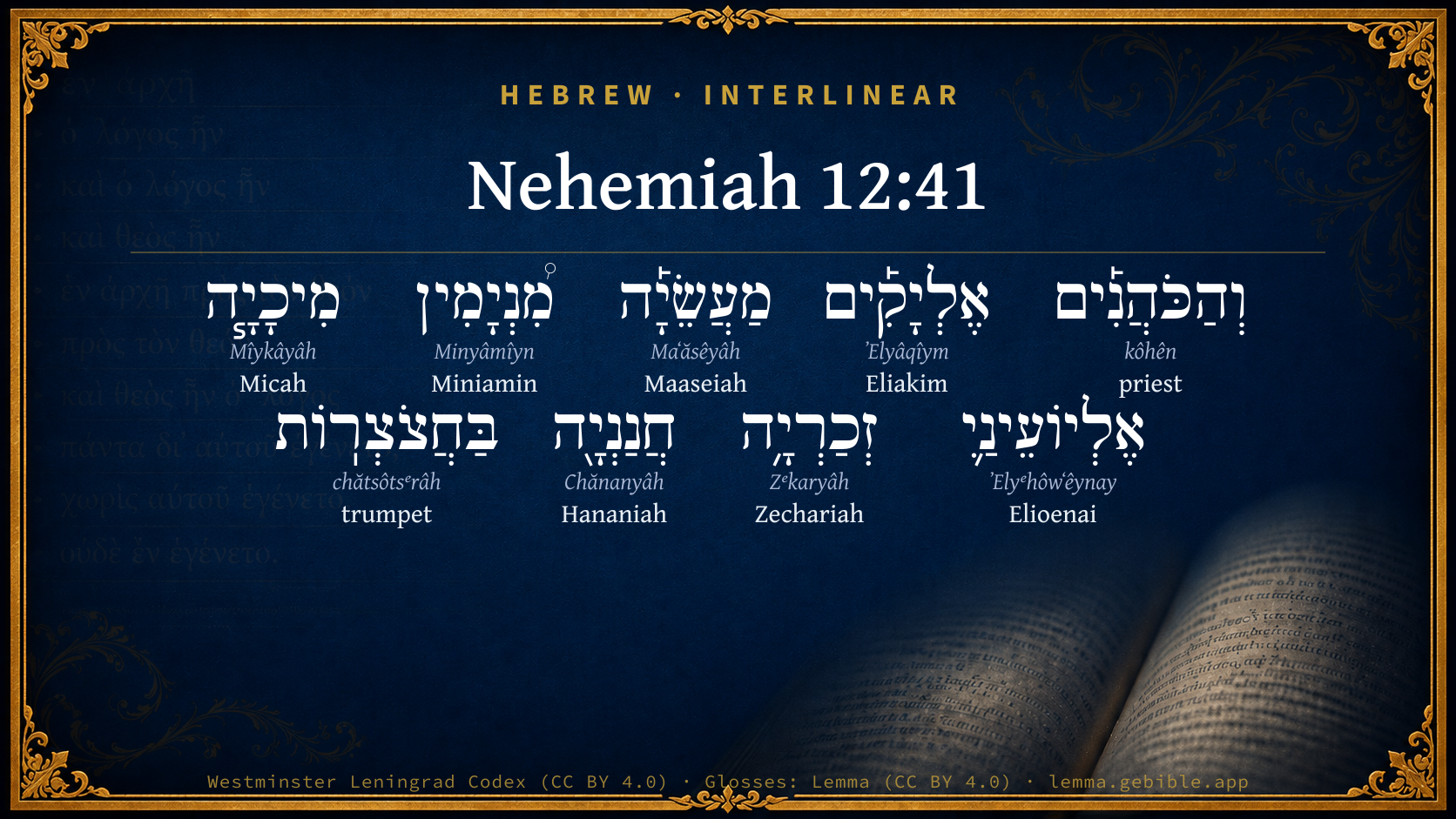
Hebrew (Westminster Leningrad Codex) Nehemiah 12:41 appears in the Hebrew Old Testament. The text above is from the Westminster Leningrad Codex. Each word links to its Strong’s number, a concise gloss, and parsing drawn from the Open Scriptures Hebrew Bible morphology. Click any word for its full Brown-Driver-Briggs (BDB) entry.
Download image
Cite this verse

Nehemiah 12:41 (World English Bible). Public Domain. Lemma interlinear Bible study tool, https://lemma.gebible.app/v/nehemiah/12/41.

Show BibTeX & RIS
BibTeX
RIS
English Translation
and the priests, Eliakim, Maaseiah, Miniamin, Micaiah, Elioenai, Zechariah, and Hananiah, with trumpets;
World English Bible · Public Domain
Download a study sheet

One document with this verse’s original text, its word-by-word gloss line, the meaning frame, cross-references with their text, attributed commentary, and full source and license credits — printable, and it pastes into notes with its structure intact.

This verse Autodidact and up

Study sheet (.html) Plain text (.txt)

A passage Seminary Student

Up to 50 verses in one chapter. A passage sheet keeps up to 6 commentary sources and 12 cross-references per verse, in the order this page ranks them, and says so on the sheet whenever that leaves anything out. Ask for a single verse and you get the Autodidact verse sheet above.

Everything on this page stays free to read, with no account — the sheet is a download of what is already on screen, not access to it.

Want to remove ads? Support Godless Engineer
Compare translations 3

The same verse in 3 English versions, stacked beneath the original-language interlinear above. Click any original word for its lexicon entry.

Each is an independent rendering of the whole verse — the interlinear is not word-aligned to these translations.

Highlighted words mark where these versions differ — a whole-verse word diff, not a word-by-word alignment.

  • World English Bible Public Domain
    and the priests, Eliakim, Maaseiah, Miniamin, Micaiah, Elioenai, Zechariah, and Hananiah, with trumpets;
  • King James Version Public Domain
    And the priests; Eliakim, Maaseiah, Miniamin, Michaiah, Elioenai, Zechariah, and Hananiah, with trumpets;
  • unfoldingWord Literal Text CC BY-SA 4.0
    and the priests, Eliakim, Maaseiah, Miniamin, Micaiah, Elioenai, Zechariah, Hananiah, with trumpets;

unfoldingWord Literal Text — © unfoldingWord, licensed CC BY-SA 4.0. Word-aligned USFM3 via Door43 (git.door43.org/unfoldingWord/en_ult).

Versions to compare (up to 4)

3 of 4 selected

Show all 18 translations

Every available English version of this verse, each an independent rendering of the whole verse.

  • World English Bible Public Domain
    and the priests, Eliakim, Maaseiah, Miniamin, Micaiah, Elioenai, Zechariah, and Hananiah, with trumpets;
  • Berean Standard Bible Public Domain
    as well as the priests with their trumpets—Eliakim, Maaseiah, Miniamin, Micaiah, Elioenai, Zechariah, and Hananiah—
  • Majority Standard Bible Public Domain
    as well as the priests with their trumpets—Eliakim, Maaseiah, Miniamin, Micaiah, Elioenai, Zechariah, and Hananiah—
  • King James Version Public Domain
    And the priests; Eliakim, Maaseiah, Miniamin, Michaiah, Elioenai, Zechariah, and Hananiah, with trumpets;
  • American Standard Version (1901) Public Domain
    and the priests, Eliakim, Maaseiah, Miniamin, Micaiah, Elioenai, Zechariah, and Hananiah, with trumpets;
  • Revised Version (1885) Public Domain
    and the priests, Eliakim, Maaseiah, Miniamin, Micaiah, Elioenai, Zechariah, and Hananiah, with trumpets;
  • Geneva Bible (1599) Public Domain
    The Priests also, Eliakim, Maaseiah, Miniamin, Michaiah, Elioenai, Zechariah, Hananiah, with trumpets,
  • Douay-Rheims (1899) Public Domain
    And Maasia, and Semeia, and Eleazar, and Azzi, and Johanan, and Melchia, and Elam, and Ezer. And the singers sung loud, and Jezraia was their overseer:
  • Young's Literal Translation Public Domain
    and the priests, Eliakim, Maaseiah, Miniamin, Michaiah, Elioenai, Zechariah, Hananiah, with trumpets,
  • Literal Standard Version CC BY-SA 4.0
    and the priests, Eliakim, Maaseiah, Miniamin, Michaiah, Elioenai, Zechariah, Hananiah, with trumpets,
  • Unlocked Literal Bible CC BY-SA 4.0
    Then the priests took their place: Eliakim, Maaseiah, Miniamin, Micaiah, Elioenai, Zechariah, and Hananiah, with the trumpets,
  • unfoldingWord Literal Text CC BY-SA 4.0
    and the priests, Eliakim, Maaseiah, Miniamin, Micaiah, Elioenai, Zechariah, Hananiah, with trumpets;
  • Darby Bible Public Domain
    and the priests, Eliakim, Maaseiah, Miniamin, Micaiah, Elioenai, Zechariah, Hananiah, with trumpets;
  • World Messianic Bible Public Domain
    and the priests, Eliakim, Maaseiah, Miniamin, Micaiah, Elioenai, Zechariah, and Hananiah, with shofars;
  • Webster's Bible Public Domain
    And the priests; Eliakim, Maaseiah, Miniamin, Michaiah, Elioenai, Zechariah, and Hananiah, with trumpets;
  • Free Bible Version CC BY-SA 4.0
    along with the priests blowing their trumpets: Eliakim, Maaseiah, Miniamin, Micaiah, Elioenai, Zechariah, and Hananiah.
  • Bible in Basic English Public Domain
    And the priests; Eliakim, Maaseiah, Miniamin, Micaiah, Elioenai, Zechariah, and Hananiah, with wind instruments;
  • JPS Tanakh (1917) Public Domain
    and the priests, Eliakim, Maaseiah, Miniamin, Micaiah, Elioenai, Zechariah, and Hananiah, with trumpets;

Literal Standard Version (2020), Covenant Press — licensed CC BY-SA 4.0. Text via the HelloAO Bible API (eBible.org). Unlocked Literal Bible (unfoldingWord) — licensed CC BY-SA 4.0. Text via the HelloAO Bible API (eBible.org). unfoldingWord Literal Text — © unfoldingWord, licensed CC BY-SA 4.0. Word-aligned USFM3 via Door43 (git.door43.org/unfoldingWord/en_ult). Free Bible Version, Dr. Jonathan Gallagher — licensed CC BY-SA 4.0. Text via the HelloAO Bible API (eBible.org).

Word by word

More ways to search: Search by grammar → Find every occurrence → Compare this word →

Practice this passage: Drill this verse → Learn its vocabulary →

About this verse

These counts appear in no published source. They are computed here, from the morphology-tagged text and Lemma’s own curated glosses. What Lemma adds →

9
words
9
distinct lemmas
Historical
section

Notable vocabulary

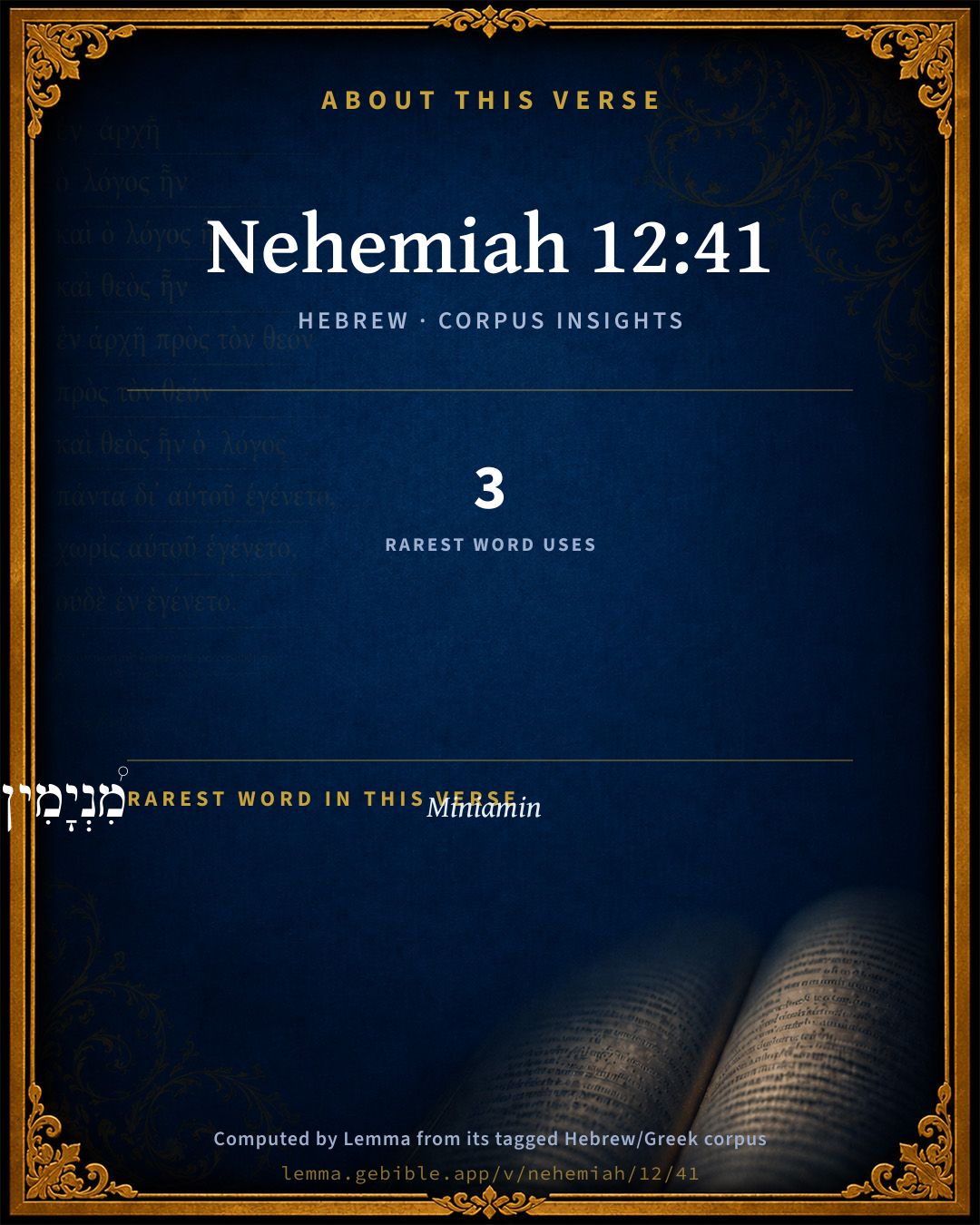
The rarest word here is מִ֠נְיָמִין Miniamin H4509 — appearing just 3 times in the whole Hebrew Bible.

Shared distinctive vocabulary

מִ֠נְיָמִין Miniamin H4509 occurs in 3 verses of the Hebrew Bible. Also found in:

Grammatical profile

  • 9 nouns
Hebrew and Greek witnesses Masoretic Hebrew ↔ Greek Septuagint

The same verse in the two great witnesses to the Old Testament, shown verse-for-verse.

These are two independent witnesses, not word-aligned to each other, and the Septuagint is shown in lemma (dictionary) form.

Hebrew Nehemiah 12:41 Masoretic · Westminster Leningrad Codex

וְהַכֹּהֲנִ֡ים אֶלְיָקִ֡ים מַעֲשֵׂיָ֡ה מִ֠נְיָמִין מִיכָיָ֧ה אֶלְיוֹעֵינַ֛י זְכַרְיָ֥ה חֲנַנְיָ֖ה בַּחֲצֹצְרֽוֹת

and the priests, Eliakim, Maaseiah, Miniamin, Micaiah, Elioenai, Zechariah, and Hananiah, with trumpets;

World English Bible · Public Domain

Greek LXX Structure differs

The Septuagint has no separate book of Nehemiah. Its Greek text is the second half of Esdras B (2 Esdras), chapters 11–23; Ezra is the first half (1–10).

A verse-for-verse comparison isn’t shown here because the chapters and verses don’t line up. Switch to the LXX edition with the MT / LXX toggle above to read the Greek directly.

Hebrew: Westminster Leningrad Codex (CC BY 4.0). Greek: Septuagint (public domain); English from a public-domain English Septuagint. How the Septuagint differs from the Hebrew →

Commentary

Notes on Nehemiah 12:41 from classic Christian and Jewish commentators (each source and its license shown beneath its notes). The classic Christian expositions comment on the surrounding passage and are grouped to its opening verse, so a note may address several verses; the Jewish commentaries on the Tanakh (Rashi and others) are per-verse, so they appear only where the commentator wrote on this verse.

Lemma curates 59 commentaries, every one of them public domain or Creative Commons licensed, each selected and text-cleaned for this edition rather than reprinted as found. About our sources →

Ellicott's Commentary for English Readers

(41) And the priests.—Like the names of the priests and Levites in Neh_12:35, these are personal; not to be found in the former lists.

A Bible Commentary for English Readers, edited by Charles John Ellicott (1878–1897) — public domain. Text from a community e-Sword module.

The Cambridge Bible for Schools and Colleges

gen. ed. J. J. S. Perowne

41. and the priests] These seven names correspond to the ‘certain of the priests’ sons with trumpets’ in Neh_12:35, where the names have dropped out.

The Cambridge Bible for Schools and Colleges (gen. ed. J. J. S. Perowne; Cambridge University Press, 1878–1918) — public domain. Text from a community e-Sword module.

John Gill's Exposition

And at that time were some appointed over the chamber for the treasuries,.... On the selfsame day the dedication was; while the people were in a good disposition, and a suitable frame for such service, certain persons from among the priests were appointed to be overseers of the chambers fixed upon for treasuries, to lay up safe in them the following things, and take care of them, that they were put to the use for which they were designed:

for the offerings, for the first fruits, and for the tithes, to gather into them out of the fields of the cities the portions of the law for the priests and Levites; what by the law of God were assigned them for their maintenance, and which the people had lately bound themselves to bring in, Neh 10:35,

for Judah rejoiced for the priests, and for the Levites that waited; at the temple, and performed their services there; they were so pleased with their ministrations that day, that they were determined to take care of them, and provide well for them, and that nothing should be wanting to them, enjoined by the law of God, and that they might not be obliged to dwell in fields and villages for the sake of their living, Neh 12:28.

John Gill's Exposition of the Whole Bible (1746–1763) — public domain (CC PDM 1.0). Text via the HelloAO Bible API.

The Pulpit Commentary

And the priests, Eliakim, etc. These names are probably personal. With a single exception, they are absent from the lists of priestly families. (Neh_10:2-8 Neh_12:12-21)

The Pulpit Commentary (1880–1919), ed. H.D.M. Spence-Jones & Joseph S. Exell — public domain. Text from a community e-Sword module.

Rashi

Rabbi Shlomo Yitzchaki (Rashi)

with the trumpets They sounded the trumpets out of their joy.

Rashi on the Tanakh — English translations: “The Judaica Press complete Tanach with Rashi, translated by A. J. Rosenberg” (CC BY 4.0); “Pentateuch with Rashi's commentary by M. Rosenbaum and A.M. Silbermann, 1929-1934” (public domain); “The Metsudah Tanach series, Lakewood, N.J” (CC BY 4.0); and “The Book of Joshua, Metsudah Publications, 1997” (CC BY 4.0). Text via Sefaria.

Lesson kit

Teaching starters — assembled from the data on this page, not authored interpretation. Every prompt links to the verse data it draws on. Edit before teaching.

Nehemiah, in the Historical, opens this verse with 9 words (9 distinct Hebrew lemmas). Its most distinctive word is Minyâmîyn (“Miniamin”). A historical commentator’s framing appears above. Read the whole chapter for the surrounding context.

Discussion questions

  1. What does “Miniamin” (Minyâmîyn) contribute to the verse as a whole?
  2. How does 2 Chronicles 31:15, which shares the word «Miniamin», read alongside this verse?
  3. These translations render this verse differently. What is at stake in choosing one wording over another?
  4. Compare how Ellicott's Commentary for English Readers and The Cambridge Bible for Schools and Colleges read this verse. Where do they agree or differ?

Things to notice

Reading settings

Reading text

Shown beneath each verse's original-language words.

Old Testament
Old Testament edition

Read the OT as the Masoretic Hebrew (MT) or the Greek Septuagint (LXX).

English shown for the Greek Septuagint (in the Hebrew ↔ Greek comparison).

Comparing translations? Open the Compare panel on any verse page to stack up to four side by side.