
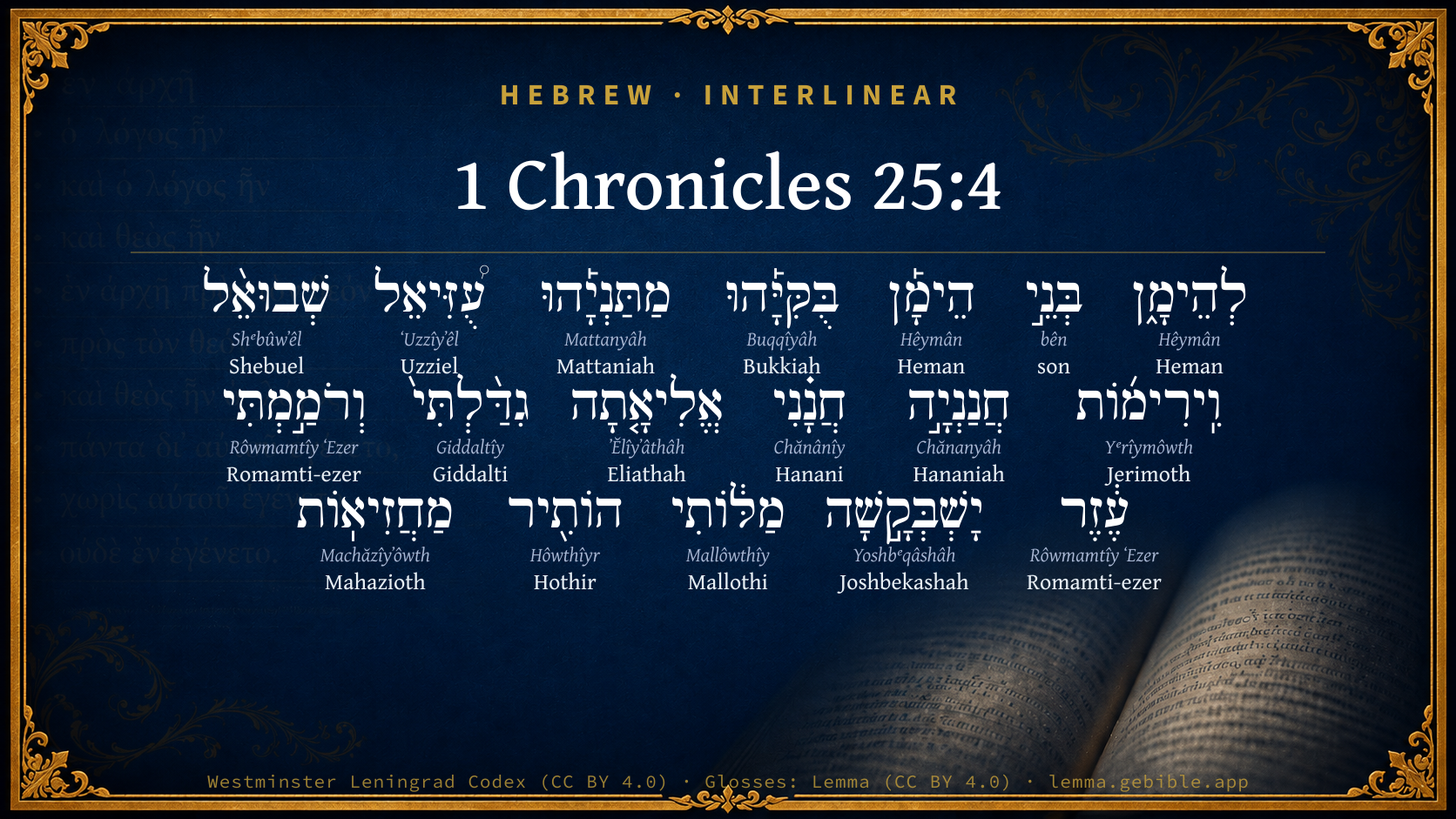
1 Chronicles 25:4

Hebrew (Westminster Leningrad Codex) 1 Chronicles 25:4 appears in the Hebrew Old Testament. The text above is from the Westminster Leningrad Codex. Each word links to its Strong’s number, a concise gloss, and parsing drawn from the Open Scriptures Hebrew Bible morphology. Click any word for its full Brown-Driver-Briggs (BDB) entry.
Download image
Cite this verse

1 Chronicles 25:4 (World English Bible). Public Domain. Lemma interlinear Bible study tool, https://lemma.gebible.app/v/1-chronicles/25/4.

Show BibTeX & RIS
BibTeX
RIS
English Translation
Of Heman; the sons of Heman: Bukkiah, Mattaniah, Uzziel, Shebuel, and Jerimoth, Hananiah, Hanani, Eliathah, Giddalti, and Romamti-ezer, Joshbekashah, Mallothi, Hothir, Mahazioth.
World English Bible · Public Domain
Highlights Full analysis ↓
Download a study sheet

One document with this verse’s original text, its word-by-word gloss line, the meaning frame, cross-references with their text, attributed commentary, and full source and license credits — printable, and it pastes into notes with its structure intact.

This verse Autodidact and up

Study sheet (.html) Plain text (.txt)

A passage Seminary Student

Up to 50 verses in one chapter. A passage sheet keeps up to 6 commentary sources and 12 cross-references per verse, in the order this page ranks them, and says so on the sheet whenever that leaves anything out. Ask for a single verse and you get the Autodidact verse sheet above.

Everything on this page stays free to read, with no account — the sheet is a download of what is already on screen, not access to it.

Want to remove ads? Support Godless Engineer
Compare translations 3

The same verse in 3 English versions, stacked beneath the original-language interlinear above. Click any original word for its lexicon entry.

Each is an independent rendering of the whole verse — the interlinear is not word-aligned to these translations.

Highlighted words mark where these versions differ — a whole-verse word diff, not a word-by-word alignment.

  • World English Bible Public Domain
    Of Heman; the sons of Heman: Bukkiah, Mattaniah, Uzziel, Shebuel, and Jerimoth, Hananiah, Hanani, Eliathah, Giddalti, and Romamti-ezer, Joshbekashah, Mallothi, Hothir, Mahazioth.
  • King James Version Public Domain
    Of Heman: the sons of Heman: Bukkiah, Mattaniah, Uzziel, Shebuel, and Jerimoth, Hananiah, Hanani, Eliathah, Giddalti, and Romamtiezer, Joshbekashah, Mallothi, Hothir, and Mahazioth:
  • unfoldingWord Literal Text CC BY-SA 4.0
    Of Heman, the sons of Heman: Bukkiah, Mattaniah, Uzziel, Shubael, and Jerimoth; Hananiah, Hanani, Eliathah, Giddalti, and Romamti Ezer; Joshbekashah, Mallothi, Hothir, Mahazioth.

unfoldingWord Literal Text — © unfoldingWord, licensed CC BY-SA 4.0. Word-aligned USFM3 via Door43 (git.door43.org/unfoldingWord/en_ult).

Versions to compare (up to 4)

3 of 4 selected

Show all 18 translations

Every available English version of this verse, each an independent rendering of the whole verse.

  • World English Bible Public Domain
    Of Heman; the sons of Heman: Bukkiah, Mattaniah, Uzziel, Shebuel, and Jerimoth, Hananiah, Hanani, Eliathah, Giddalti, and Romamti-ezer, Joshbekashah, Mallothi, Hothir, Mahazioth.
  • Berean Standard Bible Public Domain
    From the sons of Heman: Bukkiah, Mattaniah, Uzziel, Shebuel, Jerimoth, Hananiah, Hanani, Eliathah, Giddalti, Romamti-ezer, Joshbekashah, Mallothi, Hothir, and Mahazioth.
  • Majority Standard Bible Public Domain
    From the sons of Heman: Bukkiah, Mattaniah, Uzziel, Shebuel, Jerimoth, Hananiah, Hanani, Eliathah, Giddalti, Romamti-ezer, Joshbekashah, Mallothi, Hothir, and Mahazioth.
  • King James Version Public Domain
    Of Heman: the sons of Heman: Bukkiah, Mattaniah, Uzziel, Shebuel, and Jerimoth, Hananiah, Hanani, Eliathah, Giddalti, and Romamtiezer, Joshbekashah, Mallothi, Hothir, and Mahazioth:
  • American Standard Version (1901) Public Domain
    Of Heman; the sons of Heman: Bukkiah, Mattaniah, Uzziel, Shebuel, and Jerimoth, Hananiah, Hanani, Eliathah, Giddalti, and Romamti-ezer, Joshbekashah, Mallothi, Hothir, Mahazioth.
  • Revised Version (1885) Public Domain
    Of Heman: the sons of Heman; Bukkiah, Mattaniah, Uzziel, Shebuel, and Jerimoth, Hananiah, Hanani, Eliathah, Giddalti, and Romamtiezer, Joshbekashah, Mallothi, Hothir, Mahazioth:
  • Geneva Bible (1599) Public Domain
    Of Heman, the sonnes of Heman, Bukkiah, Mattaniah, Vzziel, Shebuel, and Ierimoth, Hananiah, Hanani, Eliathah, Giddalti, and Romamtiezer, Ioshbekashah, Mallothi, Hothir, and Mahazioth.
  • Douay-Rheims (1899) Public Domain
    Of Heman also: the sons of Heman, Bocciau, Mathaniau, Oziel, Subuel, and Jerimoth, Hananias, Hanani, Eliatha, Geddelthi, and Romemthiezer, and Jesbacassa, Mellothi, Othir, Mahazioth:
  • Young's Literal Translation Public Domain
    Of Heman: sons of Heman: Bukkiah, Mattaniah, Uzziel, Shebuel, and Jerimoth, Hananiah, Hanani, Eliathah, Giddalti, and Romamti-Ezer, Joshbekashah, Mallothi, Hothir, Mahazioth;
  • Literal Standard Version CC BY-SA 4.0
    Of Heman, sons of Heman: Bukkiah, Mattaniah, Uzziel, Shebuel, and Jerimoth, Hananiah, Hanani, Eliathah, Giddalti, and Romamti-Ezer, Joshbekashah, Mallothi, Hothir, Mahazioth;
  • Unlocked Literal Bible CC BY-SA 4.0
    From the sons of Heman: Bukkiah, Mattaniah, Uzziel, Shubael, and Jerimoth, Hananiah, Hanani, Eliathah, Giddalti, Romamti-Ezer, Joshbekashah, Mallothi, Hothir, and Mahazioth.
  • unfoldingWord Literal Text CC BY-SA 4.0
    Of Heman, the sons of Heman: Bukkiah, Mattaniah, Uzziel, Shubael, and Jerimoth; Hananiah, Hanani, Eliathah, Giddalti, and Romamti Ezer; Joshbekashah, Mallothi, Hothir, Mahazioth.
  • Darby Bible Public Domain
    Of Heman, the sons of Heman: Bukkijah, Mattaniah, Uzziel, Shebuel, and Jerimoth, Hananiah, Hanani, Eliathah, Giddalti, and Romamti-ezer, Joshbekashah, Mallothi, Hothir, Mahazioth:
  • World Messianic Bible Public Domain
    Of Heman, the sons of Heman: Bukkiah, Mattaniah, Uzziel, Shebuel, Jerimoth, Hananiah, Hanani, Eliathah, Giddalti, Romamti-Ezer, Joshbekashah, Mallothi, Hothir, and Mahazioth.
  • Webster's Bible Public Domain
    Of Heman: the sons of Heman; Bukkiah, Mattaniah, Uzziel, Shebuel, and Jerimoth, Hananiah, Hanani, Eliathah, Giddalti, and Romamti-ezer, Joshbekashah, Mallothi, Hothir, and Mahazioth:
  • Free Bible Version CC BY-SA 4.0
    From the sons of Heman: Bukkiah, Mattaniah, Uzziel, Shebuel, Jerimoth, Hananiah, Hanani, Eliathah, Giddalti, Romamti-ezer, Joshbekashah, Mallothi, Hothir, and Mahazioth.
  • Bible in Basic English Public Domain
    Of Heman, the sons of Heman: Bukkiah, Mattaniah, Uzziel, Shebuel and Jerimoth, Hananiah, Hanani, Eliathah, Giddalti and Romamti-ezer, Joshbekashah, Mallothi, Hothir, Mahazioth;
  • JPS Tanakh (1917) Public Domain
    Of Heman: the sons of Heman: Bukkiah, Mattaniah, Uzziel, Shebuel, and Jerimoth, Hananiah, Hanani, Eliathah, Giddalti, and Romamti-ezer, Joshbekashah, Mallothi, Hothir, Mahazioth;

Literal Standard Version (2020), Covenant Press — licensed CC BY-SA 4.0. Text via the HelloAO Bible API (eBible.org). Unlocked Literal Bible (unfoldingWord) — licensed CC BY-SA 4.0. Text via the HelloAO Bible API (eBible.org). unfoldingWord Literal Text — © unfoldingWord, licensed CC BY-SA 4.0. Word-aligned USFM3 via Door43 (git.door43.org/unfoldingWord/en_ult). Free Bible Version, Dr. Jonathan Gallagher — licensed CC BY-SA 4.0. Text via the HelloAO Bible API (eBible.org).

Word by word

More ways to search: Search by grammar → Find every occurrence → Compare this word →

Practice this passage: Drill this verse → Learn its vocabulary →

בֻּקִּיָּ֡הוּ
Buqqîyâh
H1232
“Bukkiah”
Noun, Proper
Part of Speech
Noun
Type
Proper
Full BDB Definition

Origin: from H1238 and H3050

TWOT: None

Bukkiah = "Jehovah has emptied" - a Kohathite Levite, of the sons of Heman, one of the musicians in the temple
  1. לְהֵימָ֑ן Hêymân H1968 “to/for · Heman” Preposition + Noun, Proper
  2. בְּנֵ֣י bên H1121 “sons of” Noun, Common, Masculine, Plural, Construct
  3. הֵימָ֡ן Hêymân H1968 “Heman” Noun, Proper
  4. מַתַּנְיָ֡הוּ Mattanyâh H4983 “Mattaniah” Noun, Proper
  5. עֻ֠זִּיאֵל ʻUzzîyʼêl H5816 “Uzziel” Noun, Proper
  6. שְׁבוּאֵ֨ל Shᵉbûwʼêl H7619 “Shebuel” Noun, Proper
  7. וִֽירִימ֜וֹת Yᵉrîymôwth H3406 “and · Jerimoth” Conjunction + Noun, Proper
  8. חֲנַנְיָ֣ה Chănanyâh H2608 “Hananiah” Noun, Proper
  9. חֲנָ֗נִי Chănânîy H2607 “Hanani” Noun, Proper
  10. אֱלִיאָ֤תָה ʼĔlîyʼâthâh H448 “Eliathah” Noun, Proper
  11. גִדַּ֨לְתִּי֙ Giddaltîy H1437 “Giddalti” Noun, Proper
  12. וְרֹמַ֣מְתִּי Rôwmamtîy ʻEzer H7320 “and · Romamti-ezer” Conjunction + Noun, Proper
  13. עֶ֔זֶר Rôwmamtîy ʻEzer H7320 “Romamti-ezer” Noun, Proper
  14. יָשְׁבְּקָ֣שָׁה Yoshbᵉqâshâh H3436 “Joshbekashah” Noun, Proper
  15. מַלּ֔וֹתִי Mallôwthîy H4413 “Mallothi” Noun, Proper
  16. הוֹתִ֖יר Hôwthîyr H1956 “Hothir” Noun, Proper
  17. מַחֲזִיאֽוֹת Machăzîyʼôwth H4238 “Mahazioth” Noun, Proper

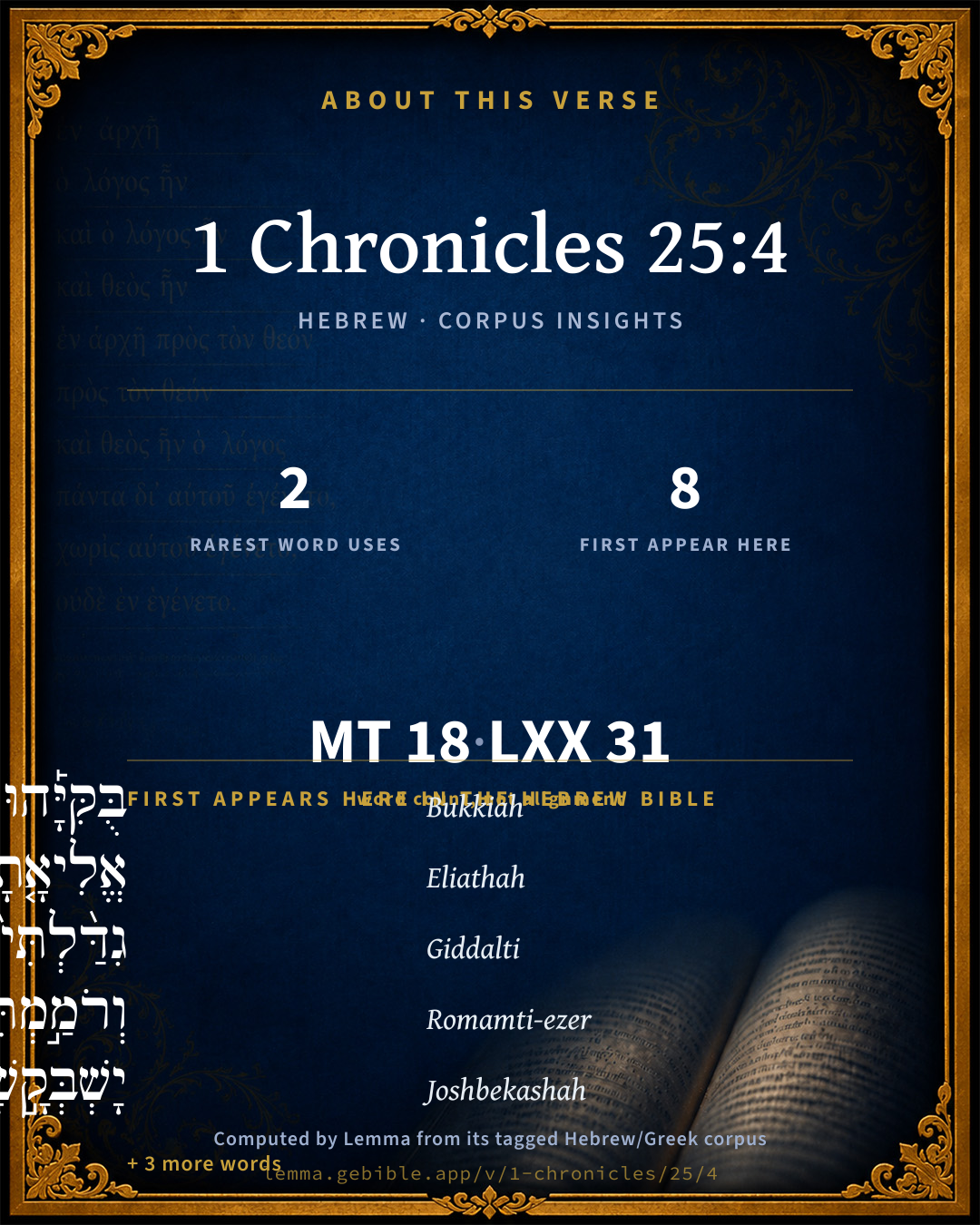
About this verse

These counts appear in no published source. They are computed here, from the morphology-tagged text and Lemma’s own curated glosses. What Lemma adds →

18
words
16
distinct lemmas
Historical
section

Notable vocabulary

The rarest word here is בֻּקִּיָּ֡הוּ Bukkiah H1232 — appearing just 2 times in the whole Hebrew Bible.

First appearance in Scripture

These words make their first canonical appearance in the Hebrew Bible here:

  • בֻּקִּיָּ֡הוּ Bukkiah H1232
  • אֱלִיאָ֤תָה Eliathah H448
  • גִדַּ֨לְתִּי֙ Giddalti H1437
  • וְרֹמַ֣מְתִּי Romamti-ezer H7320
  • יָשְׁבְּקָ֣שָׁה Joshbekashah H3436
  • מַלּ֔וֹתִי Mallothi H4413
  • הוֹתִ֖יר Hothir H1956
  • מַחֲזִיאֽוֹת Mahazioth H4238

Shared distinctive vocabulary

בֻּקִּיָּ֡הוּ Bukkiah H1232 occurs in 2 verses of the Hebrew Bible. Also found in:

Grammatical profile

  • 18 nouns

Repetition

Words recur within this verse — often emphatic in Hebrew:

  • לְהֵימָ֑ן Heman H1968 ×2
  • וְרֹמַ֣מְתִּי Romamti-ezer H7320 ×2

Hebrew & Septuagint length

In English translation the verse runs 22 words from the Hebrew and 35 from the Septuagint (LXX English) — the Septuagint runs noticeably longer here. See the side-by-side →

A rough comparison of the two English renderings, which tokenize alike — not a word-level alignment.

Word counts can differ between the Hebrew and the Greek without any difference in meaning — e.g. the Hebrew direct-object marker אֵת has no separate Greek word, and Greek often adds the article ὁ.

In the original languages it is 18 Hebrew tokens and 31 Greek tokens — but the two are counted differently (Hebrew bundles its prefixes and suffixes into one token; the Greek is in lemma form), so that isn’t a like-for-like length.

Cross-references

12

Topical passages linked to 1 Chronicles 25:4 in the Treasury of Scripture Knowledge — connected by theme and wording, ordered by reader-vote popularity; previews shown in the World English Bible.

  • 1 Chronicles 6:33 These are those who waited, and their sons. Of the sons of the Kohathites: Heman the singer, the son of Joel, the son of Samuel,
  • 1 Chronicles 15:17 So the Levites appointed Heman the son of Joel; and of his brothers, Asaph the son of Berechiah; and of the sons of Merari their brothers, Ethan the son of Kushaiah;
  • 1 Chronicles 15:19 So the singers, Heman, Asaph, and Ethan, [were appointed] with cymbals of brass to sound aloud;
  • 1 Chronicles 16:41–42 and with them Heman and Jeduthun, and the rest who were chosen, who were mentioned by name, to give thanks to Yahweh, because his loving kindness endures forever;
  • 1 Chronicles 24:20 Of the rest of the sons of Levi: of the sons of Amram, Shubael; of the sons of Shubael, Jehdeiah.
  • 1 Chronicles 24:24 The sons of Uzziel, Micah; of the sons of Micah, Shamir.
  • 1 Chronicles 24:30 The sons of Mushi: Mahli, and Eder, and Jerimoth. These were the sons of the Levites after their fathers' houses.
  • 1 Chronicles 25:22 for the fifteenth to Jeremoth, his sons and his brothers, twelve:
  • 1 Chronicles 25:28 for the one and twentieth to Hothir, his sons and his brothers, twelve:
  • 1 Chronicles 25:30 for the three and twentieth to Mahazioth, his sons and his brothers, twelve:
  • Psalms 88:1 Yahweh, the God of my salvation, I have cried day and night before you.
  • 1 Chronicles 25:20 for the thirteenth, Shubael, his sons and his brothers, twelve:

Cross-references courtesy of OpenBible.info (CC BY 4.0).

Hebrew and Greek witnesses Masoretic Hebrew ↔ Greek Septuagint

The same verse in the two great witnesses to the Old Testament, shown verse-for-verse.

Here the Septuagint runs noticeably longer than the Hebrew — LXX2012 (modern English Septuagint) 35 words vs World English Bible 22. A rough length comparison of the two English translations, not a word-level alignment — read both below.

These are two independent witnesses, not word-aligned to each other, and the Septuagint is shown in lemma (dictionary) form.

Hebrew 1 Chronicles 25:4 Masoretic · Westminster Leningrad Codex

לְהֵימָ֑ן בְּנֵ֣י הֵימָ֡ן בֻּקִּיָּ֡הוּ מַתַּנְיָ֡הוּ עֻ֠זִּיאֵל שְׁבוּאֵ֨ל וִֽירִימ֜וֹת חֲנַנְיָ֣ה חֲנָ֗נִי אֱלִיאָ֤תָה גִדַּ֨לְתִּי֙ וְרֹמַ֣מְתִּי עֶ֔זֶר יָשְׁבְּקָ֣שָׁה מַלּ֔וֹתִי הוֹתִ֖יר מַחֲזִיאֽוֹת

Of Heman; the sons of Heman: Bukkiah, Mattaniah, Uzziel, Shebuel, and Jerimoth, Hananiah, Hanani, Eliathah, Giddalti, and Romamti-ezer, Joshbekashah, Mallothi, Hothir, Mahazioth.

World English Bible · Public Domain

Greek LXX 1 Chronicles 25:4 Septuagint · lemma form

ὁ αιμανι υἱός αιμαν βουκιας καί μανθανιας καί αζαραηλ καί σουβαηλ καί ιεριμωθ καί ανανιας καί ανανι καί ηλιαθα καί γοδολλαθι καί ρωμεμθι καί ιεσβακασα καί μαλληθι καί ωθηρι καί μεαζωθ

To Aeman were reckoned the sons of Aeman, Bukias, and Matthanias, and Oziel, and Subael, and Jerimoth, and Ananias, and Anan, and Heliatha, and Godollathi, and Rometthiezer, and Jesbasaca, and Mallithi, and Otheri, and Meazoth.

LXX2012 (modern English Septuagint) · Public Domain

On this verse, Ellicott's Commentary for English Readers discusses the Septuagint’s reading. Read the note in Commentary ↓

Hebrew: Westminster Leningrad Codex (CC BY 4.0). Greek: Septuagint (public domain); English from LXX2012 (modern English Septuagint) (Public Domain). How the Septuagint differs from the Hebrew →

Commentary

Notes on 1 Chronicles 25:4 from classic Christian and Jewish commentators (each source and its license shown beneath its notes). The classic Christian expositions comment on the surrounding passage and are grouped to its opening verse, so a note may address several verses; the Jewish commentaries on the Tanakh (Rashi and others) are per-verse, so they appear only where the commentator wrote on this verse.

Lemma curates 59 commentaries, every one of them public domain or Creative Commons licensed, each selected and text-cleaned for this edition rather than reprinted as found. About our sources →

Ellicott's Commentary for English Readers

(4) Of Heman.—Rather, To Reman: the sons of Heman were, &c. Fourteen names of Hemanite leaders are given. Curiously enough, the last six, excluding the peculiar “Joshbekashah,” form, as they stand, a complete poetical couplet, which may be rendered:

“God has come; I have exalted and extolled the help;

I have spoken abundance of visions.”

Such words are very suitable in the mouth of a seer, as Heman is called in the next verse, but the arrangement of the names in this order is perhaps only a mnemonic device

Uzziel.—Power of God (Exo_6:18); called “Azareel” in 1Ch_25:18 ( God hath helped, 1Ch_12:6). The words differ in Hebrew by one letter only. The Syriac has “Uzziel” (Azael) in both places. But the difference appears in the LXX. and Vulg.

Shebuel.—In 1Ch_25:20, “Shubael,” which the LXX. reads in both places. The Syriac and Vulg. keep the distinction. (Comp. 1Ch_24:20.)

Giddalti, and Romamti-ezer.—That is, perhaps, Giddalti-ezer and Romamti-ezer. But in 1Ch_25:29 “Giddalti” occurs again without any such addition, and the name as it stands may be compared with “Mallothi.” The two verbs, giddaltî and romamtî, occur together in Isa_1:2 : “1 have nourished and brought up.”

A Bible Commentary for English Readers, edited by Charles John Ellicott (1878–1897) — public domain. Text from a community e-Sword module.

The Cambridge Bible for Schools and Colleges

gen. ed. J. J. S. Perowne

4. Heman] See 1Ch_15:17, note.

Uzziel] In 1Ch_25:18 “Azarel.” (R.V.) The variation between the two words when written with Hebrew consonants is small. Cp. note on 2Ch_26:1 (“Uzziah” and “Azariah”).

Shebuel] In 1Ch_25:20 “Shubael.”

Jerimoth] In 1Ch_25:22 “Jeremoth.”

Hananiah, Hanani] Most Hebrew names are significant, and many can be used as mottoes. In this place the Chronicler (or the authority from whom he drew the list) has so arranged the names as to suggest a sentence (extending to the end of the verse) which runs somewhat as follows:—Have mercy upon me, O Lord, have mercy upon me; I have magnified and exalted [thy] help; I spake of it sitting in affliction; grant us still [thy] visions.

The Cambridge Bible for Schools and Colleges (gen. ed. J. J. S. Perowne; Cambridge University Press, 1878–1918) — public domain. Text from a community e-Sword module.

John Gill's Exposition

Of Heman: the sons of Heman,.... The third chief singer:

Bukkiah, Mattaniah, Uzziel; the same with Azareel, Ch1 25:18.

Shebuel; called Shubael, Ch1 25:20.

and Jerimoth, Hananiah, Hanani, Eliathah, Giddalti, and Romamtiezer, Joshbekashah, Mallothi, Hothir, and Mahazioth; in all fourteen, to whom came the sixth, ninth, eleventh, fifteenth, sixteenth, eighteenth, twentieth, twenty second, twenty fourth, seventeenth, nineteenth, twentieth, and twenty third lots, Ch1 25:13.

John Gill's Exposition of the Whole Bible (1746–1763) — public domain (CC PDM 1.0). Text via the HelloAO Bible API.

The Pulpit Commentary

The two names Uzziel and Shebuel, in this verse, reappear respectively in vers. 18, 20, as Azareel and Shubael. It is remarkable that the ninth and tenth names of this list, with the twelfth, thirteenth, and fourteenth, when put together, run into two lines of verse, which may be translated, "These bestowed great and high help; I have abundantly uttered oracles." Ewald suggests that these may be the commencing lines of some ancient prophet"s oracles (Ewald, "Lehrbueh der H. Spr.," 274, S. 672, 7th edit., cited by Keil).

The Pulpit Commentary (1880–1919), ed. H.D.M. Spence-Jones & Joseph S. Exell — public domain. Text from a community e-Sword module.

Keil & Delitzsch

C. F. Keil & F. Delitzsch

Of Heman: the sons of Heman,.... The third chief singer:

Bukkiah, Mattaniah, Uzziel; the same with Azareel, Ch1 25:18.

Shebuel; called Shubael, Ch1 25:20.

and Jerimoth, Hananiah, Hanani, Eliathah, Giddalti, and Romamtiezer, Joshbekashah, Mallothi, Hothir, and Mahazioth; in all fourteen, to whom came the sixth, ninth, eleventh, fifteenth, sixteenth, eighteenth, twentieth, twenty second, twenty fourth, seventeenth, nineteenth, twentieth, and twenty third lots, Ch1 25:13.

Keil & Delitzsch — Biblical Commentary on the Old Testament (1861–1891) — public domain (CC PDM 1.0). Text via the HelloAO Bible API. (Old Testament only.)

unfoldingWord translationNotes

Door43 World Missions Community

General Information:

This continues the list of leaders of the tabernacle work which was started in 1 Chronicles 25:2.

Bukkiah ... Mahazioth

These are names of men. (See: How to Translate Names)

Heman

See how you translated this man's name in 1 Chronicles 16:41. (See: How to Translate Names)

fourteen sons and three daughters

"14 sons and 3 daughters" (See: Numbers)

to lift up his horn

An animal horn is a symbol of strength or authority. To lift up someone's horn is a metaphor for honoring him. AT: "to honor Heman" (See: Metaphor)

translationWords

God

horn

unfoldingWord translationNotes — © Distant Shores Media and the Door43 World Missions Community, licensed CC BY-SA 4.0. Source: git.door43.org/Door43/en_tn.

Rashi

Rabbi Shlomo Yitzchaki (Rashi)

and Romamti Ezer This is one name.

Rashi on the Tanakh — English translations: “The Judaica Press complete Tanach with Rashi, translated by A. J. Rosenberg” (CC BY 4.0); “Pentateuch with Rashi's commentary by M. Rosenbaum and A.M. Silbermann, 1929-1934” (public domain); “The Metsudah Tanach series, Lakewood, N.J” (CC BY 4.0); and “The Book of Joshua, Metsudah Publications, 1997” (CC BY 4.0). Text via Sefaria.

Lesson kit

Teaching starters — assembled from the data on this page, not authored interpretation. Every prompt links to the verse data it draws on. Edit before teaching.

1 Chronicles, in the Historical, opens this verse with 18 words (16 distinct Hebrew lemmas). Its most distinctive word is Buqqîyâh (“Bukkiah”). The Greek Septuagint runs longer here. A historical commentator’s framing appears above. Read the whole chapter for the surrounding context.

Discussion questions

  1. What does “Bukkiah” (Buqqîyâh) contribute to the verse as a whole?
  2. 8 words here appear for the first time in Scripture. What is being introduced at this debut?
  3. 1 Chronicles 25:13 shares the word «Bukkiah» with this verse. How do the two illuminate each other?
  4. “Heman” occurs 2× in this one verse. What is the effect of the repetition?
  5. Compared with the Hebrew, the Septuagint runs longer here. What questions does that raise?
  6. These translations render this verse differently; the difference is in the English rendering, not the original. What questions does that raise?
  7. Reading how Ellicott's Commentary for English Readers and The Cambridge Bible for Schools and Colleges read this verse, where do the two commentators agree and where do they part?

Things to notice

Reading settings

Reading text

Shown beneath each verse's original-language words.

Old Testament
Old Testament edition

Read the OT as the Masoretic Hebrew (MT) or the Greek Septuagint (LXX).

English shown for the Greek Septuagint (in the Hebrew ↔ Greek comparison).

Comparing translations? Open the Compare panel on any verse page to stack up to four side by side.