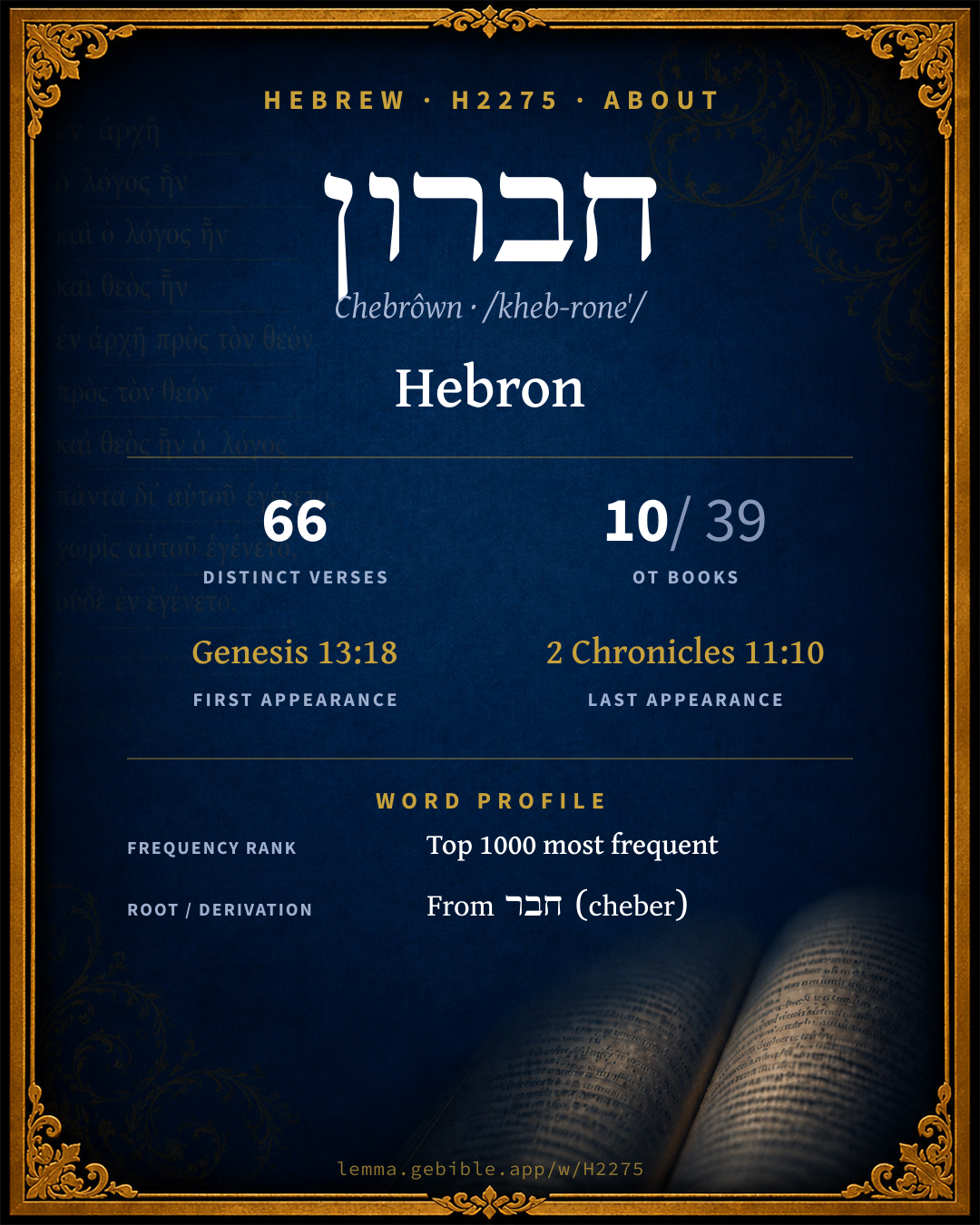
חֶבְרוֹן
Hebron
BDB lists 4 entries for ‘Hebron’ fuller range ↓
Full lexicon entry — Brown-Driver-Briggs (BDB)
From Brown-Driver-Briggs (BDB)
Where this word appears
Grammar key — what these labels mean
Part of speech
- Noun
- A naming word — a person, place, thing, or idea.
Noun type
- Proper
- A name of a specific person, place, or people (e.g. Abraham, Zion, Israel).
Every verse where H2275 appears in the Book of 1 Kings — 1 distinct verse. Click any verse to open its interlinear word-by-word view. Verse text shown in the World English Bible for context — . Each verse’s Hebrew form is shown with its reference; the English is not keyword-highlighted, since the data carries no word-level English alignment. Use “Compare translations” on any verse to read it across multiple English versions. This concordance covers the Hebrew Bible; Septuagint (Greek Old Testament) occurrences are not indexed here.
1 Kings
About this entry
At a glance — auto-summarized from this page’s data, not written by a person. Every figure links to its source below. This summary describes the numbers; it doesn’t interpret them.
חברון (Chebrôwn) is a Hebrew name most often rendered “Hebron.” Debuting at Genesis 13:18, it then recurs through the corpus. With 66 verses in 10 books, it is a moderately common word in the Hebrew Bible. It concentrates in 2 Samuel, which alone accounts for 32% of its uses. For the data behind this summary, explore 66-verse concordance and the renderings breakdown below.
Gloss history
Strong's 1890 vs modern scholarship
About this word
Strong's H2275 catalogs a Hebrew word from the Hebrew Old Testament.
These counts are not copied from any lexicon or concordance. They are computed here, from the morphology-tagged Hebrew Old Testament. What Lemma adds →
- 66
- distinct verses
- The word appears in 66 distinct verses.
- 10 / 39
- OT books
- The word appears in 10 of 39 Old Testament books.
- #558
- by frequency
- Top 1000 most frequent Hebrew words (rank 558 of 8,640 Hebrew words by occurrence).
View all 66 occurrences in the concordance →
Most concentrated in
- 2 Samuel 21 verses 32%
- 1 Chronicles 16 verses 24%
- Joshua 15 verses 23%
By section of the Old Testament
By traditional corpus
Conventional, traditional groupings — biblical authorship is debated, so this is a traditional corpus grouping, not an authorship claim. Each share is this word’s portion of its verses in that division of the Hebrew canon. Each figure is a share of the word’s 66 distinct verses.
- Prophets (Nevi'im) 41 verses · 62%
- Writings (Ketuvim) 17 verses · 26%
- Torah (Pentateuch) 8 verses · 12%
How translations render this word
Counts come from each version’s own published word-to-Strong’s tagging or interlinear alignment — an approximate guide to how each version renders this word, not a word-level alignment the data otherwise carries. Because each total is that version’s own tagged count, the per-version totals vary from one another and need not match the appearance or distinct-verse counts above. These counts may also differ from a printed concordance because Lemma counts each distinctly tagged rendering and does not collapse phrase taggings into a single head-word total. This is a fixed set of word-tagged versions (KJV, ASV, BSB, ULT) and does not change with the reading translation you choose elsewhere. Each version’s license is shown beside its name below (and on Sources).
BDB lists this Strong’s number as 3 distinct words (homographs). Each count above pools all of them and is not split by sense — see the Senses section below. A low-frequency rendering may belong to a different one of those words, not the primary meaning.
- King James Version†: Hebron 57×, Is hebron 3×, City is hebron 2×
- American Standard Version†: Hebron 55×, Same is hebron 7×, He in hebron 2×
- Berean Standard Bible†: Hebron 65×
- unfoldingWord Literal Text†: Hebron 67×, Is hebron 2×
King James Version Public Domain
Renders H2275 across 71† tagged occurrences — most commonly:
Plus 5 renderings that appear only once — usually multi-word phrases or single function words the recovered tagging swept in, not distinct renderings.
American Standard Version Public Domain
Renders H2275 across 71† tagged occurrences — most commonly:
Plus 7 renderings that appear only once — usually multi-word phrases or single function words the recovered tagging swept in, not distinct renderings.
Berean Standard Bible Public Domain
Renders H2275 across 67† tagged occurrences — most commonly:
Plus 2 renderings that appear only once — usually multi-word phrases or single function words the recovered tagging swept in, not distinct renderings. Not rendered by a distinct English word in 4 further occurrences.
unfoldingWord Literal Text CC BY-SA 4.0
Renders H2275 across 71† tagged occurrences — most commonly:
Plus 2 renderings that appear only once — usually multi-word phrases or single function words the recovered tagging swept in, not distinct renderings.
Senses in the full BDB
What do BDB’s symbols mean?
BDB uses these scholarly abbreviations:
| Symbol | Meaning |
|---|---|
| 𝔊 | the Septuagint (the ancient Greek translation, LXX) |
| 𝔙 | the Vulgate (the Latin translation) |
| 𝔖 | the Syriac version (the Peshitta) |
| 𝔗 | the Targum (the Aramaic translation) |
| ψ | the Psalms |
| √ | root (the underlying root or stem) |
| ‖ | parallel passage (a synonymous or contrasted parallel) |
| † | the dagger: every passage where the word occurs is cited |
The 2 senses and sub-senses the full Brown-Driver-Briggs lexicon distinguishes for this word, in lexicon order (not ranked by frequency), with BDB’s own verbatim wording and sub-sense lettering. Shown in Hebrew script with BDB’s own scholarly abbreviations. The condensed entry is in the Lexicon Entry tab. See also the Forms in the corpus table below.
חברון I loc. Hebron (association, league)
חברון II
- 1. grandson of Levi Ex 6:18; Nu 3:19 (both P) = 1 Ch 5:28 = 6:3, 23:12, 19, cf. 15:9. e.g. Exodus 6:18
- 2. name in Caleb’s family 1 Ch 2:42, 43. e.g. 1 Chronicles 2:42
חברון III loc. Jos 19
Senses from the full Brown-Driver-Briggs lexicon (Brown, Driver, Briggs; Oxford 1906 — public domain), digitized via Sefaria, supplemented by the OpenScriptures HebrewLexicon (CC BY 4.0). Full attribution on Sources.
Word origin
I. n.pr.loc. Hebron (association, league)—ח׳ Gn 13:18 +; c. ה loc. חֶבְרוֹנָה Jos 10:36 + 6 times; חֶבְרֹ֫נָה 2 S 2:1;—𝔊 Χεβρων; mod. El-Ḫalîl (v. RobBR i. 213 f., ii. 73 ff. GuérinJudée iii. 214 ff.); ancient city in southern Judah, where (or near which) Abr. built an altar Gn 13:18 (J), and where was a sanctuary in Dvd.’s time 2 S 15:7, cf. לפני י׳ בְּח׳ 2 S 5:3 = 1 Ch 11:3; built 7 yrs. bef. Ṣoan in Egypt according to Nu 13:22 b (JE); under a king Jos 10:3, 5, 23 (JE) 12:10 (D); assigned to Caleb Jos 14:13, 14 (JED) Ju 1:20 yet v. 1 Ch 6:40 (cf. v 41); older name קִרְיַת (הָ)אַרְבַּע according to Jos 14:15 (JED), cf. Gn 23:2; 35:27 Jos 15:54; 20:7 (all P) Ju 1:10 b; v. also Jos 15:13; 21:11 (both P); called also מַמְרֵא Gn 23:19 (and 35:27, both P); a city of refuge Jos 21:13 (P) = 1 Ch 6:42; עֵמֶק ח׳ Gn 37:14 (J); named elsewhere Nu 13:22 a (JE) Jos 10:36, 39; 11:21 (all D) Ju 1:10 a; 16:3 2 S 2:32; 15:9 2 Ch 11:10; a resort of David, and for 7 yrs. his royal city 1 S 30:31 2 S 2:1, 11; 3:2, 5, 19, 20, 22, 27, 32; 4:1, 8, 12(×2); 5:1, 3, 13 1 K 2:11; 1 Ch 3:1, 4; 11:1, 3; 12:24, 39 (van d. H. v 23, 38) 29:27; read also perhaps for תחתו 2 S 3:12, 𝔊L εἰς Χεβρων, cf. Dr; seat of Absalom’s rebellion 2 S 15:10; עָרֵי ח׳ 2 S 2:3 abode of David’s men.
I. n.pr.loc. Jos 19:38 (𝔊 Ελβων, A 𝔊L Αχραν); read probably עַבְדֹּן q.v.
— Brown-Driver-Briggs (Oxford 1906, public domain), digitized via Sefaria, supplemented by the OpenScriptures HebrewLexicon (CC BY 4.0). See Sources.
Derived from חבר (cheber) (H2267) — association.
Jastrow Dictionary
A second Hebrew/Aramaic lexicon for comparison, covering Aramaic and post-biblical (Talmudic, Targumic, Midrashic) usage that the biblical-Hebrew BDB does not. Matched by lemma rather than by Strong’s number, so a lemma may carry more than one Jastrow headword (shown separately below), and the entries cover usage well beyond the Bible.
חֶבְרוֹן
- (b. h.) pr. n. pl. Hebron, in Judea. Macc. 9ᵇ. Gen. R. s. 84 (ref. to Gen. XXXVII, 14) והלא אין ח׳ וכ׳ is not H. situated on a mountain? Yoma III, 1 עד שבח׳ up to the horizon over H.; a. fr. e.g. Genesis 37:14
A Dictionary of the Targumim, the Talmud Babli and Yerushalmi, and the Midrashic Literature (Marcus Jastrow; London, Luzac, 1903) — Public Domain. Digitized via Sefaria. Digitized via Sefaria. Full attribution on Sources.
Forms in the corpus
The 26 distinct written forms H2275 takes in the Hebrew Bible, most frequent first — each parse links to that state’s occurrences in the concordance. Hebrew forms include their vowel points and cantillation, so a single lemma takes many written forms.
| Form | Parsing | Example | Uses |
|---|---|---|---|
| חֶבְר֖וֹן | Noun, Proper | Genesis 23:2 | 8 |
| בְּ/חֶבְר֑וֹן | Noun, Proper | Genesis 13:18 | 6 |
| חֶבְר֔וֹן | Noun, Proper | Genesis 35:27 | 6 |
| בְּ/חֶבְרֽוֹן | Noun, Proper | 2 Samuel 2:32 | 5 |
| בְּ/חֶבְר֔וֹן | Noun, Proper | 2 Samuel 3:19 | 4 |
| חֶבְר֑וֹן | Noun, Proper | Genesis 23:19 | 4 |
| חֶבְרֽוֹן | Noun, Proper | 1 Chronicles 2:42 | 4 |
| בְּ/חֶבְר֖וֹן | Noun, Proper | 1 Chronicles 11:3 | 3 |
| וְ/חֶבְר֖וֹן | Noun, Proper | Exodus 6:18 | 3 |
| חֶבְר֑וֹנָ/ה | Noun, Proper | 1 Chronicles 12:23 | 3 |
| חֶבְר֔וֹנָ/ה | Noun, Proper | 1 Chronicles 11:3 | 3 |
| חֶבְר֥וֹן | Noun, Proper | 1 Chronicles 6:57 | 3 |
| בְּ/חֶבְר֤וֹן | Noun, Proper | 1 Chronicles 29:27 | 2 |
| חֶ֠בְרוֹן | Noun, Proper | Joshua 10:3 | 2 |
| חֶבְר֤וֹן | Noun, Proper | Joshua 10:5 | 2 |
| חֶבְרוֹן֒ | Noun, Proper | 2 Samuel 4:8 | 2 |
| חֶבְרוֹן֙ | Noun, Proper | Joshua 10:23 | 2 |
| בְ/חֶבְר֔וֹן | Noun, Proper | 1 Chronicles 3:4 | 1 |
| בְּ/חֶבְרוֹן֙ | Noun, Proper | 2 Samuel 5:5 | 1 |
| וְ/חֶבְר֗וֹן | Noun, Proper | Numbers 13:22 | 1 |
| חֶבְר֛וֹן | Noun, Proper | Joshua 14:13 | 1 |
| חֶבְר֣וֹנָ/ה | Noun, Proper | 1 Chronicles 11:1 | 1 |
| חֶבְרֹֽנָ/ה | Noun, Proper | 2 Samuel 2:1 | 1 |
| חֶבְרֽוֹנָ/ה | Noun, Proper | 2 Samuel 15:9 | 1 |
| לְ/חֶבְר֗וֹן | Noun, Proper | Joshua 10:39 | 1 |
| מֵ/חֶבְר֑וֹן | Noun, Proper | 2 Samuel 5:13 | 1 |
Same root — word family
Other BDB entries built from the same root as H2275, grouped by Strong’s listed origin. These share a root / origin per the lexicon — not necessarily a shared meaning. Each links to that word’s own entry.
Derives from
Shares the same root
Proper names from this root
People and places named from this root — a name, not an additional meaning of the word.
Compare all same-root words → Showing 4 of 5 — not the complete family. 2 of the same-root words are proper names (people or places). They share a root, not necessarily a meaning.
Bible dictionary
Public-domain dictionary articles matched to this entry by name (Hebron). A biblical name can be shared by more than one person or place, so an article may treat several.
Easton's Bible Dictionary · M. G. Easton, 1897
A community; alliance. (1.) A city in the south end of the valley of Eshcol, about midway between Jerusalem and Beersheba, from which it is distant about 20 miles in a straight line. It was built "seven years before Zoan in Egypt" (Gen. 13:18; Num. 13:22). It still exists under the same name, and is one of the most ancient cities in the world. Its earlier name was Kirjath-arba (Gen. 23:2; Josh. 14:15; 15:3). But "Hebron would appear to have been the original name of the city, and it was not till after Abraham's stay there that it received the name Kirjath-arba, who [i.e., Arba] was not the founder but the conqueror of the city, having led thither the tribe of the Anakim, to which he belonged. It retained this name till it came into the possession of Caleb, when the Israelites restored the original name Hebron" (Keil, Com.). The name of this city does not occur in any of the prophets or in the New Testament. It is found about forty times in the Old. It was the favorite home of Abraham. Here he pitched his tent under the oaks of Mamre, by which name it came afterwards to be known; and here Sarah died, and was buried in the cave of Machpelah (Gen. 23:17-20), which he bought from Ephron the Hittite. From this place the patriarch departed for Egypt by way of Beersheba (37:14; 46:1). It was taken by Joshua and given to Caleb (Josh. 10:36, 37; 12:10; 14:13). It became a Levitical city and a city of refuge (20:7; 21:11). When David became king of Judah this was his royal residence, and he resided here for seven and a half years (2 Sam. 5:5); and here he was anointed as king over all Israel (2 Sam. 2:1-4, 11; 1 Kings 2:11). It became the residence also of the rebellious Absalom (2 Sam. 15:10), who probably expected to find his chief support in the tribe of Judah, now called el-Khulil.
In one part of the modern city is a great mosque, which is built over the grave of Machpelah. The first European who was permitted to enter this mosque was the Prince of Wales in 1862. It was also visited by the Marquis of Bute in 1866, and by the late Emperor Frederick of Germany (then Crown-Prince of Prussia) in 1869.
One of the largest oaks in Palestine is found in the valley of Eshcol, about 3 miles north of the town. It is supposed by some to be the tree under which Abraham pitched his tent, and is called "Abraham's oak." (See OAK.)
(2.) The third son of Kohath the Levite (Ex. 6:18; 1 Chr. 6:2, 18).
(3.) 1 Chr. 2:42, 43.
(4.) A town in the north border of Asher (Josh. 19:28).
Smith's Bible Dictionary · William Smith, 1863
(alliance).
+ The third son of Kohath, who was the second son of Levi. (Exodus 6:18; Numbers 3:19; 1 Chronicles 6:2,18; 23:12) He was the founder of a family of Hebronites, (Numbers 3:27; 26:58; 1 Chronicles 26:23,30,31), or Bene-Hebron. (1 Chronicles 15:9; 23:19) + A city of Judah, (Joshua 15:54) situated among the mountains, (Joshua 20:7) 20 Roman miles south of Jerusalem, and the same distance north of Beersheba. Hebron is one of the most ancient cities in the world still existing; and in this respect it is the rival of Damascus. It was a well-known town when Abraham entered Canaan, 3800 years ago. (Genesis 13:18) Its original name was Kirjath-arba, (Judges 1:10) "the city of Arba;" so called from Arba the father of Anak. (Joshua 15:13,14; 21:13) Sarah died at Hebron; and Abraham then bought from Ephron the Hittite the field and cave of Machpelah, to serve as a family tomb (Genesis 23:2-20) The cave is still there, and the massive walls of the Haram or mosque, within which it lies, form the most remarkable object in the whole city. Abraham is called by Mohammedans el-Khulil, "the Friend," i.e. of God, and this is the modern name of Hebron. Hebron now contains about 5000 inhabitants, of whom some fifty families are Jews. It is picturesquely situated in a narrow valley, surrounded by rocky hills. The valley runs from north to south; and the main quarter of the town, surmounted by the lofty walls of the venerable Haram, lies partly on the eastern slope. (Genesis 37:14) comp. Genesis23:19 About a mile from the town, up the valley, is one of the largest oak trees in Palestine. This, say some, is the very tree beneath which Abraham pitched his tent, and it still bears the name of the patriarch. + One of the towns in the territory of Asher, (Joshua 19:28) probably Ebdon or Abdom.
Hitchcock's Bible Names Dictionary · Roswell D. Hitchcock, 1869
society; friendship
Classic public-domain reference works; full attribution on Sources.
Septuagint verse parallels
This word appears in 65 verses that also exist in the Greek Old Testament (Septuagint), out of the 66 Hebrew verses it occurs in. You can read those verses in Greek by switching the Old Testament edition to the Septuagint.
Read these verses in the Septuagint
- Genesis 13:18
- Exodus 6:18
- Numbers 3:19
- Joshua 10:3
- Judges 1:10
- 1 Samuel 30:31
- 2 Samuel 2:1
- 1 Kings 2:11
- 1 Chronicles 2:42
- 2 Chronicles 11:10
This is a verse-level parallel only — the same verses exist in both the Hebrew and Greek Old Testaments. No word-level Hebrew↔Greek correspondence is claimed: the data carries no such alignment, so no Greek word is shown as this Hebrew word’s translation. Coverage is not total — the Septuagint omits the deuterocanon and renumbers the Psalms, so some Hebrew verses have no direct Greek parallel.