
Joshua 10:3

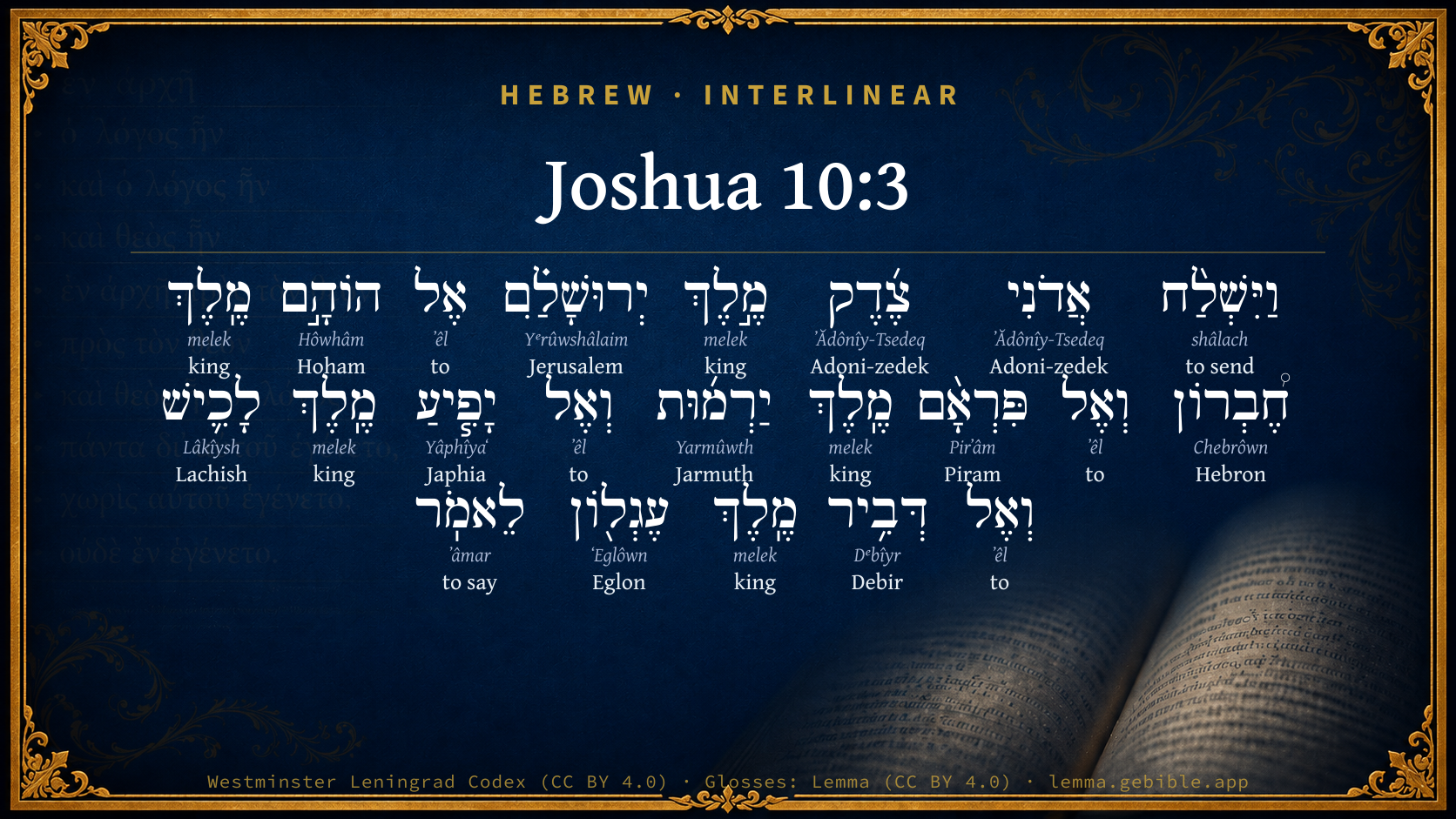
Hebrew (Westminster Leningrad Codex) Joshua 10:3 appears in the Hebrew Old Testament. The text above is from the Westminster Leningrad Codex. Each word links to its Strong’s number, a concise gloss, and parsing drawn from the Open Scriptures Hebrew Bible morphology. Click any word for its full Brown-Driver-Briggs (BDB) entry.
Download image
Cite this verse

Joshua 10:3 (World English Bible). Public Domain. Lemma interlinear Bible study tool, https://lemma.gebible.app/v/joshua/10/3.

Show BibTeX & RIS
BibTeX
RIS
English Translation
Therefore Adoni-zedek king of Jerusalem sent to Hoham king of Hebron, and to Piram king of Jarmuth, and to Japhia king of Lachish, and to Debir king of Eglon, saying,
World English Bible · Public Domain
Highlights
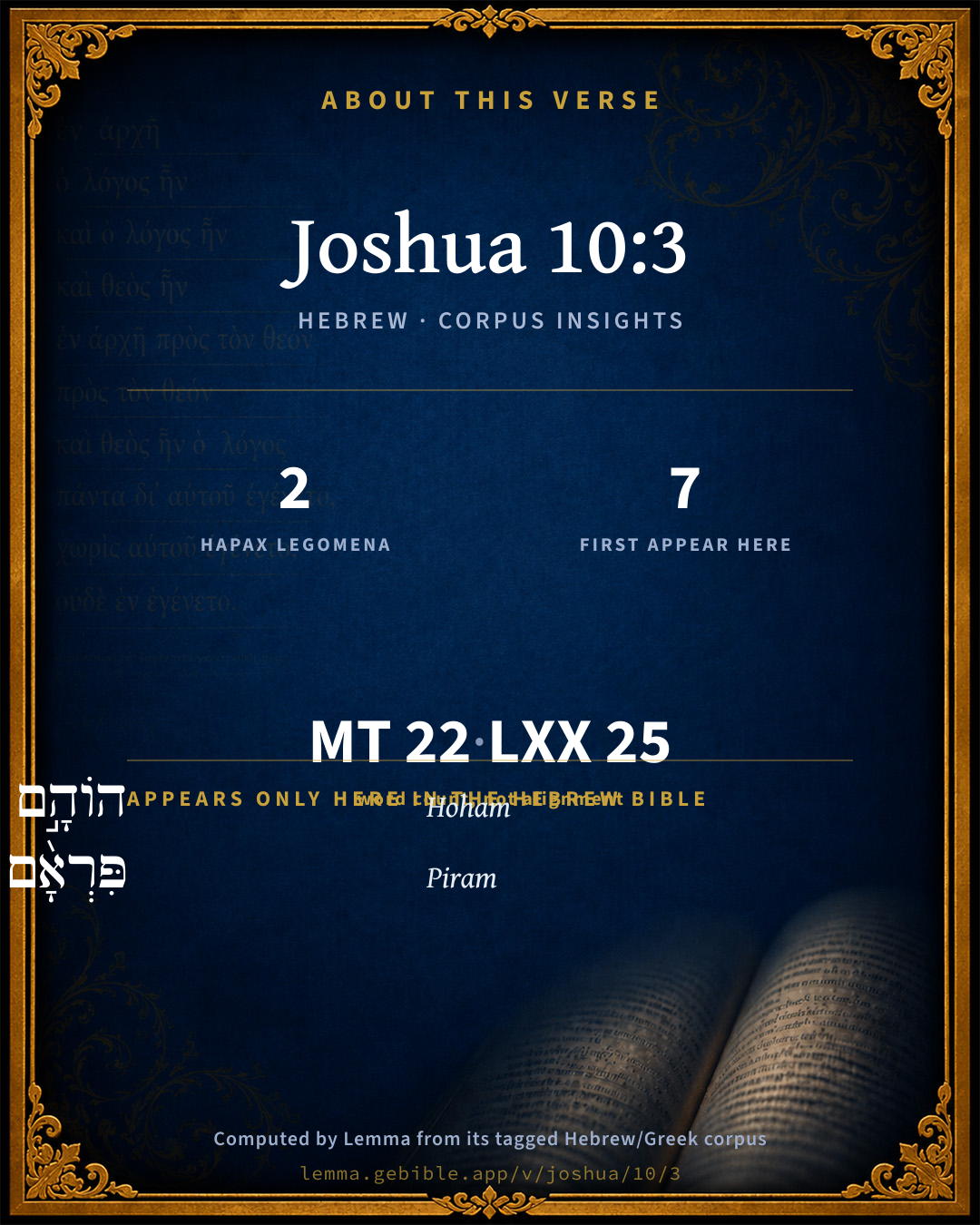
  • 2 hapax legomena — only here in the Hebrew Bible
  • 7 first appearances in the Hebrew Bible
Full analysis ↓
Download a study sheet

One document with this verse’s original text, its word-by-word gloss line, the meaning frame, cross-references with their text, attributed commentary, and full source and license credits — printable, and it pastes into notes with its structure intact.

This verse Autodidact and up

Study sheet (.html) Plain text (.txt)

A passage Seminary Student

Up to 50 verses in one chapter. A passage sheet keeps up to 6 commentary sources and 12 cross-references per verse, in the order this page ranks them, and says so on the sheet whenever that leaves anything out. Ask for a single verse and you get the Autodidact verse sheet above.

Everything on this page stays free to read, with no account — the sheet is a download of what is already on screen, not access to it.

Want to remove ads? Support Godless Engineer
Compare translations 3

The same verse in 3 English versions, stacked beneath the original-language interlinear above. Click any original word for its lexicon entry.

Each is an independent rendering of the whole verse — the interlinear is not word-aligned to these translations.

Highlighted words mark where these versions differ — a whole-verse word diff, not a word-by-word alignment.

  • World English Bible Public Domain
    Therefore Adoni-zedek king of Jerusalem sent to Hoham king of Hebron, and to Piram king of Jarmuth, and to Japhia king of Lachish, and to Debir king of Eglon, saying,
  • King James Version Public Domain
    Wherefore Adonizedec king of Jerusalem, sent unto Hoham king of Hebron, and unto Piram king of Jarmuth, and unto Japhia king of Lachish, and unto Debir king of Eglon, saying,
  • unfoldingWord Literal Text CC BY-SA 4.0
    And Adoni Zedek, the king of Jerusalem, sent to Hoham, the king of Hebron, and to Piram, the king of Jarmuth, and to Japhia, the king of Lachish, and to Debir, the king of Eglon, saying,

unfoldingWord Literal Text — © unfoldingWord, licensed CC BY-SA 4.0. Word-aligned USFM3 via Door43 (git.door43.org/unfoldingWord/en_ult).

Versions to compare (up to 4)

3 of 4 selected

Show all 18 translations

Every available English version of this verse, each an independent rendering of the whole verse.

  • World English Bible Public Domain
    Therefore Adoni-zedek king of Jerusalem sent to Hoham king of Hebron, and to Piram king of Jarmuth, and to Japhia king of Lachish, and to Debir king of Eglon, saying,
  • Berean Standard Bible Public Domain
    Therefore Adoni-zedek king of Jerusalem sent word to Hoham king of Hebron, Piram king of Jarmuth, Japhia king of Lachish, and Debir king of Eglon, saying,
  • Majority Standard Bible Public Domain
    Therefore Adoni-zedek king of Jerusalem sent word to Hoham king of Hebron, Piram king of Jarmuth, Japhia king of Lachish, and Debir king of Eglon, saying,
  • King James Version Public Domain
    Wherefore Adonizedec king of Jerusalem, sent unto Hoham king of Hebron, and unto Piram king of Jarmuth, and unto Japhia king of Lachish, and unto Debir king of Eglon, saying,
  • American Standard Version (1901) Public Domain
    Wherefore Adoni-zedek king of Jerusalem sent unto Hoham king of Hebron, and unto Piram king of Jarmuth, and unto Japhia king of Lachish, and unto Debir king of Eglon, saying,
  • Revised Version (1885) Public Domain
    Wherefore Adoni-zedek king of Jerusalem sent unto Hoham king of Hebron, and unto Piram king of Jarmuth, and unto Japhia king of Lachish, and unto Debir king of Eglon, saying,
  • Geneva Bible (1599) Public Domain
    Wherefore Adoni-zedek King of Ierusalem sent vnto Hoham King of Hebron, and vnto Piram King of Iarmuth, and vnto Iapia King of Lachish, and vnto Debir King of Eglon, saying,
  • Douay-Rheims (1899) Public Domain
    Therefore Adonisedec king of Jerusalem sent to Oham king of Hebron, and to Pharam king of Jerimoth, and to Japhia king of Lachis, and to Dabir king of Eglon, saying:
  • Young's Literal Translation Public Domain
    And Adoni-Zedek king of Jerusalem sendeth unto Hoham king of Hebron, and unto Piram king of Jarmuth, and unto Japhia king of Lachish, and unto Debir king of Eglon, saying,
  • Literal Standard Version CC BY-SA 4.0
    And Adoni-Zedek king of Jerusalem sends to Hoham king of Hebron, and to Piram king of Jarmuth, and to Japhia king of Lachish, and to Debir king of Eglon, saying,
  • Unlocked Literal Bible CC BY-SA 4.0
    So Adoni-Zedek, king of Jerusalem, sent a message to Hoham, king of Hebron, to Piram, king of Jarmuth, to Japhia, king of Lachish, and to Debir, king of Eglon:
  • unfoldingWord Literal Text CC BY-SA 4.0
    And Adoni Zedek, the king of Jerusalem, sent to Hoham, the king of Hebron, and to Piram, the king of Jarmuth, and to Japhia, the king of Lachish, and to Debir, the king of Eglon, saying,
  • Darby Bible Public Domain
    And Adoni-zedek king of Jerusalem sent to Hoham king of Hebron, and to Piream king of Jarmuth, and to Japhia king of Lachish, and to Debir king of Eglon, saying,
  • World Messianic Bible Public Domain
    Therefore Adoni-Zedek king of Jerusalem sent to Hoham king of Hebron, Piram king of Jarmuth, Japhia king of Lachish, and Debir king of Eglon, saying,
  • Webster's Bible Public Domain
    Wherefore Adoni-zedec king of Jerusalem sent to Hoham king of Hebron, and to Piram king of Jarmuth, and to Japhia king of Lachish, and to Debir king of Eglon, saying,
  • Free Bible Version CC BY-SA 4.0
    So Adoni-zedek, king of Jerusalem, sent a message to Hoham, king of Hebron, Piram, king of Jarmuth, Japhia, king of Lachish, and Debir, king of Eglon, saying,
  • Bible in Basic English Public Domain
    So Adoni-zedek, king of Jerusalem, sent to Hoham, king of Hebron, and to Piram, king of Jarmuth, and to Japhia, king of Lachish, and to Debir, king of Eglon, saying,
  • JPS Tanakh (1917) Public Domain
    Wherefore Adoni-zedek king of Jerusalem sent unto Hoham king of Hebron, and unto Piram king of Jarmuth, and unto Japhia king of Lachish, and unto Debir king of Eglon, saying:

Literal Standard Version (2020), Covenant Press — licensed CC BY-SA 4.0. Text via the HelloAO Bible API (eBible.org). Unlocked Literal Bible (unfoldingWord) — licensed CC BY-SA 4.0. Text via the HelloAO Bible API (eBible.org). unfoldingWord Literal Text — © unfoldingWord, licensed CC BY-SA 4.0. Word-aligned USFM3 via Door43 (git.door43.org/unfoldingWord/en_ult). Free Bible Version, Dr. Jonathan Gallagher — licensed CC BY-SA 4.0. Text via the HelloAO Bible API (eBible.org).

Word by word

More ways to search: Search by grammar → Find every occurrence → Compare this word →

Practice this passage: Drill this verse → Learn its vocabulary →

הוֹהָ֣ם
Hôwhâm
H1944
“Hoham”
Noun, Proper
Part of Speech
Noun
Type
Proper
Full BDB Definition

Origin: of uncertain derivation

TWOT: None

Hoham = "whom Jehovah impels" - king of Hebron at the time of the conquest of Canaan
  1. וַיִּשְׁלַ֨ח shâlach H7971 “and · to send” Conjunction + Verb, Qal, Sequential Imperfect, 3rd Person, Masculine, Singular
  2. אֲדֹנִי ʼĂdônîy-Tsedeq H139 “Adoni-zedek” Noun, Proper
  3. צֶ֜דֶק ʼĂdônîy-Tsedeq H139 “Adoni-zedek” Noun, Proper
  4. מֶ֣לֶךְ melek H4428 “king of” Noun, Common, Masculine, Singular, Construct
  5. יְרוּשָׁלִַ֗ם Yᵉrûwshâlaim H3389 “Jerusalem” Noun, Proper
  6. אֶל ʼêl H413 “to” Preposition
  7. מֶֽלֶךְ melek H4428 “king of” Noun, Common, Masculine, Singular, Construct
  8. חֶ֠בְרוֹן Chebrôwn H2275 “Hebron” Noun, Proper
  9. וְאֶל ʼêl H413 “and · to” Conjunction + Preposition
  10. פִּרְאָ֨ם Pirʼâm H6502 “Piram” Noun, Proper
  11. מֶֽלֶךְ melek H4428 “king of” Noun, Common, Masculine, Singular, Construct
  12. יַרְמ֜וּת Yarmûwth H3412 “Jarmuth” Noun, Proper
  13. וְאֶל ʼêl H413 “and · to” Conjunction + Preposition
  14. יָפִ֧יעַ Yâphîyaʻ H3309 “Japhia” Noun, Proper
  15. מֶֽלֶךְ melek H4428 “king of” Noun, Common, Masculine, Singular, Construct
  16. לָכִ֛ישׁ Lâkîysh H3923 “Lachish” Noun, Proper
  17. וְאֶל ʼêl H413 “and · to” Conjunction + Preposition
  18. דְּבִ֥יר Dᵉbîyr H1688 “Debir” Noun, Proper
  19. מֶֽלֶךְ melek H4428 “king of” Noun, Common, Masculine, Singular, Construct
  20. עֶגְל֖וֹן ʻEglôwn H5700 “Eglon” Noun, Proper
  21. לֵאמֹֽר ʼâmar H559 “to say” Preposition + Verb, Qal, Infinitive Construct

About this verse

These counts appear in no published source. They are computed here, from the morphology-tagged text and Lemma’s own curated glosses. What Lemma adds →

22
words
14
distinct lemmas
Historical
section

Notable vocabulary

2 hapax legomena — words that appear only here in the entire Hebrew Bible:

  • הוֹהָ֣ם Hoham H1944
  • פִּרְאָ֨ם Piram H6502

First appearance in Scripture

These words make their first canonical appearance in the Hebrew Bible here:

  • הוֹהָ֣ם Hoham H1944
  • פִּרְאָ֨ם Piram H6502
  • יַרְמ֜וּת Jarmuth H3412
  • יָפִ֧יעַ Japhia H3309
  • לָכִ֛ישׁ Lachish H3923
  • דְּבִ֥יר Debir H1688
  • עֶגְל֖וֹן Eglon H5700

Shared distinctive vocabulary

אֲדֹנִי Adoni-zedek H139 occurs in 2 verses of the Hebrew Bible. Also found in:

Grammatical profile

  • 2 verbs
  • 16 nouns
  • 4 prepositions

Verb forms

  • וַיִּשְׁלַ֨ח Qal · Sequential Imperfect
  • לֵאמֹֽר Qal · Infinitive Construct

Repetition

Words recur within this verse — often emphatic in Hebrew:

  • מֶ֣לֶךְ king H4428 ×5
  • אֲדֹנִי Adoni-zedek H139 ×2
  • אֶל to H413 ×4

Hebrew & Septuagint length

In English translation the verse runs 30 words from the Hebrew and 30 from the Septuagint (LXX English) — the same length.

A rough comparison of the two English renderings, which tokenize alike — not a word-level alignment.

Word counts can differ between the Hebrew and the Greek without any difference in meaning — e.g. the Hebrew direct-object marker אֵת has no separate Greek word, and Greek often adds the article ὁ.

In the original languages it is 22 Hebrew tokens and 25 Greek tokens — but the two are counted differently (Hebrew bundles its prefixes and suffixes into one token; the Greek is in lemma form), so that isn’t a like-for-like length.

Cross-references

16

Topical passages linked to Joshua 10:3 in the Treasury of Scripture Knowledge — connected by theme and wording, ordered by reader-vote popularity; previews shown in the World English Bible.

  • 2 Chronicles 11:9 and Adoraim, and Lachish, and Azekah,
  • Micah 1:13 Harness the chariot to the swift steed, inhabitant of Lachish. She was the beginning of sin to the daughter of Zion; For the transgressions of Israel were found in you.
  • Genesis 23:2 Sarah died in Kiriath Arba (the same is Hebron), in the land of Canaan. Abraham came to mourn for Sarah, and to weep for her.
  • Genesis 37:14 He said to him, "Go now, see whether it is well with your brothers, and well with the flock; and bring me word again." So he sent him out of the valley of Hebron, and he came to Shechem.
  • Numbers 13:22 They went up by the South, and came to Hebron; and Ahiman, Sheshai, and Talmai, the children of Anak, were there. (Now Hebron was built seven years before Zoan in Egypt.)
  • Joshua 10:1 Now it happened, when Adoni-zedek king of Jerusalem heard how Joshua had taken Ai, and had utterly destroyed it; as he had done to Jericho and her king, so he had done to Ai and her king; and how the inhabitants of Gibeon had made peace with Israel, and were among them;
  • Joshua 10:5 Therefore the five kings of the Amorites, the king of Jerusalem, the king of Hebron, the king of Jarmuth, the king of Lachish, the king of Eglon, gathered themselves together, and went up, they and all their hosts, and encamped against Gibeon, and made war against it.
  • Joshua 12:10–13 the king of Jerusalem, one; the king of Hebron, one;
  • Joshua 14:15 Now the name of Hebron before was Kiriath Arba; [which Arba was] the greatest man among the Anakim. The land had rest from war.
  • Joshua 15:35–39 Jarmuth, and Adullam, Socoh, and Azekah,
  • Joshua 15:54 and Humtah, and Kiriath Arba (the same is Hebron), and Zior; nine cities with their villages.
  • Joshua 15:63 As for the Jebusites, the inhabitants of Jerusalem, the children of Judah couldn't drive them out: but the Jebusites dwell with the children of Judah at Jerusalem to this day.
  • Joshua 18:28 and Zelah, Eleph, and the Jebusite (the same is Jerusalem), Gibeath, [and] Kiriath; fourteen cities with their villages. This is the inheritance of the children of Benjamin according to their families.
  • 2 Samuel 2:11 The time that David was king in Hebron over the house of Judah was seven years and six months.
  • 2 Kings 18:14 Hezekiah king of Judah sent to the king of Assyria to Lachish, saying, I have offended; return from me: that which you put on me will I bear. The king of Assyria appointed to Hezekiah king of Judah three hundred talents of silver and thirty talents of gold.
  • 2 Kings 18:17 The king of Assyria sent Tartan and Rabsaris and Rabshakeh from Lachish to king Hezekiah with a great army to Jerusalem. They went up and came to Jerusalem. When they were come up, they came and stood by the conduit of the upper pool, which is in the highway of the fuller's field.

Cross-references courtesy of OpenBible.info (CC BY 4.0).

Hebrew and Greek witnesses Masoretic Hebrew ↔ Greek Septuagint

The same verse in the two great witnesses to the Old Testament, shown verse-for-verse.

These are two independent witnesses, not word-aligned to each other, and the Septuagint is shown in lemma (dictionary) form.

Hebrew Joshua 10:3 Masoretic · Westminster Leningrad Codex

וַיִּשְׁלַ֨ח אֲדֹנִי צֶ֜דֶק מֶ֣לֶךְ יְרוּשָׁלִַ֗ם אֶל הוֹהָ֣ם מֶֽלֶךְ חֶ֠בְרוֹן וְאֶל פִּרְאָ֨ם מֶֽלֶךְ יַרְמ֜וּת וְאֶל יָפִ֧יעַ מֶֽלֶךְ לָכִ֛ישׁ וְאֶל דְּבִ֥יר מֶֽלֶךְ עֶגְל֖וֹן לֵאמֹֽר

Therefore Adoni-zedek king of Jerusalem sent to Hoham king of Hebron, and to Piram king of Jarmuth, and to Japhia king of Lachish, and to Debir king of Eglon, saying,

World English Bible · Public Domain

Greek LXX Joshua 10:3 Septuagint · lemma form

καί ἀποστέλλω αδωνιβεζεκ βασιλεύς ἰερουσαλήμ πρός αιλαμ βασιλεύς χεβρων καί πρός φιδων βασιλεύς ιεριμουθ καί πρός ιεφθα βασιλεύς λαχις καί πρός δαβιρ βασιλεύς οδολλαμ λέγω

So Adoni-bezec king of Jerusalem sent to Elam king of Hebron, and to Phidon king of Jerimuth, and to Jephtha king of Lachis, and to Dabin king of Odollam, saying,

LXX2012 (modern English Septuagint) · Public Domain

On this verse, John Gill's Exposition discusses the Septuagint’s reading. Read the note in Commentary ↓

Hebrew: Westminster Leningrad Codex (CC BY 4.0). Greek: Septuagint (public domain); English from LXX2012 (modern English Septuagint) (Public Domain). How the Septuagint differs from the Hebrew →

Targum (Aramaic paraphrase)

1

The Targum is the ancient Jewish Aramaic paraphrase of the Hebrew Scriptures — an interpretive translation, not the Hebrew text itself. Onkelos (literal) and Pseudo-Jonathan (expansive) render the Torah, and Jonathan the Prophets. Coverage is partial: where no permissively-licensed English translation exists for a verse, only the Aramaic is shown. This is verse-level text, not a word-by-word alignment to the Hebrew.

  1. Targum Jonathan Prophets (Joshua–Malachi)
    וּשְׁלַח אֲדֹנִי צֶדֶק מַלְכָּא דִירוּשְׁלֵם לְוַת הוֹהָם מַלְכָּא דְחֶבְרוֹן וּלְוַת פִּרְאָם מַלְכָּא דְיַרְמוּת וּלְוַת יָפִיעַ מַלְכָּא דְלָכִישׁ וּלְוַת דְבִיר מַלְכָּא דְעֶגְלוֹן לְמֵימָר:

    (no public-domain English translation for this verse)

    Targum Jonathan — Aramaic: “Mikraot Gedolot” (public domain). English: “Sefaria Community Translation” (CC0 1.0 (public-domain dedication)); “London "Chaldee Paraphrase," 1871” (public domain). Text via Sefaria.

Commentary

Notes on Joshua 10:3 from classic Christian and Jewish commentators (each source and its license shown beneath its notes). The classic Christian expositions comment on the surrounding passage and are grouped to its opening verse, so a note may address several verses; the Jewish commentaries on the Tanakh (Rashi and others) are per-verse, so they appear only where the commentator wrote on this verse.

Lemma curates 59 commentaries, every one of them public domain or Creative Commons licensed, each selected and text-cleaned for this edition rather than reprinted as found. About our sources →

Trapp's Complete Commentary

John Trapp

Jos 10:3 Wherefore Adonizedek king of Jerusalem sent unto Hoham king of Hebron, and unto Piram king of Jarmuth, and unto Japhia king of Lachish, and unto Debir king of Eglon, saying,

Ver. 3. Sent unto Hoham king of Hebron.] "Sic squamae Satan ita cohaerent ut earum opere textili densato quasi loricatus incedat Satan et cataphractus: quod de Faedere Concordiae qua malignantes ecclesiae membra se complexa muniebant et circumvallabant," - elegantissime Lutherus, et vere. Persecutors conspire and complot against God’s people, who may boldly say unto them, as Isa 8:9-10, "Associate yourselves, O ye people, and ye shall be broken in pieces; gird yourselves, and ye shall be broken in pieces: take counsel together, and it shall come to nought; for God is with us: … the enemy is come into the breadth of thy land, O Immanuel." These words Basil bade the persecuted Christians use to the heathen princes, Animo praesenti et intrepido, with an undaunted spirit and well-knit resolution.

John Trapp, A Commentary or Exposition upon All the Books of the Old and New Testament (1647–1656) — public domain. Text from a community e-Sword module.

Geneva Bible (1599)

Geneva Bible translators

That is, Lord of justice: so tyrants take to themselves glorious names, when indeed they be very enemies against God and all justice.

Geneva Bible (1599) marginal notes — public domain. Text via Bolls.life.

Jamieson, Fausset & Brown

Robert Jamieson, A. R. Fausset & David Brown

Wherefore Adoni-zedek . . . sent, . . . saying, Come up unto me, and help me--A combined attack was meditated on Gibeon, with a view not only to punish its people for their desertion of the native cause, but by its overthrow to interpose a barrier to the farther inroads of the Israelites. This confederacy among the mountaineers of Southern Palestine was formed and headed by the king of Jerusalem, because his territory was most exposed to danger, Gibeon being only six miles distant, and because he evidently possessed some degree of pre-eminence over his royal neighbors.

Jamieson, Fausset & Brown — Commentary Critical and Explanatory on the Whole Bible (1871) — public domain (CC PDM 1.0). Text via the HelloAO Bible API.

Adam Clarke's Commentary

Verse 3. Hoham king of Hebron] This city was situated in the mountains, southward of Jerusalem, from which it was about thirty miles distant. It fell to the tribe of Judah.

Piram king of Jarmuth] There were two cities of this name; one belonged to the tribe of Issachar, see Jos 21:29; that mentioned here fell to the tribe of Judah, see Jos 15:35; it is supposed to have been about eighteen miles distant from Jerusalem.

Japhia king of Lachish] This city is celebrated in Scripture; in that city Amaziah was slain by conspirators, 2Kg 14:19. It was besieged by Sennacherib, 2Kg 18:14; 2Kg 18:17; and without effect by the king of Assyria, as we learn from Isa 37:8: it was also besieged by the army of Nebuchadnezzar, see Jer 34:7; it also fell to the lot of Judah, Jos 15:39.

Debir king of Eglon] Where this city was situated is very uncertain; but we learn from Jos 15:39, that it fell to the lot of the tribe of Judah.

Adam Clarke's Commentary on the Bible (1810–1826) — public domain. Text from a community e-Sword/MySword module.

Ellicott's Commentary for English Readers

(3) Hebron, Jarmuth, Lachish, and Eglon.—Hebron, i.e., el-Khalil,

Jarmuth is identified as el-Yarmûk.

Lachish is still uncertain; but see Note on Terse 32.

Eglon is identified as Aglân in Philistia.

A Bible Commentary for English Readers, edited by Charles John Ellicott (1878–1897) — public domain. Text from a community e-Sword module.

The Cambridge Bible for Schools and Colleges

gen. ed. J. J. S. Perowne

3. king of Hebron] Situated amongst the mountains, 20 Roman miles, about 7 hours, south of Jerusalem; one of the most ancient cities in the world, rivalling even Damascus, being a well-known town even when Abraham first entered Canaan (Gen_13:18). Its original name was Kirjath-Arba (Jdg_1:10), “the city of Arba,” the father of Anak, and progenitor of the giant Anakims (Jos_21:11; Jos_15:13-14). Hoham denotes “Jehovah of the multitude.”

Piram king of Jarmuth] the present Yarmûk, about 1½ miles from Beit-Netif, on the left of the road to Jerusalem. Near it is an eminence called Tell-Ermûd. It was visited by Robinson.

Japhia king of Lachish] Lachish has been identified with (1) Um-Lâkis, (2) Zukkarijeh, 2½ hours south-west of Beit-Jibîrn. It was afterwards fortified by Rehoboam (2Ch_11:9). Here Amaziah died (2Ki_14:19). It was besieged by Sennacherib, who moved thence to Libnah (Isa_36:2; Isa_37:8).

Debir king of Eglon] Lachish and Eglon are mentioned in several other passages (Jos_12:11-12; Jos_15:39), in such a way as shews they were not far apart. Eglon has been identified with ’Ajlan.

3. When Nebuchadnezzar came up against Jerusalem, he fought against all “the cities of Judah that were left, against Lachish, and against Azekah: for these defenced cities remained of the cities of Judah,” i.e. they had strength to stand out, when the others had fallen (Jer_34:7).

The Cambridge Bible for Schools and Colleges (gen. ed. J. J. S. Perowne; Cambridge University Press, 1878–1918) — public domain. Text from a community e-Sword module.

John Gill's Exposition

Wherefore Adonizedek king of Jerusalem sent to Hoham king of Hebron,.... Which, according to Jerom (d) was twenty two miles from Jerusalem; it was an ancient city built seven years before Zoan in Egypt; See Gill on Gen 13:18 and See Gill on Num 13:22,

and unto Piram king of Jarmuth; a city which fell to the lot of Judah, as did Hebron, Jos 15:35; according to Jerom (e), it was four miles distant from Eleutheropolis; according to Procopius (f) fourteen, about the village Eshtaol, near to which Samson was buried, Jdg 16:31; but Jerom (g) speaks of a city called Jermus, in the tribe of Judah, which seems to be the same with this; and which he says in his day was a village, that went by the name of Jermucha, ten miles from Eleutheropolis, as you go to Aelia or Jerusalem; and as Eleutheropolis lay twenty miles from Jerusalem, this place must be ten miles from it, lying between them both:

and unto Japhia king of Lachish; which the above writer says (h) was a city in the tribe of Judah, and in his time a village, seven miles from Eleutheropolis, as you go to Daroma, or the south; and, according to Bunting (i), it lay between Eleutheropolis and Hebron, and was twenty miles from Jerusalem towards the southwest:

and unto Debir king of Eglon; which the Septuagint version calls Odollam or Adullam; and Jerom, following this version, makes Eglon the same with Adullam, when it is certain they were different places, and had distinct kings over them, Jos 12:12; and which he says (k) in his time was a very large village, twelve miles from Eleutheropolis to the east; and, according to Bunting (l) it was twelve miles from Jerusalem southward. To these four kings the king of Jerusalem sent:

saying; as follows.

(d) De loc. Heb. fol. 87. E. (e) lb. fol. 92. H. (f) Apud Reland. Palestin. Illustrat. l. 2. p. 505. (g) Ut supra, (De loc. Heb. fol. 92.) I. (h) Ib. M. (i) Travels, p. 99. (k) De loc. Heb. fol. 91. A. (l) Travels, p. 92.

John Gill's Exposition of the Whole Bible (1746–1763) — public domain (CC PDM 1.0). Text via the HelloAO Bible API.

Albert Barnes' Notes on the Bible

For Hebron, see Gen 13:18. Jarmuth, afterward one of the cities of Judah Jos 15:35, is probably identified with the modern Yarmuk. Lachish was also a city of Judah Jos 15:39, and, like Jarmuth, occupied by Jews after the captivity, Neh. 11:39. It was fortified by Rehoboam after the revolt of the Ten tribes 2Ch 11:9, and seems to have been regarded as one of the safest places of refuge 2Ki 14:19. Through Lachish the idolatry of Israel was imported into Judah Mic 1:13, and of this sin the capture of the city by Sennacherib was the punishment 2Ki 18:14-17; 2Ki 19:8. Lachish is by most authorities identified with Um Lakis, lying some twenty miles west of Eleutheropolis, on the road to Gaza (and by Conder with El Hesy).

Eglon is the modern Ajlan.

Albert Barnes' Notes on the Bible (1834–1885) — public domain. Text from a community e-Sword/MySword module.

Haydock's Catholic Bible Commentary

Hebron was about 24 miles south of Jerusalem, and Jerimoth 16. Lachis was a very famous city, (4 Kings xiv., and xviii. 14,) about nine miles south of Eleutheropolis, which was itself situated about 20,000 paces towards the south of Jerusalem; (Itin. Anton.) though some assert it was 22 or 32 miles distant. Eusebius and St. Jerome generally fix the situation of places by this city. Eglon was twelve miles to the eastward of it. The Septuagint read Odollam, (Calmet) which was either the same city, (Eusebius) or one probably near it, chap. xii. 12, 5[15]., and ver. 35, 9[39].

George Leo Haydock (1774–1849), Haydock's Catholic Family Bible and Commentary, 1859 edition — public domain. Excludes Psalms (Douay-Rheims chapter numbering differs from Protestant) and Deuterocanonical books (Catholic canon only).

Matthew Poole's English Annotations

He sent, either because he was superior to them in power or dignity, or because he was nearest the danger, and most forward in the work.

Matthew Poole's English Annotations on the Holy Bible (1683–1685) — public domain. Text from a community e-Sword/MySword module.

Whedon's Commentary on the Bible

Daniel D. Whedon

3. Hebron — This city, one of the most ancient in the world, is situated among the mountains of Judah, twenty miles south of Jerusalem. It is two thousand eight hundred feet above the Mediterranean, and is the highest town in Palestine, being six hundred feet above Jerusalem. Hence the appropriateness of the expression in Jos_20:7 : “Hebron in the mountain of Judah.” It was well known when Abraham sojourned there, nearly four thousand years ago. Its original name was Kirjath-Arba, the city of Arba, and it was sometimes called Mamre. Ritter argues that the original name was Hebron, and that this name was restored after the expulsion of the Anakim. Jos_15:14. It is now called by the Mohammedans El-Khulil, “the Friend,” that is, of God — the designation of Abraham, whose tomb, the cave of Machpelah, is still here, one of the historic remains in the Holy Land of which travellers have no doubts. It is enclosed within a mosque. The present population is about ten thousand. Jarmuth was a town in the low country of Judah, but not so far west as the plain. It was southwest from Jerusalem about eighteen miles. Robinson found here a hamlet called Yarmuk, which doubtless represents the ancient capital of Piram, and contains among the hewn stones of its ruins some traces of its ancient greatness. Lachish, probably the modern Um-Lakis, is about fifteen miles west of Hebron, on the lower range of hills, so far below the summit of Hebron that it is called “the plain.” It was rebuilt after Joshua destroyed it, and in the reign of Hezekiah was taken by Sennacherib. The siege is mentioned in 2Ch_32:9, and a plan of the city and its capture is portrayed on slabs found by Layard at Nineveh. See notes and cuts at 2Ki_18:14; 2Ki_19:8. Eglon was about eight miles west by north from Lachish on the plain. Its name is supposed to survive in Ajlan, a shapeless mass of ruins covering a round hillock. In translating this verse the Septuagint has erroneously called this place Adullam.

Daniel D. Whedon (gen. ed.), Commentary on the Old and New Testaments (1874–1909) — public domain. Text from a community e-Sword module.

The Pulpit Commentary

Hoham king of Hebron. It was a powerful confederacy which the Phoenician tribes in their desperation formed against Joshua. At its head stood the king of Jerusalem, which, from its central situation and its almost impregnable position, (see notes on Jos_15:63) might naturally stand at the head of such a league. Next came Hebron, which, from its importance from an early period, (Gen_23:2 Gen_35:27) and the gigantic stature of its inhabitants, (Num_13:33 Deu_1:28 Deu_2:10, 11 9:2) as well as its daughter cities (ver. 37), would prove a formidable addition to the strength of the confederates. Colossal blocks of stone, testifying to the presence there of the primeval races of Palestine, are still to be found in the neighbourhood. Hebron stands in "the hill country of Judaea." Its situation has been much admired, standing as it does nearly 3, 000 feet above the level of the Mediterranean, and commanding the most extensive views of the Holy Land. This is one of the most interesting in its reminiscences of all the cities in Palestine. Here Abraham pitched his tent, near the "oak of Mature." Here was the burying place of Abraham and Sarah, which has been kept in memory by an unwavering tradition even to this very day; and, sacred ground though it be to the Mohammedans, was opened to the Prince of Wales and his companions in 1862. This was the inheritance of Caleb, and here, where the affections of every Israelite would most closely centre, David fixed his capital until compelled to change it by reasons to which we have already referred. Hebron seems to have been successively occupied by various members of the Phoenician confederation. It was first founded, we learn, seven years before Zoan in Egypt. (Num_13:22) When we first hear of it, it is in the possession of Mature the Amorite. (Gen_13:18 Gen_14:13) In Genesis 28, it has clearly passed into the possession of the Hittites, and the mention of the children of Heth is too express for us to suppose that the term Hittite is used generally for the inhabitants of the land. At a much later period the Canaanites, or lowlanders, had, strangely enough, obtained possession, (Jud_1:10) and here again the accurate acquaintance of the historian with the names of the tribes (see Jud_1:4, 21, 26, 35) forbids us to suppose that he is speaking loosely. Piram king of Jarmuth. Jarmuth is mentioned in Jos_15:35, and in Neh_11:29. It has been identified with Yarmuk (see Robinson, II sec. 11, with whom Vandevelde and Conder agree), where there are the remains of very ancient walls and cisterns. Of its size and importance in the time of Joshua we know nothing. Japhia king of Lachish. Like Jarmuth, Lachish was in the Shephe-lah, or lowlands, of Judah, and we frequently hear of it in the later history of the Jews, as in 2Ki_14:19 2Ki_18:14, 17 19:8; also 2Ch_11:9. It has been identified by Von Raumer and Vandevelde, whom Keil follows, with Um Lakis, though Robinson ("Biblical Researches" II 388) denies this on the authority of Eusebius and Jerome; "but not on any reasonable grounds" (Vandevelde). This is the more clear in that Robinson rejects the authority of the Onomasticon in the case of Eglon. Um Lakis is only an hour and a quarter"s journey from Ajlann or Eglon, and this narrative (vers. 31-36) shows that Eglon was on the way from Lachish to Hebron. Conder, in his "Handbook" and in "Pal. Exploration Fund Quart. Paper," Jan., 1878, p. 20, suggests Tell el Hesy, a name which he thinks may "be a corruption of Lachlsh." This is a great mound on the main road from Eleutheropolis to Gaza. It is a strong argument for Um Lakis that there are an immense number of instances where the places retain their ancient names. The strongest argument for Tell el Hesy is that Laehish was evidently a place of some strength. Joshua, we read (ver. 32), "encamped against it" (this is said only of La-chish and Eglon), and "took it on the second day," and it successfully resisted the king of Assyria. Now Tell el Hesy was a "great mound" (Conder); but Um Lakis is described by Vandevelde as situated on "a low mound." Debir king of Eglon. This, the modern Ajlan, according to the best authorities, was on the road from Eleutheropolis to Gaza, not far from Lachish. Ruins are to be found there; but we have no means of ascertaining the size and importance of the town in the time of Joshua. The LXX, here and elsewhere in this chapter, render by Odollam . In Jos_12:11 they read Egkwn . There is considerable similarity between Gimel and Daleth, Mem and Nun in the ancient Hebrew character. From this a various reading no doubt resulted.

The Pulpit Commentary (1880–1919), ed. H.D.M. Spence-Jones & Joseph S. Exell — public domain. Text from a community e-Sword module.

John Wesley's Explanatory Notes

Adoni-zedek sent - Either because he was superior to them, or because he was nearest the danger, and most forward in the work.

John Wesley, Explanatory Notes Upon the Whole Bible (1754–1765) — public domain. Text via the GEBible commentary corpus.

unfoldingWord translationNotes

Door43 World Missions Community

Jarmuth ... Lachish ... Eglon

These are the names of cities. (See: How to Translate Names)

Hoham ... Piram ... Japhia ... Debir

These are the names of kings. (See: How to Translate Names)

Come up to me

"Travel to where I am." Jerusalem was higher in elevation than other cities in Canaan.

translationWords

king

Jerusalem

Hebron

Gibeon

Joshua

Israel

unfoldingWord translationNotes — © Distant Shores Media and the Door43 World Missions Community, licensed CC BY-SA 4.0. Source: git.door43.org/Door43/en_tn.

Lesson kit

Teaching starters — assembled from the data on this page, not authored interpretation. Every prompt links to the verse data it draws on. Edit before teaching.

Joshua, in the Historical, opens this verse with 22 words (14 distinct Hebrew lemmas). Its most distinctive word is Hôwhâm (“Hoham”). A historical commentator’s framing appears above. Read the whole chapter for the surrounding context.

Discussion questions

  1. How does “Hoham” (Hôwhâm) shape what this verse is saying?
  2. This verse holds 2 words here found nowhere else in the Hebrew Bible. What might the rare words draw attention to?
  3. 7 words here appear for the first time in Scripture. What is being introduced at this debut?
  4. Joshua 10:1 shares the word «Adoni-zedek» with this verse. How do the two illuminate each other?
  5. “king” occurs 5× in this one verse. What is the effect of the repetition?
  6. The translations on this page render this verse differently — a whole-verse word diff, not a word-by-word alignment. What might account for the different wordings?
  7. The verb «וַיִּשְׁלַ֨ח» is Qal Sequential Imperfect. How does its form color the action?
  8. Reading how Trapp's Complete Commentary and Geneva Bible (1599) read this verse, where do the two commentators agree and where do they part?

Things to notice

  • 2 words in this verse appear nowhere else in the Hebrew Bible.
  • 7 words make their first canonical appearance in Scripture here.
  • This verse counts 22 Hebrew ↔ 25 Greek words.
  • These translations choose different wording for 6 words in this verse.
  • “king” occurs 5× in this single verse.

Reading settings

Reading text

Shown beneath each verse's original-language words.

Old Testament
Old Testament edition

Read the OT as the Masoretic Hebrew (MT) or the Greek Septuagint (LXX).

English shown for the Greek Septuagint (in the Hebrew ↔ Greek comparison).

Comparing translations? Open the Compare panel on any verse page to stack up to four side by side.