1 Samuel 30:31

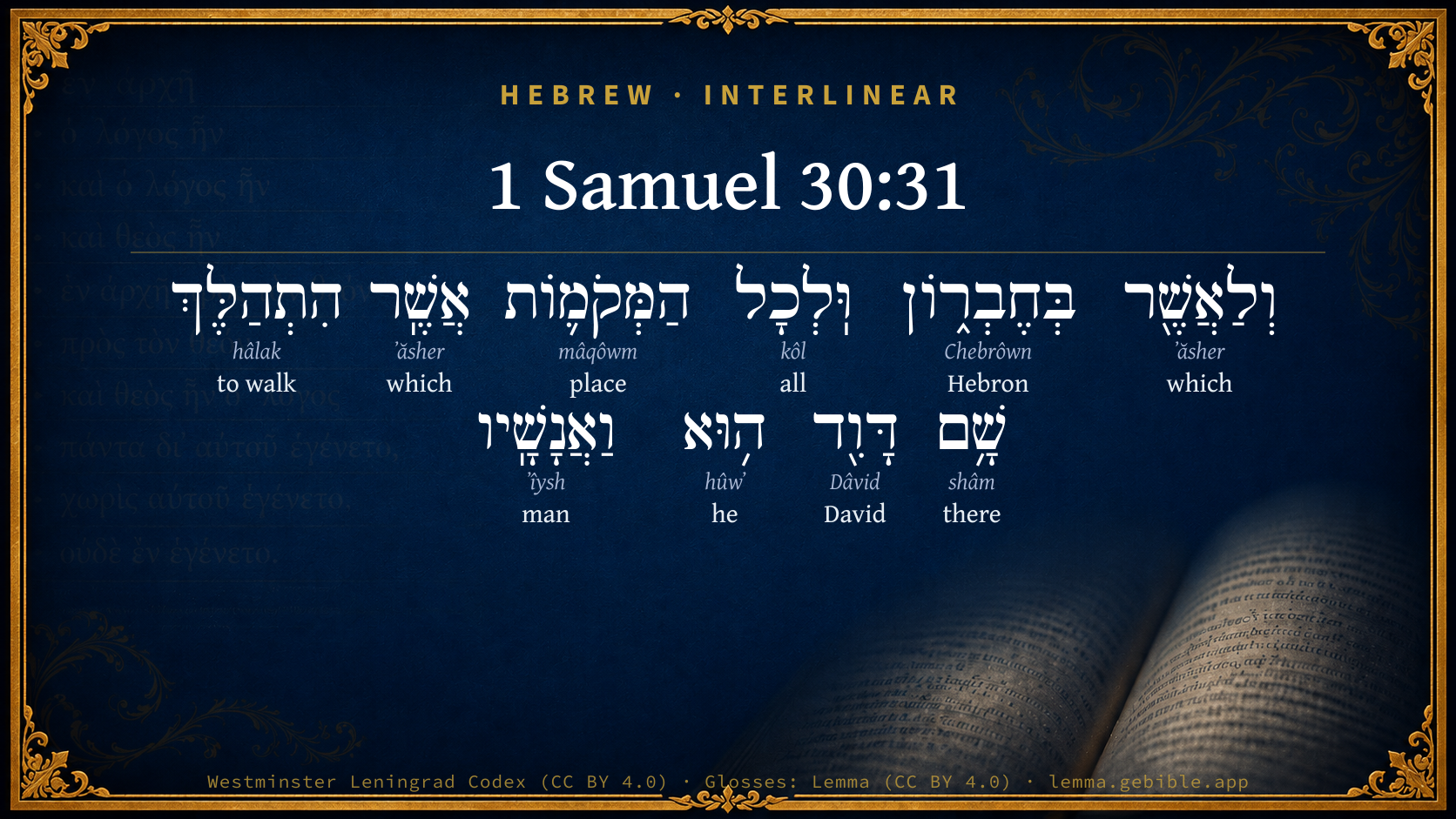
Hebrew (Westminster Leningrad Codex) 1 Samuel 30:31 appears in the Hebrew Old Testament. The text above is from the Westminster Leningrad Codex. Each word links to its Strong’s number, a concise gloss, and parsing drawn from the Open Scriptures Hebrew Bible morphology. Click any word for its full Brown-Driver-Briggs (BDB) entry.
Download image
Cite this verse

1 Samuel 30:31 (World English Bible). Public Domain. Lemma interlinear Bible study tool, https://lemma.gebible.app/v/1-samuel/30/31.

Show BibTeX & RIS
BibTeX
RIS
English Translation
and to those who were in Hebron, and to all the places where David himself and his men used to stay.
World English Bible · Public Domain
Download a study sheet

One document with this verse’s original text, its word-by-word gloss line, the meaning frame, cross-references with their text, attributed commentary, and full source and license credits — printable, and it pastes into notes with its structure intact.

This verse Autodidact and up

Study sheet (.html) Plain text (.txt)

A passage Seminary Student

Up to 50 verses in one chapter. A passage sheet keeps up to 6 commentary sources and 12 cross-references per verse, in the order this page ranks them, and says so on the sheet whenever that leaves anything out. Ask for a single verse and you get the Autodidact verse sheet above.

Everything on this page stays free to read, with no account — the sheet is a download of what is already on screen, not access to it.

Want to remove ads? Support Godless Engineer
Compare translations 3

The same verse in 3 English versions, stacked beneath the original-language interlinear above. Click any original word for its lexicon entry.

Each is an independent rendering of the whole verse — the interlinear is not word-aligned to these translations.

Highlighted words mark where these versions differ — a whole-verse word diff, not a word-by-word alignment.

  • World English Bible Public Domain
    and to those who were in Hebron, and to all the places where David himself and his men used to stay.
  • King James Version Public Domain
    And to them which were in Hebron, and to all the places where David himself and his men were wont to haunt.
  • unfoldingWord Literal Text CC BY-SA 4.0
    and to who in Hebron and to all of the places where David had walked about there, he and his men.

unfoldingWord Literal Text — © unfoldingWord, licensed CC BY-SA 4.0. Word-aligned USFM3 via Door43 (git.door43.org/unfoldingWord/en_ult).

Versions to compare (up to 4)

3 of 4 selected

Show all 18 translations

Every available English version of this verse, each an independent rendering of the whole verse.

  • World English Bible Public Domain
    and to those who were in Hebron, and to all the places where David himself and his men used to stay.
  • Berean Standard Bible Public Domain
    and to those in Hebron and in all the places where David and his men had roamed.
  • Majority Standard Bible Public Domain
    and to those in Hebron and in all the places where David and his men had roamed.
  • King James Version Public Domain
    And to them which were in Hebron, and to all the places where David himself and his men were wont to haunt.
  • American Standard Version (1901) Public Domain
    and to them that were in Hebron, and to all the places where David himself and his men were wont to haunt.
  • Revised Version (1885) Public Domain
    and to them which were in Hebron, and to all the places where David himself and his men were wont to haunt.
  • Geneva Bible (1599) Public Domain
    And to them of Hebron, and to all the places where Dauid and his men had hanted.
  • Douay-Rheims (1899) Public Domain
    And that were in Hebron, and to the rest that were in those places, in which David had abode with his men.
  • Young's Literal Translation Public Domain
    and to those in Hebron, and to all the places where David had gone up and down, he and his men.
  • Literal Standard Version CC BY-SA 4.0
    and to those in Hebron, and to all the places where David—he and his men—had gone up and down.
  • Unlocked Literal Bible CC BY-SA 4.0
    and to those who were in Hebron, and to all the places where David himself and his men habitually went.
  • unfoldingWord Literal Text CC BY-SA 4.0
    and to who in Hebron and to all of the places where David had walked about there, he and his men.
  • Darby Bible Public Domain
    and to those in Hebron, and to all the places where David himself and his men went about.
  • World Messianic Bible Public Domain
    to those who were in Hebron, and to all the places where David himself and his men used to stay.
  • Webster's Bible Public Domain
    And to them who were in Hebron, and to all the places where David himself and his men were accustomed to resort.
  • Free Bible Version CC BY-SA 4.0
    Hebron—all the places David and his men had gone to.
  • Bible in Basic English Public Domain
    And in Hebron, and to all the places where David and his men had been living.
  • JPS Tanakh (1917) Public Domain
    and to them that were in Hebron, and to all the places where David himself and his men were wont to haunt.

Literal Standard Version (2020), Covenant Press — licensed CC BY-SA 4.0. Text via the HelloAO Bible API (eBible.org). Unlocked Literal Bible (unfoldingWord) — licensed CC BY-SA 4.0. Text via the HelloAO Bible API (eBible.org). unfoldingWord Literal Text — © unfoldingWord, licensed CC BY-SA 4.0. Word-aligned USFM3 via Door43 (git.door43.org/unfoldingWord/en_ult). Free Bible Version, Dr. Jonathan Gallagher — licensed CC BY-SA 4.0. Text via the HelloAO Bible API (eBible.org).

Word by word

More ways to search: Search by grammar → Find every occurrence → Compare this word →

Practice this passage: Drill this verse → Learn its vocabulary →

בְּחֶבְר֑וֹן
Chebrôwn
H2275
“in/at · Hebron”
Preposition + Noun, Proper
Part of Speech
Preposition + Noun
Type
Proper
Full BDB Definition

Origin: from H2267

TWOT: 598i

Hebron = "association" - a city in south Judah approx 20 south of Jerusalem and approx 20 miles (30 kilometers) north of Beersheba and near where Abraham built an altar (noun proper locative) - the 3rd son of Kohath and grandson of Levi (noun proper masculine) - a descendant of Caleb (noun proper masculine)
  1. וְלַאֲשֶׁ֖ר ʼăsher H834 “and · to/for · which” Conjunction + Preposition + Particle, Relative
  2. וּֽלְכָל kôl H3605 “and · to/for · all of” Conjunction + Preposition + Noun, Common, Masculine, Singular, Construct
  3. הַמְּקֹמ֛וֹת mâqôwm H4725 “the · places” Particle, Definite Article + Noun, Common, Masculine, Plural, Absolute
  4. אֲשֶֽׁר ʼăsher H834 “which” Particle, Relative
  5. הִתְהַלֶּךְ hâlak H1980 “to walk” Verb, Hithpael, Perfect, 3rd Person, Masculine, Singular
  6. שָׁ֥ם shâm H8033 “there” Adverb
  7. דָּוִ֖ד Dâvid H1732 “David” Noun, Proper
  8. ה֥וּא hûwʼ H1931 “he” Pronoun, Personal, 3rd Person, Masculine, Singular
  9. וַאֲנָשָֽׁיו ʼîysh H376 “and · men · his” Conjunction + Noun, Common, Masculine, Plural, Construct + Suffix, Personal, 3rd Person, Masculine, Singular

About this verse

These counts appear in no published source. They are computed here, from the morphology-tagged text and Lemma’s own curated glosses. What Lemma adds →

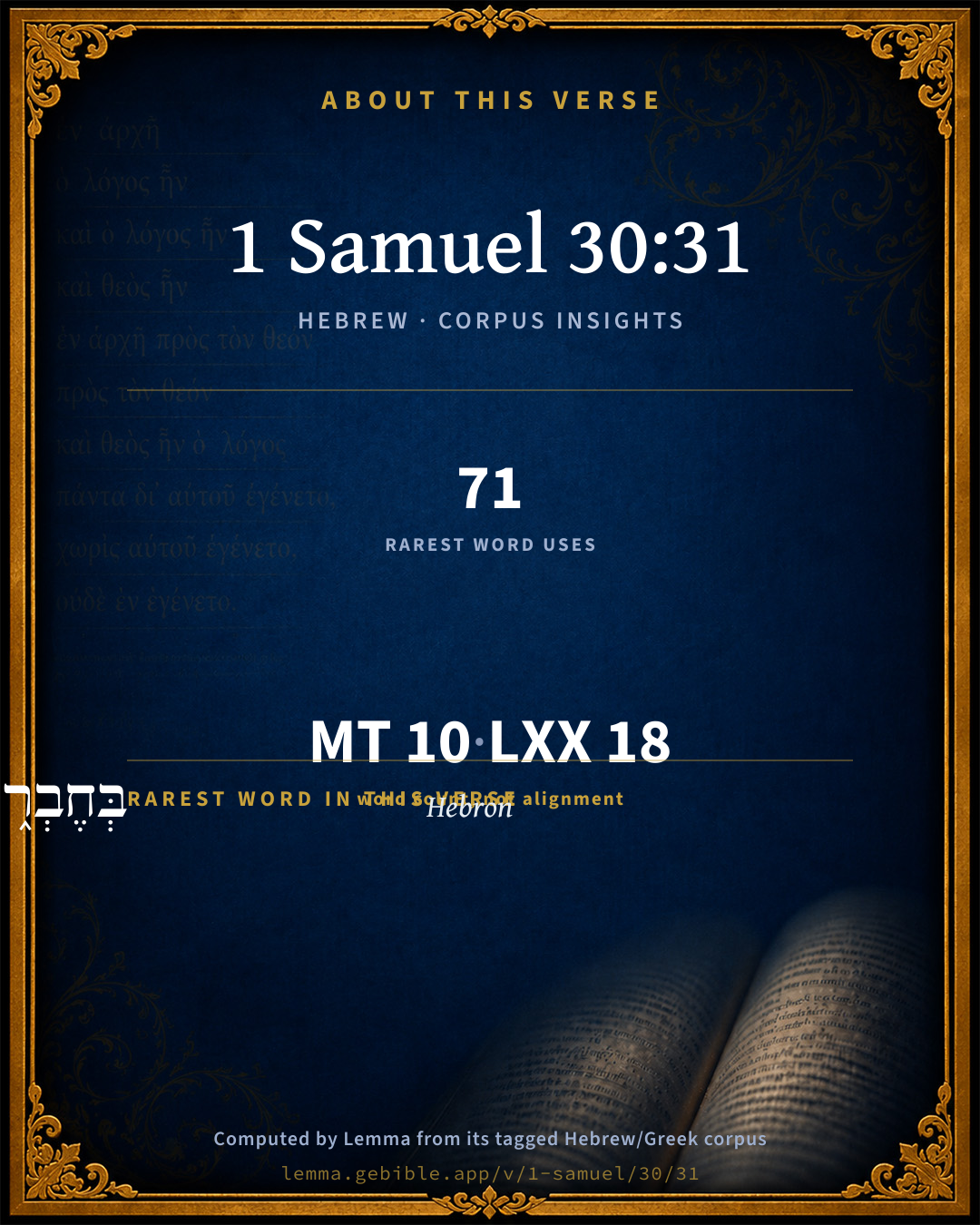
10
words
9
distinct lemmas
Historical
section

Grammatical profile

  • 1 verb
  • 5 nouns
  • 1 pronoun
  • 1 adverb
  • 2 particles

Verb forms

  • הִתְהַלֶּךְ Hithpael · Perfect

Repetition

A word recurs within this verse — often emphatic in Hebrew:

  • וְלַאֲשֶׁ֖ר which H834 ×2

Hebrew & Septuagint length

In English translation the verse runs 21 words from the Hebrew and 18 from the Septuagint (LXX English) — closely comparable.

A rough comparison of the two English renderings, which tokenize alike — not a word-level alignment.

Word counts can differ between the Hebrew and the Greek without any difference in meaning — e.g. the Hebrew direct-object marker אֵת has no separate Greek word, and Greek often adds the article ὁ.

In the original languages it is 10 Hebrew tokens and 18 Greek tokens — but the two are counted differently (Hebrew bundles its prefixes and suffixes into one token; the Greek is in lemma form), so that isn’t a like-for-like length.

Cross-references

5

Topical passages linked to 1 Samuel 30:31 in the Treasury of Scripture Knowledge — connected by theme and wording, ordered by reader-vote popularity; previews shown in the World English Bible.

  • 2 Samuel 2:1 It happened after this, that David inquired of Yahweh, saying, Shall I go up into any of the cities of Judah? Yahweh said to him, Go up. David said, Where shall I go up? He said, To Hebron.
  • Joshua 14:13–15 Joshua blessed him; and he gave Hebron to Caleb the son of Jephunneh for an inheritance.
  • 2 Samuel 2:4 The men of Judah came, and there they anointed David king over the house of Judah. They told David, saying, The men of Jabesh Gilead were those who buried Saul.
  • 2 Samuel 4:1 When [Ish-bosheth], Saul's son, heard that Abner was dead in Hebron, his hands became feeble, and all the Israelites were troubled.
  • 2 Samuel 15:10 But Absalom sent spies throughout all the tribes of Israel, saying, As soon as you hear the sound of the trumpet, then you shall say, Absalom is king in Hebron.

Cross-references courtesy of OpenBible.info (CC BY 4.0).

Hebrew and Greek witnesses Masoretic Hebrew ↔ Greek Septuagint

The same verse in the two great witnesses to the Old Testament, shown verse-for-verse.

These are two independent witnesses, not word-aligned to each other, and the Septuagint is shown in lemma (dictionary) form.

Hebrew 1 Samuel 30:31 Masoretic · Westminster Leningrad Codex

וְלַאֲשֶׁ֖ר בְּחֶבְר֑וֹן וּֽלְכָל הַמְּקֹמ֛וֹת אֲשֶֽׁר הִתְהַלֶּךְ שָׁ֥ם דָּוִ֖ד ה֥וּא וַאֲנָשָֽׁיו

and to those who were in Hebron, and to all the places where David himself and his men used to stay.

World English Bible · Public Domain

Greek LXX 1 Samuel 30:31 Septuagint · lemma form

καί ὁ ἐν χεβρων καί εἰς πᾶς ὁ τόπος ὅς διαἔρχομαι δαυίδ ἐκεῖ αὐτός καί ὁ ἀνήρ αὐτός

and to those in Chebron, and to all the places which David and his men had passed through.

LXX2012 (modern English Septuagint) · Public Domain

Hebrew: Westminster Leningrad Codex (CC BY 4.0). Greek: Septuagint (public domain); English from LXX2012 (modern English Septuagint) (Public Domain). How the Septuagint differs from the Hebrew →

Targum (Aramaic paraphrase)

1

The Targum is the ancient Jewish Aramaic paraphrase of the Hebrew Scriptures — an interpretive translation, not the Hebrew text itself. Onkelos (literal) and Pseudo-Jonathan (expansive) render the Torah, and Jonathan the Prophets. Coverage is partial: where no permissively-licensed English translation exists for a verse, only the Aramaic is shown. This is verse-level text, not a word-by-word alignment to the Hebrew.

  1. Targum Jonathan Prophets (Joshua–Malachi)
    וּלְדִי בְּחֶבְרוֹן וּלְכָל אַתְרַיָא דִי הַלִיךְ תַּמָן דָוִד הוּא וְגַבְרוֹהִי:

    (no public-domain English translation for this verse)

    Targum Jonathan — Aramaic: “Mikraot Gedolot” (public domain). English: “Sefaria Community Translation” (CC0 1.0 (public-domain dedication)); “London "Chaldee Paraphrase," 1871” (public domain). Text via Sefaria.

Commentary

Notes on 1 Samuel 30:31 from classic Christian and Jewish commentators (each source and its license shown beneath its notes). The classic Christian expositions comment on the surrounding passage and are grouped to its opening verse, so a note may address several verses; the Jewish commentaries on the Tanakh (Rashi and others) are per-verse, so they appear only where the commentator wrote on this verse.

Lemma curates 59 commentaries, every one of them public domain or Creative Commons licensed, each selected and text-cleaned for this edition rather than reprinted as found. About our sources →

Trapp's Complete Commentary

John Trapp

1Sa 30:31 And to [them] which [were] in Hebron, and to all the places where David himself and his men were wont to haunt.

Ver. 31. Were wont to haunt.] When they fled and hid from Saul, everywhere they found friends. So did the Waldenses in the worst of times. From Mentz in Germany, to Milan in Italy, they could pass and lodge with those of their own profession all along; neither forgot they that apostolical precept, "And be ye thankful," {Col 3:15} viz., to your friends and benefactors.

John Trapp, A Commentary or Exposition upon All the Books of the Old and New Testament (1647–1656) — public domain. Text from a community e-Sword module.

Tyndale Open Study Notes

Tyndale Open Resources

30:31 From Hebron, David reigned as king over Judah for 7½ years (2 Sam 2:1-7; 5:5).

Tyndale Open Study Notes — © Tyndale Open Resources, licensed CC BY-SA 4.0. Text via the HelloAO Bible API.

Geneva Bible (1599)

Geneva Bible translators

Showing himself mindful of their benefits towards him.

Geneva Bible (1599) marginal notes — public domain. Text via Bolls.life.

Adam Clarke's Commentary

Verse 31. To them which were in Hebron] This was a place strongly attached to David, and David to it, and the place where he was proclaimed king, and where he reigned more than seven years previously to the death of Ishbosheth, Saul's son, who was, for that time, his competitor in the kingdom.

David's having sent presents to all these places, not only shows his sense of gratitude, but that the booty which he took from the Amalekites must have been exceedingly great. And we learn from this also that David sojourned in many places which are not mentioned in the preceding history; for these are all said to be places where David and his men were wont to haunt.

WE are not to suppose that the transactions mentioned here and in the preceding chapter took place after Saul's interview with the woman of En-dor, they were considerably antecedent to this, but how long we do not know. What is recorded in the following chapter must have taken place the next day after Saul left En-dor.

Adam Clarke's Commentary on the Bible (1810–1826) — public domain. Text from a community e-Sword/MySword module.

Ellicott's Commentary for English Readers

(31) Hebron.—Hebron is one of the most ancient known cities in the world. It is now called El-Khalil (“friend of God”), owing to Abraham’s residence there. During the early years of David’s rule, which followed the death of Saul, Hebron was the residence and royal city of David. Beneath the building of the present Mosque of Hebron is the famous Cave of Machpelah, where Abraham and Sarah and the patriarchs Isaac and Jacob, and his wife Leah, are buried.

A Bible Commentary for English Readers, edited by Charles John Ellicott (1878–1897) — public domain. Text from a community e-Sword module.

The Cambridge Bible for Schools and Colleges

gen. ed. J. J. S. Perowne

31. Hebron] One of the most ancient cities in the world (Num_13:22). When Abraham entered Canaan it was already existing under the name of Kirjath Arba. In its neighbourhood he often sojourned, and there he bought the cave of Machpelah from Ephron the Hittite for a family sepulchre for himself and his posterity (Gen_23:2 ff.). On the conquest of Canaan it became the inheritance of Caleb (Jos_14:13-15), and was made a priestly settlement and a city of refuge (Jos_21:11-13). It was soon to attain greater importance as the capital of David’s kingdom during the first seven years and a half of his reign. It lies 20 miles south of Jerusalem, picturesquely situated in a narrow valley surrounded by rocky hills, whose sides are clothed with luxuriant vineyards. Its modern name is El Khulîl = “The Friend,” in memory of Abraham who was called “the friend of God” (2Ch_20:7; Isa_41:8; Jas_2:13).

all the places, &c.] It is evident that David’s outlaw life must have lasted for some considerable time, and have proved an important factor in preparing the men of Judah to welcome him as their king. The instances quoted above indicate that it was during this period that he gained many of the faithful friends who afterwards filled offices of trust in his kingdom.

The Cambridge Bible for Schools and Colleges (gen. ed. J. J. S. Perowne; Cambridge University Press, 1878–1918) — public domain. Text from a community e-Sword module.

John Gill's Exposition

And to them which were in Hebron,.... A noted city in the tribe of Judah, in the mountainous part of it, and a city of refuge, and where David was afterwards anointed, first king over Judah, and then over Israel, Sa2 2:4,

and to all the places where David himself and his men were wont to haunt; where they had their walks, and went to and fro when persecuted by Saul; all such places, and the inhabitants of them, David had a grateful remembrance of, who sheltered and relieved him in the times of his distress.

Next: 1 Samuel Chapter 31

John Gill's Exposition of the Whole Bible (1746–1763) — public domain (CC PDM 1.0). Text via the HelloAO Bible API.

Albert Barnes' Notes on the Bible

Hebron - Now El-Khulil (see Gen 23:2). Hebron was a city of refuge Jos 20:7, and one of the cities of the Kohathites Jos 21:11. It lies twenty miles south of Jerusalem.

Albert Barnes' Notes on the Bible (1834–1885) — public domain. Text from a community e-Sword/MySword module.

Haydock's Catholic Bible Commentary

Hebron, twenty miles south of Jerusalem. --- Rest. David remunerated all his old friends, which was the sure way to procure more. (Haydock) --- He was still uncertain what would be the event of the war between Saul and the Philistines; and desirous to make friends, who might smooth his way to the throne, according to God’s appointment. (Salien)

George Leo Haydock (1774–1849), Haydock's Catholic Family Bible and Commentary, 1859 edition — public domain. Excludes Psalms (Douay-Rheims chapter numbering differs from Protestant) and Deuterocanonical books (Catholic canon only).

Matthew Poole's English Annotations

Or, to go; whither they used to resort in the time of Saul’s persecution, either to hide themselves in some of their territories, or to get provision from thence.

Matthew Poole's English Annotations on the Holy Bible (1683–1685) — public domain. Text from a community e-Sword/MySword module.

Whedon's Commentary on the Bible

Daniel D. Whedon

31. Hebron — See on Jos_10:3. In these and other places in the same section of country David and his men were accustomed to wander, and received kindness from the elders.

Daniel D. Whedon (gen. ed.), Commentary on the Old and New Testaments (1874–1909) — public domain. Text from a community e-Sword module.

The Pulpit Commentary

Hebron, destined soon to become David"s capital, (2Sa_2:1) lay about fourteen miles south of Jerusalem. For an account of it see Conder, "Tent Work," 2:79, sqq. In comparing the list of David"s heroes (1Ch_11:26-47) with this catalogue of friendly towns, it will be found that several of them came from them, and had probably shared his exile at Ziklag. Such were Ira and Gareb, Ithrites from Jattir, Shama and Jehiel from Aroer; perhaps also Zabdi the Shiphmite (1Ch_27:27) came from Siphmoth. We find David in this narrative acting justly as a soldier, generously to those who had been kind to him in his wanderings, and forming friendships which he retained and cherished long afterwards, when from being a fugitive he had become a king.

The Pulpit Commentary (1880–1919), ed. H.D.M. Spence-Jones & Joseph S. Exell — public domain. Text from a community e-Sword module.

Rashi

Rabbi Shlomo Yitzchaki (Rashi)

Where Dovid [and his men] had gone. For they would hide him from Shaul.

Rashi on the Tanakh — English translations: “The Judaica Press complete Tanach with Rashi, translated by A. J. Rosenberg” (CC BY 4.0); “Pentateuch with Rashi's commentary by M. Rosenbaum and A.M. Silbermann, 1929-1934” (public domain); “The Metsudah Tanach series, Lakewood, N.J” (CC BY 4.0); and “The Book of Joshua, Metsudah Publications, 1997” (CC BY 4.0). Text via Sefaria.

Lesson kit

Teaching starters — assembled from the data on this page, not authored interpretation. Every prompt links to the verse data it draws on. Edit before teaching.

1 Samuel, in the Historical, opens this verse with 10 words (9 distinct Hebrew lemmas). Its most distinctive word is Chebrôwn (“Hebron”). A historical commentator’s framing appears above. Read the whole chapter for the surrounding context.

Discussion questions

  1. What does “Hebron” (Chebrôwn) contribute to the verse as a whole?
  2. How does 2 Samuel 2:1, which shares this passage’s theme, read alongside this verse?
  3. What does the repetition of “which” (2× in this one verse) do in this verse?
  4. These translations render this verse differently. What is at stake in choosing one wording over another?
  5. «הִתְהַלֶּךְ» is a Hithpael Perfect verb. How does that grammatical form shape the action described?
  6. Compare how Trapp's Complete Commentary and Tyndale Open Study Notes read this verse. Where do they agree or differ?

Things to notice

Reading settings

Reading text

Shown beneath each verse's original-language words.

Old Testament
Old Testament edition

Read the OT as the Masoretic Hebrew (MT) or the Greek Septuagint (LXX).

English shown for the Greek Septuagint (in the Hebrew ↔ Greek comparison).

Comparing translations? Open the Compare panel on any verse page to stack up to four side by side.