
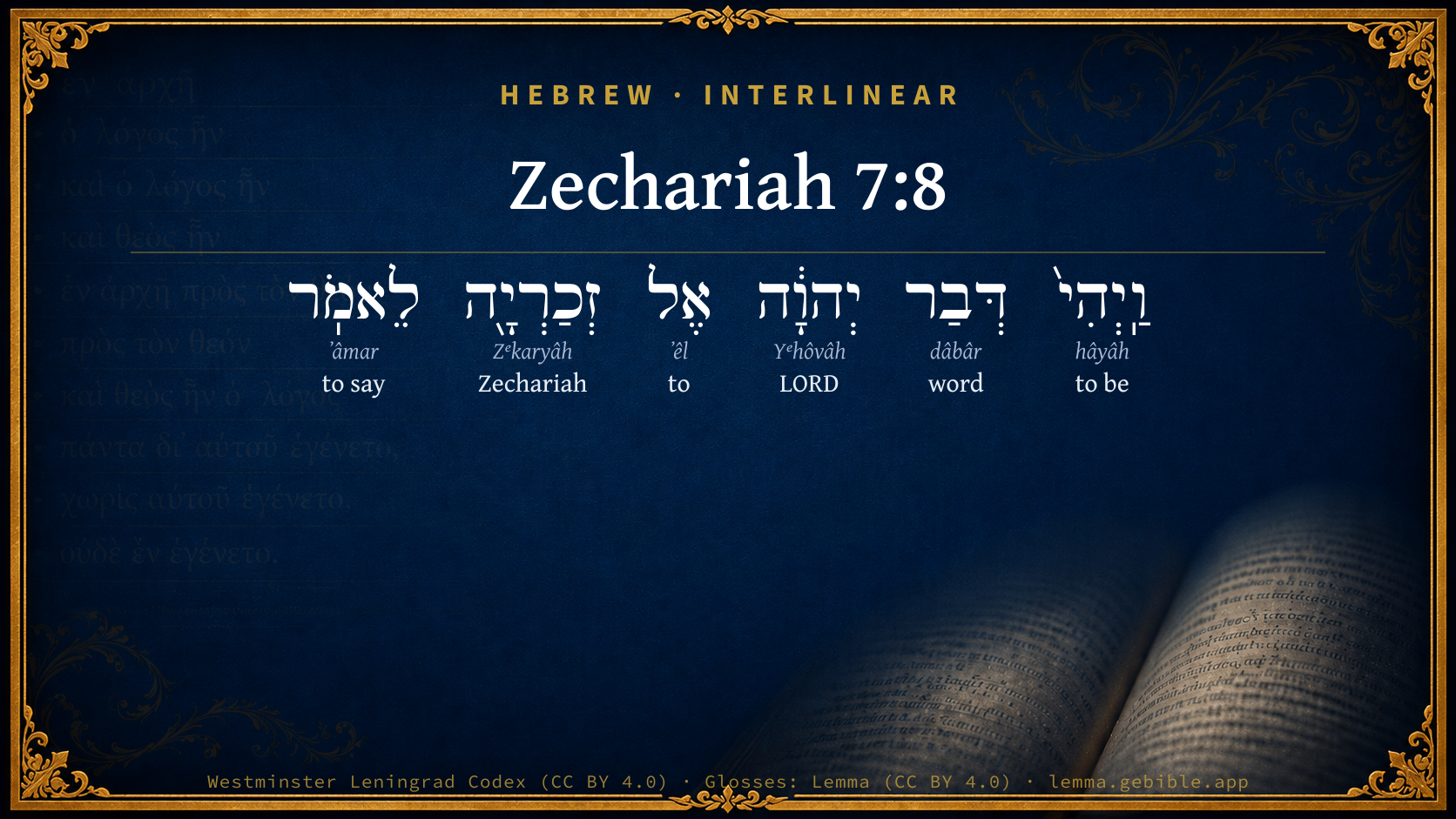
Zechariah 7:8

Hebrew (Westminster Leningrad Codex) Zechariah 7:8 appears in the Hebrew Old Testament. The text above is from the Westminster Leningrad Codex. Each word links to its Strong’s number, a concise gloss, and parsing drawn from the Open Scriptures Hebrew Bible morphology. Click any word for its full Brown-Driver-Briggs (BDB) entry.
Download image
Cite this verse

Zechariah 7:8 (World English Bible). Public Domain. Lemma interlinear Bible study tool, https://lemma.gebible.app/v/zechariah/7/8.

Show BibTeX & RIS
BibTeX
RIS
English Translation
The word of Yahweh came to Zechariah, saying,
World English Bible · Public Domain
Download a study sheet

One document with this verse’s original text, its word-by-word gloss line, the meaning frame, cross-references with their text, attributed commentary, and full source and license credits — printable, and it pastes into notes with its structure intact.

This verse Autodidact and up

Study sheet (.html) Plain text (.txt)

A passage Seminary Student

Up to 50 verses in one chapter. A passage sheet keeps up to 6 commentary sources and 12 cross-references per verse, in the order this page ranks them, and says so on the sheet whenever that leaves anything out. Ask for a single verse and you get the Autodidact verse sheet above.

Everything on this page stays free to read, with no account — the sheet is a download of what is already on screen, not access to it.

Want to remove ads? Support Godless Engineer
Compare translations 3

The same verse in 3 English versions, stacked beneath the original-language interlinear above. Click any original word for its lexicon entry.

Each is an independent rendering of the whole verse — the interlinear is not word-aligned to these translations.

Highlighted words mark where these versions differ — a whole-verse word diff, not a word-by-word alignment.

  • World English Bible Public Domain
    The word of Yahweh came to Zechariah, saying,
  • King James Version Public Domain
    And the word of the LORD came unto Zechariah, saying,
  • unfoldingWord Literal Text CC BY-SA 4.0
    And the word of Yahweh came to Zechariah, saying,

unfoldingWord Literal Text — © unfoldingWord, licensed CC BY-SA 4.0. Word-aligned USFM3 via Door43 (git.door43.org/unfoldingWord/en_ult).

Versions to compare (up to 4)

3 of 4 selected

Show all 18 translations

Every available English version of this verse, each an independent rendering of the whole verse.

  • World English Bible Public Domain
    The word of Yahweh came to Zechariah, saying,
  • Berean Standard Bible Public Domain
    Then the word of the LORD came to Zechariah, saying,
  • Majority Standard Bible Public Domain
    Then the word of the LORD came to Zechariah, saying,
  • King James Version Public Domain
    And the word of the LORD came unto Zechariah, saying,
  • American Standard Version (1901) Public Domain
    And the word of Jehovah came unto Zechariah, saying,
  • Revised Version (1885) Public Domain
    And the word of the LORD came unto Zechariah, saying,
  • Geneva Bible (1599) Public Domain
    And the worde of the Lord came vnto Zechariah, saying,
  • Douay-Rheims (1899) Public Domain
    And the word of the Lord came to Zacharias, saying:
  • Young's Literal Translation Public Domain
    And there is a word of Jehovah unto Zechariah, saying:
  • Literal Standard Version CC BY-SA 4.0
    And there is a word of YHWH to Zechariah, saying,
  • Unlocked Literal Bible CC BY-SA 4.0
    The word of Yahweh came to Zechariah, saying,
  • unfoldingWord Literal Text CC BY-SA 4.0
    And the word of Yahweh came to Zechariah, saying,
  • Darby Bible Public Domain
    And the word of Jehovah came unto Zechariah, saying,
  • World Messianic Bible Public Domain
    The LORD’s word came to Zechariah, saying,
  • Webster's Bible Public Domain
    And the word of the LORD came to Zechariah, saying,
  • Free Bible Version CC BY-SA 4.0
    The Lord Almighty sent another message to me.
  • Bible in Basic English Public Domain
    And the word of the Lord came to Zechariah, saying,
  • JPS Tanakh (1917) Public Domain
    And the word of the LORD came unto Zechariah, saying:

Literal Standard Version (2020), Covenant Press — licensed CC BY-SA 4.0. Text via the HelloAO Bible API (eBible.org). Unlocked Literal Bible (unfoldingWord) — licensed CC BY-SA 4.0. Text via the HelloAO Bible API (eBible.org). unfoldingWord Literal Text — © unfoldingWord, licensed CC BY-SA 4.0. Word-aligned USFM3 via Door43 (git.door43.org/unfoldingWord/en_ult). Free Bible Version, Dr. Jonathan Gallagher — licensed CC BY-SA 4.0. Text via the HelloAO Bible API (eBible.org).

Word by word

More ways to search: Search by grammar → Find every occurrence → Compare this word →

Practice this passage: Drill this verse → Learn its vocabulary →

זְכַרְיָ֖ה
Zᵉkaryâh
H2148
“Zechariah”
Noun, Proper
Part of Speech
Noun
Type
Proper
Full BDB Definition

Origin: from H2142 and H3050

TWOT: None

Zechariah = "Jehovah remembers" - 11th in order of the minor prophets; a priest, son of Berechiah and grandson of Iddo, who, along with Haggai, directed the rebuilding of the temple in the days of Zerubbabel - king of Israel, son of Jeroboam II - son of Meshelemiah of Shelemiah, a Korhite, and keeper of the north gate of the tabernacle of the congregation - one of the sons of Jehiel - a Levite of the second order in the temple band in the time of David - one of the princes of Judah in the reign of Jehoshaphat - son of the high priest Jehoiada, in the reign of Joash king of Judah, who was stoned in the court of the temple - a Kohathite Levite in the reign of Josiah - the leader of the sons of Pharosh who returned with Ezra - son of Bebai - one of the chiefs of the people whom Ezra summoned in council at the river Ahava; stood at Ezra's left hand when Ezra expounded the law to the people - one of the family of Elam who had married a foreign wife after the captivity - ancestor of Athaiah or Uthai - a Shilonite, descendant of Perez, grandfather of Athaiah - a priest, son of Pashur - the representative of the priestly family of Iddo in the days of Joiakim the son of Jeshua; possibly the same as 1 above - one of the priests, son of Jonathan, who blew with the trumpets at the dedication of the city wall by Ezra and Nehemiah - a chief of the Reubenites at the time of the captivity by Tiglath-pileser - one of the priests who accompanied the ark from the house of Obed-edom - son of Isshiah of Jesiah, a Kohathite Levite descended from Uzziel - 4th son of Hosah, of the children of Merari - a Manassite, father of Iddo - father of Jahaziel. He prophesied in the spirit - one of the sons of Jehoshaphat - a prophet in the reign of Uzziah, who appears to have acted as the king's counsellor, but of whom nothing is known - father of Abijah or Abi, Hezekiah's mother - one of the family of Asaph in the reign of Hezekiah - one of the rulers of the temple in the reign of Josiah - son of Jeberechiah who was taken by the prophet Isaiah as one of the 'faithful witnesses to record' when he wrote concerning Maher-shalal-hash-baz
  1. וַֽיְהִי֙ hâyâh H1961 “and · to be” Conjunction + Verb, Qal, Sequential Imperfect, 3rd Person, Masculine, Singular
  2. דְּבַר dâbâr H1697 “word of” Noun, Common, Masculine, Singular, Construct
  3. יְהוָ֔ה Yᵉhôvâh H3068 “LORD” Noun, Proper
  4. אֶל ʼêl H413 “to” Preposition
  5. לֵאמֹֽר ʼâmar H559 “to say” Preposition + Verb, Qal, Infinitive Construct

About this verse

These counts appear in no published source. They are computed here, from the morphology-tagged text and Lemma’s own curated glosses. What Lemma adds →

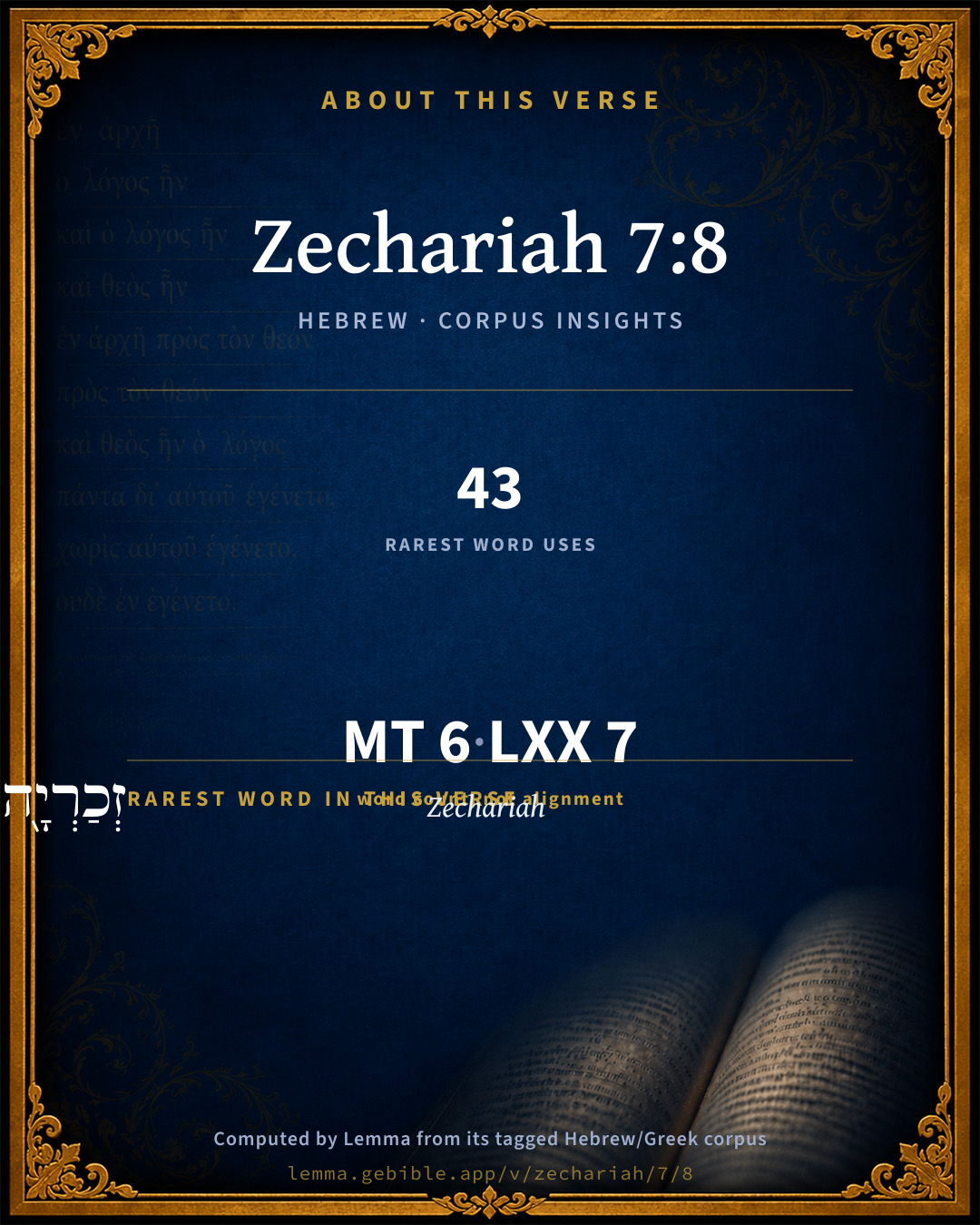
6
words
6
distinct lemmas
Prophets
section

Shared distinctive vocabulary

זְכַרְיָ֖ה Zechariah H2148 occurs in 43 verses of the Hebrew Bible. Also found in:

Grammatical profile

  • 2 verbs
  • 3 nouns
  • 1 preposition

Verb forms

  • וַֽיְהִי֙ Qal · Sequential Imperfect
  • לֵאמֹֽר Qal · Infinitive Construct

Hebrew & Septuagint length

In English translation the verse runs 8 words from the Hebrew and 10 from the Septuagint (LXX English) — closely comparable.

A rough comparison of the two English renderings, which tokenize alike — not a word-level alignment.

Word counts can differ between the Hebrew and the Greek without any difference in meaning — e.g. the Hebrew direct-object marker אֵת has no separate Greek word, and Greek often adds the article ὁ.

In the original languages it is 6 Hebrew tokens and 7 Greek tokens — but the two are counted differently (Hebrew bundles its prefixes and suffixes into one token; the Greek is in lemma form), so that isn’t a like-for-like length.

Hebrew and Greek witnesses Masoretic Hebrew ↔ Greek Septuagint

The same verse in the two great witnesses to the Old Testament, shown verse-for-verse.

These are two independent witnesses, not word-aligned to each other, and the Septuagint is shown in lemma (dictionary) form.

Hebrew Zechariah 7:8 Masoretic · Westminster Leningrad Codex

וַֽיְהִי֙ דְּבַר יְהוָ֔ה אֶל זְכַרְיָ֖ה לֵאמֹֽר

The word of Yahweh came to Zechariah, saying,

World English Bible · Public Domain

Greek LXX Zechariah 7:8 Septuagint · lemma form

καί γίγνομαι λόγος κύριος πρός ζαχαριας λέγω

And the word of the Lord came to Zacharias, saying,

LXX2012 (modern English Septuagint) · Public Domain

Hebrew: Westminster Leningrad Codex (CC BY 4.0). Greek: Septuagint (public domain); English from LXX2012 (modern English Septuagint) (Public Domain). How the Septuagint differs from the Hebrew →

Targum (Aramaic paraphrase)

1

The Targum is the ancient Jewish Aramaic paraphrase of the Hebrew Scriptures — an interpretive translation, not the Hebrew text itself. Onkelos (literal) and Pseudo-Jonathan (expansive) render the Torah, and Jonathan the Prophets. Coverage is partial: where no permissively-licensed English translation exists for a verse, only the Aramaic is shown. This is verse-level text, not a word-by-word alignment to the Hebrew.

  1. Targum Jonathan Prophets (Joshua–Malachi)
    וַהֲוָה פִּתְגַם נְבוּאָה מִן קֳדָם יְיָ עִם זְכַרְיָה לְמֵימָר:

    (no public-domain English translation for this verse)

    Targum Jonathan — Aramaic: “Mikraot Gedolot” (public domain). English: “Sefaria Community Translation” (CC0 1.0 (public-domain dedication)); “London "Chaldee Paraphrase," 1871” (public domain). Text via Sefaria.

Commentary

Notes on Zechariah 7:8 from classic Christian and Jewish commentators (each source and its license shown beneath its notes). The classic Christian expositions comment on the surrounding passage and are grouped to its opening verse, so a note may address several verses; the Jewish commentaries on the Tanakh (Rashi and others) are per-verse, so they appear only where the commentator wrote on this verse.

Lemma curates 59 commentaries, every one of them public domain or Creative Commons licensed, each selected and text-cleaned for this edition rather than reprinted as found. About our sources →

Trapp's Complete Commentary

John Trapp

Zec 7:8 And the word of the LORD came unto Zechariah, saying,

Ver. 8. And the word] {See Trapp on "Zec 7:4"}

John Trapp, A Commentary or Exposition upon All the Books of the Old and New Testament (1647–1656) — public domain. Text from a community e-Sword module.

The Preacher's Complete Homiletical Commentary

Joseph S. Exell (gen. ed.)

CRITICAL NOTES.] Zec_7:8-14.] God requires obedience, not formal fastings. The disobedience of the fathers brought judgment upon the nation.

Zec_7:9. Execute] Admonitions which have special reference to evils of which they were guilty. Judgment] Righteous impartiality in public and private matters. “Judgment of truth (cf. Eze_18:8) is such an administration of justice as simply fixes the eye upon the real circumstances of any dispute, without any personal considerations whatever, and decides them in accordance with truth” [Keil]. Mercy] Tender love to all. Compassion] to the unhappy, sympathy for human suffering.

Zec_7:10.] This verse specifies some of the chief ways of violating the preceding requisition, and shows that it covers the thoughts of the heart as well as the acts of the members [Lange]. Imagine] i.e. devise evil (Psa_36:4; Mic_2:1). Meditate no revenge, but act up to the royal law of love.

Zec_7:11.] The attitude of the people towards these precepts described. Their fathers and some of them refused], paid no serious attention; then pulled away], like a refractory beast refusing the yoke (Neh_9:29; Hos_4:16). “It seems rather to refer to one on whose shoulder we lay our hand, when he is reluctant to listen to us, in order to arrest, and beseech him to hear, but he fretfully and violently ‘draws the shoulder’ from our kind and earnest grasp” [Wardlaw] Stopped] Made heavy (Isa_6:10; Jer_7:26; Act_7:57).

Zec_7:12. Adamant] Hard and impenetrable as stone (Eze_3:9; Eze_11:19). Wrath] The consequence of disobedience and obduracy (2Ch_36:16).

Zec_7:13. He] by his prophets. They] cried in calamities, retribution in kind. They would not hear God, and he would not hear them (Pro_1:24-26; Isa_1:15).

Zec_7:14.] The great wrath described in its execution. Scattered] for 70 years among foreign and barbarous nations; like a tempest driven among those who pitied them not. After] their exile and expulsion no occupants possessed the land. Passed through] Lit. goes away and returns again (Exo_32:27), pass to and fro. They] The Jews themselves to blame; they desolated the pleasant land] lit. the land of desire; made the choice land a desert by their sins (Jer_3:19; Psa_106:24).

DIVINE REQUIREMENTS AND HUMAN DISREGARD.—Zec_7:8-14

The prophet exposes the hollowness of mere outward forms, and reminds the people that their ruin was not caused by neglect of ritual, but by disregard of the plainest duties of justice and humanity. They had refused to hear the reiterated and explicit injunctions of the prophets, and they are reproved for their folly. Notice—

I. The Divine requirements specified. They had practised injunctions of their own imposing and neglected the commands of God. The prophet repeats the substance of former teaching and urges the claims of Jehovah.

1. Sincerity in life. Obedience is better than sacrifice.

(1) Execute judgment. Practise justice officially and privately, before God and man. Judgment must be true, without personal considerations or partiality. “He that hath not given forth upon usury, neither hath taken any increase, that hath withdrawn his hand from iniquity, hath executed true judgment between man and man.”

(2) Compassionate the miserable. “Show mercy” to the unfortunate, be kind and have “compassions every man to his brother.” “Kindness is the golden chain by which society is bound together,” says Goethe.

(3) Oppress not the helpless. Special regard must be paid to the widow and the fatherless, the stranger and the poor. “Ye shall not afflict any widow or fatherless child” (Exo_22:21). “Thou shalt neither vex a stranger nor oppress him: for ye were strangers in the land of Egypt.”

2. Purity in heart. We must not only do no wrong, but not even wish it. No evil must be devised in the heart. “Let none of you imagine evil against his brother in your heart.” Cherish no ill-feeling, no wish to retaliate. All evil inclinations and spiteful intentions must be subdued. We can never act rightly if we do not feel and think rightly. Hence the law of God restrains the heart. “Beware that there be not a thought (word) in thy wicked (Belial) heart” (Deu_15:9).

II. The Divine requirements disregarded. Except men execute judgment, whatever be their fastings and pretensions, they reject the word of God. Ceremonial observances without love to God and man are a solemn mockery.

1. They refused to hearken to God’s word. They hated the claims and rebelled against the authority of God’s commands.

(1) They were wilfully deaf. “Stopped their ears.”

(2) They were wilfully prejudiced. “That they should not hear.” They had no desire to know, much less to practise. God pursued them in earnest, constant warning, but they shook their shoulders, refused to submit or bear the yoke, and were determined in their obstinate purpose (cf. Act_7:51). “They hearkened not, nor inclined their ear, but walked in the counsels and in the imagination of their evil heart, and went backward, and not forward.”

2. They hardened their hearts in sin. “They made their hearts as an adamant stone.” They were resolved that nothing should make an impression upon them: they became proud, presumptuous, and inflexible. Divine power even could neither soften their hearts nor shape their lives. “They dealt proudly, and hearkened not unto thy commandments, but sinned against thy judgments (which, if a man do, he shall live in them), and withdrew the shoulder, and hardened their neck and would not hear.”

III. The fatal consequences of disregarding the Divine requirements. Most terrible are the penalties here set forth. “Therefore,” since they have rejected God, punishment will be in proportion to the violation of his law. “Terrible penalties, withal, if thou still need penalties,” says Carlyle, “are there for disobeying.”

1. God was angry. “Therefore came” wrath, a great wrath, from the Lord of hosts. This anger is evinced—

(1) By disregarding their prayers. “They cried, and I would not hear.” There is “great reason,” says Bp. Reynolds, “that God shall refuse to hear him who refuseth to hear God.” “He that turneth away his ear from hearing the law, even his prayer shall be abomination.”

(2) By scattering them among other nations. “I scattered them with a whirlwind among all the nations.” The common bond of humanity and social intercourse was broken (Deu_28:49-50); they were cast out of their own into a land of perfect strangers, from whom they received no kindness nor mitigation of sorrows.

2. The land was desolated. “For they laid the pleasant land desolate.” It was not the enemy, but their own sins that had cursed their country. God’s presence is the beauty of a nation, but sin will turn it into a barren waste. Human guilt desolates everything that is “pleasant.” Let us take warning. If we despise God’s word he will not hear our cry in the day of wrath. The harder men grow in heart, the heavier the stroke at the judgment day. Those who are lost will have to blame their own folly. No delusion will rob them of this conviction, and no remedy can be devised for the misery which they despised and cannot endure. “They would none of my counsel; they despised all my reproof: therefore shall they eat of the fruit of their own way, and be filled with their own devices.”

RIGHTEOUS RETRIBUTION.—Zec_7:13

This is the first part of punishment, retribution in kind. They would not hear God when he called to them; now he will not hear them when they cry to him. This is God’s method of dealing with nations and individuals.

I. It is often physically true. The drunkard pays when at last he feels himself the slave of habits which he knows will ruin soul and body, and yet unable to throw them off. The licentious who survive the power of gratification may be tortured by appetites for which exhausted nature has no provision [cf. Lange].

II. It is always spiritually true. He that digs a pit for another shall fall into it himself. The backslider in heart shall be filled with his own devices (Pro_14:14). Those who contemn the word of God shall be unheard in the day of distress Alarmed at their situation, they will call, but God will not answer them. Thus men become the cause of their own misery, and constantly remind us of the wise man’s words: “Therefore shall they eat of the fruit of their own way” (Pro_1:30-31; Pro_28:9; Gal_6:7-8).

“I do as truly suffer

As e’er I did commit” [Shakespeare].

HOMILETIC HINTS AND SUGGESTIONS

Zec_7:9. Love, the royal law of life, the essence of religion. Not religious profession, but the practice of social duty. Keep from evil in thought and act. Meditate no revenge, brood over no wrongs, but in all things act up to the requirements of God’s law. “Love worketh no ill.” “Love will not permit us to injure, oppress, or offend our brother; it will not give us leave to neglect our betters, or despise our inferiors. It will restrain every inordinate passion, and not suffer us to gratify our envy at the expense of our neighbour’s credit and reputation; but it will preserve us harmless and innocent” [Bp. Sherlock].

Moral duties. Required in every age. Superior to external ordinances.

Zec_7:10. Widow and fatherless.

1. A sad condition in life. Weak and helpless.

2. A proof of God’s care. “Widows and orphans are God’s clients taken into his special protection” [Trapp].

3. An evidence of true religion. “One of the surest tests of an intelligent Christianity, as well as of a high civilization, is found in the provision made and maintained for those who so often are the victims either of cruel neglect or, alas, of wilful oppression” [Lange]. Compare the teaching of Scripture with the customs of heathenism.

Zec_7:11. Pulled away the shoulder. What is implied in these words?

1. A benevolent purpose.

2. Remarkable human power to resist it.

3. Mysterious providence to permit resistance.

4. Astounding effrontery in the conduct indicated. “Pride not only withdraws the heart from God, but lifts it up against God” [Manton].

“All pride is willing pride” [Shakespeare].

Zec_7:12. Hearts as adamant. The stone, whatever it be, was hard enough to cut ineffaceable characters (Jer_17:1); it was harder than flint (Eze_3:9). It would cut rocks; it could not be engraven itself, or receive the characters of God. This is the last sin, obduracy, persevering impenitence, which resisted the Holy Ghost, and did despite to the Spirit of grace. Not through infirmity, but of set purpose, they hardened themselves, lest they should be converted and be healed (Isa_6:10). Observe the gradations.

1. The words of God are not heard.

2. The restive shoulder is shown. Men turn away, when God by the inner motions of his Spirit, or by lesser chastisements, would bring them to the yoke of obedience. They would not hear the burden of the law, whereas they willingly bore that most heavy weight of their sins.

3. Obduracy. Their adamantine heart could be softened neither by promises nor threats; therefore nothing remained but the great wrath which they had treasured to themselves against the day of wrath [Pusey].

Hardness is the state of a person insensible alike to entreaties, expostulations, warnings, admonitions, and chastisements (Jer_5:3). Men become obdurate—

1. By separating themselves from God, the source of all life, just as a branch dries up when detached from the tree, or as a limb withers when the connection between it and the heart ceases.

2. By a life of pleasure and sin, the effects of which may be compared to those of the river north of Quito, petrifying, according to Kirwin’s account, the wood and leaves cast into its waters; or to those of the busy feet of passers-by, causing the crowded thoroughfare to grow hard [Rev. C. Neil].

Zec_7:11-12. Causes of spiritual ruin.

1. Heedless indifference.

2. Stubborn rebellion—

(1) in refusing the yoke, and

(2) in stopping the ears.

3. Resistance to the Holy Spirit.

Zec_7:13-14. Self-inflicted calamities.

1. Rejection of God in trouble.

2. Dispersion in strange lands.

3. Devastation of country. Mark the contrast: the land of desire and the land of desolation. Obey the word of God and seek to reach that heavenly “land of desire,” where desolation is unknown, and whither the spoiler can never come [cf. Fausset].

ILLUSTRATIONS TO CHAPTER 7

Zec_7:8-10, Duties. Your daily duties are a part of your religious life just as much as your devotions are [H. W. Beecher]. Formality in religion is the name of being alive [Jenkyn].

“The path of duty is the way to glory” [Tennyson].

Zec_7:11-12. Stopped ears. Wise men are instructed by reason; men of less understanding by experience; the most ignorant by necessity; and beasts by nature [Cicero].

“The ear is the road to the heart” [Voltaire].

Zec_7:13-14. Come to pass.

“The past lives o’er again

In its effects, and to the guilty spirit

The ever-frowning present is its image” [S. T. Coleridge.]

The Preacher's Complete Homiletical Commentary (gen. ed. Joseph S. Exell; Funk & Wagnalls, c. 1892) — public domain (pre-1929). A full-Bible homiletical/sermon-outline anthology covering 65 of 66 books (2 John is absent from the source module). Text from a community e-Sword module.

Keil & Delitzsch

C. F. Keil & F. Delitzsch

The second word of the Lord recals to the recollection of the people the disobedience of the fathers, and its consequences, viz., the judgment of exile, as a warning example. The introduction of the prophet's name in the heading in Zac 7:8 does not warrant the strange opinion held by Schmieder and Schlier - namely, that our prophet is here reproducing the words of an earlier Zechariah who lived before the captivity - but is merely to be attributed to a variation in the form of expression. This divine word was as follows: Zac 7:9. "Thus hath Jehovah of hosts spoken, saying, Execute judgment of truth, and show love and compassion one to another. Zac 7:10. And widows and orphans, strangers and destitute ones, oppress not; and meditate not in your heart the injury of every brother. Zac 7:11. But they refused to attend, and offered a rebellious shoulder, and hardened their ears that they might not hear. Zac 7:12. And they made their heart diamond, that they might not hear the law and the words which Jehovah of hosts sent through His Spirit by means of the former prophet, so that great wrath came from Jehovah of hosts." כּה אמר is to be taken as a preterite here, referring to what Jehovah had caused to be proclaimed to the people before the captivity. The kernel of this announcement consisted in the appeal to the people, to keep the moral precepts of the law, to practise the true love of the neighbour in public life and private intercourse. Mishpat 'ĕmeth, judgment of truth (cf. Eze 18:8), is such an administration of justice as simply fixes the eye upon the real circumstances of any dispute, without any personal considerations whatever, and decides them in accordance with truth. For the fact itself, compare Exo 22:20, Exo 22:21; Exo 23:6-9; Lev 19:15-18; Deu 10:18-19; Deu 24:14; Isa 1:17; Jer 7:5-6; Jer 22:3; Eze 18:8; Hos 12:7, etc. רעת אישׁ אחיו, the injury of a man who is his brother (as in Gen 9:5); not "injury one towards another," which would suppose a transposition of the אישׁ = אישׁ רעת אחיו. In Zac 7:11, Zac 7:12 the attitude of the people towards these admonitions of God is described. Nâthan kâthēph sōrereth: to give or offer a rebellious shoulder, as in Neh 9:29. The figure is borrowed from an ox, which will not allow a yoke to be placed upon its neck (cf. Hos 4:16). To make the ears heavy (hikhbı̄d), away from hearing, i.e., so that they do not hear (cf. Isa 6:10). To make the heart diamond (shâmı̄r), i.e., as hard as diamond. A stony heart is a heart not susceptible to impressions (cf. Eze 11:19). The relative אשׁר before shâlach refers to the two nouns named before, viz., tōrâh and debhârı̄m, though we need not on that account take tōrâh in the general sense of instruction. God also sent the law to the people through the prophets, i.e., caused them to preach it and impress it upon their hearts. The consequence of this obduracy of the people was, that "there arose great wrath from Jehovah" (cf. Zac 1:2; Kg2 3:27).

Keil & Delitzsch — Biblical Commentary on the Old Testament (1861–1891) — public domain (CC PDM 1.0). Text via the HelloAO Bible API. (Old Testament only.)

Matthew Henry's Commentary

What was said Zac 7:7, that they should have heard the words of the former prophets, is here enlarged upon, for warning to these hypocritical enquirers, who continued their sins when they asked with great preciseness whether they should continue their fasts. This prophet had before put them in mind of their fathers' disobedience to the calls of the prophets, and what was the consequence of it (Zac 1:4-6), and now here again; for others' harms should be our warnings. God's judgments upon Israel of old for their sins were written for admonition to us Christians (Co1 10:11), and the same use we should make of similar providences in our own day.

I. This prophet here repeats the heads of the sermons which the former prophets preached to their fathers (Zac 7:9, Zac 7:10), because the very same things were required of them now. "Thus does the Lord of hosts speak to you now, and thus he did speak to your fathers, saying, Execute true judgment." The duties here required of them, which would have been the lengthening of the tranquillity of their fathers and must be the restoring of their tranquillity, are not keeping fasts and offering sacrifices, but doing justly and loving mercy, duties which they were bound to by the light and law of nature, though there had been no prophets sent to insist upon them, duties which had a direct tendency to the public welfare and peace, and which they themselves would be the gainers by, and not God. 1. Magistrates must administer justice impartially, according to the maxims of the law and the merits of the cause, without respect of persons: "Judge judgment of truth, and execute it when you have judged it." 2. Neighbours must have a tender concern for one another, and must not only do one another no wrong, but must be ready to do one another all the good offices that lie in their power. They must show mercy and compassion every man to his brother, as the case called for it. The infirmities of others, as well as their calamities, are to be looked upon with compassion. Hanc veniam petimusque damusque vicissim - This kindness we ask and exercise. 3. They must not bear hard upon those whom they have advantage against, and who, they know, are not able to help themselves. They must not, either in commerce or in course of law, oppress the widow, the fatherless, the stranger, and the poor, Zac 7:10. The weakest must not be thrust to the wall because they are weakest. No thanks to men not to deny right to those who are in a capacity to demand it and recover it; but we must, not only for wrath, but also for conscience' sake, give those their own who have not power to force it from us. Or it intimates that that which is but exactness with others is exaction upon the widows and the fatherless; nay, that not relieving and helping them as we ought is, in effect, oppressing them. 4. They must not only not do wrong to any, but they must not so much as desire it nor think of it: "Let none of you imagine evil against his brother in your heart. Do not project it; do not wish it; nay do not so much as please yourself with the fancy of it." The law of God lays a restraint upon the heart, and forbids the entertaining, forbids the admitting, of a malicious, spiteful, ill-natured thought. Deu 15:9, Beware that there be not a thought in thy Belial heart against thy brother.

II. He describes the wilfulness and disobedience of their fathers, who persisted in all manner of wickedness and injustice, notwithstanding these exhortations and admonitions frequently given them in God's name; various expressions to this purport are here heaped up (Zac 7:11, Zac 7:12), setting forth the stubbornness of that carnal mind which is enmity against God, and is not in subjection to the law of God, neither indeed can be. They were obstinate and refractory, and persisted in their transgressions of the law purely from a spirit of contradiction to the law. 1. They would not, if they could help it, come within hearing of the prophets, but kept at a distance; or, if they could not avoid hearing what they said, yet they resolved they would not heed it: They refused to hearken, and looked another way as if they had not been spoken to. 2. If they did hear what was said to them, and, as it seemed, inclined at first to comply with it, yet they flew off when it came to the setting to, and, like a bullock unaccustomed to the yoke, they pulled away the shoulder, and would not submit to the easy yoke and the light burden of God's commandments. They gave a withdrawing shoulder (so the word is); they seemed to lay their shoulder to the work, but they presently withdrew it again, as those Jer 34:10, Jer 34:11. They were like a deceitful bow, as that son that said, I go, sir, but went not. 3. They filled their own minds with prejudices against the word of God, and had some objection or other ready wherewith to fortify themselves against every sermon they heard. They stopped their ears, that they should not hear, as the deaf adder (Psa 58:4), and none are so deaf as those that will not hear, that make their own ear heavy, as the word is. 4. They resolved that nothing which was said to them, for the enforcing of these injunctions, should make any impression upon them: They made their hearts as an adamant-stone, as a diamond, the hardest of stones to be wrought upon, or as a flint, which the mason cannot hew into shape as he can other stone out of the quarry. Nothing is so hard, so unmalleable, so inflexible, as the heart of a presumptuous sinner; and those whose hearts are hard may thank themselves; they are of their own hardening, and it is just with God to give them over to a reprobate sense, to the hardness and impenitence of their own hearts. These stubborn sinners hardened their hearts on purpose lest they should hear what God said to them by the written word, by the law of Moses, and by the words of the prophets that preached to them; they had Moses and the prophets, but resolved they would hear neither, nor would they have been persuaded though one had been sent to them from the dead. The words of the prophet were not regarded by them, though they were words which the Lord of hosts sent and directed to them, though he sent them immediately by his Spirit in the prophets; so that in despising them they affronted God himself and resisted the Holy Ghost. Note, The reason why men are not good is because they will not be so; they will not consider, will not comply; and therefore, if thou scornest, thou alone shalt bear it.

III. He shows the fatal consequences of it to their fathers: Therefore came great wrath from the Lord of hosts. God was highly displeased with them, and justly; he required nothing of them but what was reasonable in itself and beneficial to them; and yet they refused, and in a most insolent manner too. What master could bear to be so abused by his own servant? Such an implacable enmity to the gospel as this was to the law and the prophets was that which brought wrath to the uttermost upon the last generation of the Jewish church, Th1 2:16. Great sins against the Lord of hosts, whose authority is incontestable, bring great wrath from the Lord of hosts, whose power is irresistible. And the effect was, 1. As they had turned a deaf ear to God's word, so God turned a deaf ear to their prayers, Zac 7:13. As he cried to them in their prosperity to leave their sins, and they would not hear, but persisted in their iniquities, so they cried to him in the day of their trouble to remove his judgments, and he would not hear, but lengthened out their calamities. Those that set God at defiance, in the height of their pride, when pangs came upon them cried unto him. Lord, in trouble have they visited thee. But God has said it, and will abide by it, He that turns away his ear from hearing the law, even his prayer shall be an abomination, Pro 28:9; Pro 1:24, etc. Iniquity, regarded in the heart, will certainly spoil the success of prayer, Psa 66:18. 2. As they flew off from their duty and allegiance to God, and were of desultory and unsettled spirits, so God dissipated them and threw them about as chaff before a whirlwind: He scattered them among all the nations whom they knew not, and whom therefore they could not expect to receive any kindness from, Zac 7:14. 3. As they violated all the laws of their land, so God took away all the glories of it: Their land was desolate after them, and no man passed through or returned. All that country that was the kingdom of the two tribes, after the dispersion of the remaining Jews, upon the slaughter of Gedaliah, was left utterly uninhabited; there was not man, woman, or child, in it, till the Jews returned at the end of seventy years' captivity; nay, it should seem, the very roads that lay through the country were deserted (none passed or repassed), which, as it had an intimation of mercy in it (though they were cast out of it, yet it was kept empty for their return), so for the present it made the judgment appear much the more dismal; for what a horrid wilderness must a land be that had been so many years uninhabited! And they might thank themselves; it was they that by their own wickedness laid the pleasant land desolate. It was not so much the Chaldeans that did it. No; they did it themselves. The desolations of a land are owing to the wickedness of its inhabitants, Psa 107:34. This came of their wilful disobedience to the law of God. And the present generation saw how desolate sin had made that pleasant land, and yet would not take warning.

Matthew Henry's Commentary on the Whole Bible (1708–1710) — public domain (CC PDM 1.0). Text via the HelloAO Bible API.

Ellicott's Commentary for English Readers

(8-14) The prophet implies that true fasting is to loose the bands of wickedness and leave off oppression. But Israel had adopted quite the opposite course, and therefore God, in accordance with Deu_4:27, had scattered them among the nations.

A Bible Commentary for English Readers, edited by Charles John Ellicott (1878–1897) — public domain. Text from a community e-Sword module.

The Cambridge Bible for Schools and Colleges

gen. ed. J. J. S. Perowne

8–11. The Answer. Second Section

8. the word of the Lord came] It is not necessary to suppose that there was a break, or interval of time, between the sections which are introduced by this formula. The frequent appeal to Jehovah, as the Author of their prophecies, is a characteristic of the post-captivity prophets. Comp. chap. 8 (in which the phrase “thus saith Jehovah,” or “Jehovah of hosts,” occurs thirteen times), Hag_2:6, note.

The Cambridge Bible for Schools and Colleges (gen. ed. J. J. S. Perowne; Cambridge University Press, 1878–1918) — public domain. Text from a community e-Sword module.

John Gill's Exposition

And oppress not the widow, nor the fatherless, the stranger, nor the poor,.... Such as have no husband to provide for them, nor father and mother to care for them, and are in a strange land, where they have no friends or acquaintance, and are poor, and can not help themselves. Laws of this kind were frequently inculcated among the Jews; see Deu 24:14,

and let none of you imagine evil against his brother in your heart; thoughts of evil are sinful, and forbidden by the law of God, as well as actions, which agrees with our Lord's sense of the law, Mat 5:22, see Lev 19:17.

John Gill's Exposition of the Whole Bible (1746–1763) — public domain (CC PDM 1.0). Text via the HelloAO Bible API.

Albert Barnes' Notes on the Bible

Instead of quoting the former prophets, Zechariah gives the substance of their exhortations, as renewed to himself.

Albert Barnes' Notes on the Bible (1834–1885) — public domain. Text from a community e-Sword/MySword module.

Matthew Poole's English Annotations

See Zec 7:4

Matthew Poole's English Annotations on the Holy Bible (1683–1685) — public domain. Text from a community e-Sword/MySword module.

The Pulpit Commentary

Vers. 8-14. The people are further reminded that they had been disobedient in old time, and had been punished by exile.

Unto Zechariah. The prophet speaks of himself in the third person, as in Zec_1:1. A further explanation of God"s answer is next given. Some critics suppose that this verse is an interpolation, and that vers. 9, 10 are "the words" referred to in ver. 7.

Vers. 8-14. Hypocrisy warned.

"And the word of the Lord came unto Zechariah, saying, Thus speaketh the Lord of hosts," etc. The severe rebuke of the previous verses seems followed up in these verses by a very solemn yet very merciful warning, intended apparently to save the Jews from the various evils to which their hypocrisy had exposed them. The language of God to their fathers, as referred to in ver. 7, appears still (note "thus spake," according to Pusey, Wardlaw, and others, in ver. 9) the theme of discourse. And three successive points of importance, in connection with this language and its consequences, seem described to us here, viz.

(1) a most gracious purpose;

(2) a stubborn refusal; and

(3) a terrible doom.

I A MOST GRACIOUS PURPOSE. What was it really that, by the "former prophets" (ver. 7), God had demanded of men? Under one aspect, as before shown by us, "repentance towards" himself. Under another aspect, so it seems hem explained in vers. 9, 10, only what was good for themselves. How many blessings, e.g., if God"s laws had been really kept, and their fathers had only done as God asked of them, would have been found in the land! We may describe them as being chiefly four, viz.

(1) perfect and universal fairness of dealing;

(2) perfect kindness and generosity of dealing, as in brotherly love;

(3) special and peculiar kindness of dealing to those ("the stranger," etc.) needing it most; and

(4) total absence, in any cause whatever, of ill will in the heart. Could anything have been better? So true is it, (Rom_7:12) that "the Law" is not only "holy," or worthy of God; and "just," or fair in its requirements; but "good," also, (compare, as a partial illustration, Mar_2:27; and, in one sense also, Eze_20:11, Eze_20:13, Eze_20:21; and especially Deu_6:24 Deu_10:12, Deu_10:13)

II A STUBBORN REFUSAL. How had this message of goodness and mercy been received in the days referred to?

1. With every outward sign of dishonour. Such as

(1) marked indifference, "refusing to hearken"; (comp. Isa_30:9-11)

(2) open aversion, "pulling away the shoulder," as though saying, when special effort was made to gain their attention, "I am giving attention to something else;" and

(3) utter contempt, "stopping their ears," as much as to say, "I had rather hear nothing than listen to you". (comp. Act_22:22)

2. With every inward feeling of rebellion to correspond. This shown:

(1) By their dread of its power. Notwithstanding their extreme unwillingness to hear, something of the meaning of God"s gracious message would reach their understandings. Even if so, if they could help it, it should not penetrate to their consciences. So well were they aware of its power (see the words in ver. 12, "As an adamant stone, lest in this sense they should hear"). What a testimony on their part! What a precaution!

(2) By their defiance of its authority. How many, as here implied, its claims to reverential submission! As being essentially a "law," or command; as containing "words" of command from the "Lord of hosts" himself, whom so many obeyed; as being his command in so express a manner, because delivered by messengers known to be appointed and inspired by himself (see, again, ver. 12). All this in addition to the fact above noted of its being a message for "good." Yet to all this their unconquerable, i.e. "adamant," obstinacy refused to submit.

III A TERRIBLE DOOM. When such condescending goodness met with so perverse a return, what could ultimately ensue but "great wrath "? According to the moral laws of God"s spiritual kingdom, which are as fixed, could we only believe it, as the natural laws of his physical creation, here was a clear case of cause and effect. This is declared to us:

1. By the nature of the judgments. See how they correspond to the offence. Israel had refused to hear God. So God now refuses to hear them. (ver. 13; Mar_4:24 Gal_6:7, 8 Hos_8:7)

2. By the sentence of the Judge. God speaks of all that afterwards came upon them as being inflicted

(1) by his authority ("I scattered them," etc.);

(2) on their account ("The land was made desolate after them"); and even,

(3) in a certain sense, by the instrumentality of their transgressions. ("They laid the land desolate;" comp. also Hos_13:9 Mal_1:9)

From this review of that portion of the past history of Israel here referred to, we get a sample of many other histories as they will appear at the last. This is true:

3. Of many individual lives. Lifelong entreaty, lifelong forbearance, lifelong rebellion, followed up by more than lifelong death, impossible as that sounds, such will be in brief, and yet in full also, the history of many a soul.

4. Of many individual communities; both nations and Churches. How many cities, kingdoms, empires, and races, once great on the earth, might have all that is really essential to their history told in a precisely similar way! (see, for one example, Gen_13:13 Gen_18:20, 21 19:9 2Pe_2:8 Jud_1:7) See a succession of examples in the succession of world empires in Daniel. See, also, as to religious communities, similar lessons taught by comparison of past and present condition of some of the Apocalyptic Churches.

5. Of the whole world of the ungodly. What a long history of gracious messages and of stubborn refusals will be found at the end of the whole completed history of the race of Adam and Eve! (Rom_3:19, end; Jud_1:14, 15)

Vers. 8-14. Religion, genuine and spurious.

"And the Word of the Lord," etc. From this passage we infer three facts.

I GENUINE RELIGION IS PHILANTHROPIC. (Isa_1:16, 17 58:6, 7 Mat_5:44) "Thus speaketh the Lord of hosts, saying, Execute tree judgment, and show mercy and compassions every man to his brother," etc. Here is the ritual, the manifestation, the proof of genuine religion, and it is practical philanthropy. The sign and evidence of genuine religion is not in ceremonial observances or mere devotional exercises, but in the spirit of Christly morality, in doing good to men. St. John says, "We ought to lay down our lives for the brethren, and that because Christ laid down his life for us". (1Jn_3:16) Our love to God is to be shown in the same way as God has shown his love to us, by self-sacrifice, and self-sacrifice for our brother man. What is the true and healthy development of our love to God? The Church has too often acted as if its development was entirely theological; hence the battling for dogmas. It has too often acted as if its development was devotional, as if psalmody and prayers were the only true expression. It has too often acted as if proslytizing was the true development of love to God; hence the zeal to make converts to its faith. The text teaches, however, that self-sacrificing benevolence is the true development. "Whoso hath this world"s good," etc. The case supposed by the apostle is that of a brother in distress, looked on by a brother possessing this world"s goods, and rendering no help. John intimates that a man seeing his brother in need, having the power to help, and not helping him, cannot be a Christian. He may be a great theologian, a great pietist, a great propagandist, but no Christian.

II SPURIOUS RELIGION IS INHUMAN. "But they refused to hearken, and pulled away the shoulder, and stopped their ears, that they should not hear." This religious people not only neglected to do what they were commanded to do towards their fellow men, but the very reverse of that, "they refused to hearken," etc. The most inhuman force in the world is a spurious religion. All history shows this. Read the history of martyrdom as given by Fox or any other authentic historian. A spurious religion murdered the Son of God himself. A more cruel class of men I know not than religious men whose religion is not that of power, love, or a sound mind. Such men are ever ready to damn these who agree not with their narrow dogmas. Their dogmas make them as heartless as fiends. It makes their "hearts as an adamantine stone.

III THAT AN INHUMAN RELIGION HAS A TERRIBLE DOOM. "Therefore it is come to pass, that as he cried, and they would not hear; so they cried, and I would not hear, saith the Lord of hosts." God will make inquisition here for blood. "The cries of the persecuted and neglected enter into the ears of the Lord God of sabaoth." "Go to now, ye rich men, weep and howl for your miseries that shall come upon you. Your riches are corrupted, and your garments are moth-eaten. Your gold and silver is cankered; and the rust of them shall be a witness against you, and shall eat your flesh as it were fire. Ye have heaped treasure together for the last days. Behold, the hire of the labourers who have reaped down your fields, which is of you kept back by fraud, crieth; and the cries of them which have reaped are entered into the ears of the Lord of sabaoth. Ye have lived in pleasure on the earth, and been wanton; ye have nourished your hearts, as in a day of slaughter. Ye have condemned and killed the just; and be doth not resist you". (Jam_5:1-6) Because the religion of the Jews had become inhuman, Jehovah permitted them to be carried away into Babylon. "I scattered them with a whirlwind among all the nations whom they knew not. Thus the land was desolate after them, that no man passed through nor returned: for they laid the pleasant land desolate." God will ever harden himself against those who have hardened themselves against their fellow men. "With what measure ye mete, it shall be measured to you again. D.T.

The Pulpit Commentary (1880–1919), ed. H.D.M. Spence-Jones & Joseph S. Exell — public domain. Text from a community e-Sword module.

Kretzmann's Popular Commentary

Paul E. Kretzmann

An Appeal to the Past

v. 8. And the word of the Lord came unto Zechariah, saying,

v. 9. Thus speaketh the Lord of hosts, rather, "Thus spake Jehovah," in addressing the children of Judah in former days, before the exile, saying, Execute true judgment, literally, "judge the judgment of truth,". and show mercy and compassions every man to his brother, so that kindness and pity should be practiced at all times, Isa 58:6-7; Jer 7:28;

v. 10. and oppress not the widow nor the fatherless, the orphans, the stranger nor the poor, these four classes ever being in the care of the Lord, Isa 1:17; Jer 5:28; and let none of you imagine evil against his brother in your heart, this being a summary of a number of admonitions with which the earlier prophets had tried to influence the people for their own good.

v. 11. But they refused to hearken, they were consistently rebellious, and pulled away the shoulder, like an ox who refuses to accept the yoke on his neck, and stopped their ears, Cf Isa 6:10, that they should not hear.

v. 12. Yea, they made their hearts as an adamant stone, like the hardest stone, impervious to every impression from without, lest they should hear the Law, the books of Moses, and the words which the Lord of hosts hath sent in His Spirit, inspired by His Spirit, by the former prophets, who were the instruments of God in making known His will; therefore came a great wrath from the Lord of hosts, as shown in the captivity of Judah.

v. 18. Therefore it is come to pass, that as He cried, in the exhortations of His prophets, and they would not hear, so they cried, they called when in trouble, so Jehovah says, and I would not hear, saith the Lord of hosts;

v. 14. but I scattered them with a whirlwind, in a terrible storm of His wrath, among all the nations whom they knew not, strange to them in language, customs, and religion. Thus the land was desolate after them, that no man passed through nor returned, all of Judea practically being a wilderness; for they laid the pleasant land desolate, the children of Judah themselves being to blame for the desolation which came upon the land. When sinners receive the just punishment of their sins, they have but themselves to blame for their afflictions, though their pride would attempt to deny it.

Paul E. Kretzmann, Popular Commentary of the Bible (1921–1924) — public domain. Text from a community e-Sword module.

unfoldingWord translationNotes

Door43 World Missions Community

The word of Yahweh came to Zechariah, saying, "Yahweh

This idiom is used to introduce a special message from God. AT: "Yahweh gave a message to Zechariah. He said, 'Yahweh" or "Yahweh spoke this message to Zechariah: 'Yahweh" (See: Idiom)

Judge with true justice, covenant faithfulness, and mercy

The abstract nouns "justice," "faithfulness," and "mercy" can be stated as adjectives. AT: "When you judge, be just, faithful to the covenant, and merciful" (See: Abstract Nouns)

Let each man do this

The word "this" refers to how a person should judge.

widow

a woman whose husband has died

orphan

a child whose parents have died

foreigner

someone who travels from his own land to a different land

let none of you plot any harm against another in your heart

Here "heart" represents the thoughts of a person. AT: "you must not make plans to do evil" (See: Metonymy)

translationWords

judge

true

just

covenant faithfulness

mercy

brother

oppress

heart

unfoldingWord translationNotes — © Distant Shores Media and the Door43 World Missions Community, licensed CC BY-SA 4.0. Source: git.door43.org/Door43/en_tn.

Lesson kit

Teaching starters — assembled from the data on this page, not authored interpretation. Every prompt links to the verse data it draws on. Edit before teaching.

Zechariah, in the Prophets, opens this verse with 6 words (6 distinct Hebrew lemmas). Its most distinctive word is Zᵉkaryâh (“Zechariah”). A historical commentator’s framing appears above. Read the whole chapter for the surrounding context.

Discussion questions

  1. How does “Zechariah” (Zᵉkaryâh) shape what this verse is saying?
  2. 2 Kings 14:29 shares the word «Zechariah» with this verse. How do the two illuminate each other?
  3. These translations render this verse differently; the difference is in the English rendering, not the original. What questions does that raise?
  4. The verb «וַֽיְהִי֙» is Qal Sequential Imperfect. How does its form color the action?
  5. Reading how Trapp's Complete Commentary and The Preacher's Complete Homiletical Commentary read this verse, where do the two commentators agree and where do they part?

Things to notice

Reading settings

Reading text

Shown beneath each verse's original-language words.

Old Testament
Old Testament edition

Read the OT as the Masoretic Hebrew (MT) or the Greek Septuagint (LXX).

English shown for the Greek Septuagint (in the Hebrew ↔ Greek comparison).

Comparing translations? Open the Compare panel on any verse page to stack up to four side by side.