
2 Chronicles 21:2

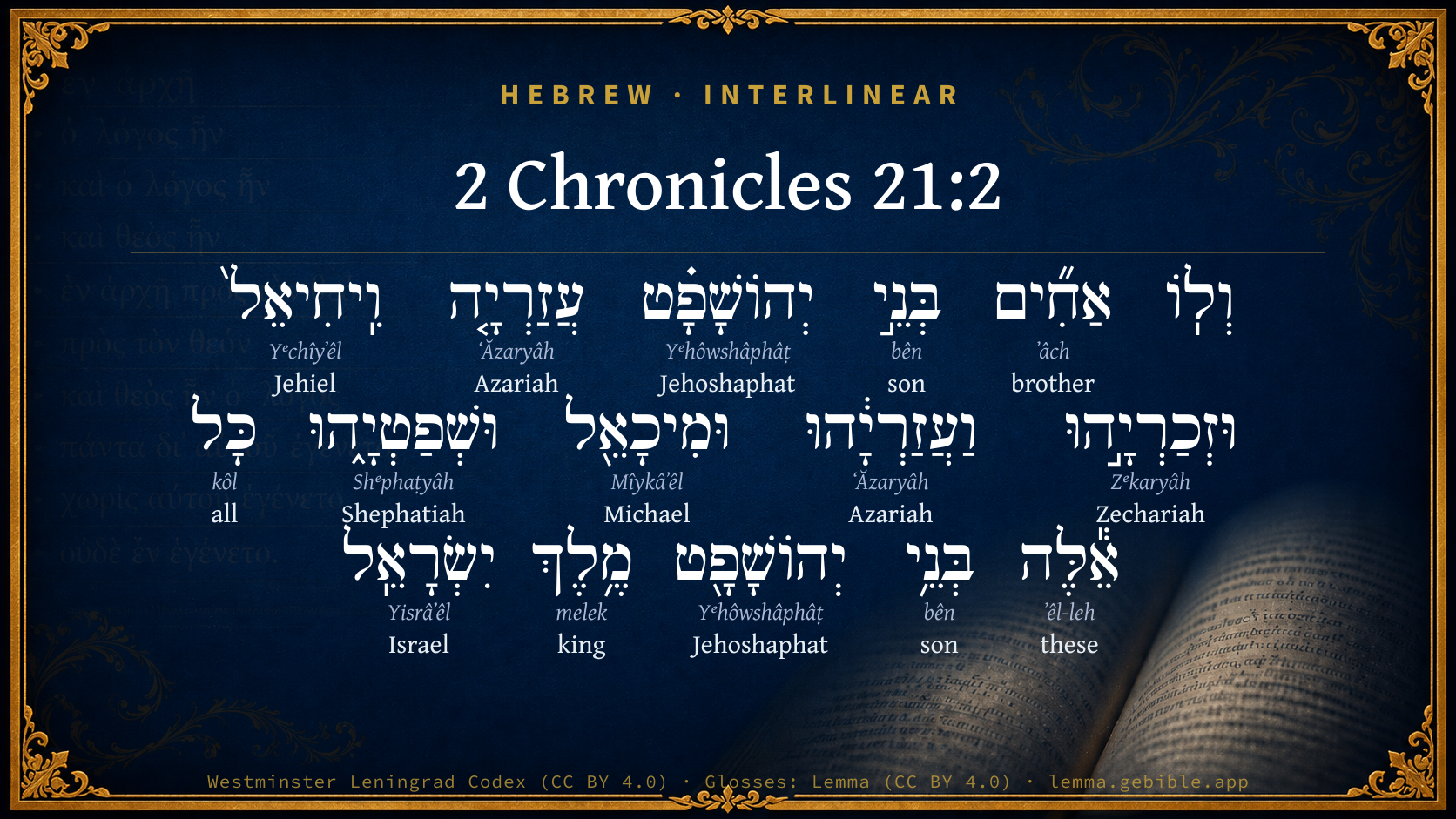
Hebrew (Westminster Leningrad Codex) 2 Chronicles 21:2 appears in the Hebrew Old Testament. The text above is from the Westminster Leningrad Codex. Each word links to its Strong’s number, a concise gloss, and parsing drawn from the Open Scriptures Hebrew Bible morphology. Click any word for its full Brown-Driver-Briggs (BDB) entry.
Download image
Cite this verse

2 Chronicles 21:2 (World English Bible). Public Domain. Lemma interlinear Bible study tool, https://lemma.gebible.app/v/2-chronicles/21/2.

Show BibTeX & RIS
BibTeX
RIS
English Translation
He had brothers, the sons of Jehoshaphat: Azariah, and Jehiel, and Zechariah, and Azariah, and Michael, and Shephatiah; all these were the sons of Jehoshaphat king of Israel.
World English Bible · Public Domain
Download a study sheet

One document with this verse’s original text, its word-by-word gloss line, the meaning frame, cross-references with their text, attributed commentary, and full source and license credits — printable, and it pastes into notes with its structure intact.

This verse Autodidact and up

Study sheet (.html) Plain text (.txt)

A passage Seminary Student

Up to 50 verses in one chapter. A passage sheet keeps up to 6 commentary sources and 12 cross-references per verse, in the order this page ranks them, and says so on the sheet whenever that leaves anything out. Ask for a single verse and you get the Autodidact verse sheet above.

Everything on this page stays free to read, with no account — the sheet is a download of what is already on screen, not access to it.

Want to remove ads? Support Godless Engineer
Compare translations 3

The same verse in 3 English versions, stacked beneath the original-language interlinear above. Click any original word for its lexicon entry.

Each is an independent rendering of the whole verse — the interlinear is not word-aligned to these translations.

Highlighted words mark where these versions differ — a whole-verse word diff, not a word-by-word alignment.

  • World English Bible Public Domain
    He had brothers, the sons of Jehoshaphat: Azariah, and Jehiel, and Zechariah, and Azariah, and Michael, and Shephatiah; all these were the sons of Jehoshaphat king of Israel.
  • King James Version Public Domain
    And he had brethren the sons of Jehoshaphat, Azariah, and Jehiel, and Zechariah, and Azariah, and Michael, and Shephatiah: all these were the sons of Jehoshaphat king of Israel.
  • unfoldingWord Literal Text CC BY-SA 4.0
    And to him brothers, the sons of Jehoshaphat: Azariah, and Jehiel, and Zechariah, and Azariahu, and Michael, and Shephatiah. All these, the sons of Jehoshaphat, the king of Israel.

unfoldingWord Literal Text — © unfoldingWord, licensed CC BY-SA 4.0. Word-aligned USFM3 via Door43 (git.door43.org/unfoldingWord/en_ult).

Versions to compare (up to 4)

3 of 4 selected

Show all 18 translations

Every available English version of this verse, each an independent rendering of the whole verse.

  • World English Bible Public Domain
    He had brothers, the sons of Jehoshaphat: Azariah, and Jehiel, and Zechariah, and Azariah, and Michael, and Shephatiah; all these were the sons of Jehoshaphat king of Israel.
  • Berean Standard Bible Public Domain
    Jehoram’s brothers, the sons of Jehoshaphat, were Azariah, Jehiel, Zechariah, Azariah, Michael, and Shephatiah; these were all sons of Jehoshaphat king of Israel.
  • Majority Standard Bible Public Domain
    Jehoram’s brothers, the sons of Jehoshaphat, were Azariah, Jehiel, Zechariah, Azariah, Michael, and Shephatiah; these were all sons of Jehoshaphat king of Israel.
  • King James Version Public Domain
    And he had brethren the sons of Jehoshaphat, Azariah, and Jehiel, and Zechariah, and Azariah, and Michael, and Shephatiah: all these were the sons of Jehoshaphat king of Israel.
  • American Standard Version (1901) Public Domain
    And he had brethren, the sons of Jehoshaphat: Azariah, and Jehiel, and Zechariah, and Azariah, and Michael, and Shephatiah; all these were the sons of Jehoshaphat king of Israel.
  • Revised Version (1885) Public Domain
    And he had brethren the sons of Jehoshaphat, Azariah, and Jehiel, and Zechariah, and Azariah, and Michael, and Shephatiah: all these were the sons of Jehoshaphat king of Israel.
  • Geneva Bible (1599) Public Domain
    And he had brethren the sonnes of Iehoshaphat, Azariah, and Iehiel, and Zechariah, and Azariah, and Michael, and Shephatiah. All these were the sonnes of Iehoshaphat King of Israel.
  • Douay-Rheims (1899) Public Domain
    And he had brethren the sons of Josaphat, Azarias, and Jahiel, and Zacharias, and Azaria, and Michael, and Saphatias, all these were the sons of Josaphat king of Juda.
  • Young's Literal Translation Public Domain
    And he hath brethren, sons of Jehoshaphat, Azariah, and Jehiel, and Zechariah, and Azariah, and Michael, and Shephatiah; all these `are' sons of Jehoshaphat king of Israel,
  • Literal Standard Version CC BY-SA 4.0
    And he has brothers, sons of Jehoshaphat: Azariah, and Jehiel, and Zechariah, and Azariah, and Michael, and Shephatiah; all these [are] sons of Jehoshaphat king of Israel,
  • Unlocked Literal Bible CC BY-SA 4.0
    Jehoram had brothers, sons of Jehoshaphat: Azariah, Jehiel, Zechariah, Azariahu, Michael, and Shephatiah. All these were sons of Jehoshaphat, king of Israel.
  • unfoldingWord Literal Text CC BY-SA 4.0
    And to him brothers, the sons of Jehoshaphat: Azariah, and Jehiel, and Zechariah, and Azariahu, and Michael, and Shephatiah. All these, the sons of Jehoshaphat, the king of Israel.
  • Darby Bible Public Domain
    And he had brethren, the sons of Jehoshaphat: Azariah and Jehiel, and Zechariah, and Azariah, and Michael, and Shephatiah: all these were sons of Jehoshaphat king of Israel.
  • World Messianic Bible Public Domain
    He had brothers, the sons of Jehoshaphat: Azariah, Jehiel, Zechariah, Azariah, Michael, and Shephatiah. All these were the sons of Jehoshaphat king of Israel.
  • Webster's Bible Public Domain
    And he had brethren the sons of Jehoshaphat, Azariah, and Jehiel, and Zechariah, and Azariah, and Michael, Shephatiah: all these were the sons of Jehoshaphat king of Israel.
  • Free Bible Version CC BY-SA 4.0
    His brothers, the sons of Jehoshaphat, were Azariah, Jehiel, Zechariah, Azariah, Michael, and Shephatiah. All were sons of Jehoshaphat, king of Judah.
  • Bible in Basic English Public Domain
    And he had brothers, sons of Jehoshaphat, Azariah, Jehiel, Zechariah, Azariah, Michael, and Shephatiah; all these were sons of Jehoshaphat, king of Israel.
  • JPS Tanakh (1917) Public Domain
    And he had brethren the sons of Jehoshaphat, Azariah, and Jehiel, and Zechariah, and Azariahu, and Michael, and Shephatiah; all these were the sons of Jehoshaphat king of Israel.

Literal Standard Version (2020), Covenant Press — licensed CC BY-SA 4.0. Text via the HelloAO Bible API (eBible.org). Unlocked Literal Bible (unfoldingWord) — licensed CC BY-SA 4.0. Text via the HelloAO Bible API (eBible.org). unfoldingWord Literal Text — © unfoldingWord, licensed CC BY-SA 4.0. Word-aligned USFM3 via Door43 (git.door43.org/unfoldingWord/en_ult). Free Bible Version, Dr. Jonathan Gallagher — licensed CC BY-SA 4.0. Text via the HelloAO Bible API (eBible.org).

Word by word

More ways to search: Search by grammar → Find every occurrence → Compare this word →

Practice this passage: Drill this verse → Learn its vocabulary →

וּמִיכָאֵ֖ל
Mîykâʼêl
H4317
“and · Michael”
Conjunction + Noun, Proper
Part of Speech
Conjunction + Noun
Type
Proper
Full BDB Definition

Origin: from H4310 and (the prefix derivative from) H3588 and H410

TWOT: None

Michael = "who is like God" - one of, the chief, or the first archangel who is described as the one who stands in time of conflict for the children of Israel - an Asherite, father of Sethur, one of the 12 spies of Israel - one of the Gadites who settled in the land of Bashan - another Gadite, ancestor of Abihail - a Gershonite Levite, ancestor of Asaph - one of the 5 sons of Izrahiah of the tribe of Issachar - a Benjamite of the sons of Beriah - one of the captains from Manasseh who joined David at Ziklag - father or ancestor of Omri, chief of the tribe of Issachar in the reign of David - one of the sons of Jehoshaphat who were murdered by their elder brother, Jehoram - father or ancestor of Zebadiah, of the sons of Shephatiah
  1. אַחִ֞ים ʼâch H251 “brothers” Noun, Common, Masculine, Plural, Absolute
  2. בְּנֵ֣י bên H1121 “sons of” Noun, Common, Masculine, Plural, Construct
  3. יְהוֹשָׁפָ֗ט Yᵉhôwshâphâṭ H3092 “Jehoshaphat” Noun, Proper
  4. עֲזַרְיָ֤ה ʻĂzaryâh H5838 “Azariah” Noun, Proper
  5. וִֽיחִיאֵל֙ Yᵉchîyʼêl H3171 “and · Jehiel” Conjunction + Noun, Proper
  6. וּזְכַרְיָ֣הוּ Zᵉkaryâh H2148 “and · Zechariah” Conjunction + Noun, Proper
  7. וַעֲזַרְיָ֔הוּ ʻĂzaryâh H5838 “and · Azariah” Conjunction + Noun, Proper
  8. וּשְׁפַטְיָ֑הוּ Shᵉphaṭyâh H8203 “and · Shephatiah” Conjunction + Noun, Proper
  9. כָּל kôl H3605 “all of” Noun, Common, Masculine, Singular, Construct
  10. אֵ֕לֶּה ʼêl-leh H428 “these” Pronoun, Demonstrative, Common, Plural
  11. בְּנֵ֥י bên H1121 “sons of” Noun, Common, Masculine, Plural, Construct
  12. יְהוֹשָׁפָ֖ט Yᵉhôwshâphâṭ H3092 “Jehoshaphat” Noun, Proper
  13. מֶ֥לֶךְ melek H4428 “king of” Noun, Common, Masculine, Singular, Construct
  14. יִשְׂרָאֵֽל Yisrâʼêl H3478 “Israel” Noun, Proper

About this verse

These counts appear in no published source. They are computed here, from the morphology-tagged text and Lemma’s own curated glosses. What Lemma adds →

16
words
12
distinct lemmas
Historical
section

Notable vocabulary

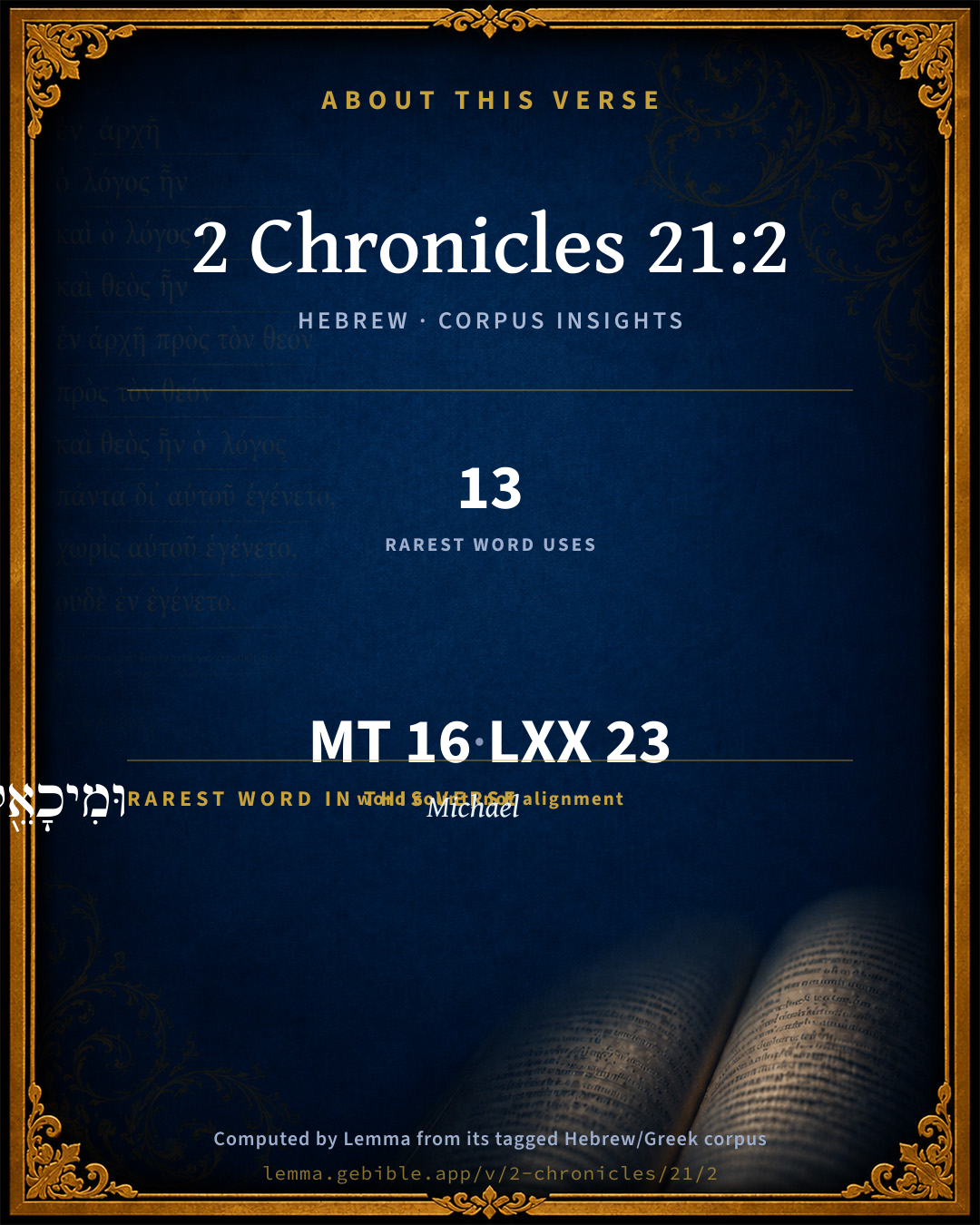
The rarest word here is וּמִיכָאֵ֖ל Michael H4317 — appearing just 13 times in the whole Hebrew Bible.

Shared distinctive vocabulary

וּמִיכָאֵ֖ל Michael H4317 occurs in 13 verses of the Hebrew Bible. Also found in:

Grammatical profile

  • 14 nouns
  • 1 pronoun
  • 1 preposition

Repetition

Words recur within this verse — often emphatic in Hebrew:

  • בְּנֵ֣י son H1121 ×2
  • יְהוֹשָׁפָ֗ט Jehoshaphat H3092 ×2
  • עֲזַרְיָ֤ה Azariah H5838 ×2

Hebrew & Septuagint length

In English translation the verse runs 28 words from the Hebrew and 30 from the Septuagint (LXX English) — closely comparable.

A rough comparison of the two English renderings, which tokenize alike — not a word-level alignment.

Word counts can differ between the Hebrew and the Greek without any difference in meaning — e.g. the Hebrew direct-object marker אֵת has no separate Greek word, and Greek often adds the article ὁ.

In the original languages it is 16 Hebrew tokens and 23 Greek tokens — but the two are counted differently (Hebrew bundles its prefixes and suffixes into one token; the Greek is in lemma form), so that isn’t a like-for-like length.

Cross-references

10

Topical passages linked to 2 Chronicles 21:2 in the Treasury of Scripture Knowledge — connected by theme and wording, ordered by reader-vote popularity; previews shown in the World English Bible.

  • 2 Chronicles 12:6 Then the princes of Israel and the king humbled themselves; and they said, Yahweh is righteous.
  • 2 Chronicles 23:2 They went about in Judah, and gathered the Levites out of all the cities of Judah, and the heads of fathers' [houses] of Israel, and they came to Jerusalem.
  • 2 Chronicles 24:5 He gathered together the priests and the Levites, and said to them, Go out to the cities of Judah, and gather of all Israel money to repair the house of your God from year to year; and see that you hasten the matter. However the Levites didn't hurry.
  • 2 Chronicles 21:4 Now when Jehoram was risen up over the kingdom of his father, and had strengthened himself, he killed all his brothers with the sword, and various also of the princes of Israel.
  • 2 Chronicles 24:16 They buried him in the city of David among the kings, because he had done good in Israel, and toward God and his house.
  • 2 Chronicles 28:19 For Yahweh brought Judah low because of Ahaz king of Israel; for he had dealt wantonly in Judah, and trespassed severely against Yahweh.
  • 2 Chronicles 28:23 For he sacrificed to the gods of Damascus, which struck him; and he said, Because the gods of the kings of Syria helped them, [therefore] will I sacrifice to them, that they may help me. But they were the ruin of him, and of all Israel.
  • 2 Chronicles 28:27 Ahaz slept with his fathers, and they buried him in the city, even in Jerusalem; for they didn't bring him into the tombs of the kings of Israel: and Hezekiah his son reigned in his place.
  • 2 Chronicles 33:18 Now the rest of the acts of Manasseh, and his prayer to his God, and the words of the seers who spoke to him in the name of Yahweh, the God of Israel, behold, they are written among the acts of the kings of Israel.
  • 2 Chronicles 35:18 There was no Passover like that kept in Israel from the days of Samuel the prophet; neither did any of the kings of Israel keep such a Passover as Josiah kept, and the priests, and the Levites, and all Judah and Israel who were present, and the inhabitants of Jerusalem.

Cross-references courtesy of OpenBible.info (CC BY 4.0).

Hebrew and Greek witnesses Masoretic Hebrew ↔ Greek Septuagint

The same verse in the two great witnesses to the Old Testament, shown verse-for-verse.

These are two independent witnesses, not word-aligned to each other, and the Septuagint is shown in lemma (dictionary) form.

Hebrew 2 Chronicles 21:2 Masoretic · Westminster Leningrad Codex

וְלֽוֹ אַחִ֞ים בְּנֵ֣י יְהוֹשָׁפָ֗ט עֲזַרְיָ֤ה וִֽיחִיאֵל֙ וּזְכַרְיָ֣הוּ וַעֲזַרְיָ֔הוּ וּמִיכָאֵ֖ל וּשְׁפַטְיָ֑הוּ כָּל אֵ֕לֶּה בְּנֵ֥י יְהוֹשָׁפָ֖ט מֶ֥לֶךְ יִשְׂרָאֵֽל

He had brothers, the sons of Jehoshaphat: Azariah, and Jehiel, and Zechariah, and Azariah, and Michael, and Shephatiah; all these were the sons of Jehoshaphat king of Israel.

World English Bible · Public Domain

Greek LXX 2 Chronicles 21:2 Septuagint · lemma form

καί αὐτός ἀδελφός υἱός ιωσαφατ ἕξ αζαριας καί ιιηλ καί ζαχαριας καί αζαριας καί μιχαηλ καί σαφατιας πᾶς οὗτος υἱός ιωσαφατ βασιλεύς ἰουδά

And he had brothers, the six sons of Josaphat, Azarias, and Jeiel, and Zacharias, and Azarias, and Michael, and Zaphatias: all these were the sons of Josaphat king of Juda.

LXX2012 (modern English Septuagint) · Public Domain

On this verse, Ellicott's Commentary for English Readers discusses the Septuagint’s reading. Read the note in Commentary ↓

Hebrew: Westminster Leningrad Codex (CC BY 4.0). Greek: Septuagint (public domain); English from LXX2012 (modern English Septuagint) (Public Domain). How the Septuagint differs from the Hebrew →

Commentary

Notes on 2 Chronicles 21:2 from classic Christian and Jewish commentators (each source and its license shown beneath its notes). The classic Christian expositions comment on the surrounding passage and are grouped to its opening verse, so a note may address several verses; the Jewish commentaries on the Tanakh (Rashi and others) are per-verse, so they appear only where the commentator wrote on this verse.

Lemma curates 59 commentaries, every one of them public domain or Creative Commons licensed, each selected and text-cleaned for this edition rather than reprinted as found. About our sources →

Ellicott's Commentary for English Readers

REIGN OF JEHORAM (2Ch_21:2-18).

THE NEW KING MURDERS HIS SIX BROTHERS

(2Ch_21:2-4).

(2) Azariah . . . and Azariah.—Heb. ‘Azaryâh . . . and Azaryâhû, different forms of the same name. All the versions give one form only. An old error of transcription may be involved (comp. 1Ch_3:6; 1Ch_3:8); but it is also possible that Jehoshaphat named two of his sons Azariah, “Iah helpeth,” in pious recognition of two several mercies. Shephatiah, “Iah judgeth,” repeats his own name in inverted shape.

The other names are—“God liveth,” “Iah remem-bereth,” “Who is like God? “—all significant of the king’s faith.

Jehoshaphat king of Israel.—The southern kingdom is called “Israel” in 2Ch_12:1; 2Ch_12:6; 2Ch_21:4; 2Ch_28:19; 2Ch_28:27, and elsewhere, as enjoying the legitimate monarchy, and maintaining the orthodox ritual and priesthood. Here, however, some Hebrew MSS., the LXX., Syriac, Vulg., and Arabic, read “Judah.”

(3) And their father gave them great gifts.—Jehoshaphat before his death had provided for his sons, as Rehoboam before him had done for his, by appointing them resident governors of the national fortresses, and sending them away with valuable presents (2Ch_11:23).

Of silver, and of gold.—The preposition (le) belongs to the chronicler’s style.

Precious things (migdônôth; Gen_24:53).—Such as jewels, robes, and spices.

Because he was the firstborn.—This was the rule. (Comp. Deu_21:15-17.) For exceptions, see 1Ch_28:5; 2Ch_11:22; 2Ch_36:1.

(4) Now when Jehoram was risen up to the kingdom of his father.—Literally, And Jehoram arose over the kingdom, &c., a peculiar expression, only found here. It seems to mean, established himself on the throne. (See Exo_1:8 for a similar phrase, and comp. the use of the same verb, 1Sa_24:20.)

He strengthened himself.—Secured his hold of power (2Ch_1:1; 2Ch_1:12, &c).

And slew all his brethren.—In order to prevent intrigues against himself. Such ruthless crimes have been customary at Oriental accessions, and are one of the natural results of polygamy. (Comp. the conduct of Abimelech (Jdg_9:5) and of Athaliah (2Ch_22:10). It was thus that Jehoram “strengthened himself.”

And divers also of the princes of Israel.—Some of the great chiefs of the clans, whose power or sympathy with his murdered brothers Jehoram may have dreaded. Or, like other Oriental despots, Jehoram may have acted from no other motive than a rapacious desire to confiscate their wealth. Some suppose that both his brethren and these “princes” had given signs of dissatisfaction at Jehoram and Athalian’s heathen policy. (Comp. 2Ch_21:13, “thy brethren . . . which were better than thyself.”)

A Bible Commentary for English Readers, edited by Charles John Ellicott (1878–1897) — public domain. Text from a community e-Sword module.

Trapp's Complete Commentary

John Trapp

2Ch 21:2 And he had brethren the sons of Jehoshaphat, Azariah, and Jehiel, and Zechariah, and Azariah, and Michael, and Shephatiah: all these [were] the sons of Jehoshaphat king of Israel.

Ver. 2. King of Israel.] Of all Israel by right; but really, of a part of them only.

John Trapp, A Commentary or Exposition upon All the Books of the Old and New Testament (1647–1656) — public domain. Text from a community e-Sword module.

Joseph Benson's Commentary

2Ch 21:2. And Azariah — Hebrew, עזריהו, Azaria-hu, distinguished by the last syllable, hu, from the Azariah mentioned in the former clause. Of Jehoshaphat king of Israel — So he is called, either, 1st, Because he was so by right: or, 2d, Because he was king not only of Judah and Benjamin, but of a great number of Israelites, who had come and settled in his kingdom.

Joseph Benson's Commentary on the Old and New Testaments (1811–1818) — public domain. Text from a community e-Sword module.

Tyndale Open Study Notes

Tyndale Open Resources

21:2-7 Jehoram, whose wife was Athaliah, the daughter of Ahab and Jezebel (18:1; 21:6; 22:2), was the first king of David’s line to receive a totally negative evaluation. His murders (21:4) seriously threatened the continuation of the dynasty, which was only preserved because of the Lord’s own loyal faithfulness to David (21:7). On three other occasions, violence was perpetrated against the royal family that all but ended the dynasty (see 21:17; 22:8-9, 10-11).

Tyndale Open Study Notes — © Tyndale Open Resources, licensed CC BY-SA 4.0. Text via the HelloAO Bible API.

Geneva Bible (1599)

Geneva Bible translators

Read 2 Chron. 15:17, how by Israel he meant Judah.

Geneva Bible (1599) marginal notes — public domain. Text via Bolls.life.

Adam Clarke's Commentary

Verse 2. And he had brethren - the sons of Jehoshaphat, king of Israel.] Jehoshaphat certainly was not king of Israel, but king of Judah. ישראל Yisrael must be a corruption in the text, for יהודה Yehudah; which is the reading of the Syriac, Arabic, Septuagint, and Vulgate: the Chaldee, only agrees with the Hebrew text. And the reading of the versions is supported by thirty-eight of Kennicott's and De Rossi's MSS. The word Judah should therefore be restored to the text.

Adam Clarke's Commentary on the Bible (1810–1826) — public domain. Text from a community e-Sword/MySword module.

The Cambridge Bible for Schools and Colleges

gen. ed. J. J. S. Perowne

2–4 (no parallel in Kings). The Names and the Fate of the other Sons of Jehoshaphat

2. brethren the sons of Jehoshaphat] It was necessary to define brethren, for the word by itself means no more than “kinsmen”; cp. 1Ch_12:2 (note).

Azariah] Since this name is repeated (with a slight variation of spelling) in the list it is probable that the text is corrupt. The error may be no more than the omission of some epithet which distinguished one Azariah from the other in the original text of the list. The LXX. gives no help.

king of Israel] Cp. 2Ch_11:3, note.

The Cambridge Bible for Schools and Colleges (gen. ed. J. J. S. Perowne; Cambridge University Press, 1878–1918) — public domain. Text from a community e-Sword module.

John Gill's Exposition

And their father gave them great gifts of silver, and of gold, and of precious things,.... As jewels and precious stones; or precious garments, as the Targum, in like manner as Abraham gave to his sons, when he sent them from Isaac:

with fenced cities in Judah; not as their own property, but he appointed them governors in them, to defend them against an enemy, and as a mark of honour to them:

but the kingdom gave he to Jehoram, because he was the firstborn; strictly observing the law in Deu 21:16, which was not always done; though it was reckoned by the Heathens contrary to the law of nations to give the kingdom to the younger (y).

(y) Justin. e Trogo, l. 16. c. 2.

John Gill's Exposition of the Whole Bible (1746–1763) — public domain (CC PDM 1.0). Text via the HelloAO Bible API.

Haydock's Catholic Bible Commentary

Azarias. The only difference between this and the former name is, that the younger brother’s (H.) has u at the end, (C.) Azrieu. Protestants and Sept., make no difference, which we should nevertheless expect. H. --- Juda. Heb. "Israel." Sept., Syriac, &c. agree with the Vulgate editions, though most of the ancient Latin MSS. have Israel. Josephat ruled over the principal tribes. Yet it seems probable, from the versions, that the Hebrew formerly read Juda.

George Leo Haydock (1774–1849), Haydock's Catholic Family Bible and Commentary, 1859 edition — public domain. Excludes Psalms (Douay-Rheims chapter numbering differs from Protestant) and Deuterocanonical books (Catholic canon only).

Matthew Poole's English Annotations

Azariah; two sons called by the same name, though doubtless distinguished by some additional title, which is not mentioned here, because it did not concern succeeding ages to know it. Though indeed there is a difference in their Hebrew names, the one being Azariah, the other Azariahu, hu being the last syllabic in his name, as in Elihu and others. Jehoshaphat king of Israel; so he is called, either,

1. Because he was so by right. Or,

2. Because he was king not only of Judah and Benjamin, but of a great number of Israelites, who had come into and settled themselves in his kingdom, in his and in his predecessor’s days; who being a considerable, and the purest and best, part of Israel, may well be called Israel, being more truly and properly God’s Israel than their apostate brethren, who were no longer worthy of that name. Or,

3. Because all his subjects were Israelites; and therefore he was

king of Israel, though not of all Israel. Or,

4. With some reflection upon his memory for making so strict an alliance and friendship with the king of Israel, whose cause he defended with his own and his kingdom’s great hazard, as if he had been the king not so much of Judah as of Israel. And this may be the rather noted here, because here speedily follows a sad effect of that wicked and cursed match. Some say Israel was foisted into some copies by the transcriber instead of Judah, as it was first written.

Matthew Poole's English Annotations on the Holy Bible (1683–1685) — public domain. Text from a community e-Sword/MySword module.

The Pulpit Commentary

Though in our version two Azariahs appear among the six sons of Jehoshaphat here given, the Hebrew text shows hyrz in the one place and Why; rz) in the other. Nothing is known of the previous history of these six, now so cruelly murdered by their eldest brother. It will be observed that Jehoshaphat is styled King of Israel, probably merely generically. Into this way the writer of Chronicles would run, at any rate, more easily than the writer of Kings.

HOMILIES BY T. WHITELAW Vers. 2-11.

The character of Jehoram.

I A DEGENERATE SON.

1. The advantages Jehoram possessed.

(1) A good father, Jehoshaphat, whose example should have led him, whose instructions should have taught him, (Pro_1:8) whose prayers should have won him to walk in wisdom"s ways. But they did not. Piety is not hereditary. Example often fails to impress, instruction to convince, prayer to save, the children of godly parents. Numerous instances in Scripture (1Sa_2:12 1Sa_8:3 1Sa_15:1, etc.) and in ordinary life.

(2) A good estate. As Jehoshaphat"s firstborn, he succeeded whether during his father"s lifetime (Keil) or at his father"s death (Bahr) uncertain to an exalted throne and a peaceful realm, became ruler of a promisingpeople and a growing empire. He had much to make him contented with his lot and thankful for his mercies, to lead him to think of God and devote himself to the practice of religion, as well as to consecrate his talents to advancing the moral and material interests of his subjects. Nevertheless, he neglected both his own and his people"s salvation.

(3) A good God, who had kept him alive for thirty-two years, when many better men than he had been cut off in youth (ver. 5); who had allowed him time to mature in wisdom before calling him to assume the burdensome responsibilities of the throne; who had promoted him to his father"s crown, which might easily have been given to another (ver. 3); who bore with him in his wickedness for his servant David"s sake (ver. 7); who punished him by suffering the Edomites to revolt (ver. 8), stirring up the Philistines and Arabians against him (ver. 15), and afflicting him with a mortal malady (ver. 18), of which he was forewarned by a letter from Elijah (ver. 12). Yet for all this Jehoram walked not in the ways of Jehoshaphat his father, or in the ways of Asa his grandfather, but in the ways of Ahab, the King of Israel (vers. 6, 12, 13).

2. The disadvantages under which he laboured.

(1) A bad heart. That Jehoram, though belonging to Judah and a son of Jehoshaphat, was not a child of grace, his whole subsequent career attested., All are not Israel, that are of Israel: neither, because they are Abraham"s seed, are they all children"; (Rom_9:6, Rom_9:7) "For he is not a Jew, which is one outwardly: but he is a Jew, which is one inwardly". (Rom_2:28, Rom_2:29) That Jehoram was not born good was no excuse, since Jehovah"s grace was ready to assist him in overcoming his natural corruption (Deu_30:6; 1Ki_8:58; Psa_110:3)

(2) A bad wife. Athaliah, though a king"s daughter (ver. 6), was a wicked woman. Exalted in station, beautiful in person, gifted with high mental endowments, she may have been; nevertheless, she was inwardly, essentially, and radically of depraved instincts. Like her mother Jezebel, she was superstitious, profligate, bloodthirsty, imperious, and resolute. She belonged to the type of woman of which Herodias and perhaps Drusilla and Bernice were New Testament examples, and to which should be assigned the Shakespearean creations of Lady Macbeth and Cleopatra In the hands of such women even strong men find it difficult to resist the fatal influence of their superior natures, while feeble creatures like Ahab and Jehoram are dragged like captives at their chariot-wheels. The most dreadful calamity that can befall a weakling is to wed such a spouse. A woman leagued with the devil will drag her husband to perdition with a certainty and celerity that hardly even the grace of God can prevent. In such plight was Jehoram.

(3) A bad environment. Though not everything, a man"s surroundings are something. They help to make or mar him. If good, they will at least hinder his deterioration; if bad, they will hasten it. Perhaps nothing could have been worse for Jehoram than to have Ahab"s daughter for a wife; it was no amelioration of his hard fate to have Ahab for a father-in-law, Jezebel for a mother-in-law, Ahaziah and Jehoram for brothers-in-law, and the house of Omri generally as relatives and friends. It was hardly surprising that in after-years Jehoram, the King of Judah, had no moral resemblance to Jehoshaphat"s son.

II AN UNNATURAL BROTHER.

1. The names of Jehorams brothers. Six in number; they had excellent names.

(1) Azariah, "whom Jehovah helps." "Happy is the man that hath the God of Jacob for his Help". (Psa_146:5) This name may have been given by Jehoshaphat to his second and his filth sons distinguished slightly by the spelling, Azarjah and Azarjahu to emphasize that all hope for stability in his house and prosperity in his kingdom depended on and proceeded from the assistance of Heaven.

(2) Jehiel, "God liveth." Perhaps this truth was impressed upon Jehosha-phat"s heart by the birth of his third son, (Psa_127:3) as it was upon David"s, by his continued preservation from the hand of Saul. (Psa_18:46)

(3) Zechariah, "whom Jehovah remembers." Probably given by Jehoshaphat to his son after Zechariah, the father of Jahaziel, who predicted the overthrow of the Moabites. (2Ch_20:14) Or, Jehoshaphat may have counted his fourth son a happy proof that Jehovah had not forgotten him, but was still mindful of his covenant.

(4) Azariah (see above).

(5) Michael, "who is like unto God?" A great thought for a young man to carry about with him on life"s journey, and one that might stir him to noble deeds as well as lead him into pleasant ways. This thought was familiar to, (Exo_8:10) to David, (Psa_86:8) to Ethan the Ezrahite, (Psa_89:6) and to Isaiah. (Isa_40:18)

(6) Shephatiah, "whom Jehovah defends." The name of one of David"s, (2Sa_3:4) and probably for this reason bestowed upon Jehoshaphat"s.

1. The ranks of Jehorams brothers. Princes of the blood royal, they were well provided for and well placed by their father, whose crown fell to Jehoram as heir-apparent. Great gifts of silver, gold, and other precious things were bestowed upon them, while they were appointed, as Rehoboam"s sons had been, (2Ch_11:23) commandants of

2. fortresses in the different fenced cities of Judah. Thus they had no need to be discontented with their lot, and most likely were not.

3. The characters of Jehorams brethren. They were better than he (ver. 13). Presumably in every way physically, mentally, morally, religiously. This last, perhaps, specially intended. Jehoshaphat"s piety had exercised upon them more influence than upon him; they disapproved of the idolatrous behaviour and wicked policy generally of him and his wife.

4. The murder of Jehorams brethren. Whatever the motive cupidity or a desire to appropriate their wealth, fear or a dread of being insecure upon his throne while they lived, or hatred of their persons because they shunned his evil ways it was a hideous deed of blood, which has seldom been paralleled amongst Oriental kings. "Upon the death of Selimus II (1582). Amurah III, succeeding to the Turkish empire, caused his five brothers Mustapha, Solymon, Abdalla, Osman, and Sinagar without pity or commiseration, to be strangled in his presence and burned with his dead father" (Whitecross, "Anecdotes on the Old Testament," p. 190). Along with his brethren, he put to death a number of the princes of Israel, and for probably a similar reason, because they disapproved of his conduct and sympathized with his brethren.

III A WORTHLESS KING.

1. An apostate in religion. To be sure, he never had religion in reality. Yet, as Judah"s sovereign and Jehoshaphat"s son, he ought to have upheld the true worship of Jehovah. But instead he became a devotee of Baal, a favourer of the false gods his half-heathen wife patronized, building high places for them in the mountains of Judah thus practically reversing the work of his devout father (2Ch_17:6) and grandfather, (2Ch_14:2) and causing the inhabitants of Jerusalem to commit fornication, i.e. to practise idolatry (Isa_23:17; Eze_16:29; Rev_19:2) yea, compelling Judah by violence to go astray. (Deu_13:6, Deu_13:11)

2. A weakling in government. Udder him the Edomites, who had in Jehoshaphat"s reign been tributary to Judah, (2Ki_3:9) becoming restive, achieved their independence. According to Josephus ("Ant.," 9:5. 1), they first slew their king, who had yielded to Jehoshaphat, and afterwards elected one who raised the standard of revolt. A feeble attempt to reduce them to subjection proved abortive. At Zair, on the way to Edom not to be identified with Zoar (Ewald), which belonged to Moab, but perhaps with the modern ruin Zueirah, on the south-west of the Dead Sea (Conder) he, with all his princes and chariots, encountered the rebels; but whether he defeated them (Jamieson), or only cut his way through them when they had encompassed him (Keil), is obscure, though even on the former supposition his success was not permanent or decisive. Either then or soon afterwards the Edomites completely renounced the yoke of Judah. About the same period also, Libnah a city in the district of Eleutheropolis (Eusebius), though as yet unknown succeeded in establishing its freedom.

3. A pigmy in manhood. Apart from the plague which struck him in his last days, while yet in middle life (ver. 15) he was obviously a poor and contemptible creature. When he died nobody lamented him at least, nobody among his subjects. "He departed without being desired" (ver. 20). Men were glad to see the last of him. They would not burn a burning for him, as they did for his good father and pious grandfather when they died. His rotten carcase they buried in the city of David; they would not desecrate with it the sepulchres of the kings.

Learn:

1. The necessity of personal religion no man may trade upon his father"spiety.

2. The duty of parents to provide for their children exemplified byJehoshaphat"s donations to his sons.

3. The bitterness of sin"s fruit when fully developed: "Sin, when it isfinished, bringeth forth death" in its worst forms murder, fratricide, etc.

4. The value of a good wife inferred from the calamity of a bad one.

5. The mercy of God to great sinners, even when they do not repent illustrated by God"s tolerance of Jehoram.

6. The essential weakness of sin as shown by the Edomite revolt against Judah.

7. The pestilential influence of sin in high places: "One sinner destroyeth much good. W.

The Pulpit Commentary (1880–1919), ed. H.D.M. Spence-Jones & Joseph S. Exell — public domain. Text from a community e-Sword module.

John Wesley's Explanatory Notes

Azariah - Two sons called by the same name, though doubtless distinguished by some additional title: which is not mentioned here, because it did not concern succeeding ages to know it. Of Israel - So he is called either,

1. Because he was so by right: or

2. Because he was king not only of Judah and Benjamin, but of a great number of Israelites, who had come and settled in his kingdom.

John Wesley, Explanatory Notes Upon the Whole Bible (1754–1765) — public domain. Text via the GEBible commentary corpus.

Lesson kit

Teaching starters — assembled from the data on this page, not authored interpretation. Every prompt links to the verse data it draws on. Edit before teaching.

2 Chronicles, in the Historical, opens this verse with 16 words (12 distinct Hebrew lemmas). Its most distinctive word is Mîykâʼêl (“Michael”). A historical commentator’s framing appears above. Read the whole chapter for the surrounding context.

Discussion questions

  1. The word Mîykâʼêl carries the sense “Michael.” How does it shape the verse?
  2. How does Numbers 13:13, which shares the word «Michael», read alongside this verse?
  3. What does the repetition of “son” (2× in this one verse) do in this verse?
  4. These translations render this verse differently; the difference is in the English rendering, not the original. What questions does that raise?
  5. Compare how Ellicott's Commentary for English Readers and Trapp's Complete Commentary read this verse. Where do they agree or differ?

Things to notice

Reading settings

Reading text

Shown beneath each verse's original-language words.

Old Testament
Old Testament edition

Read the OT as the Masoretic Hebrew (MT) or the Greek Septuagint (LXX).

English shown for the Greek Septuagint (in the Hebrew ↔ Greek comparison).

Comparing translations? Open the Compare panel on any verse page to stack up to four side by side.