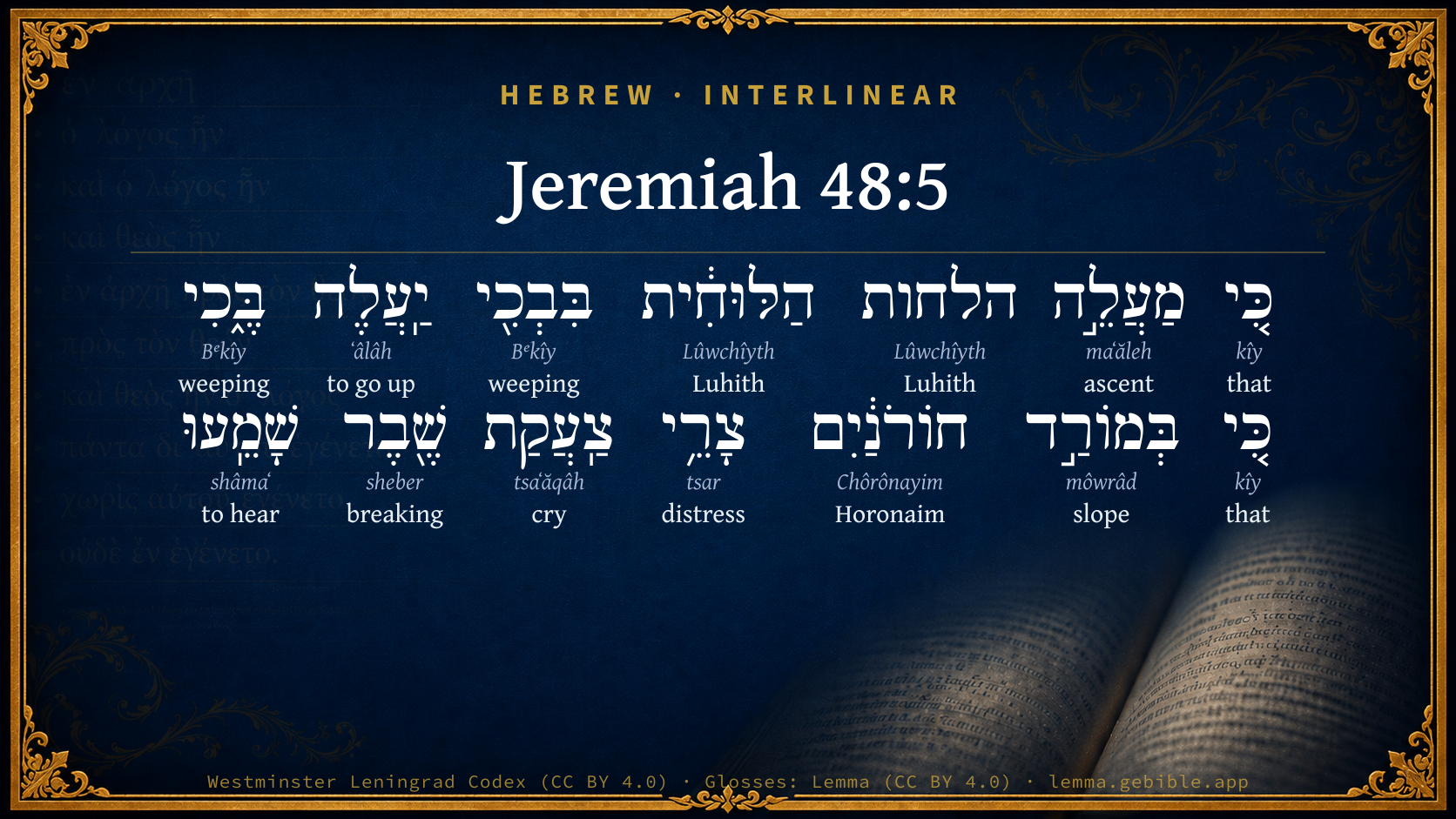
Jeremiah 48:5

Hebrew (Westminster Leningrad Codex) Jeremiah 48:5 appears in the Hebrew Old Testament. The text above is from the Westminster Leningrad Codex. Each word links to its Strong’s number, a concise gloss, and parsing drawn from the Open Scriptures Hebrew Bible morphology. Click any word for its full Brown-Driver-Briggs (BDB) entry.
Download image
Cite this verse

Jeremiah 48:5 (World English Bible). Public Domain. Lemma interlinear Bible study tool, https://lemma.gebible.app/v/jeremiah/48/5.

Show BibTeX & RIS
BibTeX
RIS
English Translation
For by the ascent of Luhith with continual weeping shall they go up; for at the descent of Horonaim they have heard the distress of the cry of destruction.
World English Bible · Public Domain
Download a study sheet

One document with this verse’s original text, its word-by-word gloss line, the meaning frame, cross-references with their text, attributed commentary, and full source and license credits — printable, and it pastes into notes with its structure intact.

This verse Autodidact and up

Study sheet (.html) Plain text (.txt)

A passage Seminary Student

Up to 50 verses in one chapter. A passage sheet keeps up to 6 commentary sources and 12 cross-references per verse, in the order this page ranks them, and says so on the sheet whenever that leaves anything out. Ask for a single verse and you get the Autodidact verse sheet above.

Everything on this page stays free to read, with no account — the sheet is a download of what is already on screen, not access to it.

Want to remove ads? Support Godless Engineer
Compare translations 3

The same verse in 3 English versions, stacked beneath the original-language interlinear above. Click any original word for its lexicon entry.

Each is an independent rendering of the whole verse — the interlinear is not word-aligned to these translations.

Highlighted words mark where these versions differ — a whole-verse word diff, not a word-by-word alignment.

  • World English Bible Public Domain
    For by the ascent of Luhith with continual weeping shall they go up; for at the descent of Horonaim they have heard the distress of the cry of destruction.
  • King James Version Public Domain
    For in the going up of Luhith continual weeping shall go up; for in the going down of Horonaim the enemies have heard a cry of destruction.
  • unfoldingWord Literal Text CC BY-SA 4.0
    They go up the hill of Luhith weeping, for on the way down to Horonaim, screams are heard because of the destruction.

unfoldingWord Literal Text — © unfoldingWord, licensed CC BY-SA 4.0. Word-aligned USFM3 via Door43 (git.door43.org/unfoldingWord/en_ult).

Versions to compare (up to 4)

3 of 4 selected

Show all 18 translations

Every available English version of this verse, each an independent rendering of the whole verse.

  • World English Bible Public Domain
    For by the ascent of Luhith with continual weeping shall they go up; for at the descent of Horonaim they have heard the distress of the cry of destruction.
  • Berean Standard Bible Public Domain
    For on the ascent to Luhith they weep bitterly as they go, and on the descent to Horonaim cries of distress resound over the destruction:
  • Majority Standard Bible Public Domain
    For on the ascent to Luhith they weep bitterly as they go, and on the descent to Horonaim cries of distress resound over the destruction:
  • King James Version Public Domain
    For in the going up of Luhith continual weeping shall go up; for in the going down of Horonaim the enemies have heard a cry of destruction.
  • American Standard Version (1901) Public Domain
    For by the ascent of Luhith with continual weeping shall they go up; for at the descent of Horonaim they have heard the distress of the cry of destruction.
  • Revised Version (1885) Public Domain
    For by the ascent of Luhith with continual weeping shall they go up; for in the going down of Horonaim they have heard the distress of the cry of destruction.
  • Geneva Bible (1599) Public Domain
    For at the going vp of Luhith, the mourner shall goe vp with weeping: for in the going downe of Horonaim, the enemies haue heard a cry of destruction,
  • Douay-Rheims (1899) Public Domain
    For by the ascent of Luith shall the mourner go up with weeping: for in the descent of Oronaim the enemies have heard a howling of destruction.
  • Young's Literal Translation Public Domain
    For the ascent of Luhith with weeping, Go up doth weeping, For in the descent of Horonaim Adversaries a cry of desolation have heard.
  • Literal Standard Version CC BY-SA 4.0
    For the ascent of Luhith with weeping, || Weeping goes up, || For in the descent of Horonaim || Adversaries have heard a cry of desolation.
  • Unlocked Literal Bible CC BY-SA 4.0
    They go up the hill of Luhith weeping, for on the way down to Horonaim, screams are heard because of the destruction.
  • unfoldingWord Literal Text CC BY-SA 4.0
    They go up the hill of Luhith weeping, for on the way down to Horonaim, screams are heard because of the destruction.
  • Darby Bible Public Domain
    For by the ascent of Luhith continual weeping shall go up; for in the descent of Horonaim is heard the anguish of the cry of destruction.
  • World Messianic Bible Public Domain
    For they will go up by the ascent of Luhith with continual weeping. For at the descent of Horonaim they have heard the distress of the cry of destruction.
  • Webster's Bible Public Domain
    For in the ascent of Luhith continual weeping shall go up; for in the descent of Horonaim the enemies have heard a cry of destruction.
  • Free Bible Version CC BY-SA 4.0
    People weep as they go up to Luhith; and as they come down to Horonaim their sad cries at the destruction echo around.
  • Bible in Basic English Public Domain
    For by the slope of Luhith they will go up, weeping all the way; for on the way down to Horonaim the cry of destruction has come to their ears.
  • JPS Tanakh (1917) Public Domain
    For by the ascent of Luhith with continual weeping shall they go up; for in the going down of Horonaim they have heard the distressing cry of destruction.

Literal Standard Version (2020), Covenant Press — licensed CC BY-SA 4.0. Text via the HelloAO Bible API (eBible.org). Unlocked Literal Bible (unfoldingWord) — licensed CC BY-SA 4.0. Text via the HelloAO Bible API (eBible.org). unfoldingWord Literal Text — © unfoldingWord, licensed CC BY-SA 4.0. Word-aligned USFM3 via Door43 (git.door43.org/unfoldingWord/en_ult). Free Bible Version, Dr. Jonathan Gallagher — licensed CC BY-SA 4.0. Text via the HelloAO Bible API (eBible.org).

Word by word

More ways to search: Search by grammar → Find every occurrence → Compare this word →

Practice this passage: Drill this verse → Learn its vocabulary →

הלחות
Lûwchîyth
H3872
“the · Luhith”
Particle, Definite Article + Noun, Proper
Part of Speech
Particle + Noun
Type
Proper
Full BDB Definition

Origin: from the same as H3871

TWOT: None

Luhith = "tablets" - a town of Moab, south of the Arnon River
  1. כִּ֚י kîy H3588 “that” Conjunction
  2. מַעֲלֵ֣ה maʻăleh H4608 “ascent of” Noun, Common, Masculine, Singular, Construct
  3. הַלּוּחִ֔ית Lûwchîyth H3872 “the · Luhith” Particle, Definite Article + Noun, Proper
  4. בִּבְכִ֖י Bᵉkîy H1065 “in/at · weeping” Preposition + Noun, Common, Masculine, Singular, Absolute
  5. יַֽעֲלֶה ʻâlâh H5927 “to go up” Verb, Qal, Imperfect, 3rd Person, Masculine, Singular
  6. בֶּ֑כִי Bᵉkîy H1065 “weeping” Noun, Common, Masculine, Singular, Absolute
  7. כִּ֚י kîy H3588 “that” Conjunction
  8. בְּמוֹרַ֣ד môwrâd H4174 “in/at · slope of” Preposition + Noun, Common, Masculine, Singular, Construct
  9. חוֹרֹנַ֔יִם Chôrônayim H2773 “Horonaim” Noun, Proper
  10. צָרֵ֥י tsar H6862 “distresses of” Noun, Common, Masculine, Plural, Construct
  11. צַֽעֲקַת tsaʻăqâh H6818 “cry of” Noun, Common, Feminine, Singular, Construct
  12. שֶׁ֖בֶר sheber H7667 “breaking” Noun, Common, Masculine, Singular, Absolute
  13. שָׁמֵֽעוּ shâmaʻ H8085 “to hear” Verb, Qal, Perfect, 3rd Person, Common, Plural

About this verse

These counts appear in no published source. They are computed here, from the morphology-tagged text and Lemma’s own curated glosses. What Lemma adds →

14
words
11
distinct lemmas
Prophets
section

Notable vocabulary

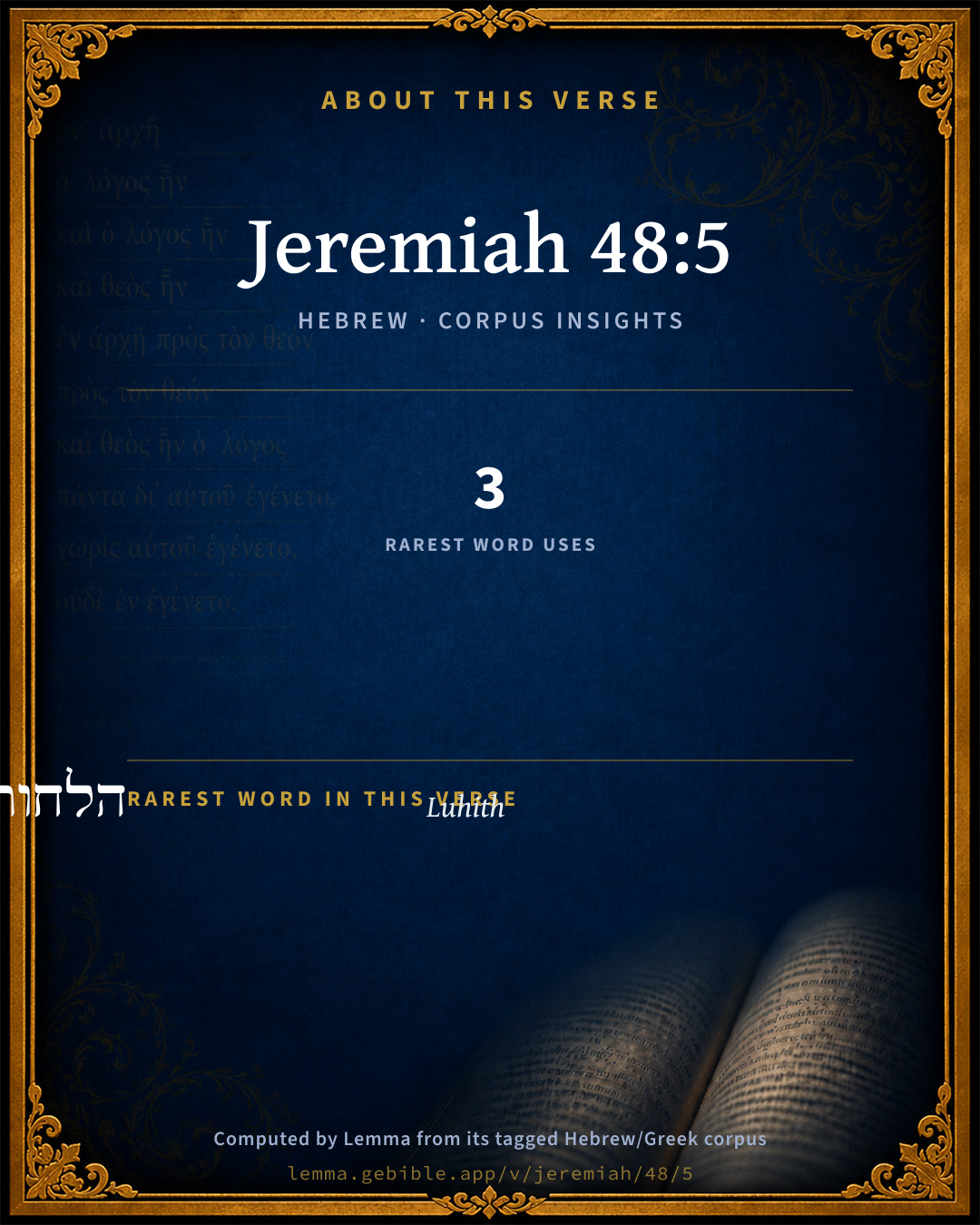
The rarest word here is הלחות Luhith H3872 — appearing just 3 times in the whole Hebrew Bible.

Shared distinctive vocabulary

הלחות Luhith H3872 occurs in 2 verses of the Hebrew Bible. Also found in:

Grammatical profile

  • 2 verbs
  • 10 nouns
  • 2 conjunctions

Verb forms

  • יַֽעֲלֶה Qal · Imperfect
  • שָׁמֵֽעוּ Qal · Perfect

Repetition

Words recur within this verse — often emphatic in Hebrew:

  • הלחות Luhith H3872 ×2
  • בִּבְכִ֖י weeping H1065 ×2
  • כִּ֚י that H3588 ×2

Cross-references

1

Topical passages linked to Jeremiah 48:5 in the Treasury of Scripture Knowledge — connected by theme and wording, ordered by reader-vote popularity; previews shown in the World English Bible.

  • Isaiah 15:5 My heart cries out for Moab; her nobles [flee] to Zoar, to Eglath Shelishiyah: for by the ascent of Luhith with weeping they go up; for in the way of Horonaim they raise up a cry of destruction.

Cross-references courtesy of OpenBible.info (CC BY 4.0).

Hebrew and Greek witnesses Masoretic Hebrew ↔ Greek Septuagint

The same verse in the two great witnesses to the Old Testament, shown verse-for-verse.

These are two independent witnesses, not word-aligned to each other, and the Septuagint is shown in lemma (dictionary) form.

Hebrew Jeremiah 48:5 Masoretic · Westminster Leningrad Codex

כִּ֚י מַעֲלֵ֣ה הלחות הַלּוּחִ֔ית בִּבְכִ֖י יַֽעֲלֶה בֶּ֑כִי כִּ֚י בְּמוֹרַ֣ד חוֹרֹנַ֔יִם צָרֵ֥י צַֽעֲקַת שֶׁ֖בֶר שָׁמֵֽעוּ

For by the ascent of Luhith with continual weeping shall they go up; for at the descent of Horonaim they have heard the distress of the cry of destruction.

World English Bible · Public Domain

Greek LXX Structure differs

In the Septuagint, Jeremiah is about an eighth shorter than the Hebrew and arranges its material differently — the Oracles Against the Nations (Hebrew chapters 46–51) appear in the middle of the Greek book, after 25:13. Because the chapter and verse boundaries do not line up, a verse-for-verse comparison with the Hebrew is not shown.

A verse-for-verse comparison isn’t shown here because the chapters and verses don’t line up. Switch to the LXX edition with the MT / LXX toggle above to read the Greek directly.

On this verse, Ellicott's Commentary for English Readers discusses the Septuagint’s reading. Read the note in Commentary ↓

Hebrew: Westminster Leningrad Codex (CC BY 4.0). Greek: Septuagint (public domain); English from a public-domain English Septuagint. How the Septuagint differs from the Hebrew →

Targum (Aramaic paraphrase)

1

The Targum is the ancient Jewish Aramaic paraphrase of the Hebrew Scriptures — an interpretive translation, not the Hebrew text itself. Onkelos (literal) and Pseudo-Jonathan (expansive) render the Torah, and Jonathan the Prophets. Coverage is partial: where no permissively-licensed English translation exists for a verse, only the Aramaic is shown. This is verse-level text, not a word-by-word alignment to the Hebrew.

  1. Targum Jonathan Prophets (Joshua–Malachi)
    אֲרֵי מַסוּקִית לוּחִית כַּד בָּכָן יִסְקוּן בָּכָן אֲרֵי בְּמַחֲתֵית חוֹרוֹנַיִם צִוְחַת תְּבִירֵי קְרָב יְבַסְרוּן:

    (no public-domain English translation for this verse)

    Targum Jonathan — Aramaic: “Mikraot Gedolot” (public domain). English: “Sefaria Community Translation” (CC0 1.0 (public-domain dedication)); “London "Chaldee Paraphrase," 1871” (public domain). Text via Sefaria.

Commentary

Notes on Jeremiah 48:5 from classic Christian and Jewish commentators (each source and its license shown beneath its notes). The classic Christian expositions comment on the surrounding passage and are grouped to its opening verse, so a note may address several verses; the Jewish commentaries on the Tanakh (Rashi and others) are per-verse, so they appear only where the commentator wrote on this verse.

Lemma curates 59 commentaries, every one of them public domain or Creative Commons licensed, each selected and text-cleaned for this edition rather than reprinted as found. About our sources →

Trapp's Complete Commentary

John Trapp

Jer 48:5 For in the going up of Luhith continual weeping shall go up; for in the going down of Horonaim the enemies have heard a cry of destruction.

Ver. 5. Continual weeping shall go up.] Heb., Weeping with weeping shall go up - i.e., they shall weep abundantly.

John Trapp, A Commentary or Exposition upon All the Books of the Old and New Testament (1647–1656) — public domain. Text from a community e-Sword module.

Tyndale Open Study Notes

Tyndale Open Resources

48:5-6 Luhith was another small village near Horonaim. The sorrows of oppression would reach into the smallest places.

Tyndale Open Study Notes — © Tyndale Open Resources, licensed CC BY-SA 4.0. Text via the HelloAO Bible API.

Geneva Bible (1599)

Geneva Bible translators

Horonaim and Luhith were two places whereby the Moabites should flee, Isa. 15:5.

Geneva Bible (1599) marginal notes — public domain. Text via Bolls.life.

Jamieson, Fausset & Brown

Robert Jamieson, A. R. Fausset & David Brown

going up of Luhith . . . going down of Horonaim--Horonaim lay in a plain, Luhith on a height. To the latter, therefore, the Moabites would flee with "continual weeping," as a place of safety from the Chaldeans. Literally, "Weeping shall go up upon weeping."

Jamieson, Fausset & Brown — Commentary Critical and Explanatory on the Whole Bible (1871) — public domain (CC PDM 1.0). Text via the HelloAO Bible API.

John Calvin's Commentaries

Here Jeremiah uses another figure, that the weeping would be everywhere heard in the ascent to Luhith. It is probable, and it appears from the Prophet’s words, that this city was situated on a high place. He then says, that men would go up with weeping in the ascent to Luhith; literally, In (or with) weeping shall weeping ascend But some read as though it were written בכה, beke, weeping; nor is there a doubt but that the verb יעלה, iole, refers to a person. But Jeremiah seems to have mentioned weeping twice in order to show that men would not only weep in one place, but during the long course of their ascent, as though he had said, “They who shall be near the city shall weep, and they in the middle of their course, and those at the foot of the mountain;” that is, there shall be weeping in every place. We now then perceive the meaning of the Prophet.

He afterwards says, In the descent to Horonaim It hence appears that this city was situated in a low place or on a plain; and therefore I know not why they say that one part of it was higher than the other. It might indeed be that it had a hill in it; but the place was in a level country, and had mountains around it, as we learn from the Prophet’s words, In the descent to Horonaim the enemies shall hear a cry of distress By saying that enemies would hear a cry, he means that the citizens of Horonaim and their neighbors would become frantic through grief. For fear restrains weeping, and when any one sees an enemy near, the very sight of him checks him, so that he dares not openly to show his grief; and then shame also restrains tears as well as sighings, for an enemy would deride our weepings in our misery. There is no doubt then, but that the Prophet here amplifies the grievousness of their sorrow, when he says, that though the citizens of Horonaim had enemies before their eyes, they would yet break forth with weeping and loud crying, and that the reproach and derision of enemies would not restrain them.

John Calvin's Commentaries (1540-1563) — public domain. Text from the Calvin Translation Society English edition (1840s-50s) via the Christian Classics Ethereal Library (ccel.org). Calvin's coverage is partial (roughly two-thirds of the Bible); uncommented books and verses are honest gaps, never fabricated. The 19th-century editor's footnotes and remarks are omitted so the notes are faithfully Calvin's own voice.

Ellicott's Commentary for English Readers

(5) In the going up of Luhith.—Here again we have an echo from Isa_15:5. Jerome (Onomast. s.v. Luith) describes it as between Zoar and Areopolis (= Rabbath-Moab). The ascent was probably to a local sanctuary. A various reading, Laboth, followed by the LXX., gives the meaning “the ascent of planks,” as though it were a wooden staircase. Alike in that and in the descent from Horonaim (possibly the fugitives who came down from the heights of the one city are represented as going up with wailing to the other) the enemies of Moab would hear the cry that proclaimed its downfall.

A Bible Commentary for English Readers, edited by Charles John Ellicott (1878–1897) — public domain. Text from a community e-Sword module.

The Cambridge Bible for Schools and Colleges

gen. ed. J. J. S. Perowne

5. See preceding note.

The Cambridge Bible for Schools and Colleges (gen. ed. J. J. S. Perowne; Cambridge University Press, 1878–1918) — public domain. Text from a community e-Sword module.

John Gill's Exposition

For in the going up of Luhith continual weeping shall go up,.... This is another city, which was built on a high hill, which had a considerable ascent to it, whither those that escaped from Horonaim might flee for safety; but as they went up the hill would weep bitterly, and all the way they went, because of the loss of friends and sustenance, and the danger they themselves were still in. Of this place See Gill on Isa 15:5;

for in the going down of Horonaim the enemies have heard a cry of destruction; a place before mentioned, which lay low, in the descent of which, the enemies, the Chaldeans, heard the cries of those that fled from Horonaim, and went up from thence to Luhith, which cry was as follows:

John Gill's Exposition of the Whole Bible (1746–1763) — public domain (CC PDM 1.0). Text via the HelloAO Bible API.

Albert Barnes' Notes on the Bible

Luhith was situated upon an eminence, and Jeremiah describes one set of weeping fugitives as pressing close upon another.

In the going down of Horonaim ... - Rather, in the descent of Horonaim they have heard the distresses of the cry of breaking, i. e., the cry of distress occasioned by the ruin inflicted by the enemy. It was situated in a hollow, probably near the Dead Sea.

Albert Barnes' Notes on the Bible (1834–1885) — public domain. Text from a community e-Sword/MySword module.

Matthew Poole's English Annotations

Of

Luhith we read only in this place, and Isa 15:5; it was a city of Moab, and situated upon a hill, as appears both here and where it is mentioned in Isaiah. Some think that to this city the Moabites fled for sanctuary from the Chaldeans, and fleeing made so great an outcry that their enemies who pursued them heard their cry.

Matthew Poole's English Annotations on the Holy Bible (1683–1685) — public domain. Text from a community e-Sword/MySword module.

Whedon's Commentary on the Bible

Daniel D. Whedon

5. In the going up of Luhith — The literal reading of the last clause is, with weeping shall go up weeping. “Luhith” was on an eminence; and the sense is, that wave upon wave of weeping, or rank presses upon rank of weepers.

Daniel D. Whedon (gen. ed.), Commentary on the Old and New Testaments (1874–1909) — public domain. Text from a community e-Sword module.

The Pulpit Commentary

For in the going up of Luhith, etc. The verse is substantially taken from Isaiah, (Isa_15:5) but with variations peculiar to this chapter. The most peculiar of these is that in the first verse half, which is literally, weeping goeth up (not, shall go up) with weeping, which is explained by Dr. Payne Smith to mean "one set of weeping fugitives pressing close upon another." To the present commentator (as also to Delitzsch see his note Isa_15:5) there seems no reasonable doubt that b"ki, the word rendered "weeping," should rather be bo, "upon it," so that the passage will run, as in Isaiah, "for the going up of Luhith with weeping doth one go up if," Hitzig (whom for once we find agreeing with Delitzsch) remarks that the miswriting b"ki for bo may be easily accounted for by the fact that ki, "for," is the word which follows next. We have no right to ascribe to Jeremiah such an artificial and un-Hebraic an expression as that of the received text. Small as the matter may be in itself, it is not unimportant as suggesting to the Old Testament student a caution against the too unreserved adoption of the canon Lectioni faciliori praestat ardua. In the going down of Horonaim. An interesting variation from Isaiah. The older poet, less attentive to minutiae, had said vaguely, "in the road to Horonaim;" by a slight change of expression, the younger and more reflective writer produces a striking antithesis between the ascent to the hill-town, and the descent to the hollow in which Horonaim ("double cavern") appears to have been situated. It is possible, however, that Jeremiah has preserved the original reading, and that "the road" in Isaiah, l.c., is due to the carelessness of a scribe. The enemies have heard a cry of destruction. But why this reference to the enemies? The rendering, however, is ungrammatical. The text is, literally, the enemies of the cry of destruction have they heard. The prophecy in Isaiah omits "the enemies of," and has a different verb for "have they heard." Can the inserted words be an intrusion from the margin? The later scribes were accustomed to insert glosses in the margin on occasions where we should have thought them entirely unnecessary for the purpose of explanation. But then why "the enemies of"? It is an insoluble enigma.

The Pulpit Commentary (1880–1919), ed. H.D.M. Spence-Jones & Joseph S. Exell — public domain. Text from a community e-Sword module.

John Wesley's Explanatory Notes

Luhith - To this city the Moabites fled for sanctuary, and flying made so great an out-cry that their enemies who pursued them heard it.

John Wesley, Explanatory Notes Upon the Whole Bible (1754–1765) — public domain. Text via the GEBible commentary corpus.

Rashi

Rabbi Shlomo Yitzchaki (Rashi)

the ascent of Luhith It is a place name, the ascent of a mountain.

Rashi on the Tanakh — English translations: “The Judaica Press complete Tanach with Rashi, translated by A. J. Rosenberg” (CC BY 4.0); “Pentateuch with Rashi's commentary by M. Rosenbaum and A.M. Silbermann, 1929-1934” (public domain); “The Metsudah Tanach series, Lakewood, N.J” (CC BY 4.0); and “The Book of Joshua, Metsudah Publications, 1997” (CC BY 4.0). Text via Sefaria.

Lesson kit

Teaching starters — assembled from the data on this page, not authored interpretation. Every prompt links to the verse data it draws on. Edit before teaching.

Jeremiah, in the Prophets, opens this verse with 14 words (11 distinct Hebrew lemmas). Its most distinctive word is Lûwchîyth (“Luhith”). A historical commentator’s framing appears above. Read the whole chapter for the surrounding context.

Discussion questions

  1. How does “Luhith” (Lûwchîyth) shape what this verse is saying?
  2. Isaiah 15:5 shares the word «Luhith» with this verse. How do the two illuminate each other?
  3. “Luhith” occurs 2× in this one verse. What is the effect of the repetition?
  4. The translations on this page render this verse differently — a whole-verse word diff, not a word-by-word alignment. What might account for the different wordings?
  5. The verb «יַֽעֲלֶה» is Qal Imperfect. How does its form color the action?
  6. Reading how Trapp's Complete Commentary and Tyndale Open Study Notes read this verse, where do the two commentators agree and where do they part?

Things to notice

Reading settings

Reading text

Shown beneath each verse's original-language words.

Old Testament
Old Testament edition

Read the OT as the Masoretic Hebrew (MT) or the Greek Septuagint (LXX).

English shown for the Greek Septuagint (in the Hebrew ↔ Greek comparison).

Comparing translations? Open the Compare panel on any verse page to stack up to four side by side.