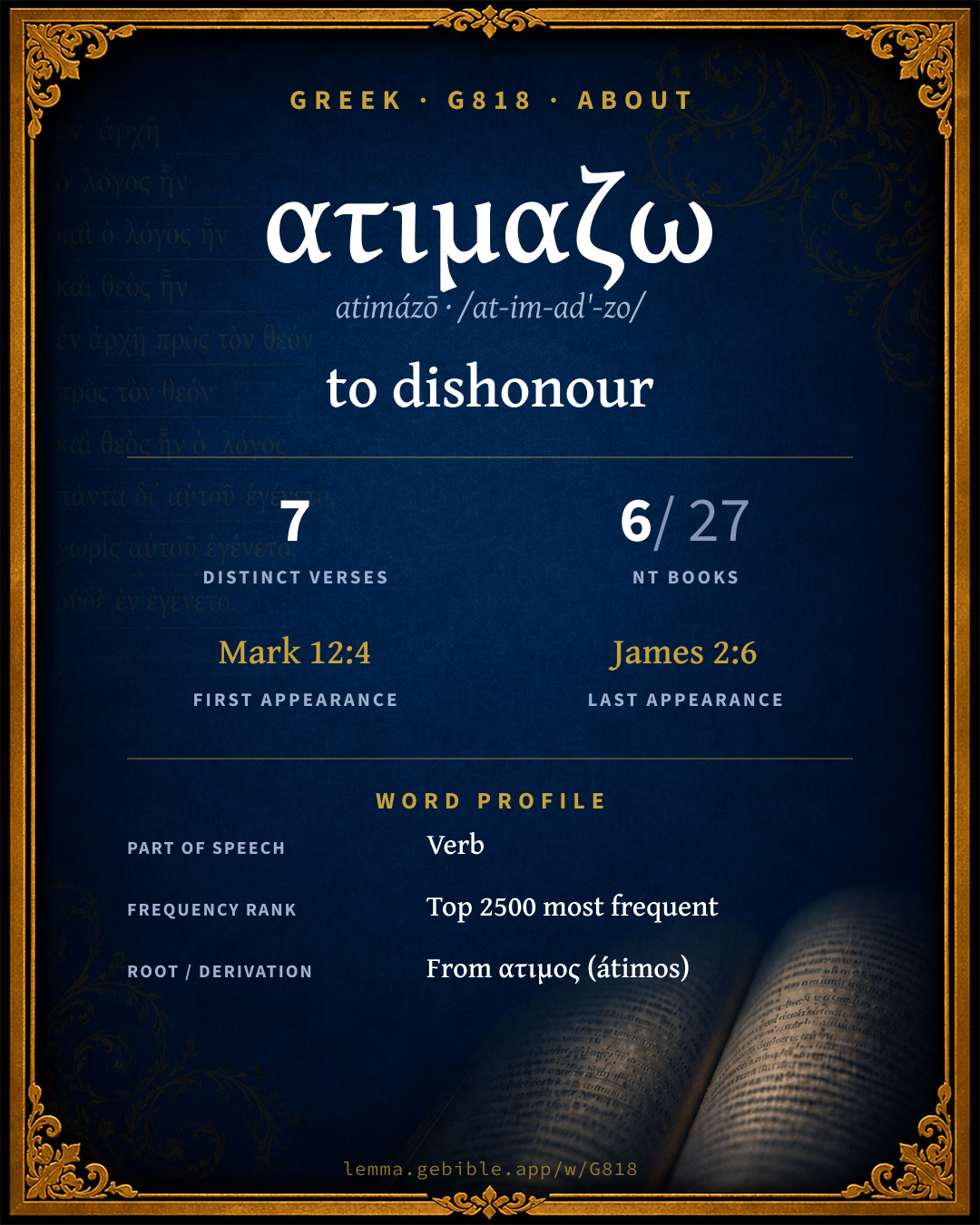
ἀτιμάζω
to dishonour
Full lexicon entry — Thayer's Greek Lexicon
From Thayer's Greek Lexicon
Where this word appears
See every Aorist-tense verb in the Greek New Testament →
Grammar key — what these labels mean
Part of speech
- Verb
- An action or state-of-being word.
Tense
- Aorist
- Action viewed as a simple whole, without regard to duration — often past (perfective aspect).
- Present
- Ongoing or general action in present time (imperfective aspect).
Voice
- Active
- The subject performs the action.
- Passive
- The subject receives the action.
- Middle or Passive
- A form that may be middle or passive — resolved by context.
Mood
- Indicative
- States a fact or asks a factual question (the mood of reality).
- Participle
- A verbal adjective (“writing,” “having written”).
- Infinitive
- A verbal noun (“to write”), unmarked for person or number.
Case
- Nominative
- The case of the subject (and the predicate nominative).
Person
- 2nd person
- The one addressed (“you”).
- 3rd person
- The one spoken about (“he / she / it / they”).
Gender
- Masculine
- Grammatically masculine.
Number
- Plural
- More than one.
- Singular
- One.
3 distinct verses where G818 appears in the Present tense, across 2 books. Filtered view — show all forms. Click any verse to open its interlinear word-by-word view. Verse text shown in the World English Bible for context — . Each verse’s Greek form is shown with its reference; the English is not keyword-highlighted, since the data carries no word-level English alignment. Use “Compare translations” on any verse to read it across multiple English versions. This concordance covers the Greek New Testament; Septuagint (Greek Old Testament) occurrences of this word are not indexed here.
John 1 verse
Romans 2 verses
About this entry
At a glance — auto-summarized from this page’s data, not written by a person. Every figure links to its source below. This summary describes the numbers; it doesn’t interpret them.
At its core, ατιμαζω (atimázō) means “to dishonour.” Scripture first uses it in Mark 12:4. It turns up in 7 verses across 6 books, an uncommon footprint. The word gravitates to Romans (29%), then Mark and Luke. It shares a root with ατιμος, ατιμια and ατιμοω. Dig into 7-verse concordance and the renderings breakdown below.
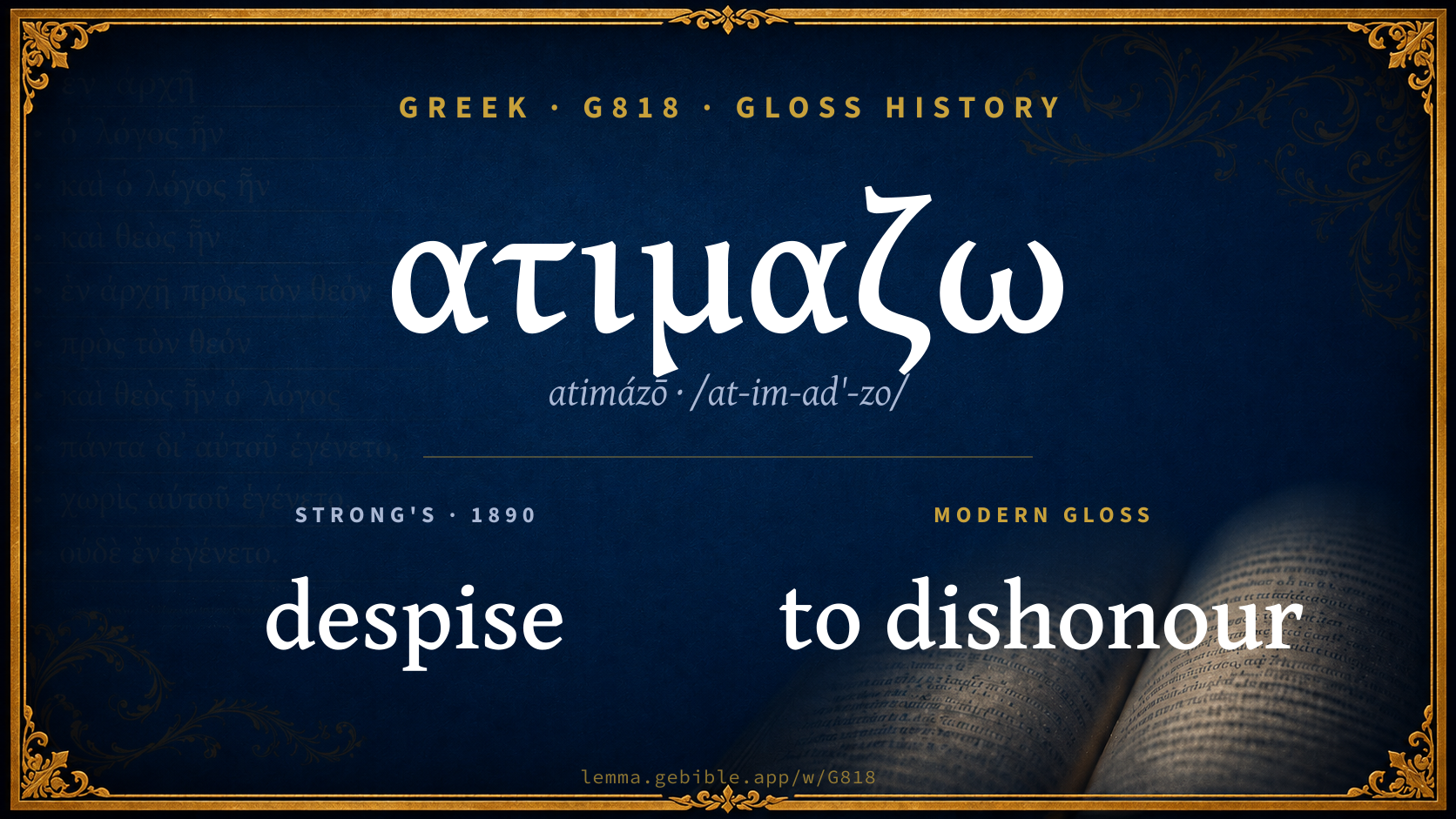
Gloss history
Strong's 1890 vs modern scholarship
About this word
Strong's G818 catalogs a Greek word from the Greek New Testament.
These counts are not copied from any lexicon or concordance. They are computed here, from the morphology-tagged Greek New Testament. What Lemma adds →
- 7
- distinct verses
- The word appears in 7 distinct verses.
- 6 / 27
- NT books
- The word appears in 6 of 27 New Testament books.
- #1,358
- by frequency
- Top 2500 most frequent Greek words (rank 1,358 of 5,347 Greek words by occurrence).
View all 7 occurrences in the concordance →
By section of the New Testament
By traditional corpus
Conventional, traditional groupings — biblical authorship is debated, so this is a traditional corpus grouping, not an authorship claim. Some books belong to more than one corpus (Luke is in both the Gospels and the Lukan corpus, and so on), so these shares overlap and need not total 100%. Each figure is a share of the word’s 7 distinct verses.
- Gospels 3 verses · 43%
- Lukan (Luke–Acts) 2 verses · 29%
- Pauline corpus 2 verses · 29%
- Johannine 1 verse · 14%
- General (Catholic) Epistles 1 verse · 14%
How translations render this word
Counts come from each version’s own published word-to-Strong’s tagging or interlinear alignment — an approximate guide to how each version renders this word, not a word-level alignment the data otherwise carries. Because each total is that version’s own tagged count, the per-version totals vary from one another and need not match the appearance or distinct-verse counts above. These counts may also differ from a printed concordance because Lemma counts each distinctly tagged rendering and does not collapse phrase taggings into a single head-word total. This is a fixed set of word-tagged versions (KJV, ASV, BSB, ULT) and does not change with the reading translation you choose elsewhere. Each version’s license is shown beside its name below (and on Sources).
- King James Version: Dishonour 1×, Dishonourest thou 1×, Do dishonour 1×
- American Standard Version: Dishonor 1×, Dishonorest thou 1×, Handled 1×
- Berean Standard Bible: Dishonor 1×, Dishonoring 1×, Do you dishonor 1×
- unfoldingWord Literal Text: Dishonor 2×
King James Version Public Domain
Renders G818 across 6 tagged occurrences — most commonly:
American Standard Version Public Domain
Renders G818 across 7 tagged occurrences — most commonly:
Berean Standard Bible Public Domain
Renders G818 across 7 tagged occurrences — most commonly:
unfoldingWord Literal Text CC BY-SA 4.0
Renders G818 across 8 tagged occurrences — most commonly:
Plus 6 renderings that appear only once — usually multi-word phrases or single function words the recovered tagging swept in, not distinct renderings.
Senses in Thayer's
The 1 sense Thayer's distinguishes for this word, in lexicon order (not ranked by frequency or importance). The full entry — with sub-senses — is in the Lexicon Entry tab.
- to dishonour, insult, treat with contempt
Word origin
Derived from ατιμος (átimos) (G820) — unhonoured.
From G820 ; to render infamous that is (by implication) contemn or maltreat : - despise dishonour suffer shame entreat shamefully.
— Strong’s Exhaustive Concordance (1890), public domain.
Forms in the corpus
The 7 distinct written forms G818 takes in the Greek New Testament, most frequent first — each parse links to that tense’s occurrences in the concordance.
| Form | Parsing | Example | Uses |
|---|---|---|---|
| ἀτιμάζεις atimázeis | Verb, Present, Active, Indicative, 2nd person, Singular | Romans 2:23 | 1 |
| ἀτιμάζεσθαι atimázesthai | Verb, Present, Middle or Passive, Infinitive | Romans 1:24 | 1 |
| ἀτιμάζετέ atimázeté | Verb, Present, Active, Indicative, 2nd person, Plural | John 8:49 | 1 |
| ἀτιμάσαντες atimásantes | Verb, Aorist, Active, Participle, Nominative, Plural, Masculine | Luke 20:11 | 1 |
| ἀτιμασθῆναι atimasthē̂nai | Verb, Aorist, Passive, Infinitive | Acts 5:41 | 1 |
| ἠτίμασαν ētímasan | Verb, Aorist, Active, Indicative, 3rd person, Plural | Mark 12:4 | 1 |
| ἠτιμάσατε ētimásate | Verb, Aorist, Active, Indicative, 2nd person, Plural | James 2:6 | 1 |
Same root — word family
Other Thayer's entries built from the same root as G818, grouped by Strong’s listed origin. These share a root / origin per the lexicon — not necessarily a shared meaning. Each links to that word’s own entry.
Derives from
Shares the same root
Compare all same-root words → They share a root, not necessarily a meaning.
Septuagint usage
The same Greek word ατιμαζω appears 25 times in the Greek Old Testament (Septuagint), across 25 verses in 9 books.
- 25
- LXX occurrences
- Tagged occurrences of this Greek word in the Septuagint.
- 25
- verses
- Distinct Septuagint verses containing this word.
- 9 / 39
- OT books
- The word appears in 9 of the 39 Old Testament books.
Sample Septuagint occurrences
- Genesis 16:4 ἀτιμάζω
- Deuteronomy 27:16 ἀτιμάζω
- 1 Samuel 10:27 ἀτιμάζω
- 2 Samuel 10:5 ἀτιμάζω
- Esther 1:18 ἀτιμάζω
- Proverbs 14:2 ἀτιμάζω
- Isaiah 5:15 ἀτιμάζω
- Ezekiel 28:24 ἀτιμάζω
- Micah 7:6 ἀτιμάζω
Septuagint occurrences (same lexeme)
Every verse where the same Strong’s number (G818) appears in the Greek Septuagint. Verse text shown in the World English Bible for context; the Greek form is the matched word — the English is not keyword-highlighted.
- Genesis 16:4 ἀτιμάζω He went in to Hagar, and she conceived. When she saw that she had conceived, her mistress was despised in her eyes.
- Genesis 16:5 ἀτιμάζω Sarai said to Abram, "This wrong is your fault. I gave my handmaid into your bosom, and when she saw that she had conceived, I was despised in her eyes. Yahweh judge between me and you."
- Deuteronomy 27:16 ἀτιμάζω Cursed be he who sets light by his father or his mother. All the people shall say, Amen.
- 1 Samuel 10:27 ἀτιμάζω But certain worthless fellows said, How shall this man save us? They despised him, and brought him no present. But he held his peace.
- 1 Samuel 17:22 ἀτιμάζω David left his baggage in the hand of the keeper of the baggage, and ran to the army, and came and greeted his brothers.
- 2 Samuel 10:5 ἀτιμάζω When they told it to David, he sent to meet them; for the men were greatly ashamed. The king said, Wait at Jericho until your beards be grown, and then return.
- Esther 1:18 ἀτιμάζω This day will the princesses of Persia and Media who have heard of the deed of the queen say [the like] to all the king's princes. So [will there arise] much contempt and wrath.
- Proverbs 14:2 ἀτιμάζω He who walks in his uprightness fears Yahweh, But he who is perverse in his ways despises him.
- Proverbs 14:21 ἀτιμάζω He who despises his neighbor sins, But blessed is he who has pity on the poor.
- Proverbs 19:26 ἀτιμάζω He who robs his father and drives away his mother, Is a son who causes shame and brings reproach.
- Proverbs 22:10 ἀτιμάζω Drive out the mocker, and strife will go out; Yes, quarrels and insults will stop.
- Proverbs 22:22 ἀτιμάζω Don't exploit the poor, because he is poor; And don't crush the needy in court;
- Proverbs 27:22 ἀτιμάζω Though you grind a fool in a mortar with a pestle along with grain, Yet his foolishness will not be removed from him.
- Proverbs 28:7 ἀτιμάζω Whoever keeps the law is a wise son; But he who is a companion of gluttons shames his father.
- Proverbs 30:17 ἀτιμάζω The eye that mocks at his father, And scorns obedience to his mother: The ravens of the valley shall pick it out, The young eagles shall eat it.
- Proverbs 30:32 ἀτιμάζω "If you have done foolishly in lifting up yourself, Or if you have thought evil, Put your hand over your mouth.
- Isaiah 5:15 ἀτιμάζω So man is brought low, Mankind is humbled, And the eyes of the arrogant ones are humbled;
- Isaiah 16:14 ἀτιμάζω But now Yahweh has spoken, saying, Within three years, as the years of a hireling, the glory of Moab shall be brought into contempt, with all his great multitude; and the remnant shall be very small and of no account.
- Isaiah 23:9 ἀτιμάζω Yahweh of hosts has purposed it, to stain the pride of all glory, to bring into contempt all the honorable of the earth.
- Isaiah 53:3 ἀτιμάζω He was despised, and rejected by men; a man of suffering, and acquainted with disease: and as one from whom men hide their face he was despised; and we didn't respect him.
- Ezekiel 28:24 ἀτιμάζω There shall be no more a pricking brier to the house of Israel, nor a hurting thorn of any that are round about them, that did despite to them; and they shall know that I am the Lord Yahweh.
- Ezekiel 28:26 ἀτιμάζω They shall dwell securely therein; yes, they shall build houses, and plant vineyards, and shall dwell securely, when I have executed judgments on all those who do them despite round about them; and they shall know that I am Yahweh their God.
- Ezekiel 36:3 ἀτιμάζω therefore prophesy, and say, Thus says the Lord Yahweh: Because, even because they have made you desolate, and swallowed you up on every side, that you might be a possession to the residue of the nations, and you are taken up in the lips of talkers, and the evil report of the people;
- Ezekiel 36:5 ἀτιμάζω therefore thus says the Lord Yahweh: Surely in the fire of my jealousy have I spoken against the residue of the nations, and against all Edom, that have appointed my land to themselves for a possession with the joy of all their heart, with despite of soul, to cast it out for a prey.
- Micah 7:6 ἀτιμάζω For the son dishonors the father, The daughter rises up against her mother, The daughter-in-law against her mother-in-law; A man's enemies are the men of his own house.
These are occurrences of the same Greek lexeme (G818) in the Septuagint — not a translation of any one Hebrew word. The store carries no word-level Hebrew↔Greek alignment, so no Hebrew original is asserted here. Counts come from the recovered LXX Strong's tagging — high-frequency vocabulary is well covered, while rare or late forms may be untagged — so they reflect tagged occurrences and may slightly undercount.