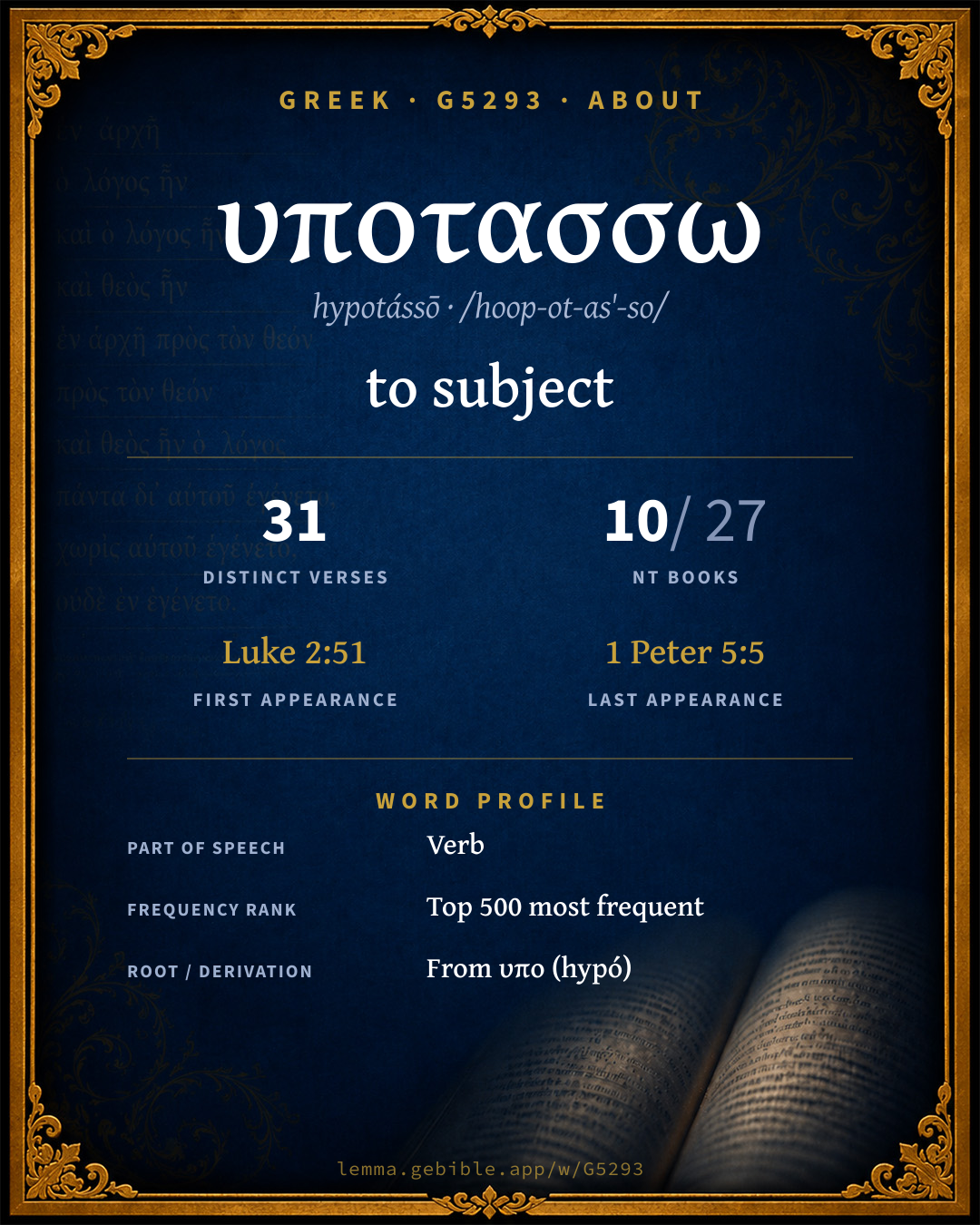
ὑποτάσσω
to subject
‘to subject’ is one of 6 main senses fuller range ↓
Full lexicon entry — Thayer's Greek Lexicon
From Thayer's Greek Lexicon
Where this word appears
See every Present-tense verb in the Greek New Testament →
Grammar key — what these labels mean
Part of speech
- Verb
- An action or state-of-being word.
Tense
- Present
- Ongoing or general action in present time (imperfective aspect).
- Aorist
- Action viewed as a simple whole, without regard to duration — often past (perfective aspect).
- Future
- Action expected in future time.
- Perfect
- A completed past action with continuing present results.
Voice
- Passive
- The subject receives the action.
- Active
- The subject performs the action.
- Middle
- The subject acts on or for itself, or with special interest in the action.
Mood
- Indicative
- States a fact or asks a factual question (the mood of reality).
- Imperative
- Expresses a command or request.
- Infinitive
- A verbal noun (“to write”), unmarked for person or number.
- Participle
- A verbal adjective (“writing,” “having written”).
- Subjunctive
- Expresses probability, purpose, or possibility (the mood of contingency).
Case
- Nominative
- The case of the subject (and the predicate nominative).
- Genitive
- The case of source, possession, or “of” — answers “whose / from what.”
- Accusative
- The case of the direct object and of extent.
- Dative
- The case of the indirect object, means, or location — “to / for / with / in.”
Person
- 3rd person
- The one spoken about (“he / she / it / they”).
- 2nd person
- The one addressed (“you”).
- 1st person
- The speaker (“I / we”).
Gender
- Feminine
- Grammatically feminine.
- Masculine
- Grammatically masculine.
- Neuter
- Grammatically neuter.
Number
- Singular
- One.
- Plural
- More than one.
Grammatical forms 25 distinct
- Verb, Present, Passive, Indicative, 3rd person, Singular 5 times (13%)
- Verb, Aorist, Passive, Imperative, 2nd person, Plural 3 times (8%)
- Verb, Aorist, Active, Indicative, 3rd person, Singular 3 times (8%)
- Verb, Present, Middle, Infinitive 3 times (8%)
- Verb, Aorist, Active, Infinitive 2 times (5%)
- Verb, Present, Passive, Participle, Nominative, Plural, Feminine 2 times (5%)
- Verb, Present, Passive, Participle, Nominative, Plural, Masculine 2 times (5%)
- Verb, Aorist, Passive, Indicative, 3rd person, Plural 1 time (3%)
+17 more forms (17 occurrences)
Parsed forms decoded from the imported morphology (Robinson–Tischendorf, public domain), counted across 38 parsed occurrences — not distinct verses.
Every verse where G5293 appears — 31 distinct verses across 10 books. Click any verse to open its interlinear word-by-word view. Verse text shown in the World English Bible for context — . Each verse’s Greek form is shown with its reference; the English is not keyword-highlighted, since the data carries no word-level English alignment. Use “Compare translations” on any verse to read it across multiple English versions. This concordance covers the Greek New Testament; Septuagint (Greek Old Testament) occurrences of this word are not indexed here.
Luke 3 verses
- Luke 2:51 ὑποτασσόμενος pres pass ptcp nom sg masc And he went down with them, and came to Nazareth. He was subject to them, and his mother kept all these sayings in her heart.
- Luke 10:17 ὑποτάσσεται pres pass ind 3sg The seventy returned with joy, saying, "Lord, even the demons are subject to us in your name!"
- Luke 10:20 ὑποτάσσεται pres pass ind 3sg Nevertheless, don't rejoice in this, that the spirits are subject to you, but rejoice that your names are written in heaven."
Romans 5 verses
- Romans 8:7 ὑποτάσσεται pres pass ind 3sg because the mind of the flesh is hostile towards God; for it is not subject to God's law, neither indeed can it be.
- Romans 8:20 ὑπετάγη ὑποτάξαντα aor pass ind 3sg aor act ptcp acc sg masc For the creation was subjected to vanity, not of its own will, but because of him who subjected it, in hope
- Romans 10:3 ὑπετάγησαν aor pass ind 3pl For being ignorant of God's righteousness, and seeking to establish their own righteousness, they didn't subject themselves to the righteousness of God.
- Romans 13:1 ὑποτασσέσθω pres mid impv 3sg Let every soul be in subjection to the higher authorities, for there is no authority except from God, and those who exist are ordained by God.
- Romans 13:5 ὑποτάσσεσθαι pres mid inf Therefore you need to be in subjection, not only because of the wrath, but also for conscience' sake.
1 Corinthians 5 verses
- 1 Corinthians 14:32 ὑποτάσσεται pres pass ind 3sg The spirits of the prophets are subject to the prophets,
- 1 Corinthians 14:34 ὑποτασσέσθωσαν pres pass impv 3pl let your wives keep silent in the assemblies, for it has not been permitted for them to speak; but let them be in subjection, as the law also says.
- 1 Corinthians 15:27 ὑπέταξεν ὑποτέτακται ὑποτάξαντος aor act ind 3sg perf pass ind 3sg aor act ptcp gen sg masc For, "He put all things in subjection under his feet." But when he says, "All things are put in subjection," it is evident that he is excepted who subjected all things to him.
- 1 Corinthians 15:28 ὑποταγῇ ὑποταγήσεται ὑποτάξαντι aor pass subj 3sg fut pass ind 3sg aor act ptcp dat sg masc When all things have been subjected to him, then the Son will also himself be subjected to him who subjected all things to him, that God may be all in all.
- 1 Corinthians 16:16 ὑποτάσσησθε pres pass subj 2pl that you also be in subjection to such, and to everyone who helps in the work and labors.
Ephesians 3 verses
- Ephesians 1:22 ὑπέταξεν aor act ind 3sg He put all things in subjection under his feet, and gave him to be head over all things for the assembly,
- Ephesians 5:21 ὑποτασσόμενοι pres pass ptcp nom pl masc subjecting yourselves one to another in the fear of Christ.
- Ephesians 5:24 ὑποτάσσεται pres pass ind 3sg But as the assembly is subject to Christ, so let the wives also be to their own husbands in everything.
Philippians 1 verse
Colossians 1 verse
Titus 3 verses
- Titus 2:5 ὑποτασσομένας pres pass ptcp acc pl fem to be sober-minded, chaste, workers at home, kind, being in subjection to their own husbands, that God's word may not be blasphemed.
- Titus 2:9 ὑποτάσσεσθαι pres mid inf Exhort servants to be in subjection to their own masters, and to be well-pleasing in all things; not contradicting;
- Titus 3:1 ὑποτάσσεσθαι pres mid inf Remind them to be in subjection to rulers and to authorities, to be obedient, to be ready for every good work,
Hebrews 3 verses
- Hebrews 2:5 ὑπέταξεν aor act ind 3sg For he didn't subject the world to come, of which we speak, to angels.
- Hebrews 2:8 ὑπέταξας ὑποτάξαι ὑποτεταγμένα aor act ind 2sg aor act inf perf pass ptcp acc pl neut You have put all things in subjection under his feet." For in that he subjected all things to him, he left nothing that is not subject to him. But now we don't see all things subjected to him, yet.
- Hebrews 12:9 ὑποταγησόμεθα fut pass ind 1pl Furthermore, we had the fathers of our flesh to chasten us, and we paid them respect. Shall we not much rather be in subjection to the Father of spirits, and live?
James 1 verse
1 Peter 6 verses
- 1 Peter 2:13 Ὑποτάγητε aor pass impv 2pl Therefore subject yourselves to every ordinance of man for the Lord's sake: whether to the king, as supreme;
- 1 Peter 2:18 ὑποτασσόμενοι pres pass ptcp nom pl masc Servants, be in subjection to your masters with all fear; not only to the good and gentle, but also to the wicked.
- 1 Peter 3:1 ὑποτασσόμεναι pres pass ptcp nom pl fem In like manner, wives, be in subjection to your own husbands; so that, even if any don't obey the Word, they may be won by the behavior of their wives without a word;
- 1 Peter 3:5 ὑποτασσόμεναι pres pass ptcp nom pl fem For this is how the holy women before, who hoped in God, also adorned themselves, being in subjection to their own husbands:
- 1 Peter 3:22 ὑποταγέντων aor pass ptcp gen pl masc who is at the right hand of God, having gone into heaven, angels and authorities and powers being made subject to him.
- 1 Peter 5:5 ὑποτάγητε aor pass impv 2pl Likewise, you younger ones, be subject to the elder. Yes, all of you gird yourselves with humility, to subject yourselves to one another; for "God resists the proud, but gives grace to the humble."
About this entry
At a glance — auto-summarized from this page’s data, not written by a person. Every figure links to its source below. This summary describes the numbers; it doesn’t interpret them.
υποτασσω (hypotássō) is a Greek verb most often rendered “to subject.” Its English rendering has broadened — “submit yourselves” classically, “submit” (Berean Standard Bible) and “be subjected” (unfoldingWord Literal Text) in modern versions; see the renderings breakdown. The Greek New Testament uses it across 31 verses — moderately common. It first appears in Luke 2:51. Ranging over 6 senses, it is not a single-sense word. The sections below give every sense, occurrence, and version rendering.
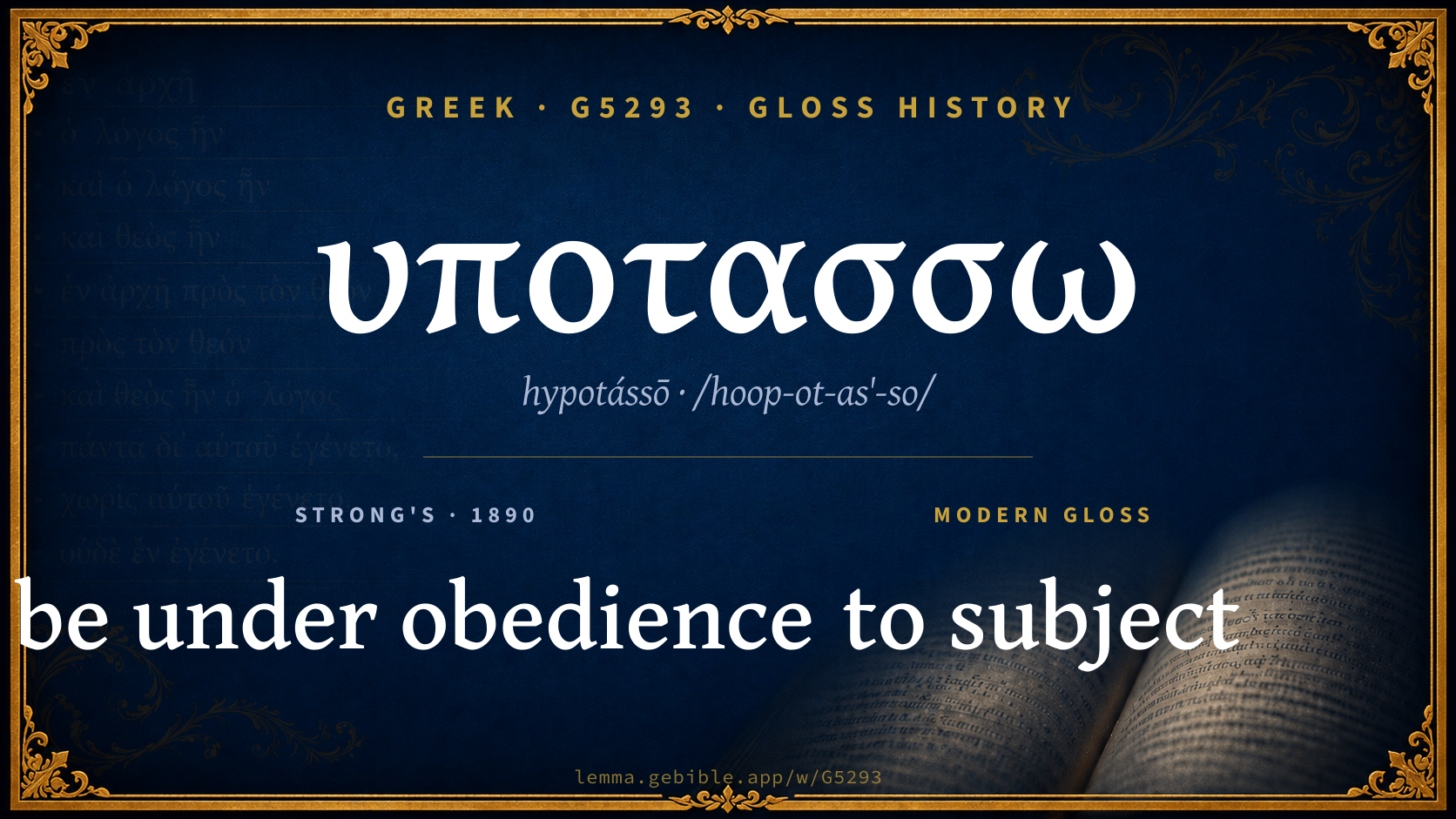
Gloss history
Strong's 1890 vs modern scholarship
About this word
Strong's G5293 catalogs a Greek word from the Greek New Testament.
These counts are not copied from any lexicon or concordance. They are computed here, from the morphology-tagged Greek New Testament. What Lemma adds →
- 31
- distinct verses
- The word appears in 31 distinct verses.
- 10 / 27
- NT books
- The word appears in 10 of 27 New Testament books.
- #392
- by frequency
- Top 500 most frequent Greek words (rank 392 of 5,347 Greek words by occurrence).
View all 31 occurrences in the concordance →
Most concentrated in
- 1 Peter 6 verses 19%
- Romans 5 verses 16%
- 1 Corinthians 5 verses 16%
By section of the New Testament
By traditional corpus
Conventional, traditional groupings — biblical authorship is debated, so this is a traditional corpus grouping, not an authorship claim. Some books belong to more than one corpus (Luke is in both the Gospels and the Lukan corpus, and so on), so these shares overlap and need not total 100%. Each figure is a share of the word’s 31 distinct verses.
- Pauline corpus 18 verses · 58%
- General (Catholic) Epistles 7 verses · 23%
- Gospels 3 verses · 10%
- Lukan (Luke–Acts) 3 verses · 10%
- Hebrews 3 verses · 10%
How translations render this word
Counts come from each version’s own published word-to-Strong’s tagging or interlinear alignment — an approximate guide to how each version renders this word, not a word-level alignment the data otherwise carries. Because each total is that version’s own tagged count, the per-version totals vary from one another and need not match the appearance or distinct-verse counts above. These counts may also differ from a printed concordance because Lemma counts each distinctly tagged rendering and does not collapse phrase taggings into a single head-word total. This is a fixed set of word-tagged versions (KJV, ASV, BSB, ULT) and does not change with the reading translation you choose elsewhere. Each version’s license is shown beside its name below (and on Sources).
- King James Version: Submit yourselves 6×, Be subject 5×, Are subject 3×
- American Standard Version: Be in subjection 6×, Be subject 3×, Subject 3×
- Berean Standard Bible: Submit 8×, Submit yourselves 5×, Subject 3×
- unfoldingWord Literal Text: Be subjected 7×, Are subjected 2×, He has put 2×
King James Version Public Domain
Renders G5293 across 49 tagged occurrences — most commonly:
Plus 29 renderings that appear only once — usually multi-word phrases or single function words the recovered tagging swept in, not distinct renderings.
American Standard Version Public Domain
Renders G5293 across 49 tagged occurrences — most commonly:
Plus 23 renderings that appear only once — usually multi-word phrases or single function words the recovered tagging swept in, not distinct renderings.
Berean Standard Bible Public Domain
Renders G5293 across 38 tagged occurrences — most commonly:
Plus 18 renderings that appear only once — usually multi-word phrases or single function words the recovered tagging swept in, not distinct renderings.
unfoldingWord Literal Text CC BY-SA 4.0
Renders G5293 across 45 tagged occurrences — most commonly:
Plus 30 renderings that appear only once — usually multi-word phrases or single function words the recovered tagging swept in, not distinct renderings.
Senses in Thayer's
The 6 senses Thayer's distinguishes for this word, in lexicon order (not ranked by frequency or importance). The full entry — with sub-senses — is in the Lexicon Entry tab.
- to arrange under, to subordinate
- to subject, put in subjection
- to subject one's self, obey
- to submit to one's control
- to yield to one's admonition or advice
- to obey, be subject A Greek military term meaning "to arrange [troop divisions] in amilitary fashion under the command…
Word origin
Derived from υπο (hypó) (G5259) — under.
Forms in the corpus
The 26 distinct written forms G5293 takes in the Greek New Testament, most frequent first — each parse links to that tense’s occurrences in the concordance.
Same root — word family
Other Thayer's entries built from the same root as G5293, grouped by Strong’s listed origin. These share a root / origin per the lexicon — not necessarily a shared meaning. Each links to that word’s own entry.
Derives from
Shares the same root
- υπαγω hypágō G5217 to depart
- υπακουω hypakoúō G5219 to listen
- υπανδρος hýpandros G5220 under (married)
- υπανταω hypantáō G5221 to meet
- υπαρχω hypárchō G5225 to be at hand
- υπεικω hypeíkō G5226 to yield
- υπεναντιος hypenantíos G5227 adversary
- υπεχω hypéchō G5254 to sustain
- υπηρετης hypērétēs G5257 servant
- υπνος hýpnos G5258 sleep
- υποβαλλω hypobállō G5260 to instigate
- υπογραμμος hypogrammós G5261 example
- υποδεικνυμι hypodeíknymi G5263 to demonstrate
- υποδεχομαι hypodéchomai G5264 to welcome
- υποδεω hypodéō G5265 to bind on
- υποδικος hypódikos G5267 debtor
- υποζυγιον hypozýgion G5268 beast of burden
- υποζωννυμι hypozṓnnymi G5269 to undergird
- υποκατω hypokátō G5270 underneath
- υποκρινομαι hypokrínomai G5271 to pretend
- υπολαμβανω hypolambánō G5274 to welcome
- υποληνιον hypolḗnion G5276 wine pit
- υπομενω hypoménō G5278 to endure
- υπομιμνησκω hypomimnḗskō G5279 to remind
+15 more words share this root (not shown).
Derived from this word
Compare all same-root words → Showing 4 of 42 — not the complete family. They share a root, not necessarily a meaning.
Septuagint usage
The same Greek word υποτασσω appears 16 times in the Greek Old Testament (Septuagint), across 16 verses in 6 books.
- 16
- LXX occurrences
- Tagged occurrences of this Greek word in the Septuagint.
- 16
- verses
- Distinct Septuagint verses containing this word.
- 6 / 39
- OT books
- The word appears in 6 of the 39 Old Testament books.
Sample Septuagint occurrences
- 1 Kings 10:15 ὑποτάσσω
- 1 Chronicles 22:18 ὑποτάσσω
- 2 Chronicles 9:14 ὑποτάσσω
- Psalms 8:7 ὑποτάσσω
- Daniel 7:27 ὑποτάσσω
- Haggai 2:18 ὑποτάσσω
Septuagint occurrences (same lexeme)
Every verse where the same Strong’s number (G5293) appears in the Greek Septuagint. Verse text shown in the World English Bible for context; the Greek form is the matched word — the English is not keyword-highlighted.
- 1 Kings 10:15 ὑποτάσσω besides [that which] the traders [brought], and the traffic of the merchants, and of all the kings of the mixed people, and of the governors of the country.
- 1 Chronicles 22:18 ὑποτάσσω Isn't Yahweh your God with you? Hasn't he given you rest on every side? for he has delivered the inhabitants of the land into my hand; and the land is subdued before Yahweh, and before his people.
- 1 Chronicles 29:24 ὑποτάσσω All the princes, the mighty men, and also all of the sons of king David submitted themselves to Solomon the king.
- 2 Chronicles 9:14 ὑποτάσσω besides that which the traders and merchants brought: and all the kings of Arabia and the governors of the country brought gold and silver to Solomon.
- Psalms 8:7 ὑποτάσσω All sheep and oxen, Yes, and the animals of the field,
- Psalms 17:48 ὑποτάσσω
- Psalms 36:7 ὑποτάσσω How precious is your loving kindness, God! The children of men take refuge under the shadow of your wings.
- Psalms 46:4 ὑποτάσσω There is a river, the streams of which make the city of God glad, The holy place of the tents of the Most High.
- Psalms 59:10 ὑποτάσσω My God will go before me with his loving kindness. God will let me look at my enemies in triumph.
- Psalms 61:2 ὑποτάσσω From the end of the earth, I will call to you, when my heart is overwhelmed. Lead me to the rock that is higher than I.
- Psalms 61:6 ὑποτάσσω You will prolong the king's life; His years shall be for generations.
- Psalms 107:10 ὑποτάσσω Some sat in darkness and in the shadow of death, Being bound in affliction and iron,
- Psalms 143:2 ὑποτάσσω Don't enter into judgment with your servant, For in your sight no man living is righteous.
- Daniel 7:27 ὑποτάσσω The kingdom and the dominion, and the greatness of the kingdoms under the whole the sky, shall be given to the people of the saints of the Most High: his kingdom is an everlasting kingdom, and all dominions shall serve and obey him.
- Daniel 11:37 ὑποτάσσω Neither shall he regard the gods of his fathers, nor the desire of women, nor regard any god; for he shall magnify himself above all.
- Haggai 2:18 ὑποτάσσω 'Consider, please, from this day and backward, from the twenty-fourth day of the ninth month, since the day that the foundation of Yahweh's temple was laid, consider it.
These are occurrences of the same Greek lexeme (G5293) in the Septuagint — not a translation of any one Hebrew word. The store carries no word-level Hebrew↔Greek alignment, so no Hebrew original is asserted here. Counts come from the recovered LXX Strong's tagging — high-frequency vocabulary is well covered, while rare or late forms may be untagged — so they reflect tagged occurrences and may slightly undercount.