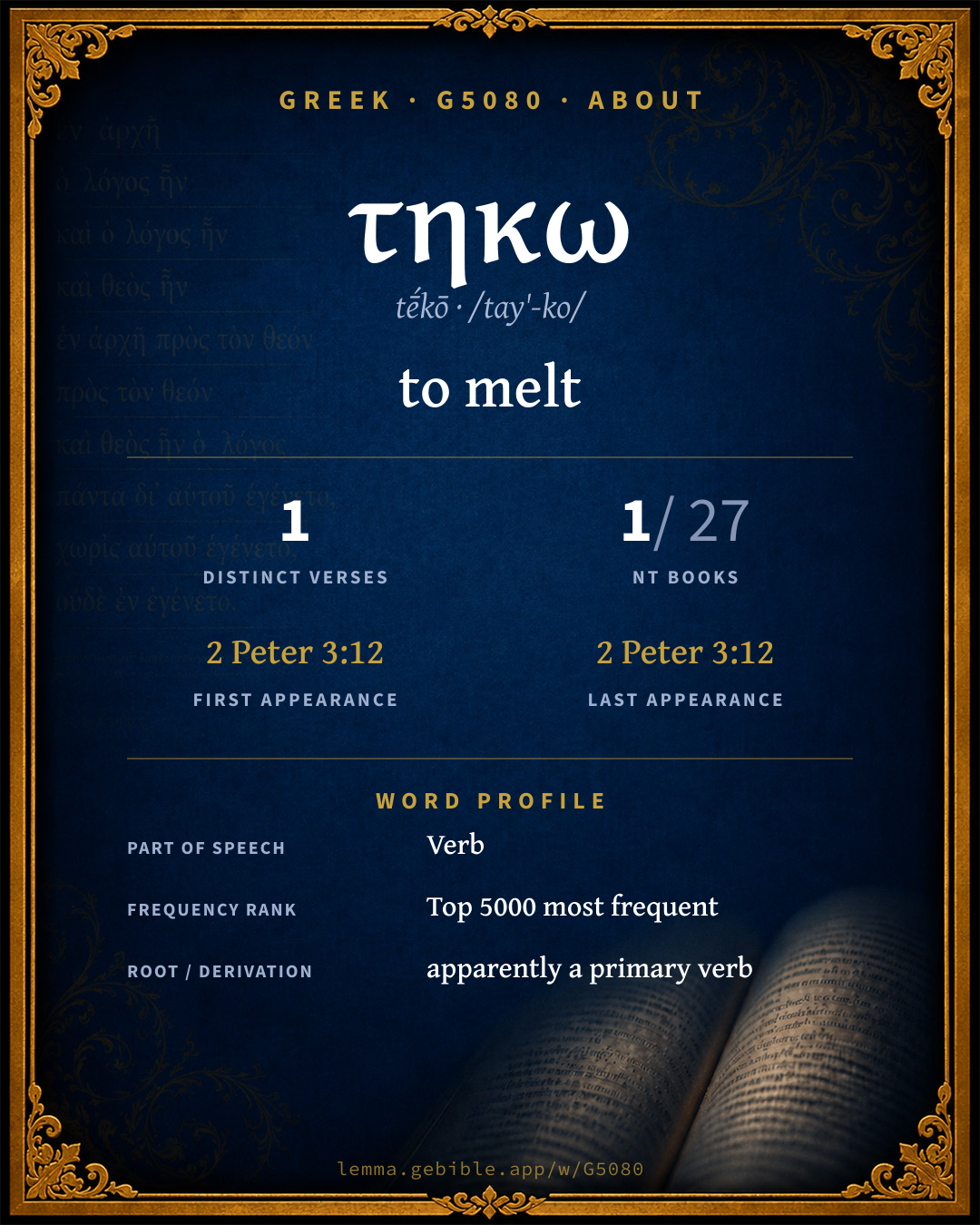
τήκω
to melt
‘to melt’ is one of 3 main senses fuller range ↓
Full lexicon entry — Thayer's Greek Lexicon
From Thayer's Greek Lexicon
Where this word appears
Grammar key — what these labels mean
Part of speech
- Verb
- An action or state-of-being word.
Tense
- Present
- Ongoing or general action in present time (imperfective aspect).
Voice
- Passive
- The subject receives the action.
Mood
- Indicative
- States a fact or asks a factual question (the mood of reality).
Person
- 3rd person
- The one spoken about (“he / she / it / they”).
Number
- Singular
- One.
Every verse where G5080 appears — 1 distinct verse across 1 book. Click any verse to open its interlinear word-by-word view. Verse text shown in the World English Bible for context — . Each verse’s Greek form is shown with its reference; the English is not keyword-highlighted, since the data carries no word-level English alignment. Use “Compare translations” on any verse to read it across multiple English versions. This concordance covers the Greek New Testament; Septuagint (Greek Old Testament) occurrences of this word are not indexed here.
2 Peter 1 verse
About this entry
At a glance — auto-summarized from this page’s data, not written by a person. Every figure links to its source below. This summary describes the numbers; it doesn’t interpret them.
The Greek verb τηκω centers on the idea of “to melt.” A scarce word — 1 verse in all of the Greek New Testament. 2 Peter dominates its distribution — 1 of 1 verses. Scripture uses it exactly once, at 2 Peter 3:12. Thayer's distinguishes 3 senses for it. For the data behind this summary, explore the sense tree and the renderings breakdown below.
Gloss history
Strong's 1890 vs modern scholarship
About this word
Strong's G5080 catalogs a Greek word from the Greek New Testament.
These counts are not copied from any lexicon or concordance. They are computed here, from the morphology-tagged Greek New Testament. What Lemma adds →
- 1
- distinct verses
- The word appears in 1 distinct verse.
- 1 / 27
- NT books
- The word appears in 1 of 27 New Testament books.
- #3,503
- by frequency
- Top 5000 most frequent Greek words (rank 3,503 of 5,347 Greek words by occurrence).
View all 1 occurrence in the concordance →
Most concentrated in
- 2 Peter 1 verse 100%
By section of the New Testament
By traditional corpus
Conventional, traditional groupings — biblical authorship is debated, so this is a traditional corpus grouping, not an authorship claim. Some books belong to more than one corpus (Luke is in both the Gospels and the Lukan corpus, and so on), so these shares overlap and need not total 100%. Each figure is a share of the word’s 1 distinct verse.
- General (Catholic) Epistles 1 verse · 100%
How translations render this word
Counts come from each version’s own published word-to-Strong’s tagging or interlinear alignment — an approximate guide to how each version renders this word, not a word-level alignment the data otherwise carries. Because each total is that version’s own tagged count, the per-version totals vary from one another and need not match the appearance or distinct-verse counts above. These counts may also differ from a printed concordance because Lemma counts each distinctly tagged rendering and does not collapse phrase taggings into a single head-word total. This is a fixed set of word-tagged versions (KJV, ASV, BSB, ULT) and does not change with the reading translation you choose elsewhere. Each version’s license is shown beside its name below (and on Sources).
- King James Version: Shall melt 1×
- American Standard Version: Shall melt 1×
- Berean Standard Bible: Will melt 1×
- unfoldingWord Literal Text: Will be melted 1×
King James Version Public Domain
Renders G5080 across 1 tagged occurrence — most commonly:
American Standard Version Public Domain
Renders G5080 across 1 tagged occurrence — most commonly:
Berean Standard Bible Public Domain
Renders G5080 across 1 tagged occurrence — most commonly:
unfoldingWord Literal Text CC BY-SA 4.0
Renders G5080 across 1 tagged occurrence — most commonly:
Senses in Thayer's
The 3 senses Thayer's distinguishes for this word, in lexicon order (not ranked by frequency or importance). The full entry — with sub-senses — is in the Lexicon Entry tab.
- to make liquid
- to become liquid, to melt
- to perish or become destroyed by melting
Word origin
Origin: apparently a primary verb
Apparently a primary verb; to liquefy : - melt.
— Strong’s Exhaustive Concordance (1890), public domain.
Septuagint usage
The same Greek word τηκω appears 35 times in the Greek Old Testament (Septuagint), across 33 verses in 15 books.
- 35
- LXX occurrences
- Tagged occurrences of this Greek word in the Septuagint.
- 33
- verses
- Distinct Septuagint verses containing this word.
- 15 / 39
- OT books
- The word appears in 15 of the 39 Old Testament books.
Sample Septuagint occurrences
- Exodus 15:15 τήκω
- Leviticus 26:39 τήκω
- Deuteronomy 28:65 τήκω
- Joshua 5:1 τήκω
- Judges 15:14 τήκω
- 2 Samuel 17:10 τήκω
- Job 6:17 τήκω
- Psalms 21:15 τήκω
- Isaiah 24:23 τήκω
- Jeremiah 6:29 τήκω
- Ezekiel 4:17 τήκω
- Micah 1:4 τήκω
Septuagint occurrences (same lexeme)
Every verse where the same Strong’s number (G5080) appears in the Greek Septuagint. Verse text shown in the World English Bible for context; the Greek form is the matched word — the English is not keyword-highlighted.
- Exodus 15:15 τήκω Then the chiefs of Edom were dismayed. Trembling takes hold of the mighty men of Moab. All the inhabitants of Canaan are melted away.
- Exodus 16:21 τήκω They gathered it morning by morning, everyone according to his eating. When the sun grew hot, it melted.
- Leviticus 26:39 τήκω Those of you who are left will pine away in their iniquity in your enemies' lands; and also in the iniquities of their fathers shall they pine away with them.
- Deuteronomy 28:65 τήκω Among these nations shall you find no ease, and there shall be no rest for the sole of your foot: but Yahweh will give you there a trembling heart, and failing of eyes, and pining of soul;
- Deuteronomy 32:24 τήκω [They shall be] wasted with hunger, and devoured with burning heat Bitter destruction; The teeth of animals will I send on them, With the poison of crawling things of the dust.
- Joshua 5:1 τήκω It happened, when all the kings of the Amorites, who were beyond the Jordan westward, and all the kings of the Canaanites, who were by the sea, heard how that Yahweh had dried up the waters of the Jordan from before the children of Israel, until we were passed over, that their heart melted, neither was there spirit in them any more, because of the children of Israel.
- Judges 15:14 τήκω When he came to Lehi, the Philistines shouted as they met him: and the Spirit of Yahweh came mightily on him, and the ropes that were on his arms became as flax that was burnt with fire, and his bands dropped from off his hands.
- 2 Samuel 17:10 τήκω Even he who is valiant, whose heart is as the heart of a lion, will utterly melt; for all Israel knows that your father is a mighty man, and those who are with him are valiant men.
- Job 6:17 τήκω In the dry season, they vanish. When it is hot, they are consumed out of their place.
- Job 7:5 τήκω My flesh is clothed with worms and clods of dust. My skin closes up, and breaks out afresh.
- Job 11:20 τήκω But the eyes of the wicked shall fail, They shall have no way to flee; Their hope shall be the giving up of the spirit."
- Job 17:5 τήκω He who denounces his friends for a prey, Even the eyes of his children shall fail.
- Job 42:6 τήκω Therefore I abhor myself, And repent in dust and ashes."
- Psalms 21:15 τήκω
- Psalms 57:9 τήκω I will give thanks to you, Lord, among the peoples. I will sing praises to you among the nations.
- Psalms 67:3 τήκω Let the peoples praise you, God. Let all the peoples praise you.
- Psalms 74:4 τήκω Your adversaries have roared in the midst of your assembly. They have set up their standards as signs.
- Psalms 96:5 τήκω For all the gods of the peoples are idols, But Yahweh made the heavens.
- Psalms 106:26 τήκω Therefore he swore to them That he would overthrow them in the wilderness,
- Psalms 111:10 τήκω The fear of Yahweh is the beginning of wisdom. All those who do his work have a good understanding. His praise endures forever!
- Psalms 147:7 τήκω Sing to Yahweh with thanksgiving. Sing praises on the harp to our God,
- Isaiah 24:23 τήκω Then the moon shall be confounded, and the sun ashamed; for Yahweh of Hosts will reign on Mount Zion, and in Jerusalem; and before his elders shall be glory.
- Isaiah 63:19 τήκω We are become as they over whom you never bear rule, as those who were not called by your name.
- Isaiah 64:1 τήκω Oh that you would tear the heavens, that you would come down, that the mountains might quake at your presence,
- Jeremiah 6:29 τήκω The bellows blow fiercely; the lead is consumed of the fire: in vain do they go on refining; for the wicked are not plucked away.
- Ezekiel 4:17 τήκω that they may want bread and water, and be dismayed one with another, and pine away in their iniquity.
- Ezekiel 24:10 τήκω Heap on the wood, make the fire hot, boil well the flesh, and make thick the broth, and let the bones be burned.
- Ezekiel 24:11 τήκω Then set it empty on the coals of it, that it may be hot, and the brass of it may burn, and that the filthiness of it may be molten in it, that the rust of it may be consumed.
- Ezekiel 33:10 τήκω You, son of man, tell the house of Israel: Thus you speak, saying, Our transgressions and our sins are on us, and we pine away in them; how then can we live?
- Micah 1:4 τήκω The mountains melt under him, And the valleys split apart, Like wax before the fire, Like waters that are poured down a steep place.
- Nahum 1:6 τήκω Who can stand before his indignation? Who can endure the fierceness of his anger? His wrath is poured out like fire, and the rocks are broken apart by him.
- Habakkuk 3:6 τήκω He stood, and shook the earth. He looked, and made the nations tremble. The ancient mountains were crumbled. The age-old hills collapsed. His ways are eternal.
- Zechariah 14:12 τήκω This will be the plague with which Yahweh will strike all the peoples who have warred against Jerusalem: their flesh will consume away while they stand on their feet, and their eyes will consume away in their sockets, and their tongue will consume away in their mouth.
These are occurrences of the same Greek lexeme (G5080) in the Septuagint — not a translation of any one Hebrew word. The store carries no word-level Hebrew↔Greek alignment, so no Hebrew original is asserted here. Counts come from the recovered LXX Strong's tagging — high-frequency vocabulary is well covered, while rare or late forms may be untagged — so they reflect tagged occurrences and may slightly undercount.