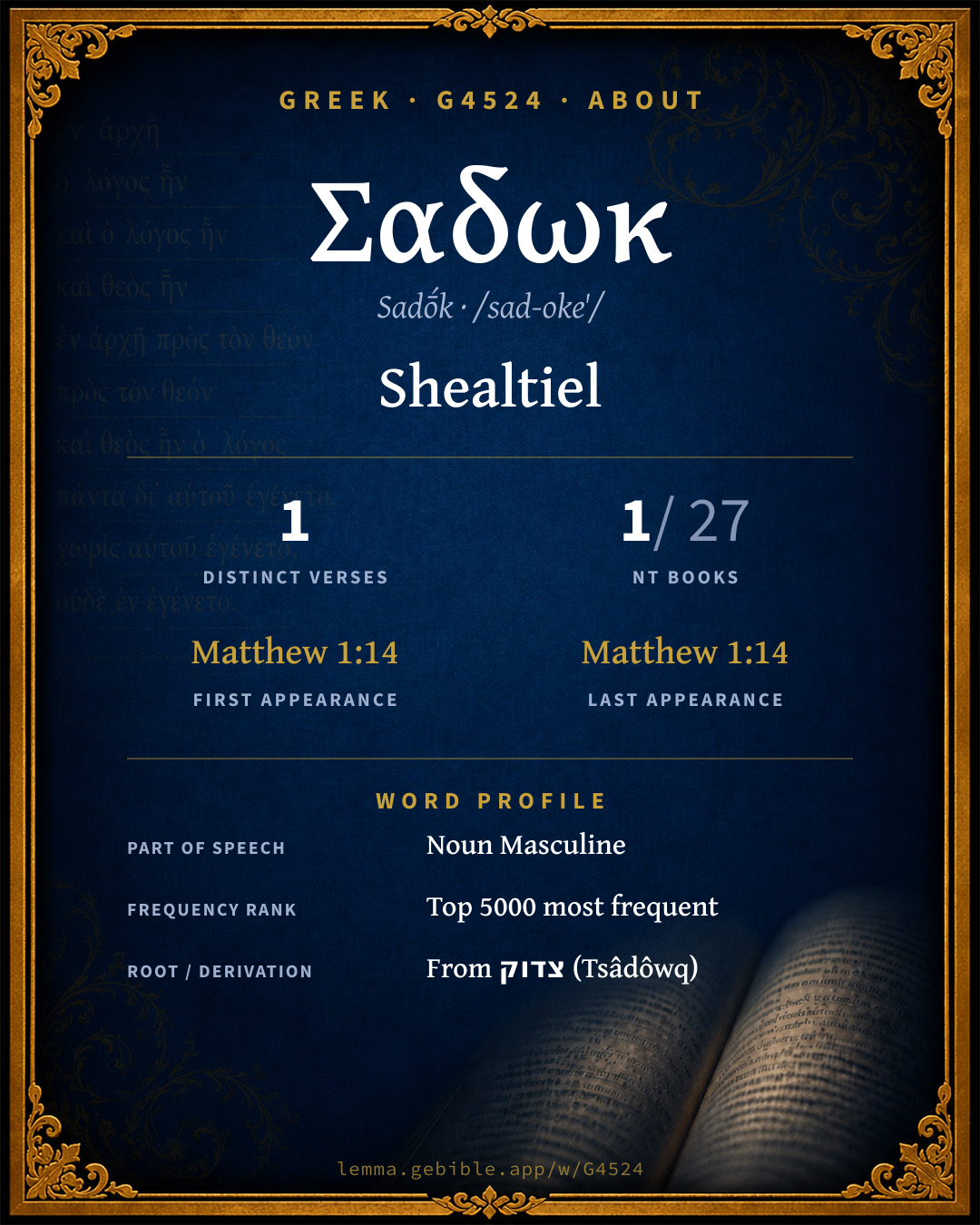
Σαδώκ
Shealtiel
Thayer's lists 2 entries for ‘Shealtiel’ fuller range ↓
Full lexicon entry — Thayer's Greek Lexicon
From Thayer's Greek Lexicon
Where this word appears
Every verse where G4524 appears — 1 distinct verse across 1 book. Click any verse to open its interlinear word-by-word view. Verse text shown in the World English Bible for context — . Each verse’s Greek form is shown with its reference; the English is not keyword-highlighted, since the data carries no word-level English alignment. Use “Compare translations” on any verse to read it across multiple English versions. This concordance covers the Greek New Testament; Septuagint (Greek Old Testament) occurrences of this word are not indexed here.
Matthew 1 verse
About this entry
At a glance — auto-summarized from this page’s data, not written by a person. Every figure links to its source below. This summary describes the numbers; it doesn’t interpret them.
Σαδωκ (Sadṓk) is a Greek name most often rendered “Shealtiel.” It is rare — just 1 verse in the entire Greek New Testament. It clusters heavily in Matthew, which alone accounts for 100% of its uses. A true hapax — its single appearance is Matthew 1:14. For the data behind this summary, explore 1-verse concordance and the renderings breakdown below.
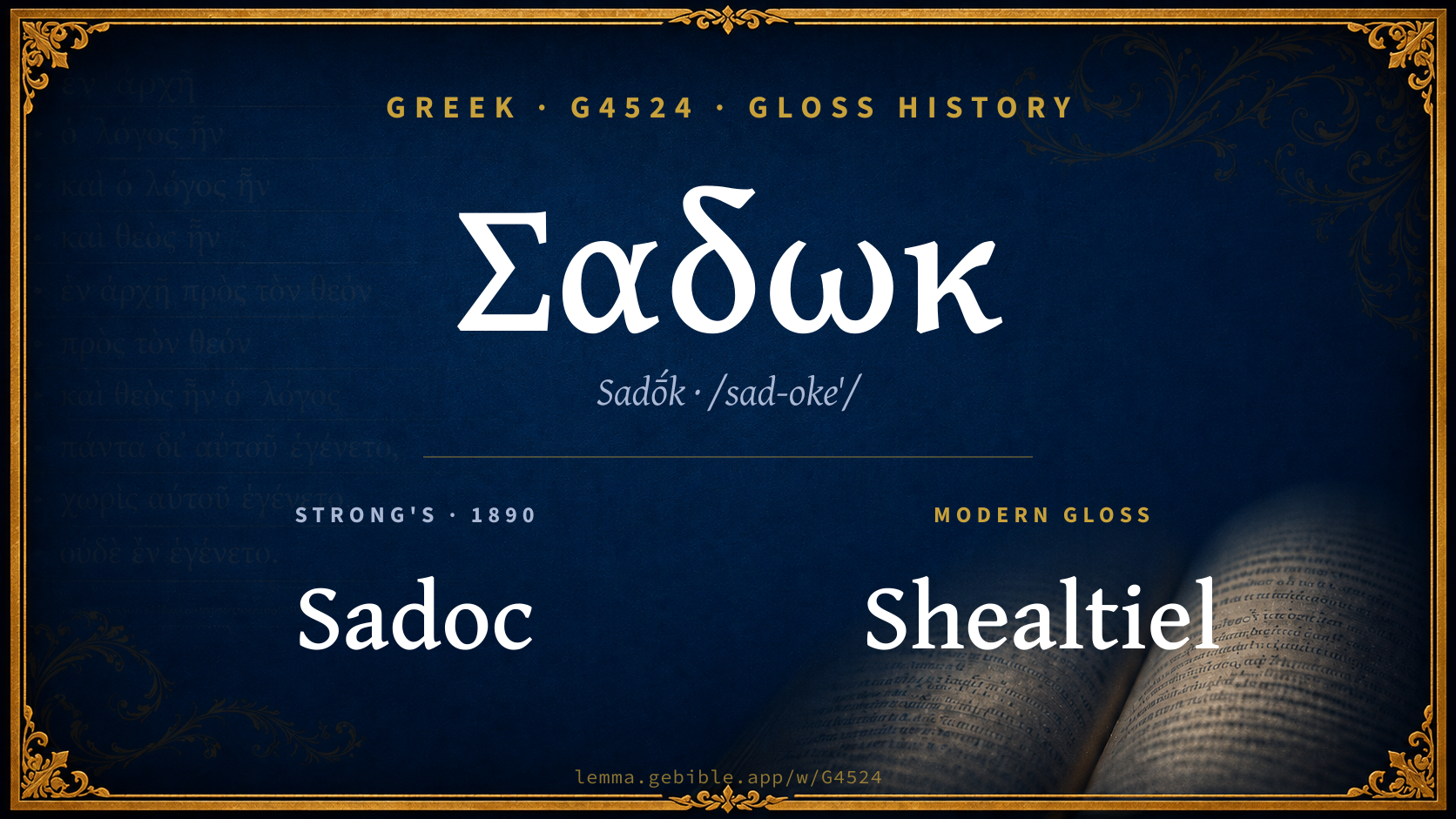
Gloss history
Strong's 1890 vs modern scholarship
About this word
Strong's G4524 catalogs a Greek word from the Greek New Testament.
These counts are not copied from any lexicon or concordance. They are computed here, from the morphology-tagged Greek New Testament. What Lemma adds →
- 1
- distinct verses
- The word appears in 1 distinct verse.
- 1 / 27
- NT books
- The word appears in 1 of 27 New Testament books.
- #2,678
- by frequency
- Top 5000 most frequent Greek words (rank 2,678 of 5,347 Greek words by occurrence).
View all 1 occurrence in the concordance →
Most concentrated in
- Matthew 1 verse 100%
By section of the New Testament
By traditional corpus
Conventional, traditional groupings — biblical authorship is debated, so this is a traditional corpus grouping, not an authorship claim. Some books belong to more than one corpus (Luke is in both the Gospels and the Lukan corpus, and so on), so these shares overlap and need not total 100%. Each figure is a share of the word’s 1 distinct verse.
- Gospels 1 verse · 100%
How translations render this word
Counts come from each version’s own published word-to-Strong’s tagging or interlinear alignment — an approximate guide to how each version renders this word, not a word-level alignment the data otherwise carries. Because each total is that version’s own tagged count, the per-version totals vary from one another and need not match the appearance or distinct-verse counts above. These counts may also differ from a printed concordance because Lemma counts each distinctly tagged rendering and does not collapse phrase taggings into a single head-word total. This is a fixed set of word-tagged versions (KJV, ASV, BSB, ULT) and does not change with the reading translation you choose elsewhere. Each version’s license is shown beside its name below (and on Sources).
- King James Version: Sadoc 2×
- American Standard Version: Sadoc 2×
- Berean Standard Bible: Zadok 2×
- unfoldingWord Literal Text: Zadok 2×
King James Version Public Domain
Renders G4524 across 2 tagged occurrences — most commonly:
American Standard Version Public Domain
Renders G4524 across 2 tagged occurrences — most commonly:
Berean Standard Bible Public Domain
Renders G4524 across 2 tagged occurrences — most commonly:
unfoldingWord Literal Text CC BY-SA 4.0
Renders G4524 across 2 tagged occurrences — most commonly:
Senses in Thayer's
The 2 senses Thayer's distinguishes for this word, in lexicon order (not ranked by frequency or importance). The full entry — with sub-senses — is in the Lexicon Entry tab.
- Sadoc = "just"
- a descendant of Zerubbabel in the genealogy of Christ
Word origin
Derived from צדוק (Tsâdôwq) (H6659) — Zadok.
Of hebrew origin [ H6659 ]; Sadoc (that is Tsadok ) an Israelite : - Sadoc.
— Strong’s Exhaustive Concordance (1890), public domain.
Forms in the corpus
The 2 distinct written forms G4524 takes in the Greek New Testament, most frequent first — each parse links to that case’s occurrences in the concordance.
| Form | Parsing | Example | Uses |
|---|---|---|---|
| Σαδώκ Sadṓk | Noun, Proper, indeclinable | Matthew 1:14 | 1 |
| Σαδὼκ Sadṑk | Noun, Proper, indeclinable | Matthew 1:14 | 1 |
Same root — word family
Other Thayer's entries built from the same root as G4524, grouped by Strong’s listed origin. These share a root / origin per the lexicon — not necessarily a shared meaning. Each links to that word’s own entry.
Derives from
Proper names from this root
People and places named from this root — a name, not an additional meaning of the word.
Compare all same-root words → 2 of the same-root words are proper names (people or places). They share a root, not necessarily a meaning.
Bible dictionary
Public-domain dictionary articles matched to this entry by name (Shealtiel). A biblical name can be shared by more than one person or place, so an article may treat several.
Easton's Bible Dictionary · M. G. Easton, 1897
Asked for of God, father of Zerubbabel (Ezra 3:2, 8; Neh. 12:1).
Smith's Bible Dictionary · William Smith, 1863
(asked of God), father of Zerubbabel. (Ezra 3:2,8; 5:2; Nehemiah 12:1; Haggai 1:1,12,14; 2:2,23) (B.C. about 580.)
Hitchcock's Bible Names Dictionary · Roswell D. Hitchcock, 1869
same as Salathiel
Classic public-domain reference works; full attribution on Sources.
Septuagint usage
The same Greek word Σαδωκ appears 43 times in the Greek Old Testament (Septuagint), across 40 verses in 6 books.
- 43
- LXX occurrences
- Tagged occurrences of this Greek word in the Septuagint.
- 40
- verses
- Distinct Septuagint verses containing this word.
- 6 / 39
- OT books
- The word appears in 6 of the 39 Old Testament books.
Sample Septuagint occurrences
- 2 Samuel 15:24 σαδωκ
- 1 Kings 1:8 σαδωκ
- 2 Kings 15:33 σαδωκ
- 1 Chronicles 5:34 σαδωκ
- 2 Chronicles 27:1 σαδωκ
- Ezra 13:4 σαδωκ
Septuagint occurrences (same lexeme)
Every verse where the same Strong’s number (G4524) appears in the Greek Septuagint. Verse text shown in the World English Bible for context; the Greek form is the matched word — the English is not keyword-highlighted.
- 2 Samuel 15:24 σαδωκ Behold, Zadok also [came], and all the Levites with him, bearing the ark of the covenant of God; and they set down the ark of God; and Abiathar went up, until all the people had done passing out of the city.
- 2 Samuel 15:25 σαδωκ The king said to Zadok, Carry back the ark of God into the city: if I shall find favor in the eyes of Yahweh, he will bring me again, and show me both it, and his habitation:
- 2 Samuel 15:27 σαδωκ The king said also to Zadok the priest, "Aren't you a seer? Return into the city in peace, and your two sons with you, Ahimaaz your son, and Jonathan the son of Abiathar.
- 2 Samuel 15:29 σαδωκ Zadok therefore and Abiathar carried the ark of God again to Jerusalem: and they abode there.
- 2 Samuel 15:35 σαδωκ Don't you have Zadok and Abiathar the priests there with you? therefore it shall be, that whatever thing you shall hear out of the king's house, you shall tell it to Zadok and Abiathar the priests.
- 2 Samuel 15:36 σαδωκ Behold, they have there with them their two sons, Ahimaaz, Zadok's son, and Jonathan, Abiathar's son; and by them you shall send to me everything that you shall hear.
- 2 Samuel 17:15 σαδωκ Then said Hushai to Zadok and to Abiathar the priests, Thus and thus did Ahithophel counsel Absalom and the elders of Israel; and thus and thus have I counseled.
- 2 Samuel 18:19 σαδωκ Then said Ahimaaz the son of Zadok, Let me now run, and bear the king news, how that Yahweh has avenged him of his enemies.
- 2 Samuel 18:22 σαδωκ Then said Ahimaaz the son of Zadok yet again to Joab, But come what may, Please let me also run after the Cushite. Joab said, Why will you run, my son, seeing that you will have no reward for the news?
- 2 Samuel 18:27 σαδωκ The watchman said, I think the running of the foremost is like the running of Ahimaaz the son of Zadok. The king said, He is a good man, and comes with good news.
- 2 Samuel 19:12 σαδωκ You are my brothers, you are my bone and my flesh: why then are you the last to bring back the king?
- 2 Samuel 20:25 σαδωκ and Sheva was scribe; and Zadok and Abiathar were priests;
- 1 Kings 1:8 σαδωκ But Zadok the priest, and Benaiah the son of Jehoiada, and Nathan the prophet, and Shimei, and Rei, and the mighty men who belonged to David, were not with Adonijah.
- 1 Kings 1:26 σαδωκ But he hasn't called me, even me your servant, and Zadok the priest, and Benaiah the son of Jehoiada, and your servant Solomon.
- 1 Kings 1:32 σαδωκ King David said, Call to me Zadok the priest, and Nathan the prophet, and Benaiah the son of Jehoiada. They came before the king.
- 1 Kings 1:34 σαδωκ and let Zadok the priest and Nathan the prophet anoint him there king over Israel; and blow you the trumpet, and say, [Long] live king Solomon.
- 1 Kings 1:38 σαδωκ So Zadok the priest, and Nathan the prophet, and Benaiah the son of Jehoiada, and the Cherethites and the Pelethites, went down, and caused Solomon to ride on king David's mule, and brought him to Gihon.
- 1 Kings 1:39 σαδωκ Zadok the priest took the horn of oil out of the Tent, and anointed Solomon. They blew the trumpet; and all the people said, [Long] live king Solomon.
- 1 Kings 1:44 σαδωκ and the king has sent with him Zadok the priest, and Nathan the prophet, and Benaiah the son of Jehoiada, and the Cherethites and the Pelethites; and they have caused him to ride on the king's mule;
- 1 Kings 1:45 σαδωκ and Zadok the priest and Nathan the prophet have anointed him king in Gihon; and they are come up from there rejoicing, so that the city rang again. This is the noise that you have heard.
- 1 Kings 2:35 σαδωκ The king put Benaiah the son of Jehoiada in his room over the host; and Zadok the priest did the king put in the room of Abiathar.
- 1 Kings 2:46 σαδωκ So the king commanded Benaiah the son of Jehoiada; and he went out, and fell on him, so that he died. The kingdom was established in the hand of Solomon.
- 1 Kings 4:2 σαδωκ These were the princes whom he had: Azariah the son of Zadok, the priest;
- 2 Kings 15:33 σαδωκ He was twenty-five years old when he began to reign; and he reigned sixteen years in Jerusalem: and his mother's name was Jerusha the daughter of Zadok.
- 1 Chronicles 5:34 σαδωκ
- 1 Chronicles 5:38 σαδωκ
- 1 Chronicles 6:38 σαδωκ the son of Izhar, the son of Kohath, the son of Levi, the son of Israel.
- 1 Chronicles 9:11 σαδωκ and Azariah the son of Hilkiah, the son of Meshullam, the son of Zadok, the son of Meraioth, the son of Ahitub, the ruler of the house of God;
- 1 Chronicles 12:29 σαδωκ Of the children of Benjamin, the brothers of Saul, three thousand: for hitherto the greatest part of them had kept their allegiance to the house of Saul.
- 1 Chronicles 15:11 σαδωκ David called for Zadok and Abiathar the priests, and for the Levites, for Uriel, Asaiah, and Joel, Shemaiah, and Eliel, and Amminadab,
- 1 Chronicles 16:39 σαδωκ and Zadok the priest, and his brothers the priests, before the tent of Yahweh in the high place that was at Gibeon,
- 1 Chronicles 18:16 σαδωκ and Zadok the son of Ahitub, and Abimelech the son of Abiathar, were priests; and Shavsha was scribe;
- 1 Chronicles 24:3 σαδωκ David with Zadok of the sons of Eleazar, and Ahimelech of the sons of Ithamar, divided them according to their ordering in their service.
- 1 Chronicles 24:6 σαδωκ Shemaiah the son of Nethanel the scribe, who was of the Levites, wrote them in the presence of the king, and the princes, and Zadok the priest, and Ahimelech the son of Abiathar, and the heads of the fathers' [houses] of the priests and of the Levites; one fathers' house being taken for Eleazar, and one taken for Ithamar.
- 1 Chronicles 24:31 σαδωκ These likewise cast lots even as their brothers the sons of Aaron in the presence of David the king, and Zadok, and Ahimelech, and the heads of the fathers' [houses] of the priests and of the Levites; the fathers' [houses] of the chief even as those of his younger brother.
- 1 Chronicles 27:17 σαδωκ of Levi, Hashabiah the son of Kemuel: of Aaron, Zadok:
- 1 Chronicles 29:22 σαδωκ and ate and drink before Yahweh on that day with great gladness. They made Solomon the son of David king the second time, and anointed him to Yahweh to be prince, and Zadok to be priest.
- 2 Chronicles 27:1 σαδωκ Jotham was twenty-five years old when he began to reign; and he reigned sixteen years in Jerusalem: and his mother's name was Jerushah the daughter of Zadok.
- 2 Chronicles 31:10 σαδωκ Azariah the chief priest, of the house of Zadok, answered him and said, Since [the people] began to bring the offerings into the house of Yahweh, we have eaten and had enough, and have left plenty: for Yahweh has blessed his people; and that which is left is this great store.
- Ezra 13:4 σαδωκ
These are occurrences of the same Greek lexeme (G4524) in the Septuagint — not a translation of any one Hebrew word. The store carries no word-level Hebrew↔Greek alignment, so no Hebrew original is asserted here. Counts come from the recovered LXX Strong's tagging — high-frequency vocabulary is well covered, while rare or late forms may be untagged — so they reflect tagged occurrences and may slightly undercount.