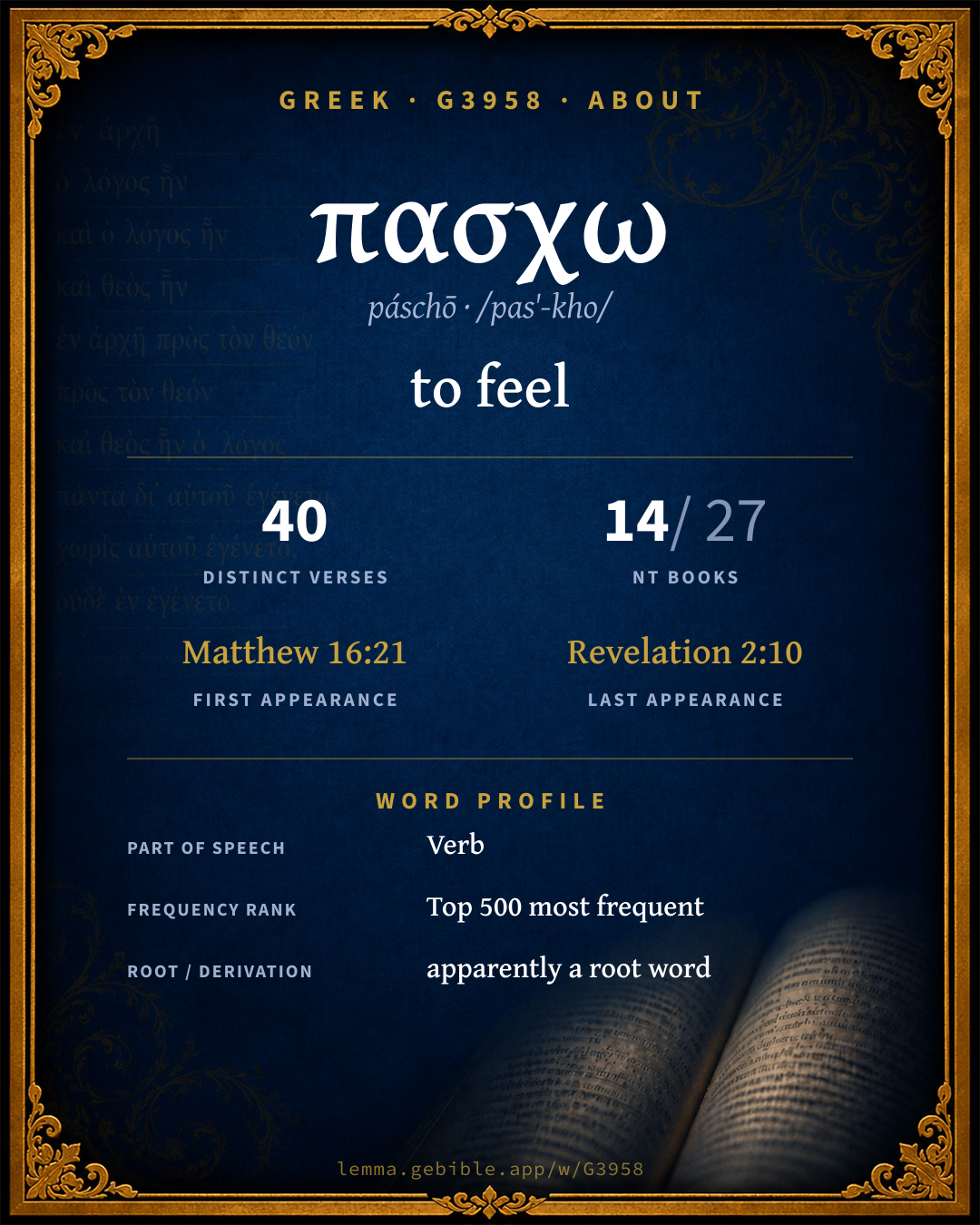
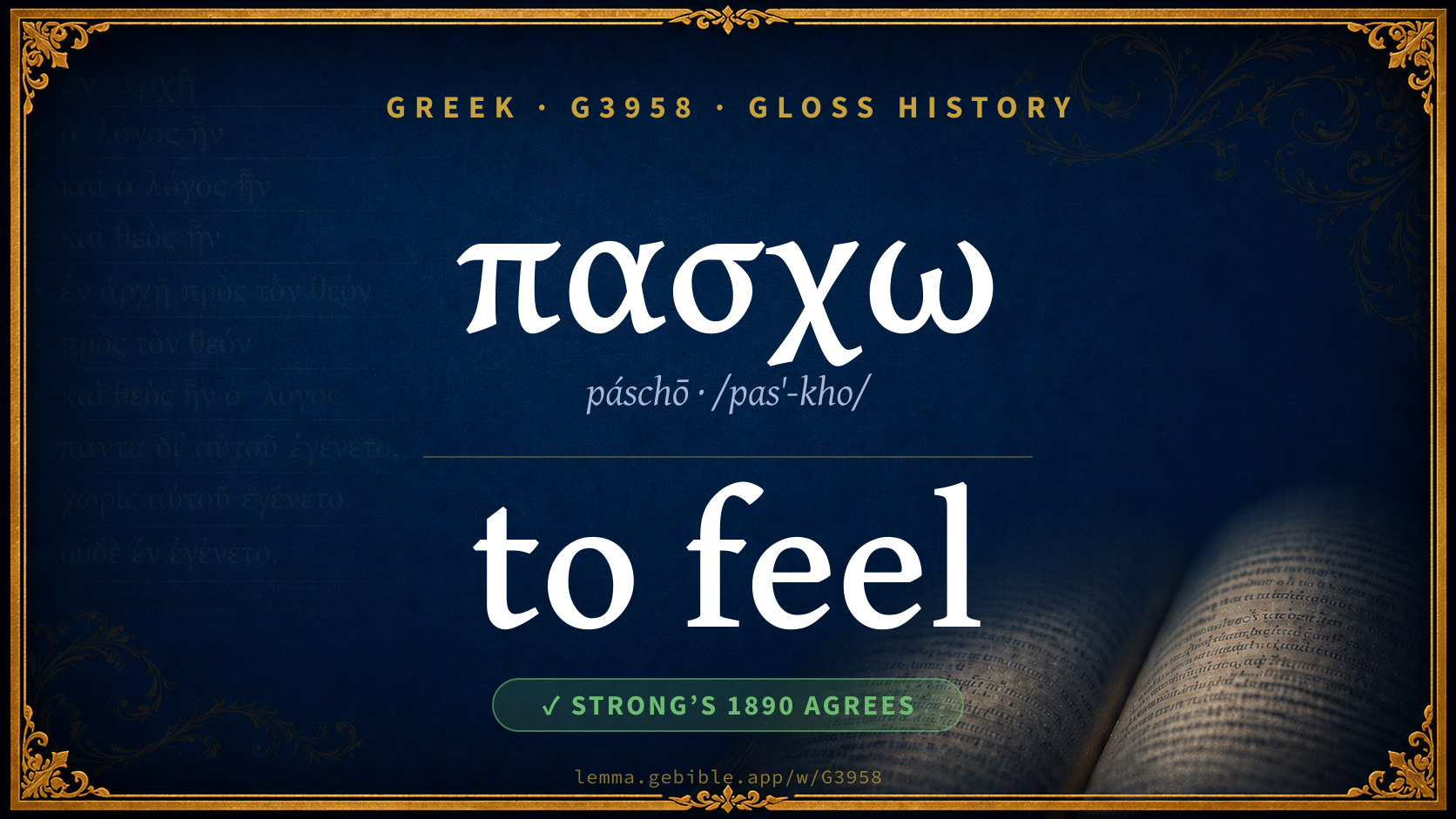
πασχω
to feel
Full lexicon entry — Thayer's Greek Lexicon
From Thayer's Greek Lexicon
Where this word appears
See every Aorist-tense verb in the Greek New Testament →
Grammar key — what these labels mean
Part of speech
- Verb
- An action or state-of-being word.
Tense
- Aorist
- Action viewed as a simple whole, without regard to duration — often past (perfective aspect).
- Present
- Ongoing or general action in present time (imperfective aspect).
- Perfect
- A completed past action with continuing present results.
Voice
- Active
- The subject performs the action.
Mood
- Infinitive
- A verbal noun (“to write”), unmarked for person or number.
- Indicative
- States a fact or asks a factual question (the mood of reality).
- Participle
- A verbal adjective (“writing,” “having written”).
- Subjunctive
- Expresses probability, purpose, or possibility (the mood of contingency).
- Imperative
- Expresses a command or request.
- Optative
- Expresses a wish or a remote possibility.
Case
- Nominative
- The case of the subject (and the predicate nominative).
- Accusative
- The case of the direct object and of extent.
- Genitive
- The case of source, possession, or “of” — answers “whose / from what.”
Person
- 3rd person
- The one spoken about (“he / she / it / they”).
- 2nd person
- The one addressed (“you”).
- 1st person
- The speaker (“I / we”).
Gender
- Masculine
- Grammatically masculine.
- Feminine
- Grammatically feminine.
Number
- Singular
- One.
- Plural
- More than one.
23 distinct verses where G3958 appears in the Aorist tense, across 8 books. Filtered view — show all forms. Click any verse to open its interlinear word-by-word view. Verse text shown in the World English Bible for context — . Each verse’s Greek form is shown with its reference; the English is not keyword-highlighted, since the data carries no word-level English alignment. Use “Compare translations” on any verse to read it across multiple English versions. This concordance covers the Greek New Testament; Septuagint (Greek Old Testament) occurrences of this word are not indexed here.
Matthew 2 verses
- Matthew 16:21 παθεῖν aor act inf From that time, Jesus began to show his disciples that he must go to Jerusalem and suffer many things from the elders, chief priests, and scribes, and be killed, and the third day be raised up.
- Matthew 27:19 ἔπαθον aor act ind 1sg While he was sitting on the judgment seat, his wife sent to him, saying, "Have nothing to do with that righteous man, for I have suffered many things this day in a dream because of him."
Mark 3 verses
- Mark 5:26 παθοῦσα aor act ptcp nom sg fem and had suffered many things by many physicians, and had spent all that she had, and was no better, but rather grew worse,
- Mark 8:31 παθεῖν aor act inf He began to teach them that the Son of Man must suffer many things, and be rejected by the elders, the chief priests, and the scribes, and be killed, and after three days rise again.
- Mark 9:12 πάθῃ aor act subj 3sg He said to them, "Elijah indeed comes first, and restores all things. How is it written about the Son of Man, that he should suffer many things and be despised?
Luke 5 verses
- Luke 9:22 παθεῖν aor act inf saying, "The Son of Man must suffer many things, and be rejected by the elders, chief priests, and scribes, and be killed, and the third day be raised up."
- Luke 17:25 παθεῖν aor act inf But first, he must suffer many things and be rejected by this generation.
- Luke 22:15 παθεῖν aor act inf He said to them, "I have earnestly desired to eat this Passover with you before I suffer,
- Luke 24:26 παθεῖν aor act inf Didn't the Christ have to suffer these things and to enter into his glory?"
- Luke 24:46 παθεῖν aor act inf He said to them, "Thus it is written, and thus it was necessary for the Christ to suffer and to rise from the dead the third day,
Acts 5 verses
- Acts 1:3 παθεῖν aor act inf To these he also showed himself alive after he suffered, by many proofs, appearing to them over a period of forty days, and speaking about God's Kingdom.
- Acts 3:18 παθεῖν aor act inf But the things which God announced by the mouth of all his prophets, that Christ should suffer, he thus fulfilled.
- Acts 9:16 παθεῖν aor act inf For I will show him how many things he must suffer for my name's sake."
- Acts 17:3 παθεῖν aor act inf explaining and demonstrating that the Christ had to suffer and rise again from the dead, and saying, "This Jesus, whom I proclaim to you, is the Christ."
- Acts 28:5 ἔπαθεν aor act ind 3sg However he shook off the creature into the fire, and wasn't harmed.
Galatians 1 verse
1 Thessalonians 1 verse
Hebrews 3 verses
- Hebrews 5:8 ἔπαθεν aor act ind 3sg though he was a Son, yet learned obedience by the things which he suffered.
- Hebrews 9:26 παθεῖν aor act inf or else he must have suffered often since the foundation of the world. But now once at the end of the ages, he has been revealed to put away sin by the sacrifice of himself.
- Hebrews 13:12 ἔπαθεν aor act ind 3sg Therefore Jesus also, that he might sanctify the people through his own blood, suffered outside of the gate.
1 Peter 3 verses
- 1 Peter 2:21 ἔπαθεν aor act ind 3sg For to this you were called, because Christ also suffered for us, leaving you an example, that you should follow his steps,
- 1 Peter 4:1 παθόντος παθὼν aor act ptcp gen sg masc aor act ptcp nom sg masc Forasmuch then as Christ suffered for us in the flesh, arm yourselves also with the same mind; for he who has suffered in the flesh has ceased from sin;
- 1 Peter 5:10 παθόντας aor act ptcp acc pl masc But may the God of all grace, who called you to his eternal glory by Christ Jesus, after you have suffered a little while, perfect, establish, strengthen, and settle you.
About this entry
At a glance — auto-summarized from this page’s data, not written by a person. Every figure links to its source below. This summary describes the numbers; it doesn’t interpret them.
At its core, πασχω (páschō) means “to feel.” It first appears in Matthew 16:21. It turns up in 40 verses across 14 books, a moderately common footprint. The word gravitates to 1 Peter (25%), then Luke and Acts. It clusters with παθος and πενθος under a shared root. Dig into 40-verse concordance and the renderings breakdown below.
Gloss history
Strong's 1890 vs modern scholarship
About this word
Strong's G3958 catalogs a Greek word from the Greek New Testament.
These counts are not copied from any lexicon or concordance. They are computed here, from the morphology-tagged Greek New Testament. What Lemma adds →
- 40
- distinct verses
- The word appears in 40 distinct verses.
- 14 / 27
- NT books
- The word appears in 14 of 27 New Testament books.
- #364
- by frequency
- Top 500 most frequent Greek words (rank 364 of 5,347 Greek words by occurrence).
View all 40 occurrences in the concordance →
By section of the New Testament
By traditional corpus
Conventional, traditional groupings — biblical authorship is debated, so this is a traditional corpus grouping, not an authorship claim. Some books belong to more than one corpus (Luke is in both the Gospels and the Lukan corpus, and so on), so these shares overlap and need not total 100%. Each figure is a share of the word’s 40 distinct verses.
- Gospels 13 verses · 33%
- Lukan (Luke–Acts) 11 verses · 28%
- General (Catholic) Epistles 10 verses · 25%
- Pauline corpus 7 verses · 18%
- Hebrews 4 verses · 10%
- Johannine 1 verse · 3%
- Revelation 1 verse · 3%
How translations render this word
Counts come from each version’s own published word-to-Strong’s tagging or interlinear alignment — an approximate guide to how each version renders this word, not a word-level alignment the data otherwise carries. Because each total is that version’s own tagged count, the per-version totals vary from one another and need not match the appearance or distinct-verse counts above. These counts may also differ from a printed concordance because Lemma counts each distinctly tagged rendering and does not collapse phrase taggings into a single head-word total. This is a fixed set of word-tagged versions (KJV, ASV, BSB, ULT) and does not change with the reading translation you choose elsewhere. Each version’s license is shown beside its name below (and on Sources).
- King James Version: Suffer 17×, Have suffered 4×, Suffered 3×
- American Standard Version: Suffer 15×, Suffered 5×, Should suffer 2×
- Berean Standard Bible: Suffer 13×, Suffered 7×, Suffering 3×
- unfoldingWord Literal Text: Suffer 17×, Having suffered 4×, Suffered 4×
King James Version Public Domain
Renders G3958 across 46 tagged occurrences — most commonly:
Plus 16 renderings that appear only once — usually multi-word phrases or single function words the recovered tagging swept in, not distinct renderings.
American Standard Version Public Domain
Renders G3958 across 45 tagged occurrences — most commonly:
Plus 23 renderings that appear only once — usually multi-word phrases or single function words the recovered tagging swept in, not distinct renderings.
Berean Standard Bible Public Domain
Renders G3958 across 42 tagged occurrences — most commonly:
Plus 17 renderings that appear only once — usually multi-word phrases or single function words the recovered tagging swept in, not distinct renderings.
unfoldingWord Literal Text CC BY-SA 4.0
Renders G3958 across 47 tagged occurrences — most commonly:
Plus 14 renderings that appear only once — usually multi-word phrases or single function words the recovered tagging swept in, not distinct renderings.
Senses in Thayer's
The 1 sense Thayer's distinguishes for this word, in lexicon order (not ranked by frequency or importance). The full entry — with sub-senses — is in the Lexicon Entry tab.
- to be affected or have been affected, to feel, have a sensible experience, to undergo
Word origin
Origin: apparently a root word
Apparently a primary verb (the third form used only in certain tenses for it); to experience a sensation or impression (usually painful): - feel passion suffer vex.
— Strong’s Exhaustive Concordance (1890), public domain.
Forms in the corpus
The 20 distinct written forms G3958 takes in the Greek New Testament, most frequent first — each parse links to that tense’s occurrences in the concordance.
Same root — word family
Other Thayer's entries built from the same root as G3958, grouped by Strong’s listed origin. These share a root / origin per the lexicon — not necessarily a shared meaning. Each links to that word’s own entry.
Derived from this word
Compare all same-root words → They share a root, not necessarily a meaning.
Septuagint usage
The same Greek word πασχω appears 4 times in the Greek Old Testament (Septuagint), across 4 verses in 4 books.
- 4
- LXX occurrences
- Tagged occurrences of this Greek word in the Septuagint.
- 4
- verses
- Distinct Septuagint verses containing this word.
- 4 / 39
- OT books
- The word appears in 4 of the 39 Old Testament books.
Sample Septuagint occurrences
- Esther 9:26 πάσχω
- Ezekiel 16:5 πάσχω
- Amos 6:6 πάσχω
- Zechariah 11:5 πάσχω
Septuagint occurrences (same lexeme)
Every verse where the same Strong’s number (G3958) appears in the Greek Septuagint. Verse text shown in the World English Bible for context; the Greek form is the matched word — the English is not keyword-highlighted.
- Esther 9:26 πάσχω Therefore they called these days Purim, after the name of Pur. Therefore because of all the words of this letter, and of that which they had seen concerning this matter, and that which had come to them,
- Ezekiel 16:5 πάσχω No eye pitied you, to do any of these things to you, to have compassion on you; but you were cast out in the open field, for that your person was abhorred, in the day that you were born.
- Amos 6:6 πάσχω Who drink wine in bowls, And anoint themselves with the best oils; But they are not grieved for the affliction of Joseph.
- Zechariah 11:5 πάσχω Their buyers slaughter them, and go unpunished. Those who sell them say, 'Blessed be Yahweh, for I am rich;' and their own shepherds don't pity them.
These are occurrences of the same Greek lexeme (G3958) in the Septuagint — not a translation of any one Hebrew word. The store carries no word-level Hebrew↔Greek alignment, so no Hebrew original is asserted here. Counts come from the recovered LXX Strong's tagging — high-frequency vocabulary is well covered, while rare or late forms may be untagged — so they reflect tagged occurrences and may slightly undercount.