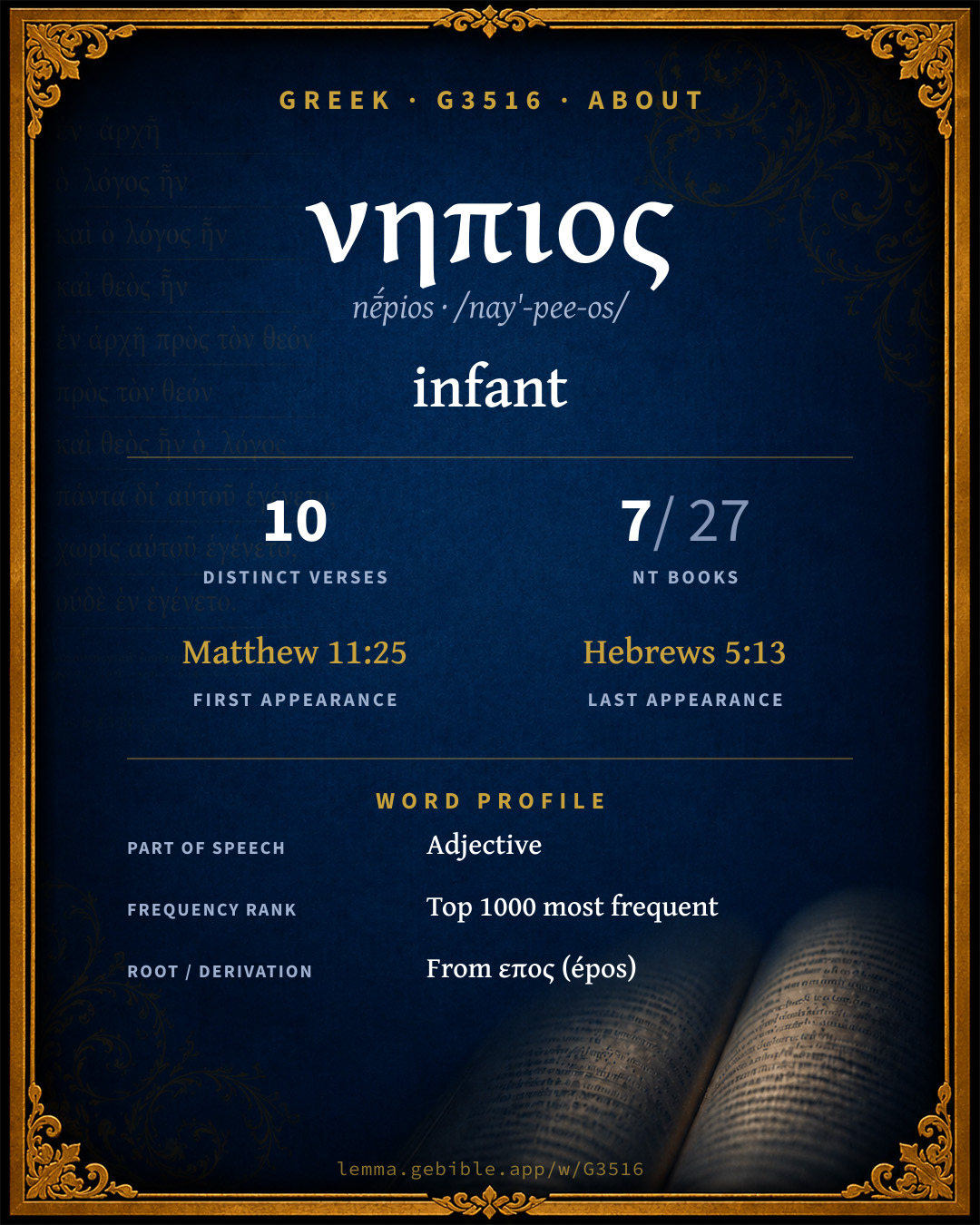
νήπιος
infant
‘infant’ is one of 3 main senses fuller range ↓
Full lexicon entry — Thayer's Greek Lexicon
From Thayer's Greek Lexicon
Where this word appears
See every Nominative-case word in the Greek New Testament →
Grammar key — what these labels mean
Part of speech
- Adjective
- A word that describes or qualifies a noun.
Case
- Nominative
- The case of the subject (and the predicate nominative).
- Dative
- The case of the indirect object, means, or location — “to / for / with / in.”
- Genitive
- The case of source, possession, or “of” — answers “whose / from what.”
Gender
- Masculine
- Grammatically masculine.
Number
- Singular
- One.
- Plural
- More than one.
Grammatical forms
- Adjective, Nominative, Singular, Masculine 6 times (43%)
- Adjective, Dative, Plural, Masculine 3 times (21%)
- Adjective, Genitive, Plural, Masculine 2 times (14%)
- Adjective, Nominative, Plural, Masculine 2 times (14%)
- Adjective, Genitive, Singular, Masculine 1 time (7%)
Parsed forms decoded from the imported morphology (Robinson–Tischendorf, public domain), counted across 14 parsed occurrences — not distinct verses.
Every verse where G3516 appears — 10 distinct verses across 7 books. Click any verse to open its interlinear word-by-word view. Verse text shown in the World English Bible for context — . Each verse’s Greek form is shown with its reference; the English is not keyword-highlighted, since the data carries no word-level English alignment. Use “Compare translations” on any verse to read it across multiple English versions. This concordance covers the Greek New Testament; Septuagint (Greek Old Testament) occurrences of this word are not indexed here.
Matthew 2 verses
- Matthew 11:25 νηπίοις adj dat pl masc At that time, Jesus answered, "I thank you, Father, Lord of heaven and earth, that you hid these things from the wise and understanding, and revealed them to infants.
- Matthew 21:16 νηπίων adj gen pl masc and said to him, "Do you hear what these are saying?" Jesus said to them, "Yes. Did you never read, 'Out of the mouth of babes and nursing babies you have perfected praise?'"
Luke 1 verse
Romans 1 verse
1 Corinthians 2 verses
- 1 Corinthians 3:1 νηπίοις adj dat pl masc Brothers, I couldn't speak to you as to spiritual, but as to fleshly, as to babies in Christ.
- 1 Corinthians 13:11 νήπιος νήπιος νήπιος νήπιος νηπίου adj nom sg masc adj nom sg masc adj nom sg masc adj nom sg masc adj gen sg masc When I was a child, I spoke as a child, I felt as a child, I thought as a child. Now that I have become a man, I have put away childish things.
Galatians 2 verses
Ephesians 1 verse
Hebrews 1 verse
About this entry
At a glance — auto-summarized from this page’s data, not written by a person. Every figure links to its source below. This summary describes the numbers; it doesn’t interpret them.
νηπιος — transliterated nḗpios — is a Greek adjective carrying the sense “infant.” Debuting at Matthew 11:25, it then recurs through the corpus. It appears 10 verses across 7 books of the Greek New Testament, among its uncommon vocabulary. Its lexical range runs to 3 senses. Related forms include επος, ηπιος and νηπιαζω. Each statement above links to its evidence; the full detail follows below.
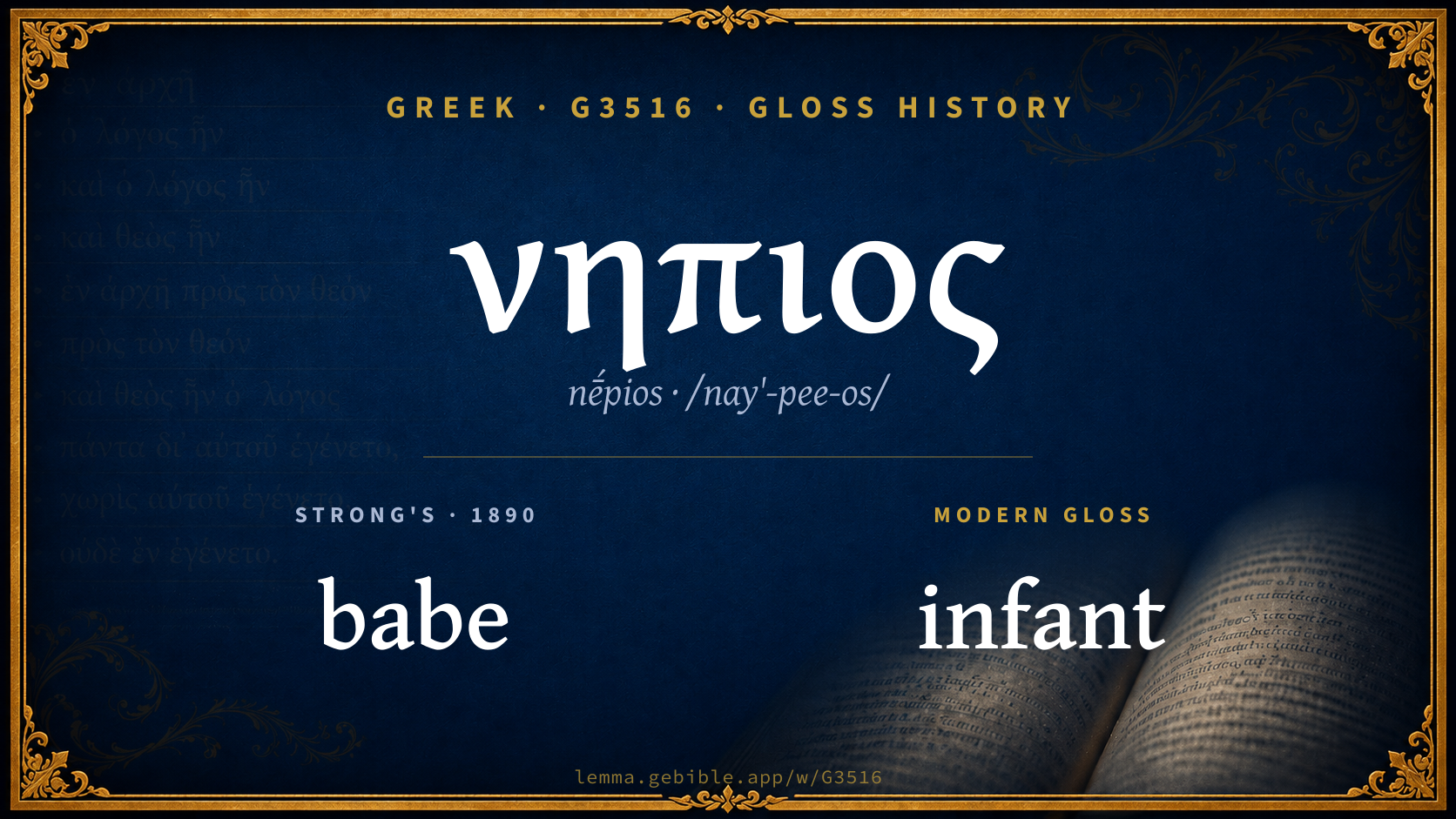
Gloss history
Strong's 1890 vs modern scholarship
About this word
Strong's G3516 catalogs a Greek word from the Greek New Testament.
These counts are not copied from any lexicon or concordance. They are computed here, from the morphology-tagged Greek New Testament. What Lemma adds →
- 10
- distinct verses
- The word appears in 10 distinct verses.
- 7 / 27
- NT books
- The word appears in 7 of 27 New Testament books.
- #814
- by frequency
- Top 1000 most frequent Greek words (rank 814 of 5,347 Greek words by occurrence).
View all 10 occurrences in the concordance →
Most concentrated in
- Matthew 2 verses 20%
- 1 Corinthians 2 verses 20%
- Galatians 2 verses 20%
By section of the New Testament
By traditional corpus
Conventional, traditional groupings — biblical authorship is debated, so this is a traditional corpus grouping, not an authorship claim. Some books belong to more than one corpus (Luke is in both the Gospels and the Lukan corpus, and so on), so these shares overlap and need not total 100%. Each figure is a share of the word’s 10 distinct verses.
- Pauline corpus 6 verses · 60%
- Gospels 3 verses · 30%
- Lukan (Luke–Acts) 1 verse · 10%
- Hebrews 1 verse · 10%
How translations render this word
Counts come from each version’s own published word-to-Strong’s tagging or interlinear alignment — an approximate guide to how each version renders this word, not a word-level alignment the data otherwise carries. Because each total is that version’s own tagged count, the per-version totals vary from one another and need not match the appearance or distinct-verse counts above. These counts may also differ from a printed concordance because Lemma counts each distinctly tagged rendering and does not collapse phrase taggings into a single head-word total. This is a fixed set of word-tagged versions (KJV, ASV, BSB, ULT) and does not change with the reading translation you choose elsewhere. Each version’s license is shown beside its name below (and on Sources).
- King James Version: Babes 5×, Child 5×, Children 2×
- American Standard Version: Babes 5×, Child 5×, Children 2×
- Berean Standard Bible: Child 5×, Infants 3×, Children 2×
- unfoldingWord Literal Text: Child 6×, Little children 5×, Children 2×
King James Version Public Domain
Renders G3516 across 14 tagged occurrences — most commonly:
Plus 2 renderings that appear only once — usually multi-word phrases or single function words the recovered tagging swept in, not distinct renderings.
American Standard Version Public Domain
Renders G3516 across 14 tagged occurrences — most commonly:
Plus 2 renderings that appear only once — usually multi-word phrases or single function words the recovered tagging swept in, not distinct renderings.
Berean Standard Bible Public Domain
Renders G3516 across 15 tagged occurrences — most commonly:
Plus 3 renderings that appear only once — usually multi-word phrases or single function words the recovered tagging swept in, not distinct renderings.
unfoldingWord Literal Text CC BY-SA 4.0
Renders G3516 across 15 tagged occurrences — most commonly:
Plus 2 renderings that appear only once — usually multi-word phrases or single function words the recovered tagging swept in, not distinct renderings.
Senses in Thayer's
The 3 senses Thayer's distinguishes for this word, in lexicon order (not ranked by frequency or importance). The full entry — with sub-senses — is in the Lexicon Entry tab.
- an infant, little child
- a minor, not of age
- metaph. childish, untaught, unskilled
Word origin
Derived from επος (épos) (G2031) — word.
From an obsolete particle νη ne; implying negation and G2031 ; not speaking that is an infant ( minor ); figuratively a simple minded person an immature Christian : - babe child (+ -ish).
— Strong’s Exhaustive Concordance (1890), public domain.
Forms in the corpus
The 6 distinct written forms G3516 takes in the Greek New Testament, most frequent first — each parse links to that case’s occurrences in the concordance.
| Form | Parsing | Example | Uses |
|---|---|---|---|
| νήπιος nḗpios | Adjective, Nominative, Singular, Masculine | 1 Corinthians 13:11 | 5 |
| νηπίοις nēpíois | Adjective, Dative, Plural, Masculine | Matthew 11:25 | 3 |
| νήπιοι nḗpioi | Adjective, Nominative, Plural, Masculine | Galatians 4:3 | 2 |
| νηπίων nēpíōn | Adjective, Genitive, Plural, Masculine | Matthew 21:16 | 2 |
| νήπιός nḗpiós | Adjective, Nominative, Singular, Masculine | Galatians 4:1 | 1 |
| νηπίου nēpíou | Adjective, Genitive, Singular, Masculine | 1 Corinthians 13:11 | 1 |
Same root — word family
Other Thayer's entries built from the same root as G3516, grouped by Strong’s listed origin. These share a root / origin per the lexicon — not necessarily a shared meaning. Each links to that word’s own entry.
Derives from
Shares the same root
Derived from this word
Compare all same-root words → They share a root, not necessarily a meaning.
Septuagint usage
The same Greek word νηπιος appears 30 times in the Greek Old Testament (Septuagint), across 30 verses in 12 books.
- 30
- LXX occurrences
- Tagged occurrences of this Greek word in the Septuagint.
- 30
- verses
- Distinct Septuagint verses containing this word.
- 12 / 39
- OT books
- The word appears in 12 of the 39 Old Testament books.
Sample Septuagint occurrences
- 1 Samuel 15:3 νήπιος
- 2 Kings 8:12 νήπιος
- Job 3:16 νήπιος
- Psalms 8:3 νήπιος
- Proverbs 1:32 νήπιος
- Isaiah 11:8 νήπιος
- Jeremiah 6:11 νήπιος
- Lamentations 1:5 νήπιος
- Ezekiel 9:6 νήπιος
- Hosea 11:1 νήπιος
- Joel 2:16 νήπιος
- Nahum 3:10 νήπιος
Septuagint occurrences (same lexeme)
Every verse where the same Strong’s number (G3516) appears in the Greek Septuagint. Verse text shown in the World English Bible for context; the Greek form is the matched word — the English is not keyword-highlighted.
- 1 Samuel 15:3 νήπιος Now go and strike Amalek, and utterly destroy all that they have, and don't spare them; but kill both man and woman, infant and suckling, ox and sheep, camel and donkey.
- 1 Samuel 22:19 νήπιος Nob, the city of the priests, struck he with the edge of the sword, both men and women, children and nursing babies, and oxen and donkeys and sheep, with the edge of the sword.
- 2 Kings 8:12 νήπιος Hazael said, Why weeps my lord? He answered, Because I know the evil that you will do to the children of Israel: their strongholds will you set on fire, and their young men will you kill with the sword, and will dash in pieces their little ones, and rip up their women with child.
- Job 3:16 νήπιος Or as a hidden untimely birth I had not been, As infants who never saw light.
- Job 24:12 νήπιος From out of the populous city, men groan. The soul of the wounded cries out, Yet God doesn't regard the folly.
- Job 31:10 νήπιος Then let my wife grind for another, And let others sleep with her.
- Job 33:25 νήπιος His flesh shall be fresher than a child's; He returns to the days of his youth.
- Psalms 8:3 νήπιος When I consider your heavens, the work of your fingers, The moon and the stars, which you have ordained;
- Psalms 16:14 νήπιος
- Psalms 18:8 νήπιος Smoke went out of his nostrils. Consuming fire came out of his mouth. Coals were kindled by it.
- Psalms 63:8 νήπιος My soul stays close to you. Your right hand holds me up.
- Psalms 114:6 νήπιος You mountains, that you skipped like rams; You little hills, like lambs?
- Psalms 118:130 νήπιος
- Psalms 136:9 νήπιος The moon and stars to rule by night; For his loving kindness endures forever:
- Proverbs 1:32 νήπιος For the backsliding of the simple will kill them. The careless ease of fools will destroy them.
- Proverbs 23:13 νήπιος Don't withhold correction from a child. If you punish him with the rod, he will not die.
- Isaiah 11:8 νήπιος The sucking child shall play on the hole of the asp, and the weaned child shall put his hand on the adder's den.
- Jeremiah 6:11 νήπιος Therefore I am full of the wrath of Yahweh; I am weary with holding in: pour it out on the children in the street, and on the assembly of young men together; for even the husband with the wife shall be taken, the aged with him who is full of days.
- Jeremiah 9:20 νήπιος Yet hear the word of Yahweh, you women, and let your ear receive the word of his mouth; and teach your daughters wailing, and everyone her neighbor lamentation.
- Jeremiah 50:6 νήπιος My people have been lost sheep: their shepherds have caused them to go astray; they have turned them away on the mountains; they have gone from mountain to hill; they have forgotten their resting-place.
- Jeremiah 51:7 νήπιος Babylon has been a golden cup in Yahweh's hand, who made all the earth drunken: the nations have drunk of her wine; therefore the nations are mad.
- Lamentations 1:5 νήπιος Her adversaries are become the head, her enemies prosper; For Yahweh has afflicted her for the multitude of her transgressions: Her young children are gone into captivity before the adversary.
- Lamentations 2:11 νήπιος My eyes do fail with tears, my heart is troubled; My liver is poured on the earth, because of the destruction of the daughter of my people, Because the young children and the infants swoon in the streets of the city.
- Lamentations 2:19 νήπιος Arise, cry out in the night, at the beginning of the watches; Pour out your heart like water before the face of the Lord: Lift up your hands toward him for the life of your young children, that faint for hunger at the head of every street.
- Lamentations 2:20 νήπιος Look, Yahweh, and see to whom you have done thus! Shall the women eat their fruit, the children that are dandled in the hands? Shall the priest and the prophet be killed in the sanctuary of the Lord?
- Lamentations 4:4 νήπιος The tongue of the sucking child cleaves to the roof of his mouth for thirst: The young children ask bread, and no man breaks it to them.
- Ezekiel 9:6 νήπιος kill utterly the old man, the young man and the virgin, and little children and women; but don't come near any man on whom is the mark: and begin at my sanctuary. Then they began at the old men that were before the house.
- Hosea 11:1 νήπιος "When Israel was a child, then I loved him, And called my son out of Egypt.
- Joel 2:16 νήπιος Gather the people. Sanctify the assembly. Assemble the elders. Gather the children, and those who suck the breasts. Let the bridegroom go forth from his room, And the bride out of her chamber.
- Nahum 3:10 νήπιος Yet was she carried away. She went into captivity. Her young children also were dashed in pieces at the head of all the streets, and they cast lots for her honorable men, and all her great men were bound in chains.
These are occurrences of the same Greek lexeme (G3516) in the Septuagint — not a translation of any one Hebrew word. The store carries no word-level Hebrew↔Greek alignment, so no Hebrew original is asserted here. Counts come from the recovered LXX Strong's tagging — high-frequency vocabulary is well covered, while rare or late forms may be untagged — so they reflect tagged occurrences and may slightly undercount.