Hebrews 5:13

Greek (Tischendorf 8th ed.) Hebrews 5:13 appears in the Greek New Testament. The text above is from the Tischendorf 8th edition. Each word links to its Strong’s number and a concise gloss. Click any word for its full Thayer’s Greek Lexicon entry.
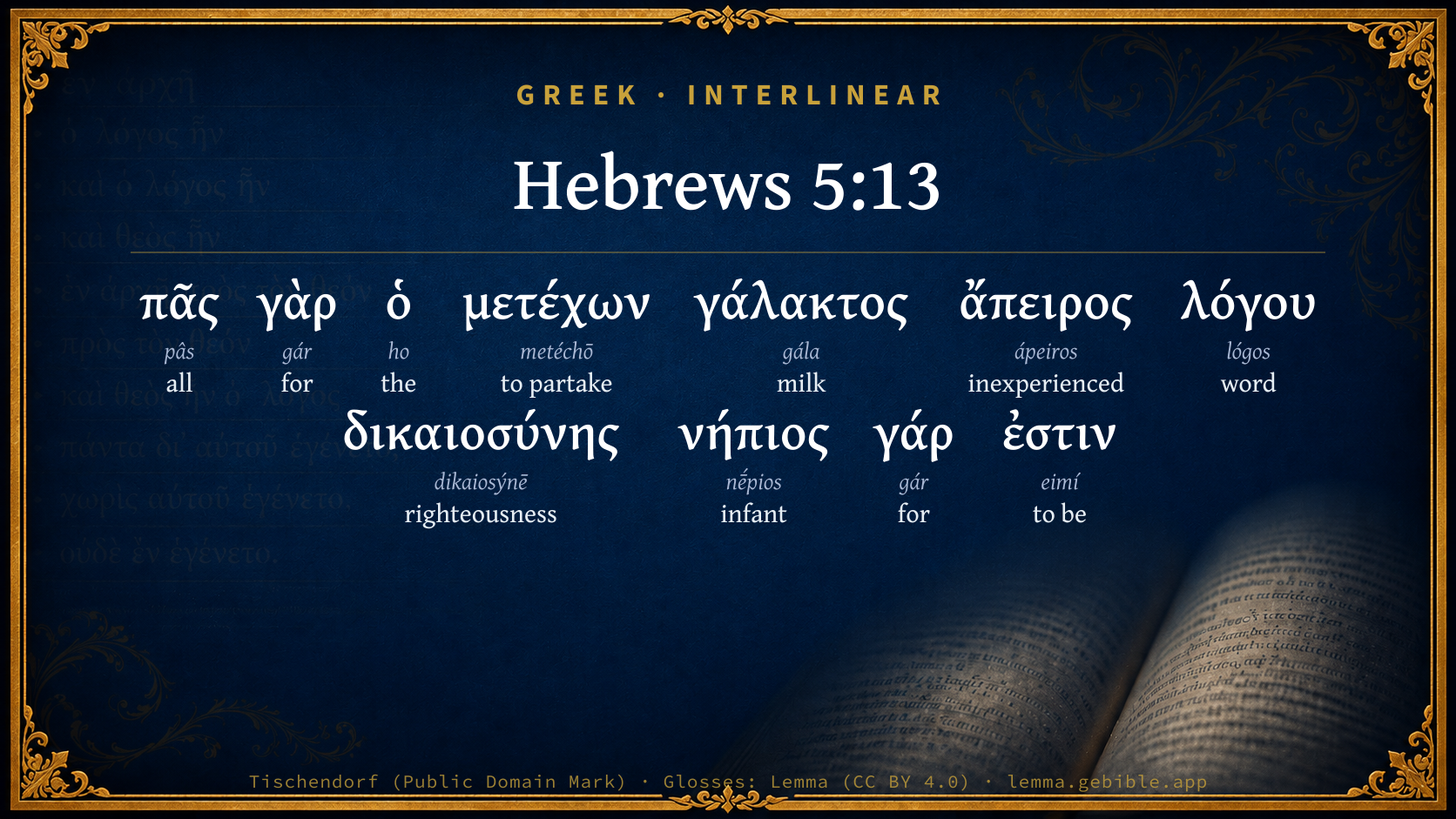
Download image
Cite this verse

Hebrews 5:13 (World English Bible). Public Domain. Lemma interlinear Bible study tool, https://lemma.gebible.app/v/hebrews/5/13.

Show BibTeX & RIS
BibTeX
RIS
English Translation
For everyone who lives on milk is not experienced in the word of righteousness, for he is a baby.
World English Bible · Public Domain
Highlights
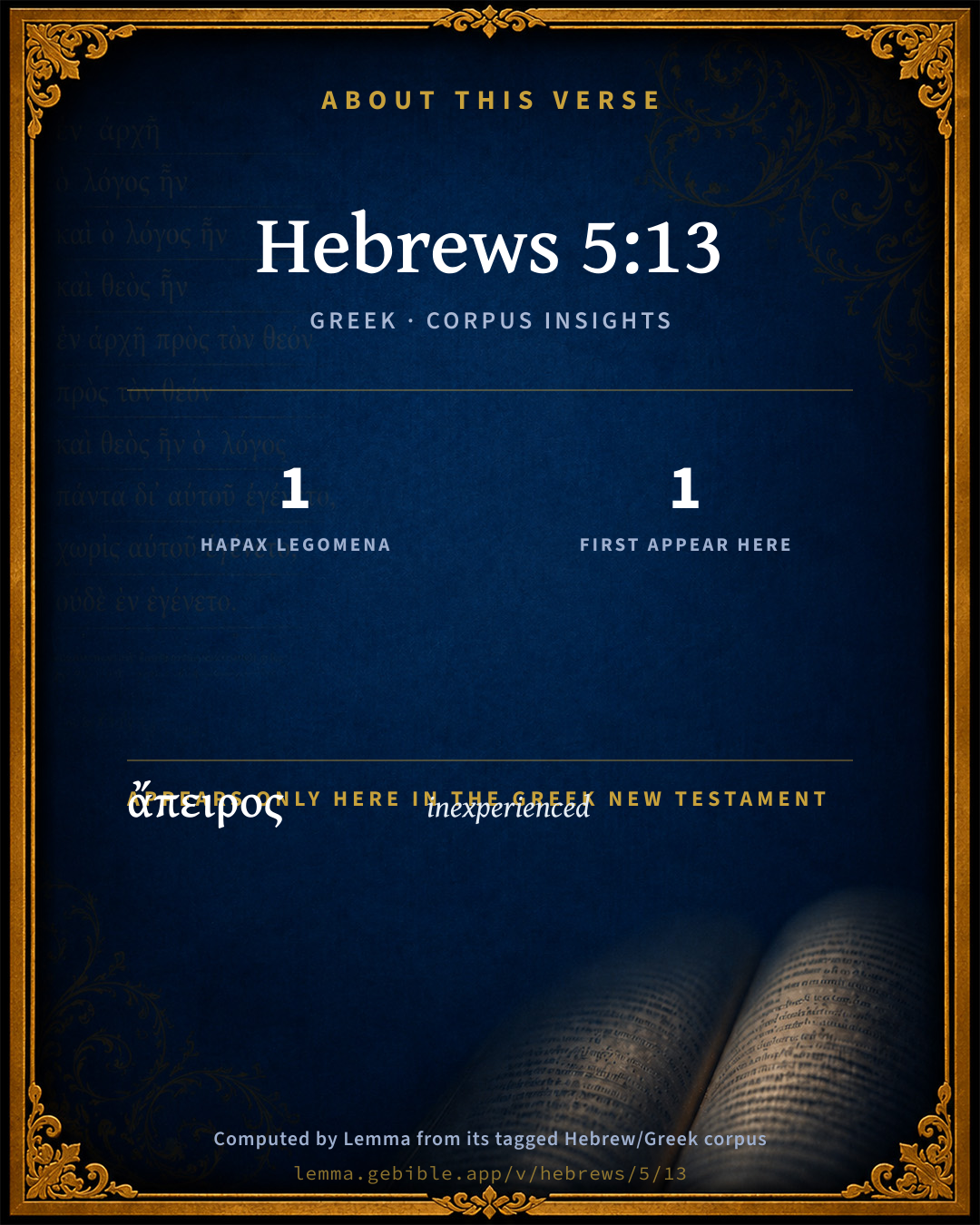
  • 1 hapax legomenon — only here in the Greek New Testament
  • 1 first appearance in the Greek New Testament
Full analysis ↓
Download a study sheet

One document with this verse’s original text, its word-by-word gloss line, the meaning frame, cross-references with their text, attributed commentary, and full source and license credits — printable, and it pastes into notes with its structure intact.

This verse Autodidact and up

Study sheet (.html) Plain text (.txt)

A passage Seminary Student

Up to 50 verses in one chapter. A passage sheet keeps up to 6 commentary sources and 12 cross-references per verse, in the order this page ranks them, and says so on the sheet whenever that leaves anything out. Ask for a single verse and you get the Autodidact verse sheet above.

Everything on this page stays free to read, with no account — the sheet is a download of what is already on screen, not access to it.

Want to remove ads? Support Godless Engineer
Compare translations 3

The same verse in 3 English versions, stacked beneath the original-language interlinear above. Click any original word for its lexicon entry.

Each is an independent rendering of the whole verse — the interlinear is not word-aligned to these translations.

Highlighted words mark where these versions differ — a whole-verse word diff, not a word-by-word alignment.

  • World English Bible Public Domain
    For everyone who lives on milk is not experienced in the word of righteousness, for he is a baby.
  • King James Version Public Domain
    For every one that useth milk is unskilful in the word of righteousness: for he is a babe.
  • unfoldingWord Literal Text CC BY-SA 4.0
    For anyone partaking of milk inexperienced message of righteousness, because he is an infant.

unfoldingWord Literal Text — © unfoldingWord, licensed CC BY-SA 4.0. Word-aligned USFM3 via Door43 (git.door43.org/unfoldingWord/en_ult).

Versions to compare (up to 4)

3 of 4 selected

Show all 19 translations

Every available English version of this verse, each an independent rendering of the whole verse.

  • World English Bible Public Domain
    For everyone who lives on milk is not experienced in the word of righteousness, for he is a baby.
  • Berean Standard Bible Public Domain
    For everyone who lives on milk is still an infant, inexperienced in the message of righteousness.
  • Majority Standard Bible Public Domain
    For everyone who lives on milk is still an infant, inexperienced in the message of righteousness.
  • King James Version Public Domain
    For every one that useth milk is unskilful in the word of righteousness: for he is a babe.
  • American Standard Version (1901) Public Domain
    For every one that partaketh of milk is without experience of the word of righteousness; for he is a babe.
  • Revised Version (1885) Public Domain
    For every one that partaketh of milk is without experience of the word of righteousness; for he is a babe.
  • Geneva Bible (1599) Public Domain
    For euery one that vseth milke, is inexpert in the worde of righteousnes: for he is a babe.
  • Douay-Rheims (1899) Public Domain
    For every one that is a partaker of milk, is unskillful in the word of justice: for he is a little child.
  • Young's Literal Translation Public Domain
    for every one who is partaking of milk `is' unskilled in the word of righteousness -- for he is an infant,
  • Literal Standard Version CC BY-SA 4.0
    for everyone who is partaking of milk [is] unskilled in the word of righteousness—for he is an infant,
  • Unlocked Literal Bible CC BY-SA 4.0
    For anyone who only takes milk is inexperienced with the message of righteousness, because he is still a little child.
  • unfoldingWord Literal Text CC BY-SA 4.0
    For anyone partaking of milk inexperienced message of righteousness, because he is an infant.
  • Darby Bible Public Domain
    For every one that partakes of milk [is] unskilled in the word of righteousness, for he is a babe;
  • World Messianic Bible Public Domain
    For everyone who lives on milk is not experienced in the word of righteousness, for he is a baby.
  • Webster's Bible Public Domain
    For every one that useth milk, is unskillful in the word of righteousness: for he is a babe.
  • Free Bible Version CC BY-SA 4.0
    Those who drink baby milk don't have the experience of living the right way—they're just babies.
  • Bible in Basic English Public Domain
    For everyone who takes milk is without experience of the word of righteousness: he is a child.
  • Text-Critical English NT CC BY 4.0
    Anyone who lives on milk is unacquainted with the teaching about righteousness, for he is an infant.
  • Tyndale New Testament (1534) Public Domain
    For every man that is feed with mylke is inexperte in the worde of rightewesnes. For he is but a babe.

Literal Standard Version (2020), Covenant Press — licensed CC BY-SA 4.0. Text via the HelloAO Bible API (eBible.org). Unlocked Literal Bible (unfoldingWord) — licensed CC BY-SA 4.0. Text via the HelloAO Bible API (eBible.org). unfoldingWord Literal Text — © unfoldingWord, licensed CC BY-SA 4.0. Word-aligned USFM3 via Door43 (git.door43.org/unfoldingWord/en_ult). Free Bible Version, Dr. Jonathan Gallagher — licensed CC BY-SA 4.0. Text via the HelloAO Bible API (eBible.org).

Word by word

More ways to search: Search by grammar → Find every occurrence → Compare this word →

Practice this passage: Drill this verse → Learn its vocabulary →

About this verse

These counts appear in no published source. They are computed here, from the morphology-tagged text and Lemma’s own curated glosses. What Lemma adds →

11
words
10
distinct lemmas
General Epistles
section

Notable vocabulary

1 hapax legomenon — a word that appears only here in the entire Greek New Testament:

  • ἄπειρος inexperienced G552

First appearance in Scripture

This word makes its first canonical appearance in the Greek New Testament here:

  • ἄπειρος inexperienced G552

Shared distinctive vocabulary

γάλακτος milk G1051 occurs in 5 verses of the Greek New Testament. Also found in:

Repetition

A word recurs within this verse:

Cross-references

14

Topical passages linked to Hebrews 5:13 in the Treasury of Scripture Knowledge — connected by theme and wording, ordered by reader-vote popularity; previews shown in the World English Bible.

  • 1 Corinthians 14:20 Brothers, don't be children in thoughts, yet in malice be babies, but in thoughts be mature.
  • 1 Peter 2:2 as newborn babes, long for the pure milk of the Word, that you may grow thereby,
  • 2 Timothy 3:16 Every writing inspired by God is profitable for teaching, for reproof, for correction, and for instruction which is in righteousness,
  • Isaiah 28:9 Whom will he teach knowledge? and whom will he make to understand the message? those who are weaned from the milk, and drawn from the breasts?
  • Ephesians 4:14 that we may no longer be children, tossed back and forth and carried about with every wind of doctrine, by the trickery of men, in craftiness, after the wiles of error;
  • 1 Corinthians 3:1 Brothers, I couldn't speak to you as to spiritual, but as to fleshly, as to babies in Christ.
  • 1 Corinthians 13:11 When I was a child, I spoke as a child, I felt as a child, I thought as a child. Now that I have become a man, I have put away childish things.
  • 2 Corinthians 3:9 For if the service of condemnation has glory, the service of righteousness exceeds much more in glory.
  • Psalms 119:123 My eyes fail looking for your salvation, For your righteous word.
  • Matthew 11:25 At that time, Jesus answered, "I thank you, Father, Lord of heaven and earth, that you hid these things from the wise and understanding, and revealed them to infants.
  • Romans 10:5–6 For Moses writes about the righteousness of the law, "The one who does them will live by them."
  • Mark 10:15 Most assuredly I tell you, whoever will not receive the Kingdom of God like a little child, he will in no way enter into it."
  • Romans 1:17–18 For in it is revealed God's righteousness from faith to faith. As it is written, "But the righteous shall live by faith."
  • Romans 2:20 a corrector of the foolish, a teacher of babies, having in the law the form of knowledge and of the truth.

Cross-references courtesy of OpenBible.info (CC BY 4.0).

Commentary

Notes on Hebrews 5:13 from classic Christian and Jewish commentators (each source and its license shown beneath its notes). The classic Christian expositions comment on the surrounding passage and are grouped to its opening verse, so a note may address several verses; the Jewish commentaries on the Tanakh (Rashi and others) are per-verse, so they appear only where the commentator wrote on this verse.

Lemma curates 59 commentaries, every one of them public domain or Creative Commons licensed, each selected and text-cleaned for this edition rather than reprinted as found. About our sources →

Bengel's Gnomon

Johann Albrecht Bengel

Heb 5:13. Ὁ μετέχων, he that partakes) Even strong men feed on milk, but not on milk chiefly, much less on milk alone. Therefore they are intended m this passage, who, in short, either take or seek nothing but milk.—ἄπειρος, unskilful) not expert, without strength and practice.—λόγου δικαιοσύνης, in the word of righteousness) Δίκαιον from δίχα: comp. διάκρισιν, discernment, in the following verse. For δικαιοσύνη, righteousness, is such perfection (תמים Jos 24:14, LXX.) as after having put away evil from it, attains to the just (proper) degree of good: γεγυμνασμένα (Heb 5:14), exercised, is in consonance with it; comp. Heb 12:11, where in like manner exercise and righteousness are joined. Such a word of righteousness is the doctrine of Christ in the New Testament. Righteousness of faith and of life is understood, and each on either side, according as circumstances have arisen.—νήπιος, a babe) The antithesis is τελείων, of them that are perfect: comp. Eph 4:13-14.

Bengel's Gnomon of the New Testament — English translation (T&T Clark, Edinburgh, 1860) — public domain. Text from a community e-Sword module.

Meyer's Critical & Exegetical Commentary

Heinrich August Wilhelm Meyer

Heb_5:13-14. Establishing of the γεγόνατε χρείαν ἔχοντες γάλακτος καὶ οὐ στερεᾶς τροφῆς, Heb_5:12. Sense: for it is universally characteristic of him who (in a spiritual respect) has need of milk, that he is, because not of ripe age, still inexperienced in the λόγος δικαιοσύνης; and this is just your case. Solid food, on the other hand, is proper only for the τέλειοι; τέλειοι, however, ye are not yet. In connection with this acceptation of the words, there is no occasion for finding anything out of place in the γάρ in relation to that which precedes, and either, with Storr, making it co-ordinate with the γάρ, Heb_5:12, and referring it back like this to Heb_5:11,which on account of the figure Heb_5:13-14, retained from Heb_5:12, is already seen to be inadmissible,or for saying, with Bleek and Bisping, that the progress of thought would come out more naturally if the author had written: πᾶς γὰρ ὁ ἄπειρος λόγου δικαιοσύνης μετέχει γάλακτος· νήπιος γάρ ἐστιν.

ὁ μετέχων γάλακτος] he who (in a spiritual respect) partakes of milk, i.e. only in this possesses his nourishment, is not in a position to take in solid food. Bengel: Lacte etiam robusti vescuntur, sed non lacte praecipue, nedum lacte solo. Itaque notantur hoc loco ii, qui nil denique nisi lac aut capiunt aut petunt.

ἄπειρος λόγου δικαιοσύνης] sc. ἐστίν, he is still inexperienced in the word of righteousness. Expositors have almost without exception been guided by the presupposition (as also Bleek, de Wette, Tholuck, Kurtz still are) that λόγος δικαιοσύνης is only a varying form of expression for the same idea as is expressed, Heb_5:12; Heb_5:14, by στερεὰ τροφή, or, Heb_6:1, by τελειότης. λόγος δικαιοσύνης has then either been taken as equivalent to λόγος δίκαιος or τέλειος, and the higher, more perfect type of doctrine found indicated in the expression. So Schlichting (sermo justitiae videtur positus pro sermone justo, h. e. perfecto ac solido), Grotius (Hic δικαιοσύνης dixit pro τελειότητος … et genitivus est pro adjective), Abresch (doctrina vel institutio justa, h. e. perfecta, plena, omnia complectens, quae ad perspicuam distinctamque pertineant doctrinae Christianae intelligentiam), Schulz (that true [rightly so called] higher doctrine), Kuinoel, Bisping, Kurtz, and many others. Or δικαιοσύνης has been more correctly regarded as genitive of the object. In the latter case δικαιοσύνη is taken either, as Michaelis, ad Peirc., with an appeal to the Hebrew צְדָקָה, in the sense of ἀλήθεια,[75] as the doctrine of the essence of the matter itself, in opposition to the typical figures thereof; or λόγος δικαιοσύνης is understood specially, as by Oecumenius, of the λόγος περὶ τῆς θεότητος τοῦ κυρίου, or, as by Carpzov, of the: doctrina de sacerdotio Jesu Christi Melchisedeciano, quae dicitur ὁ λόγος δικαιοσύνης propterea, quia Melchisedecus, vi nominis, βασιλεὺς δικαιοσύνης vertitur, Heb_7:2, eaque appellatio ad Christum sacerdotem applicatur, cujus πρέπον fuit πληρῶσαι πᾶσαν δικαιοσύνην, Mat_3:15; or the words are made to refer, as by Primasius, Zeger, Bengel, de Wette, and others, to intellectual and moral perfection in general, as also already Chrysostom, who explains the expression by Ἡ ἌΝΩ ΦΙΛΟΣΟΦΊΑ (and after him Theophylact), leaves us the choice of understanding the ΒΊΟς ἌΚΡΟς ΚΑῚ ἨΚΡΙΒΩΜΈΝΟς (according to Mat_5:20), or ΤῸΝ ΧΡΙΣΤῸΝ ΚΑῚ ΤῸΝ ὙΨΗΛῸΝ ΠΕΡῚ ΑὐΤΟῦ ΛΌΓΟΝ. But the fundamental presupposition, out of which all these interpretations have sprung, is an erroneous one. For the emphasis falls not upon ΛΌΓΟς ΔΙΚΑΙΟΣΎΝΗς, but upon the ἌΠΕΙΡΟς, on that account preposed. Not for a non-possession of the ΛΌΓΟς ΔΙΚΑΙΟΣΎΝΗς, but only for a want of experience in the same, only for an insufficient, schoolboys knowledge of it, does the author blame the readers. The ΛΌΓΟς ΔΙΚΑΙΟΣΎΝΗς in itself, therefore, stands as indifferently related to the notion of the ΣΤΕΡΕᾺ ΤΡΟΦΉ or ΤΕΛΕΙΌΤΗς as to the notion of the ΣΤΟΙΧΕῖΑ, to which Ebrard reckons it. Only by the more or less exhaustive imparting of its subject-matter does it become the one or the other. For the word of righteousness is nothing more than a periphrasis of Christianity or the gospel, inasmuch as just the righteousness availing with God[76] is the central-point of its contents. Quite analogous to this mode of designation is the Pauline characterization of the gospel office of teaching by ἠ διακονία τῆς δικαιοσύνης, 2Co_3:9, and of the teachers of Christianity by διάκονοι δικαιοσύνης, 2Co_11:15; on which account also it is unnecessary, for the justification of the expression chosen, with Bleek, Bisping, and Maier, to assume an allusion to the exposition of the name Melchisedec, βασιλεὺς δικαιοσύνης, given Heb_7:2.

νήπιος γάρ ἐστιν] for he is still a babe, a novice in Christianity. Setting forth of the naturalness of the ἄπειρος λόγου δικαιοσύνης.

[75] Delitzsch, too, with an allusion to the use of צֶדֶק, ישֶׁר, מֵישָׁרִים, takes δικαιοσύνη as a synonym of ἀλήθεια; but will then have the genitive δικαιοσύνης looked upon not as expressing the contents, but as a defining of the quality of λόγος, and will interpret λόγος of the faculty of speech. Thus, then, λόγος δικαιοσύνης is taken to mean: the faculty of speaking in accordance with righteousness, i.e. the discourse on spiritual things which is guided in strict accord with the norm of the true, and harmoniously combines all the factors of the case, proportionately regarded, without leaving one of them out of sight; and in ver. 13 is supposed to be contained the following most rigid connection of ideas: he who must still receive milk is still ignorant of rightly-constituted, i.e. right-teaching or orthodox, discourse; for he is a child only beginning to lisp, and not yet capable of speech. This strange view, based upon the incomprehensible grounds, that since νήπιος (from νη and ἔπος) denotes one incapable of speech, an infant, there is a presumption in favour of λόγος in ἄπειρος λόγου δικαιοσύνης having the signification of faculty of speech,and this signification is here the more probable in regard to the αἰσθησήρια occurring in the antithetic parallel clause, inasmuch as ὁ λόγος, in the sense of language, is met with countless times in Philo along with the αἴσθησις or the πέντε αἰσθήσεις, of which the organs are known as αἰσθητήρια,bears its refutation upon the face of it. It is not at all suitable to the connection, as Riehm (Lehrbegr. des Hebräerbr. p. 734) and Alford have already observed; since according to this there is no question as to the faculty for speaking on spiritual subjects, but only as to the faculty for understanding the same.As discourse will Hofmann also have λόγος interpreted, in that he fully subtilizes the notion lying in δικαιοσύνη, and finds indicated by the total expression λόγος δικαιοσύνης only correct discourse. For, according to him, the words ver. 13 are used in their most literal sense, and allude to the fact that he who is still fed with milk at the maternal breast is as yet no judge of correct discourse!

[76] Of the righteousness availing with God (comp. also Heb_11:7), have Beza, Jac. Cappellus, Peirce, Storr, Klee, Tholuck, Bleek, Stein, Ebrard, Bloomfield, and others already rightly interpreted δικαιοσύνη.In the above exposition, Alford, Riehm (Lehrbegr. des Hebräerbr. p. 733), and Woerner have concurred; save that, according to Riehm, by virtue of an over-refined distinction, the gospel is not called the word of righteousness because the righteousness availing with God is the central-point of its contents, but because it leads to righteousness; because, by its proclamation to man, the possibility is created and the opportunity is afforded of entering into a condition of the rightness of his relation to God, inasmuch, namely, as he assumes a believing attitude towards the word proclaimed. But why should the author, familiar as he was with Pauls manner of teaching, and attaching his own doctrinal presentation thereto,albeit with independence of character,have shrunk from recognising, as the central theme of the gospel, the righteousness which avails with God, since even this was only a general notion, which did not exclude a peculiar conception and treatment, where it was a question of the development of details, and insistance thereon?

Meyer — Critical and Exegetical Commentary on the New Testament — English translation by Peter Christie, edited by Frederick Crombie (T&T Clark, 1880) — public domain. Text from a community e-Sword module.

Expositor's Greek Testament

ed. W. Robertson Nicoll

Heb 5:13 . πᾶς γὰρ … νήπιος γάρ ἐστι . “For every one who partakes of milk [as his sole diet] is without experience of the word of righteousness; for he is a babe.” The reference of γὰρ is somewhat obscure. It seems intended to substantiate the last clause of Heb 5:12 : “Ye cannot receive solid food, for you have no experience of the word of righteousness”. But he softens the statement by generalising it. Every one that lives on milk is necessarily unacquainted with the higher teaching, which is now λόγος δικ . ἄπειρος having no experience of, ignorant; as κακότητος ἄπειροι , Empedocles in Fairbanks, Phil. of Greece , p. 202. ἄπειρος ἀγρεύειν , Babrius, lxix. 2; ἄπ . τοῦ ἀγωνίζεσθαι , Antiphon, Jebb, p. 8. λόγου δικαιοσύνης , with teaching of righteous conduct the suckling has nothing to do; he cannot act for himself, but can merely live and grow; he cannot discern good and evil, and must take what is given him. Righteousness is not within the suckling’s horizon. He cannot as yet be taught it; still less can he be a teacher of it (Heb 5:12 ) νήπιος γάρ ἐστι , for he cannot even speak [ νη - ἔπος = infans], he is an infant. The infant can neither understand nor impart teaching regarding a life of which he has no experience, and whose language he does not know. Indirectly, this involves that the higher instruction the writer wished to deliver was important because of its bearing on conduct. [Other interpretations abound. Chrysostom and Theophylact understand the reference to be either to the Christian life or to Christ Himself and the knowledge of His person. Others, as Beza, Lünemann, and many others, take it as “a periphrasis for Christianity or the Gospel, inasmuch as the righteousness which avails with God is precisely the contents of the Gospel”. Riehm also thinks that the Gospel is meant, “because it leads to righteousness”. Westcott understands it of the “teaching which deals at once with the one source of righteousness in Christ, and the means by which man is enabled to be made partaker of it”. The view of Carpzov, and also that of Bleek, is governed by the connection of Melchizedek with righteousness in Heb 7:2 .]

The Expositor's Greek Testament, edited by W. Robertson Nicoll (1897–1910) — public domain. Text from a community e-Sword module.

Geneva Bible (1599)

Geneva Bible translators

In the word that teacheth righteousness.

Geneva Bible (1599) marginal notes — public domain. Text via Bolls.life.

Jamieson, Fausset & Brown

Robert Jamieson, A. R. Fausset & David Brown

useth--Greek, "partaketh," that is, taketh as his portion. Even strong men partake of milk, but do not make milk their chief, much less their sole, diet.

the word of righteousness--the Gospel wherein "the righteousness of God is revealed from faith to faith" (Rom 1:17), and which is called "the ministration of righteousness" (Co2 3:9). This includes the doctrine of justification and sanctification: the first principles, as well as the perfection, of the doctrine of Christ: the nature of the offices and person of Christ as the true Melchisedec, that is, "King of righteousness" (compare Mat 3:15).

Jamieson, Fausset & Brown — Commentary Critical and Explanatory on the Whole Bible (1871) — public domain (CC PDM 1.0). Text via the HelloAO Bible API.

Adam Clarke's Commentary

Verse 13. For every one that useth milk] It is very likely that the apostle, by using this term, refers to the doctrines of the law, which were only the rudiments of religion, and were intended to lead us to Christ, that we might be justified by faith.

The word of righteousness] αογος δικαιοσυνης. The doctrine of justification. I believe this to be the apostle's meaning. He that uses milk-rests in the ceremonies and observances of the law, is unskilful in the doctrine of justification; for this requires faith in the sacrificial death of the promised Messiah.

Adam Clarke's Commentary on the Bible (1810–1826) — public domain. Text from a community e-Sword/MySword module.

John Calvin's Commentaries

13. For every one who uses milk, or, who partakes of milk, etc. He means those who from tenderness or weakness as yet refuse solid doctrine; for otherwise he who is grown up is not averse to milk. But he reproves here an infancy in understanding, such as constrains God even to prattle with us. He then says, that babes are not fit to receive the word of righteousness, understanding by righteousness the perfection of which he will presently speak. For the Apostle does not here, as I think, refer to the question, how we are justified before God, but takes the word in a simpler sense, as denoting that completeness of knowledge which leads to perfection, which office Paul ascribes to the Gospel in his epistle to the Colossians, 1:28; as though he had said, that those who indulge themselves in their ignorance preclude themselves from a real knowledge of Christ, and that the doctrine of the Gospel is unfruitful in them, because they never reach the goal, nor come even near it.

John Calvin's Commentaries (1540-1563) — public domain. Text from the Calvin Translation Society English edition (1840s-50s) via the Christian Classics Ethereal Library (ccel.org). Calvin's coverage is partial (roughly two-thirds of the Bible); uncommented books and verses are honest gaps, never fabricated. The 19th-century editor's footnotes and remarks are omitted so the notes are faithfully Calvin's own voice.

Ellicott's Commentary for English Readers

(13) The change of expression from having need of milk to partaking of milk (that is, making it the solo food) is significant. Those who are addressed had lost interest in the deeper truths of Christianity, those truths which alone expressed and explained its proper nature. Their temptation apparently was towards mingling a rudimentary Christian doctrine with the teaching of the synagogue. Yielding to this they would lose all real Knowledge of the very elements of Christian truth, and with this all true knowledge of the Old Testament itself. The connection between this verse and the last may probably be, Ye have come to need milk, for—making it by choice your sole food—ye stand self-confessed as babes.

Unskilful.—Rather, without experience. The “word of righteousness” evidently must signify complete, properly-developed Christian teaching. The only question is, Why is this particular designation chosen? In the Epistle to the Romans such a description would be natural (see especially Rom_1:17; Rom_9:31); but “righteousness” is not the direct and manifest subject of this Epistle. Still, the expressions of which the writer makes use in Heb_10:38; Heb_11:7, together with the general similarity between his teaching and St. Paul’s, go very far towards explaining his choice of this special expression as descriptive of the religion of Christ. In like manner another phrase, “law of liberty,” is characteristic of St. James.

A Bible Commentary for English Readers, edited by Charles John Ellicott (1878–1897) — public domain. Text from a community e-Sword module.

The Cambridge Bible for Schools and Colleges

gen. ed. J. J. S. Perowne

13. that useth milk] The meaning is “who feeds on milk.”

unskilful] “Inexperienced.”

for he is a babe] This is a frequent metaphor in St Paul, who also contrasts “babes” (nçpioi) with the mature (teleioi), Gal_4:3; 1Co_2:6; Eph_4:13-14. We are only to be “babes” in wickedness (1Co_14:20).

the word of righteousness] i.e. the Scriptures, and especially the Gospel (see 2Ti_3:16; Rom_1:17, “therein is the righteousness of God revealed”).

The Cambridge Bible for Schools and Colleges (gen. ed. J. J. S. Perowne; Cambridge University Press, 1878–1918) — public domain. Text from a community e-Sword module.

John Gill's Exposition

But strong meat belongeth to them that are of full age,.... Or perfect; see Co1 2:6. This does not intend a perfection of justification; for though some have a greater degree of faith than others, and a clearer discovery of their justification, yet babes in Christ are as perfectly justified as more grown and experienced believers; nor a perfection of sanctification, for there is no perfection of holiness but in Christ; and though the work of sanctification may be in greater perfection in one saint than in another, yet all are imperfect in this life; and as to a perfection of parts, babes have this as well as adult persons: but it designs a perfection of knowledge; for though none are entirely perfect, yet some have arrived to a greater degree of the knowledge of Gospel mysteries than others, and to these the strong meat of the Gospel belongs; they are capable of understanding the more mysterious parts of the Gospel; of searching into the deep things of God; and of receiving and digesting the more sublime truths of the Christian religion:

even those who by reason of use, have their senses exercised to discern both good and evil; that is, their spiritual senses, the internal senses of the understanding and judgment, signified by external ones; as by seeing the Son; hearing the voice of Christ; savouring or smelling a sweet odour in the things of God, and Christ; tasting that the Lord is gracious; feeling and handling the word of life, as these are held forth in the everlasting Gospel: and these being exercised on their proper object, by use, an habit is contracted; and such are qualified for discerning, as between moral good and evil, and the worse and better state of the church, and between law and Gospel, so between the doctrines of Christ, and the doctrines of men; who find they differ: the doctrines of Christ such experienced persons find to be good, wholesome, nourishing, and salutary; and the doctrines of men to be evil, to eat, as does a canker, and to be pernicious, poisonous, and damnable; and the discernment they make, and the judgment they form, are not according to the dictates of carnal reason, but according to the Scriptures of truth, and their own experience.

Next: Hebrews Chapter 6

John Gill's Exposition of the Whole Bible (1746–1763) — public domain (CC PDM 1.0). Text via the HelloAO Bible API.

Trapp's Complete Commentary

John Trapp

13 For every one that useth milk is unskilful in the word of righteousness: for he is a babe.

Ver. 13. In the word of righteousness] That is, in the more solid doctrine of the gospel concerning Christ, who is our righteousness.

John Trapp, A Commentary or Exposition upon All the Books of the Old and New Testament (1647–1656) — public domain. Text from a community e-Sword module.

Albert Barnes' Notes on the Bible

For every one that useth milk - Referring to the food of children. The apostle has in view here those Christians who resemble children in this respect, that they are not capable of receiving the stronger food adapted to those of mature age.

Is unskilful - Inexperienced; who has not skill to perform anything. The word is properly applied to one who has not experience or skill, or who is ignorant. Here it does not mean that they were not true Christians - but that they had not the experience or skill requisite to enable them to understand the higher mysteries of the Christian religion.

In the word of righteousness - The doctrine respecting the way in which men become righteous, or the way of salvation by the Redeemer; see the notes on Rom 1:17.

For He is a babe - That is, in religious matters. He understands the great system only as a child may. It is common to speak of “babes in knowledge,” as denoting a state of ignorance.

Albert Barnes' Notes on the Bible (1834–1885) — public domain. Text from a community e-Sword/MySword module.

Matthew Poole's English Annotations

The Spirit proves these Hebrews such infants by describing the state of them, and of their contrary, and tacitly applying it to them under a metaphor or allegory started by him before.

For every one that useth milk; for, saith he, every one of you who take in nothing but the elements and weakest kind of doctrines, and can bear no other, have not digested the first principles of the oracles of God.

Is unskilful in the word of righteousness; are απειρος, not truly knowing, not proving nor experiencing, never exercised or practised in, the word of righteousness, the gospel doctrine, which is in itself an eternal certain truth, the revelation of the righteousness of God to faith, Rom 1:16,17, and the instrumental conveyer of it to faith; a perfect rule of righteousness, making Christians conform exactly to the mind and will of God, and so reaching the state of strong and perfect ones, Col 1:25-29.

For he is a babe; he is but a new-born Christian, a child in Christ’s school, one that cannot be experienced in the perfections of God’s word, because he is weak in knowledge, ignorant and unconstant like an infant, 1Co 14:20; compare Eph 4:14.

Matthew Poole's English Annotations on the Holy Bible (1683–1685) — public domain. Text from a community e-Sword/MySword module.

Whedon's Commentary on the Bible

Daniel D. Whedon

13. Every one that useth milk—The milk, or first principles, are indicated by specimens, in Heb_6:1-2.

Is a babe—Spiritually ignorant and weak.

Daniel D. Whedon (gen. ed.), Commentary on the Old and New Testaments (1874–1909) — public domain. Text from a community e-Sword module.

The Pulpit Commentary

For every one that partaketh of milk is unskillful in the word of righteousness: for he is a babe. Reason for saying that they are such as have need of milk; for milk is the nourishment of infants, and he that is an infant in respect of spiritual growth is apeirov logou dikaiosunhv : not of necessity unacquainted with it altogether, but still not versed in it; he is but a tyro. "Word of righteousness" may be taken as a general term to denote what we might call religious lore; referring here especially to the gospel, which is eminently the revelation of the "righteousness of God"; (Rom_1:17; cf. 2Co_3:9, h diakonia thv dikaiosunhv : and 2Co_11:15, diakonoi dikaiosunhv) but not excluding a more general conception. There is no need to suppose an exclusive reference to the more perfect doctrine in opposition to the elements, since, of the whole subject of religious knowledge, the nhpiov may be said to be apeirov in the sense of being without the matured skill that experience gives. Hence, too, we are certainly not justified in finding in the phrase a specific allusion to the Pauline doctrine of justification by faith only, which is not suggested by the context or by what follows. Still less may we (with Delitzsch) so ignore the notable significance of dikaiosunh as to reduce the expression to a synonym for "rightly framed, that is sound and orthodox discourse."

The Pulpit Commentary (1880–1919), ed. H.D.M. Spence-Jones & Joseph S. Exell — public domain. Text from a community e-Sword module.

John Wesley's Explanatory Notes

Everyone that useth milk - That neither desires, nor can digest, anything else: otherwise strong men use milk; but not milk chiefly, and much less that only. Is unexperienced in the word of righteousness - The sublimer truths of the gospel. Such are all who desire and can digest nothing but the doctrine of justification and imputed righteousness.

John Wesley, Explanatory Notes Upon the Whole Bible (1754–1765) — public domain. Text via the GEBible commentary corpus.

Burkitt's Expository Notes on the New Testament

William Burkitt

Our apostle here speaks of the difference of doctrines under the metaphor of meats: From whence we may gather,

1. That the Word of God, in the dispensation of it, is food provided for the souls of men.

2. That the Word, as food, will not profit the soul until it be eaten, and digested: It is not food prepared, but food received, that nourishes. When manna was gathered and eaten, it nourished the Israelites: But when gathered and laid by, it putrified and bred worms.

Lord! What pains do some take to gather manna, to hear the Word, but alas! it lies by them, and is of no use.

Learn, 3. That as the gospel is the word of righteousness, so God requires and expects that all those who live under the dispensation of the gospel should be skillful in the word of righteousness. The gospel is a word of righteousness; it is so declaratively, as the severity of God against sin is hereby more fully revealed, and as the righteousness which God requireth, approveth, and accepteth for our justification, is therein declared; and the righteousness which God requireth in us, and expecteth from us, is hereby discovered also; and as it is the great instrument of working holiness in us, and making us inherently righteous, so it is the word of righteousness efficiently as well as declaratively; our justification is wrought in us thereby, Joh 17:17.

Learn, 4. That the spiritual senses of believers, well exercised in the word of righteousness, are the best and most undeceiving helps in judging of what is good or evil, what is true or false, that is proposed to them: Such, by reason of use, have their senses exercised to discern both good and evil.

William Burkitt's Expository Notes on the New Testament (1700–1703) — public domain. Text from a community e-Sword module.

The People's New Testament

B. W. Johnson

13. Every one that useth milk, etc. Those who only understand the A B C's of Christianity are only babes in Christ, like the babes whose food is milk. Such an one cannot handle the word of righteousness skillfully.

B. W. Johnson's The People's New Testament with Notes (1889–1891) — public domain. Electronic text from the Christian Classics Ethereal Library (CCEL) ThML edition.

Cambridge Greek Testament for Schools and Colleges

13. ὁ μετέχων γάλακτος, “who feeds on milk.”

ἄπειρος, “inexperienced.”

νήπιος. This is a frequent metaphor in St Paul, who also contrasts “babes” (νήπιοι) with the mature (τέλειοι), Gal 4:3; 1Co 2:6; Eph 4:13-14. We are only to be “babes” in wickedness (1Co 14:20).

λόγου δικαιοσύνης, i.e. the Scriptures, and especially the Gospel (see 2Ti 3:16; Rom 1:17, “therein is the righteousness of God revealed”). The Hebrew צְדָקָה has almost the sense of ἀλήθεια.

Cambridge Greek Testament for Schools and Colleges (Cambridge University Press, 1896; 21 vols, various authors incl. Carr, Maclear, Plummer, Farrar, Lumby, Moule, M. R. James, Simcox) — public domain. Text from a community e-Sword module.

Vincent's Word Studies in the New Testament

Marvin R. Vincent

Useth [μετεχων] . Rend. partakes of. See on ch. Heb 1:9; Heb 2:14; Heb 3:1, 14. Unskilful [απειρος] . N. T. o. Rend. unskilled or inexperienced.

In the word of righteousness [λογου δικαιοσυνης] . The phrase N. T. o. The genitive dikaiosunhv of righteousness is combined in N. T. with way, God, gift, instruments, servants, law, ministration, fruit and fruits, ministers, hope, breastplate, crown, king, preacher. It is a mistake to attempt to give the phrase here a concrete meaning. It signifies simply a word of normally right character. It is not = the Christian revelation, which would require the article. Probably, however, in the foreground of the writer's thought was the word spoken by the Son (ch. 1 2); the salvation which at first was spoken by the Lord (ch. 2 3). 191 A babe [νηπιος] . See on Rom 2:20; 1Co 3:1; Eph 4:14.

Marvin R. Vincent, Word Studies in the New Testament (1887–1900) — public domain. Text from a community e-Sword/MySword module.

Westcott on Hebrews & the Epistles of John

Brooke Foss Westcott

13. was γὰρ ὁ μετ. ydA.] The argu-

13 bx. 1 ἐστίν D.*. νηκ. γ. + ἀκμήν D,°. mont would havo boon cloarer if the torms of tho sontonce had boon inverted : ‘For ovory ono that is inexporioncod...—as you shew yoursolvos to bo—is fed with milk...’ But tho writer profers to suggest the fact that his readors are actually living in the most rudimentary stage of faith, ‘partaking of milk,’ and so condemning thomselves of unfitness for deeper instruction. For overy one that partaketh of milk, and the Hebrews had brought themselves to this diot, is according to the figure a mere infant, and necessarily ignorant of the teachings and the problems of lifo. Such a oue therefore could not but be without experience of the word of righteousness (Vulg. arpore sermonis justitia), unprepared by past training to ontor upon the discussion of the larger problems of Christian thought,

The absence of the definite articles (λόγος δικαιοσύνης not ὁ A. τῆς dex.) shews that the main conception of the phrase lies in the character and not in the concrete roalisation of the ‘word.’ It is not ‘the word of righteousness,’ tho full exposition of the Obristian Faith (2 Cor. iii. 9), but teaching such as belongs to it, ‘ teaching of rightcousness,’ teaching which deals at once with the one sourco of rightoousncss in Christ, and the means by which mau is enabled to be made partaker of it. The doctrine of Christ's priestly work is based upon these conceptions, which belong to the ‘solid food’ of the mature boliever.

Chrysostom offers two interprotaκαιοσύνης, τουτέστι, τῆς ἄνω φιλοσοφίας ἄπειρος, οὐ δύναται παραδέξασθαι βίον ἄκρον καὶ ἠκριβωμένον᾽ ἣ δικαιοσύνην

The discernment of ‘ good and evil’

Brooke Foss Westcott (1825–1901), The Epistle to the Hebrews (1889) and The Epistles of St John (1883) — public domain (pre-1929). Text recovered from Internet Archive / Google Books OCR scans. Westcott’s Gospel of John commentary is not included (its OCR lost the chapter running-heads required for reliable verse-keying). Some Greek quoted in the Hebrews volume is imperfectly rendered by the OCR.

Lesson kit

Teaching starters — assembled from the data on this page, not authored interpretation. Every prompt links to the verse data it draws on. Edit before teaching.

Hebrews, in the General Epistles, opens this verse with 11 words (10 distinct Greek lemmas). Its most distinctive word is ápeiros (“inexperienced”). A historical commentator’s framing appears above. Read the whole chapter for the surrounding context.

Discussion questions

  1. The word ápeiros carries the sense “inexperienced.” How does it shape the verse?
  2. 1 word here appears nowhere else in the Greek New Testament. Why might the author reach for such rare wording?
  3. This is the first place “inexperienced” appears in Scripture (first appears here). What does its debut here establish?
  4. How does 1 Corinthians 3:2, which shares the word «milk», read alongside this verse?
  5. What does the repetition of “for” (2× in this one verse) do in this verse?
  6. These translations render this verse differently. What is at stake in choosing one wording over another?
  7. Compare how Bengel's Gnomon and Meyer's Critical & Exegetical Commentary read this verse. Where do they agree or differ?

Things to notice

  • 1 word in this verse appears nowhere else in the Greek New Testament.
  • 1 word makes its first canonical appearance in Scripture here.
  • These translations choose different wording for 17 words in this verse.
  • “for” occurs 2× in this single verse.
  • 10 distinct Greek lemmas span 11 words in this verse.

Reading settings

Reading text

Shown beneath each verse's original-language words.

Old Testament
Old Testament edition

Read the OT as the Masoretic Hebrew (MT) or the Greek Septuagint (LXX).

English shown for the Greek Septuagint (in the Hebrew ↔ Greek comparison).

Comparing translations? Open the Compare panel on any verse page to stack up to four side by side.