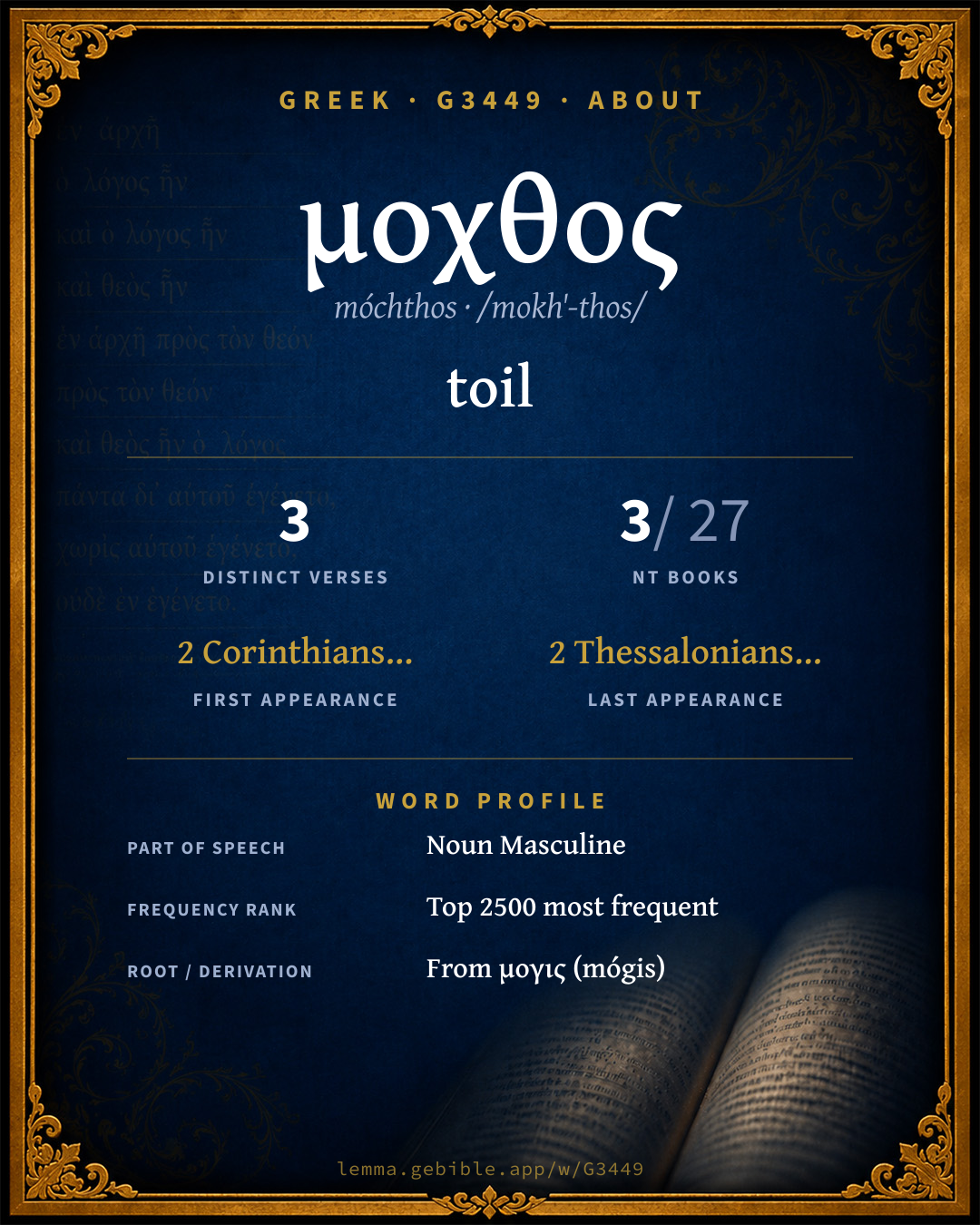
μόχθος
toil
Full lexicon entry — Thayer's Greek Lexicon
From Thayer's Greek Lexicon
Where this word appears
Grammar key — what these labels mean
Part of speech
- Noun
- A naming word — a person, place, thing, or idea.
Case
- Dative
- The case of the indirect object, means, or location — “to / for / with / in.”
- Accusative
- The case of the direct object and of extent.
Gender
- Masculine
- Grammatically masculine.
Number
- Singular
- One.
Every verse where G3449 appears in the Book of 1 Thessalonians — 1 distinct verse. Click any verse to open its interlinear word-by-word view. Verse text shown in the World English Bible for context — . Each verse’s Greek form is shown with its reference; the English is not keyword-highlighted, since the data carries no word-level English alignment. Use “Compare translations” on any verse to read it across multiple English versions. This concordance covers the Greek New Testament; Septuagint (Greek Old Testament) occurrences of this word are not indexed here.
1 Thessalonians
About this entry
At a glance — auto-summarized from this page’s data, not written by a person. Every figure links to its source below. This summary describes the numbers; it doesn’t interpret them.
μοχθος — transliterated móchthos — is a Greek noun carrying the sense “toil.” It occurs a mere 3 verses across Scripture. More than a third of its appearances fall in 2 Corinthians. It first appears in 2 Corinthians 11:27. Related forms include μογις, μογιλαλος and μολις. See the sense tree, 3-verse concordance, and the renderings breakdown below.
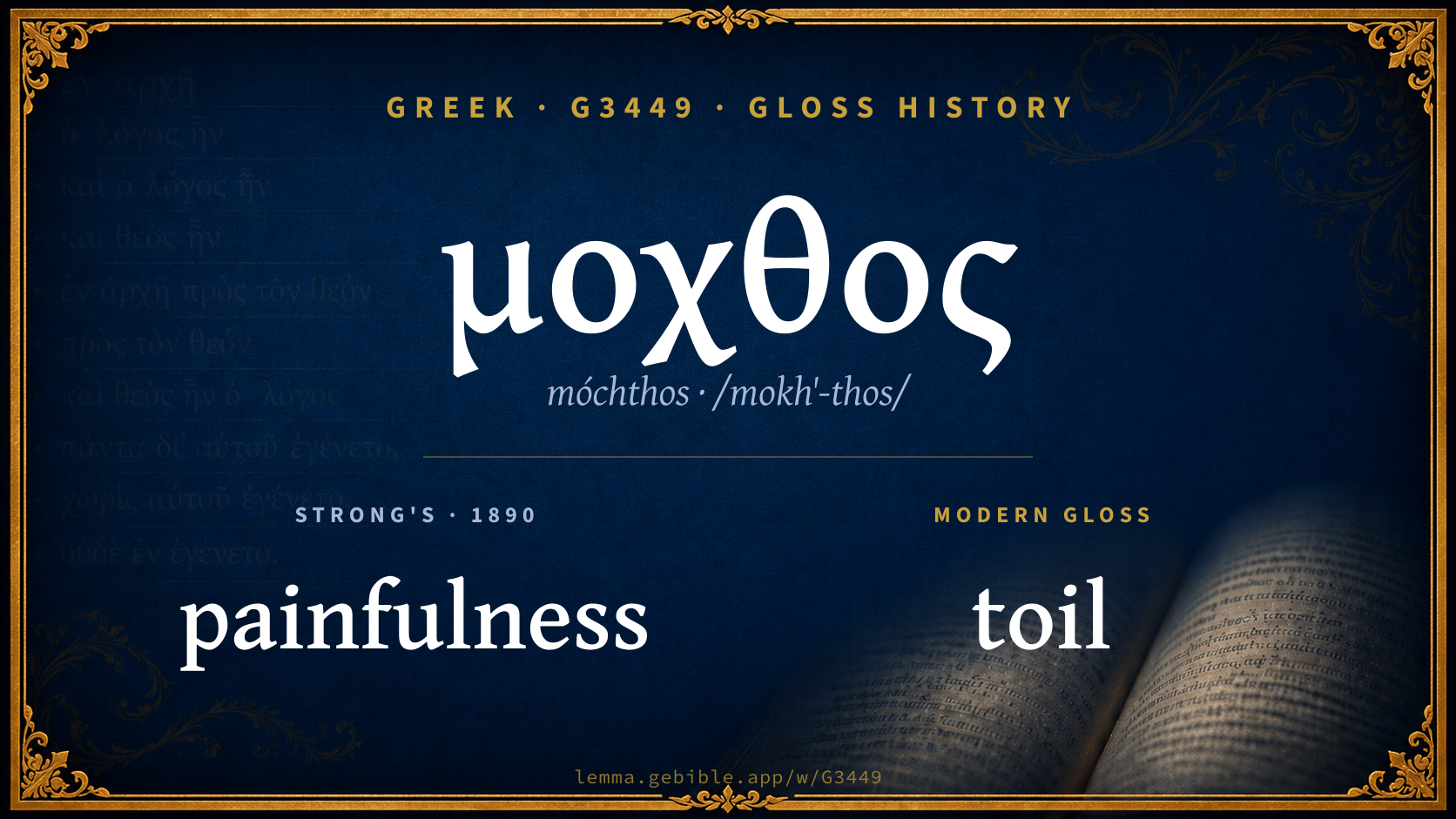
Gloss history
Strong's 1890 vs modern scholarship
About this word
Strong's G3449 catalogs a Greek word from the Greek New Testament.
These counts are not copied from any lexicon or concordance. They are computed here, from the morphology-tagged Greek New Testament. What Lemma adds →
- 3
- distinct verses
- The word appears in 3 distinct verses.
- 3 / 27
- NT books
- The word appears in 3 of 27 New Testament books.
- #2,203
- by frequency
- Top 2500 most frequent Greek words (rank 2,203 of 5,347 Greek words by occurrence).
View all 3 occurrences in the concordance →
Most concentrated in
- 2 Corinthians 1 verse 33%
- 1 Thessalonians 1 verse 33%
- 2 Thessalonians 1 verse 33%
By section of the New Testament
By traditional corpus
Conventional, traditional groupings — biblical authorship is debated, so this is a traditional corpus grouping, not an authorship claim. Some books belong to more than one corpus (Luke is in both the Gospels and the Lukan corpus, and so on), so these shares overlap and need not total 100%. Each figure is a share of the word’s 3 distinct verses.
- Pauline corpus 3 verses · 100%
How translations render this word
Counts come from each version’s own published word-to-Strong’s tagging or interlinear alignment — an approximate guide to how each version renders this word, not a word-level alignment the data otherwise carries. Because each total is that version’s own tagged count, the per-version totals vary from one another and need not match the appearance or distinct-verse counts above. These counts may also differ from a printed concordance because Lemma counts each distinctly tagged rendering and does not collapse phrase taggings into a single head-word total. This is a fixed set of word-tagged versions (KJV, ASV, BSB, ULT) and does not change with the reading translation you choose elsewhere. Each version’s license is shown beside its name below (and on Sources).
- King James Version: Travail 2×
- American Standard Version: Travail 2×
- Berean Standard Bible: Toil 3×
- unfoldingWord Literal Text: Hardship 2×
King James Version Public Domain
Renders G3449 across 3 tagged occurrences — most commonly:
Plus 1 rendering that appears only once — usually multi-word phrases or single function words the recovered tagging swept in, not distinct renderings.
American Standard Version Public Domain
Renders G3449 across 2 tagged occurrences — most commonly:
Berean Standard Bible Public Domain
Renders G3449 across 3 tagged occurrences — most commonly:
unfoldingWord Literal Text CC BY-SA 4.0
Renders G3449 across 3 tagged occurrences — most commonly:
Plus 1 rendering that appears only once — usually multi-word phrases or single function words the recovered tagging swept in, not distinct renderings.
Senses in Thayer's
The 1 sense Thayer's distinguishes for this word, in lexicon order (not ranked by frequency or importance). The full entry — with sub-senses — is in the Lexicon Entry tab.
- a hard and difficult labour, toil, travail, hardship, distress
Word origin
Derived from μογις (mógis) (G3425) — hardly.
From the base of G3425 ; toil that is (by implication) sadness : - painfulness travail.
— Strong’s Exhaustive Concordance (1890), public domain.
Forms in the corpus
The 2 distinct written forms G3449 takes in the Greek New Testament, most frequent first — each parse links to that case’s occurrences in the concordance.
| Form | Parsing | Example | Uses |
|---|---|---|---|
| μόχθῳ móchthō | Noun, Dative, Singular, Masculine | 2 Corinthians 11:27 | 2 |
| μόχθον móchthon | Noun, Accusative, Singular, Masculine | 1 Thessalonians 2:9 | 1 |
Same root — word family
Other Thayer's entries built from the same root as G3449, grouped by Strong’s listed origin. These share a root / origin per the lexicon — not necessarily a shared meaning. Each links to that word’s own entry.
Derives from
Shares the same root
Compare all same-root words → They share a root, not necessarily a meaning.
Septuagint usage
The same Greek word μοχθος appears 39 times in the Greek Old Testament (Septuagint), across 37 verses in 11 books.
- 39
- LXX occurrences
- Tagged occurrences of this Greek word in the Septuagint.
- 37
- verses
- Distinct Septuagint verses containing this word.
- 11 / 39
- OT books
- The word appears in 11 of the 39 Old Testament books.
Sample Septuagint occurrences
- Exodus 18:8 μόχθος
- Leviticus 25:43 μόχθος
- Numbers 20:14 μόχθος
- Deuteronomy 26:7 μόχθος
- Ezra 19:32 μόχθος
- Job 2:9 μόχθος
- Ecclesiastes 1:3 μόχθος
- Isaiah 55:2 μόχθος
- Jeremiah 3:24 μόχθος
- Lamentations 3:65 μόχθος
- Ezekiel 23:29 μόχθος
Septuagint occurrences (same lexeme)
Every verse where the same Strong’s number (G3449) appears in the Greek Septuagint. Verse text shown in the World English Bible for context; the Greek form is the matched word — the English is not keyword-highlighted.
- Exodus 18:8 μόχθος Moses told his father-in-law all that Yahweh had done to Pharaoh and to the Egyptians for Israel's sake, all the hardships that had come on them on the way, and how Yahweh delivered them.
- Leviticus 25:43 μόχθος You shall not rule over him with harshness, but shall fear your God.
- Leviticus 25:46 μόχθος You may make them an inheritance for your children after you, to hold for a possession; of them may you take your slaves forever: but over your brothers the children of Israel you shall not rule, one over another, with harshness.
- Leviticus 25:53 μόχθος As a servant hired year by year shall he be with him: he shall not rule with harshness over him in your sight.
- Numbers 20:14 μόχθος Moses sent messengers from Kadesh to the king of Edom, Thus says your brother Israel, You know all the travail that has happened to us:
- Numbers 23:21 μόχθος He has not saw iniquity in Jacob; Neither has he seen perverseness in Israel: Yahweh his God is with him, The shout of a king is among them.
- Deuteronomy 26:7 μόχθος and we cried to Yahweh, the God of our fathers, and Yahweh heard our voice, and saw our affliction, and our toil, and our oppression;
- Ezra 19:32 μόχθος
- Job 2:9 μόχθος Then his wife said to him, "Do you still maintain your integrity? Renounce God, and die."
- Ecclesiastes 1:3 μόχθος What does man gain from all his labor in which he labors under the sun?
- Ecclesiastes 2:10 μόχθος Whatever my eyes desired, I didn't keep from them. I didn't withhold my heart from any joy, for my heart rejoiced because of all my labor, and this was my portion from all my labor.
- Ecclesiastes 2:11 μόχθος Then I looked at all the works that my hands had worked, and at the labor that I had labored to do; and, behold, all was vanity and a chasing after wind, and there was no profit under the sun.
- Ecclesiastes 2:18 μόχθος I hated all my labor in which I labored under the sun, seeing that I must leave it to the man who comes after me.
- Ecclesiastes 2:19 μόχθος Who knows whether he will be a wise man or a fool? Yet he will have rule over all of my labor in which I have labored, and in which I have shown myself wise under the sun. This also is vanity.
- Ecclesiastes 2:20 μόχθος Therefore I began to cause my heart to despair concerning all the labor in which I had labored under the sun.
- Ecclesiastes 2:21 μόχθος For there is a man whose labor is with wisdom, with knowledge, and with skillfulness; yet he shall leave it for his portion to a man who has not labored for it. This also is vanity and a great evil.
- Ecclesiastes 2:22 μόχθος For what has a man of all his labor, and of the striving of his heart, in which he labors under the sun?
- Ecclesiastes 2:24 μόχθος There is nothing better for a man than that he should eat and drink, and make his soul enjoy good in his labor. This also I saw, that it is from the hand of God.
- Ecclesiastes 3:13 μόχθος Also that every man should eat and drink, and enjoy good in all his labor, is the gift of God.
- Ecclesiastes 4:4 μόχθος Then I saw all the labor and achievement that is the envy of a man's neighbor. This also is vanity and a striving after wind.
- Ecclesiastes 4:6 μόχθος Better is a handful, with quietness, than two handfuls with labor and chasing after wind.
- Ecclesiastes 4:8 μόχθος There is one who is alone, and he has neither son nor brother. There is no end to all of his labor, neither are his eyes satisfied with wealth. For whom then, do I labor, and deprive my soul of enjoyment? This also is vanity, yes, it is a miserable business.
- Ecclesiastes 4:9 μόχθος Two are better than one, because they have a good reward for their labor.
- Ecclesiastes 5:14 μόχθος Those riches perish by misfortune, and if he has fathered a son, there is nothing in his hand.
- Ecclesiastes 5:17 μόχθος All his days he also eats in darkness, he is frustrated, and has sickness and wrath.
- Ecclesiastes 5:18 μόχθος Behold, that which I have seen to be good and proper is for one to eat and to drink, and to enjoy good in all his labor, in which he labors under the sun, all the days of his life which God has given him; for this is his portion.
- Ecclesiastes 6:7 μόχθος All the labor of man is for his mouth, and yet the appetite is not filled.
- Ecclesiastes 8:15 μόχθος Then I commended mirth, because a man has no better thing under the sun, than to eat, and to drink, and to be joyful: for that will accompany him in his labor all the days of his life which God has given him under the sun.
- Ecclesiastes 9:9 μόχθος Live joyfully with the wife whom you love all the days of your life of vanity, which he has given you under the sun, all your days of vanity: for that is your portion in life, and in your labor in which you labor under the sun.
- Ecclesiastes 10:15 μόχθος The labor of fools wearies every one of them; for he doesn't know how to go to the city.
- Isaiah 55:2 μόχθος Why do you spend money for that which is not bread? and your labor for that which doesn't satisfy? listen diligently to me, and eat you that which is good, and let your soul delight itself in fatness.
- Isaiah 61:8 μόχθος For I, Yahweh, love justice, I hate robbery with iniquity; and I will give them their recompense in truth, and I will make an everlasting covenant with them.
- Jeremiah 3:24 μόχθος But the shameful thing has devoured the labor of our fathers from our youth, their flocks and their herds, their sons and their daughters.
- Jeremiah 28:35 μόχθος
- Lamentations 3:65 μόχθος You will give them hardness of heart, your curse to them.
- Ezekiel 23:29 μόχθος and they shall deal with you in hatred, and shall take away all your labor, and shall leave you naked and bare; and the nakedness of your prostitution shall be uncovered, both your lewdness and your prostitution.
- Ezekiel 34:4 μόχθος You haven't strengthened the diseased, neither have you healed that which was sick, neither have you bound up that which was broken, neither have you brought back that which was driven away, neither have you sought that which was lost; but with force and with rigor have you ruled over them.
These are occurrences of the same Greek lexeme (G3449) in the Septuagint — not a translation of any one Hebrew word. The store carries no word-level Hebrew↔Greek alignment, so no Hebrew original is asserted here. Counts come from the recovered LXX Strong's tagging — high-frequency vocabulary is well covered, while rare or late forms may be untagged — so they reflect tagged occurrences and may slightly undercount.