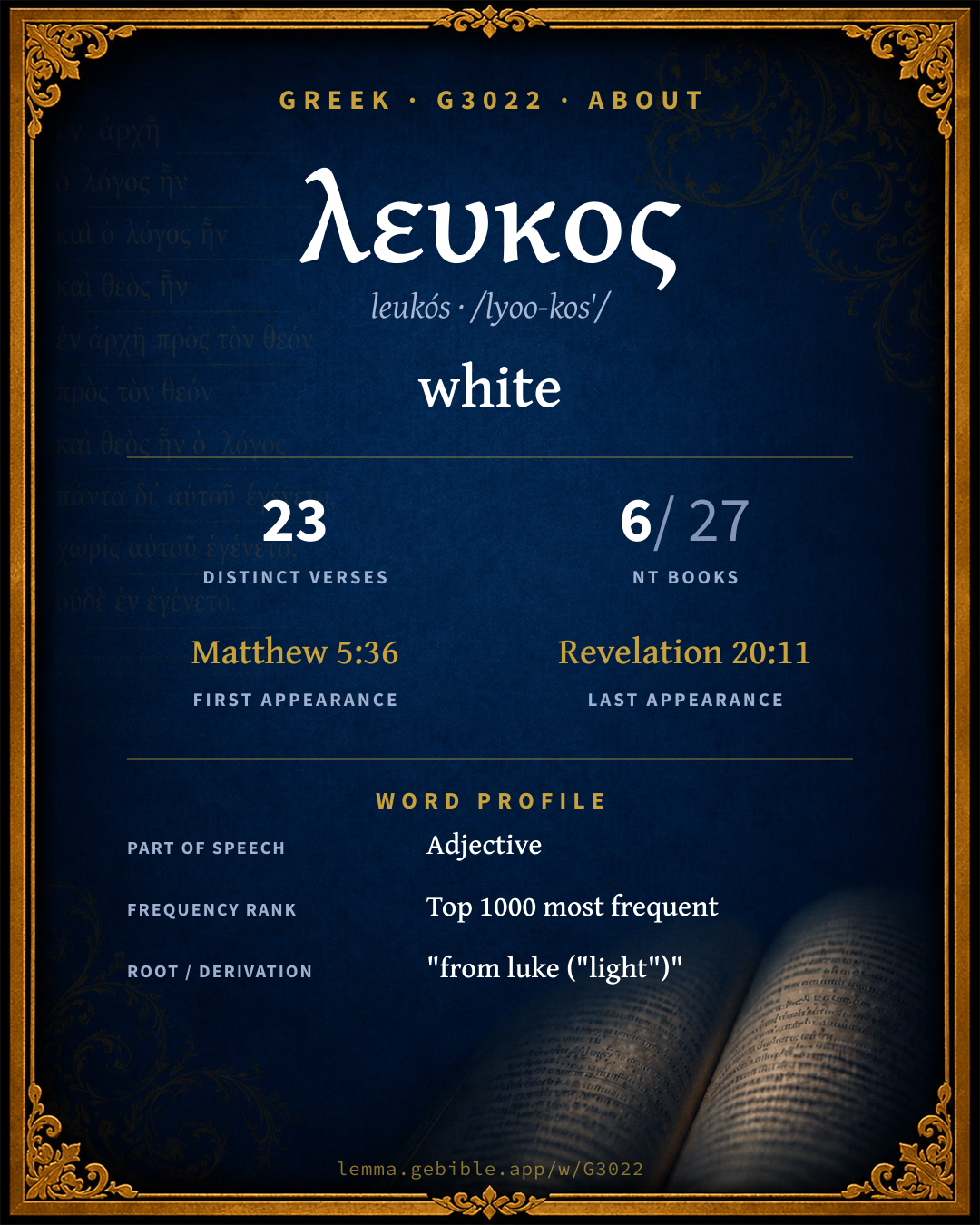
λευκός
white
Full lexicon entry — Thayer's Greek Lexicon
From Thayer's Greek Lexicon
Where this word appears
See every Accusative-case word in the Greek New Testament →
Grammar key — what these labels mean
Part of speech
- Adjective
- A word that describes or qualifies a noun.
Case
- Dative
- The case of the indirect object, means, or location — “to / for / with / in.”
- Accusative
- The case of the direct object and of extent.
- Nominative
- The case of the subject (and the predicate nominative).
Gender
- Neuter
- Grammatically neuter.
- Feminine
- Grammatically feminine.
- Masculine
- Grammatically masculine.
Number
- Plural
- More than one.
- Singular
- One.
1 verse where G3022 appears in the Accusative case in the Book of Mark. Filtered view — show all forms. Click any verse to open its interlinear word-by-word view. Verse text shown in the World English Bible for context — . Each verse’s Greek form is shown with its reference; the English is not keyword-highlighted, since the data carries no word-level English alignment. Use “Compare translations” on any verse to read it across multiple English versions. This concordance covers the Greek New Testament; Septuagint (Greek Old Testament) occurrences of this word are not indexed here.
Mark
About this entry
At a glance — auto-summarized from this page’s data, not written by a person. Every figure links to its source below. This summary describes the numbers; it doesn’t interpret them.
The Greek adjective λευκος centers on the idea of “white.” The word gravitates to Revelation (61%), then Matthew and Mark. It turns up in 23 verses across 6 books, an uncommon footprint. First canonically at Matthew 5:36, it enters the text early. It clusters with λευκαινω, λυκος and λυχνος under a shared root. For the data behind this summary, explore the sense tree and the renderings breakdown below.
Gloss history
Strong's 1890 vs modern scholarship
About this word
Strong's G3022 catalogs a Greek word from the Greek New Testament.
These counts are not copied from any lexicon or concordance. They are computed here, from the morphology-tagged Greek New Testament. What Lemma adds →
- 23
- distinct verses
- The word appears in 23 distinct verses.
- 6 / 27
- NT books
- The word appears in 6 of 27 New Testament books.
- #530
- by frequency
- Top 1000 most frequent Greek words (rank 530 of 5,347 Greek words by occurrence).
View all 23 occurrences in the concordance →
Most concentrated in
- Revelation 14 verses 61%
- Matthew 3 verses 13%
- Mark 2 verses 9%
By section of the New Testament
By traditional corpus
Conventional, traditional groupings — biblical authorship is debated, so this is a traditional corpus grouping, not an authorship claim. Some books belong to more than one corpus (Luke is in both the Gospels and the Lukan corpus, and so on), so these shares overlap and need not total 100%. Each figure is a share of the word’s 23 distinct verses.
- Johannine 16 verses · 70%
- Revelation 14 verses · 61%
- Gospels 8 verses · 35%
- Lukan (Luke–Acts) 2 verses · 9%
How translations render this word
Counts come from each version’s own published word-to-Strong’s tagging or interlinear alignment — an approximate guide to how each version renders this word, not a word-level alignment the data otherwise carries. Because each total is that version’s own tagged count, the per-version totals vary from one another and need not match the appearance or distinct-verse counts above. These counts may also differ from a printed concordance because Lemma counts each distinctly tagged rendering and does not collapse phrase taggings into a single head-word total. This is a fixed set of word-tagged versions (KJV, ASV, BSB, ULT) and does not change with the reading translation you choose elsewhere. Each version’s license is shown beside its name below (and on Sources).
- King James Version: White 22×
- American Standard Version: White 22×
- Berean Standard Bible: White 24×
- unfoldingWord Literal Text: White 24×
King James Version Public Domain
Renders G3022 across 25 tagged occurrences — most commonly:
Plus 3 renderings that appear only once — usually multi-word phrases or single function words the recovered tagging swept in, not distinct renderings.
American Standard Version Public Domain
Renders G3022 across 25 tagged occurrences — most commonly:
Plus 3 renderings that appear only once — usually multi-word phrases or single function words the recovered tagging swept in, not distinct renderings.
Berean Standard Bible Public Domain
Renders G3022 across 25 tagged occurrences — most commonly:
Plus 1 rendering that appears only once — usually multi-word phrases or single function words the recovered tagging swept in, not distinct renderings.
unfoldingWord Literal Text CC BY-SA 4.0
Renders G3022 across 25 tagged occurrences — most commonly:
Plus 1 rendering that appears only once — usually multi-word phrases or single function words the recovered tagging swept in, not distinct renderings.
Senses in Thayer's
The 1 sense Thayer's distinguishes for this word, in lexicon order (not ranked by frequency or importance). The full entry — with sub-senses — is in the Lexicon Entry tab.
- light, bright, brilliant
Word origin
Origin: "from luke ("light")"
From λύκη lukē (light); white : - white.
— Strong’s Exhaustive Concordance (1890), public domain.
Forms in the corpus
The 14 distinct written forms G3022 takes in the Greek New Testament, most frequent first — each parse links to that case’s occurrences in the concordance.
Same root — word family
Other Thayer's entries built from the same root as G3022, grouped by Strong’s listed origin. These share a root / origin per the lexicon — not necessarily a shared meaning. Each links to that word’s own entry.
Derived from this word
Compare all same-root words → They share a root, not necessarily a meaning.
Septuagint usage
The same Greek word λευκος appears 32 times in the Greek Old Testament (Septuagint), across 28 verses in 9 books.
- 32
- LXX occurrences
- Tagged occurrences of this Greek word in the Septuagint.
- 28
- verses
- Distinct Septuagint verses containing this word.
- 9 / 39
- OT books
- The word appears in 9 of the 39 Old Testament books.
Sample Septuagint occurrences
- Genesis 30:35 λευκός
- Exodus 16:14 λευκός
- Leviticus 13:3 λευκός
- Ecclesiastes 9:8 λευκός
- Song of Solomon 5:10 λευκός
- Isaiah 41:19 λευκός
- Daniel 7:9 λευκός
- Hosea 4:13 λευκός
- Zechariah 1:8 λευκός
Septuagint occurrences (same lexeme)
Every verse where the same Strong’s number (G3022) appears in the Greek Septuagint. Verse text shown in the World English Bible for context; the Greek form is the matched word — the English is not keyword-highlighted.
- Genesis 30:35 λευκός That day, he removed the male goats that were streaked and spotted, and all the female goats that were speckled and spotted, every one that had white in it, and all the black ones among the sheep, and gave them into the hand of his sons.
- Genesis 30:37 λευκός Jacob took to himself rods of fresh poplar, almond, plane tree, peeled white streaks in them, and made the white appear which was in the rods.
- Genesis 31:8 λευκός If he said this, 'The speckled will be your wages,' then all the flock bore speckled. If he said this, 'The streaked will be your wages,' then all the flock bore streaked.
- Genesis 49:12 λευκός His eyes will be red with wine, His teeth white with milk.
- Exodus 16:14 λευκός When the dew that lay had gone, behold, on the surface of the wilderness was a small round thing, small as the hoar-frost on the ground.
- Exodus 16:31 λευκός The house of Israel called the name of it Manna, and it was like coriander seed, white; and its taste was like wafers with honey.
- Leviticus 13:3 λευκός and the priest shall examine the plague in the skin of the body: and if the hair in the plague has turned white, and the appearance of the plague is deeper than the body's skin, it is the plague of leprosy; and the priest shall examine him, and pronounce him unclean.
- Leviticus 13:4 λευκός If the bright spot is white in the skin of his body, and the appearance of it isn't deeper than the skin, and the hair of it hasn't turned white, then the priest shall isolate the infected person for seven days.
- Leviticus 13:10 λευκός and the priest shall examine him. Behold, if there is a white rising in the skin, and it has turned the hair white, and there is raw flesh in the rising,
- Leviticus 13:13 λευκός then the priest shall examine him; and, behold, if the leprosy has covered all his flesh, he shall pronounce him clean of the plague. It has all turned white: he is clean.
- Leviticus 13:16 λευκός Or if the raw flesh turns again, and is changed to white, then he shall come to the priest;
- Leviticus 13:17 λευκός and the priest shall examine him; and, behold, if the plague has turned white, then the priest shall pronounce him clean of the plague. He is clean.
- Leviticus 13:19 λευκός and in the place of the boil there is a white rising, or a bright spot, reddish-white, then it shall be shown to the priest;
- Leviticus 13:20 λευκός and the priest shall examine it; and, behold, if the appearance of it is lower than the skin, and the hair of it has turned white, then the priest shall pronounce him unclean. It is the plague of leprosy. It has broken out in the boil.
- Leviticus 13:21 λευκός But if the priest examines it, and, behold, there are no white hairs in it, and it isn't deeper than the skin, but is dim, then the priest shall isolate him seven days.
- Leviticus 13:24 λευκός "Or when the body has a burn from fire on its skin, and the raw flesh of the burn becomes a bright spot, reddish-white, or white,
- Leviticus 13:25 λευκός then the priest shall examine it; and, behold, if the hair in the bright spot has turned white, and the appearance of it is deeper than the skin; it is leprosy. It has broken out in the burning, and the priest shall pronounce him unclean. It is the plague of leprosy.
- Leviticus 13:26 λευκός But if the priest examines it, and, behold, there is no white hair in the bright spot, and it isn't lower than the skin, but is faded; then the priest shall isolate him seven days.
- Leviticus 13:42 λευκός But if there is in the bald head, or the bald forehead, a reddish-white plague; it is leprosy breaking out in his bald head, or his bald forehead.
- Leviticus 13:43 λευκός Then the priest shall examine him; and, behold, if the rising of the plague is reddish-white in his bald head, or in his bald forehead, like the appearance of leprosy in the skin of the flesh,
- Ecclesiastes 9:8 λευκός Let your garments be always white, and don't let your head lack oil.
- Song of Solomon 5:10 λευκός My beloved is white and ruddy. The best among ten thousand.
- Isaiah 41:19 λευκός I will put in the wilderness the cedar, the acacia, and the myrtle, and the oil tree; I will set in the desert the fir tree, the pine, and the box tree together:
- Daniel 7:9 λευκός I saw until thrones were placed, and one who was ancient of days sat: his clothing was white as snow, and the hair of his head like pure wool; his throne was fiery flames, [and] the wheels of it burning fire.
- Hosea 4:13 λευκός They sacrifice on the tops of the mountains, And burn incense on the hills, under oaks and poplars and terebinths, Because its shade is good. Therefore your daughters play the prostitute, And your brides commit adultery.
- Zechariah 1:8 λευκός "I had a vision in the night, and, behold, a man riding on a red horse, and he stood among the myrtle trees that were in a ravine; and behind him there were red, brown, and white horses.
- Zechariah 6:3 λευκός in the third chariot white horses; and in the fourth chariot dappled horses, all of them powerful.
- Zechariah 6:6 λευκός The one with the black horses goes out toward the north country; and the white went out after them; and the dappled went forth toward the south country."
These are occurrences of the same Greek lexeme (G3022) in the Septuagint — not a translation of any one Hebrew word. The store carries no word-level Hebrew↔Greek alignment, so no Hebrew original is asserted here. Counts come from the recovered LXX Strong's tagging — high-frequency vocabulary is well covered, while rare or late forms may be untagged — so they reflect tagged occurrences and may slightly undercount.