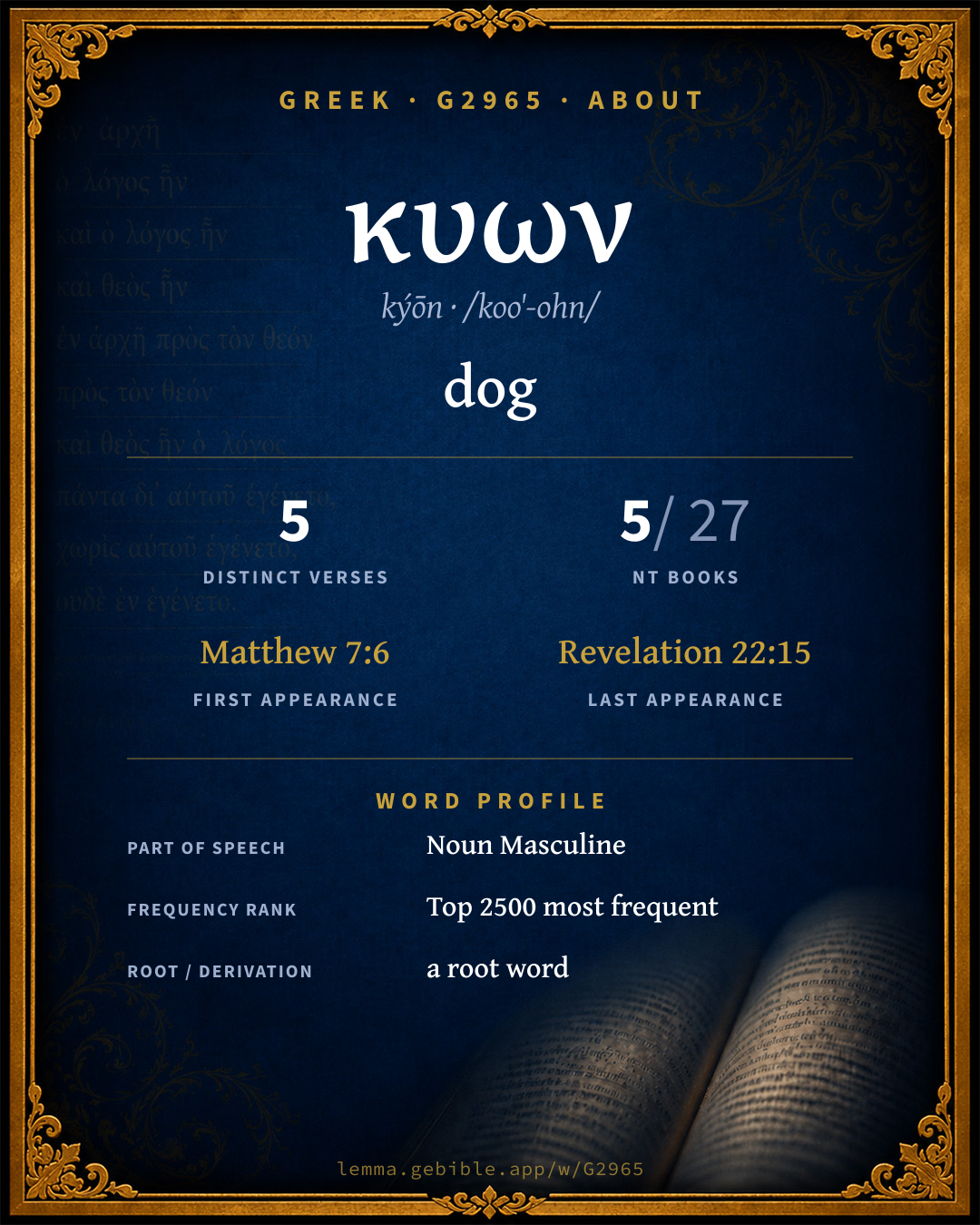
κύων
dog
‘dog’ is one of 2 main senses fuller range ↓
Full lexicon entry — Thayer's Greek Lexicon
From Thayer's Greek Lexicon
Where this word appears
Grammar key — what these labels mean
Part of speech
- Noun
- A naming word — a person, place, thing, or idea.
Case
- Nominative
- The case of the subject (and the predicate nominative).
- Accusative
- The case of the direct object and of extent.
- Dative
- The case of the indirect object, means, or location — “to / for / with / in.”
Gender
- Masculine
- Grammatically masculine.
Number
- Plural
- More than one.
- Singular
- One.
Every verse where G2965 appears in the Book of Revelation — 1 distinct verse. Click any verse to open its interlinear word-by-word view. Verse text shown in the World English Bible for context — . Each verse’s Greek form is shown with its reference; the English is not keyword-highlighted, since the data carries no word-level English alignment. Use “Compare translations” on any verse to read it across multiple English versions. This concordance covers the Greek New Testament; Septuagint (Greek Old Testament) occurrences of this word are not indexed here.
Revelation
About this entry
At a glance — auto-summarized from this page’s data, not written by a person. Every figure links to its source below. This summary describes the numbers; it doesn’t interpret them.
κυων — transliterated kýōn — is a Greek noun carrying the sense “dog.” The Greek New Testament uses it only 5 verses. It first appears in Matthew 7:6. Its lexical range runs to 2 senses. Related forms include κυναριον. Each statement above links to its evidence; the full detail follows below.
Gloss history
Strong's 1890 vs modern scholarship
About this word
Strong's G2965 catalogs a Greek word from the Greek New Testament.
These counts are not copied from any lexicon or concordance. They are computed here, from the morphology-tagged Greek New Testament. What Lemma adds →
- 5
- distinct verses
- The word appears in 5 distinct verses.
- 5 / 27
- NT books
- The word appears in 5 of 27 New Testament books.
- #1,648
- by frequency
- Top 2500 most frequent Greek words (rank 1,648 of 5,347 Greek words by occurrence).
View all 5 occurrences in the concordance →
Most concentrated in
- Matthew 1 verse 20%
- Luke 1 verse 20%
- Philippians 1 verse 20%
By section of the New Testament
By traditional corpus
Conventional, traditional groupings — biblical authorship is debated, so this is a traditional corpus grouping, not an authorship claim. Some books belong to more than one corpus (Luke is in both the Gospels and the Lukan corpus, and so on), so these shares overlap and need not total 100%. Each figure is a share of the word’s 5 distinct verses.
- Gospels 2 verses · 40%
- Lukan (Luke–Acts) 1 verse · 20%
- Johannine 1 verse · 20%
- Pauline corpus 1 verse · 20%
- General (Catholic) Epistles 1 verse · 20%
- Revelation 1 verse · 20%
How translations render this word
Counts come from each version’s own published word-to-Strong’s tagging or interlinear alignment — an approximate guide to how each version renders this word, not a word-level alignment the data otherwise carries. Because each total is that version’s own tagged count, the per-version totals vary from one another and need not match the appearance or distinct-verse counts above. These counts may also differ from a printed concordance because Lemma counts each distinctly tagged rendering and does not collapse phrase taggings into a single head-word total. This is a fixed set of word-tagged versions (KJV, ASV, BSB, ULT) and does not change with the reading translation you choose elsewhere. Each version’s license is shown beside its name below (and on Sources).
- King James Version: Dogs 3×
- American Standard Version: Dogs 3×
- Berean Standard Bible: Dogs 4×
- unfoldingWord Literal Text: Dogs 4×
King James Version Public Domain
Renders G2965 across 5 tagged occurrences — most commonly:
Plus 2 renderings that appear only once — usually multi-word phrases or single function words the recovered tagging swept in, not distinct renderings.
American Standard Version Public Domain
Renders G2965 across 5 tagged occurrences — most commonly:
Plus 2 renderings that appear only once — usually multi-word phrases or single function words the recovered tagging swept in, not distinct renderings.
Berean Standard Bible Public Domain
Renders G2965 across 5 tagged occurrences — most commonly:
Plus 1 rendering that appears only once — usually multi-word phrases or single function words the recovered tagging swept in, not distinct renderings.
unfoldingWord Literal Text CC BY-SA 4.0
Renders G2965 across 5 tagged occurrences — most commonly:
Plus 1 rendering that appears only once — usually multi-word phrases or single function words the recovered tagging swept in, not distinct renderings.
Senses in Thayer's
The 2 senses Thayer's distinguishes for this word, in lexicon order (not ranked by frequency or importance). The full entry — with sub-senses — is in the Lexicon Entry tab.
- a dog
- metaph. a man of impure mind, an impudent man
Word origin
Origin: a root word
A primary word; a dog (hound) (literally or figuratively): - dog.
— Strong’s Exhaustive Concordance (1890), public domain.
Forms in the corpus
The 4 distinct written forms G2965 takes in the Greek New Testament, most frequent first — each parse links to that case’s occurrences in the concordance.
| Form | Parsing | Example | Uses |
|---|---|---|---|
| κύνες kýnes | Noun, Nominative, Plural, Masculine | Luke 16:21 | 2 |
| κυσίν kysín | Noun, Dative, Plural, Masculine | Matthew 7:6 | 1 |
| κύνας kýnas | Noun, Accusative, Plural, Masculine | Philippians 3:2 | 1 |
| κύων kýōn | Noun, Nominative, Singular, Masculine | 2 Peter 2:22 | 1 |
Same root — word family
Other Thayer's entries built from the same root as G2965, grouped by Strong’s listed origin. These share a root / origin per the lexicon — not necessarily a shared meaning. Each links to that word’s own entry.
Derived from this word
Compare all same-root words → They share a root, not necessarily a meaning.
Septuagint usage
The same Greek word κυων appears 34 times in the Greek Old Testament (Septuagint), across 32 verses in 13 books.
- 34
- LXX occurrences
- Tagged occurrences of this Greek word in the Septuagint.
- 32
- verses
- Distinct Septuagint verses containing this word.
- 13 / 39
- OT books
- The word appears in 13 of the 39 Old Testament books.
Sample Septuagint occurrences
- Exodus 11:7 κύων
- Deuteronomy 23:19 κύων
- Judges 7:5 κύων
- 1 Samuel 17:23 κύων
- 2 Samuel 3:8 κύων
- 1 Kings 12:24 κύων
- 2 Kings 8:13 κύων
- Job 30:1 κύων
- Psalms 21:17 κύων
- Proverbs 7:22 κύων
- Ecclesiastes 9:4 κύων
- Isaiah 56:10 κύων
Septuagint occurrences (same lexeme)
Every verse where the same Strong’s number (G2965) appears in the Greek Septuagint. Verse text shown in the World English Bible for context; the Greek form is the matched word — the English is not keyword-highlighted.
- Exodus 11:7 κύων But against any of the children of Israel a dog won't even bark or move its tongue, against man or animal; that you may know that Yahweh makes a distinction between the Egyptians and Israel.
- Exodus 22:30 κύων You shall do likewise with your oxen and with your sheep. Seven days it shall be with its mother, then on the eighth day you shall give it me.
- Deuteronomy 23:19 κύων You shall not lend on interest to your brother; interest of money, interest of food, interest of anything that is lent on interest:
- Judges 7:5 κύων So he brought down the people to the water: and Yahweh said to Gideon, Everyone who laps of the water with his tongue, as a dog laps, him shall you set by himself; likewise everyone who bows down on his knees to drink.
- 1 Samuel 17:23 κύων As he talked with them, behold, there came up the champion, the Philistine of Gath, Goliath by name, out of the ranks of the Philistines, and spoke according to the same words: and David heard them.
- 1 Samuel 24:15 κύων Yahweh therefore be judge, and give sentence between me and you, and see, and plead my cause, and deliver me out of your hand.
- 2 Samuel 3:8 κύων Then was Abner very angry for the words of Ish-bosheth, and said, Am I a dog's head that belongs to Judah? This day do I show kindness to the house of Saul your father, to his brothers, and to his friends, and have not delivered you into the hand of David; and yet you charge me this day with a fault concerning this woman.
- 2 Samuel 9:8 κύων He did obeisance, and said, "What is your servant, that you should look on such a dead dog as I am?"
- 2 Samuel 16:9 κύων Then said Abishai the son of Zeruiah to the king, "Why should this dead dog curse my lord the king? Please let me go over and take off his head."
- 1 Kings 12:24 κύων Thus says Yahweh, You shall not go up, nor fight against your brothers the children of Israel: return every man to his house; for this thing is of me. So they listened to the word of Yahweh, and returned and went their way, according to the word of Yahweh.
- 1 Kings 16:4 κύων Him who dies of Baasha in the city shall the dogs eat; and him who dies of his in the field shall the birds of the sky eat.
- 1 Kings 20:19 κύων So these went out of the city, the young men of the princes of the provinces, and the army which followed them.
- 1 Kings 20:23 κύων The servants of the king of Syria said to him, Their god is a god of the hills; therefore they were stronger than we: but let us fight against them in the plain, and surely we shall be stronger than they.
- 1 Kings 20:24 κύων Do this thing: take the kings away, every man out of his place, and put captains in their room;
- 1 Kings 22:38 κύων They washed the chariot by the pool of Samaria; and the dogs licked up his blood (now the prostitutes washed themselves [there]); according to the word of Yahweh which he spoke.
- 2 Kings 8:13 κύων Hazael said, But what is your servant, who is but a dog, that he should do this great thing? Elisha answered, Yahweh has shown me that you shall be king over Syria.
- 2 Kings 9:10 κύων The dogs shall eat Jezebel in the portion of Jezreel, and there shall be none to bury her. He opened the door, and fled.
- 2 Kings 9:36 κύων Therefore they came back, and told him. He said, This is the word of Yahweh, which he spoke by his servant Elijah the Tishbite, saying, In the portion of Jezreel shall the dogs eat the flesh of Jezebel;
- Job 30:1 κύων "But now those who are younger than I, have me in derision, Whose fathers I would have disdained to put with my sheep dogs.
- Psalms 21:17 κύων
- Psalms 21:21 κύων
- Psalms 58:7 κύων Let them vanish as water that flows away. When they draw the bow, let their arrows be made blunt.
- Psalms 58:15 κύων
- Psalms 67:24 κύων
- Proverbs 7:22 κύων He followed her immediately, As an ox goes to the slaughter, As a fool stepping into a noose.
- Proverbs 26:11 κύων As a dog that returns to his vomit, So is a fool who repeats his folly.
- Proverbs 26:17 κύων Like one who grabs a dog's ears Is one who passes by and meddles in a quarrel not his own.
- Ecclesiastes 9:4 κύων For to him who is joined with all the living there is hope; for a living dog is better than a dead lion.
- Isaiah 56:10 κύων His watchmen are blind, they are all without knowledge; they are all mute dogs, they can't bark; dreaming, lying down, loving to slumber.
- Isaiah 56:11 κύων Yes, the dogs are greedy, they can never have enough; and these are shepherds who can't understand: they have all turned to their own way, each one to his gain, from every quarter.
- Isaiah 66:3 κύων He who kills an ox is as he who kills a man; he who sacrifices a lamb, as he who breaks a dog's neck; he who offers an offering, [as he who offers] pig's blood; he who burns frankincense, as he who blesses an idol. Yes, they have chosen their own ways, and their soul delights in their abominations:
- Jeremiah 15:3 κύων I will appoint over them four kinds, says Yahweh: the sword to kill, and the dogs to tear, and the birds of the sky, and the animals of the earth, to devour and to destroy.
These are occurrences of the same Greek lexeme (G2965) in the Septuagint — not a translation of any one Hebrew word. The store carries no word-level Hebrew↔Greek alignment, so no Hebrew original is asserted here. Counts come from the recovered LXX Strong's tagging — high-frequency vocabulary is well covered, while rare or late forms may be untagged — so they reflect tagged occurrences and may slightly undercount.