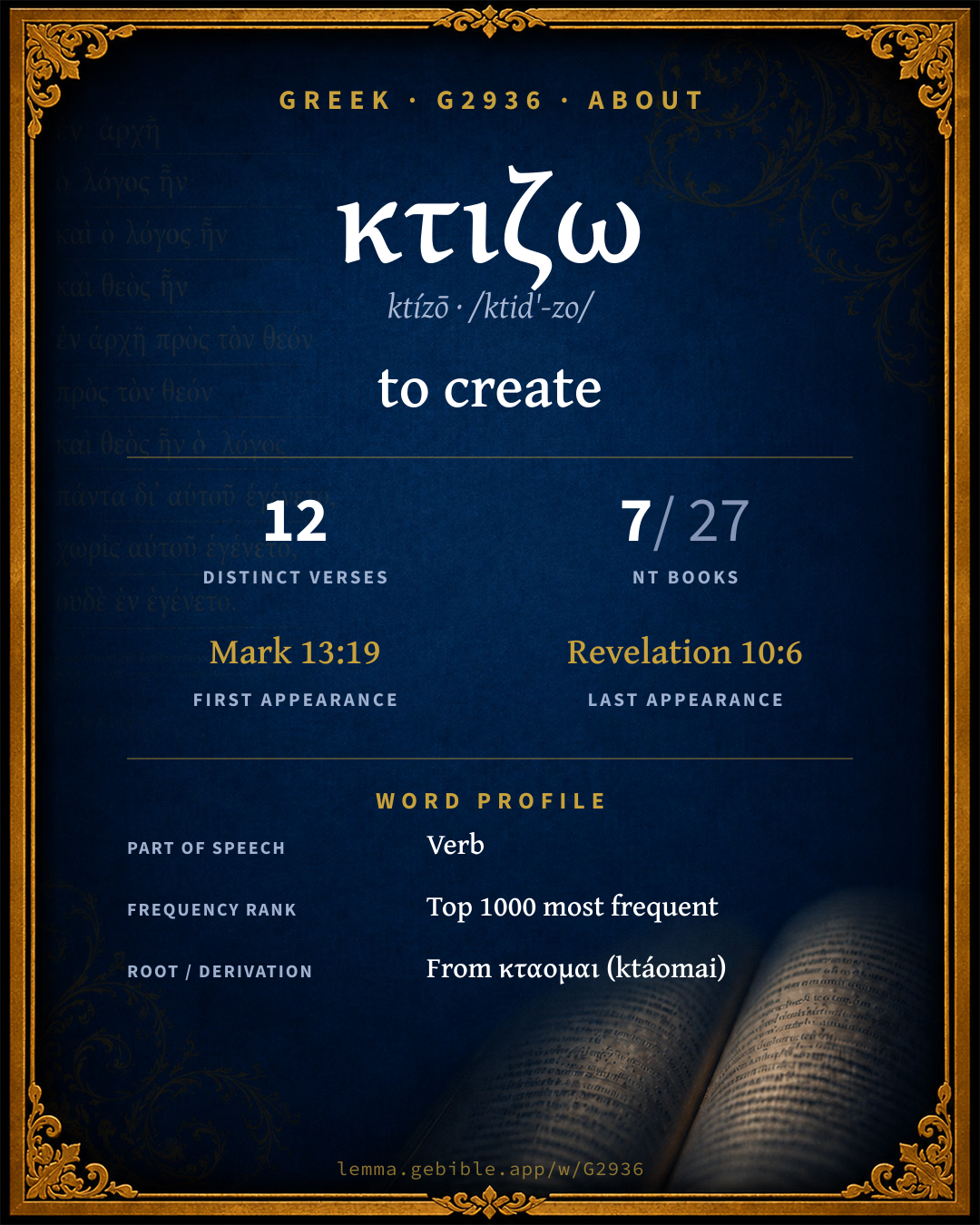
κτίζω
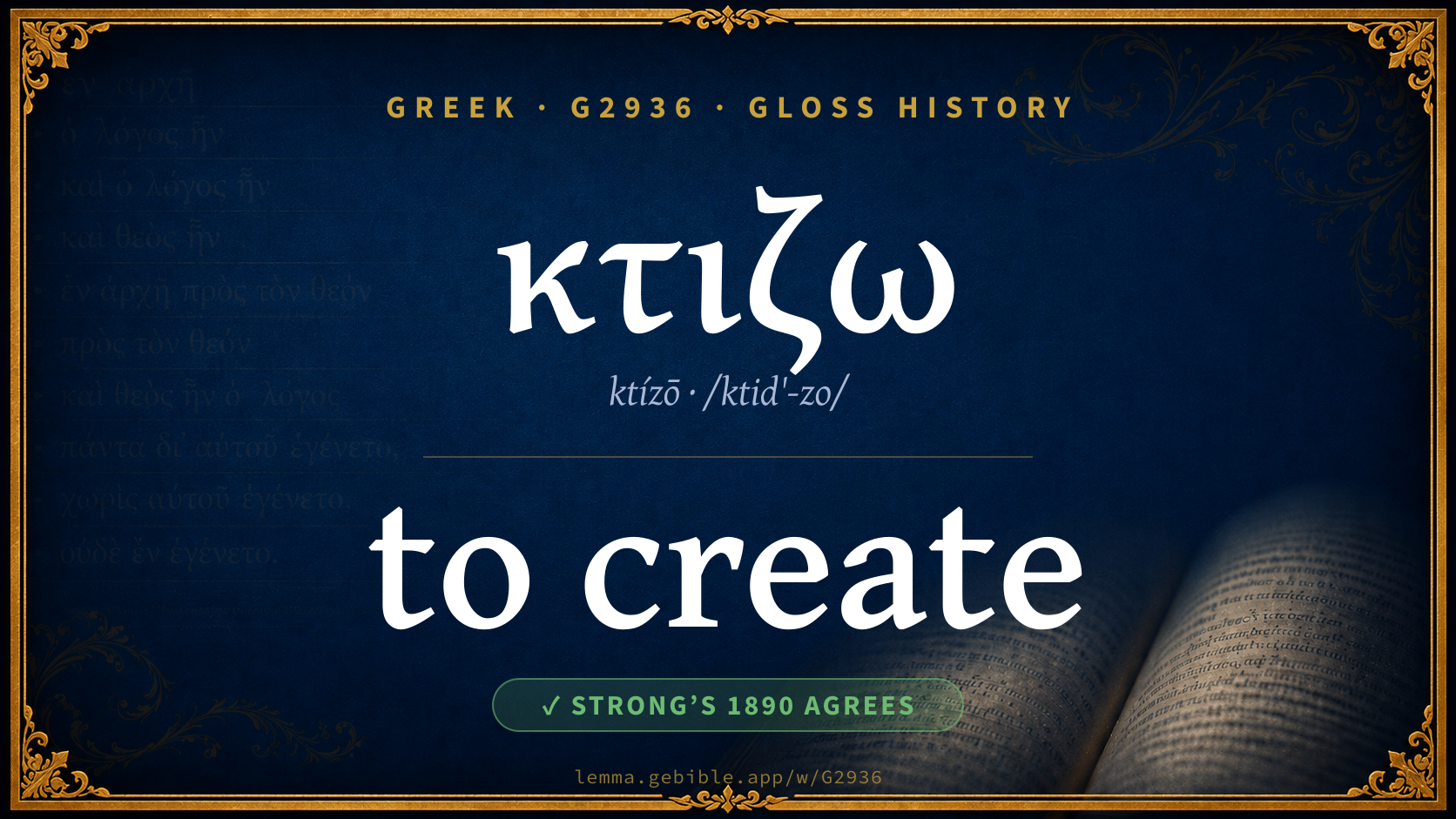
to create
‘to create’ is one of 3 main senses fuller range ↓
Full lexicon entry — Thayer's Greek Lexicon
From Thayer's Greek Lexicon
Where this word appears
See every Aorist-tense verb in the Greek New Testament →
Grammar key — what these labels mean
Part of speech
- Verb
- An action or state-of-being word.
Tense
- Aorist
- Action viewed as a simple whole, without regard to duration — often past (perfective aspect).
- Perfect
- A completed past action with continuing present results.
Voice
- Active
- The subject performs the action.
- Passive
- The subject receives the action.
Mood
- Indicative
- States a fact or asks a factual question (the mood of reality).
- Participle
- A verbal adjective (“writing,” “having written”).
- Subjunctive
- Expresses probability, purpose, or possibility (the mood of contingency).
Case
- Accusative
- The case of the direct object and of extent.
- Dative
- The case of the indirect object, means, or location — “to / for / with / in.”
- Genitive
- The case of source, possession, or “of” — answers “whose / from what.”
- Nominative
- The case of the subject (and the predicate nominative).
Person
- 3rd person
- The one spoken about (“he / she / it / they”).
- 2nd person
- The one addressed (“you”).
Gender
- Masculine
- Grammatically masculine.
Number
- Singular
- One.
- Plural
- More than one.
12 distinct verses where G2936 appears in the Aorist tense, across 7 books. Filtered view — show all forms. Click any verse to open its interlinear word-by-word view. Verse text shown in the World English Bible for context — . Each verse’s Greek form is shown with its reference; the English is not keyword-highlighted, since the data carries no word-level English alignment. Use “Compare translations” on any verse to read it across multiple English versions. This concordance covers the Greek New Testament; Septuagint (Greek Old Testament) occurrences of this word are not indexed here.
Mark 1 verse
Romans 1 verse
1 Corinthians 1 verse
Ephesians 4 verses
- Ephesians 2:10 κτισθέντες aor pass ptcp nom pl masc For we are his workmanship, created in Christ Jesus for good works, which God prepared before that we would walk in them.
- Ephesians 2:15 κτίσῃ aor act subj 3sg having abolished in the flesh the hostility, the law of commandments contained in ordinances, that he might create in himself one new man of the two, making peace;
- Ephesians 3:9 κτίσαντι aor act ptcp dat sg masc and to make all men see what is the administration of the mystery which for ages has been hidden in God, who created all things through Jesus Christ;
- Ephesians 4:24 κτισθέντα aor pass ptcp acc sg masc and put on the new man, who in the likeness of God has been created in righteousness and holiness of truth.
Colossians 2 verses
- Colossians 1:16 ἐκτίσθη ἔκτισται aor pass ind 3sg perf pass ind 3sg For by him were all things created, in the heavens and on the earth, things visible and things invisible, whether thrones or dominions or principalities or powers; all things have been created through him, and for him.
- Colossians 3:10 κτίσαντος aor act ptcp gen sg masc and have put on the new man, that is being renewed in knowledge after the image of his Creator,
1 Timothy 1 verse
Revelation 2 verses
- Revelation 4:11 ἔκτισας ἐκτίσθησαν aor act ind 2sg aor pass ind 3pl "Worthy are you, our Lord and God, the Holy One, to receive the glory, the honor, and the power, for you created all things, and because of your desire they existed, and were created!"
- Revelation 10:6 ἔκτισεν aor act ind 3sg and swore by him who lives forever and ever, who created heaven and the things that are in it, the earth and the things that are in it, and the sea and the things that are in it, that there will no longer be delay,
About this entry
At a glance — auto-summarized from this page’s data, not written by a person. Every figure links to its source below. This summary describes the numbers; it doesn’t interpret them.
At its core, κτιζω (ktízō) means “to create.” Scripture first uses it in Mark 13:19. With 12 verses in 7 books, it is an uncommon word in the Greek New Testament. Its uses concentrate in Ephesians (33% of all occurrences). Ranging over 3 senses, it is not a single-sense word. Dig into 12-verse concordance and the renderings breakdown below.
Gloss history
Strong's 1890 vs modern scholarship
About this word
Strong's G2936 catalogs a Greek word from the Greek New Testament.
These counts are not copied from any lexicon or concordance. They are computed here, from the morphology-tagged Greek New Testament. What Lemma adds →
- 12
- distinct verses
- The word appears in 12 distinct verses.
- 7 / 27
- NT books
- The word appears in 7 of 27 New Testament books.
- #814
- by frequency
- Top 1000 most frequent Greek words (rank 814 of 5,347 Greek words by occurrence).
View all 12 occurrences in the concordance →
Most concentrated in
- Ephesians 4 verses 33%
- Colossians 2 verses 17%
- Revelation 2 verses 17%
By section of the New Testament
By traditional corpus
Conventional, traditional groupings — biblical authorship is debated, so this is a traditional corpus grouping, not an authorship claim. Some books belong to more than one corpus (Luke is in both the Gospels and the Lukan corpus, and so on), so these shares overlap and need not total 100%. Each figure is a share of the word’s 12 distinct verses.
- Pauline corpus 9 verses · 75%
- Johannine 2 verses · 17%
- Revelation 2 verses · 17%
- Gospels 1 verse · 8%
How translations render this word
Counts come from each version’s own published word-to-Strong’s tagging or interlinear alignment — an approximate guide to how each version renders this word, not a word-level alignment the data otherwise carries. Because each total is that version’s own tagged count, the per-version totals vary from one another and need not match the appearance or distinct-verse counts above. These counts may also differ from a printed concordance because Lemma counts each distinctly tagged rendering and does not collapse phrase taggings into a single head-word total. This is a fixed set of word-tagged versions (KJV, ASV, BSB, ULT) and does not change with the reading translation you choose elsewhere. Each version’s license is shown beside its name below (and on Sources).
- King James Version: Created 7×, Were created 2×
- American Standard Version: Created 8×
- Berean Standard Bible: Created 6×, Creator 3×, Were created 3×
- unfoldingWord Literal Text: Created 5×, Having created 2×, Were created 2×
King James Version Public Domain
Renders G2936 across 16 tagged occurrences — most commonly:
Plus 7 renderings that appear only once — usually multi-word phrases or single function words the recovered tagging swept in, not distinct renderings.
American Standard Version Public Domain
Renders G2936 across 16 tagged occurrences — most commonly:
Plus 8 renderings that appear only once — usually multi-word phrases or single function words the recovered tagging swept in, not distinct renderings.
Berean Standard Bible Public Domain
Renders G2936 across 14 tagged occurrences — most commonly:
Plus 2 renderings that appear only once — usually multi-word phrases or single function words the recovered tagging swept in, not distinct renderings. Not rendered by a distinct English word in 1 further occurrence.
unfoldingWord Literal Text CC BY-SA 4.0
Renders G2936 across 15 tagged occurrences — most commonly:
Plus 6 renderings that appear only once — usually multi-word phrases or single function words the recovered tagging swept in, not distinct renderings.
Senses in Thayer's
The 3 senses Thayer's distinguishes for this word, in lexicon order (not ranked by frequency or importance). The full entry — with sub-senses — is in the Lexicon Entry tab.
- to make habitable, to people, a place, region, island
- of God creating the worlds
- to form, shape, i.e. to completely change or transform
Word origin
Derived from κταομαι (ktáomai) (G2932) — to acquire.
Probably akin to G2932 (through the idea of the proprietorship of the manufacturer ); to fabricate that is found ( form originally): - create Creator make.
— Strong’s Exhaustive Concordance (1890), public domain.
Forms in the corpus
The 11 distinct written forms G2936 takes in the Greek New Testament, most frequent first — each parse links to that tense’s occurrences in the concordance.
Same root — word family
Other Thayer's entries built from the same root as G2936, grouped by Strong’s listed origin. These share a root / origin per the lexicon — not necessarily a shared meaning. Each links to that word’s own entry.
Derives from
Shares the same root
Derived from this word
Compare all same-root words → Showing 4 of 8 — not the complete family. They share a root, not necessarily a meaning.
Septuagint usage
The same Greek word κτιζω appears 29 times in the Greek Old Testament (Septuagint), across 27 verses in 14 books.
- 29
- LXX occurrences
- Tagged occurrences of this Greek word in the Septuagint.
- 27
- verses
- Distinct Septuagint verses containing this word.
- 14 / 39
- OT books
- The word appears in 14 of the 39 Old Testament books.
Sample Septuagint occurrences
- Genesis 14:19 κτίζω
- Exodus 9:18 κτίζω
- Deuteronomy 4:32 κτίζω
- Psalms 32:9 κτίζω
- Proverbs 8:22 κτίζω
- Ecclesiastes 12:1 κτίζω
- Isaiah 22:11 κτίζω
- Jeremiah 38:22 κτίζω
- Ezekiel 28:13 κτίζω
- Daniel 4:29 κτίζω
- Hosea 13:4 κτίζω
- Amos 4:13 κτίζω
Septuagint occurrences (same lexeme)
Every verse where the same Strong’s number (G2936) appears in the Greek Septuagint. Verse text shown in the World English Bible for context; the Greek form is the matched word — the English is not keyword-highlighted.
- Genesis 14:19 κτίζω He blessed him, and said, "Blessed be Abram of God Most High, possessor of heaven and earth:
- Genesis 14:22 κτίζω Abram said to the king of Sodom, "I have lifted up my hand to Yahweh, God Most High, possessor of heaven and earth,
- Exodus 9:18 κτίζω Behold, tomorrow about this time I will cause it to rain a very grievous hail, such as has not been in Egypt since the day it was founded even until now.
- Deuteronomy 4:32 κτίζω For ask now of the days that are past, which were before you, since the day that God created man on the earth, and from the one end of the sky to the other, whether there has been [any such thing] as this great thing is, or has been heard like it?
- Deuteronomy 32:6 κτίζω Do you thus requite Yahweh, Foolish people and unwise? Isn't he your father who has bought you? He has made you, and established you.
- Psalms 32:9 κτίζω Don't be like the horse, or like the mule, which have no understanding, Who are controlled by bit and bridle, or else they will not come near to you.
- Psalms 50:12 κτίζω If I were hungry, I would not tell you, For the world is mine, and all that is in it.
- Psalms 88:13 κτίζω But to you, Yahweh, I have cried. In the morning, my prayer comes before you.
- Psalms 88:48 κτίζω
- Psalms 101:19 κτίζω
- Psalms 103:30 κτίζω
- Psalms 148:5 κτίζω Let them praise the name of Yahweh, For he commanded, and they were created.
- Proverbs 8:22 κτίζω "Yahweh possessed me in the beginning of his work, Before his deeds of old.
- Ecclesiastes 12:1 κτίζω Remember also your Creator in the days of your youth, Before the evil days come, and the years draw near, When you will say, "I have no pleasure in them;"
- Isaiah 22:11 κτίζω you made also a reservoir between the two walls for the water of the old pool. But you didn't look to him who had done this, neither did you have respect for him who purposed it long ago.
- Isaiah 45:7 κτίζω I form the light, and create darkness; I make peace, and create evil. I am Yahweh, who does all these things.
- Isaiah 45:8 κτίζω Distil, you heavens, from above, and let the skies pour down righteousness: let the earth open, that it may bring forth salvation, and let it cause righteousness to spring up together; I, Yahweh, have created it.
- Isaiah 46:11 κτίζω calling a ravenous bird from the east, the man of my counsel from a far country; yes, I have spoken, I will also bring it to pass; I have purposed, I will also do it.
- Isaiah 54:16 κτίζω Behold, I have created the smith who blows the fire of coals, and brings forth a weapon for his work; and I have created the waster to destroy.
- Jeremiah 38:22 κτίζω behold, all the women who are left in the king of Judah's house shall be brought forth to the king of Babylon's princes, and those women shall say, Your familiar friends have set you on, and have prevailed over you: [now that] your feet are sunk in the mire, they are turned away back.
- Ezekiel 28:13 κτίζω You were in Eden, the garden of God; every precious stone adorned you: ruby, topaz, emerald, chrysolite, onx, jasper, sapphire, turquoise, and beryl. Gold work of tambourines and of pipes was in you. In the day that you were created they were prepared.
- Ezekiel 28:15 κτίζω You were perfect in your ways from the day that you were created, until unrighteousness was found in you.
- Daniel 4:29 κτίζω At the end of twelve months he was walking in the royal palace of Babylon.
- Hosea 13:4 κτίζω "Yet I am Yahweh your God from the land of Egypt; And you will know no god but me, And besides me there is no savior.
- Amos 4:13 κτίζω For, behold, he who forms the mountains, And creates the wind, And declares to man what is his thought; Who makes the morning darkness, And treads on the high places of the Earth: Yahweh, the God of hosts, is his name."
- Haggai 2:9 κτίζω 'The latter glory of this house will be greater than the former,' says Yahweh of Hosts; 'and in this place will I give peace,' says Yahweh of Hosts."
- Malachi 2:10 κτίζω Don't we all have one father? Hasn't one God created us? Why do we deal treacherously every man against his brother, profaning the covenant of our fathers?
These are occurrences of the same Greek lexeme (G2936) in the Septuagint — not a translation of any one Hebrew word. The store carries no word-level Hebrew↔Greek alignment, so no Hebrew original is asserted here. Counts come from the recovered LXX Strong's tagging — high-frequency vocabulary is well covered, while rare or late forms may be untagged — so they reflect tagged occurrences and may slightly undercount.