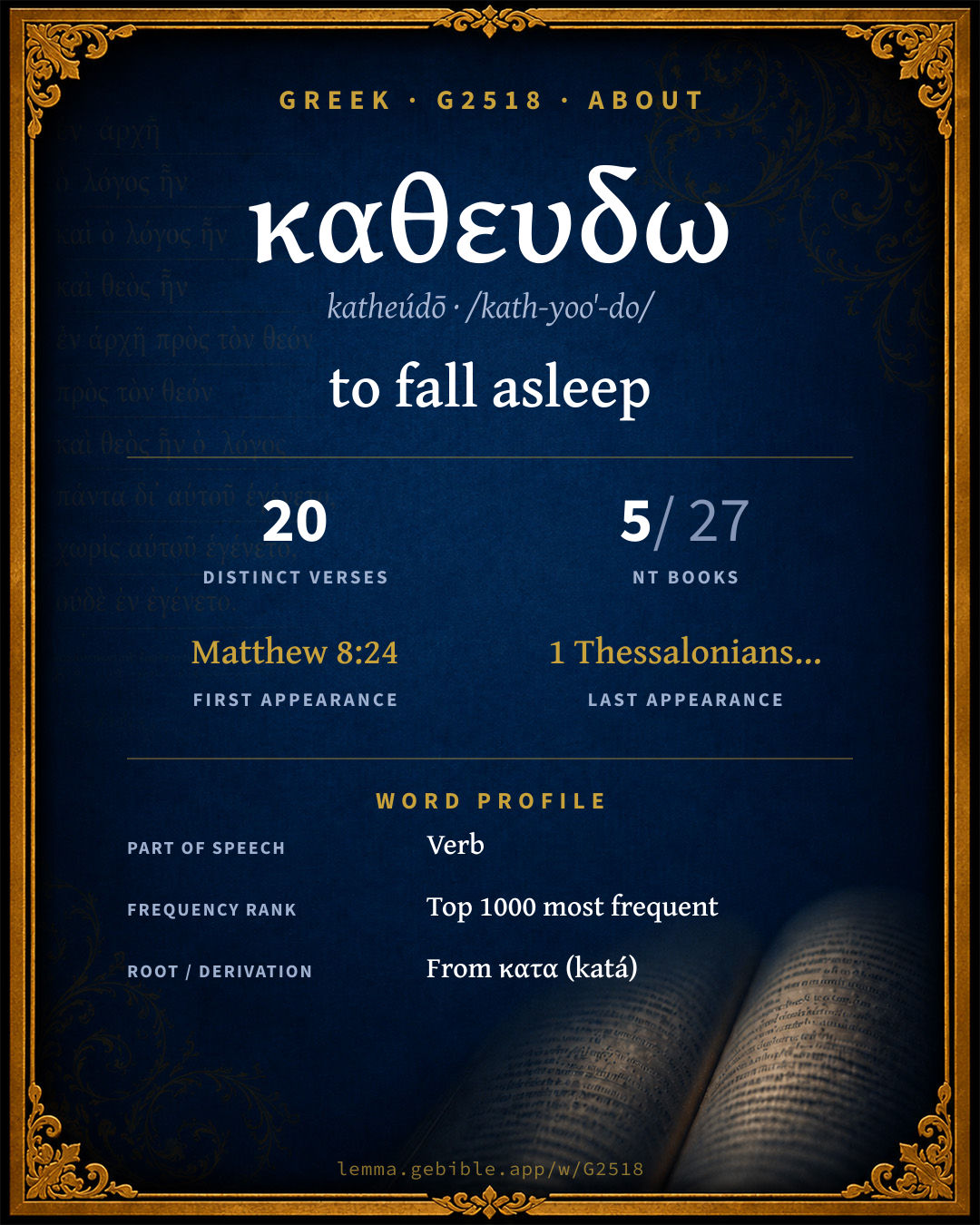
καθεύδω
to fall asleep
‘to fall asleep’ is one of 4 main senses fuller range ↓
Full lexicon entry — Thayer's Greek Lexicon
From Thayer's Greek Lexicon
Where this word appears
See every Present-tense verb in the Greek New Testament →
Grammar key — what these labels mean
Part of speech
- Verb
- An action or state-of-being word.
Tense
- Present
- Ongoing or general action in present time (imperfective aspect).
- Imperfect
- Continuous or repeated action in past time (“was writing”).
Voice
- Active
- The subject performs the action.
Mood
- Participle
- A verbal adjective (“writing,” “having written”).
- Indicative
- States a fact or asks a factual question (the mood of reality).
- Subjunctive
- Expresses probability, purpose, or possibility (the mood of contingency).
- Infinitive
- A verbal noun (“to write”), unmarked for person or number.
Case
- Accusative
- The case of the direct object and of extent.
- Nominative
- The case of the subject (and the predicate nominative).
Person
- 2nd person
- The one addressed (“you”).
- 3rd person
- The one spoken about (“he / she / it / they”).
- 1st person
- The speaker (“I / we”).
Gender
- Masculine
- Grammatically masculine.
Number
- Plural
- More than one.
- Singular
- One.
Every verse where G2518 appears in the Book of Matthew — 7 distinct verses. Click any verse to open its interlinear word-by-word view. Verse text shown in the World English Bible for context — . Each verse’s Greek form is shown with its reference; the English is not keyword-highlighted, since the data carries no word-level English alignment. Use “Compare translations” on any verse to read it across multiple English versions. This concordance covers the Greek New Testament; Septuagint (Greek Old Testament) occurrences of this word are not indexed here.
Matthew
- Matthew 8:24 ἐκάθευδεν impf act ind 3sg Behold, a great tempest arose in the sea, so much that the boat was covered with the waves, but he was asleep.
- Matthew 9:24 καθεύδει pres act ind 3sg he said to them, "Make room, because the girl isn't dead, but sleeping." They were ridiculing him.
- Matthew 13:25 καθεύδειν pres act inf but while people slept, his enemy came and sowed darnel also among the wheat, and went away.
- Matthew 25:5 ἐκάθευδον impf act ind 3pl Now while the bridegroom delayed, they all slumbered and slept.
- Matthew 26:40 καθεύδοντας pres act ptcp acc pl masc He came to the disciples, and found them sleeping, and said to Peter, "What, couldn't you watch with me for one hour?
- Matthew 26:43 καθεύδοντας pres act ptcp acc pl masc He came again and found them sleeping, for their eyes were heavy.
- Matthew 26:45 καθεύδετε pres act ind 2pl Then he came to his disciples, and said to them, "Sleep on now, and take your rest. Behold, the hour is at hand, and the Son of Man is betrayed into the hands of sinners.
About this entry
At a glance — auto-summarized from this page’s data, not written by a person. Every figure links to its source below. This summary describes the numbers; it doesn’t interpret them.
καθευδω — transliterated katheúdō — is a Greek verb carrying the sense “to fall asleep.” Its lexical range runs to 4 senses. The Greek New Testament uses it across 20 verses — uncommon. More than a third of its appearances fall in Matthew. It first appears in Matthew 8:24. See the sense tree, 20-verse concordance, and the renderings breakdown below.
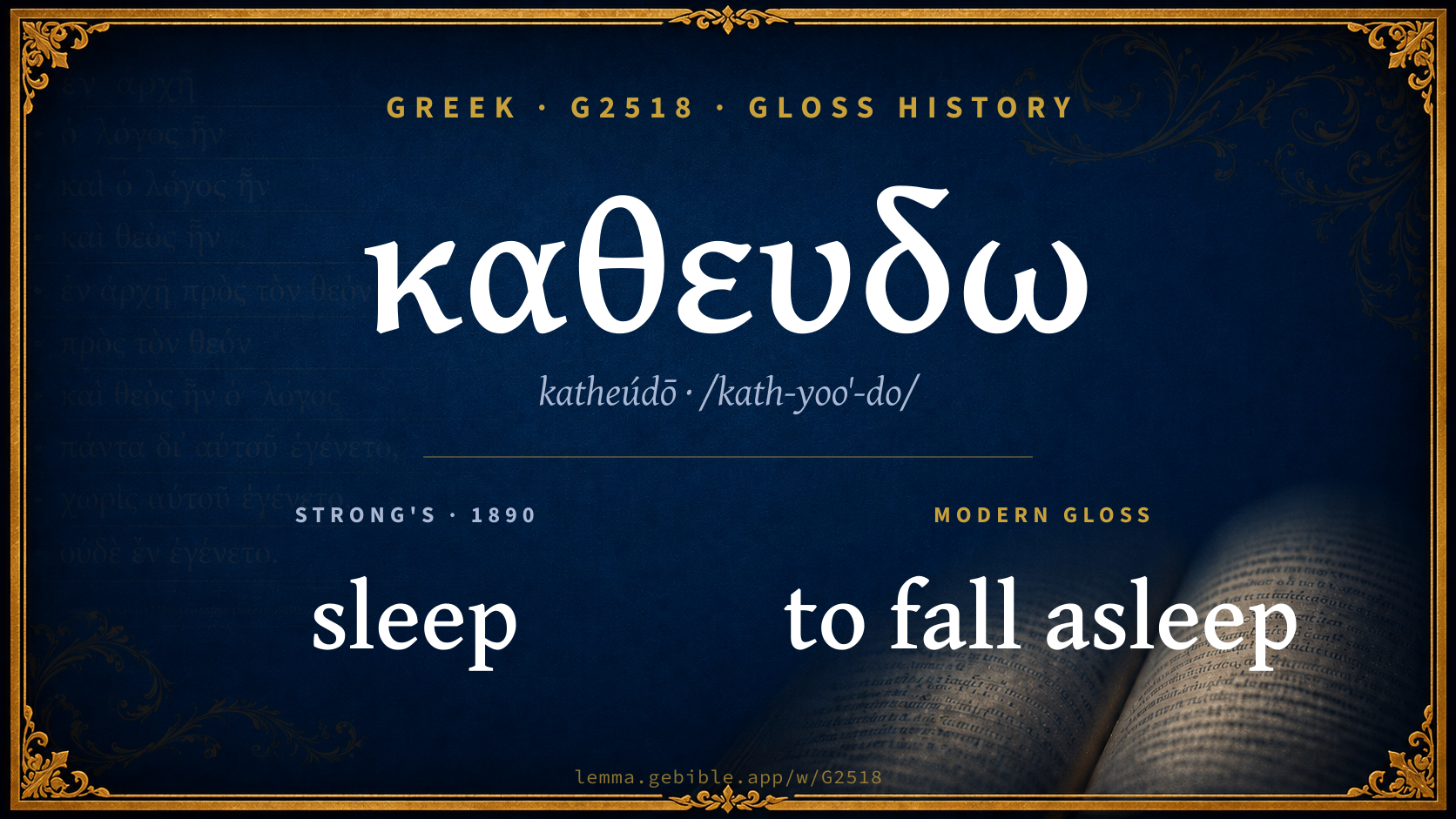
Gloss history
Strong's 1890 vs modern scholarship
About this word
Strong's G2518 catalogs a Greek word from the Greek New Testament.
These counts are not copied from any lexicon or concordance. They are computed here, from the morphology-tagged Greek New Testament. What Lemma adds →
- 20
- distinct verses
- The word appears in 20 distinct verses.
- 5 / 27
- NT books
- The word appears in 5 of 27 New Testament books.
- #586
- by frequency
- Top 1000 most frequent Greek words (rank 586 of 5,347 Greek words by occurrence).
View all 20 occurrences in the concordance →
Most concentrated in
- Matthew 7 verses 35%
- Mark 7 verses 35%
- 1 Thessalonians 3 verses 15%
By section of the New Testament
By traditional corpus
Conventional, traditional groupings — biblical authorship is debated, so this is a traditional corpus grouping, not an authorship claim. Some books belong to more than one corpus (Luke is in both the Gospels and the Lukan corpus, and so on), so these shares overlap and need not total 100%. Each figure is a share of the word’s 20 distinct verses.
- Gospels 16 verses · 80%
- Pauline corpus 4 verses · 20%
- Lukan (Luke–Acts) 2 verses · 10%
How translations render this word
Counts come from each version’s own published word-to-Strong’s tagging or interlinear alignment — an approximate guide to how each version renders this word, not a word-level alignment the data otherwise carries. Because each total is that version’s own tagged count, the per-version totals vary from one another and need not match the appearance or distinct-verse counts above. These counts may also differ from a printed concordance because Lemma counts each distinctly tagged rendering and does not collapse phrase taggings into a single head-word total. This is a fixed set of word-tagged versions (KJV, ASV, BSB, ULT) and does not change with the reading translation you choose elsewhere. Each version’s license is shown beside its name below (and on Sources).
- King James Version: Asleep 4×, Sleep 3×, Sleepeth 3×
- American Standard Version: Sleeping 5×, Sleep 4×, Sleepeth 3×
- Berean Standard Bible: Sleeping 6×, Asleep 4×, Are you still sleeping 2×
- unfoldingWord Literal Text: Sleeping 9×, Sleep 3×, Are you 2×
King James Version Public Domain
Renders G2518 across 23 tagged occurrences — most commonly:
Plus 7 renderings that appear only once — usually multi-word phrases or single function words the recovered tagging swept in, not distinct renderings.
American Standard Version Public Domain
Renders G2518 across 24 tagged occurrences — most commonly:
Plus 8 renderings that appear only once — usually multi-word phrases or single function words the recovered tagging swept in, not distinct renderings.
Berean Standard Bible Public Domain
Renders G2518 across 22 tagged occurrences — most commonly:
Plus 8 renderings that appear only once — usually multi-word phrases or single function words the recovered tagging swept in, not distinct renderings.
unfoldingWord Literal Text CC BY-SA 4.0
Renders G2518 across 25 tagged occurrences — most commonly:
Plus 7 renderings that appear only once — usually multi-word phrases or single function words the recovered tagging swept in, not distinct renderings.
Senses in Thayer's
The 4 senses Thayer's distinguishes for this word, in lexicon order (not ranked by frequency or importance). The full entry — with sub-senses — is in the Lexicon Entry tab.
- to fall asleep, drop off to sleep
- to sleep normally
- euphemistically, to be dead
- metaph.
Word origin
Derived from κατα (katá) (G2596) — down.
From G2596 and εὕδω heudō (to sleep ); to lie down to rest that is (by implication) to fall asleep (literally or figuratively): - (be a-) sleep.
— Strong’s Exhaustive Concordance (1890), public domain.
Forms in the corpus
The 12 distinct written forms G2518 takes in the Greek New Testament, most frequent first — each parse links to that tense’s occurrences in the concordance.
Same root — word family
Other Thayer's entries built from the same root as G2518, grouped by Strong’s listed origin. These share a root / origin per the lexicon — not necessarily a shared meaning. Each links to that word’s own entry.
Derives from
Shares the same root
- καθα kathá G2505 according as
- καθαιρεω kathairéō G2507 to tear down
- καθαπτω katháptō G2510 to fasten down
- καθεδρα kathédra G2515 seat
- καθεζομαι kathézomai G2516 to sit down
- καθεξης kathexēs G2517 in order
- καθηγητης kathēgētḗs G2519 guide
- καθηκω kathḗkō G2520 to come down
- καθημαι káthēmai G2521 to sit down
- καθημερινος kathēmerinós G2522 daily
- καθιημι kathíēmi G2524 to send down
- καθιστημι kathístēmi G2525 to place
- καθο kathó G2526 according to what
- καθολου kathólou G2527 wholly
- καθοπλιζω kathoplízō G2528 to arm
- καθοραω kathoráō G2529 to see clearly
- καθοτι kathóti G2530 according to what
- καθως kathṓs G2531 according as
- καμμυω kammýō G2576 to close eyes
- καταβαινω katabaínō G2597 to descend
- καταβαλλω katabállō G2598 to cast down
- καταβαρεω katabaréō G2599 to weigh down
- καταβιβαζω katabibázō G2601 to bring down
- καταβραβευω katabrabeúō G2603 to defraud
+103 more words share this root (not shown).
Compare all same-root words → Showing 4 of 129 — not the complete family. They share a root, not necessarily a meaning.
Septuagint usage
The same Greek word καθευδω appears 28 times in the Greek Old Testament (Septuagint), across 25 verses in 12 books.
- 28
- LXX occurrences
- Tagged occurrences of this Greek word in the Septuagint.
- 25
- verses
- Distinct Septuagint verses containing this word.
- 12 / 39
- OT books
- The word appears in 12 of the 39 Old Testament books.
Sample Septuagint occurrences
- Genesis 28:13 καταεὕδω
- 1 Samuel 3:2 καταεὕδω
- 2 Samuel 4:5 καταεὕδω
- 1 Kings 18:27 καταεὕδω
- Psalms 87:6 καταεὕδω
- Proverbs 3:24 καταεὕδω
- Song of Solomon 5:2 καταεὕδω
- Isaiah 51:20 καταεὕδω
- Ezekiel 4:9 καταεὕδω
- Daniel 4:3 καταεὕδω
- Amos 6:4 καταεὕδω
- Jonah 1:5 καταεὕδω
Septuagint occurrences (same lexeme)
Every verse where the same Strong’s number (G2518) appears in the Greek Septuagint. Verse text shown in the World English Bible for context; the Greek form is the matched word — the English is not keyword-highlighted.
- Genesis 28:13 καταεὕδω Behold, Yahweh stood above it, and said, "I am Yahweh, the God of Abraham your father, and the God of Isaac. The land whereon you lie, to you will I give it, and to your seed.
- Genesis 39:10 καταεὕδω It happened that as she spoke to Joseph day by day, that he didn't listen to her, to lie by her, or to be with her.
- 1 Samuel 3:2 καταεὕδω It happened at that time, when Eli was laid down in his place (now his eyes had begun to grow dim, so that he could not see),
- 1 Samuel 3:3 καταεὕδω and the lamp of God hadn't yet gone out, and Samuel had laid down [to sleep], in the temple of Yahweh, where the ark of God was;
- 1 Samuel 3:5 καταεὕδω He ran to Eli, and said, Here am I; for you called me. He said, I didn't call; lie down again. He went and lay down.
- 1 Samuel 3:6 καταεὕδω Yahweh called yet again, Samuel. Samuel arose and went to Eli, and said, Here am I; for you called me. He answered, I didn't call, my son; lie down again.
- 1 Samuel 3:9 καταεὕδω Therefore Eli said to Samuel, Go, lie down: and it shall be, if he call you, that you shall say, Speak, Yahweh; for your servant hears. So Samuel went and lay down in his place.
- 1 Samuel 19:9 καταεὕδω An evil spirit from Yahweh was on Saul, as he sat in his house with his spear in his hand; and David was playing with his hand.
- 1 Samuel 26:5 καταεὔδω David arose, and came to the place where Saul had encamped; and David saw the place where Saul lay, and Abner the son of Ner, the captain of his host: and Saul lay within the place of the wagons, and the people were encamped round about him.
- 1 Samuel 26:7 καταεὕδωκαταεὔδω So David and Abishai came to the people by night: and, behold, Saul lay sleeping within the place of the wagons, with his spear stuck in the ground at his head; and Abner and the people lay round about him.
- 2 Samuel 4:5 καταεὕδω The sons of Rimmon the Beerothite, Rechab and Baanah, went, and came about the heat of the day to the house of Ish-bosheth, as he took his rest at noon.
- 2 Samuel 4:6 καταεὕδω They came there into the midst of the house, as though they would have fetched wheat; and they struck him in the body: and Rechab and Baanah his brother escaped.
- 2 Samuel 4:7 καταεὕδω Now when they came into the house, as he lay on his bed in his bedchamber, they struck him, and killed him, and beheaded him, and took his head, and went by the way of the Arabah all night.
- 2 Samuel 12:3 καθεύδω but the poor man had nothing, except one little ewe lamb, which he had bought and raised. It grew up together with him, and with his children. It ate of his own food, drank of his own cup, and lay in his bosom, and was to him like a daughter.
- 1 Kings 18:27 καταεὕδω It happened at noon, that Elijah mocked them, and said, Cry aloud; for he is a god: either he is musing, or he is gone aside, or he is on a journey, or peradventure he sleeps and must be awakened.
- Psalms 87:6 καταεὕδω Yahweh will count, when he writes up the peoples, "This one was born there." Selah.
- Proverbs 3:24 καταεὕδω When you lie down, you will not be afraid. Yes, you will lie down, and your sleep will be sweet.
- Proverbs 6:22 καταεὕδω When you walk, it will lead you. When you sleep, it will watch over you. When you awake, it will talk with you.
- Song of Solomon 5:2 καταεὕδω I was asleep, but my heart was awake. It is the voice of my beloved who knocks: Open to me, my sister, my love, my dove, my undefiled; For my head is filled with dew, My hair with the dampness of the night.
- Isaiah 51:20 καταεὕδω Your sons have fainted, they lie at the head of all the streets, as an antelope in a net; they are full of the wrath of Yahweh, the rebuke of your God.
- Ezekiel 4:9 καταεὕδω Take for yourself also wheat, and barley, and beans, and lentils, and millet, and spelt, and put them in one vessel, and make you bread of it; [according to] the number of the days that you shall lie on your side, even three hundred ninety days, shall you eat of it.
- Daniel 4:3 καταεὕδω How great are his signs! and how mighty are his wonders! his kingdom is an everlasting kingdom, and his dominion is from generation to generation.
- Daniel 12:2 καταεὕδω Many of those who sleep in the dust of the earth shall awake, some to everlasting life, and some to shame and everlasting contempt.
- Amos 6:4 καταεὕδω Who lie on beds of ivory, And stretch themselves on their couches, And eat the lambs out of the flock, And the calves out of the midst of the stall;
- Jonah 1:5 καταεὕδω Then the mariners were afraid, and cried every man to his god. They threw the cargo that was in the ship into the sea, to lighten it. But Jonah had gone down into the innermost parts of the ship, and he was laying down, and was fast asleep.
These are occurrences of the same Greek lexeme (G2518) in the Septuagint — not a translation of any one Hebrew word. The store carries no word-level Hebrew↔Greek alignment, so no Hebrew original is asserted here. Counts come from the recovered LXX Strong's tagging — high-frequency vocabulary is well covered, while rare or late forms may be untagged — so they reflect tagged occurrences and may slightly undercount.