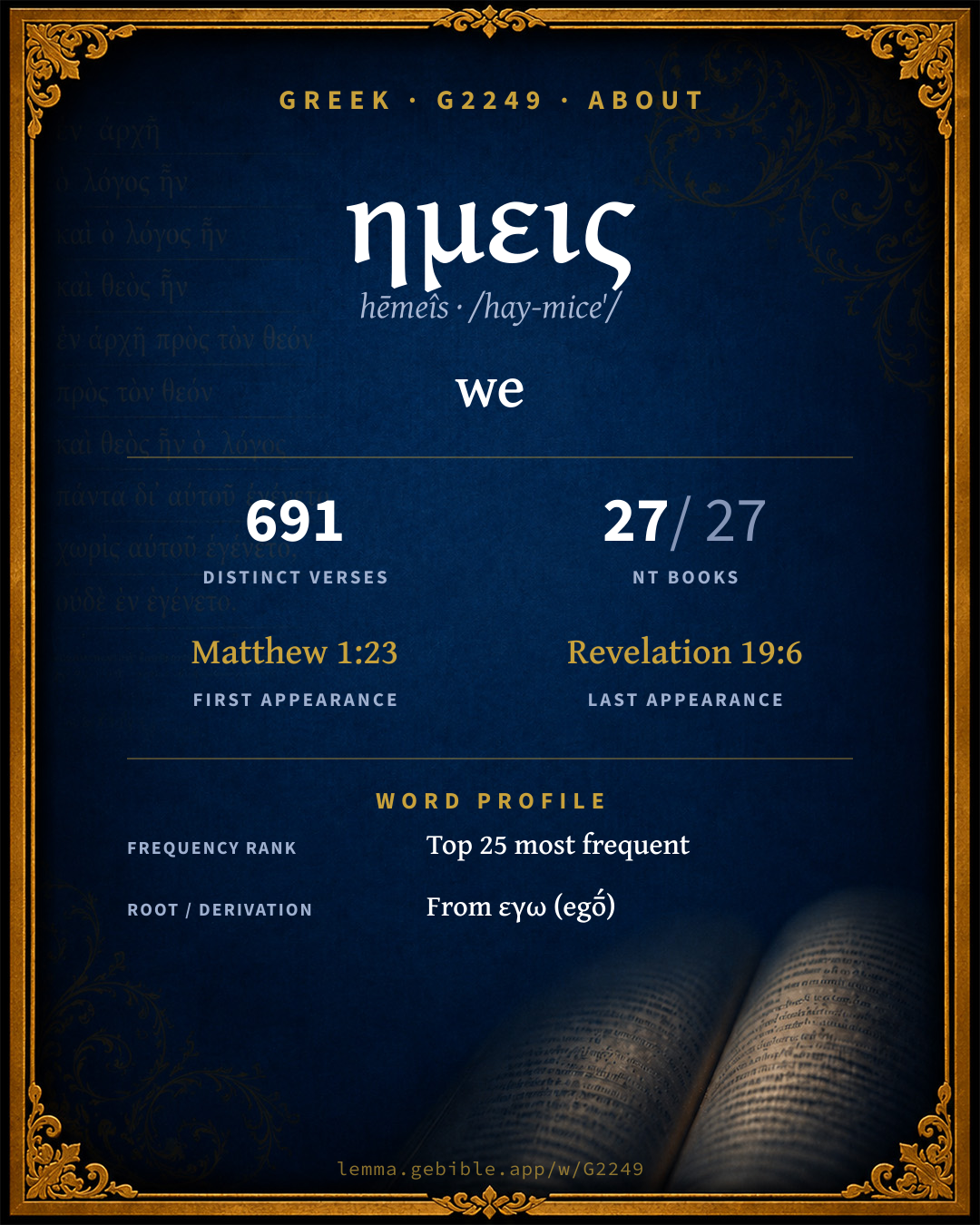
ἡμεῖς
we
Full lexicon entry — Thayer's Greek Lexicon
From Thayer's Greek Lexicon
Where this word appears
See every Genitive-case word in the Greek New Testament →
Grammar key — what these labels mean
Part of speech
- Personal pronoun
- Stands in for a person already named (“I,” “you,” “he”).
Case
- Genitive
- The case of source, possession, or “of” — answers “whose / from what.”
- Dative
- The case of the indirect object, means, or location — “to / for / with / in.”
- Accusative
- The case of the direct object and of extent.
- Nominative
- The case of the subject (and the predicate nominative).
Person
- 1st person
- The speaker (“I / we”).
Number
- Plural
- More than one.
44 verses where G2249 appears in the Genitive case in the Book of Acts. Filtered view — show all forms. Click any verse to open its interlinear word-by-word view. Verse text shown in the World English Bible for context — . Each verse’s Greek form is shown with its reference; the English is not keyword-highlighted, since the data carries no word-level English alignment. Use “Compare translations” on any verse to read it across multiple English versions. This concordance covers the Greek New Testament; Septuagint (Greek Old Testament) occurrences of this word are not indexed here.
Acts
- Acts 1:22 ἡμῶν ἡμῖν pron 1 gen pl pron 1 dat pl beginning from the baptism of John, to the day that he was received up from us, of these one must become a witness with us of his resurrection."
- Acts 2:8 ἡμεῖς ἡμῶν pron 1 nom pl pron 1 gen pl How do we hear, everyone in our own native language?
- Acts 2:39 ἡμῶν pron 1 gen pl For to you is the promise, and to your children, and to all who are far off, even as many as the Lord our God will call to himself."
- Acts 3:13 ἡμῶν pron 1 gen pl The God of Abraham, Isaac, and Jacob, the God of our fathers, has glorified his Servant Jesus, whom you delivered up, and denied in the presence of Pilate, when he had determined to release him.
- Acts 3:22 ἡμῶν pron 1 gen pl For Moses indeed said to the fathers, 'The Lord God will raise up a prophet for you from among your brothers, like me. You shall listen to him in all things whatever he says to you.
- Acts 3:25 ἡμῶν pron 1 gen pl You are the children of the prophets, and of the covenant which God made with our fathers, saying to Abraham, 'In your seed will all the families of the earth be blessed.'
- Acts 4:25 ἡμῶν pron 1 gen pl who by the mouth of your servant, David, said, 'Why do the nations rage, And the peoples plot a vain thing?
- Acts 5:30 ἡμῶν pron 1 gen pl The God of our fathers raised up Jesus, whom you killed, hanging him on a tree.
- Acts 7:2 ἡμῶν pron 1 gen pl He said, "Brothers and fathers, listen. The God of glory appeared to our father Abraham, when he was in Mesopotamia, before he lived in Haran,
- Acts 7:11 ἡμῶν pron 1 gen pl Now a famine came over all the land of Egypt and Canaan, and great affliction. Our fathers found no food.
- Acts 7:12 ἡμῶν pron 1 gen pl But when Jacob heard that there was grain in Egypt, he sent out our fathers the first time.
- Acts 7:15 ἡμῶν pron 1 gen pl Jacob went down into Egypt, and he died, himself and our fathers,
- Acts 7:19 ἡμῶν pron 1 gen pl The same took advantage of our race, and mistreated our fathers, and forced them to throw out their babies, so that they wouldn't stay alive.
- Acts 7:27 ἡμῶν pron 1 gen pl But he who did his neighbor wrong pushed him away, saying, 'Who made you a ruler and a judge over us?
- Acts 7:38 ἡμῶν ἡμῖν pron 1 gen pl pron 1 dat pl This is he who was in the assembly in the wilderness with the angel that spoke to him on Mount Sinai, and with our fathers, who received living oracles to give to us,
- Acts 7:39 ἡμῶν pron 1 gen pl to whom our fathers wouldn't be obedient, but rejected him, and turned back in their hearts to Egypt,
- Acts 7:40 ἡμῖν ἡμῶν ἡμᾶς pron 1 dat pl pron 1 gen pl pron 1 acc pl saying to Aaron, 'Make us gods that will go before us, for as for this Moses, who led us out of the land of Egypt, we don't know what has become of him.'
- Acts 7:44 ἡμῶν pron 1 gen pl "Our fathers had the tent of the testimony in the wilderness, even as he who spoke to Moses commanded him to make it according to the pattern that he had seen;
- Acts 7:45 ἡμῶν ἡμῶν pron 1 gen pl pron 1 gen pl which also our fathers, in their turn, brought in with Joshua when they entered into the possession of the nations, whom God drove out before the face of our fathers, to the days of David,
- Acts 9:38 ἡμῶν pron 1 gen pl As Lydda was near Joppa, the disciples, hearing that Peter was there, sent two men to him, imploring him not to delay in coming to them.
- Acts 13:17 ἡμῶν pron 1 gen pl The God of this people chose our fathers, and exalted the people when they stayed as aliens in the land of Egypt, and with an uplifted arm, he led them out of it.
- Acts 13:32 ἡμεῖς ἡμῶν pron 1 nom pl pron 1 gen pl We bring you good news of the promise made to the fathers,
- Acts 15:9 ἡμῶν pron 1 gen pl He made no distinction between us and them, cleansing their hearts by faith.
- Acts 15:10 ἡμῶν ἡμεῖς pron 1 gen pl pron 1 nom pl Now therefore why do you tempt God, that you should put a yoke on the neck of the disciples which neither our fathers nor we were able to bear?
- Acts 15:24 ἡμῶν pron 1 gen pl Because we have heard that some who went out from us have troubled you with words, unsettling your souls, saying, 'You must be circumcised and keep the law,' to whom we gave no commandment;
- Acts 15:25 ἡμῖν ἡμῶν pron 1 dat pl pron 1 gen pl it seemed good to us, having come to one accord, to choose out men and send them to you with our beloved Barnabas and Paul,
- Acts 15:26 ἡμῶν pron 1 gen pl men who have risked their lives for the name of our Lord Jesus Christ.
- Acts 16:16 ἡμῶν ἡμῖν pron 1 gen pl pron 1 dat pl It happened, as we were going to prayer, that a certain girl having a spirit of divination met us, who brought her masters much gain by fortune telling.
- Acts 16:20 ἡμῶν pron 1 gen pl When they had brought them to the magistrates, they said, "These men, being Jews, are agitating our city,
- Acts 17:20 ἡμῶν pron 1 gen pl For you bring certain strange things to our ears. We want to know therefore what these things mean."
- Acts 17:27 ἡμῶν pron 1 gen pl that they should seek the Lord, if perhaps they might reach out for him and find him, though he is not far from each one of us.
- Acts 19:37 ἡμῶν pron 1 gen pl For you have brought these men here, who are neither robbers of temples nor blasphemers of your goddess.
- Acts 20:7 ἡμῶν pron 1 gen pl On the first day of the week, when the disciples were gathered together to break bread, Paul talked with them, intending to depart on the next day, and continued his speech until midnight.
- Acts 20:21 ἡμῶν pron 1 gen pl testifying both to Jews and to Greeks repentance toward God, and faith toward our Lord Jesus.
- Acts 21:17 ἡμῶν ἡμᾶς pron 1 gen pl pron 1 acc pl When we had come to Jerusalem, the brothers received us gladly.
- Acts 22:14 ἡμῶν pron 1 gen pl He said, 'The God of our fathers has appointed you to know his will, and to see the Righteous One, and to hear a voice from his mouth.
- Acts 24:4 ἡμῶν pron 1 gen pl But, that I don't delay you, I entreat you to bear with us and hear a few words.
- Acts 26:6 ἡμῶν pron 1 gen pl Now I stand here to be judged for the hope of the promise made by God to our fathers,
- Acts 26:7 ἡμῶν pron 1 gen pl which our twelve tribes, earnestly serving night and day, hope to attain. Concerning this hope I am accused by the Jews, King Agrippa!
- Acts 26:14 ἡμῶν pron 1 gen pl When we had all fallen to the earth, I heard a voice saying to me in the Hebrew language, 'Saul, Saul, why are you persecuting me? It is hard for you to kick against the goads.'
- Acts 27:10 ἡμῶν pron 1 gen pl and said to them, "Sirs, I perceive that the voyage will be with injury and much loss, not only of the cargo and the ship, but also of our lives."
- Acts 27:18 ἡμῶν pron 1 gen pl As we labored exceedingly with the storm, the next day they began to throw things overboard.
- Acts 27:27 ἡμῶν pron 1 gen pl But when the fourteenth night had come, as we were driven back and forth in the Adriatic Sea, about midnight the sailors surmised that they were drawing near to some land.
- Acts 28:15 ἡμῶν ἡμῖν pron 1 gen pl pron 1 dat pl From there the brothers, when they heard of us, came to meet us as far as The Market of Appius and The Three Taverns. When Paul saw them, he thanked God, and took courage.
About this entry
At a glance — auto-summarized from this page’s data, not written by a person. Every figure links to its source below. This summary describes the numbers; it doesn’t interpret them.
ημεις (hēmeîs) is a Greek word most often rendered “we.” It first appears in Matthew 1:23. The Greek New Testament uses it across 691 verses — among the most common. Sharing its root, it stands alongside εγω, εμος and εμου. For the data behind this summary, explore the sense tree and the renderings breakdown below.
Gloss history
Strong's 1890 vs modern scholarship

About this word
Strong's G2249 catalogs a Greek word from the Greek New Testament.
These counts are not copied from any lexicon or concordance. They are computed here, from the morphology-tagged Greek New Testament. What Lemma adds →
- 691
- distinct verses
- The word appears in 691 distinct verses.
- 27 / 27
- NT books
- The word appears in 27 of 27 New Testament books.
- #23
- by frequency
- Top 25 most frequent Greek words (rank 23 of 5,347 Greek words by occurrence).
View all 691 occurrences in the concordance →
Most concentrated in
- Acts 109 verses 16%
- 2 Corinthians 81 verses 12%
- Luke 54 verses 8%
By section of the New Testament
By traditional corpus
Conventional, traditional groupings — biblical authorship is debated, so this is a traditional corpus grouping, not an authorship claim. Some books belong to more than one corpus (Luke is in both the Gospels and the Lukan corpus, and so on), so these shares overlap and need not total 100%. Each figure is a share of the word’s 691 distinct verses.
- Pauline corpus 318 verses · 46%
- Lukan (Luke–Acts) 163 verses · 24%
- Gospels 157 verses · 23%
- Johannine 99 verses · 14%
- General (Catholic) Epistles 68 verses · 10%
- Hebrews 25 verses · 4%
- Revelation 14 verses · 2%
How translations render this word
Counts come from each version’s own published word-to-Strong’s tagging or interlinear alignment — an approximate guide to how each version renders this word, not a word-level alignment the data otherwise carries. Because each total is that version’s own tagged count, the per-version totals vary from one another and need not match the appearance or distinct-verse counts above. These counts may also differ from a printed concordance because Lemma counts each distinctly tagged rendering and does not collapse phrase taggings into a single head-word total. This is a fixed set of word-tagged versions (KJV, ASV, BSB, ULT) and does not change with the reading translation you choose elsewhere. Each version’s license is shown beside its name below (and on Sources).
- King James Version: We 118×, Shall we 2×, Us 2×
- American Standard Version: We 117×, Us 3×
King James Version Public Domain
Renders G2249 across 126 tagged occurrences — most commonly:
Plus 4 renderings that appear only once — usually multi-word phrases or single function words the recovered tagging swept in, not distinct renderings.
American Standard Version Public Domain
Renders G2249 across 129 tagged occurrences — most commonly:
Plus 9 renderings that appear only once — usually multi-word phrases or single function words the recovered tagging swept in, not distinct renderings.
Senses in Thayer's
The 1 sense Thayer's distinguishes for this word, in lexicon order (not ranked by frequency or importance). The full entry — with sub-senses — is in the Lexicon Entry tab.
- us, we etc.
Word origin
Derived from εγω (egṓ) (G1473) — I.
Nomitive plural of G1473 ; we (only used when emphatic): - us we (ourselves).
— Strong’s Exhaustive Concordance (1890), public domain.
Forms in the corpus
The 5 distinct written forms G2249 takes in the Greek New Testament, most frequent first — each parse links to that case’s occurrences in the concordance.
| Form | Parsing | Example | Uses |
|---|---|---|---|
| ἡμῶν hēmō̂n | Personal pronoun, 1st person, Genitive, Plural | Matthew 1:23 | 401 |
| ἡμῖν hēmîn | Personal pronoun, 1st person, Dative, Plural | Matthew 3:15 | 168 |
| ἡμᾶς hēmâs | Personal pronoun, 1st person, Accusative, Plural | Matthew 6:13 | 167 |
| ἡμεῖς hēmeîs | Personal pronoun, 1st person, Nominative, Plural | Matthew 6:12 | 122 |
| Ἡμεῖς Hēmeîs | Personal pronoun, 1st person, Nominative, Plural | Acts 20:13 | 4 |
Same root — word family
Other Thayer's entries built from the same root as G2249, grouped by Strong’s listed origin. These share a root / origin per the lexicon — not necessarily a shared meaning. Each links to that word’s own entry.
Derives from
Shares the same root
Compare all same-root words → Showing 4 of 7 — not the complete family. 1 of the same-root words is a proper name (a person or place). They share a root, not necessarily a meaning.