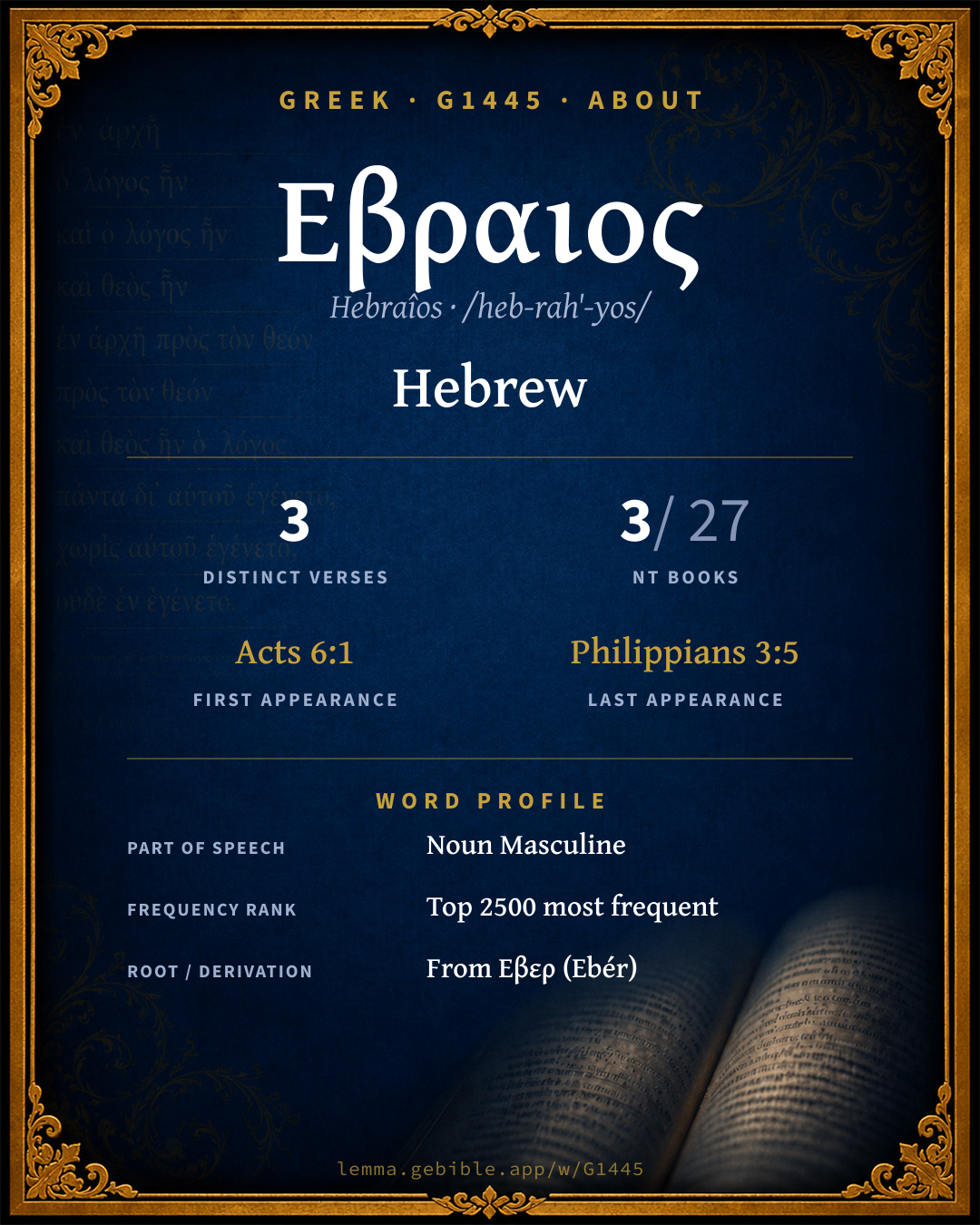
Ἑβραῖος
Hebrew
Thayer's lists 3 entries for ‘Hebrew’ fuller range ↓
Full lexicon entry — Thayer's Greek Lexicon
From Thayer's Greek Lexicon
Where this word appears
See every Nominative-case word in the Greek New Testament →
Grammar key — what these labels mean
Part of speech
- Adjective
- A word that describes or qualifies a noun.
Case
- Accusative
- The case of the direct object and of extent.
- Genitive
- The case of source, possession, or “of” — answers “whose / from what.”
- Nominative
- The case of the subject (and the predicate nominative).
Gender
- Masculine
- Grammatically masculine.
Number
- Plural
- More than one.
- Singular
- One.
1 distinct verse where G1445 appears in the Accusative case, across 1 book. Filtered view — show all forms. Click any verse to open its interlinear word-by-word view. Verse text shown in the World English Bible for context — . Each verse’s Greek form is shown with its reference; the English is not keyword-highlighted, since the data carries no word-level English alignment. Use “Compare translations” on any verse to read it across multiple English versions. This concordance covers the Greek New Testament; Septuagint (Greek Old Testament) occurrences of this word are not indexed here.
Acts 1 verse
About this entry
At a glance — auto-summarized from this page’s data, not written by a person. Every figure links to its source below. This summary describes the numbers; it doesn’t interpret them.
Εβραιος — transliterated Hebraîos — is a Greek name carrying the sense “Hebrew.” A scarce word — 3 verses in all of the Greek New Testament. Its uses concentrate in Acts (33% of all occurrences). Debuting at Acts 6:1, it then recurs through the corpus. See 3-verse concordance and the renderings breakdown below.
Gloss history
Strong's 1890 vs modern scholarship
About this word
Strong's G1445 catalogs a Greek word from the Greek New Testament.
These counts are not copied from any lexicon or concordance. They are computed here, from the morphology-tagged Greek New Testament. What Lemma adds →
- 3
- distinct verses
- The word appears in 3 distinct verses.
- 3 / 27
- NT books
- The word appears in 3 of 27 New Testament books.
- #1,877
- by frequency
- Top 2500 most frequent Greek words (rank 1,877 of 5,347 Greek words by occurrence).
View all 3 occurrences in the concordance →
Most concentrated in
- Acts 1 verse 33%
- 2 Corinthians 1 verse 33%
- Philippians 1 verse 33%
By section of the New Testament
By traditional corpus
Conventional, traditional groupings — biblical authorship is debated, so this is a traditional corpus grouping, not an authorship claim. Some books belong to more than one corpus (Luke is in both the Gospels and the Lukan corpus, and so on), so these shares overlap and need not total 100%. Each figure is a share of the word’s 3 distinct verses.
- Pauline corpus 2 verses · 67%
- Lukan (Luke–Acts) 1 verse · 33%
How translations render this word
Counts come from each version’s own published word-to-Strong’s tagging or interlinear alignment — an approximate guide to how each version renders this word, not a word-level alignment the data otherwise carries. Because each total is that version’s own tagged count, the per-version totals vary from one another and need not match the appearance or distinct-verse counts above. These counts may also differ from a printed concordance because Lemma counts each distinctly tagged rendering and does not collapse phrase taggings into a single head-word total. This is a fixed set of word-tagged versions (KJV, ASV, BSB, ULT) and does not change with the reading translation you choose elsewhere. Each version’s license is shown beside its name below (and on Sources).
- King James Version: Hebrews 3×
- American Standard Version: Hebrews 3×
- Berean Standard Bible: Hebrews 2×
- unfoldingWord Literal Text: Hebrews 3×
King James Version Public Domain
Renders G1445 across 4 tagged occurrences — most commonly:
Plus 1 rendering that appears only once — usually multi-word phrases or single function words the recovered tagging swept in, not distinct renderings.
American Standard Version Public Domain
Renders G1445 across 4 tagged occurrences — most commonly:
Plus 1 rendering that appears only once — usually multi-word phrases or single function words the recovered tagging swept in, not distinct renderings.
Berean Standard Bible Public Domain
Renders G1445 across 4 tagged occurrences — most commonly:
Plus 2 renderings that appear only once — usually multi-word phrases or single function words the recovered tagging swept in, not distinct renderings.
unfoldingWord Literal Text CC BY-SA 4.0
Renders G1445 across 4 tagged occurrences — most commonly:
Plus 1 rendering that appears only once — usually multi-word phrases or single function words the recovered tagging swept in, not distinct renderings.
Senses in Thayer's
The 3 senses Thayer's distinguishes for this word, in lexicon order (not ranked by frequency or importance). The full entry — with sub-senses — is in the Lexicon Entry tab.
- Hebrew
- in a narrower sense, those who live in Palestine and use the language of the country
- all Jewish Christians, whether they spoke Aramaic or Greek
Word origin
Derived from Εβερ (Ebér) (G1443) — Shelah.
From G1443 ; a hebraean (that is Hebrew) or Jew : - Hebrew.
— Strong’s Exhaustive Concordance (1890), public domain.
Forms in the corpus
The 4 distinct written forms G1445 takes in the Greek New Testament, most frequent first — each parse links to that case’s occurrences in the concordance.
| Form | Parsing | Example | Uses |
|---|---|---|---|
| Ἑβραίους Hebraíous | Adjective, Accusative, Plural, Masculine | Acts 6:1 | 1 |
| Ἑβραίων Hebraíōn | Adjective, Genitive, Plural, Masculine | Philippians 3:5 | 1 |
| Ἑβραῖοί Hebraîoí | Adjective, Nominative, Plural, Masculine | 2 Corinthians 11:22 | 1 |
| Ἑβραῖος Hebraîos | Adjective, Nominative, Singular, Masculine | Philippians 3:5 | 1 |
Same root — word family
Other Thayer's entries built from the same root as G1445, grouped by Strong’s listed origin. These share a root / origin per the lexicon — not necessarily a shared meaning. Each links to that word’s own entry.
Derives from
Proper names from this root
People and places named from this root — a name, not an additional meaning of the word.
Compare all same-root words → 3 of the same-root words are proper names (people or places). They share a root, not necessarily a meaning.
Bible dictionary
Public-domain dictionary articles matched to this entry by name (Hebrew). A biblical name can be shared by more than one person or place, so an article may treat several.
Easton's Bible Dictionary · M. G. Easton, 1897
A name applied to the Israelites in Scripture only by one who is a foreigner (Gen. 39:14, 17; 41:12, etc.), or by the Israelites when they speak of themselves to foreigners (40:15; Ex. 1:19), or when spoken of an contrasted with other peoples (Gen. 43:32; Ex. 1:3, 7, 15; Deut. 15:12). In the New Testament there is the same contrast between Hebrews and foreigners (Acts 6:1; Phil. 3:5).
Derivation. (1.) The name is derived, according to some, from Eber (Gen. 10:24), the ancestor of Abraham. The Hebrews are "sons of Eber" (10:21).
(2.) Others trace the name of a Hebrew root-word signifying "to pass over," and hence regard it as meaning "the man who passed over," viz., the Euphrates; or to the Hebrew word meaning "the region" or "country beyond," viz., the land of Chaldea. This latter view is preferred. It is the more probable origin of the designation given to Abraham coming among the Canaanites as a man from beyond the Euphrates (Gen. 14:13).
(3.) A third derivation of the word has been suggested, viz., that it is from the Hebrew word 'abhar, "to pass over," whence 'ebher, in the sense of a "sojourner" or "passer through" as distinct from a "settler" in the land, and thus applies to the condition of Abraham (Heb. 11:13).
Smith's Bible Dictionary · William Smith, 1863
This word first occurs as given to Abram by the Canaanites, (Genesis 4:13) because he had crossed the Euphrates. The name is also derived from Eber, "beyond, on the other side," Abraham and his posterity being called Hebrews in order to express a distinction between the races east and west of the Euphrates. It may also be derived from Heber, one of the ancestors of Abraham. (Genesis 10:24) The term Israelite was used by the Jews of themselves among themselves; the term Hebrew was the name by which they were known to foreigners. The latter was accepted by the Jews in their external relations; and after the general substitution of the word Jew, it still found a place in that marked and special feature of national contradistinction, the language.
Classic public-domain reference works; full attribution on Sources.
Septuagint usage
The same Greek word Εβραιος appears 28 times in the Greek Old Testament (Septuagint), across 27 verses in 6 books.
- 28
- LXX occurrences
- Tagged occurrences of this Greek word in the Septuagint.
- 27
- verses
- Distinct Septuagint verses containing this word.
- 6 / 39
- OT books
- The word appears in 6 of the 39 Old Testament books.
Sample Septuagint occurrences
- Genesis 39:14 εβραῖος
- Exodus 1:15 εβραῖος
- Numbers 24:24 εβραῖος
- Deuteronomy 15:12 εβραῖος
- 1 Samuel 4:6 εβραῖος
- Jeremiah 41:9 εβραῖος
Septuagint occurrences (same lexeme)
Every verse where the same Strong’s number (G1445) appears in the Greek Septuagint. Verse text shown in the World English Bible for context; the Greek form is the matched word — the English is not keyword-highlighted.
- Genesis 39:14 εβραῖος that she called to the men of her house, and spoke to them, saying, "Behold, he has brought in a Hebrew to us to mock us. He came in to me to lie with me, and I cried with a loud voice.
- Genesis 39:17 εβραῖος She spoke to him according to these words, saying, "The Hebrew servant, whom you have brought to us, came in to me to mock me,
- Genesis 40:15 εβραῖος For indeed, I was stolen away out of the land of the Hebrews, and here also have I done nothing that they should put me into the dungeon."
- Genesis 41:12 εβραῖος There was with us there a young man, a Hebrew, servant to the captain of the guard, and we told him, and he interpreted to us our dreams. To each man according to his dream he interpreted.
- Genesis 43:32 εβραῖος They served him by himself, and them by themselves, and the Egyptians, that ate with him, by themselves, because the Egyptians don't eat bread with the Hebrews, for that is an abomination to the Egyptians.
- Exodus 1:15 εβραῖος The king of Egypt spoke to the Hebrew midwives, of whom the name of the one was Shiphrah, and the name of the other Puah,
- Exodus 1:22 εβραῖος Pharaoh charged all his people, saying, "You shall cast every son who is born into the river, and every daughter you shall save alive."
- Exodus 2:6 εβραῖος She opened it, and saw the child, and, behold, the baby cried. She had compassion on him, and said, "This is one of the Hebrews' children."
- Exodus 2:7 εβραῖος Then his sister said to Pharaoh's daughter, "Should I go and call a nurse for you from the Hebrew women, that she may nurse the child for you?"
- Exodus 2:11 εβραῖος It happened in those days, when Moses had grown up, that he went out to his brothers, and looked at their burdens. He saw an Egyptian striking a Hebrew, one of his brothers.
- Exodus 2:13 εβραῖος He went out the second day, and, behold, two men of the Hebrews were fighting with each other. He said to him who did the wrong, "Why do you strike your fellow?"
- Exodus 3:18 εβραῖος They will listen to your voice, and you shall come, you and the elders of Israel, to the king of Egypt, and you shall tell him, 'Yahweh, the God of the Hebrews, has met with us. Now please let us go three days' journey into the wilderness, that we may sacrifice to Yahweh, our God.'
- Exodus 5:3 εβραῖος They said, "The God of the Hebrews has met with us. Please let us go three days' journey into the wilderness, and sacrifice to Yahweh, our God, lest he fall on us with pestilence, or with the sword."
- Exodus 7:16 εβραῖος You shall tell him, 'Yahweh, the God of the Hebrews, has sent me to you, saying, "Let my people go, that they may serve me in the wilderness:" and, behold, until now you haven't listened.
- Exodus 9:1 εβραῖος Then Yahweh said to Moses, "Go in to Pharaoh, and tell him, 'This is what Yahweh, the God of the Hebrews, says: "Let my people go, that they may serve me.
- Exodus 9:13 εβραῖος Yahweh said to Moses, "Rise up early in the morning, and stand before Pharaoh, and tell him, 'This is what Yahweh, the God of the Hebrews, says: "Let my people go, that they may serve me.
- Exodus 10:3 εβραῖος Moses and Aaron went in to Pharaoh, and said to him, "This is what Yahweh, the God of the Hebrews, says: 'How long will you refuse to humble yourself before me? Let my people go, that they may serve me.
- Exodus 21:2 εβραῖος If you buy a Hebrew servant, he shall serve six years and in the seventh he shall go out free without paying anything.
- Numbers 24:24 εβραῖος But ships [shall come] from the coast of Kittim, They shall afflict Asshur, and shall afflict Eber; He also shall come to destruction.
- Deuteronomy 15:12 εβραῖος If your brother, a Hebrew man, or a Hebrew woman, be sold to you, and serve you six years; then in the seventh year you shall let him go free from you.
- 1 Samuel 4:6 εβραῖος When the Philistines heard the noise of the shout, they said, What means the noise of this great shout in the camp of the Hebrews? They understood that the ark of Yahweh was come into the camp.
- 1 Samuel 4:9 εβραῖος Be strong, and behave yourselves like men, O you Philistines, that you not be servants to the Hebrews, as they have been to you: quit yourselves like men, and fight.
- 1 Samuel 13:19 εβραῖος Now there was no smith found throughout all the land of Israel; for the Philistines said, Lest the Hebrews make them swords or spears:
- 1 Samuel 14:11 εβραῖος Both of them disclosed themselves to the garrison of the Philistines: and the Philistines said, Behold, the Hebrews come forth out of the holes where they had hid themselves.
- 1 Samuel 17:8 εβραῖος He stood and cried to the armies of Israel, and said to them, Why are you come out to set your battle in array? am I not a Philistine, and you servants to Saul? choose you a man for you, and let him come down to me.
- Jeremiah 41:9 εβραῖος Now the pit in which Ishmael cast all the dead bodies of the men whom he had killed, by the side of Gedaliah (the same was who which Asa the king had made for fear of Baasha king of Israel), Ishmael the son of Nethaniah filled it with those who were killed.
- Jeremiah 41:14 εβραῖος So all the people who Ishmael had carried away captive from Mizpah turned about and came back, and went to Johanan the son of Kareah.
These are occurrences of the same Greek lexeme (G1445) in the Septuagint — not a translation of any one Hebrew word. The store carries no word-level Hebrew↔Greek alignment, so no Hebrew original is asserted here. Counts come from the recovered LXX Strong's tagging — high-frequency vocabulary is well covered, while rare or late forms may be untagged — so they reflect tagged occurrences and may slightly undercount.